 Playable Books
Pyotr Ilyich Tchaikovsky · section 19 of 36
Chapter XVII. The Harmonization of a given melody
Read and hear this section in the playable edition →


by a new difficulty. Not only must he see that the harmonies are properly connected, but he must find the chords which shall best answer the demands and purpose of the melody. We cannot see from the melody itself what are the chords appropriate to it; for every tone of the melody may belong to several different chords, not all of which would answer the appropriate harmonic purpose. The mere fact that one of the notes of a melody fits into a certain chord, does not justify our application of that chord. Further, we must see that the chord demanded by the melody, be such that it can be legitimately connected with its neighbours; that the voice-leading be gcod; and finally, that at certain points of the melody there shall occur special harmonic formulas, such as Cadences.
We will now examine the circumstances, conditions and points of view that determine us in the choice of this or that chord.
§ 47. The proper use of the triads, in their fundamental form is already known to us. But the functions exercised by their inversions in the harmonization of given melodies (especially in the case of the six-four chord) we must inspect more closely.
a) The chord of the Sixth appears far more frequently than any other of the inversions; and its proper use is attended by no difficulties.
We need merely strive to use it at points, where the Bass is in contrary motion. Where the Bass is at rest, this chord sounds feeble and lifeless; especially if it be followed by the fundamental form of a triad on the same Bass tone.
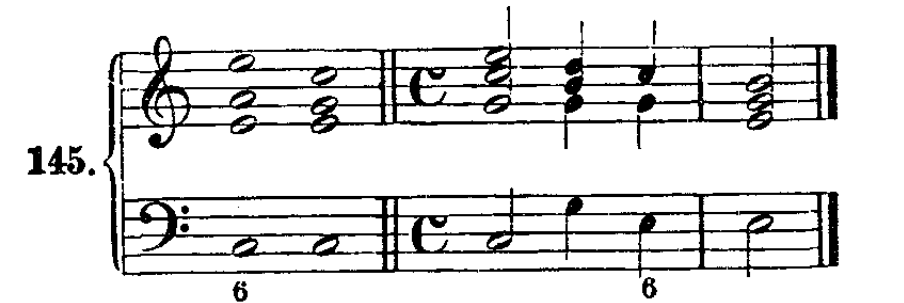
b) The chord of the sixth and fourth can be effectively employed in but few cases.
These are as follows:
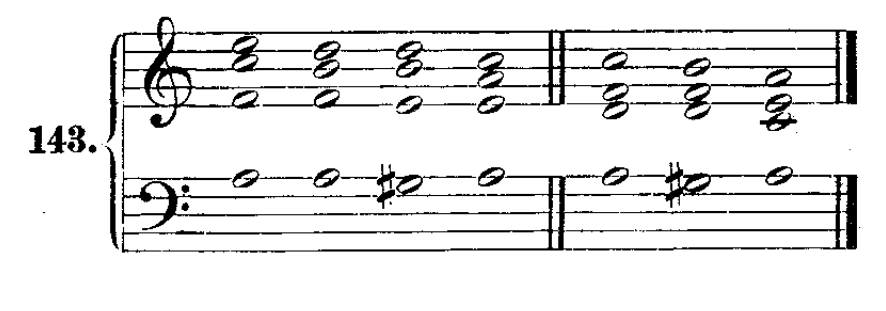
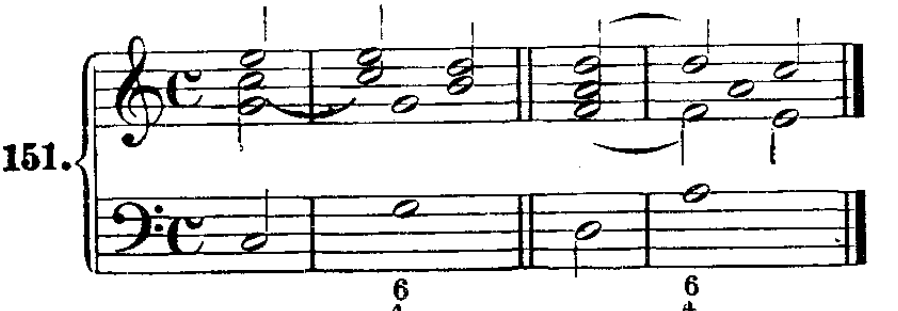
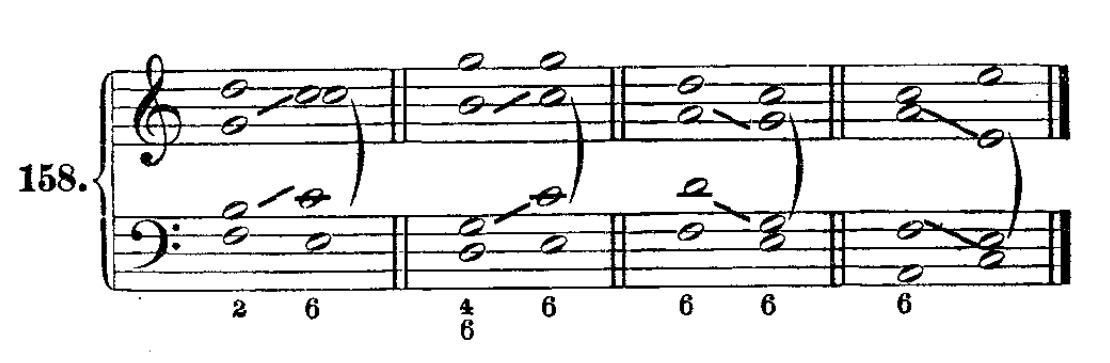
1) When-the Bass progresses through all the intervals of the triad in succession, beginning with the fundamental tone, while the upper voices remain stationary.
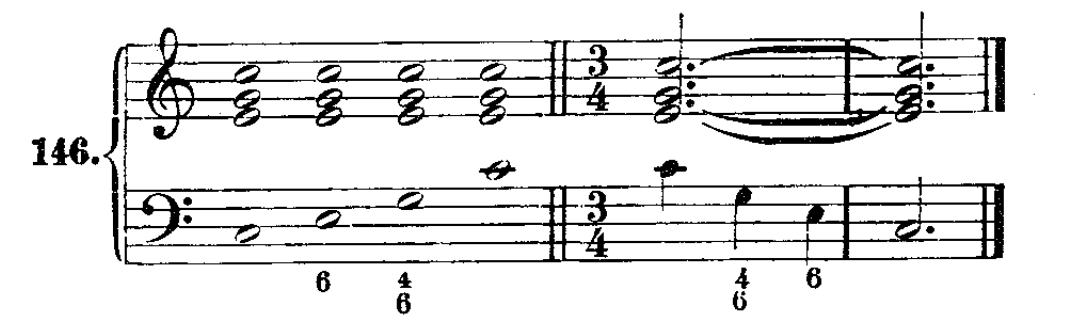
2) When the six-four chord stands between two triads in itheir fundamental form, with the Bass remaining stationary.
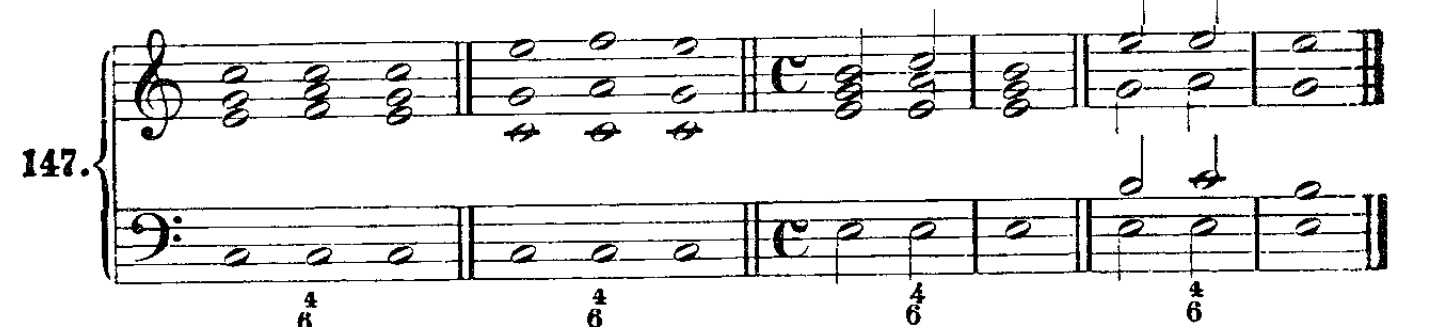
147. a4. 5: IF eae] =| en ce | a Cot —|FF col = 4 6 This case may be modified by allowing the Bass of the ehord following the six-four chord to progress one step up-or downwards, special care being taken that the chord-connection be very smooth.
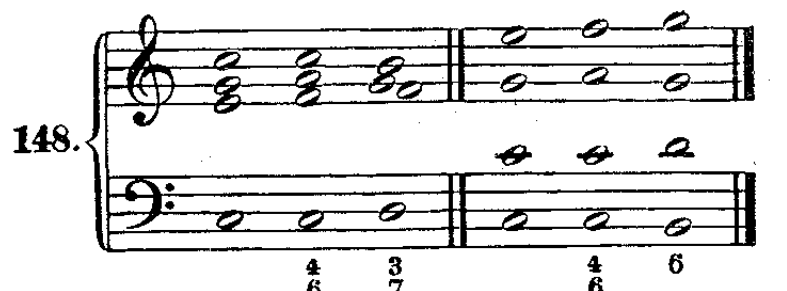
In this case the six-four chord should occur on the unaccented part of the measure.
3) When the Bass progresses stepwise into and from the chord of the sixth and fourth. The fourth is then the link between the six-four chord and the chords on either side of it. Such a case occurs for example, if the chord stands between the fundamental form and the Sixth-chord of one and the same triad,
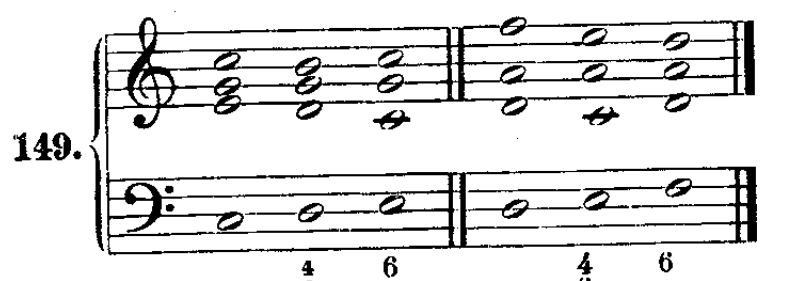
This chord must in any case be connected with one of the neighboring chords by means of its fourth; and into or from its other neighbor the fourth must progress stepwise.
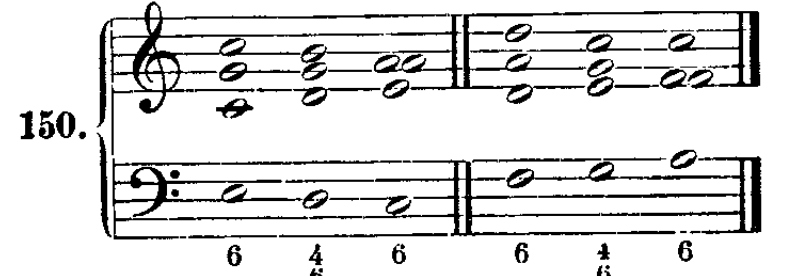
4) When the six-rour chord occurs on the accented part of the measure, directly following its fundamental triad, and progressing into the triad a fifth above it*).
There are doubtless still other opportunities for the use of the chord of the sixth and fourth; but we cannot, in a theoretical treatise, enumerate each and every case occurring in the practice of the art, the purpose of musical science being rather to contemplate and systematize the harmonic combinations in most general use.
*) The six-four chord is here the result of suspensions, see Chapter XXIII § 73.
It is left to the talented pupil to follow the promptings of his musical instinct and occasionally overstep the theoretical limits herein set down. The less talented student, however, who is in need of definite and concisely expressed theoretical principles should work in strict accordance with the rules, troublesome and unbending though they be. These rules have sprung empirically out of the musical promptings of man’s nature.
§ 48. Let us turn now to the dissonant harmonies. The Dominant chord can be used without restriction in all cases; if its seventh is prepared the chord sounds milder and more agreeable. The resolution of the fundamental form of the Dominant chord into the tonic triad constitutes the formula called a Cadence. To this formula belongs the property of completely closing off a composition or one of its parts—especially if the triad appears in octave position. For which reason this succession of chords should be avoided in the middle of a piece of music. The versions of the Dominant chord, however, have not this cadencing character and are therefore better suited to the intermediate portions of a piece, where the element of motion is uppermost and smooth, and fluent voice-leading necessary.
The other chords of the seventh, as well as the chord of the ninth, require preparation of their dissonances; consequently they can be employed only at points of the melody, where such preparation is possible. The diminished seventh-chord alone may enter unprepared, in the manner of the dominant chord; but good voice-leading is important. Finally, any dissonant chord can be employed, as long as a proper solution is possible.
Dissonant chords should not be used too lavishly; proper musical economy prohibits a superabundance of them. In triads lies true harmonic beauty. In his free choice of chords the beginner should not strive after exceptional, singular effect; for, while these are of inestimable value to the accomplished composer in expressing certain peculiar moods, a heaping up of vague dissonances is not advantageous in a piece of writing, which has no such special purpose, and in which absolute beauty is sought rather than relative beauty.
§ 49. We must always commence with a consonant chord in fundamental form. At the close should appear the so-called prolonged cadence: except in cases where the last notes of the melody exclude its use.
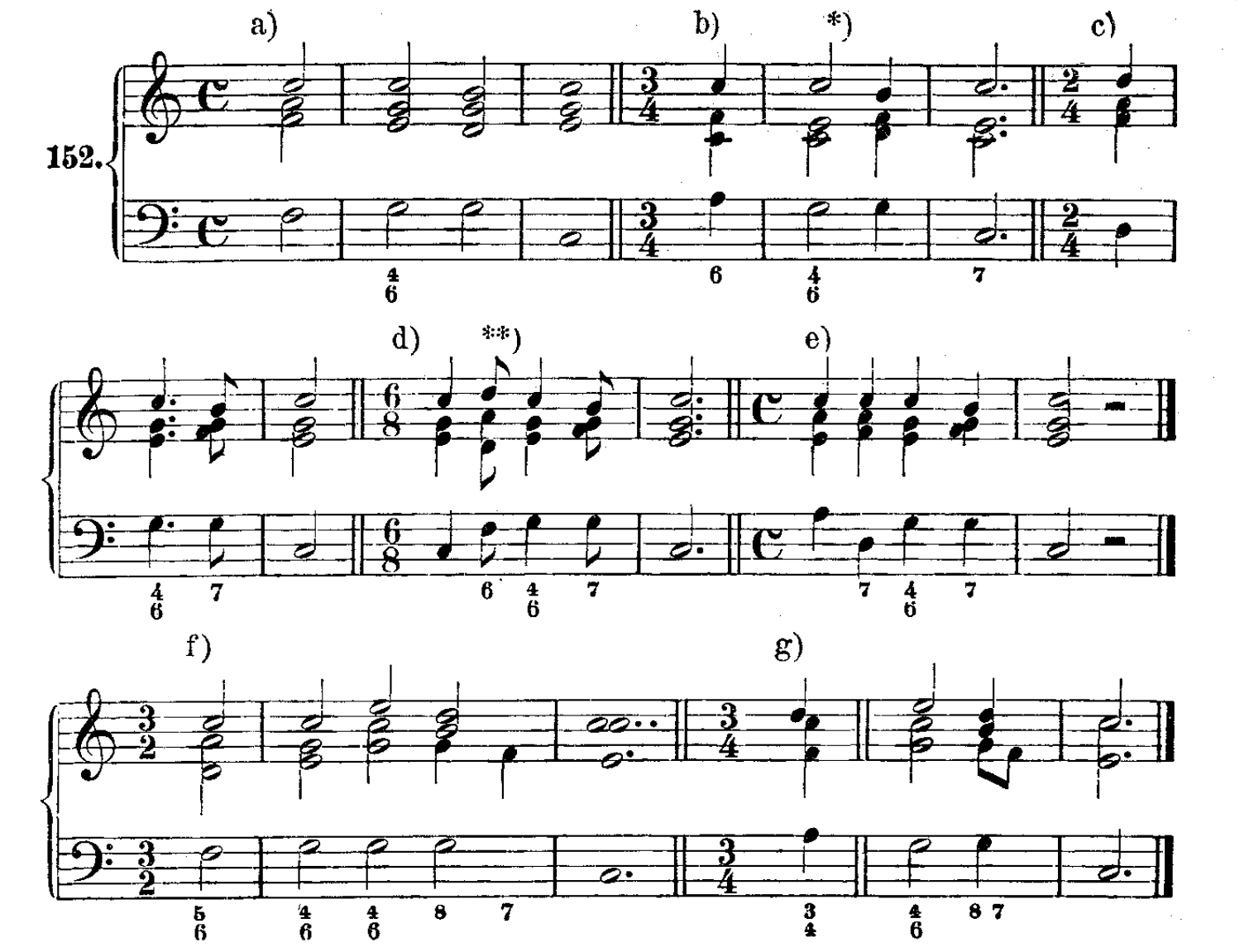
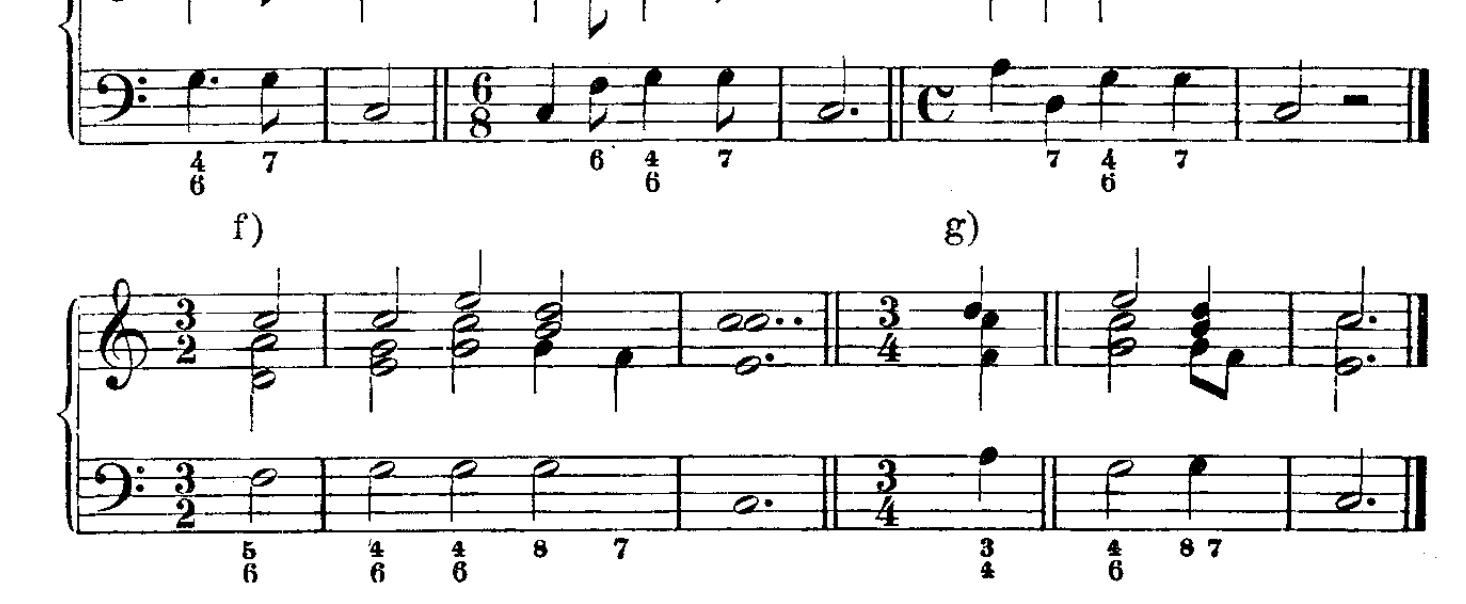
The augmented cadence consists of four chords, of which the last two (Dominant-seventh and Tonic) constitute the cadence, properly speaking. The first two chords must be the tonic and the subdominant. There are two kinds of prolonged cadence, depending on which of these two chords is placed first.
A. Cadences of the I-st class are constituted as follows.
1) On an unaccented beat *) we find one of the chords belonging to the sub-dominant group—that is, either the triad on the 4-th degree (in fundamental form or as chord of the sixth) or the triad on the 2-nd degree (also in fundamental form or as chord of the sixth) or, finally, as a special exception to the rules of resolution—the chord of the seventh on the 2-nd degree, in any one of its first three forms.
2) Then follows on an accented beat the chord of the six-four of the tonic triad, which in turn is succeeded by the cadence proper, that is to say: 3) on an unaccented beat the Dominant chord or the Dominant triad and 4) on accented beat the tonic triad in its fundamental form.
Examples of prolonged cadences of the first group follow:
*) I must take for granted, that the distinction between accented and unaccented paris of a measure (Arsis and Thesis) is known to the pupil.
B. Cadences of the second group are constituted as follows.
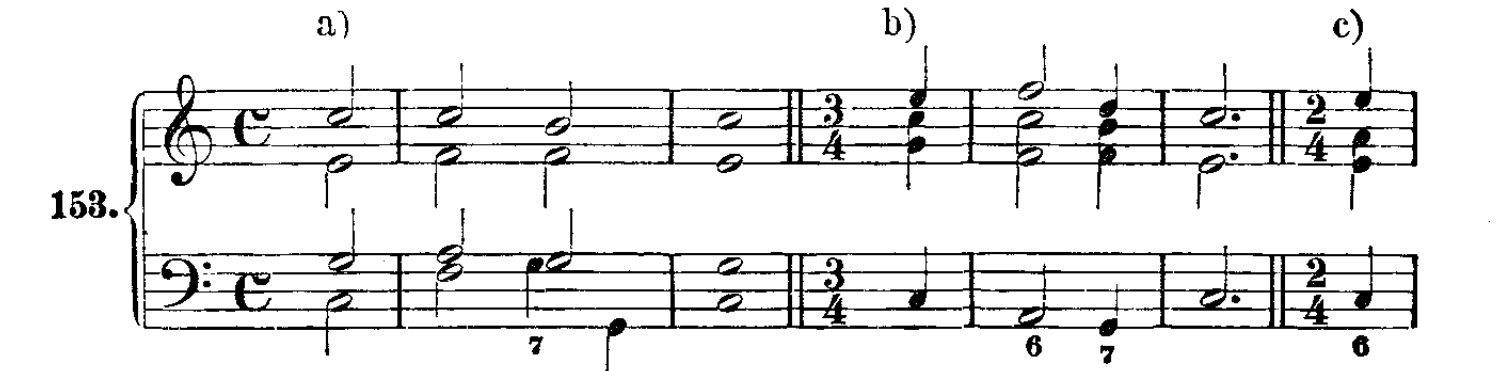
1) On unaccented beat we find one of the chords belonging to the tonic group,—that is to say, the triads on the 1-st and 6-th degrees in fundamental form or as chord of the sixth.
2) follows on accented beat one of the chords of the sub-dominant group (triads on the 4-th or 2-nd degree or, also, the chord of the seventh on the 2-nd degree) in fundamental form or first inversion.
3) Dominant chord or Dominant triad in fundamental form.
+) the tonic triad in fundamental form.
Examples of such cadences follow:
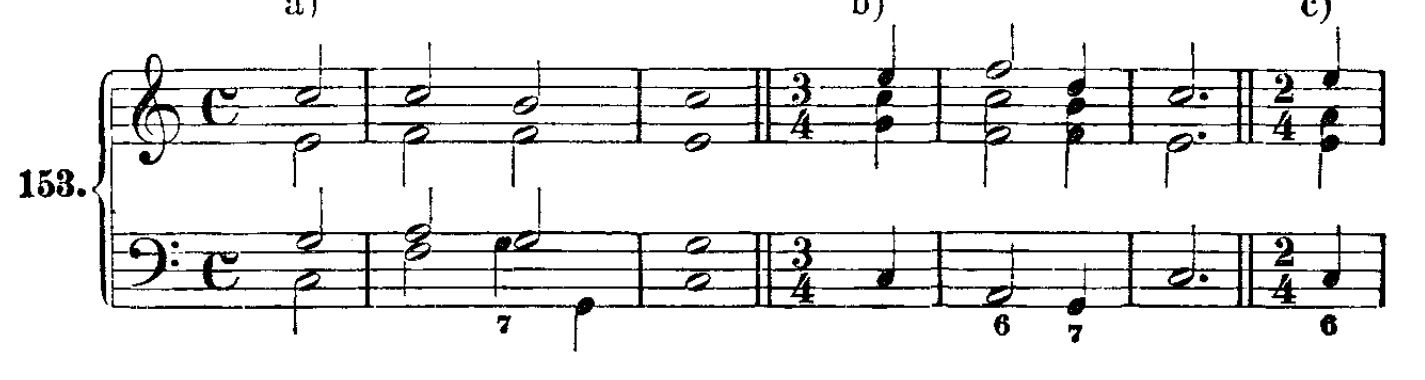
*) In three-divisioned time the chord of the six-four must take up the greater part of the measure.
¥*) In mixed time the chord of the six-four may fall on the second accented part of the measure,
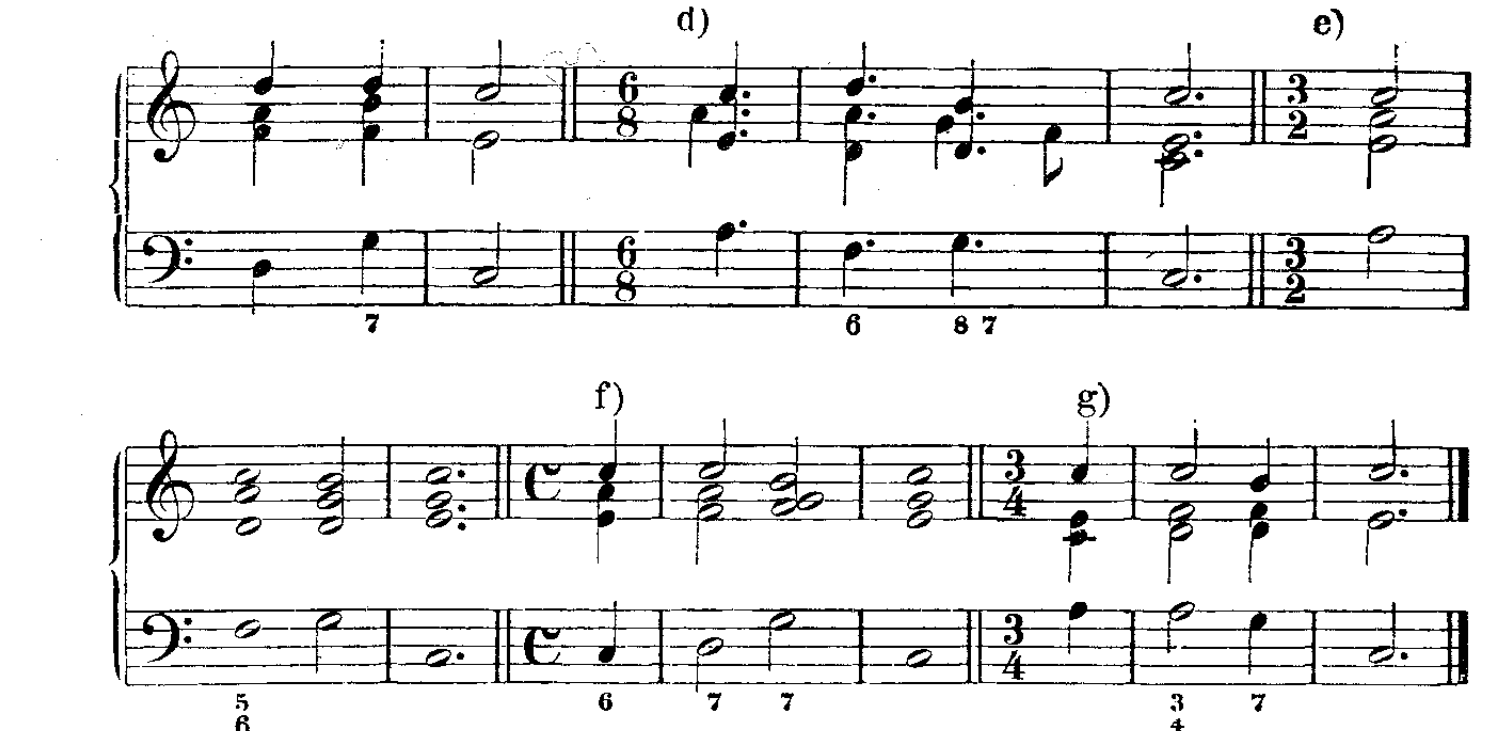
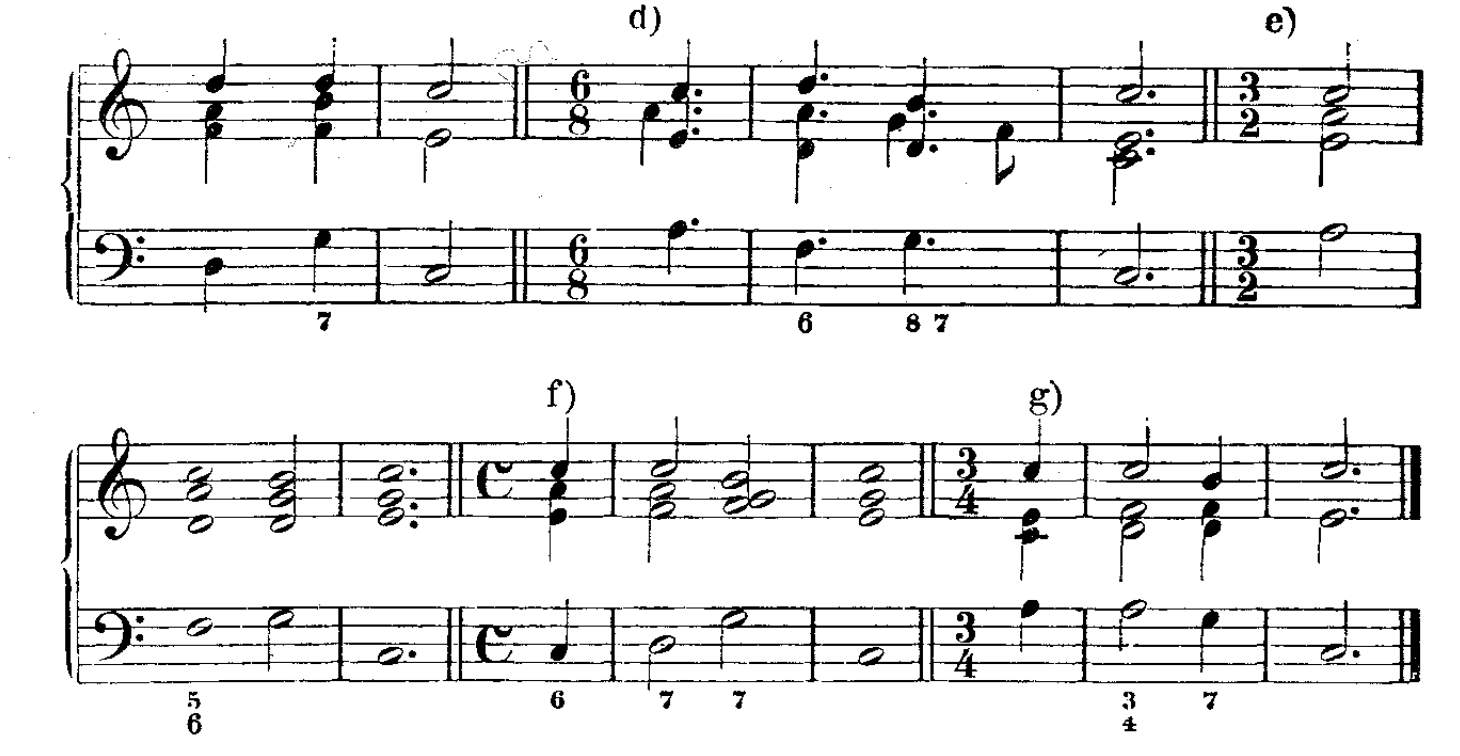
The case e, in which the chord of the sixth and fifth falls on the accented beat is one of the commonest forms of this group of cadences.
The cadence must be perfect; that is, the last triad must appear in the position of the octave or fifth; if this triad, however, is in the position of the third, the cadence is imperfect.
Im minor the prolonged cadence is constructed as in major.
§ 50. We cannot sufficiently emphasize the importance of guarding from the very start against forbidden progressions of fifths and octaves. My prolonged experience has taught me, that no fault grows into a habit more easily than negligence in this respect. The ablest pupil will overlook a great number of open or concealed fifths and octaves, if he work carelessly. A closer examination of concealed progressions is here in place *).
On the whole, such progressions cannot be set down as absolute faults‘ there are even many cases, where they are unavoidable, e. g. in the resolution of certain dissonant chords:
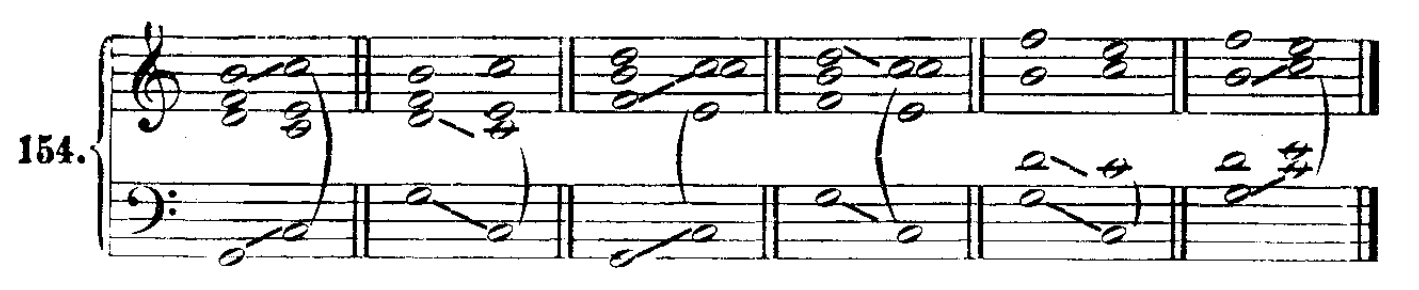
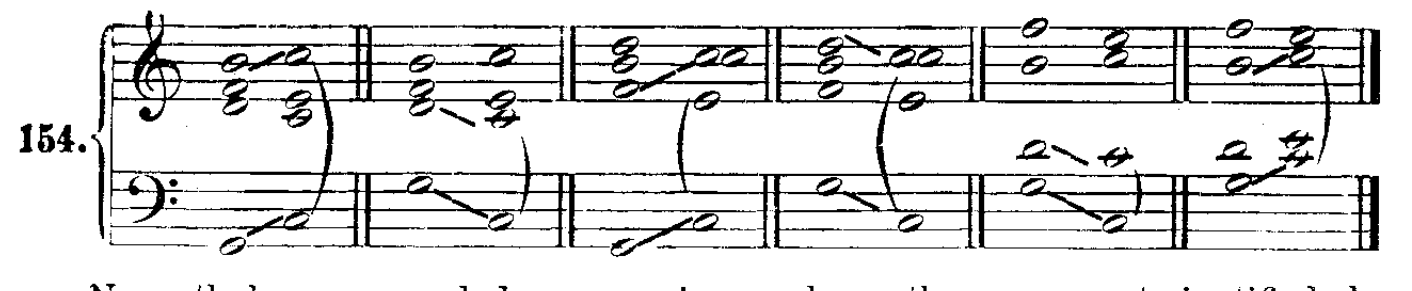
Nevertheless, concealed progressions, where they are not justified by some higher harmonic law, serve to mar the purity of the writing, and are consequently to be avoided whereever possible
Here some hints on this subject will perhaps be in place, dispelling any doubts of the student as to when and how deviations from the rules governing concealed progressions can be made.
A. Concealed octaves and fifths in the outer voices.
They are often very disagreeable and occur most frequently of all, because of the extreme mobility of these voices.
They should be avoided by all means:
*) These progressions are called concealed for the reason, that they do not actually appear in the voices in question, but must be imagined. They are hidden in the silent tones that fill out the interval of the jump made by one o1 both voices.
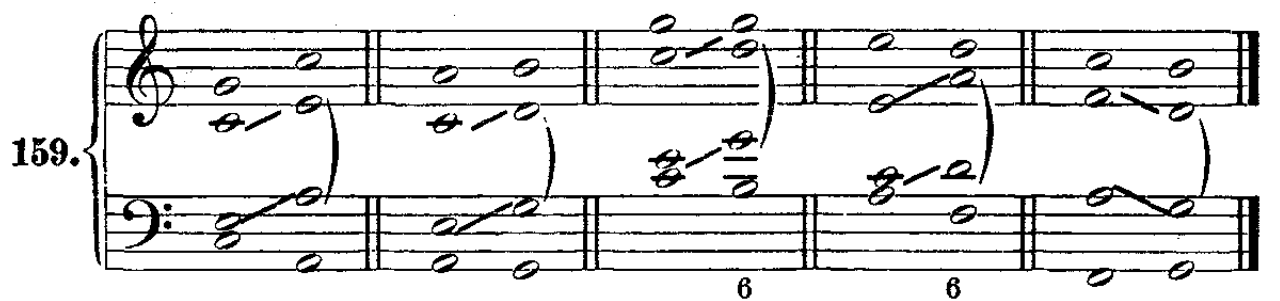
I. when the upper voice progresses by a jump *)
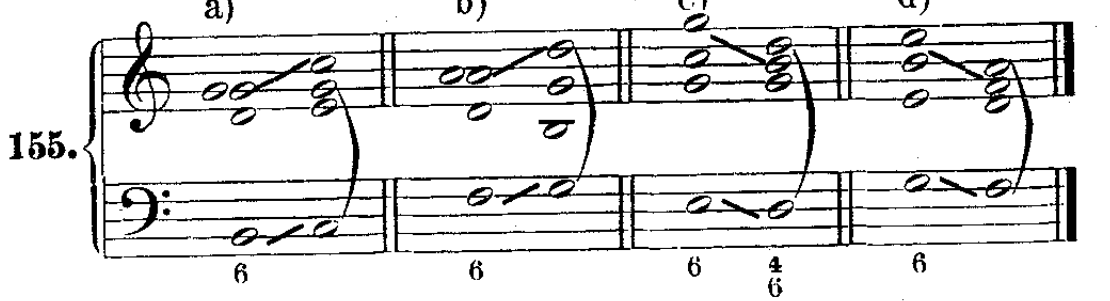
Il. when all the voices progress in parallel motion.
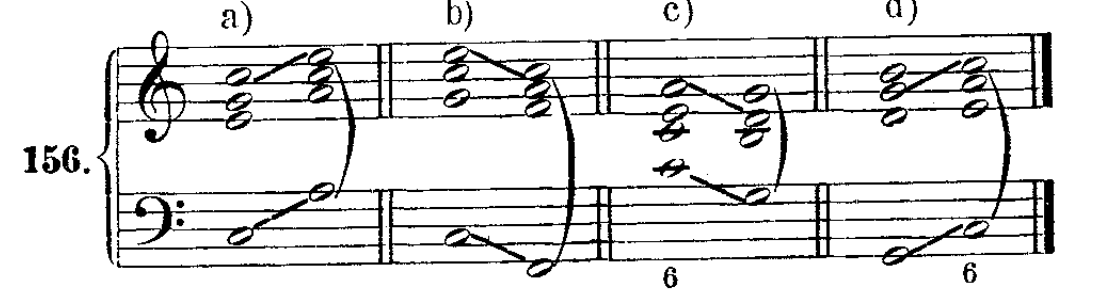
Concealed octaves sound particularly unpleasant, when the octave appears as doubled Fifth in the six-four chord, or as doubled third in the sixth— chord as in example I-c or II-d.
Ill Where the outer voices move in jumps in the same direction—even though the inner voices remain stationary or progress stepwise—concealed Fifths and Octaves are likewise to be avoided
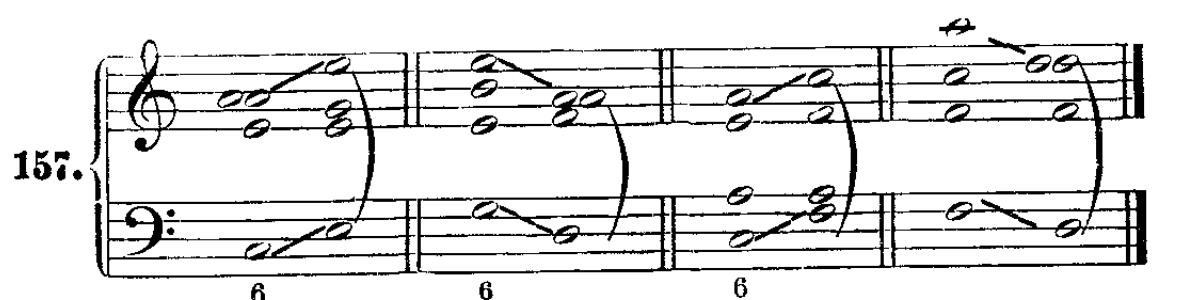
B) Concealed progressions in the inner voices.
Concealed octaves are here entirely out of the question, arising solely in consequence of bad voice-leading
*) Despite the jump in the upper voice, concealed progressions sound by no means unpleasant, when they occur in the connection of a triad with the Dominant chord and when the sev uth is prepared in an inner voice.
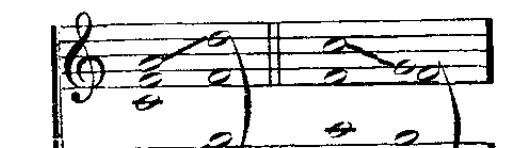
Concealed Fifths, however, are permitted, provided the voice—leading is natural.
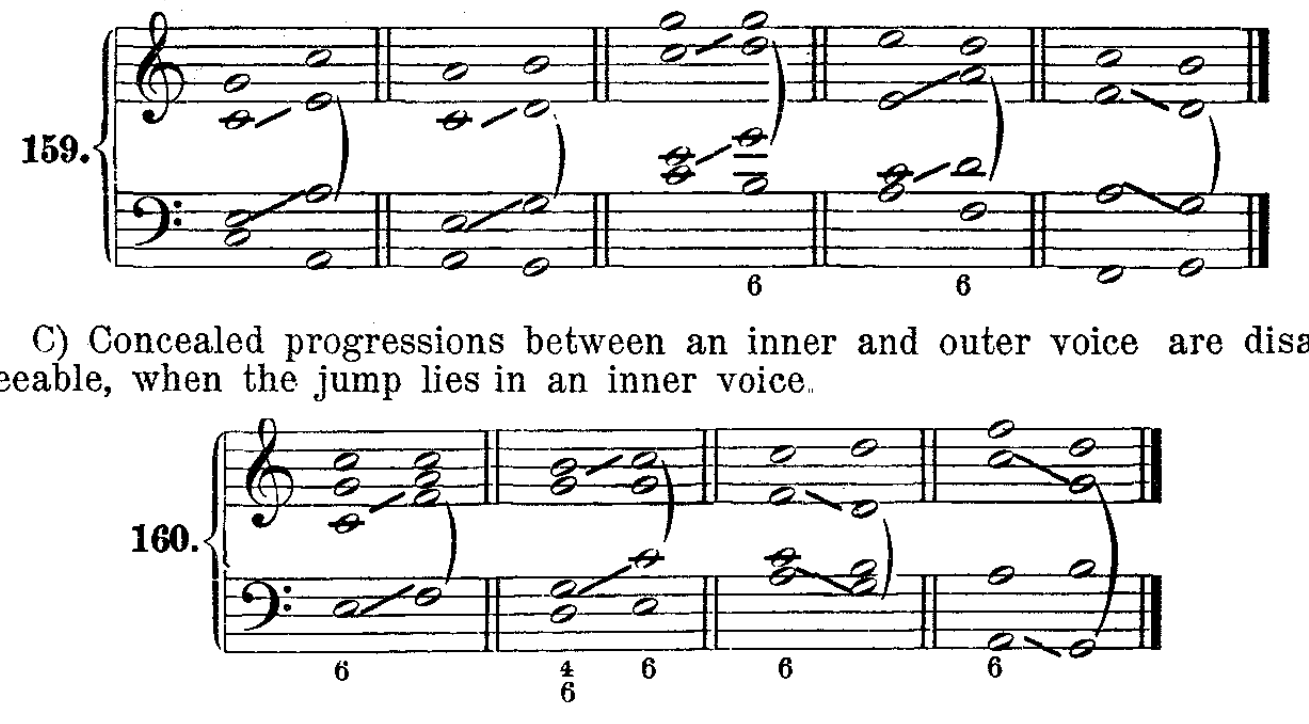
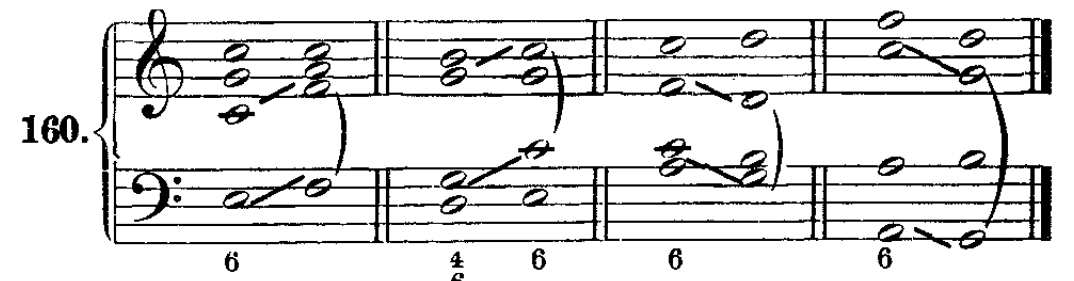
C) Concealed progressions between an inner and outer voice are disagreeable, when the jump lies in an inner voice.
In most remaining cases concealed progressions are scarcely to be avoided (as e. g. in the resolution of the Dominant chord); and it is really not at all necessary to avoid them.
In closing this chapter we would again remind the pupil that he must concentrate his attention on good voice-leading and rational chord progressions. Only such attention will enable him entirely to avoid forbidden open progressions and to confine the use of concealed fifths and octaves to cases, where their occurrence is absolutely unavoidable *).
Note. The Bass must not progress by successive jumps in the same direction.
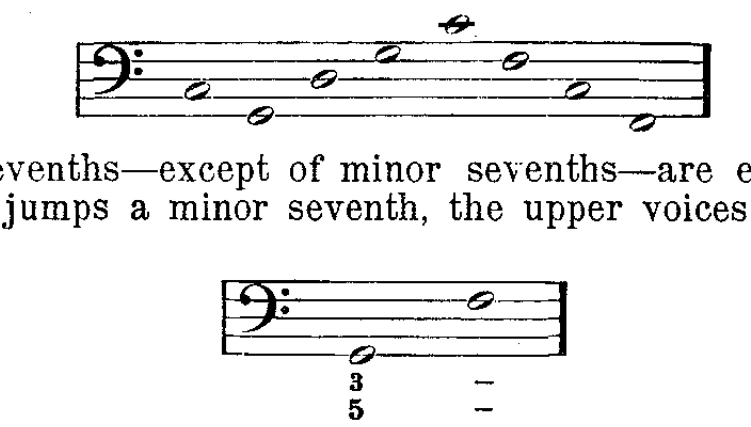
Jumps of sevenths—except of minor sevenths—are entirely prohibited; where the bass jumps a minor seventh, the upper voices must remain sta-
The jump of an octave is permissible.
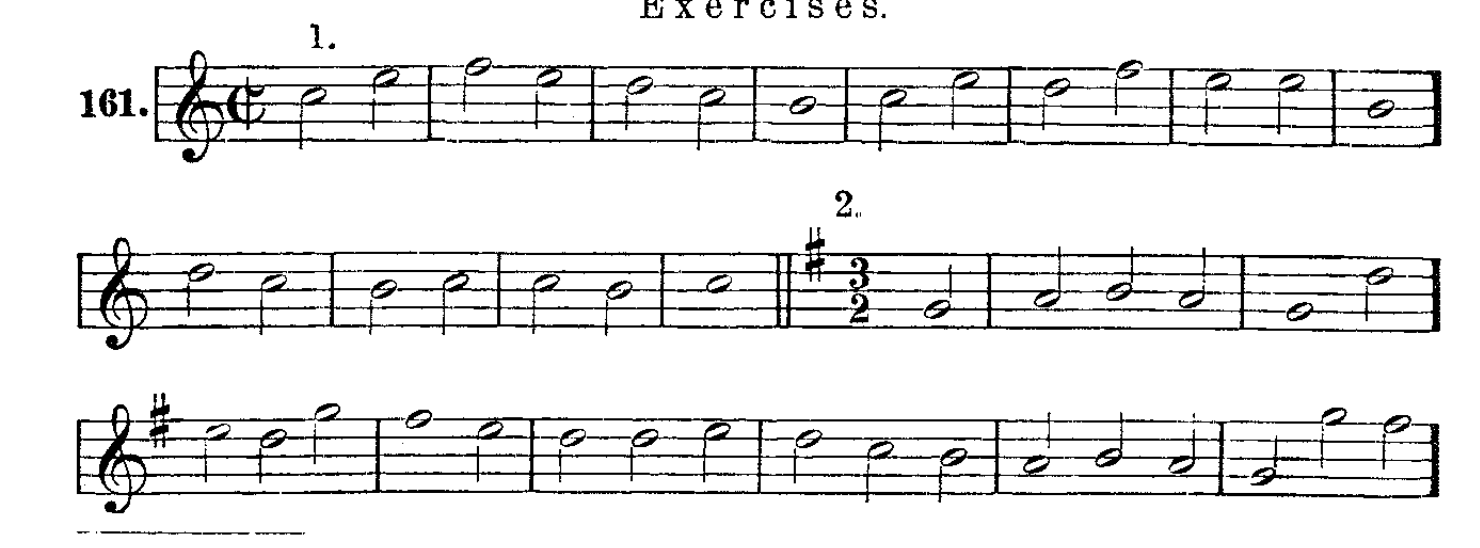
*) Two parallel fifths are permitted, when the second is diminished; but not vice versa.
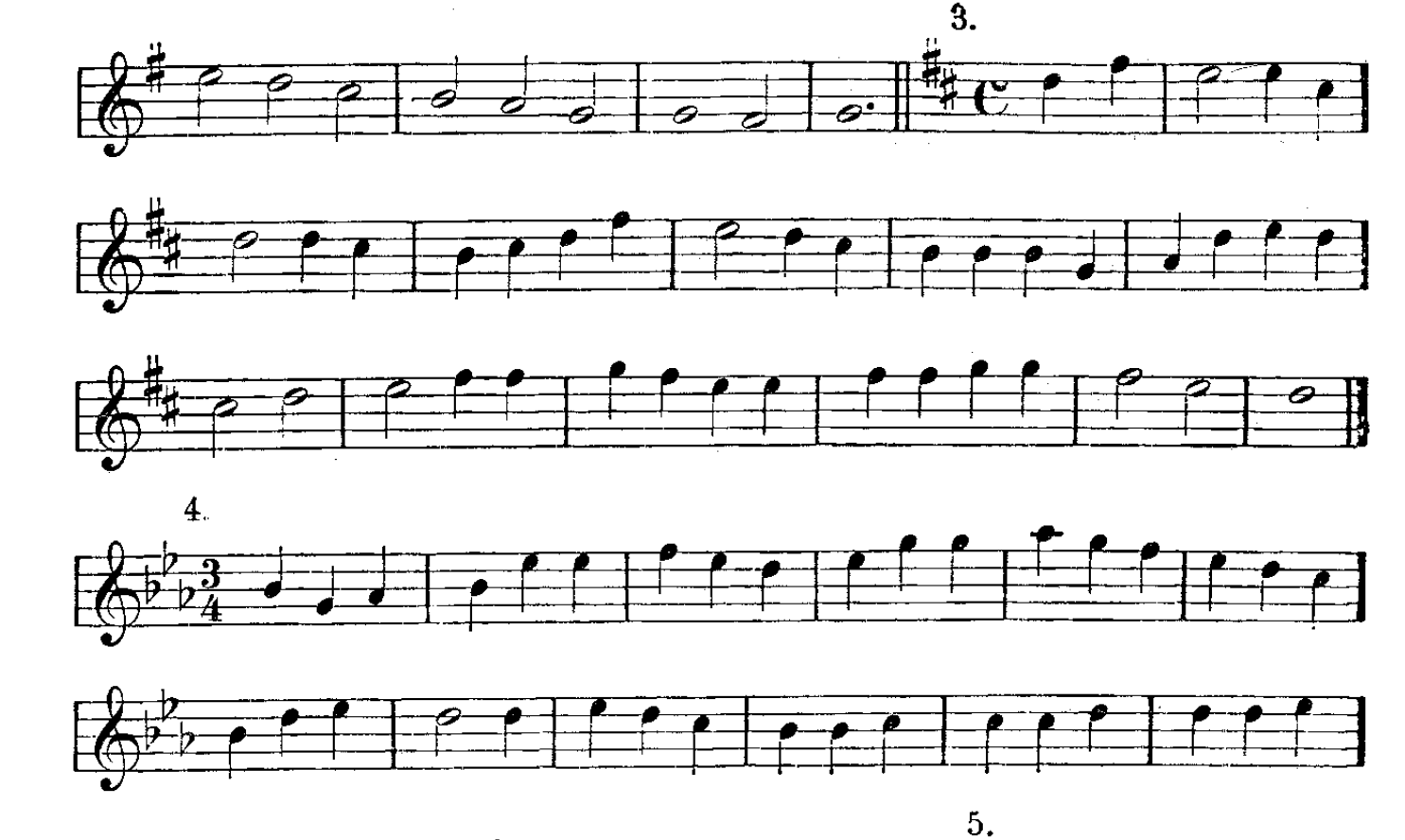
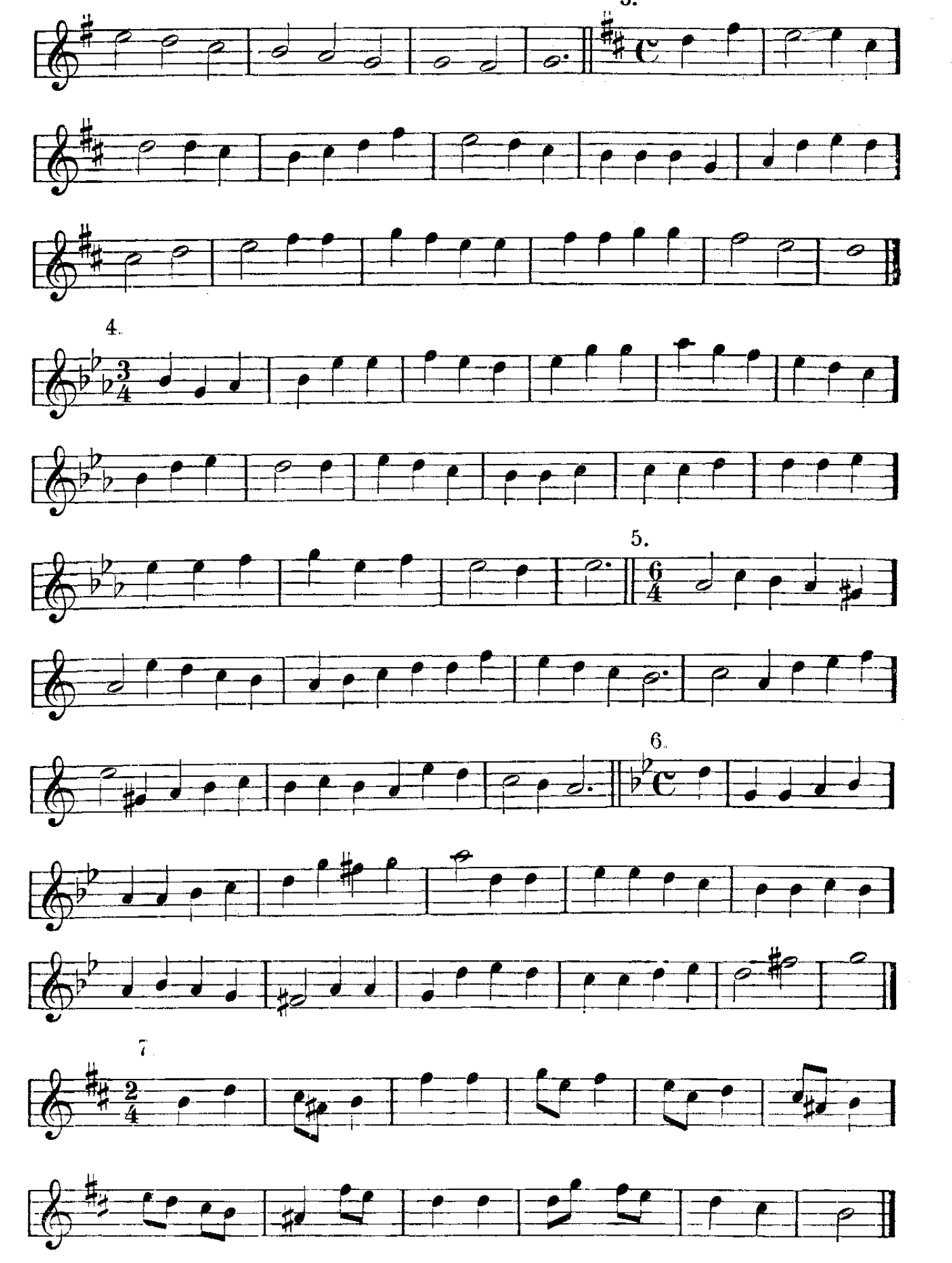
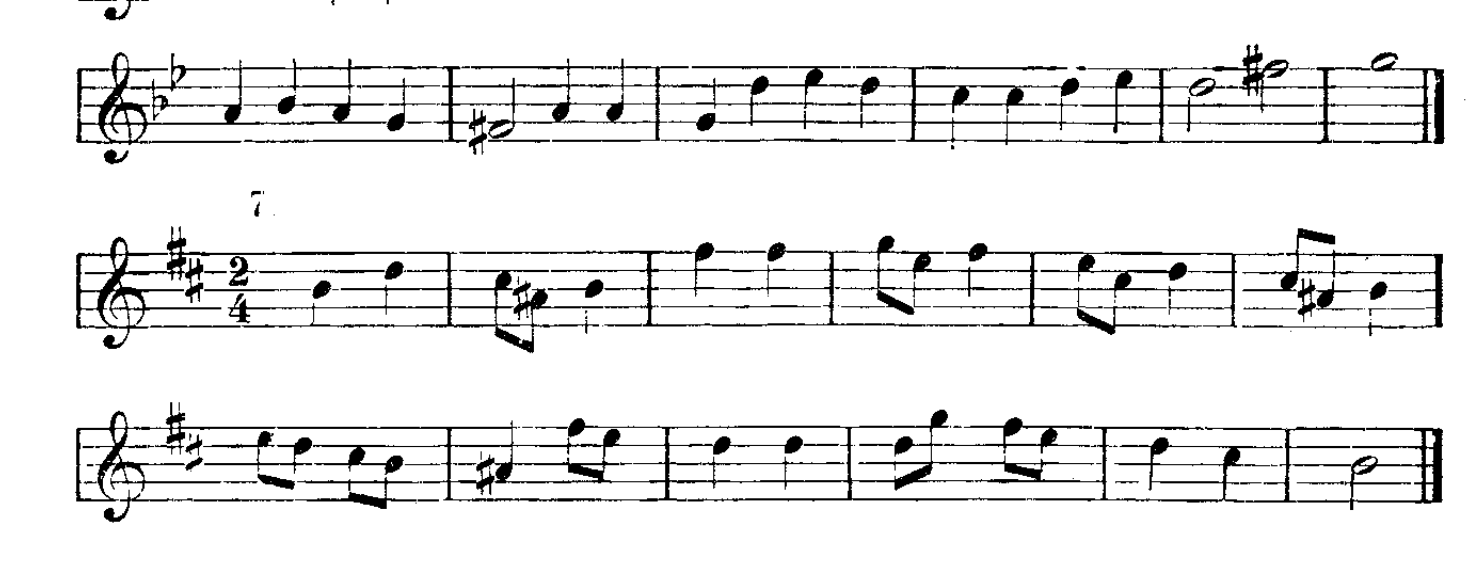
§ 51. Harmonic combinations are not always limited to one key; they may, in the course of a composition, leave the main key, passing into the domain of neighbouring keys more or less remote and finally return to the original key
To pass from one key into another it is not sufficient merely to employ a number of chords not belonging to the main key—we must clearly establish the new key; that is to say, we must insert a chord, that can belong only to the key we wish to reach and which, forming the bridge between the two keys, clearly defines the new from the old.
Such a transition from the harmony of one key into that of another by means of a chord, which unmistakeably denotes transition, is called: Modulation.