 Playable Books
Arnold Schoenberg · section 55 of 66
1. Altered Chords
Read and hear this section in the playable edition →The most important chromatic changes that can be made to triads have already been made available to the pupil through the discussion of secondary dominants, relations to the minor subdominant, the Neapolitan sixth, the augmented six-five chord, and so on. The following general survey repeats what has already been shown and supplies what is still missing, though without claiming completeness. Thus upward alterations of a major third are not mentioned here—not because I consider them impossible, for I include them among alterations of seventh chords, but because I did not intend to present everything possible regardless of whether it already occurs in the literature. I have therefore not proceeded systematically here, but have generally mentioned only what brought an example to mind, or what I believed an example ought to be found for; sometimes, admittedly, also what tempted me to invent an example myself.
Each tone of a triad is chromatically altered upward or downward.* The alteration may affect one tone, two, or all three. I am reluctant to accept alteration of the root and prefer to assume that a new root has entered. I already gave my reasons when discussing the Neapolitan sixth.
* The derivation of the word “alter” from Latin alter, “the other,” allows it to be understood as “change.” But perhaps the better understanding is that, when altering, one takes the other tone instead of the diatonic one. This points to the replacement of major and minor by the chromatic scale, often mentioned here. In technical musical language, the tendency to abbreviate expressions corrupts many things so thoroughly that restoring their original meaning is almost impossible. I find this with the expression “upward in the fourth circle of fifths” or “upward into the fourth circle of fifths,” probably shortened from “four steps, divisions, or degrees upward around the circle of fifths.” It need hardly be said that I use such abbreviations only reluctantly, yet shrink from introducing the correct old usage as an innovation.
Lowering the third of major triads and raising the third of minor triads produces the forms already familiar to us:
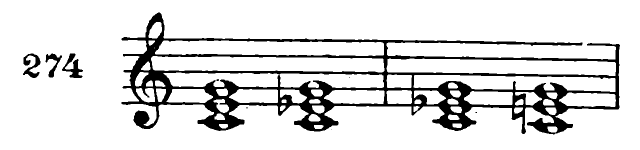
By raising or lowering the fifth of the major and minor triad:

By raising the fifth and lowering the third of the major triad:
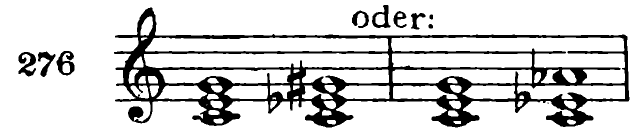
By lowering the third and fifth of the major triad, or the fifth alone of the minor triad:
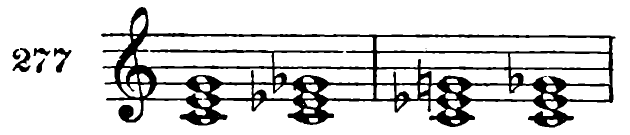
By lowering the fifth and raising the third of the minor triad:
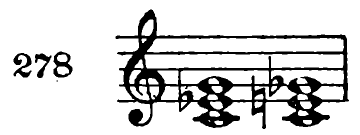
By lowering the root of the major or minor triad:
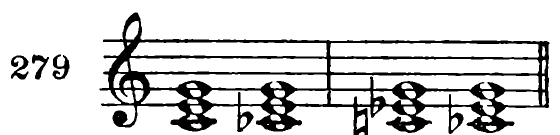
By lowering the root and third of the major triad:
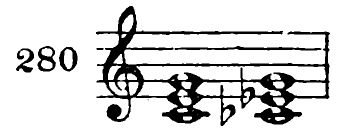
By raising the fifth and lowering the root, with simultaneous enharmonic respelling, in the major and minor triad:
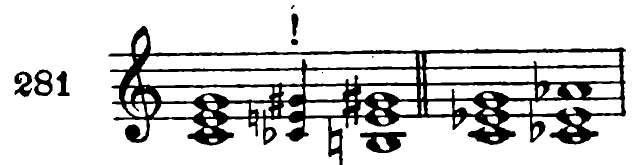
By raising the fifth and lowering the third and root in the major triad; by raising the fifth and third and lowering the root, with enharmonic respelling, in the minor triad:
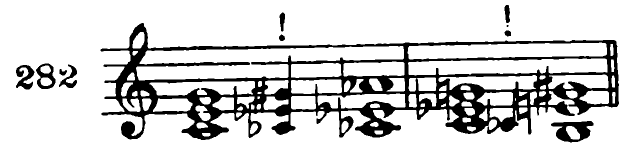
By lowering the third and raising the root in the major triad, or raising the root in the minor triad: 283a. Lowering the fifth and raising the root in the major triad; lowering the fifth and raising the third and root in the minor triad: 283b. Lowering the third and fifth and raising the root in the major triad; lowering the fifth and raising the root in the minor triad: 283c.

Some of these alterations yield chords that, as stated, must be referred to a different root when the original root is altered. In other cases, unless one wishes to enter the now pointless dispute over spelling, it is practical to respell enharmonically and write, for example, C–E-flat–A-flat instead of C–E-flat–G-sharp. This is so even though the rule for alteration is usually given as follows: upward alteration is expressed by a sharp or double sharp, possibly a natural; downward alteration by a flat, double flat, or natural. More generally, alteration is expressed by placing the appropriate accidental before the same written note.

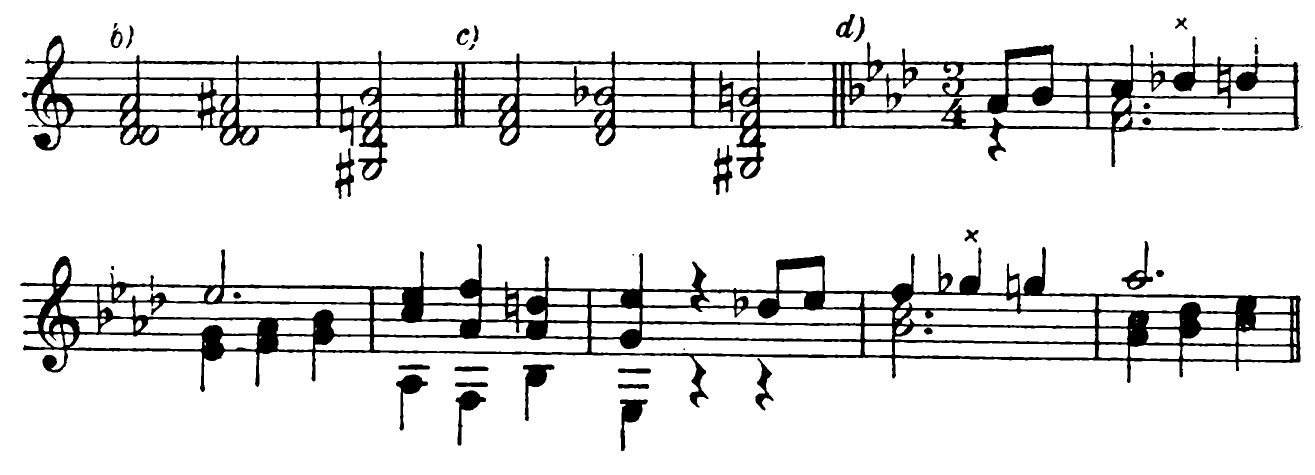
Instead of the complicated notation that often results from this pedantic accuracy, I prefer to use the spelling that refers back to a familiar chord. This will be possible with most of these chords. In other cases one may take the individual voice into account and at least notate that simply. Thus I would prefer to replace 284b with 284c, as in 284d from the scherzo of Beethoven's Piano Sonata, Op. 26.
The sonorities produced by these alterations are independent chords. Anyone who wishes may regard them as passing phenomena. This is all the easier because, after all, when one thinks of tonality, everything except degree I is, so to speak, passing—or at least going, in motion.
Example 285 shows simpler cases, 286 more complicated ones.
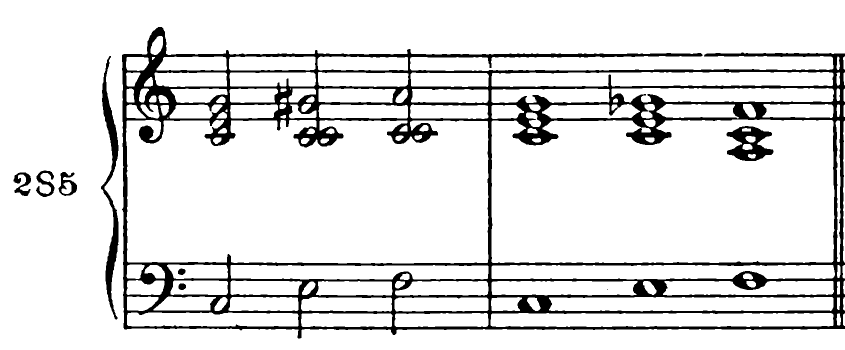
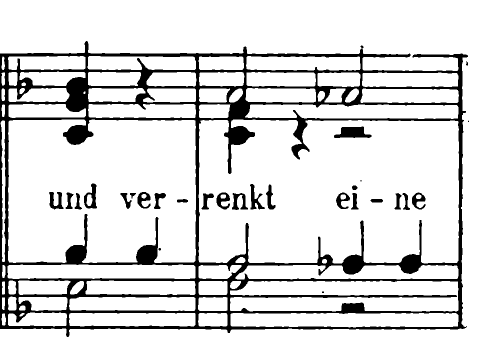
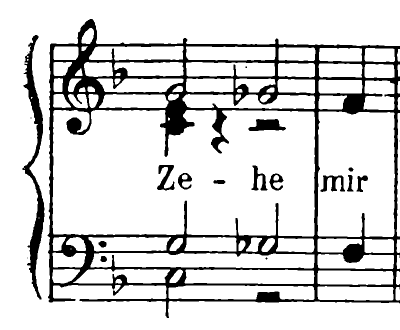
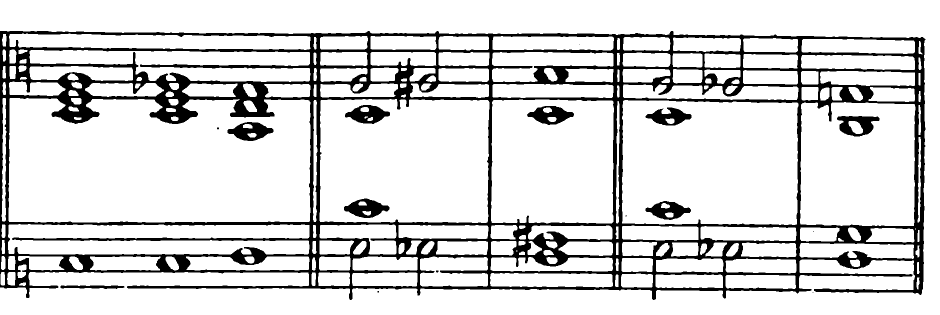
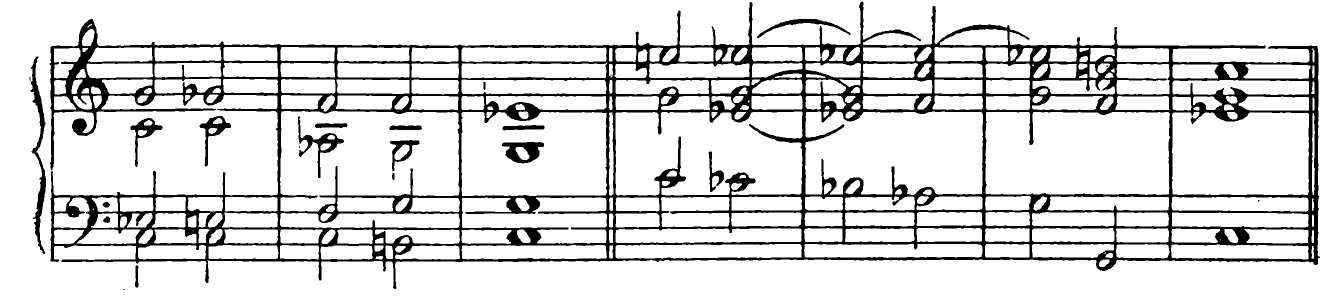
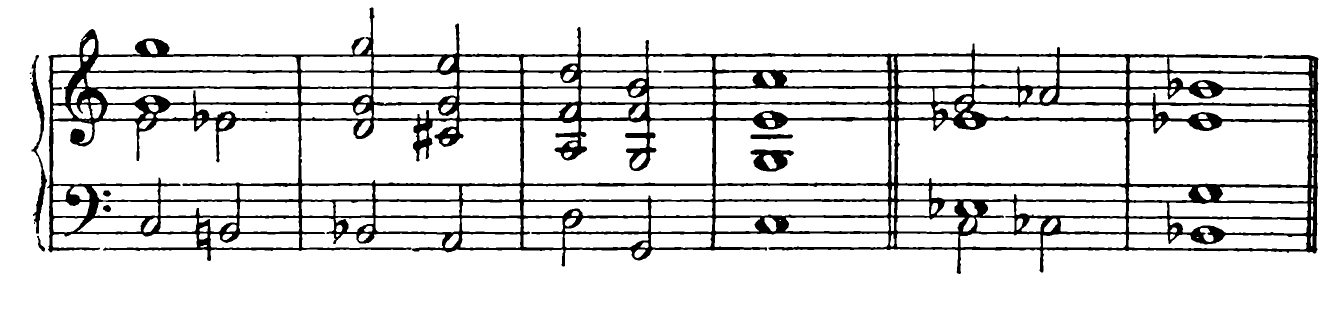
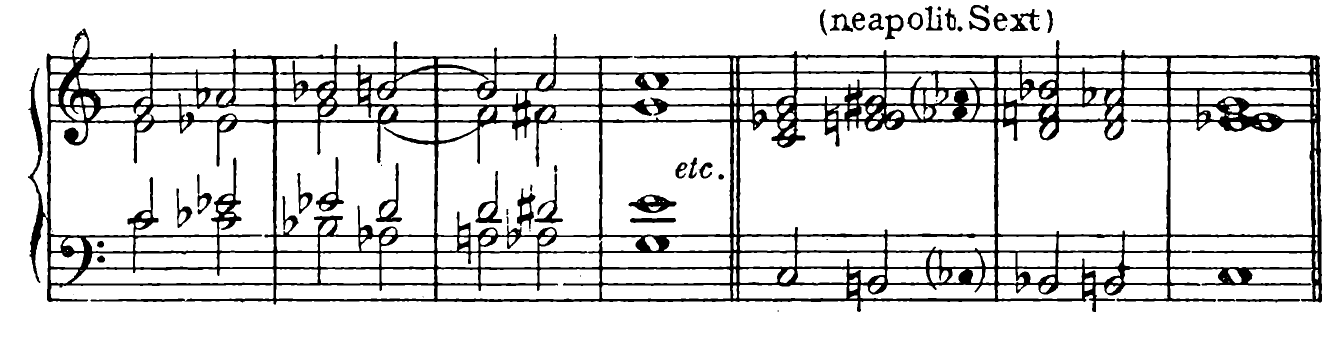
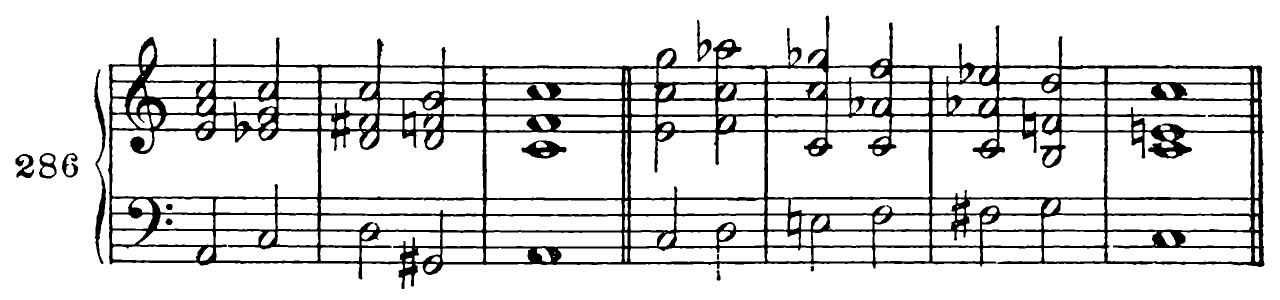
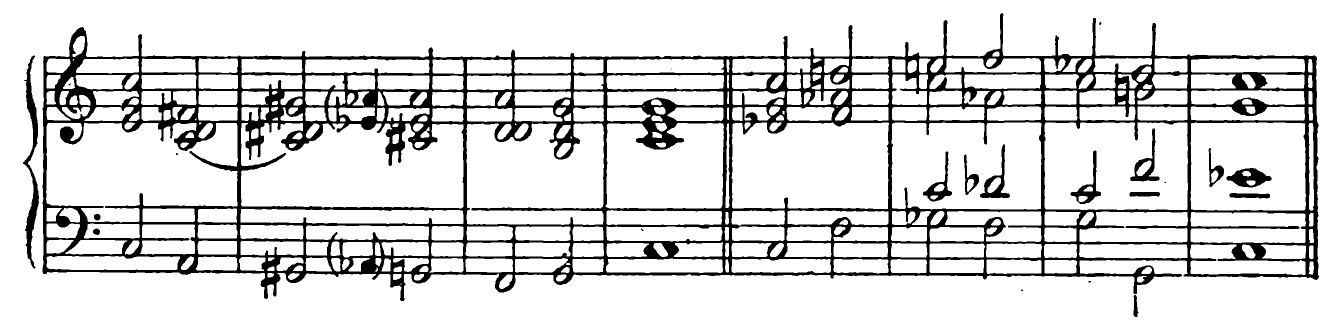
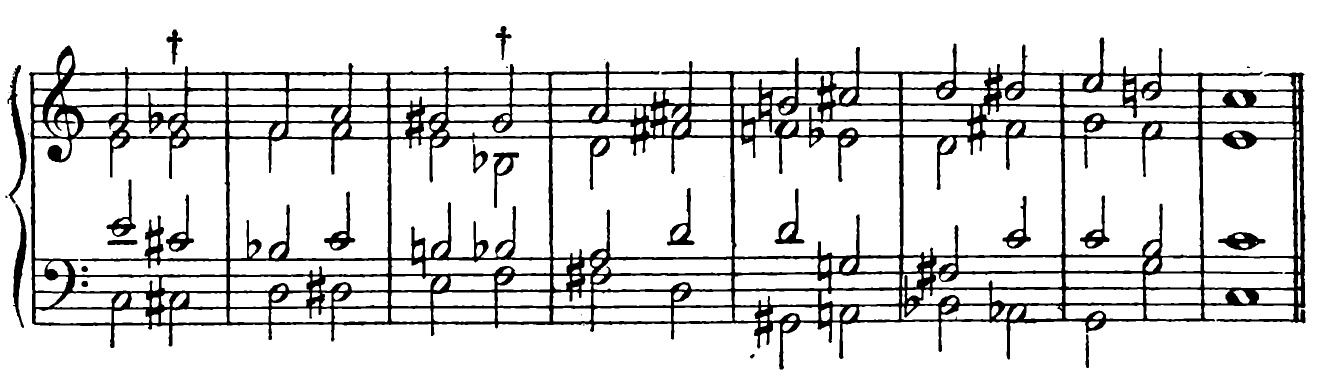
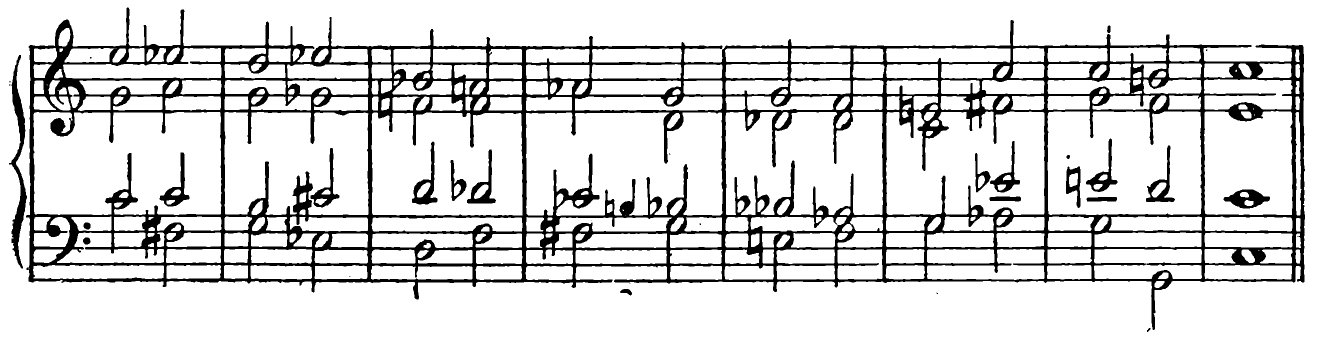
One or another chord may be harsh. For example, the chord from 283c occurs at the dagger in 286, also on other degrees. It resembles an incomplete dominant seventh chord; the missing third makes it awkward. Yet it is not entirely unusable. The occurrence of a certainly harsh chord in “classical” music may reconcile even sensitive listeners if they consider that their sensitivity to harsh chords here symbolically represents Figaro's sensitivity. Let us not forget that Figaro has not dislocated his toe: he is merely feigning that pain.
Alterations can be made to seventh and ninth chords in a similar way. Alteration of the root can definitely be disregarded here. Altering the seventh or ninth will in most cases yield no new forms. Nevertheless, it will be possible to trace certain connections to such origins and use them only where they arise chromatically—if one insists! Unless one prefers simply to acknowledge that melodic events such as passing motion did indeed produce the harmonic events of altered chords, but that the recollection of their origin need not necessarily be composed into the passage. The snail may carry its house, but a composition need not forever carry around a statement of motives, an exact legal justification for its right to exist. Such a chord could certainly be a voice-leading event, yet it is not used at the particular place because of that justification; it stands there because it is a chord like the others.
I shall confine myself to indicating the possible alterations of seventh chords and showing a few connections.


For the present, the pupil should continue to hold to the idea—let it be recalled once more—that altering a tone is primarily caused by the need for an artificial leading tone. An upward alteration will readily continue another semitone upward; a downward alteration, which creates a descending leading tone, another semitone downward. But an altered tone may remain stationary, and occasionally it may move in the direction opposite to that suggested by its leading-tone impulse. At least this will be decisive when judging phenomena such as those marked with the circle-and-line sign in 287, whose usability may arouse doubts. Alteration has been shown here only for the dominant seventh chord. Working through secondary seventh and ninth chords in the same way is partly superfluous, because the same forms often arise; discussing all these chords would exceed even the scope of this book. The pupil can easily try it himself. Naturally, they lead only to other degrees of the key; otherwise there is no difference. I have already decided earlier how they should be introduced and whether the pupil should use them.
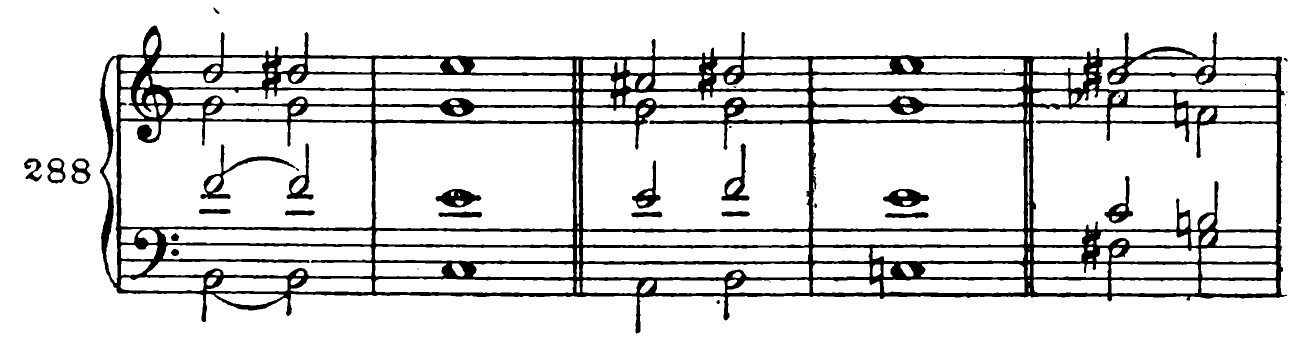
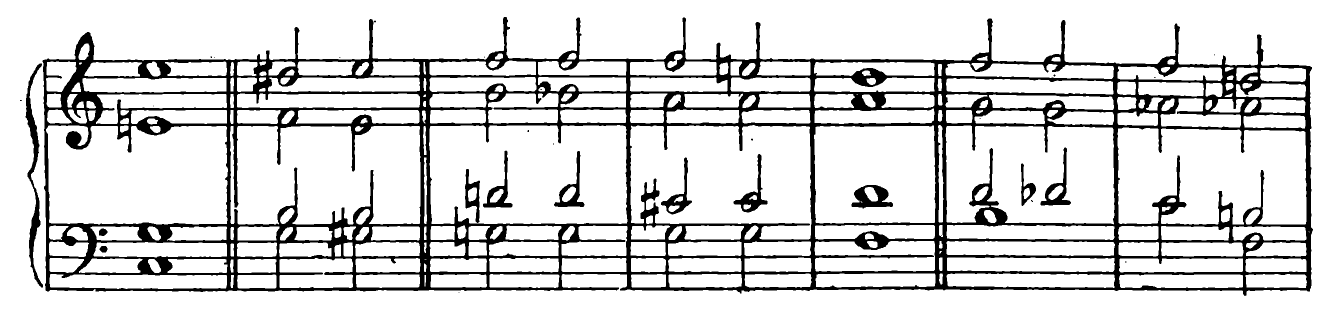
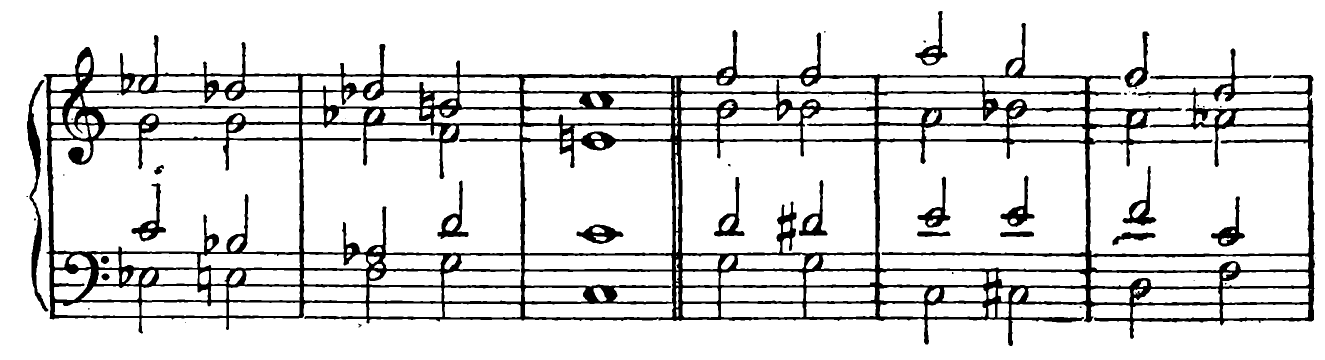
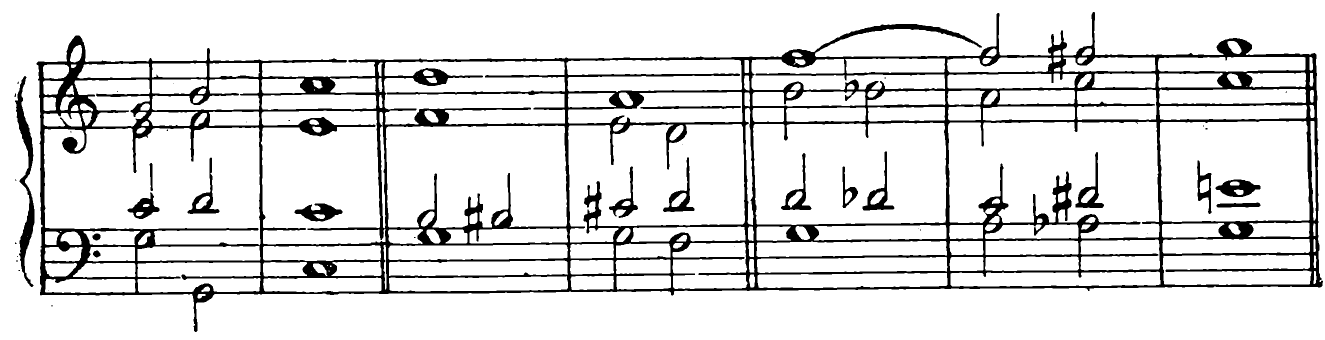
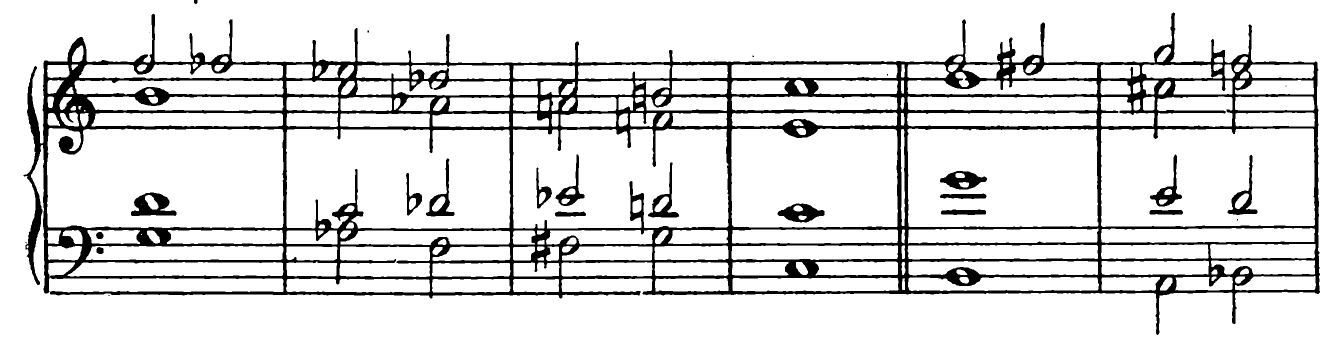
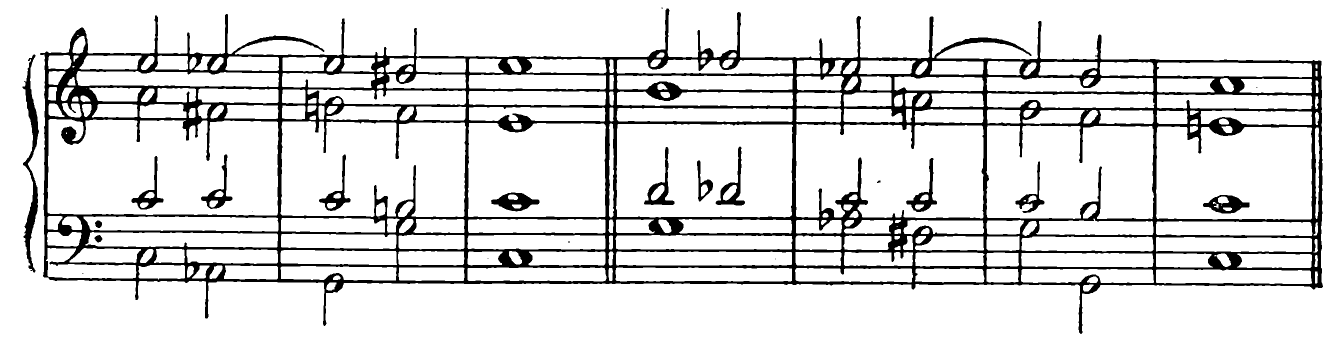
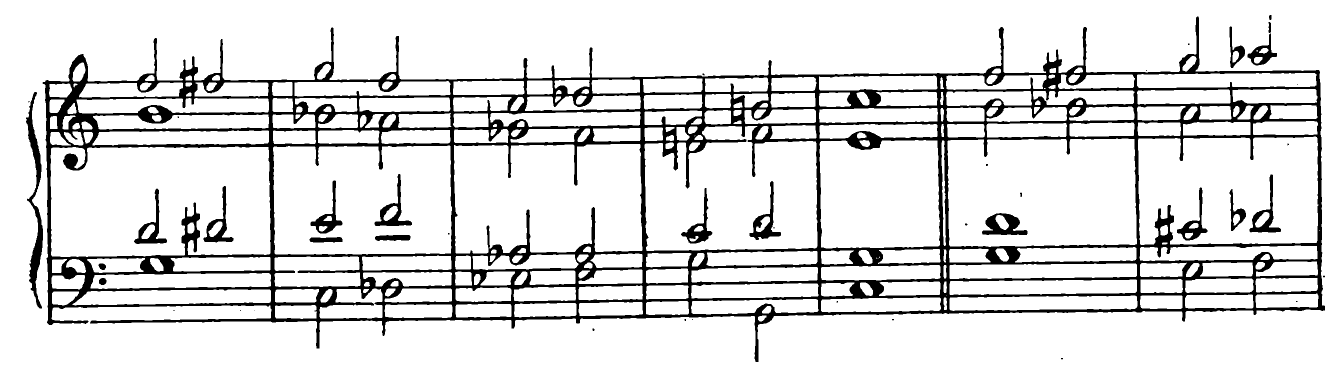
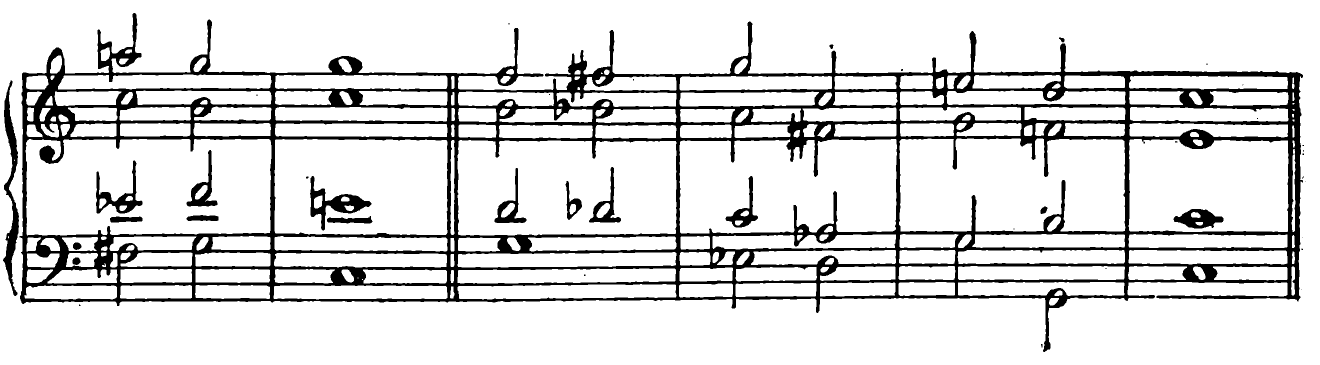
As can be seen, even alterations whose possible uses are not obvious at first glance can produce quite good effects. Naturally, part of this effect is due to melodic voice leading, and one will be inclined to regard them as chromatic passing notes. But one should not: reference to roots remains a more useful aid for harmonic analysis than justification through melody. The latter says only something about the chord's origin. The former provides consistent information about its use and tendencies.
The “aesthetic” legitimacy of these connections is beyond doubt: they already work well here in purely harmonic terms. Once the force of the motive, the melody, is added, their possible uses become substantially richer.

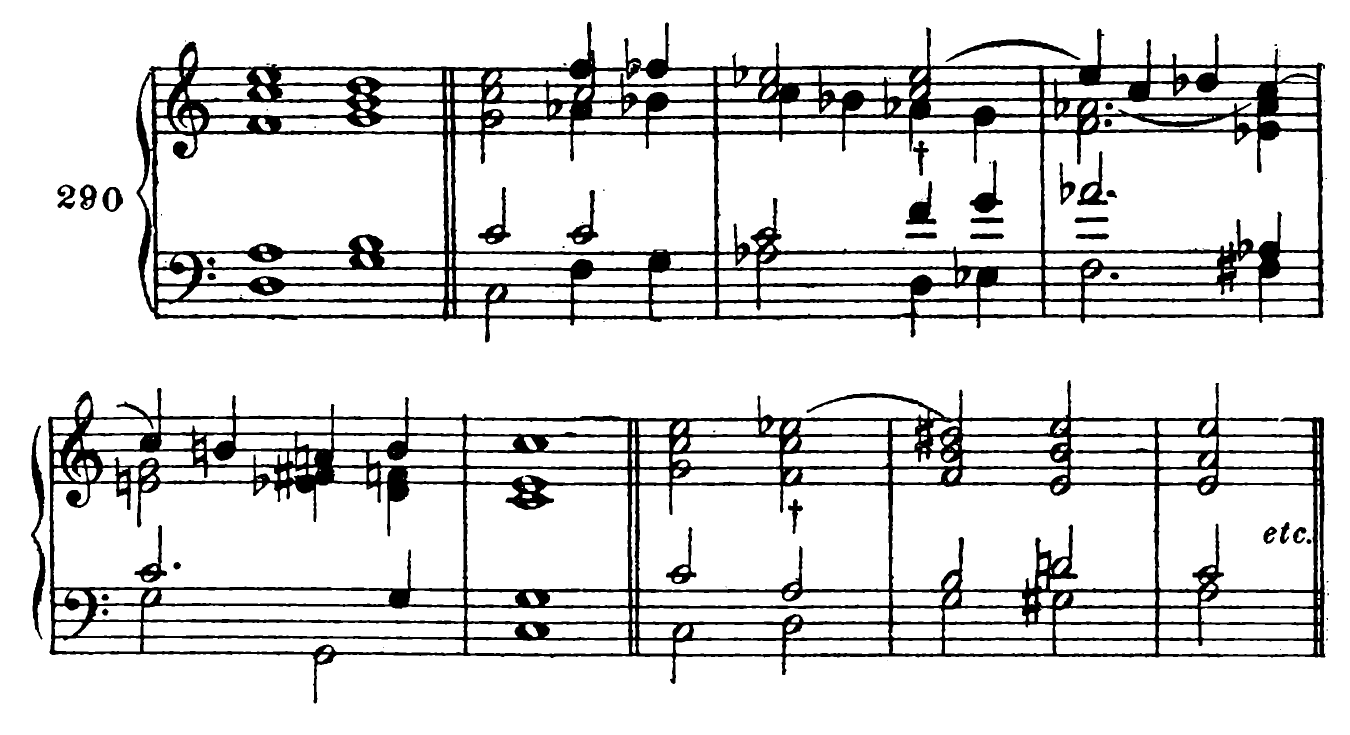
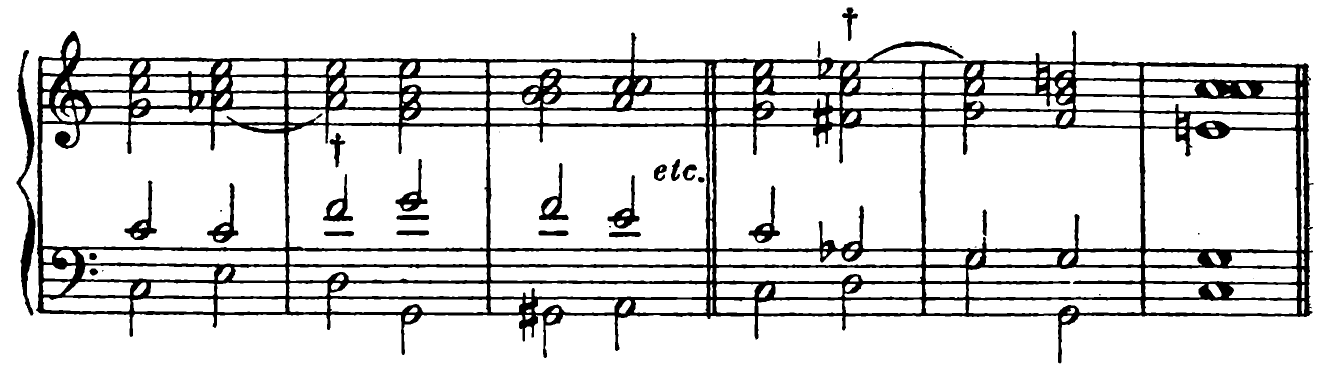
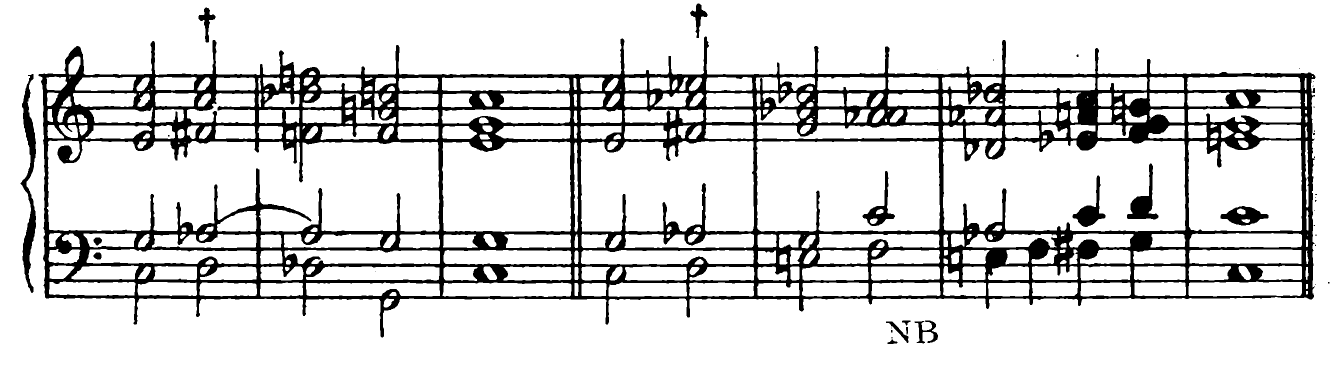
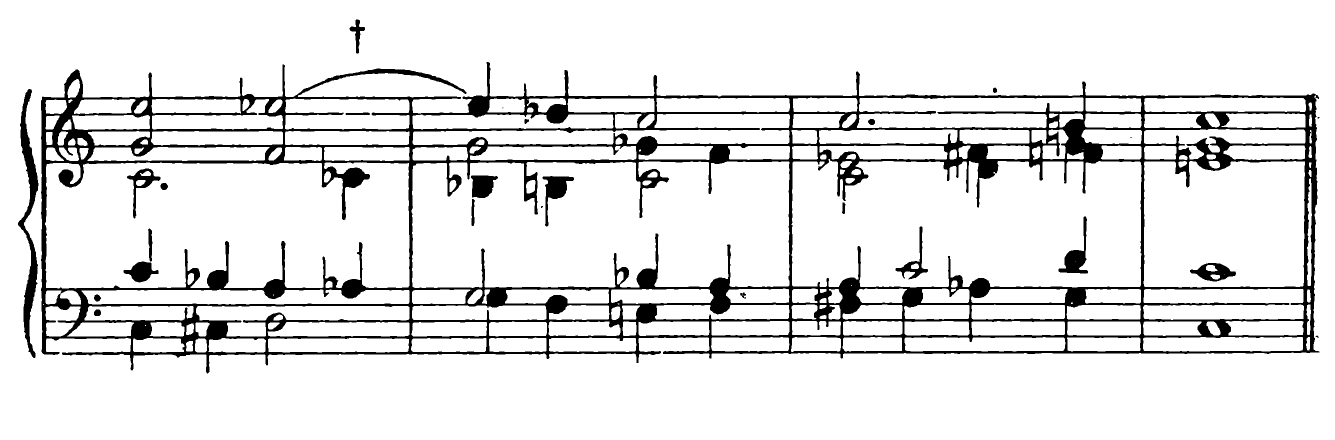
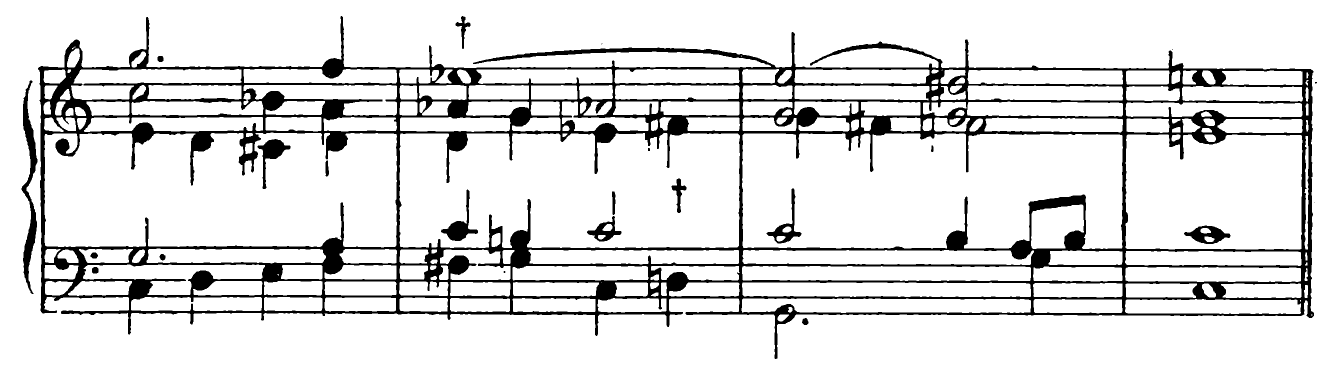
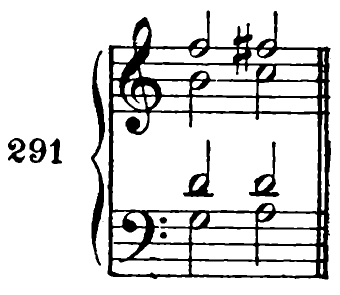
Example 289 presents alterations of the ninth chord, and 290 some possibilities for using them. I still adhere to letting the altered tone continue in the direction of its alteration. Just as a seventh chord can resolve deceptively, so naturally can a ninth chord and an altered ninth chord. And since even very moderate theorists accept that the seventh may rise, as example 291, found in almost every textbook, demonstrates, one must surely concede that the ninth of a ninth chord can at least rise chromatically.
Naturally, this increases the possibilities for treating the ninth chord.
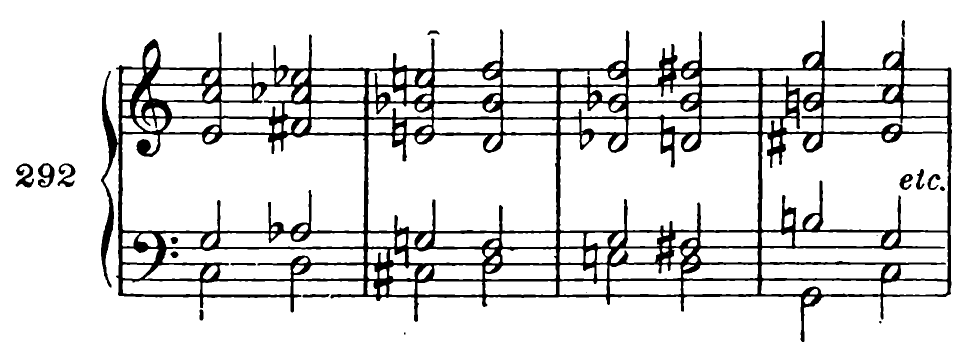
Example 292 shows two cases of an ascending ninth. The pupil can seek further ones himself.