Playable Books
Arnold Schoenberg · section 58 of 66
4. More Chord Possibilities
Read and hear this section in the playable edition →The premise that a seventh can also rise makes it possible to use the diatonic seventh chord on degree I of minor.
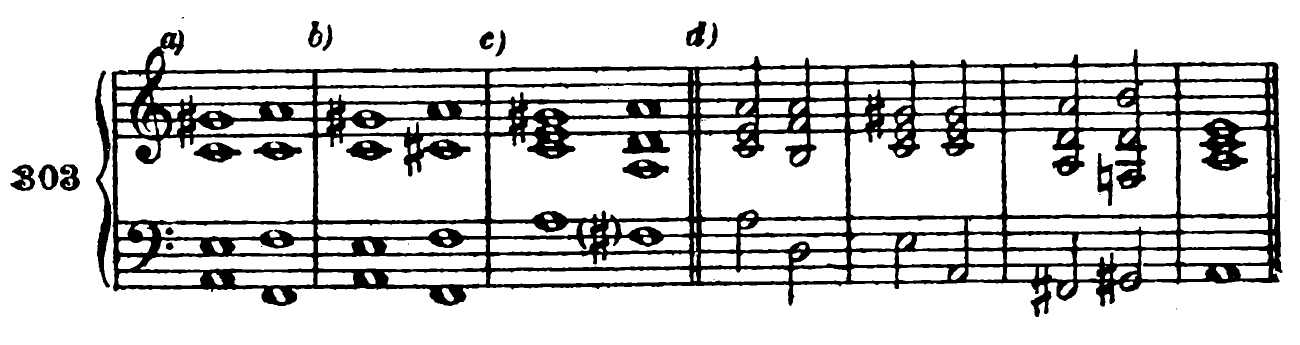
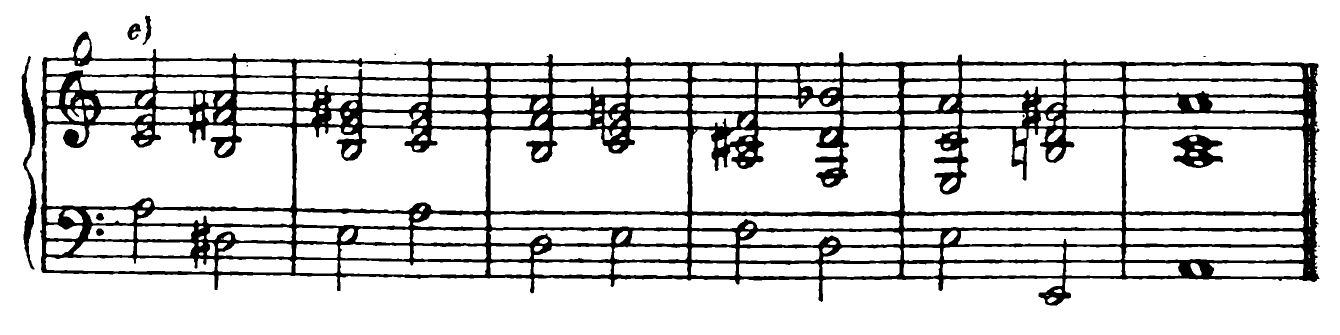
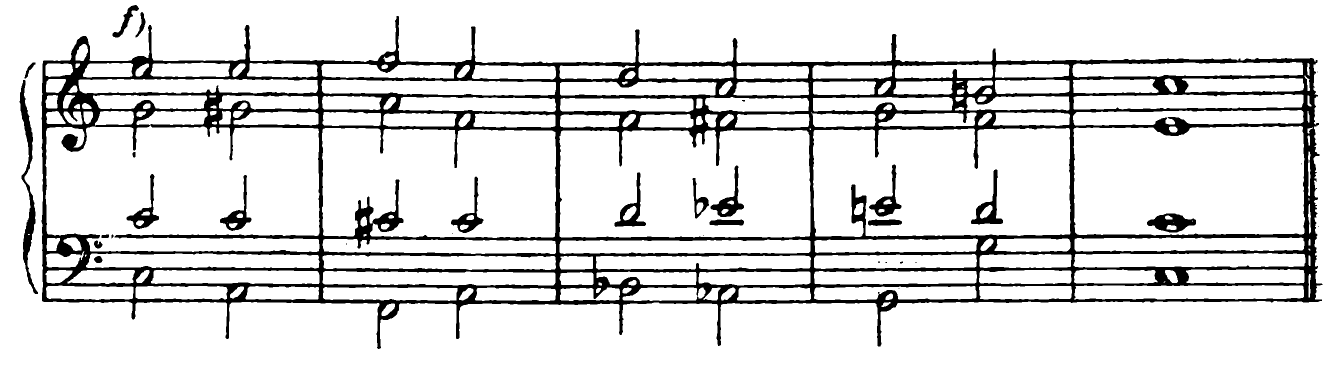
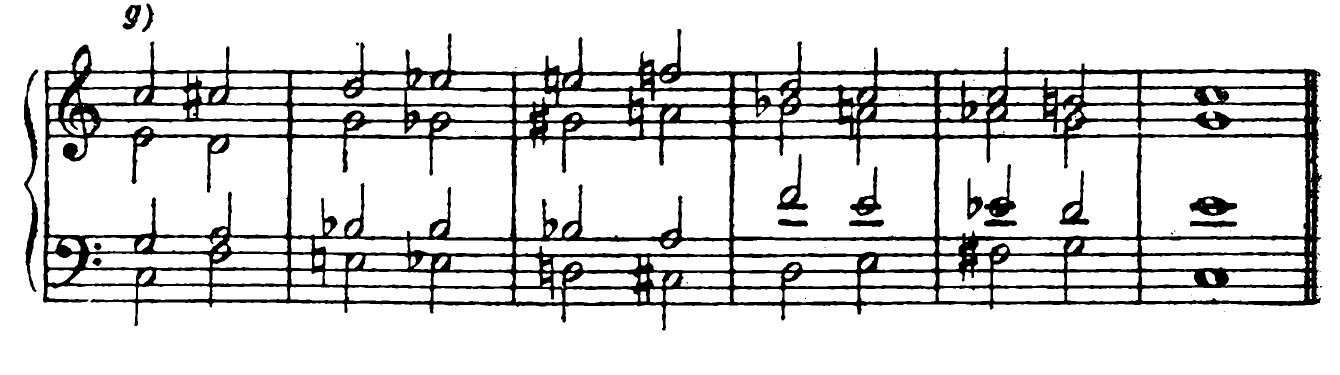
This can be transferred to other degrees of a key and give good results there, especially in combination with vagrant chords (303e, f, g).
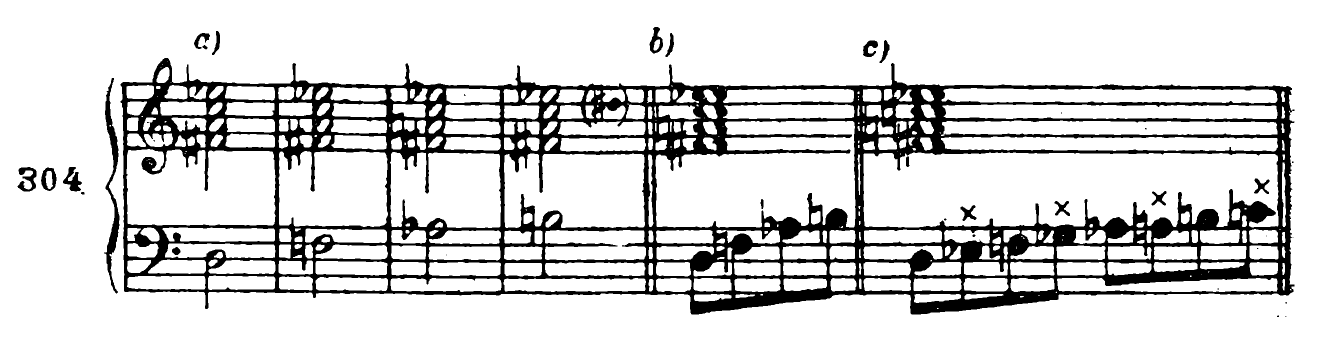
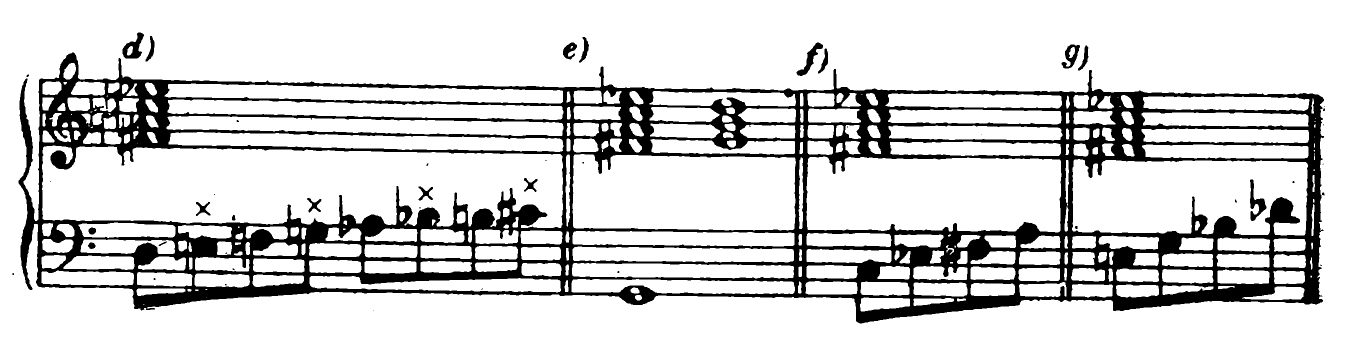
Another matter unsuitable for sensitive ears, but frequent in modern music, especially in Richard Strauss, is the use of different bass tones with a diminished seventh chord. This rests on the fact that a diminished seventh chord can be understood in four ways as a ninth chord. If one imagines a sufficient pause, or an event permitting reinterpretation, after each of the four cases in 304a, nothing prevents connecting these four chords into a succession. Indeed, this already occurs in classical music. But if one imagines it faster, or imagines the reinterpretation accomplished without assistance—this “thinking faster” is one of the principal impulses of development in every sense, just as thinking too slowly, which easily becomes identical with “not thinking at all,” produces the opposite—one understands how it becomes possible (304b) to play against one diminished seventh chord a voice consisting of the four tones of another diminished seventh chord. It may help that, when one writes a scale against the diminished seventh chord (304c), its principal notes on the quarter beats also yield these tones. But such a scale can also take the form of 304d, because every moment permits reinterpretation if one thinks quickly. Here the four tones forming the third diminished seventh chord appear in the bass on the weak eighths: E, G, B-flat, D-flat. An analogy for the five-part dissonant sonorities occurring there is found in the pedal-point form 304e: they prove to be transpositions of this G–F-sharp–A–C–E-flat onto three other bass tones. Combining the two forms 304d and e thus explains why in 304g the third diminished seventh chord can also be written against F-sharp–A–C–E-flat: each individual moment can be understood like 304e. Since 304f is self-evident, and the conditions under which the other eight tones can occur against a diminished seventh chord have just been demonstrated, the possibility of combining all twelve tones with the diminished seventh chord has been established. It follows that any melody could be harmonized over a diminished seventh chord. One will not do so, because it would be uninteresting and contrived. One would rather invent a new, characteristic harmony straight away. But it could be done! Naturally, this is not for sensitive ears, only for good ones—for ears that grasp quickly!
I mentioned a chord by Mozart that occurs in his music as a rapidly passing event. Naturally, it can then also occur slowly, for one understands it better that way. Even sensitive ears ought then to be able to grasp it—and notice it. This chord (305a) would yield a pleasant sequence (305b):
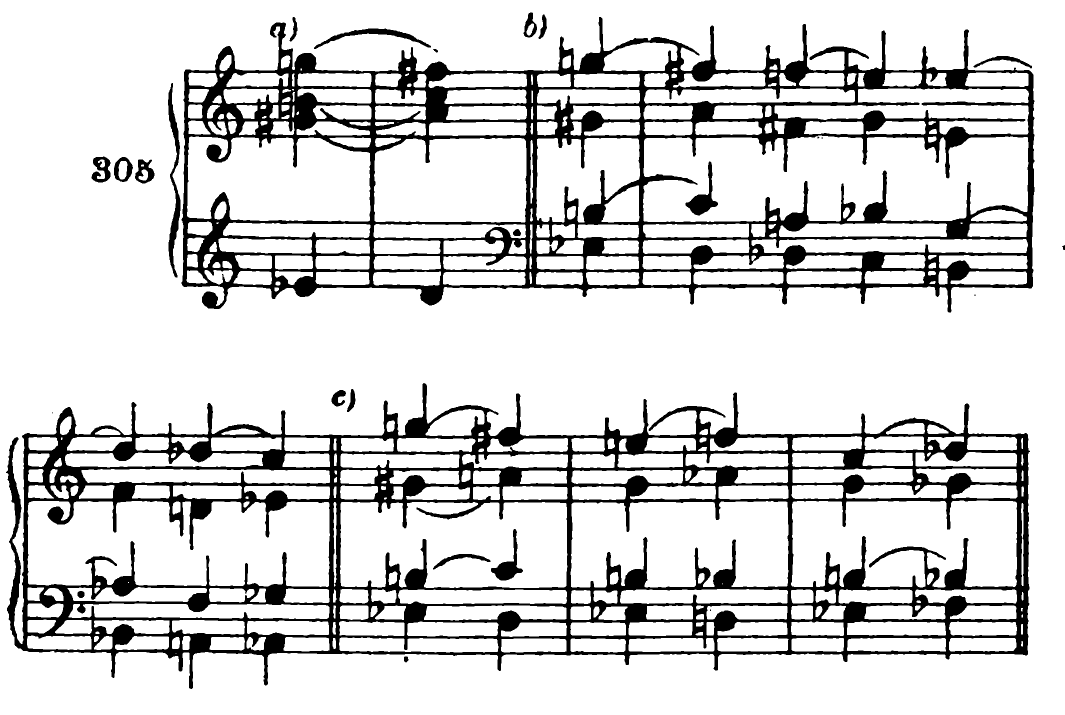
Using inversions (305c) makes it still more attractive. Surely no one can object: it is by Mozart!
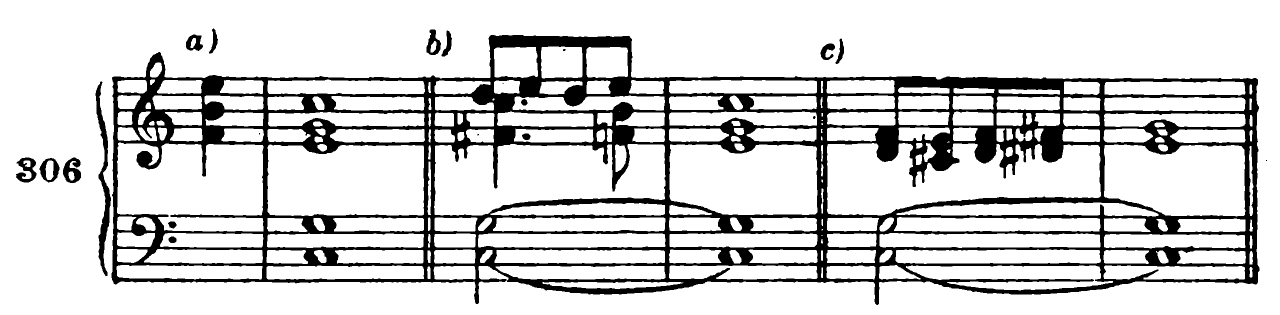
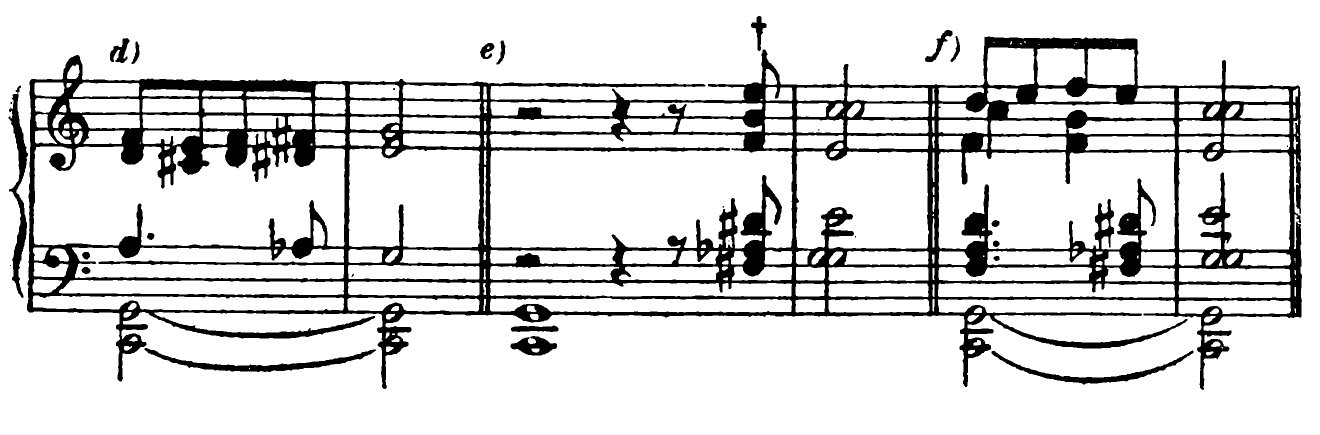
But now I would also like to show a chord that does not occur in Mozart, yet could almost be found in Bach. The leap away from E in 306a hardly needs explanation. Its appearance over a pedal point in 306b could surely occur too. The same applies to the figures 306c and d, which are not unusual. But if they are placed together, a chord consisting of eight different tones results (306e, at the dagger). It could occur as in 306f. I do not know whether it does occur. But considering what I showed from Bach's eight-part motets, where a six-part chord appears that sensitive ears would scarcely find more agreeable than this eight-part one, one may surely say: if twelve-part choral settings by Bach exist, perhaps this chord does occur after all! Or at least it could occur—even though there are no ninth chords!