Playable Books
Pyotr Ilyich Tchaikovsky · section 6 of 36
Chapter IV. Deviations from rules governing the connection of related Triads
Read and hear this section in the playable edition →
§ 14. In the foregoing exercises we retained the common tone in the same voice, when connecting two chords and thus obtained greater beauty and smoothness in harmonic progressions. We need observe this rule, however, only in so far as it does not hinder us in our true purpose: a free and independent leading of the voices.
This aim we will seek gradually to attain by disregarding at times those restraining rules, whose purpose it was at the start to fortify us against error. Even at this stage we might occasionally do so. provided we thereby improve the voice-leading. Thus it has been said, for example, that the position of the upper voices should not be too high. Now, if we see that this can be avoided by a deviation from the rule in question, we may make such a deviation, observing, however, the necessary precaution. We must bear in mind chiefly the following points:.
1) Two triads, however closely related internally and externally, must never directly follow each other in the same position, as parallel fifths and octaves must necessarily occur.
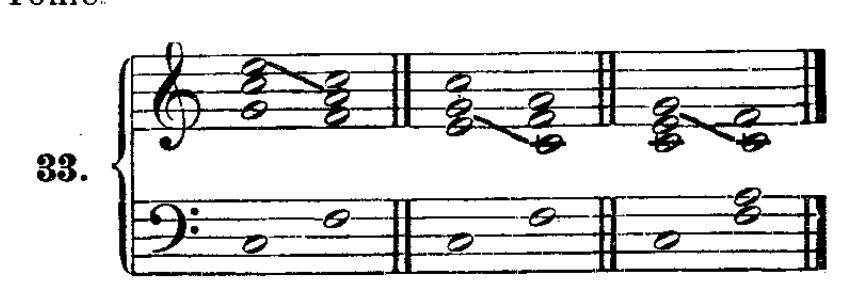
2) The uppermost voice must make no jumps greater than a fourth.
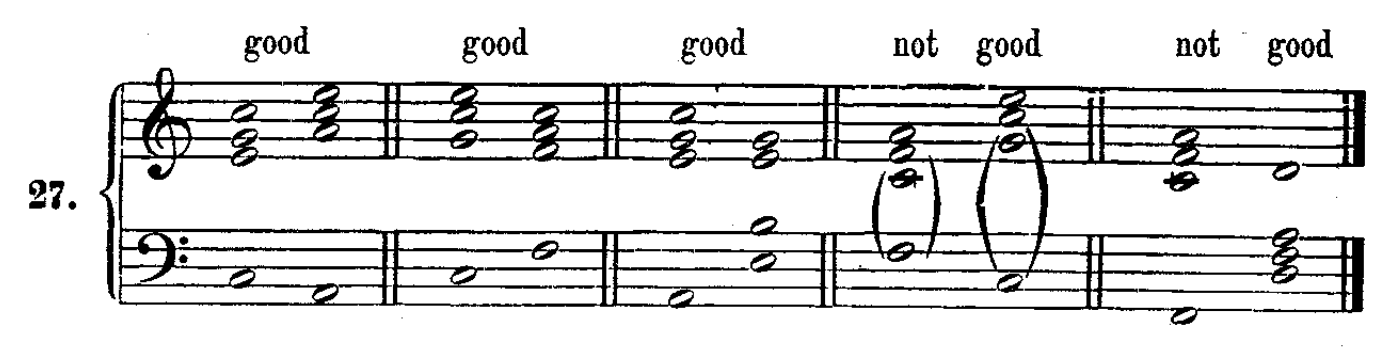
good good good not good not good
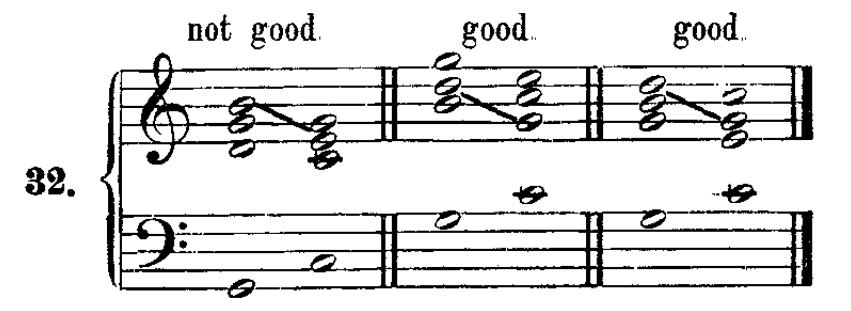
3) In this case the Bass must progress in contrary motion to the upper parts, so that no concealed Fifths and Octaves are formed.
Besides the parallel or open Fifths and Octaves there exist also concealed ones. These occur, when two voices jump in parallel motion into a Fifth or Octave

These hidden progressions, however, lose their disagreable nature, if the two chords possess a common tone, which remains in the same voice, e. g.
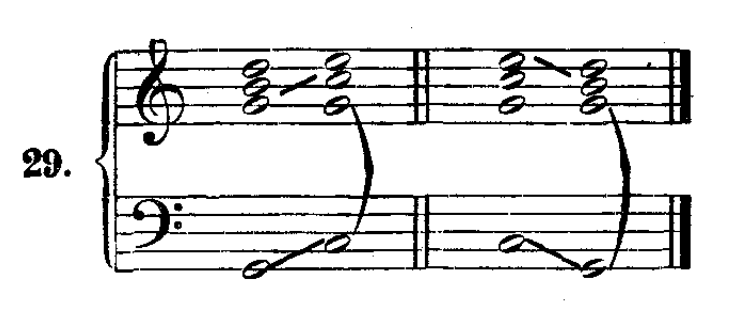
But if this rule is not applied, the concealed Fifths and Octaves sound extremely unpleasant.
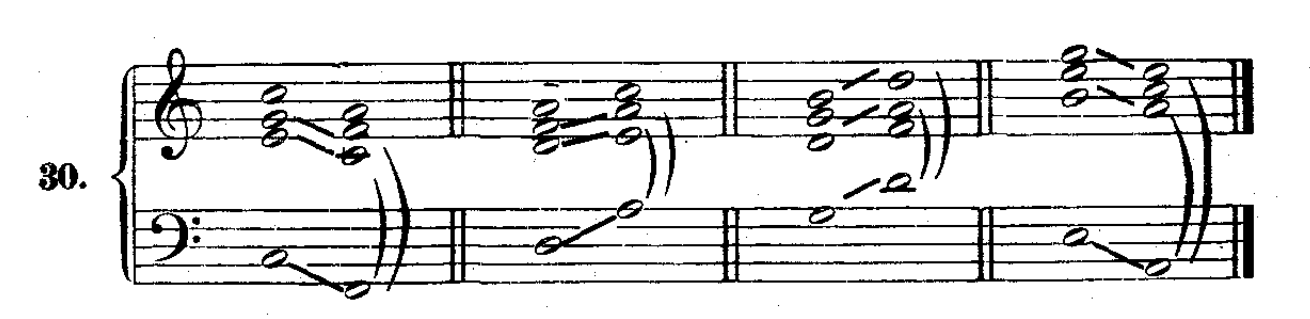
Directly we employ contrary motion, which excludes these hidden progressions, the same chord-combinations sound pleasant.
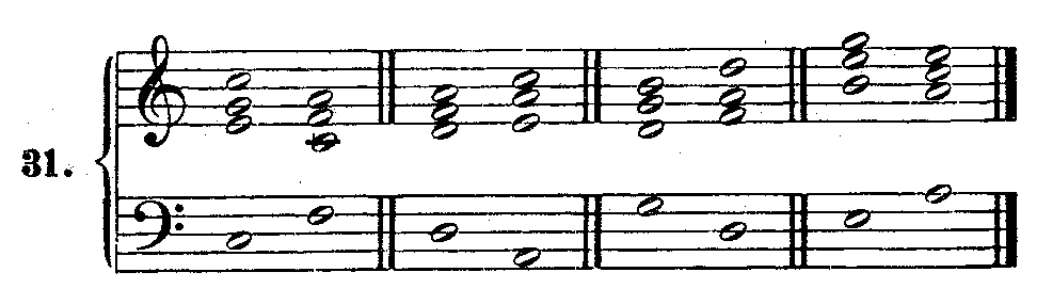
In the following examples therefore, deviations from the rule in question are admissible only, if contrary motion can be employed in the Bass.
If the leading tone, the third of the Dominant triad, is in the Soprano voice, and the Dominant triad is followed by the tonic, the deviation is not permitted, as the tendency of the leading tone is to move ‘upward a halftone into the tonic. Should we find it, however. in one of the inner voices, we may lead it a third downward.
The same holds good for the tonic triad, if succeeded by the sub-dominant triad. In this case the third of the tonic triad partakes of the nature of the leading tone, since these two chords have the same relationship as Dominant to Tonic.