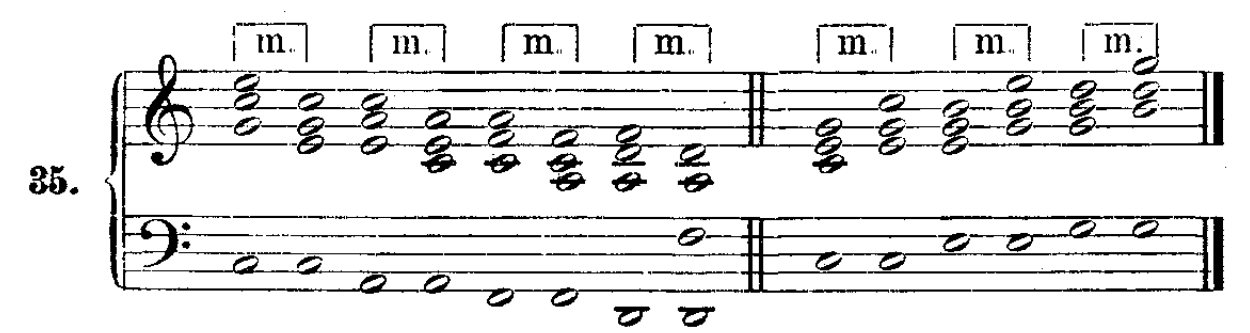
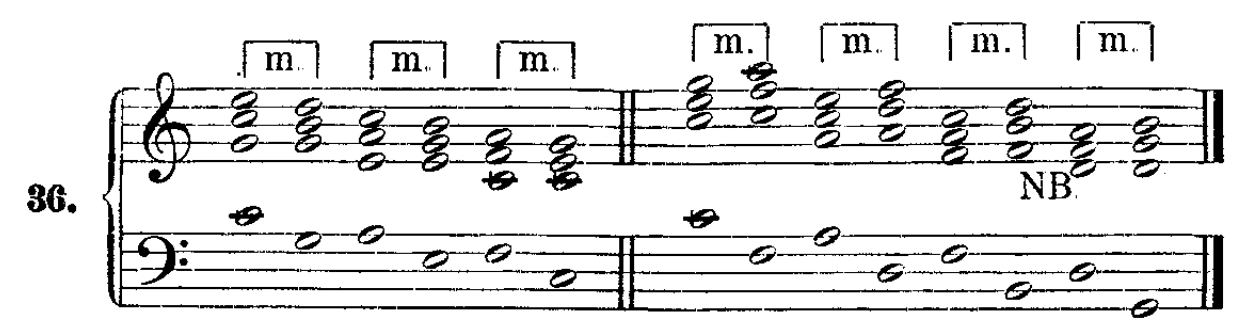
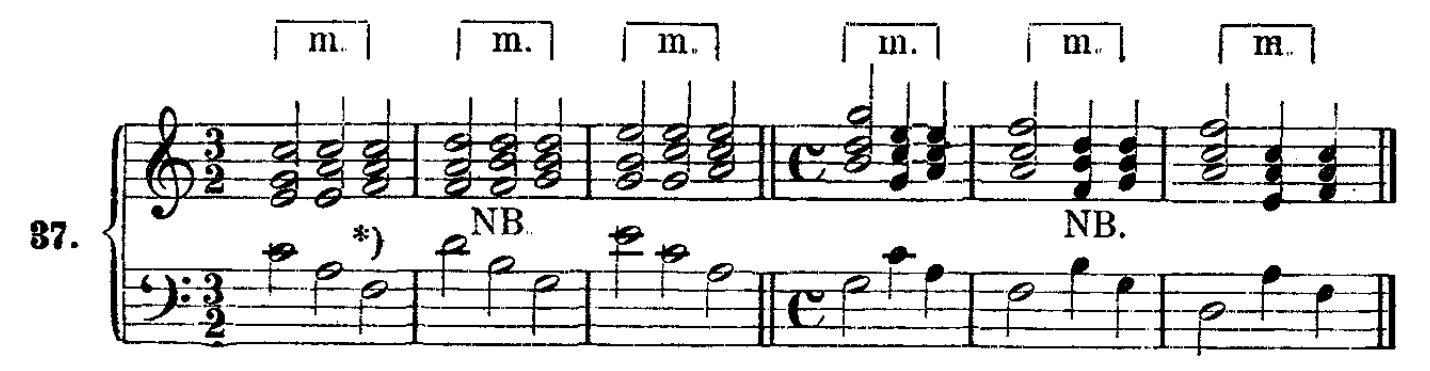
§ 15. A Harmonic Sequence is a chord-progression, in which a motive consisting of two or more chords is repeated a number of times, always on different steps of the scale, thereby giving rise to motion downwards or upwards.
In the repetitions the same arrangement of voices has to prevail as in the motive.
The motive may consist either of several positions of one and the same chord, or of different chords properly connected.
§ 16. At the places marked NB. we find the diminished triad on the 7-th degree. Because of the dissonant interval it contains (the diminished fifth) it must not be used with as much liberty as the other triads of the seale. We will, therefore, indulge in its use only with the greatest precaution. Its use in the Sequence is justified on the ground that the repetition of the motive and the carrying out of the Sequence demand it.
§ 17. It may be stated with regard to the diminished triad, that its use is not absolutely restricted to the Sequence. It may appear, for instance, supported between two related triads, in which case the common tones must unquestionably be retained in the same voices.
*) Contrary to the rule in § 11. the Bass here progresses upward by a Sixth, instead of downward by a Third. This is permitted whenever the carrying out of the motive demands it.
 Playable Books