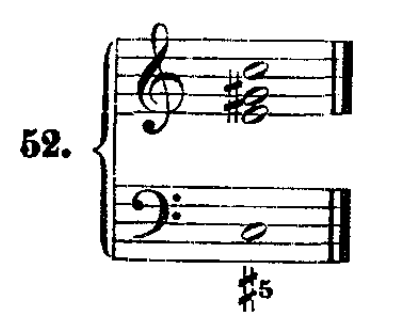
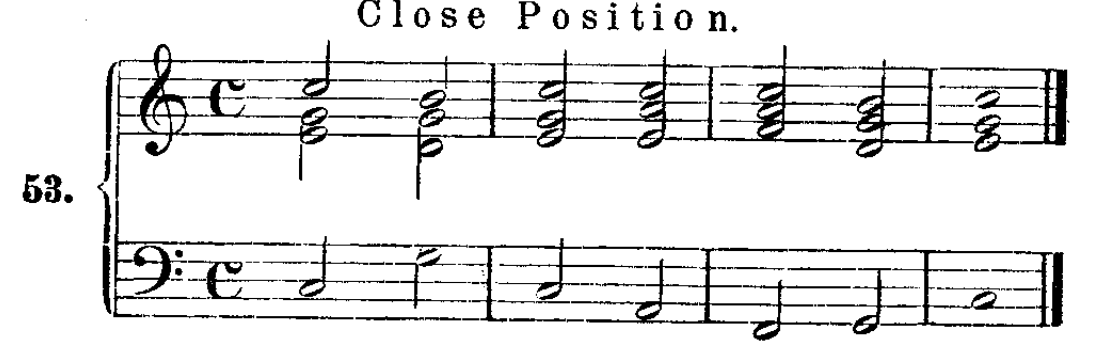
§ 22. A distribution of the voices. in which, reckoning down from the Soprano, the Alto and Tenor have respectively the next succeeding intervals,
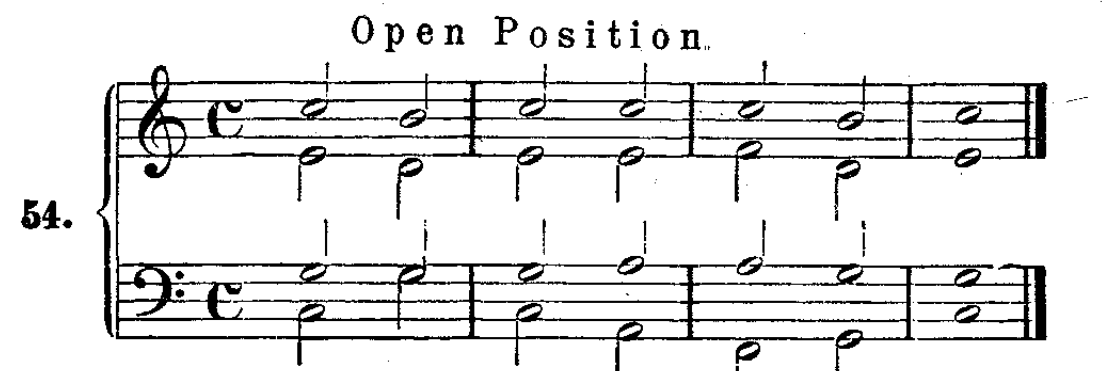
In distinction to this we have the,,open position“; in which the inner voices are separated from the Soprano and from each other by two intervals of the chord, so that what was Tenor in close position becomes Alto in open, and the tone that served for Alto is transposed down an octave into the Tenor. So one and the same group of chords can be written in two
A merely mechanical transposition of the inner voices, however, makes it evident that our leading of the voices is by no means free as yet; that, in other words, the inner voices are still subordinate to the upper voice. While the voices are, in most cases, distributed to best advantage in either of these two positions—which we shall call normal positions—we call attention to the fact that, the freer and more independent the movement of the voices, the more beautiful the harmony. Each voice must be independent of the others. Neither close nor open positions must preponderate; they must alternate and even give way to still other—exceptional positions.
Exercises: lt will suffice, to work out the foregoing exercises in open position.
 Playable Books