 Playable Books
Pyotr Ilyich Tchaikovsky · section 10 of 36
Chapter VIII. The Inversions of the Triad
Read and hear this section in the playable edition →§ 23. The fundamental tone of a triad is not always in the Bass, it may be substituted by the third or the fifth of the triad.
A triad, which has not the fundamental tone for its Bass is called inverted; and the process by which the fundamental! is transposed into one of the upper voices is called,,Inversion“ of the triad.
Every triad has two inversions:
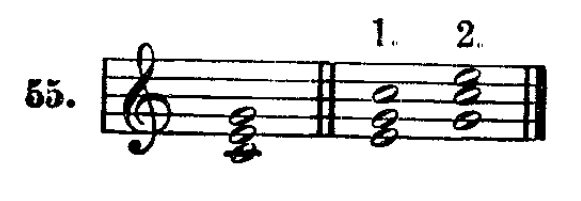
The first inversion is called the chord of the third and sixth, because the upper voices are distant respectively a third and a sixth from the Bass. This chord is more briefly called the chord of the sixth.
The second inversion is called the chord of the sixth and fourth.
Beside the external distinction between the fundamental triad and its inversions, there exists an internal, or, we might say,,,spiritual” difference. This latter is evinced by the different harmonic significance of these three forms of the triad, as well as by their different impressions on the human ear.
The triad in its fundamental form contains a perfect consonance — the pure Fifth—which lends to it the element of absolute repose and completeness in itself. This chord is perfect, an,accord parfait“, as the French call it. The inversions of the triad, however, contain no perfect consonances; they lack this element of repose and evince a tendency to progress. For this reason the inversions of the triads are—as a rule—to be found in the middle of a composition, rarely at the commencement, and never at the end,
The manipulation of the inversions of the triads will present some difficulties to the student. But these he will doubtless overcome with the aid of rules serving that purpose. The rules, however, will be disclosed to him later on, in the harmonization of given melodies,
§ 24. Hitherto we have doubled only the fundamental tone in the fundamental form of the triad. We remarked, it will be remembered, that this is not only the most usual, but also the best course to pursue, as the nature of the chord seems to demand if. If, now, we distribute the upper voices of the inversions in the same manner as in the fundamental position, we obtain the following aspects of the chord:
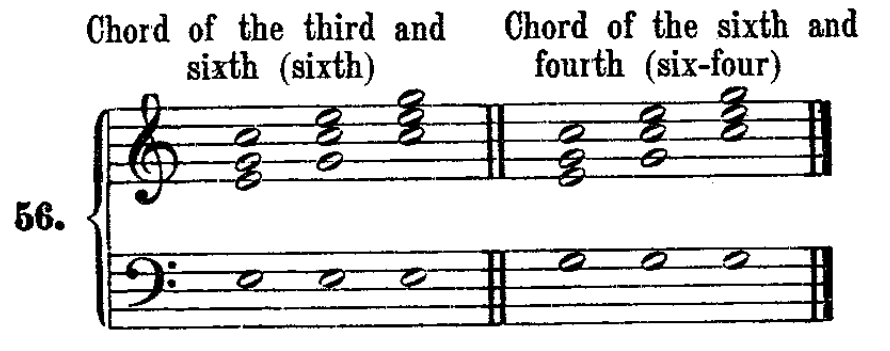
Chord of the third and Chord of the sixth and sixth (sixth) fourth (six-four) Ca.
In the chord of the sixth the third appears doubled; in the chord of the six-four—the fifth. A doubling of the third, however, being unnatural and unsatisfactory to the musical ear, it is better to double the fundamental tone or the fifth in the chord of the sixth. This necessitates an exceptional position of the voices.
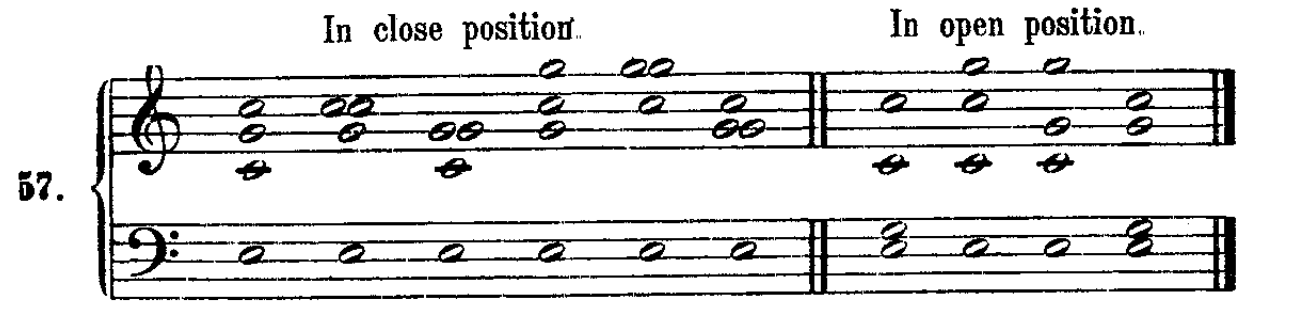
In close position. In open position.
The advisibility of doubling any one interval depends on the distribution of the voices in the preceding chord, or on the connection of the chord of the sixth with the following chord.
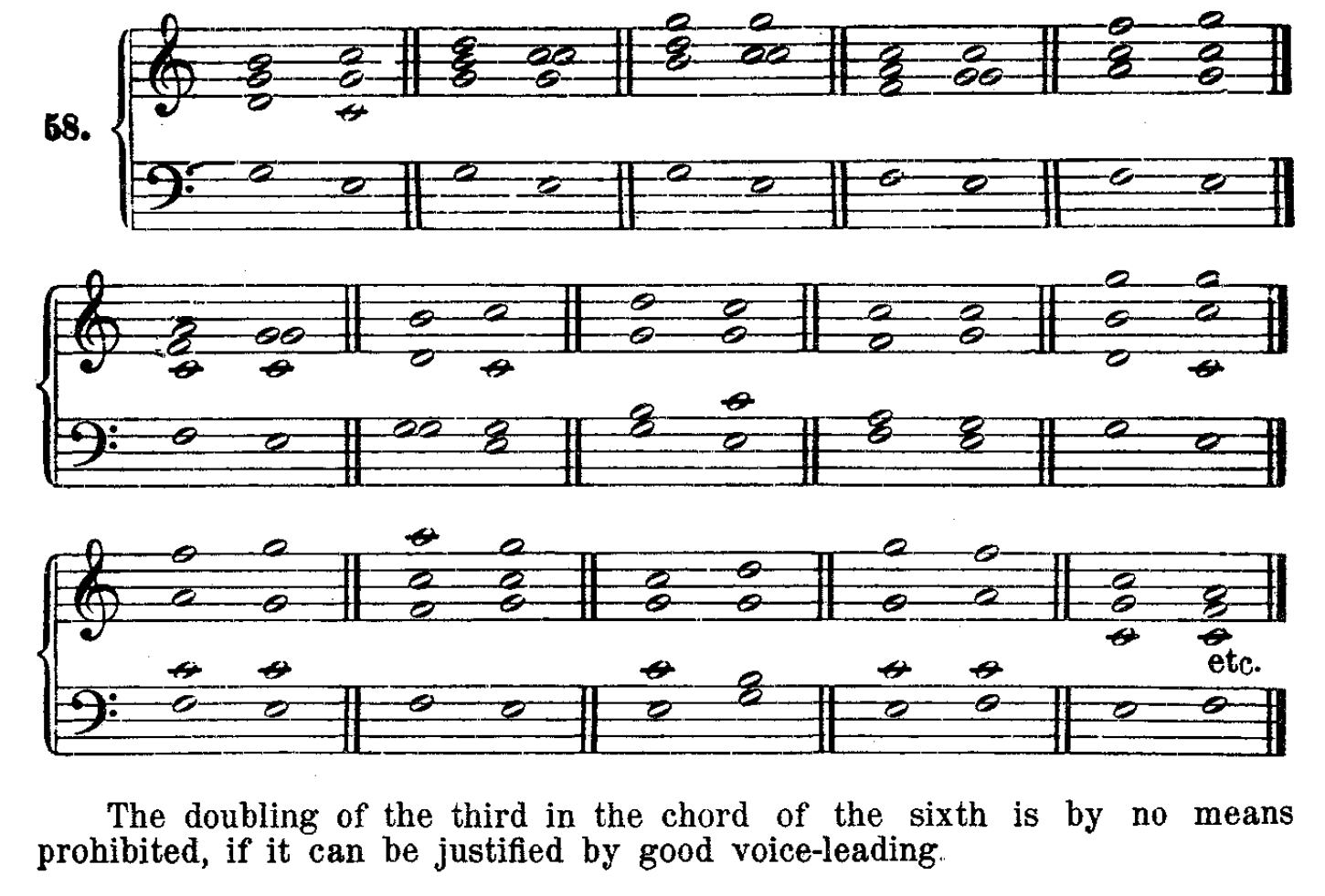
The doubling of the third in the chord of the sixth is by no means prohibited, if it can be justified by good voice-leading.
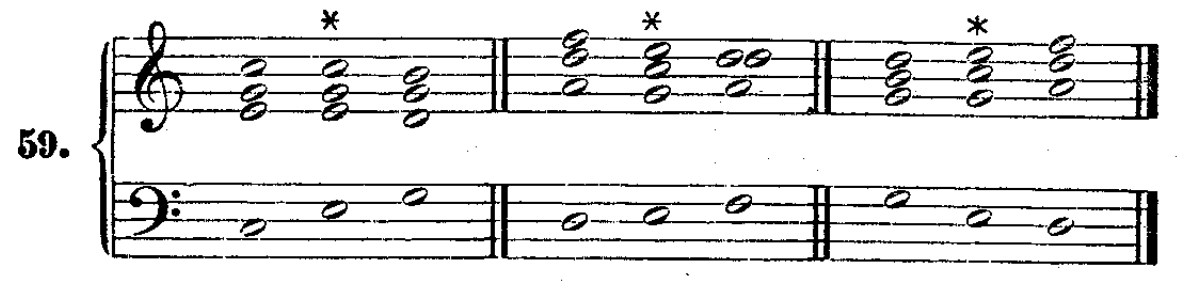
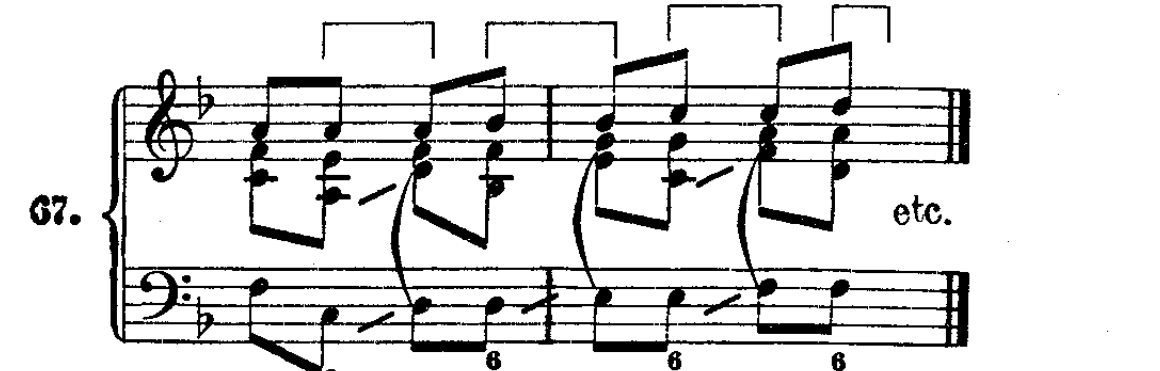
Remark. Frequently we meet with a whole series of chords of the sixth, which follow scalewise one after the other. In such a case it is best to lead two voices parallel to the Bass and the third in contrary motion to it. Thus we obtain an alternate doubling of fundamental, third and fifth. If the Bass moves upward, we commence by doubling the Fifth; if downward, we double first the fundamental.
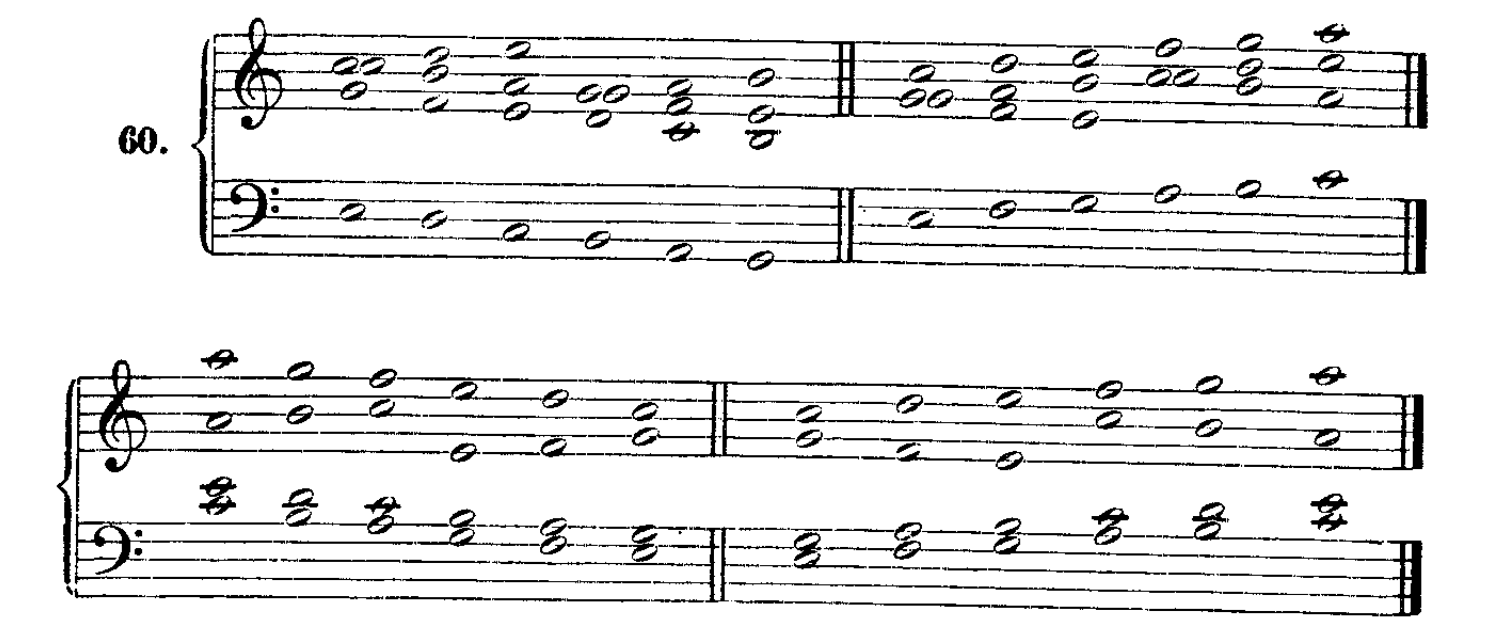
If the chord of the sixth of the dominant triad is followed by the tonic, the third of the former must never be doubled, as it is the leading tone.
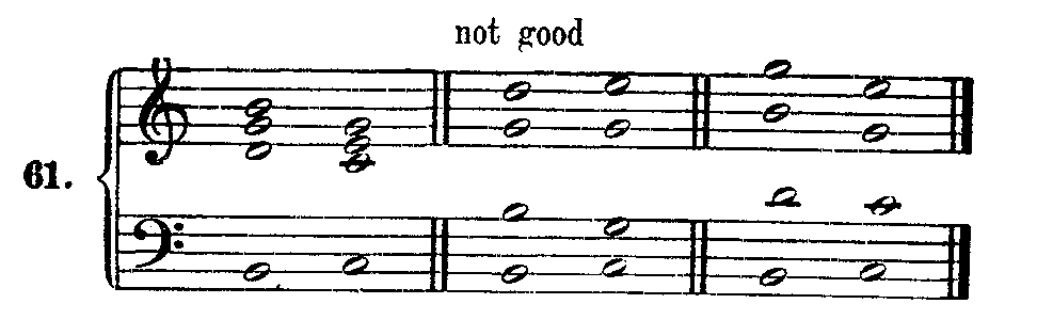
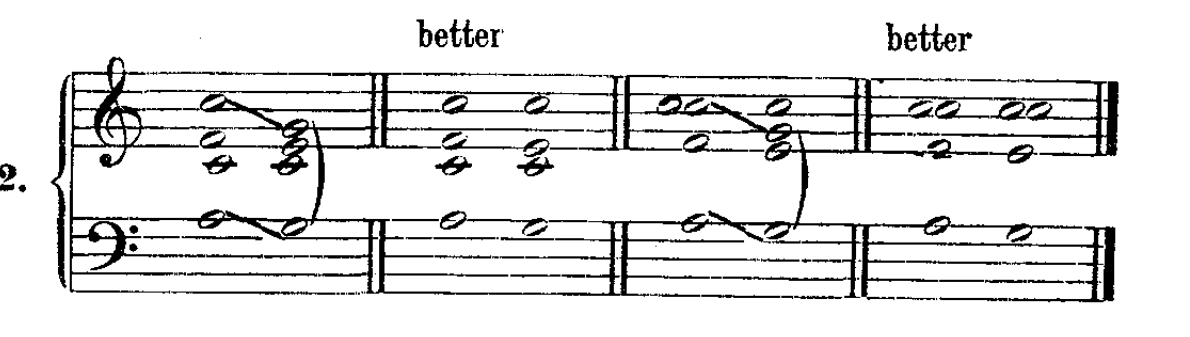
A doubled fifth sounds not at all unpleasant; so that the close position of the upper voices of the six-four chord may be retained. The fundamental is doubled only in cases where we wish to avoid concealed octaves, which sound especially bad in the six-four chord.
ik it sin ik
§ 25. The chord of the sixth will be discoursed at length later on; for the present we can say that it appears much more seldom than the other forms of the triad. It assumes great importance, however, in a certain harmonic closing formula, called the,,Cadence“.
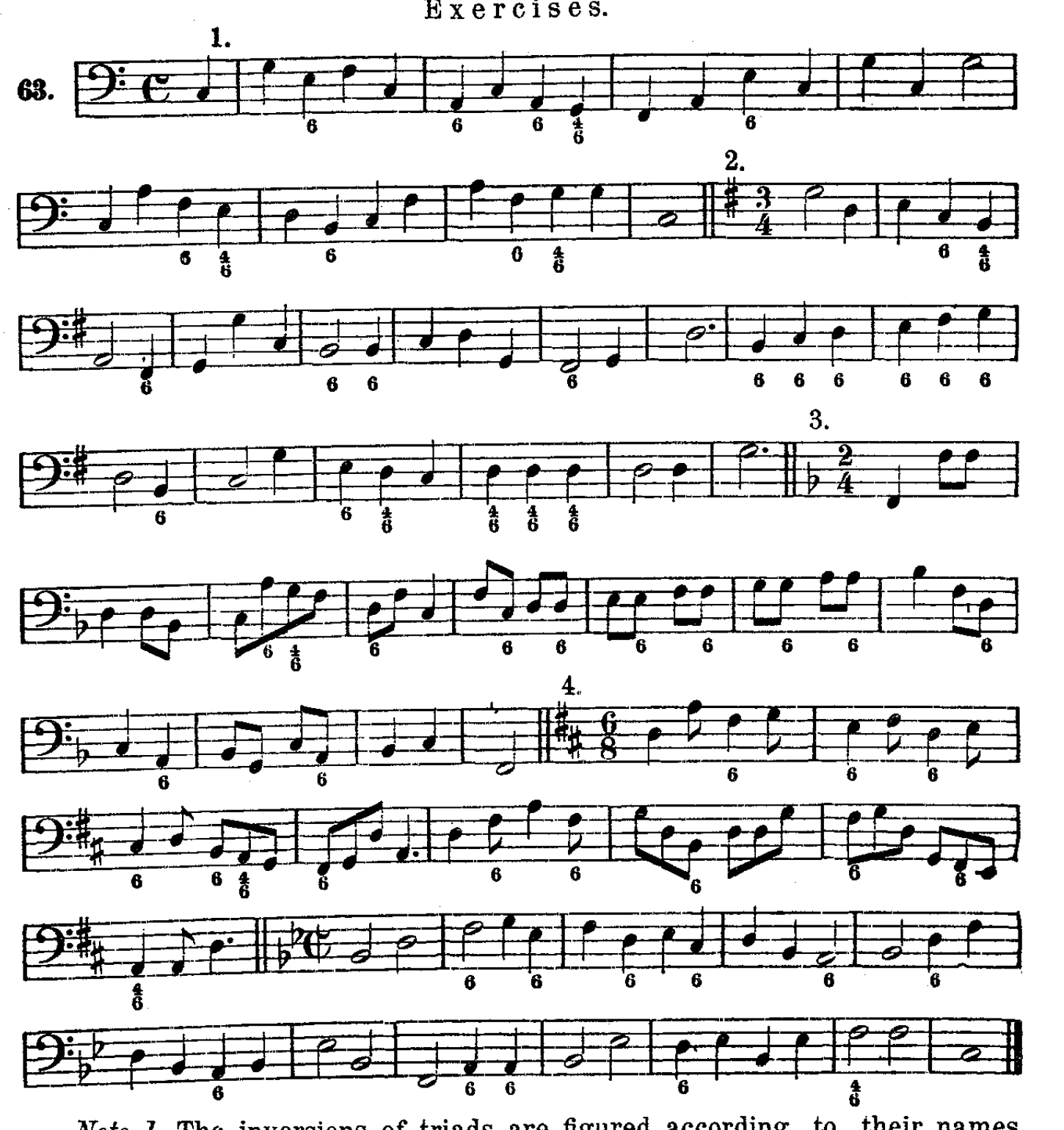
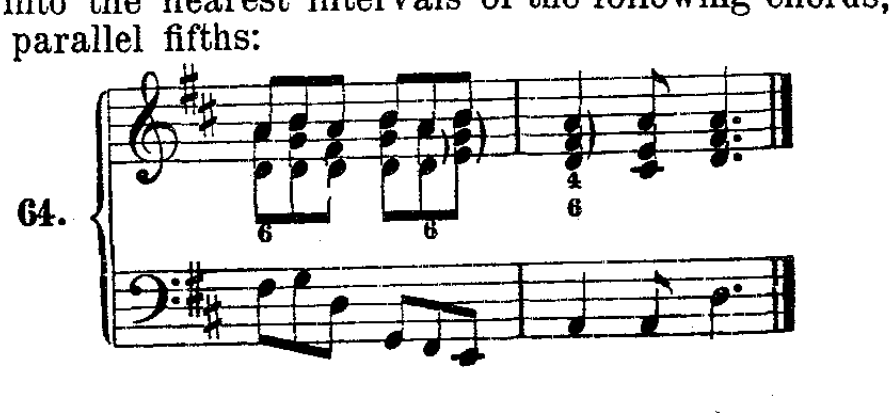
Note 1. The inversions of triads are figured according to their names. the first—6; the second—.. Note 11. The pupil must take the greatest pains to avoid forbidden progressions, as only the most unplagging attention serves eventually to eliminate them entirely. For this purpose the position of the chords must frequently be changed. If for instance in the last two bars of the 4-th exercise the triad on G be placed in the position of the third and the voices led respectively into the nearest intervals of the following chords, we obtain three successive parallel fifths: o-# :
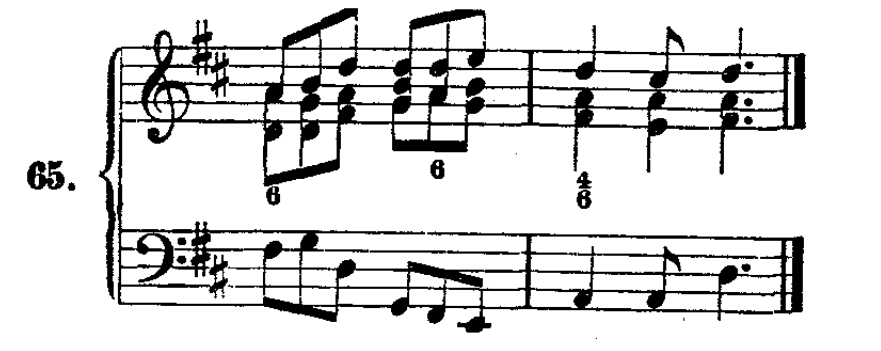
We avoid these faulty progressions, however, by placing the triad on G in the position of the fifth: _
As regards concealed progressions, we would say that, while they are if possible to be avoided, they are not absolutely forbidden, if the leading of the voices demands them. The concealed octaves, for instance, which appear in the following sequence, are pretty well justified by the repetition of the motive:
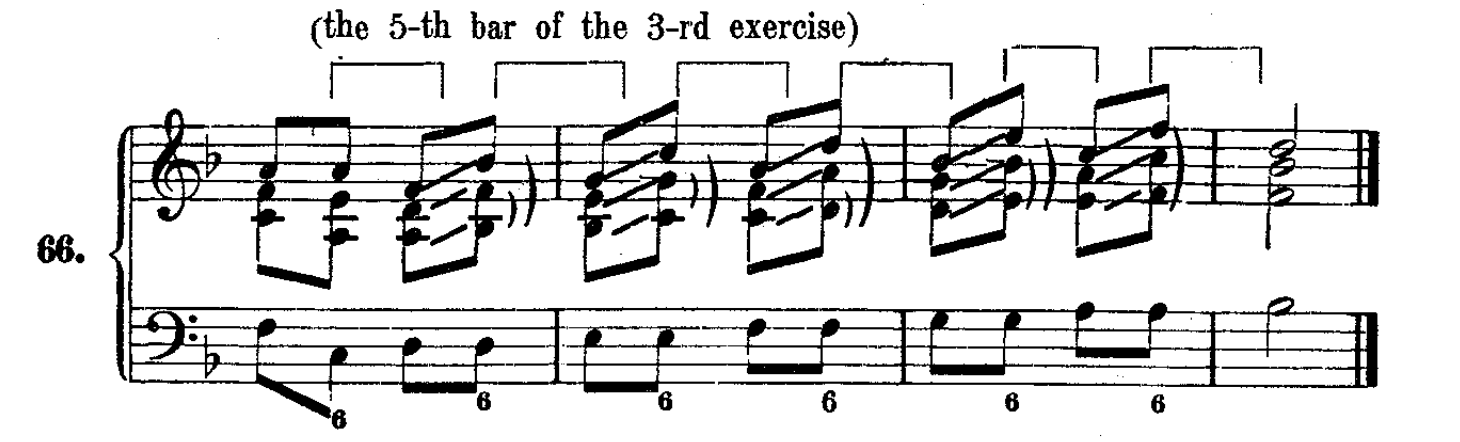
(the 5-th bar of the 3-rd exercise)
Much more to be condemned would be their appearance in the motive itself instead of in its repetition:
ft t — Hi ls 6 6 In working these exercises the pupil will meet with numerous little obstacles, which theory is not able to point out; but these will gradually disappear, as the pupil strives to perfect his technic.