 Playable Books
Pyotr Ilyich Tchaikovsky · section 18 of 36
Chapter XVI. Chords of sequence in minor
Read and hear this section in the playable edition →
chords of the seventh can be resolved into the required triad or chord of the 7-th, as we shall soon see. Let us first inspect separately the chords of the seventh built on the several degrees of the minor scale.
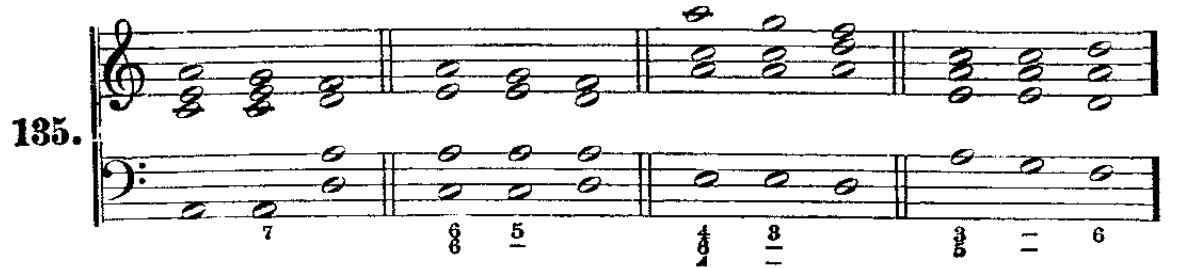

I. The chord of the seventh on the 1I-st degree cannot serve our purpose, because, in its resolution, the seventh would progress downward by a tone and a half, which would be quite at variance with the real purpose of resolution. For, it is only by a melodic progression of the dissonance downward into a consonance, that our musical susceptibilities, disturbed by that dissonance, are quitted.
U. The chord of the seventh on the 2-nd degree resolves in the regular manner into the dominant triad, and is much used.
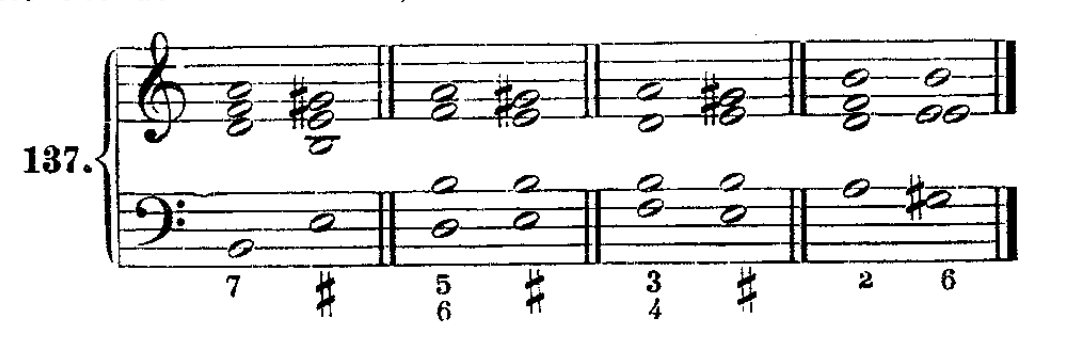
Equally well can it be connected with the dominant chord.
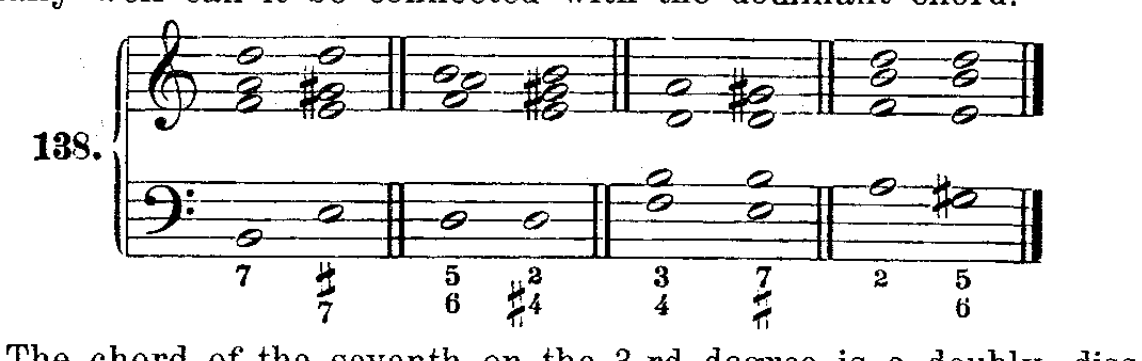
II. The chord of the seventh on the 3-rd degree is a doubly dissonant chord, because it contains, besides the seventh, an augmented triad. It is nevertheless used, its augmented fifth being led, without exception, a halftone upwards.
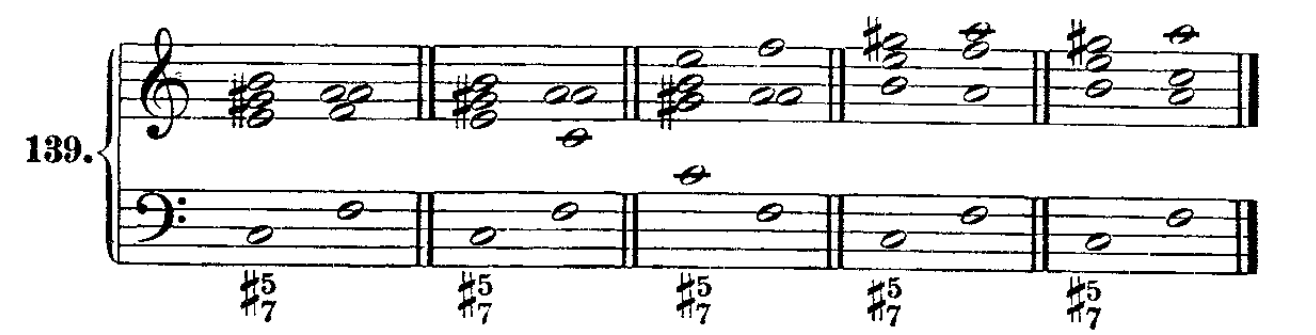
Still, this chord and its inversions are but rarely employed, as the preparation of the dissonances is generally fraught with much difficulty.
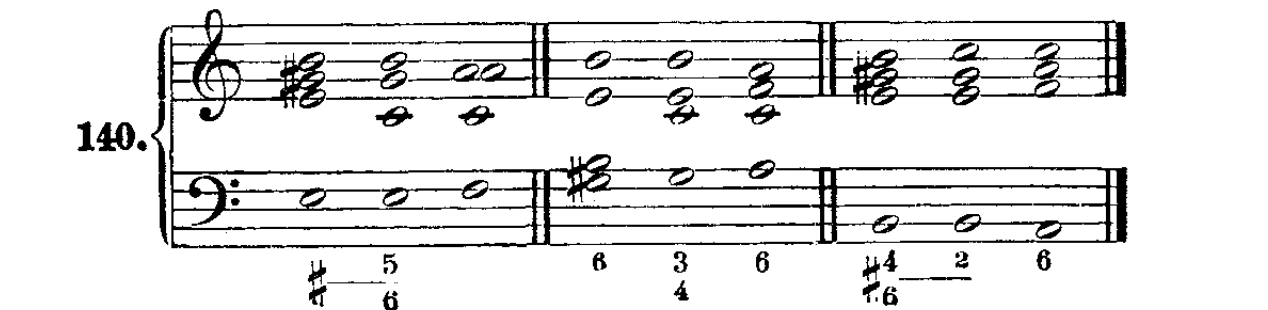
1V. The chord of the seventh on the 4-th degree is commonly resolved into the chord of the diminished seventh, and not into the triad, in order, firstly, that the third should not make the steps of the augmented second, and that, secondly, when the third resolves downwards, the doubling of the fundamental (at the same time leading-tone) of the augmented triad should be avoided 141. Resolution into the triad — Resol. into the Sev. chord. —H- G
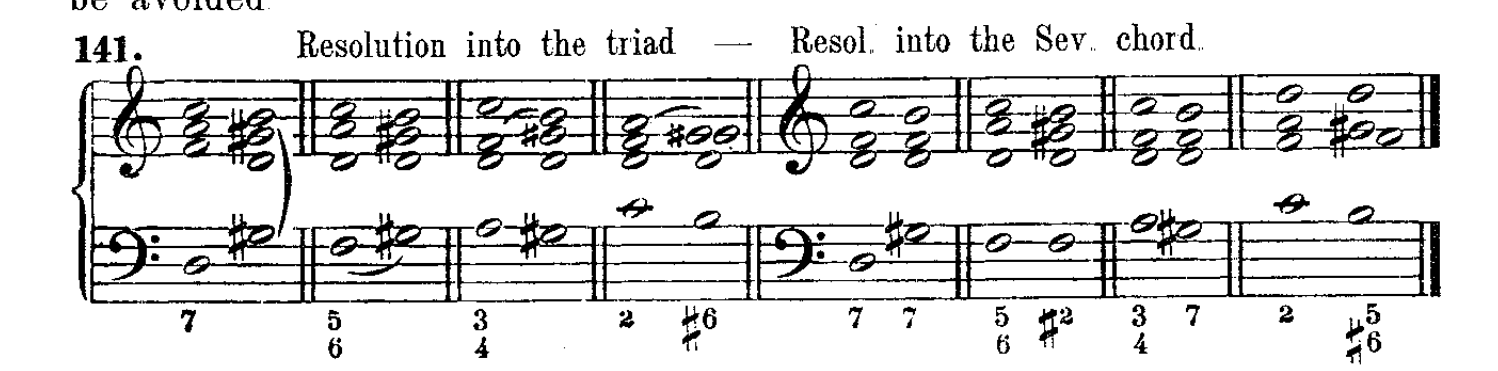
V. The chord of the seventh on the 6-th degree is likewise best resolved into the seventh-chord and not into the triad of the 2-nd deguee.
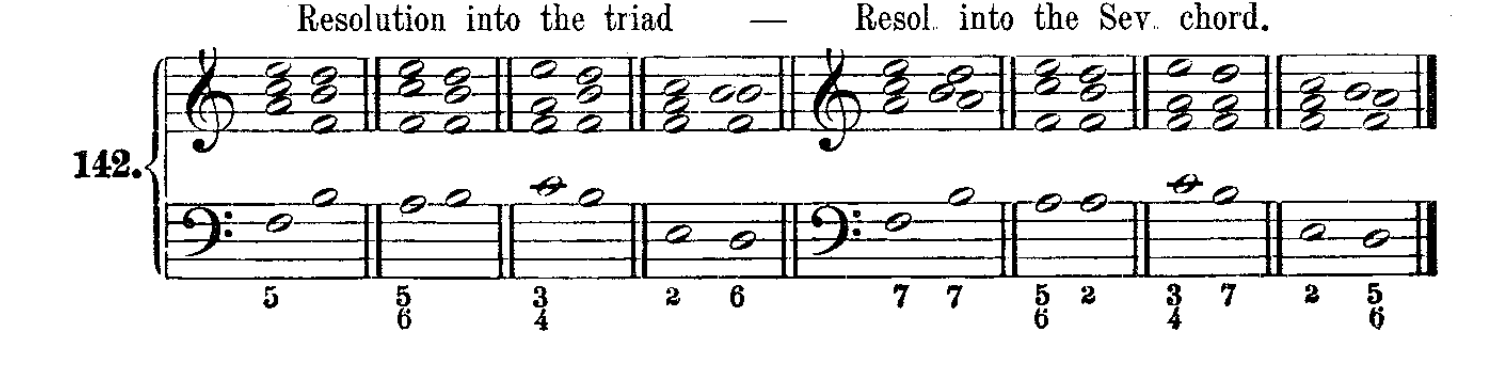
Resolution into the triad — Resol. into the Sev. chord.
it Tt It —_ If jail; 7 2 5
VI. The chord of the seventh on the 7-th degree is not used in the character of a sequerice chord, as its resolution into the harmonies of the 3-rd degree presents many difficulties. 7
We learn from the aforesaid, that a complete sequence in minor is not practicable. We can construct merely fragments of such a sequence, consisting of the chords on the 6-th, 2-nd and 5-th—or of the chords on the 4-th and 7-th degrees.