 Playable Books
Pyotr Ilyich Tchaikovsky · section 22 of 36
Chapter XX. Harmonization of given melodies with modulations
Read and hear this section in the playable edition →§ 60. When, in a given melody, notes occur with accidentals foreign to the key, we infer that at such points the melody modulates into some other key. What key this shall be, is determined by different circumstances. If we regard the note with the accidental as one of the intervals of the Dominantseventh chord or some other modulating chord, we must, in choosing such a chord, see that the next note of the melody allows of its proper resolution. The choice of the chord is further conditioned by its distance from the main key.
In mere musical fragments, such as constitute the exercises of this textbook, modulations to remote keys should be avoided.
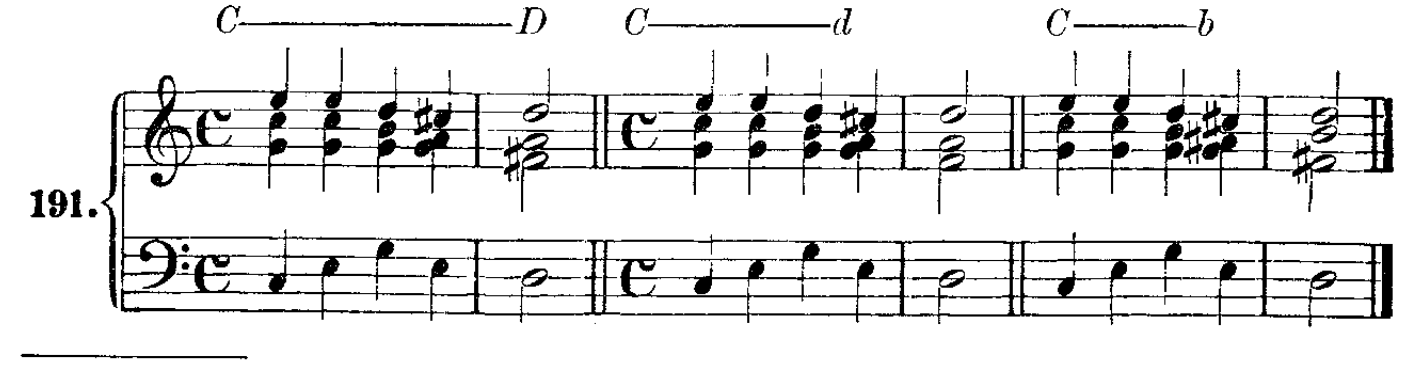
The trend of the melody itself also determines, in a measure, the choice of the modulation. If, for instance, in a melody in C major we meet with ac sharp, followed by d,—into what key would it be best to modulate? The note ¢ sharp, coming, as it does, before d, gives us the choice between three different modulations: those into d major d minor and b minor.
*) To these should be added the chain of Dominant triads.
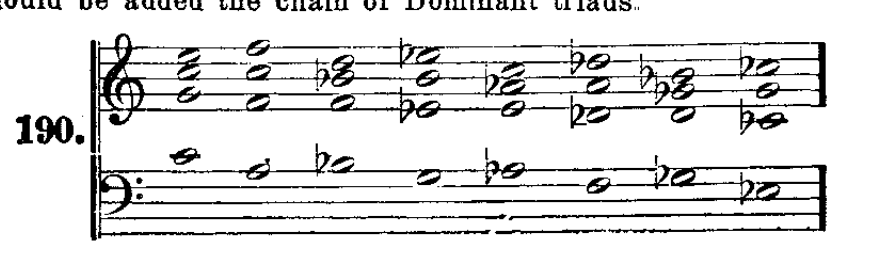
The second of those keys lies nearest, the d minor triad occurring in the key of c major. Nevertheless, we may choose either of the other two keys, provided the further tendency of the melody justifies its application.

In the first case we would have to modulate to d minor, in the second to d major, and in the third to b minor.
When, however, the melody gives no hint as to the choice of any certain key, we must follow the dictates of our musical instinct. In the following example the modulation to G is just as proper as that to E, seeing that both these keys are equally far removed from the given key.
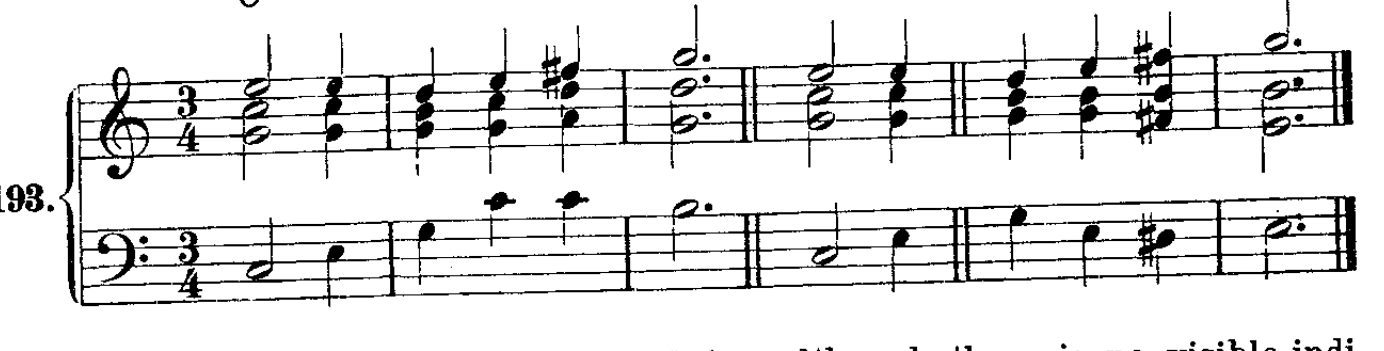
Sometimes a modulation is called for, although there is no visible indication of it.
In the 4-th bar of the following melody, for example, the note d causes us to feel, that the modulation to e minor is to be followed by one to G major.
Finally, modulations may occur, where the melody does not really demand them.
*) At this point we encounter a modulation to a minor, which is peculiar for the fact that the chord of the seventh on the 2-nd degree resolves into the Dominant seventh chord.

*) Whole notes in the melody by no means demand correspondingly long notes in the other voices. The quarter notes occurring in the above melody indicate that the same time-division would be appropriate in the first two bars, and that the prolonged note in the Soprano is to be regarded merely as a tone common to several chords.