 Playable Books
Pyotr Ilyich Tchaikovsky · section 31 of 36
Chapter XXIX. Strict Part-writing
Read and hear this section in the playable edition →§ 111. Suspensions, passing-notes and changing-notes greatly enhance the melodiousness of the voices; the simplest chord—-succession can, by means of these three attributes of voice-leading, be exalted to a high pitch of artistic and technical perfection. Nowhere is this perfection so thoroughly attained as in so-called strict part-writing He who can skilfully handle the scanty material, to which this mode of writing is restricted, may well consider himself a master of harmonization. The seemingly insignificant material of strict part-writing coupled with a highly-finished, melodious voice-leading, enables us. after having thoroughly mastered the principles of this mode of writing, to evolve the most beautiful harmonic forms.
We have said in a former chapter that strongly dissonant tone-combinations—as, for instance, the sequence chords and the augmented and diminished chords—are frequently of great value to the composer, in cases, where, by their very harshness, he is enabled to express certain characteristic moods; these dissonances, however, possess no such significance for the student, who, uninfluenced by any special ideas or aims, seeks absolute harmonic beauty. In this sense strict partwriting is an excellent school for the young composer, since it absolutely excludes dissonance in chords, and chromatic progression in melody, pursuing chiefly the practical aim of singableness and simple intonation
Just at this stage this strict mode of writing should prove beneficial to the student, serving as a sort of healthy contrast to the different morbid, unnatural, artificially derived harmonies, of which we have had a surfeit in the last chapters
§ 112. Strict part-writing is founded upon a consonating relation between the Bass and the other voices; consequently it admits only major and minor triads with their first inversions, and the chord of the sixth of the diminished triad. The fourth being regarded as a dissonance, chords of the sixth and fourth are excluded. The same is true of all dissonant chords with their inversions. The cadence consists of the Dominant triad or its first inversion (the chord of the sixth of the diminished triad is also used), and its resolution into the tonic triad; the cadence must be a perfect one, that is to say, the tonic triad must appear in octave position.
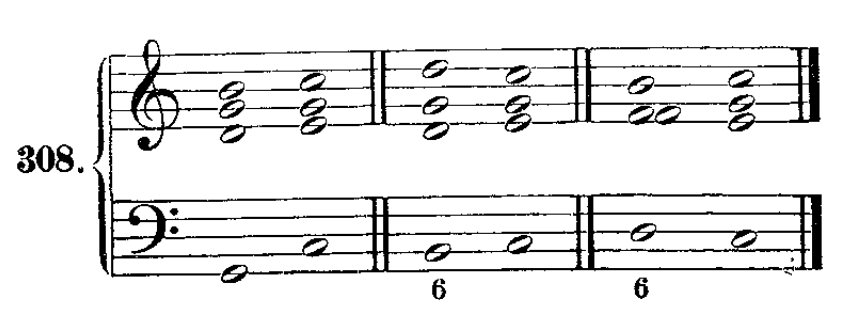
§ 113. Regarding the melodic progression of the voices the following should be observed: Strict part-writing admits, jumps of octaves, minor sixths,—pure fifths and fourths, major and minor thirds—jumps of major sixths are to be avoided. Jumps of dissonant intervals (seventh) are positively prohibited—even when the notes forming them belong to the diatonic scale; chromatic progressions are likewise forbidden.
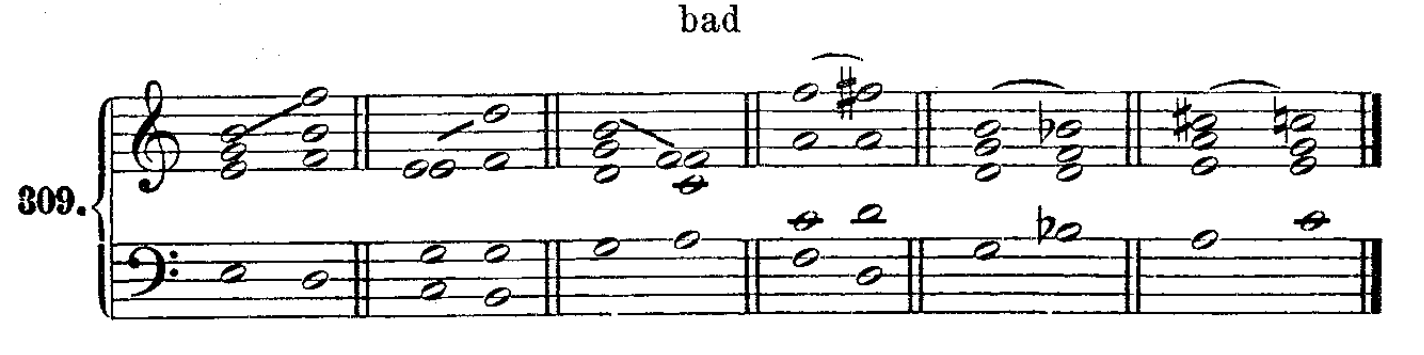
§ 114. The following parallel progressions are prohibited: fifths and octaves and major thirds, when progressing a major second. The last restriction dates back to olden times, when music was almost entirely confined to strict part-writing, and the augmented fourth (Zritonus) was the only known augmented interval. Not only the Tritonus and its inversion, but any melodic and harmonic progression similar in effect, was strictly prohibited.
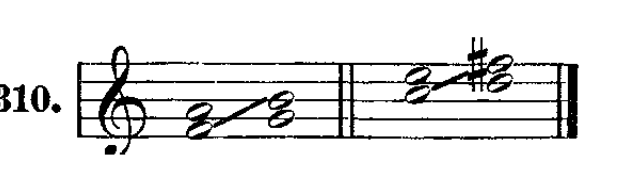
The parallel progression of two major thirds a haif-tone upwards was permitted, since it gave rise to no Tritonus, e. g.
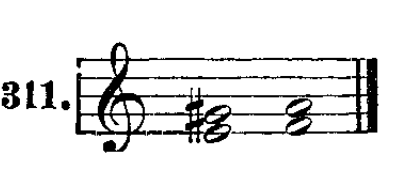
§ 115. Modulations into the nearest keys are permitted provided that chromatic progressions do not occur.
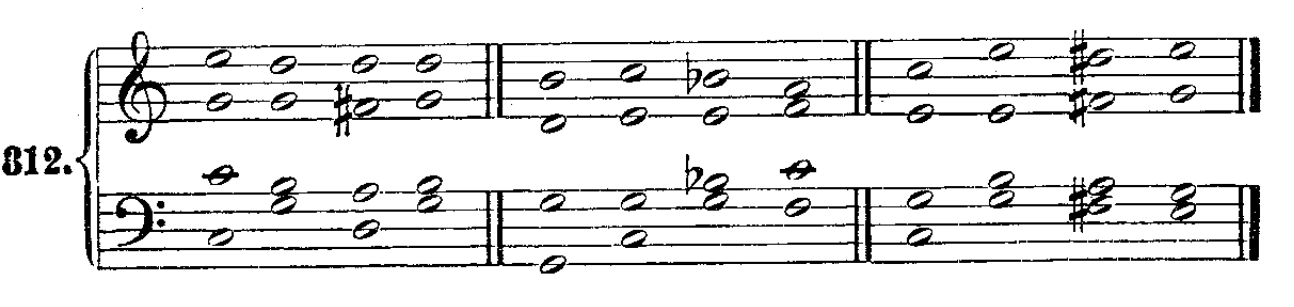
§ 116. From minor we may freely pass into the parallel major key, a modulation not being necessary; chromatic progressions are. however, to be avoided. In like manner parallel minor harmonies are permitted in major.
§ 117. For the sake of greater freedom in the voice-leading the parts, may cross, that is to say, deviate from their normal relative position and adopt, for the time being, the inverse relation.
§ 118. From what has been said, we conclude that in strict part-writing natural intervals, that is, progressions by steps and consonant jumps are considered most singable and simple for the human voice to intonate.
Harmonic intricacies must give place to purety of intonation.
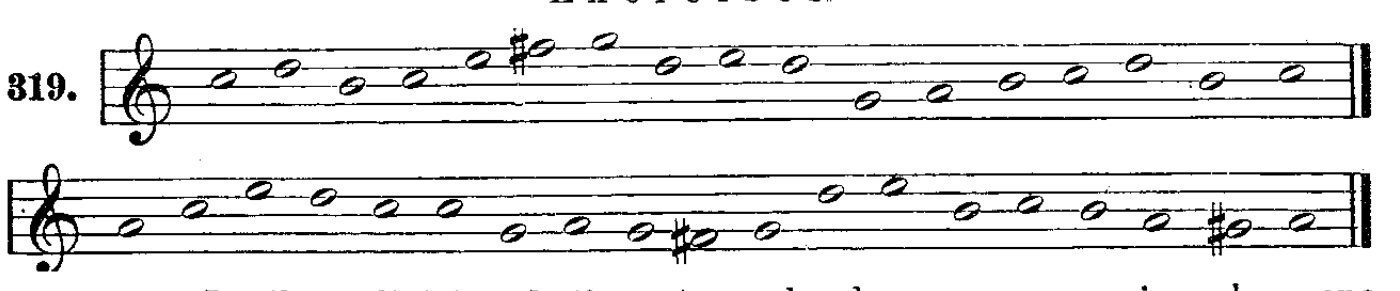
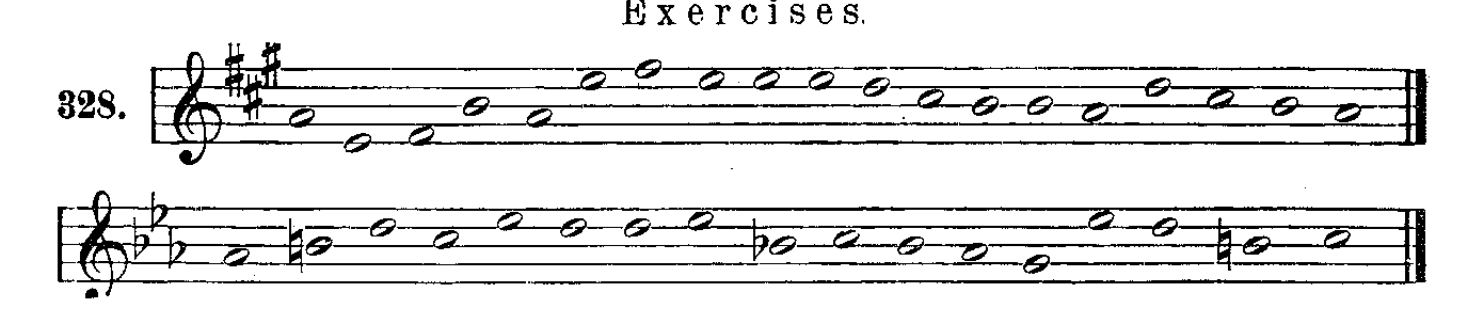
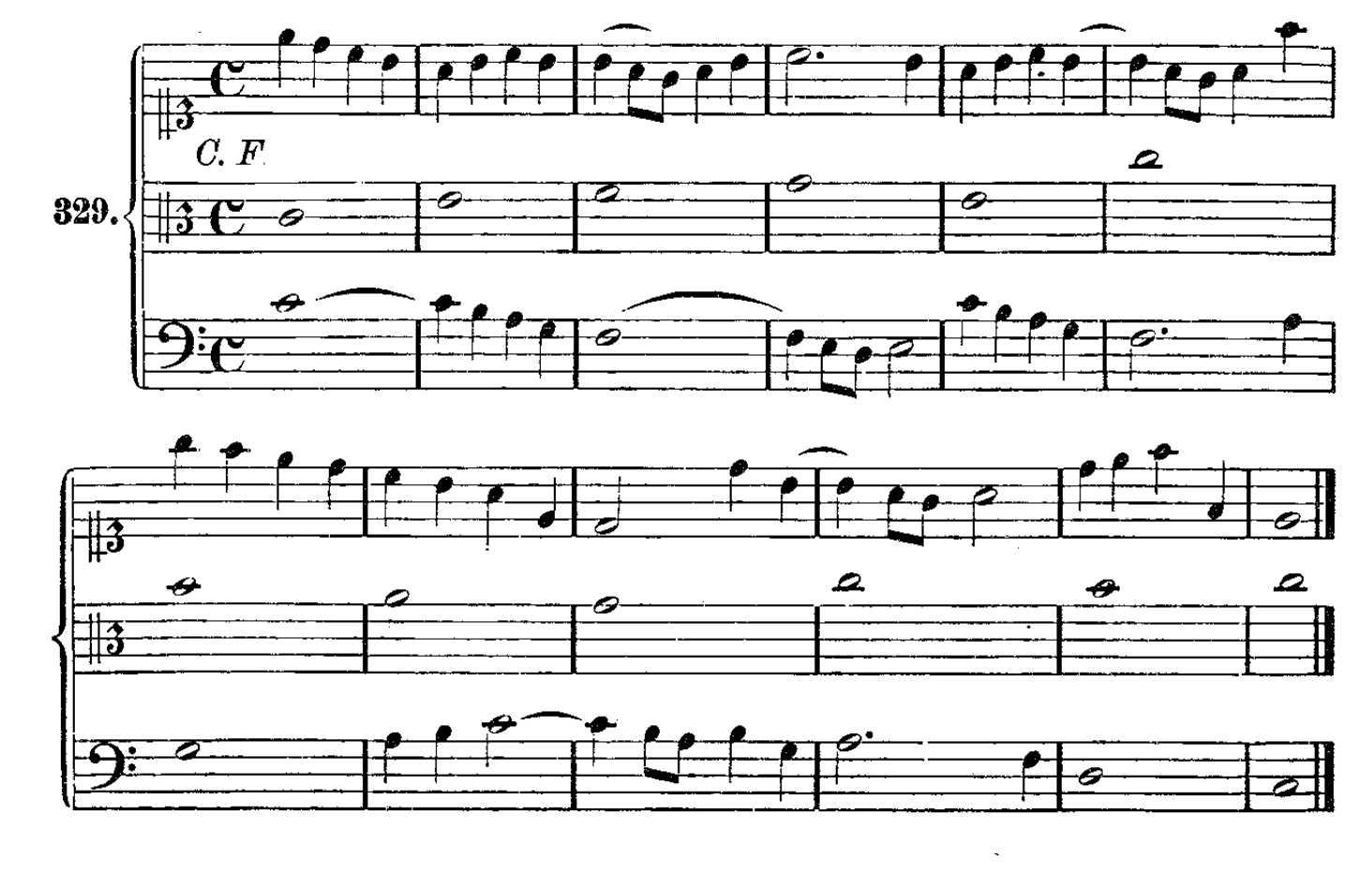
§ 119. In our exercises we shall employ the Cantus firmus, which, being a melody of whole notes, can easily be transposed into any other voice. We will at first harmonize this melody in whole notes, writing each voice in its respective clef, and on a separate staff.
Note. No voice must exceed its proper limits.
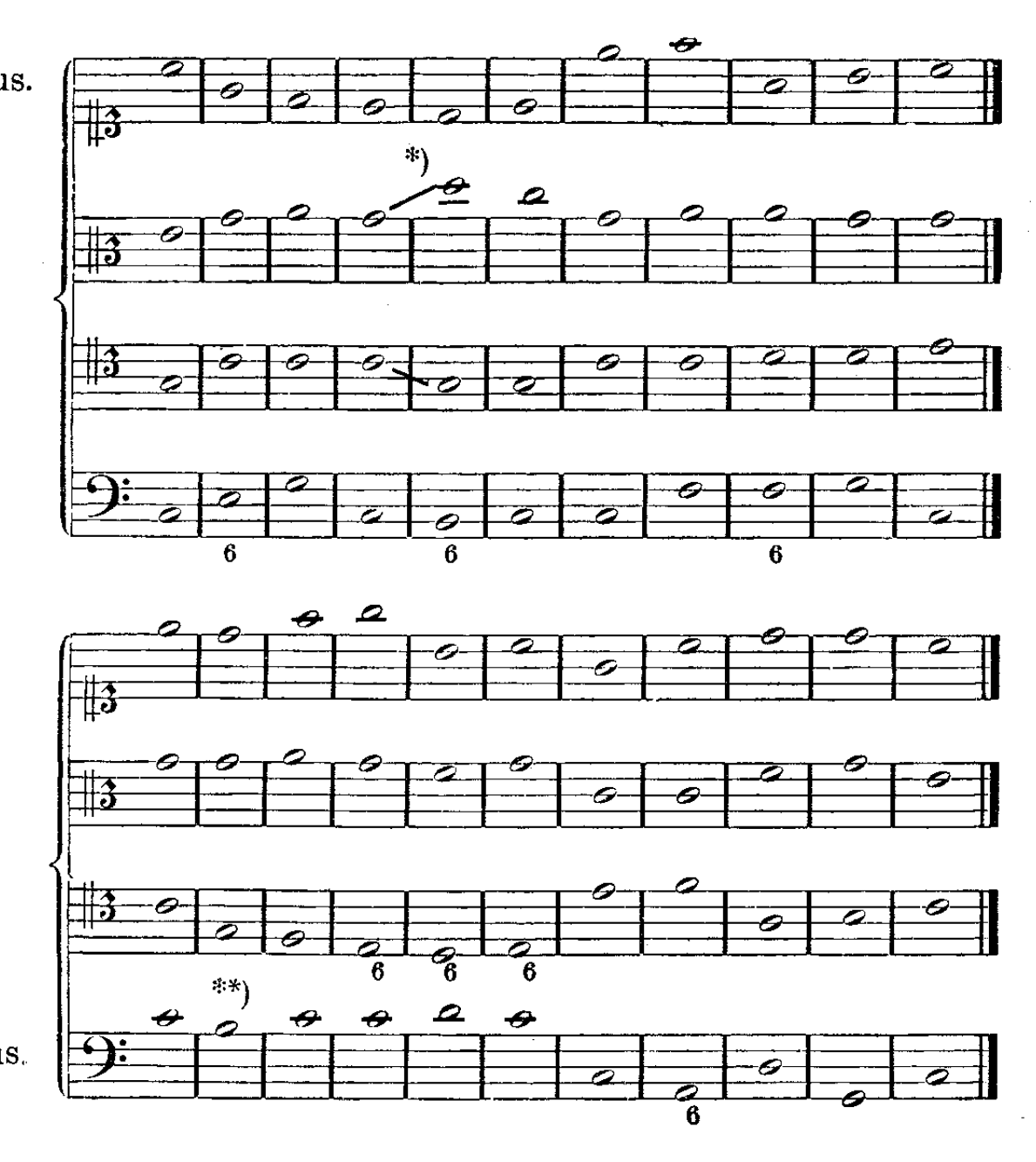
Exercise. Harmonize the following melodies, considering them as cantus firmus successively in each voice.
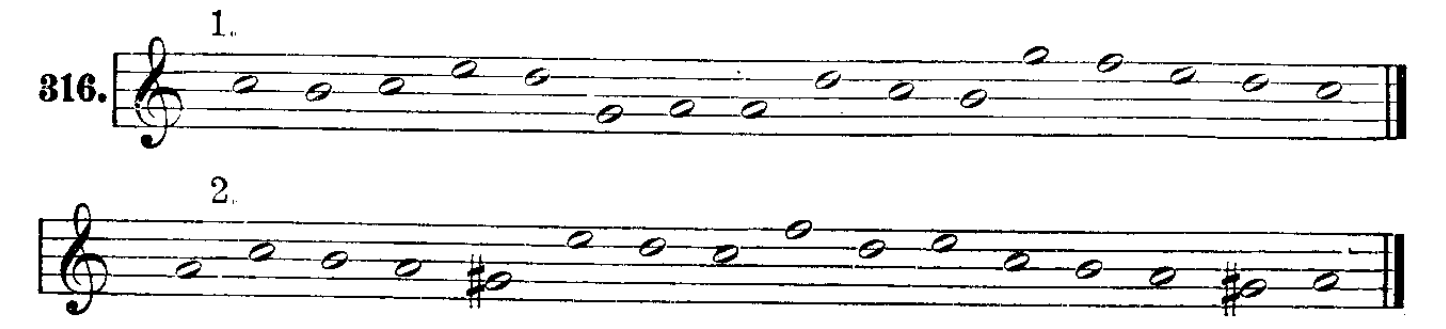
Note. In transposing the cantus firmus into another voice, we can employ some other key better suited to the limits of the voice in question.
§ 120. Whole notes can be split up into half notes, 1) when two different chords are to appear in the bar, 2) in consequence of suspensions, pas-
*) Fifths and octaves are permitted in the inner voices, if contrary motion be employed. **) At this point the Tenor lies below the Bass, and assumes, for the time being, the significance of the latter voice, sing and changing notes. Suspensions from above downward must be prepared and resolved according to rule. Only diatonic passing—and_ changingnotes can be employed. The 7-th degree in minor is not raised when it is a passing note.
rary 2 2. eo f a oS a.
Note. Octaves and Fifths on two similarly accented beats are regarded as faulty open progressions.
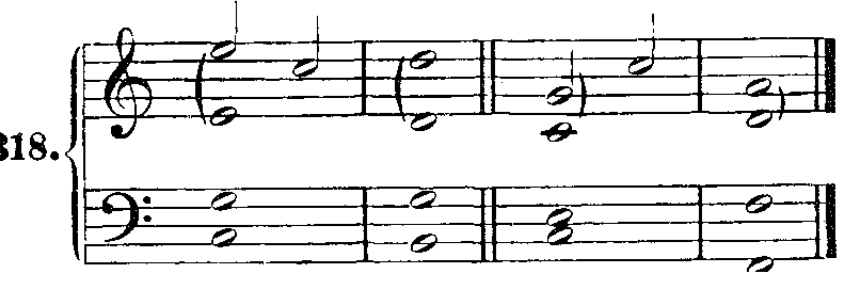
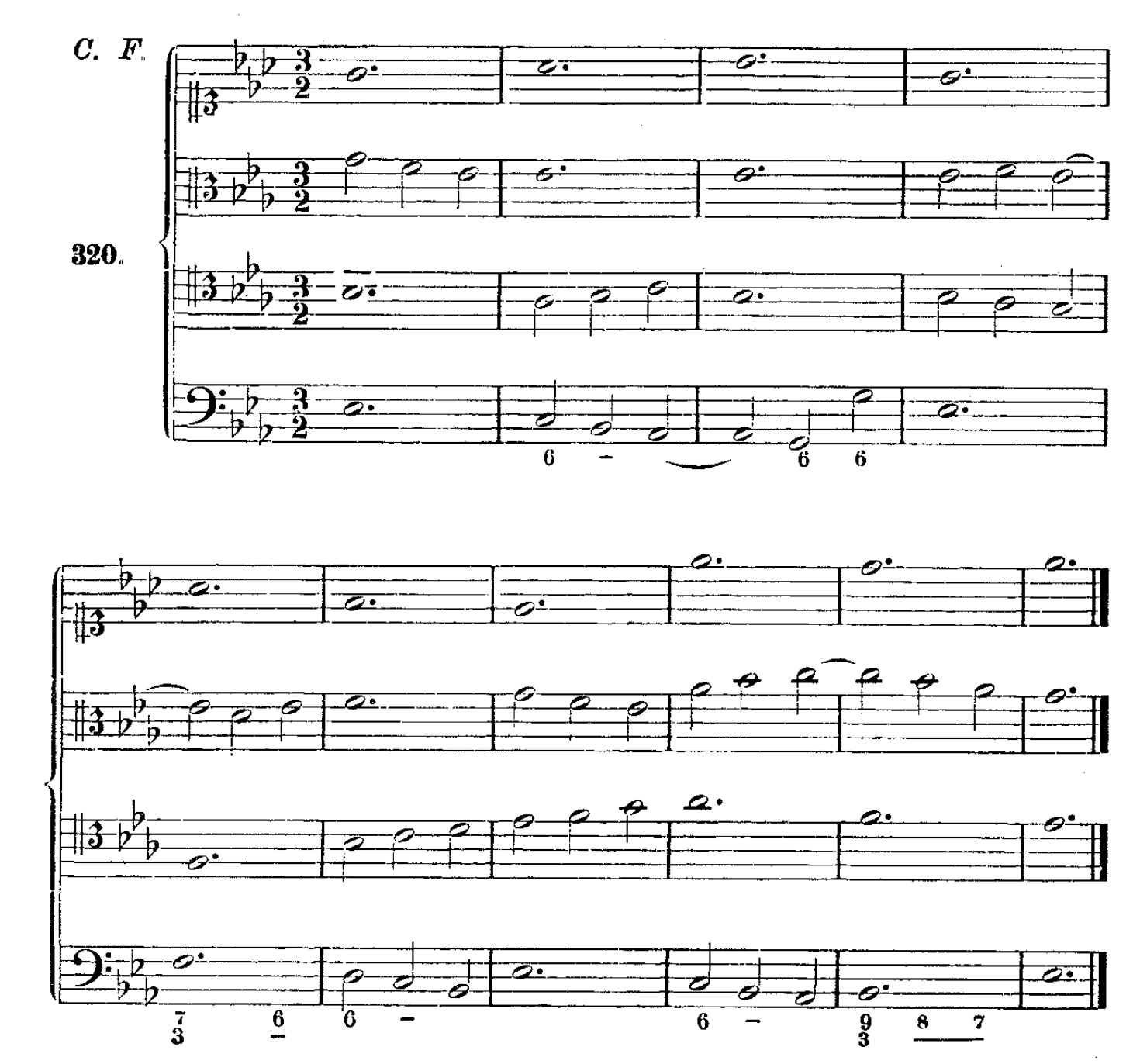
§ 121. In three-divisioned time two chords can appear in a bar, one on the accented part of the measure and the other on the second unaccented
*) The exceptions to the rule governing the resolution of suspensions, as given in § 77-3, are also permissible in strict part writing beat; on the first unaccented beat can appear only the resolution of a suspension, if there be one, or passing—or changing notes—no actual chord must occupy this beat. ~
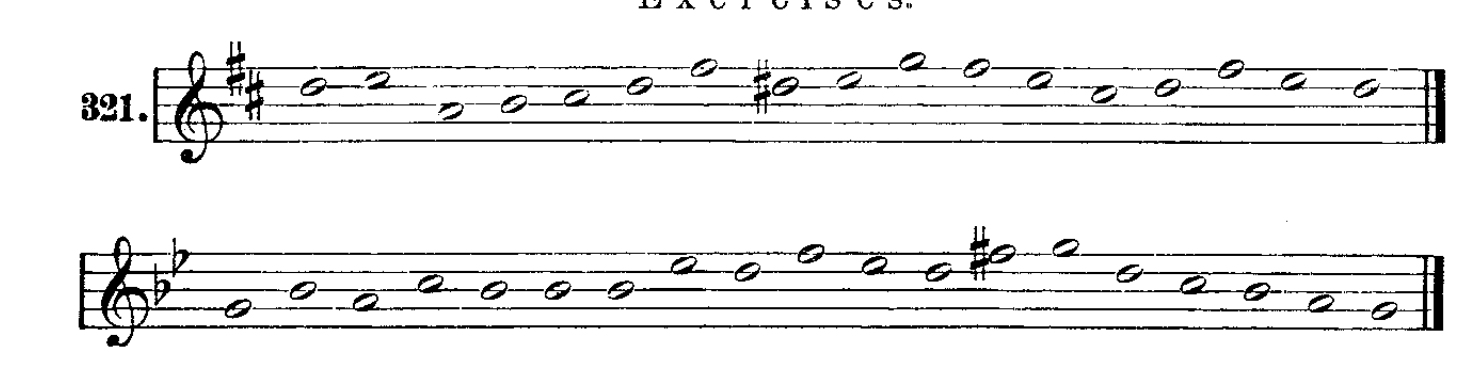
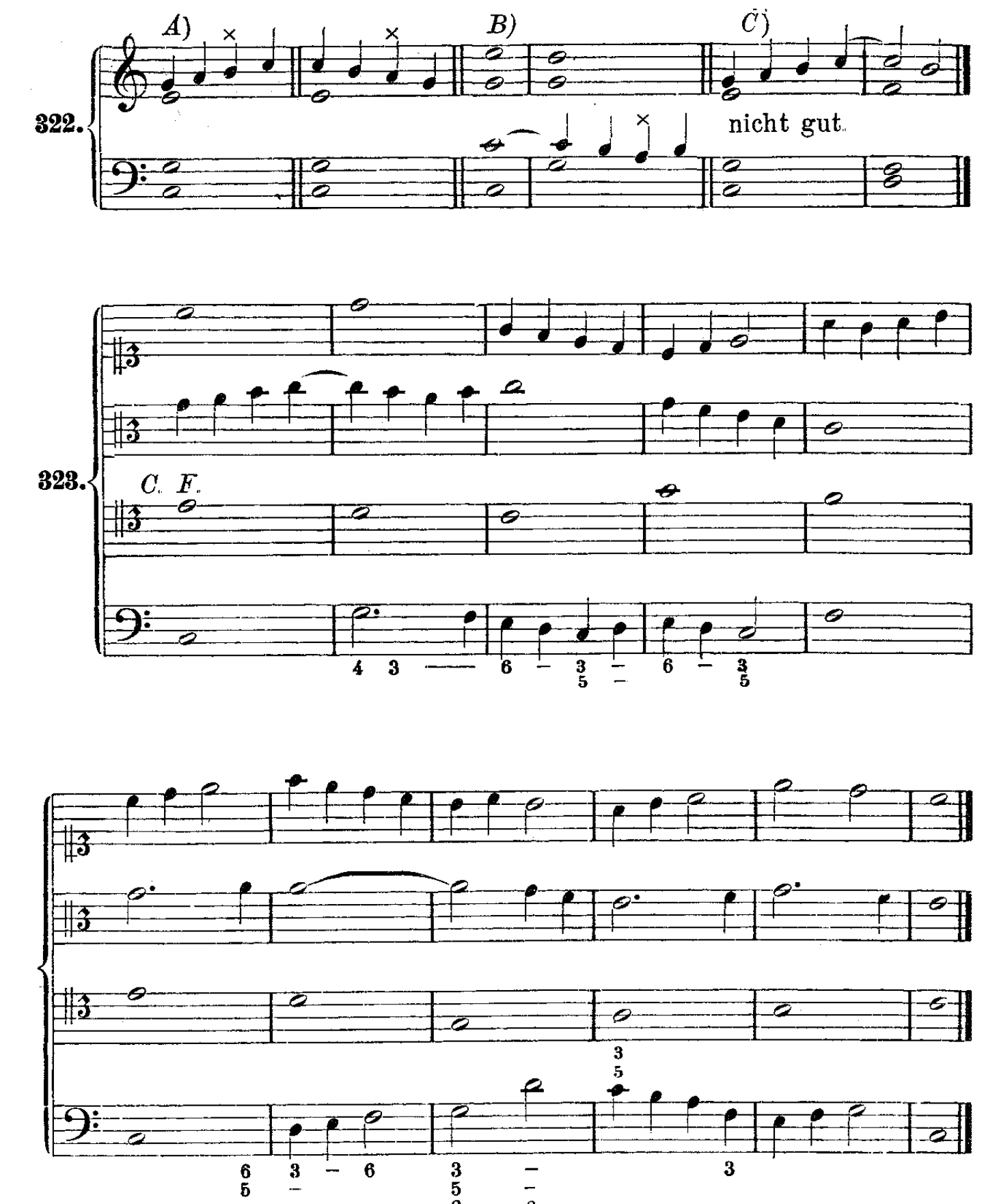
§ 122. In four-divisioned time the second accented part of the measure can be occupied*by an actual chord or a suspension; the unaccented beats. are devoted to the resolutions of suspensions, and to passing — and changing notes.
Of the two passing-notes, which fill out the interval of a fourth, the second may fall on the second accented part of the measure (A). On this beat may also fall a changing-note following the resolution of a suspension (8). The preparation of a suspension must never be of shorter duration than the suspension itself.
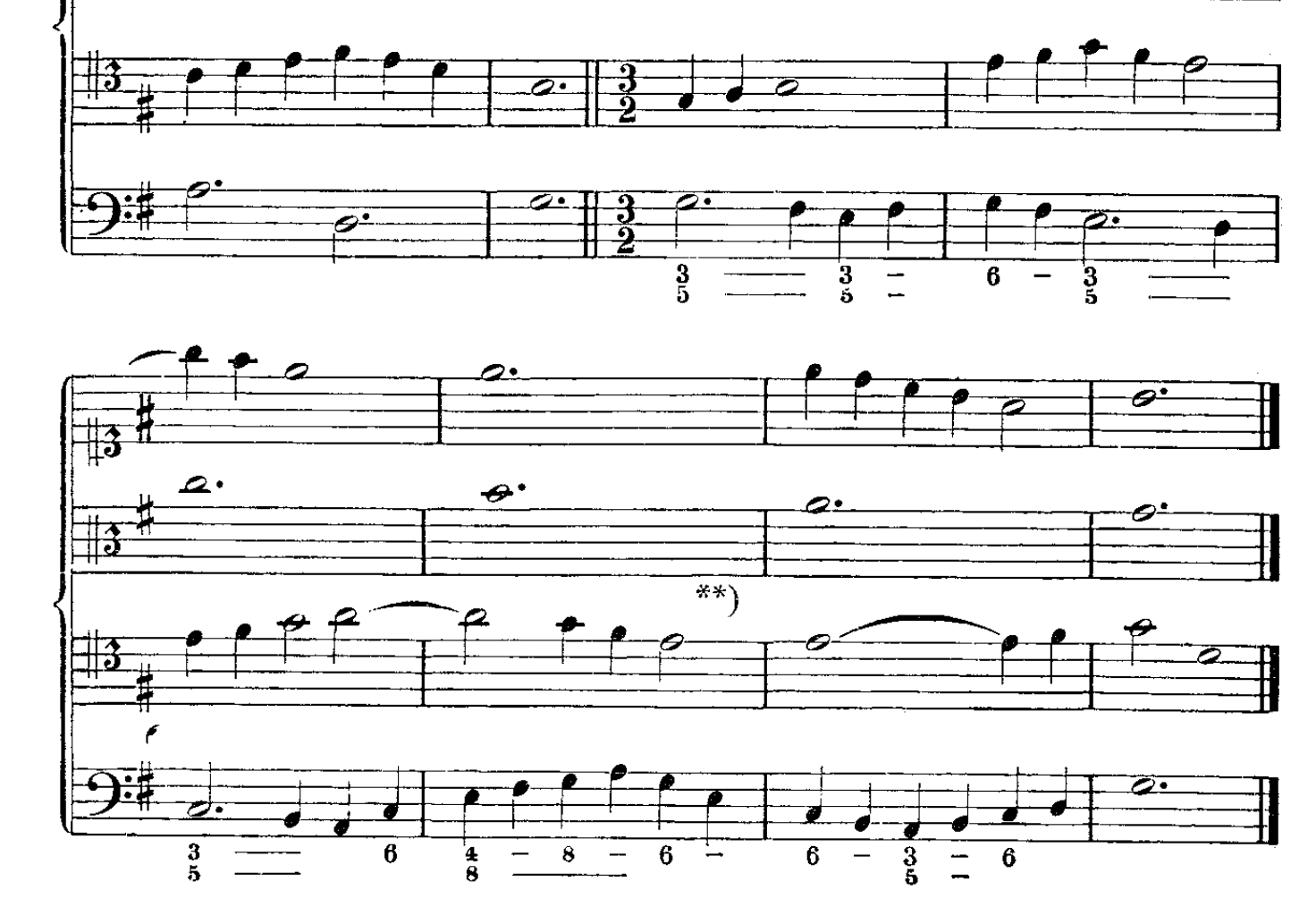
In six-divisioned time two cases are to be distinguished: the six-quarter measure and the three—half measure. In the first we have two accented beats, the one and the four; in the second. however, there appear three accented beats, one, three and five. The six-quarter measure should be regarded as consisting of two three—quarter measures: the three-half measure, as being made up of three two—quarter measures. In the latter measure the third and fifth quarters may be taken up by passing-notes, as in the case of the second accented beat in four-divisioned time. A changing-note can, again, fall on the third quarter, provided it is preceded by the resolution of a suspension. A suspended half-note can occur only at the beginning of a bar; suspended quarter-notes can fall also on the third and fifth quarters.
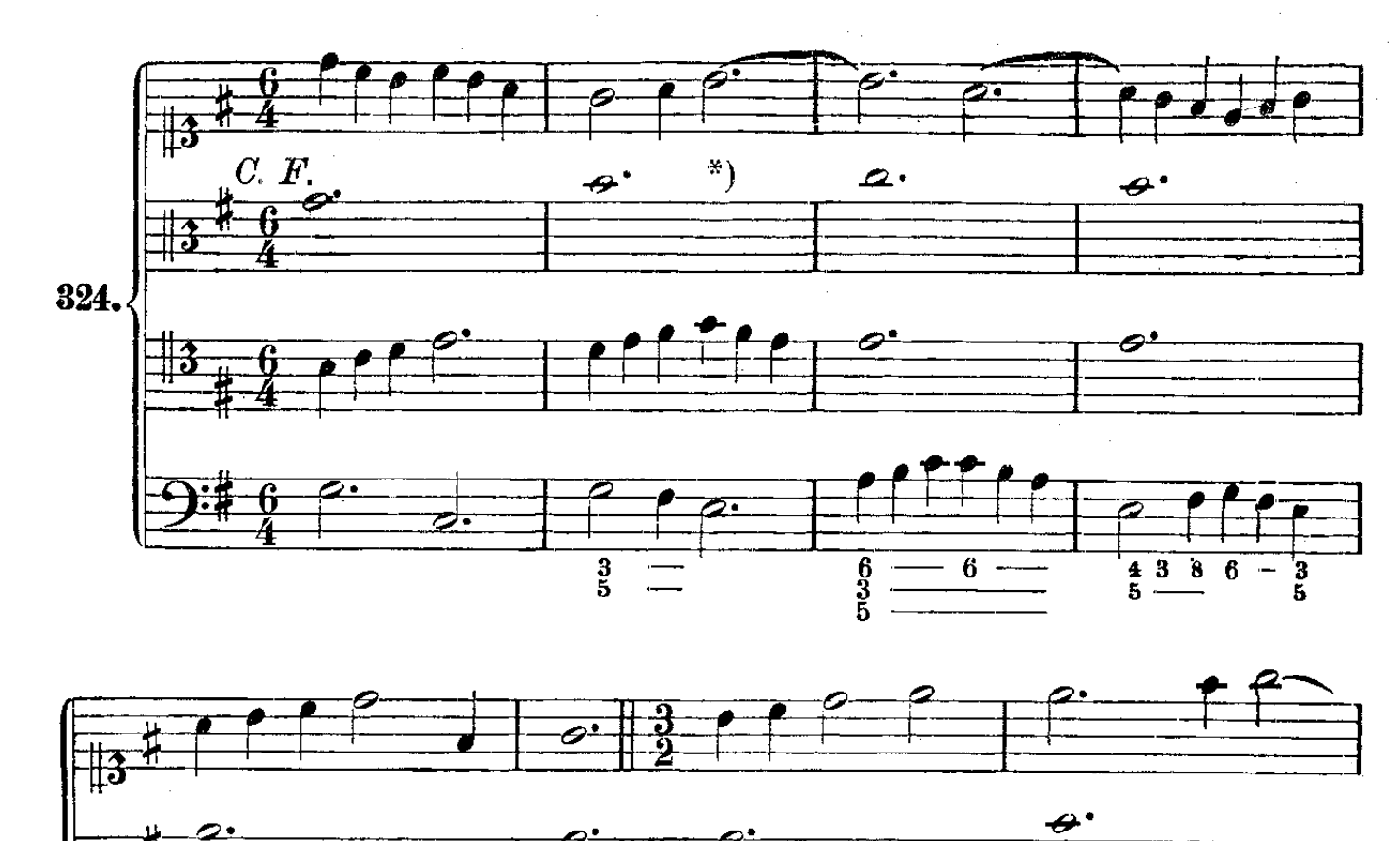
*) On unaccented beat the third of the triad may be omitted.
**) Here again the third of the triad is omitted on an unaccented beat.
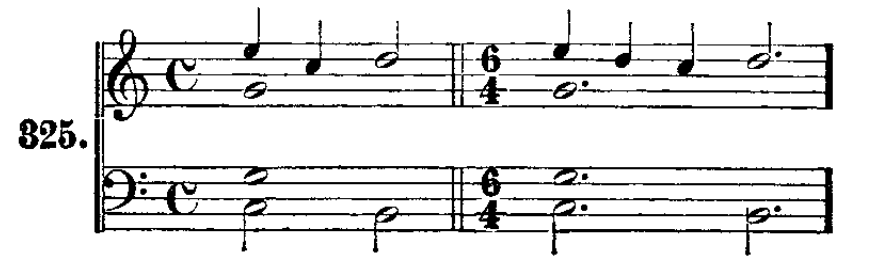
§ 123. Eighth-notes occur in strict writing only in one case where a suspension on the first accented beat is followed b and the changing-note below, on the first unaccented part of the measure.
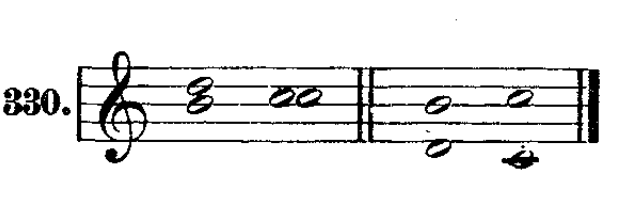
§ 124. In three-voiced strict writing we find either complete triads or triads with fifth omitted; in the latter the third is generally doubled. In the cadence the tonic triad can appear with third omitted.
In two-voiced writing the accented beats must be occupied by consonances, perfect or imperfect. The cadence consists either of a third whose intervals resolve by steps into the tonic prime, or of a sixth resolvinginto the tonic octave.
Dissonances can occur, on accented beats, only in consequence of suspensions; on unaccented beats, as a result of passing—or changing-notes.
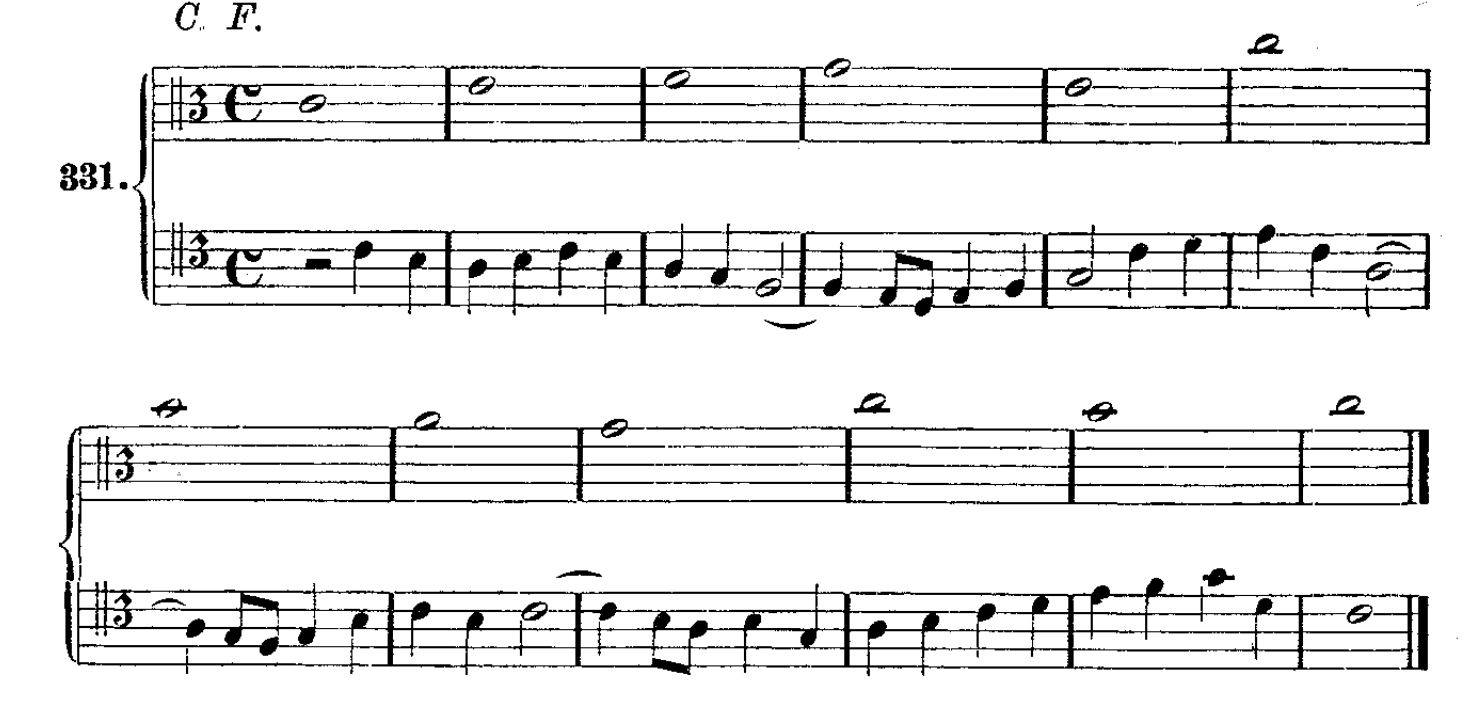
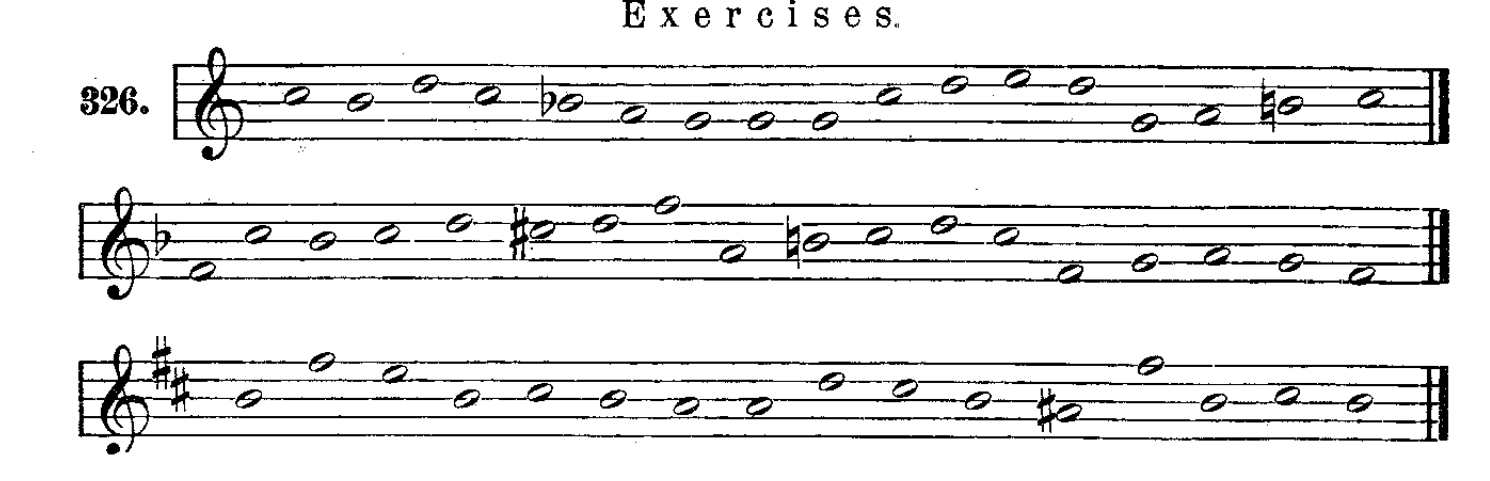
Exercise. Harmonize in two and three voices a cantus firmus out of ene of the preceding exercises.
§ 125. Having mastered the principles of two and three-voiced writing, we are in a position, when employing many voices, to avail ourselves from time to time of a pause in some voice. Such a pause in a voice can, however, set in only immediately after an accented beat.
Model of five-voiced writing:
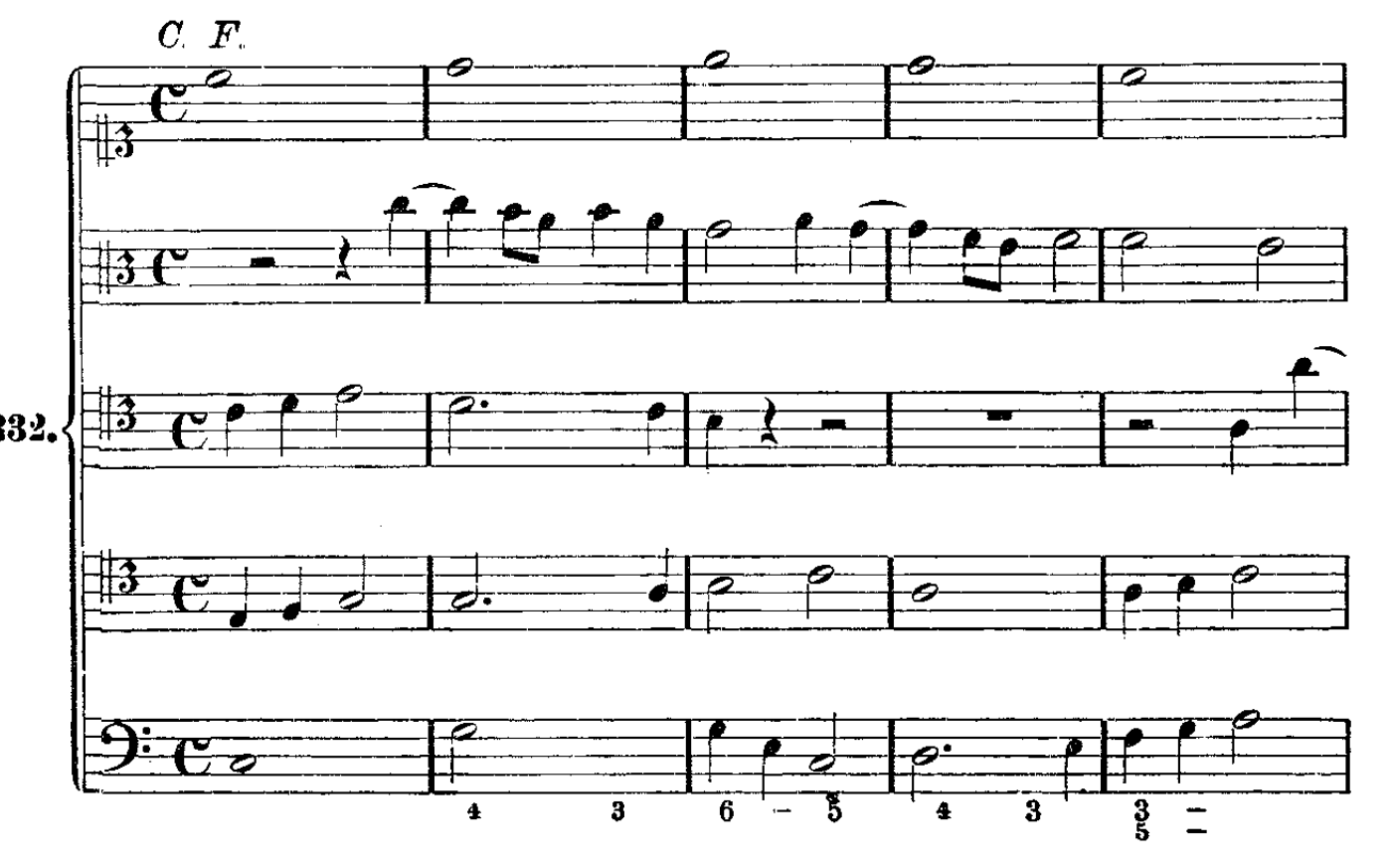
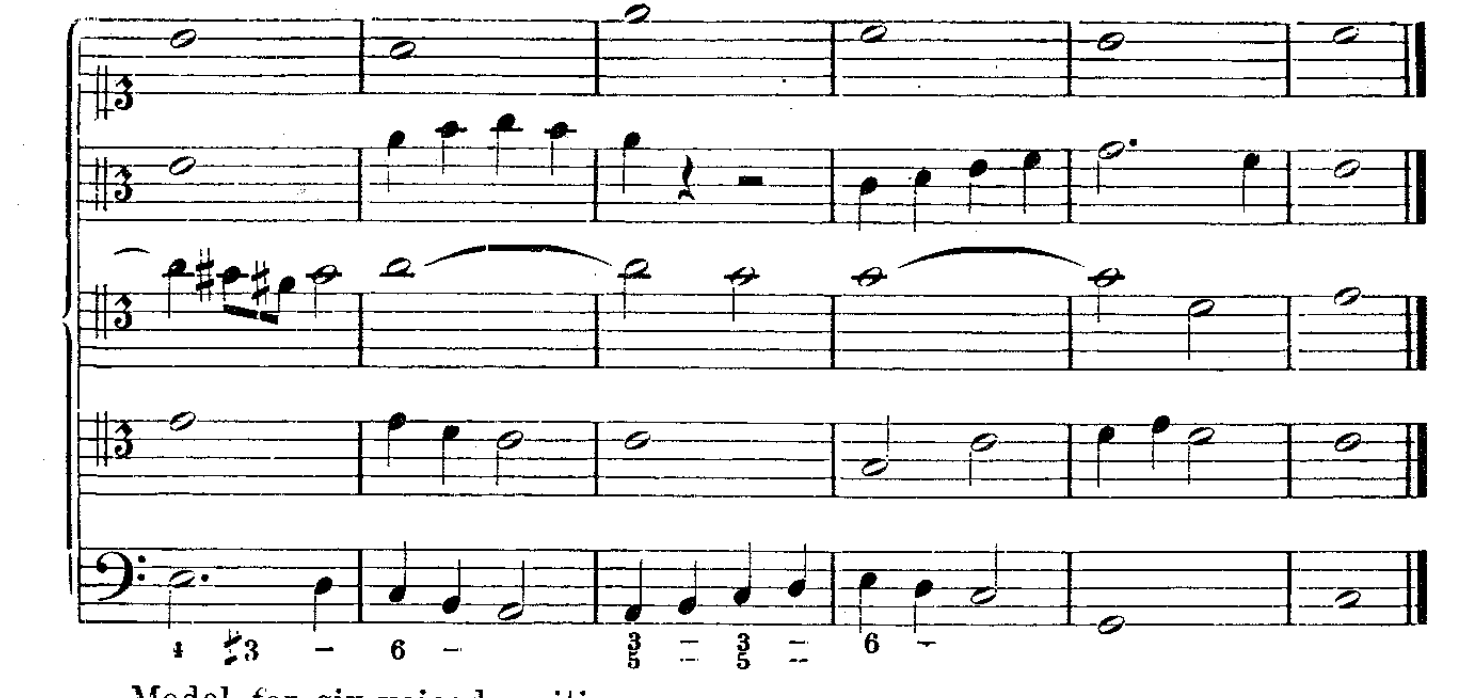
Model for s
Exercises. Harmonize several of the foregoing ©. f. ’s in five and sixvoices,