 Playable Books
Pyotr Ilyich Tchaikovsky · section 30 of 36
Chapter XXVIII. Changing-notes
Read and hear this section in the playable edition →

§ 107. Changing notes fall on relatively unaccented beats, similarly to two identical harmonic notes. Every note of the chord has two changingnotes, one above and the other below.
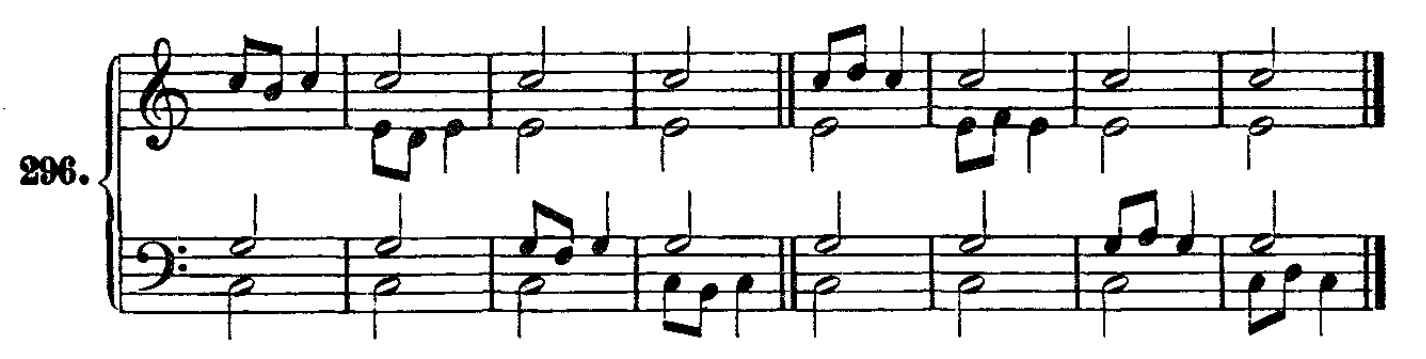
A changing-note that is separated from its harmonic-note by a major second, may be moved closer to the harmonic note by means of an accidental. This is usually the case with the lower changing-notes; the upper changing-notes remain diatonic.
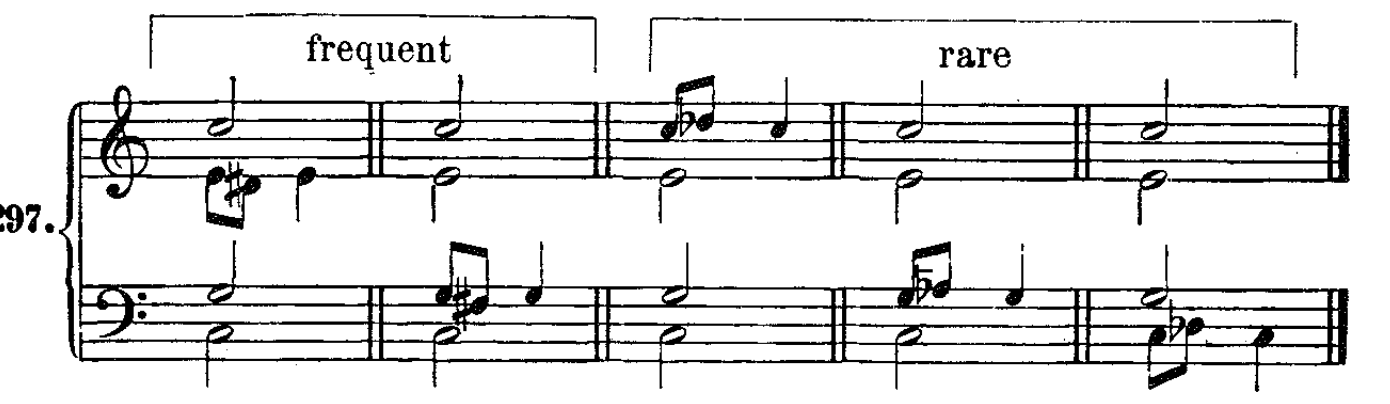
Changing-notes occurring in two voices at the same time can move either in parallel or in contrary motion. Parallel changing-notes, while having an agreeable effect, are used less frequently than those in contrary motion; the latter, though by no means always consonating, are extensively used, and, if the dissonances they form are not too harsh, contribute in a great measure to the beauty of the harmony.
Note. The figuring of changing-notes is similar to that of passing-notes (vide: note of § 86).
§ 108. By means of passing-notes and changing-notes we are enabled, while leaving the skeleton inviolate, to divide up the harmony into fragments more or less minute. thus lending the whole melodic and rythmical variety, A copious use of passing—and changing-notes in a piece constitutes melodic figuration, e. g.:
Note. Where crosses appear, passing—and changing-notes occur simultaneously, _
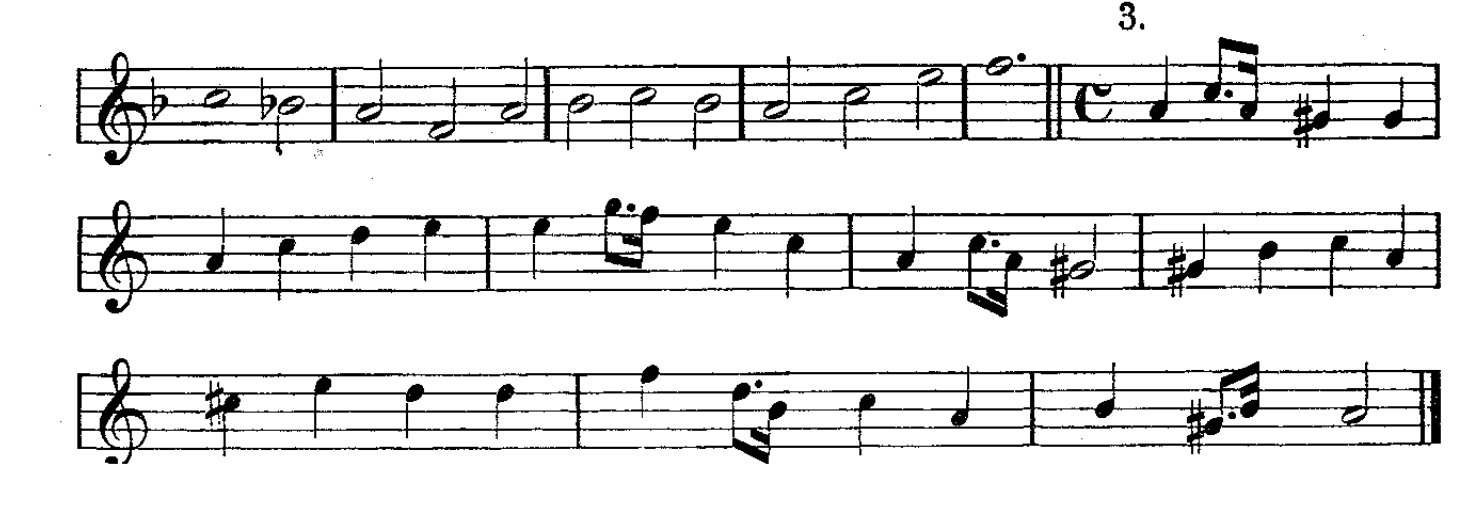
Exercise. In the harmonization of the following melodies seek appropriately to employ passing—and changing notes.

§ 109. In practice changing-notes occur, deviating from the general rules, as follows:
a) changing-notes entering by a skip,
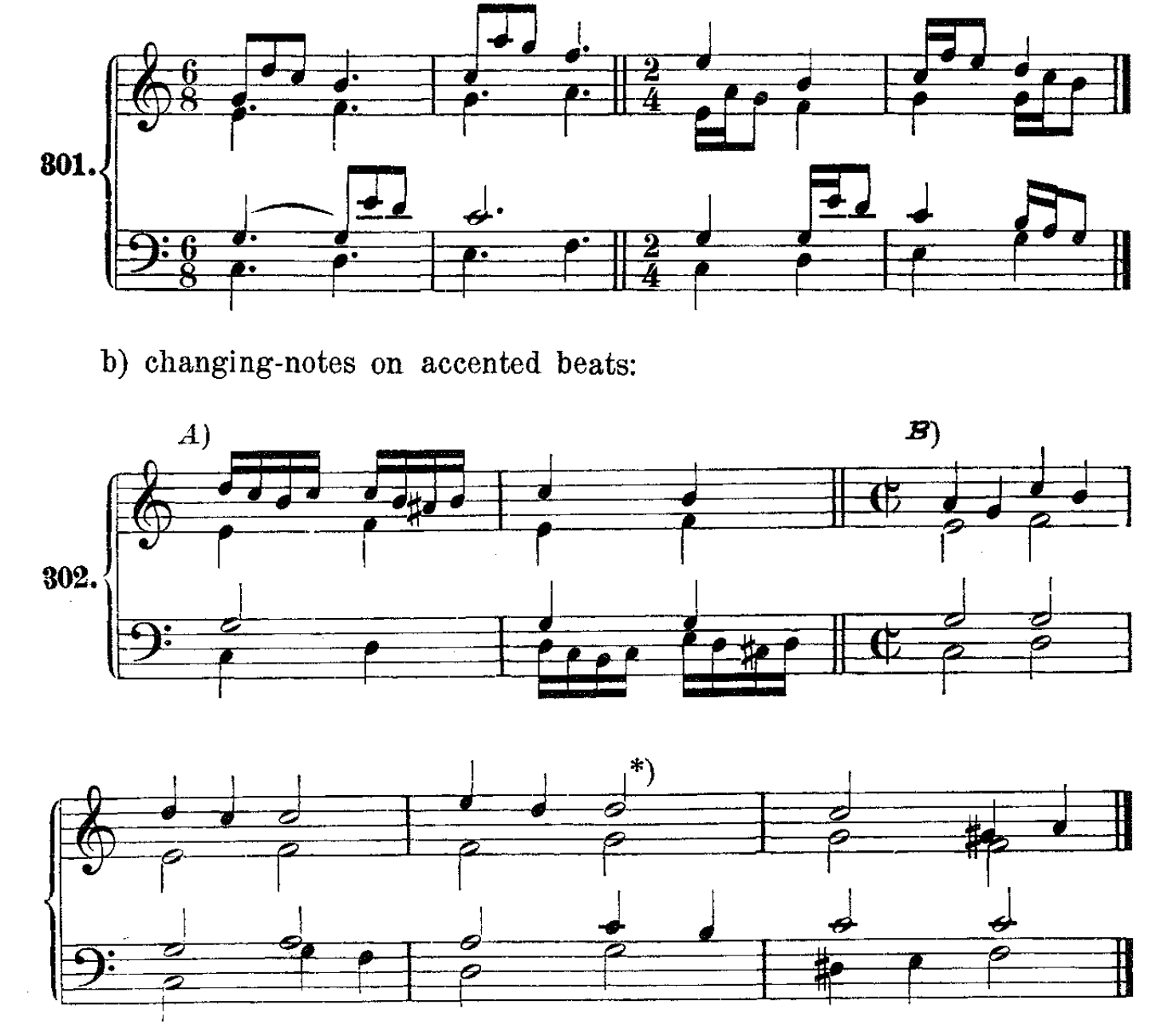
These changing-notes savor of the suspension, prepared as in A, unprepared as in B. _ ¢) Two changing-notes occurring in close succession, both either on accented beat, or on unaccented beat:.
*) At the entrance of the fourth bar we see a cross relation bet~veen Soprano and Bass, and a little further on one between Alto and Soprano; these cross relations are’ by no means unpleasant, since they are not formed by two harmonic notes. The d sharp in the Bass and the g sharp in the Soprano are merely changing notes entering by a skip.
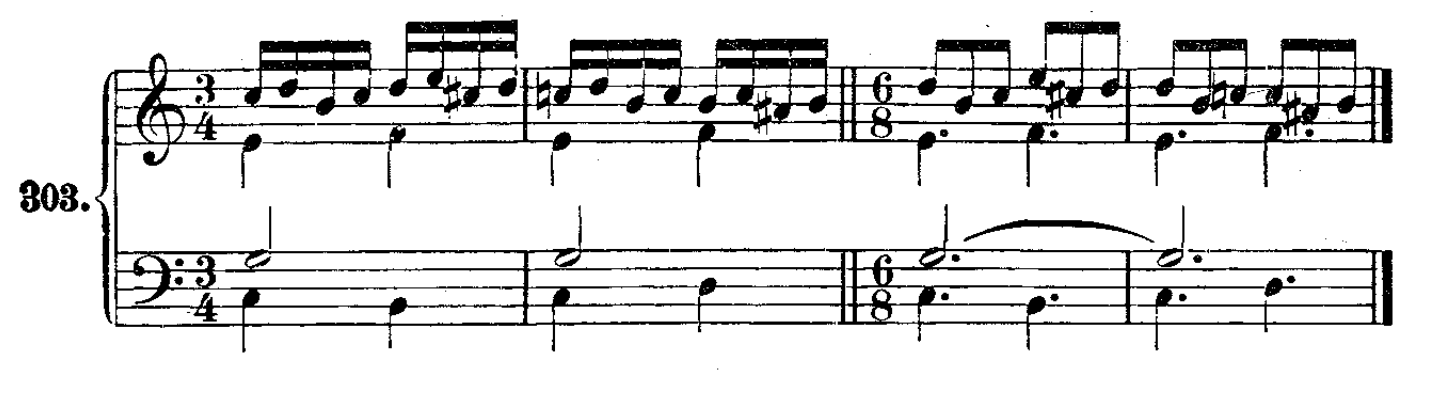
d) Changing-notes are often found after a suspension, sometimes even before its resolution.
Here again we would advise the student not to indulge a systematic use of exceptional forms; if, in his more advanced studies, he should feel the desire to apply his knowledge of such forms, he is at liberty to do so.
§ 110. In closing this chapter we will consider briefly those accidental harmonic formations that have the appearance of chords. They arise on unaccented beats, when one or more voices progress in steps from chord to chord; that is, in consequence of passing or changing notes. These seeming chords can easily be distinguished from real chords by their irregular resolution, the accidental way, in which they enter, and the absence of rythmic accent.
In the following examples these accidental chords are indicated by crosses.
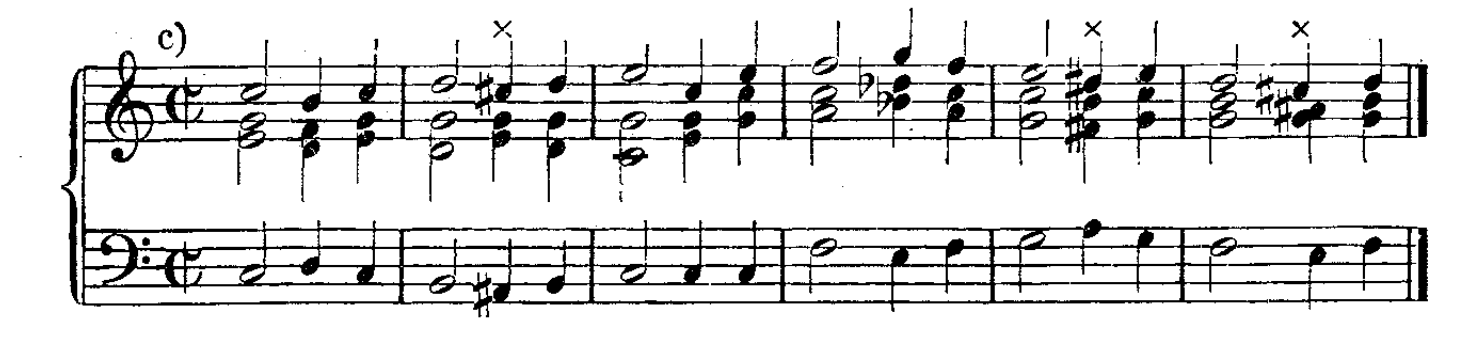
In the following example, in which the four voices are arrayed in two groups moving in contrary motion to each-other, we find these,seeming“ chords on accented beats.
In the last example the progression in steps of all the voices justifies tone-combinations which bear not the slightest resemblance to chords. (vide: NB). Our musical instinct must aid us in determining the harmonic framework of such tone-structures; the harmonic components of example e) are about as follows:
In this same example the chord of the six-four appears ——| several times as a passing—chord.
The melodic development of the voices.