 Playable Books
Pyotr Ilyich Tchaikovsky · section 32 of 36
Chapter XXX. The further development of Voice-leading
Read and hear this section in the playable edition →Having now, in strict part-writing, learned the art, melodically to round off and perfect the voices, we can return to freer harmonic forms: all possible chord-combinations are again at our disposal, provided the elegance and fluency of the movement be not impaired, and the inordinate desire of certain chord-effects do not gain the upper hand. Strict writing is really nothing more than an excellent school; there is after all no necessity for confining ourselves to its extremely narrow limits, when so many other interesting harmonic combinations are clamoring for use. In our remaining exercises we will therefore completely reinstate all the old harmonic forms, taking care, however, not to violate the principles of melodious voice-leading. Simplicity and naturalness shall always be our aim; bold, far-fetched complications shall invariably be avoided.
Surely the student should now be competent to distinguish between harmonies that can be unreservedly employed, and those whose use is limited to certain conditions, being justified only by the distinct purpose of the composer—by the idea which underlies his composition
For the sake of recapitulation we enumerate here the chords that constitute the essential material of Harmony:
1) All consonant triads, with their inversions.
2) The Dominant-Seventh chord and the diminished Seventh chord, with their inversions, as well as the chord of the sixth of the diminished triad.
3) The chords of sequence (whose use is, indeed, somewhat limited), of which that on the 2-nd degree is most in use.
All other chords are superfluous; at any rate their occurrence should not be too frequent, being in each case justified by a distinct purpose.
Regarding melodic figuration we would emphasize, that the suspension is first in importance. Serving as it does to animate the rythm, it presents at the same time an excellent means of chord—connection. Suspensions, moreover, impart to the harmony a refined, noble character, and supply, through their dissonance, the element of variety. They are employed to best advantage in slow movements (Andante, Adagio, Largo), since a proper appreciation of their beauty demands that the ear be clearly aware of preparation and resolution. In fast tempo, suspensions are most appropriate at the end, where the Harmony becomes more composed; here they occupy, not merely a part of the measure, but the entire measure, or even a number of measures at a time.
Passing and changing notes, while contributing nothing really new in the chords, are nevertheless of great value from a melodic and rythmic standpoint.
§ 129. Jumps, which are forbidden in strict writing, are permissible in the freer form. Of all jumps within the compass of an octave, that of the major seventh alone is unmelodic. Jumps of augmented intervals should, as we have learned, always be replaced by their inversions—diminished intervals. Chromatic progressions may occur, but not too often.
§ 130. In three—part writing the diminished triad and its second inversion may be applied

The Tritonus or its inversion may occur on accented beat in two-part writing; but only if it is followed by the tonié with third: the leading tone is led upwards into the tonic, while the 4-th degree performs a step of a second downward.
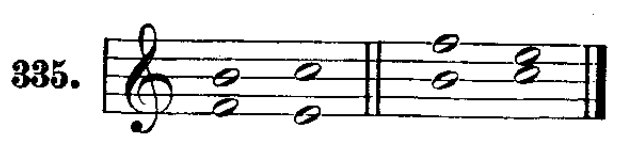
To the modern musician the Tritonus does not have the force of a harsh dissonance, since it partakes of the nature of the Dominant—Seventh chord. In like manner we tolerate, in two—part writing, the minor seventh and its inversion, provided a proper resolution is effected.

On the whole, all those dissonances belonging to the dominion of the Dominant-Seventh and diminished-Seventh chords are much used. The resolution into the tonic, however, must invariably follow, either directly or with the intervention of one or more intervals forming part of the dissonant chord.

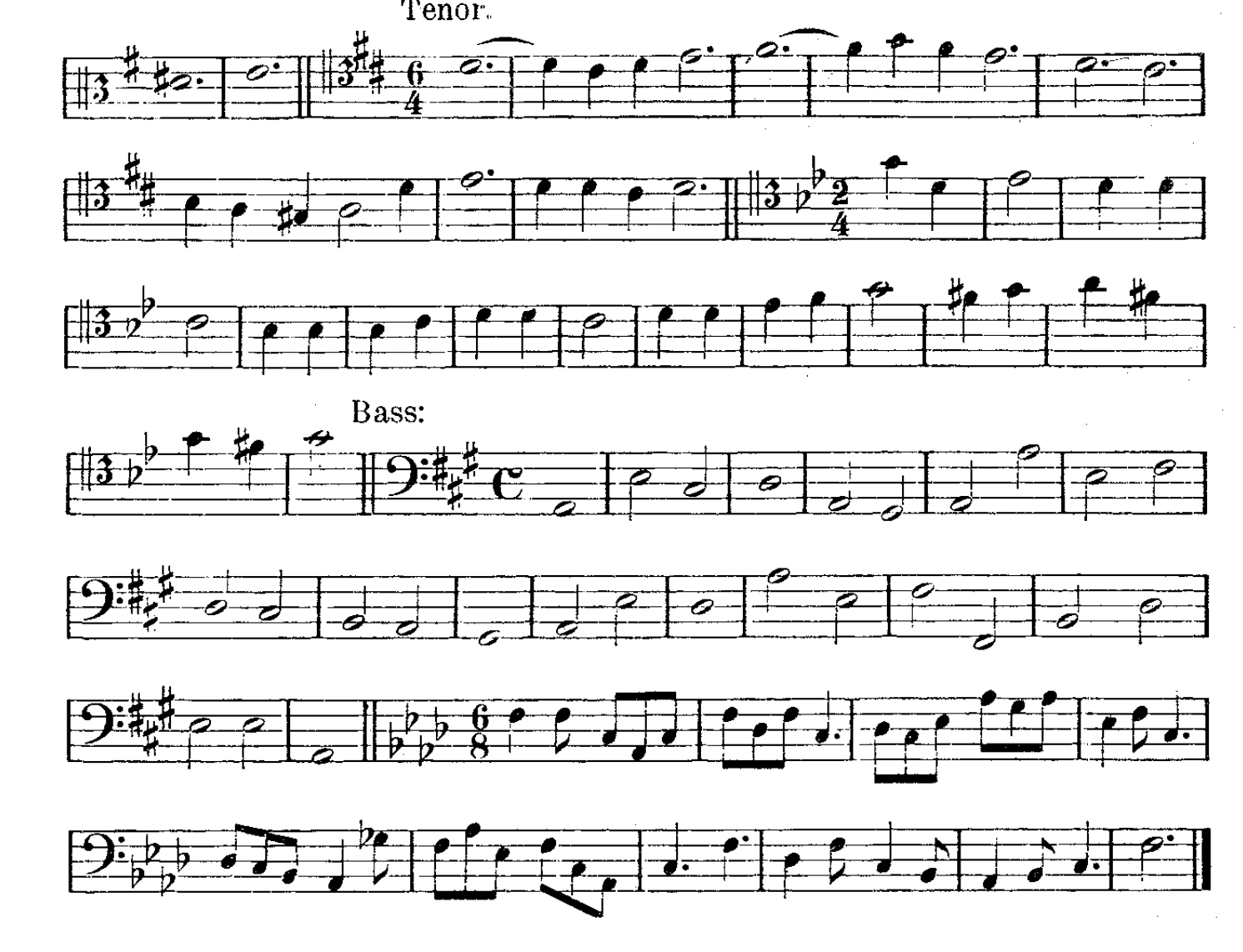
§ 131. The cantus firmus need not always be made up of whole notes. The following melodies are to be used as Cantus firmus in four, five, and six-part exercises.
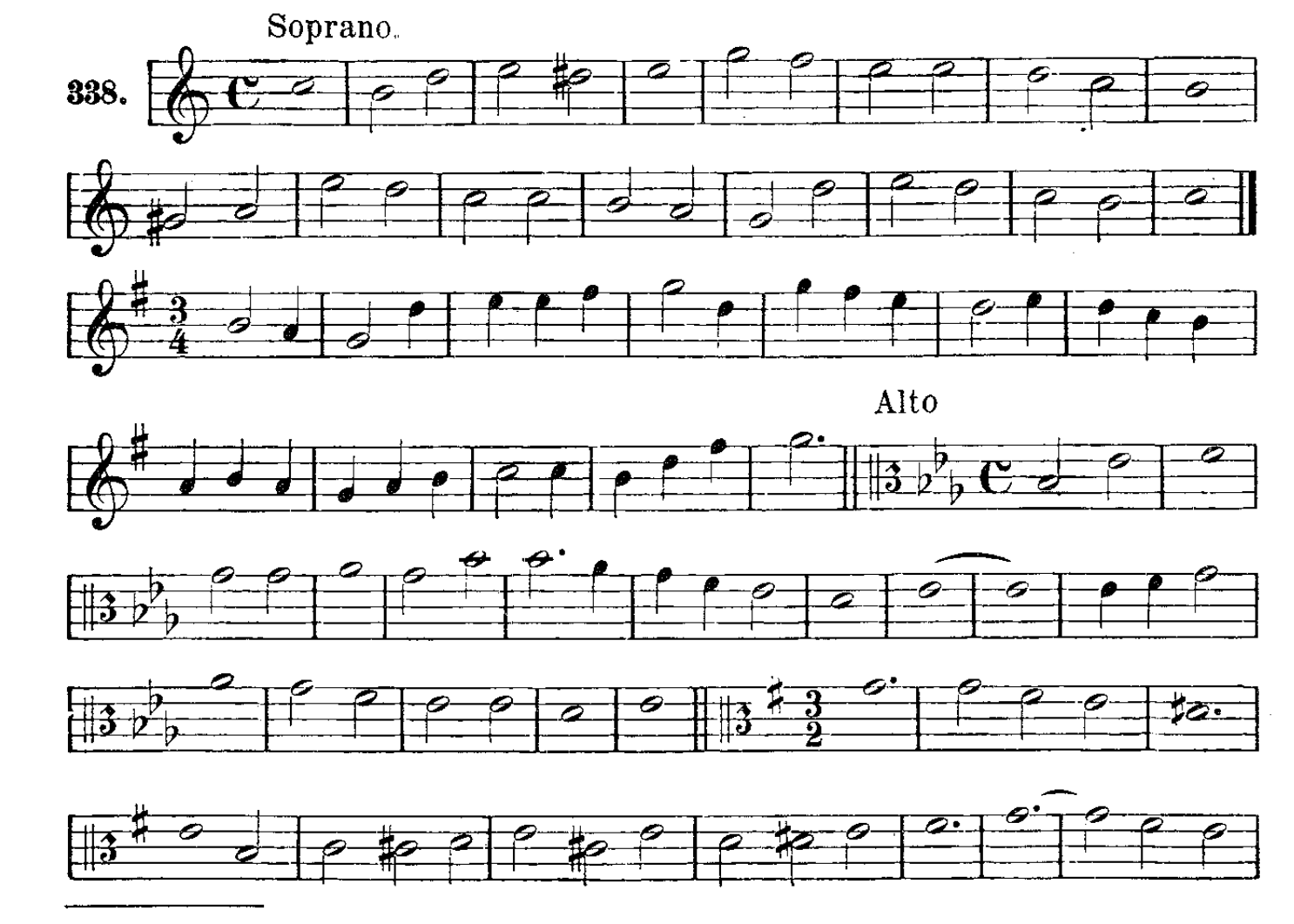
*) Special exercises in two and three-part writing are not necessary; these forms frequently occur where more voices are used during a pause of several of the voices.
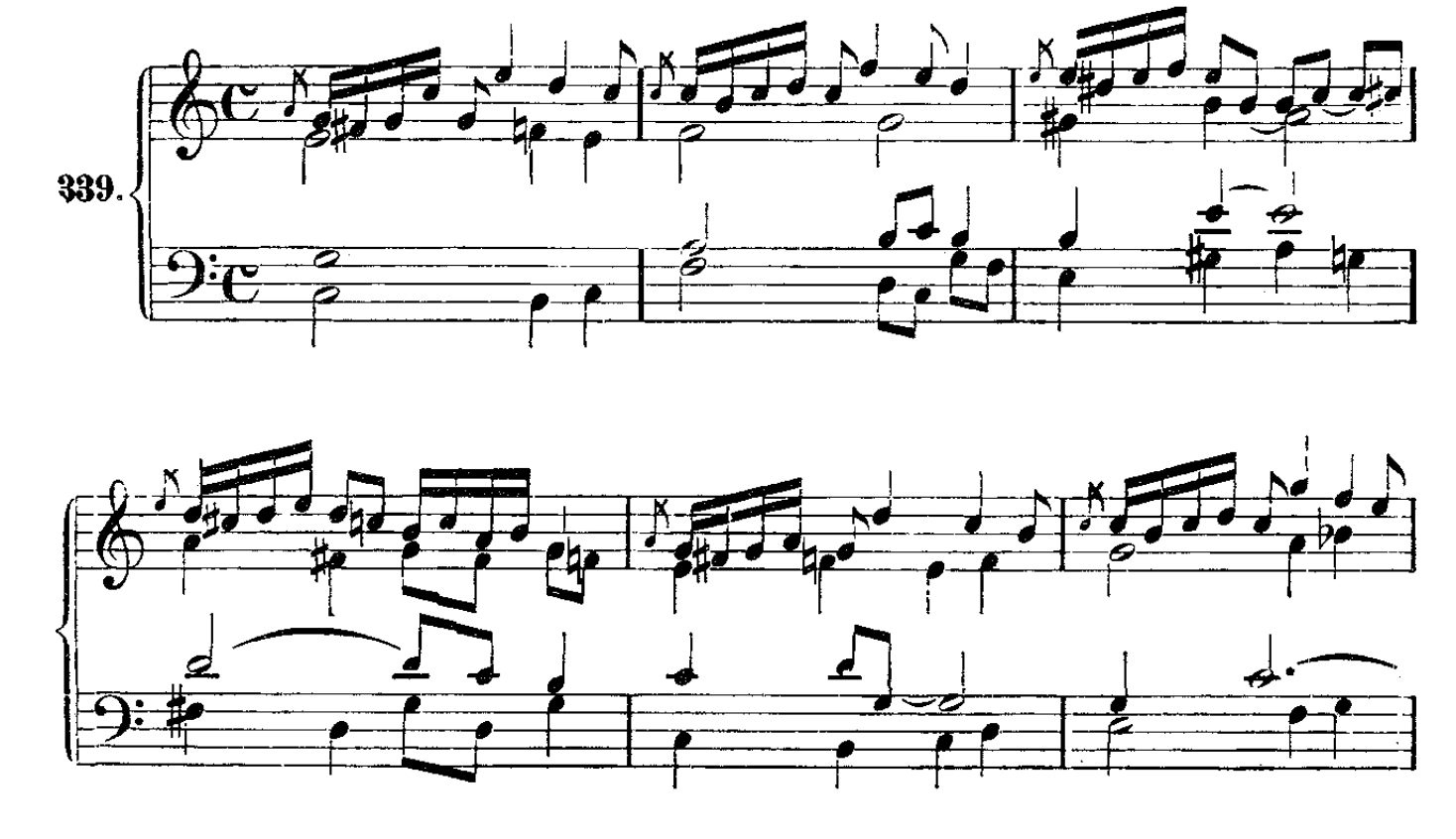
§ 132. In harmonizing a voice laden with all sorts of melodic embellishments, one must carefully consider what is the proper harmony underlying each and every turn of the melody. The harmonic accompaniment of a voice so complex in structure must be characterized by rythmic tranquillity, in order, by means of contrast, better to display the melody.
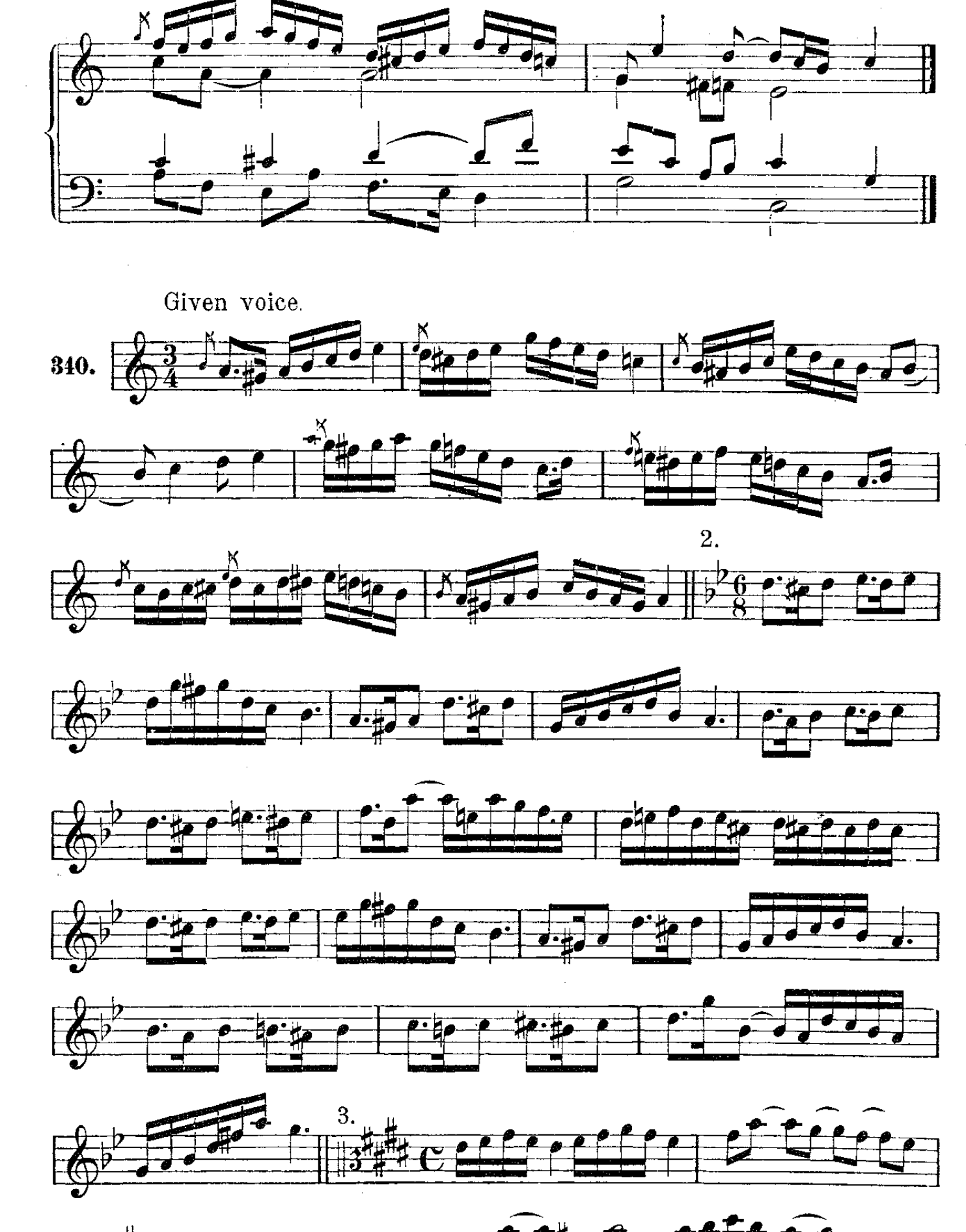
§ 133. Hitherto we have constructed our exercises within the limits of the human voice, have, that is to say, employed the vocal style, which is the surest means for mastering voice-leading — the basis of the technic of composition. The instrumental style is naturally much freer than the vocal, since it must regulate not merely a few distinct voices but great harmonic masses (Orchestre—Pianoforte—and chamber-music compositions), which only now and then give place to smaller fewer-voiced tone-combinations. Instrumental music exhibits such an infinite variety of harmonic forms, that a systematic arrangement of these were impossible. A careful analysis of standard compositions (as, for instance, the Beethoven Sonates) is the surest method for gaining a perfect comprehension of this difficult subject. For this reason the student should devote as much time as possible to the most thorough and conscientious study of the best instrumental works. A perfect comprehension of these works is however impossible without a knowledge of harmonic figuration, the subject of the following chapter.