 Playable Books
Mayank Sanganeria · section 4 of 12
Chapter 3 — The Skeleton
Read and hear this section in the playable edition →The skeleton is the line's hidden melody: one guide tone per arrival, moving by step or holding still. Build it first, sing it, and everything else becomes decoration. This is Ligon's linear harmony turned into a composing procedure.
The two strands of ii–V–I
Every ii–V–I carries two guide-tone strands. Each alternates between 3 and 7, and neither moves more than a whole step.
Ex. 3.1 — The two strands through Dm7–G7–Cmaj7. Strand A starts on the 3rd, holds, then falls. Strand B starts on the 7th, falls, then holds.
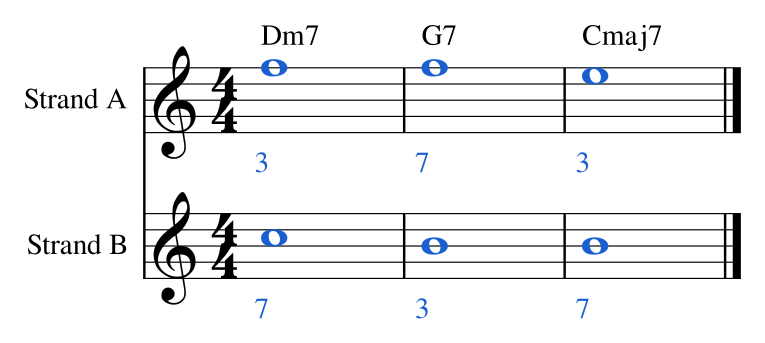
In Strand A, F holds across the change from Dm7 to G7, turning from 3rd into 7th, then falls a half step to E. In Strand B, C falls a half step to B, turning from 7th into 3rd, then B holds into Cmaj7 as the 7th. Between them, the two strands spell all the harmonic information in the progression. Play them as double stops, or ask a pianist to play only these two notes. You'll hear the ii–V–I clearly with no roots at all.
The holds are the strongest moments in the skeleton. One pitch stays put while its function changes underneath it, and the ear hears the harmony move under a still note. A line that holds its guide tone across a change, or re-attacks it (Chapter 4), sounds far more sophisticated than one that leaps to a fresh chord tone.
Pick one strand per phrase. Switching strands mid-phrase is a register jump, so play it as one, usually at a phrase boundary or on a long note. Ex. P.1 does exactly this: Strand A on each beat 1, Strand B on beat 3.
The elaboration ladder
Build lines in levels, each one doubling the rhythmic density of the last. Every level keeps every note of the level below it, on the same beat. This is musical reduction read backward: instead of stripping a finished line down to its skeleton, you grow a line up from one.
Ex. 3.2 — Strand A grown from whole notes to eighth notes. Each level keeps every blue note of the level above it.
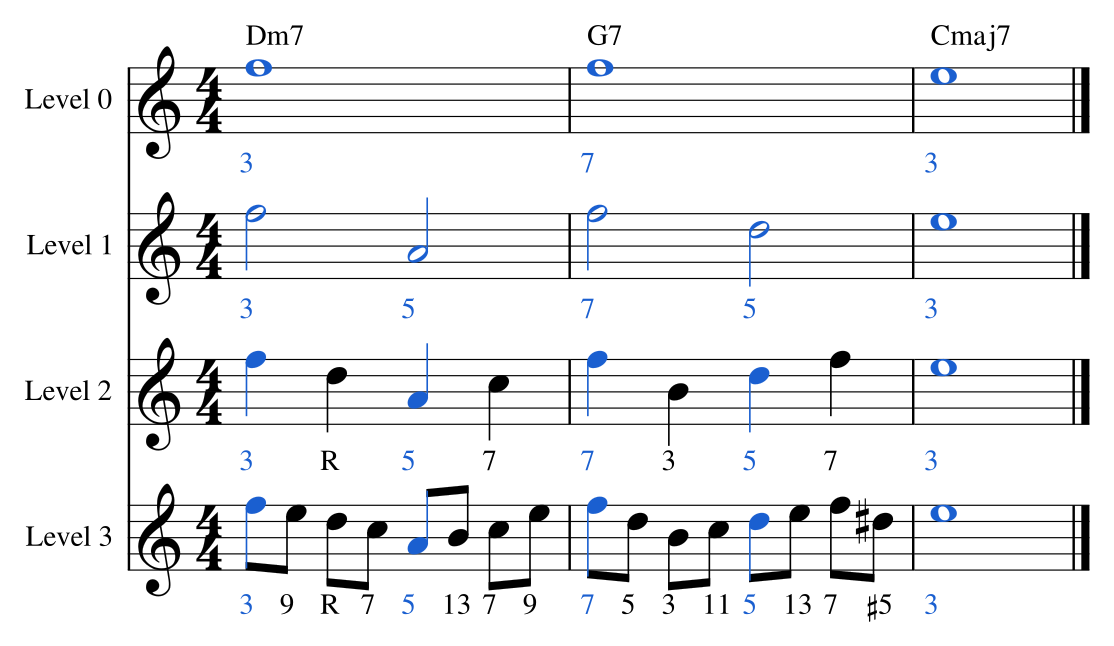
- Level 0 is the skeleton: F, F, E in whole notes.
- Level 1 adds a chord tone on beat 3: A over Dm7, D over G7. These are the half-bar arrivals from Chapter 2.
- Level 2 fills every beat with a chord tone. The line is now a walking arpeggio: F D A C, F B D F, E.
- Level 3 adds the upbeats. Most are passing tones or tensions, and the last upbeat of each bar is a pickup into the next arrival: E into F, D♯ into E.
Level 3 adds nothing new in principle; it just gives every beat a pickup. But listen to the difference. Level 2 is correct and stiff. Level 3, with E leaning into F and D♯ leaning into E, starts to swing even when played straight, because every upbeat points the line forward.
Use the ladder as a practice routine. Climb one level at a time, and don't move up until the level below is effortless. A line you can't sing as whole notes won't survive as eighth notes.
Beyond ii–V–I
The general rule works for any pair of chords. From your current skeleton tone, move to the nearest chord tone of the next chord, preferring 3 and 7. Ties go to the strand you're already on.
Dominant-to-dominant motion is the cleanest case. When dominants move around the cycle of fourths, the 7th of each chord falls a half step to the 3rd of the next, and that 3rd falls a half step to become the following 7th. The result is two chromatic lines falling in parallel.
Ex. 3.3 — Guide tones through a chain of dominants, E7–A7–D7–G7–Cmaj7. Each strand falls chromatically, alternating 7 and 3.
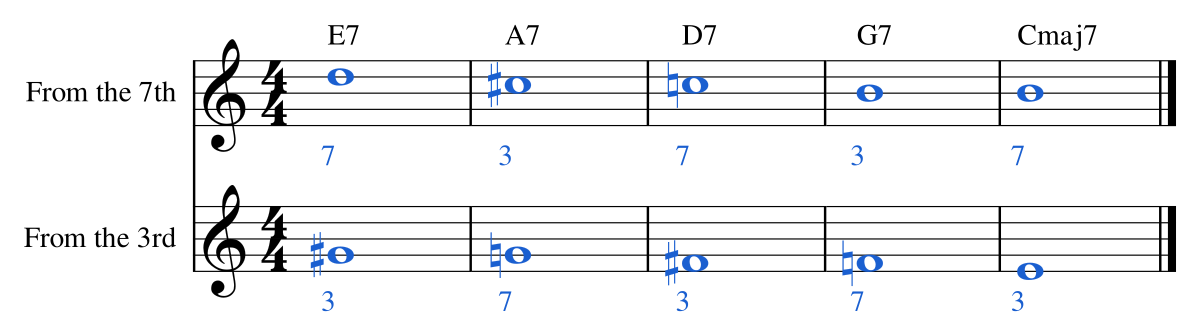
This chain is the harmonic engine of countless bridges and turnarounds. Once you hear the two descending strands, a run of dominant chords stops being a blur and becomes two slow chromatic melodies. Either one, decorated with the cells of Chapter 4, is a complete line.
Drill: sing the skeleton
Put on a ii–V–I backing track. Sing Strand A in whole notes, then Strand B, then alternate by chorus. Then climb the ladder: play Levels 1, 2 and 3 of Strand A as written, then build your own ladder for Strand B. Take both through 12 keys over a few weeks, not in one sitting.