Playable Books
Pyotr Ilyich Tchaikovsky · section 13 of 36
Chapter XI. Free Voice-Leading
Read and hear this section in the playable edition →

§ 32. We have learnt that the voices of a chord may appear in close or open position; and that these two positions are the most normal and advantageous. But true harmonic beauty does not consist in arranging the voices of a chord in this way or that; in consists rather in the character and independence ot the voices themselves—that is, in voice-leading which not only is not dependent on these two positions, but, on the contrary, gives rise to either one of them by reason of its peculiar character. Hitherto, in all our examples, the movement of the middle voices was determined by the upper voice and thus no opportunity for independence was offered. But as soon as it is no longer dominated by the upper voice, each voice gains in significance, deriving, as it were, a distinct physiognomyand _ character of its own, which entirely determines the positions of the voices in a chord; so that an arbitrary use of close or wide positions is not practicable. The alternate employment of these two positions will then be found necessary. A free leading of the voices may also occasion an exceptional or abnormal position of the intervals of a chord, as for instance in the following triad
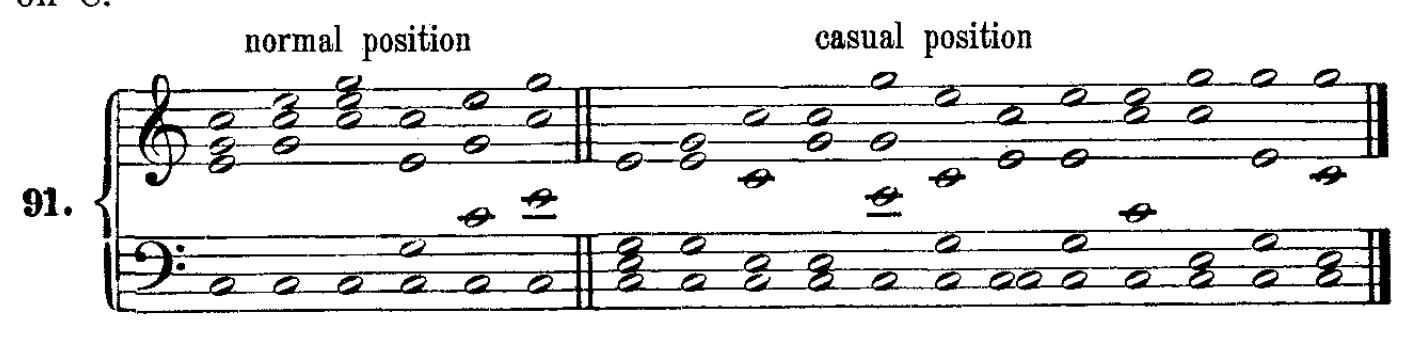
It should be remembered, then, that free voice-leading is of such a nature as to bring about not only an alternate recurrence of the two normal positions, but also accidental, unsymmetrical positions of the intervals.
§ 33. To gain a clear idea of the character of the several voices, we must remember in the first place, that we have to deal with outer and inner voices.
The two outer voices (Soprano and Bass) are of a very mobile nature. They might be likened to a curved line rising and falling in waves. Fifths and fourths are characteristic jumps in the Bass; though this voice is also very partial to scale—like progressions by steps, mostly in contrary motion to the Soprano
The Soprano best adapts itself to progression by steps, though jumps of fourths, fifths, sixths and octaves are by no means excluded. Such jumps, however, must never follow one another in close succession.
The inner voices are distinctly averse to much motion; they are fitted by nature to retain the common tones of chords. Often they retain one and the same tone through two, three or more bars. The inner voices are best kept at an altitude not too high and should not be too far apart from each other. Where the chord is not in close position, however, they must not approach each other too closely. We must be peculiar to avoid a position of the voices, in which the inner voices are close to the Bass. with the Soprano lying very high. Theory can supply but a very general insight into the nature of the voices. It is for the student—-provided he is sufficiently talented—gradually to learn and appreciate by diligent application all the finer points and peculiarities of free-voice-leading — matters which cannot be laid down in formula. The following is an example of free-voice-leading:
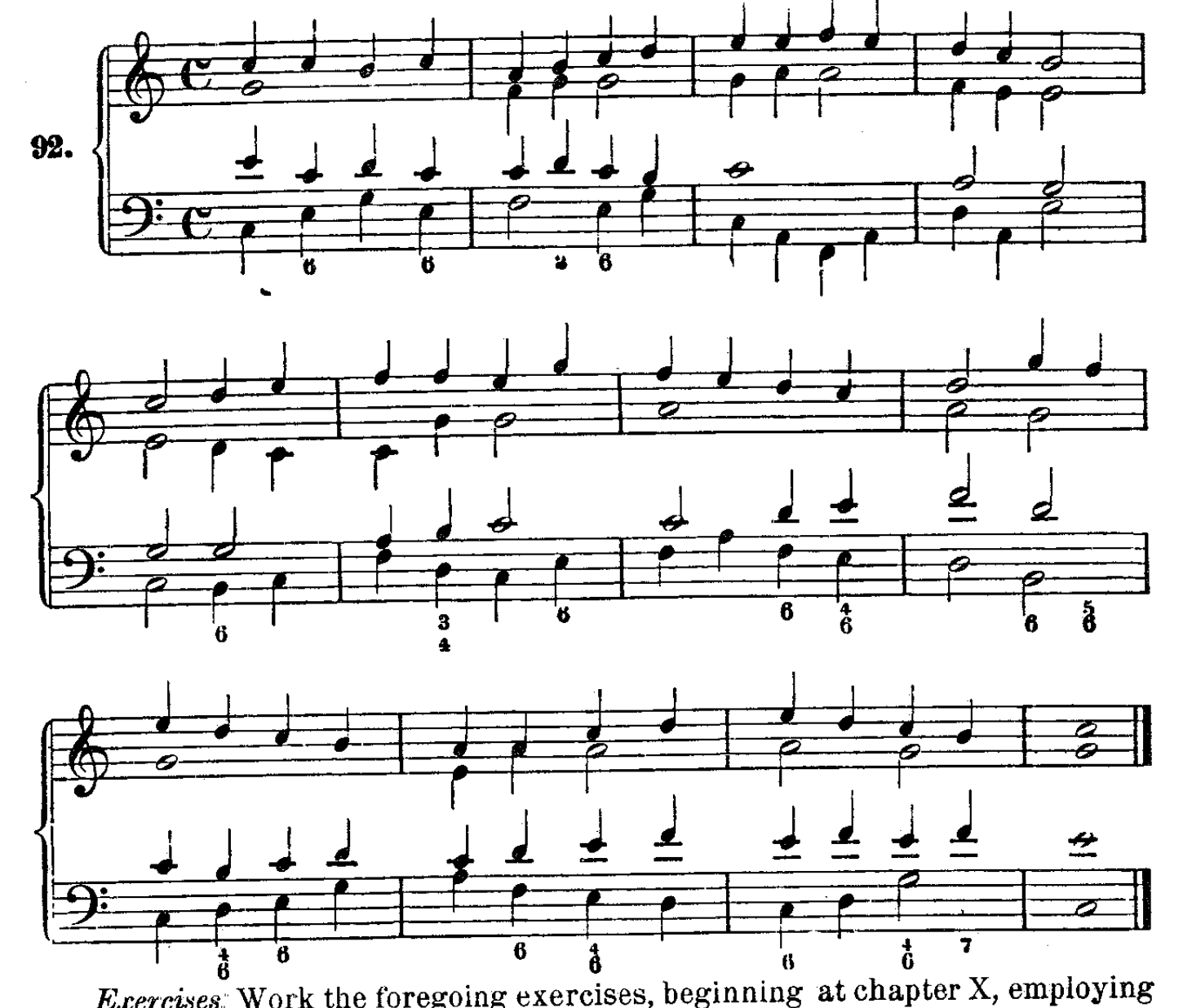
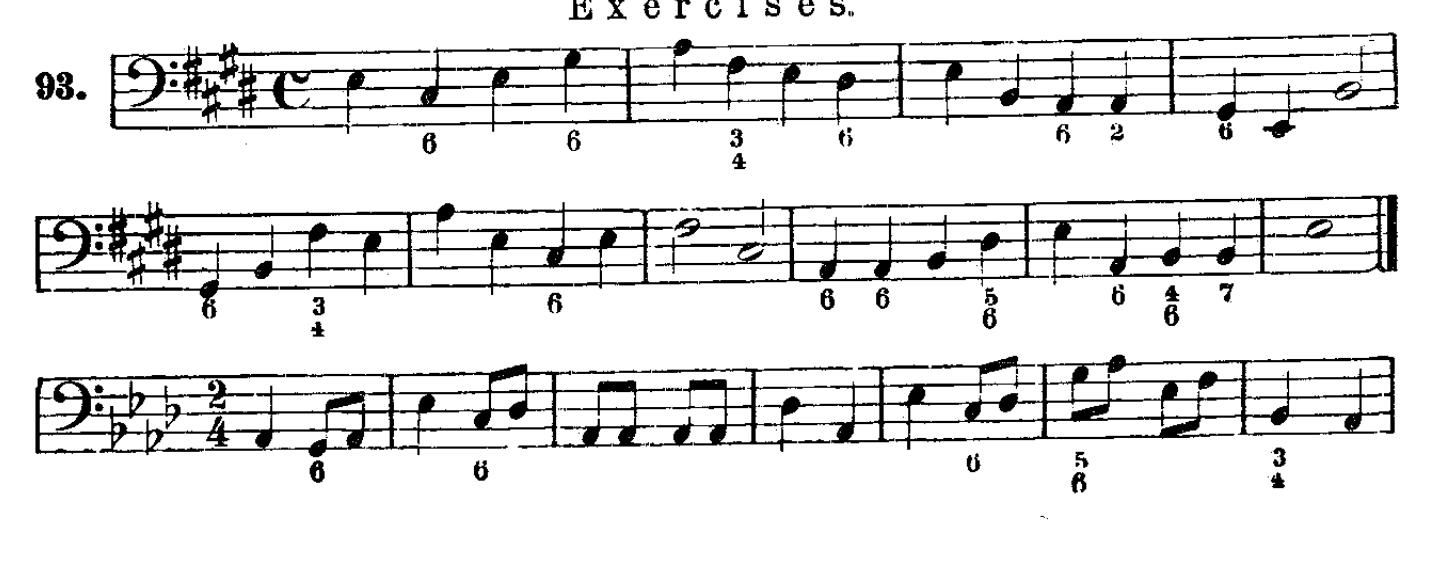
6 Exercises: Work the foregoing exercises, beginning at chapter X, employing a free leading of the voices. Note. In the exercises the pupil must not overstep the limits of the human voices represented respectively by the parts. These limits are as follows: Soprano from d to g: Alto: from the small ‘a to the d; Tenor: from the small 4 to the g; Bass: from the great, g to the c. Only in cases of absolute necessity can these limits be surpassed, and then never by more than one tone.