 Playable Books
Hector Berlioz · section 23 of 67
The Flute
Read and hear this section in the playable edition →

Clarinets in E5, made of metal, are said to be still in use in some military bands. They might pe Serve as substitutes for the very ough trumpets required by Bach in one of his Brandenburg Conce greater range, greater evenness, facility and purity than the old one; yet, the fingering remains unchanged or is in some cases even simplified.
M. Adolphe Sax’s new bass clarinet is still further improved. It has 22 keys. It surpasses the old instrument above all by its perfect purity of intonation, also by its qual temperament throughout the chromatic scale, and oy its greater volume of sound. Its tube is very long, and
the bell almost touches the ground when the player stands upright. This could have caused a considerable weakening of the tone; but the skillful manufacturer remedied it by attaching a concave metal reflector under the bell. The reflector not only prevents any loss of sound. but also permits the player to emit the tone in any direction and thereby even increases its sonority, The bass clarinets of M. Sax are tuned in B®,
Instruments without reeds
THE FLUTE The Ordinary, Large Flute
[his instrument, for a long time so imperfect in many espects, has now achieved such perfection and evenness f tone that no further improvement remains to be deired. We owe this to the skill of some manufacturers nd to Boehm’s method, following Gordon's discovery. The same will soon happen with the other wood-wind astruments. The purity of their tones remained far rom perfect as long as the holes were placed according > the natural distance of the fingers instead of the ra- ‘onal division of the sound-tube, i.e. a division based on 1e laws of acoustics and determined by the nodal points f vibrations. Gordon and subsequently Boehm* started y boring the holes of their wind instruments at the oints fixed by acoustical laws without considering thether the fingers could reach these holes with ease, ith difficulty, or perhaps not at all. They felt sure that le difficulties thus created would be resolved in the ourse of time through some new contrivances. After the instruments had been bored in this fashion id thus tuned to correct pitch, they invented a mechanm of keys and rings which could easily be reached by ie fingers of the player. This device opened or closed ¢ holes which otherwise wuold not be accessible to the agers. This necessitated a complete change in fingerg; but the difficulty was soon conquered. In view of the mpensations offered by the new instruments built acirding to Gordon's and Boehm’s system, we have no vabt that they will displace the old wood-wind instruents within a few vears. Unfortunately, this is still not so in Germany. Some of Boehm's flutes as well as the old flutes
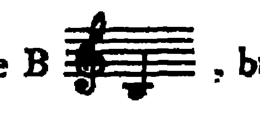
have the B ==. but flutes without this low B are
said to have a better intonation. The B? and B can still be produced in piano, the C only with caution.
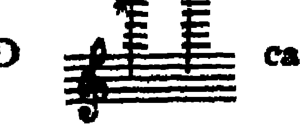
In forte C¥ and D can also be played.
Wooden flutes have a finer tone than metal ones (silver or gold), but the latter respond more easily.
Just a few years ago the flute had a range of only two taves and a fifth:
Including the chromatic intervals limited on the old flute. Thanks to the kevs added to the
: new flute. major and minor trills sre practicable over a the greater portion of its range:, Franee, there are also Boehm clarinets, bassoons and oboes In use..
Two semitones below and three above were gradually added to this scale: this increased the range to three complete octaves:
Including the chromatic intervals
However, not all flutists having instruments with the device necessary for producing the lowest C and C=, it is usually better not to use these tones in the orchestra.
This restriction is no longer valid. I must not fail
to warn the composer against using the high C as in my “Heldenleben.”

The end of Act 2 of “Meistersinger” is also extremely difficult for the flutes, especially in staccato; in
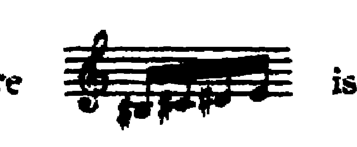
legato the figure — is easier. Compare
also the end of “Goetterdaemmerung”, which is very
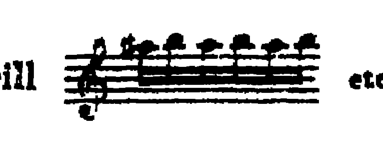
dificult for the flute. The trill Fx ee,
in the “Ride of the Valkyries” (full score, p. 805) is very difficult to execute on the old flute.
The two highest tones, B and C, are rather difficult to produce and sound somewhat shrill; they should not
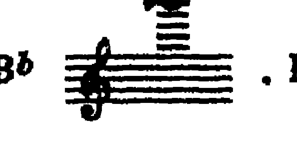
be employed in pianissimo, High B® :. how-
ever, can be sounded easiiy and srstained in the softest piano without any danger. The number of tones permitting trills was rather

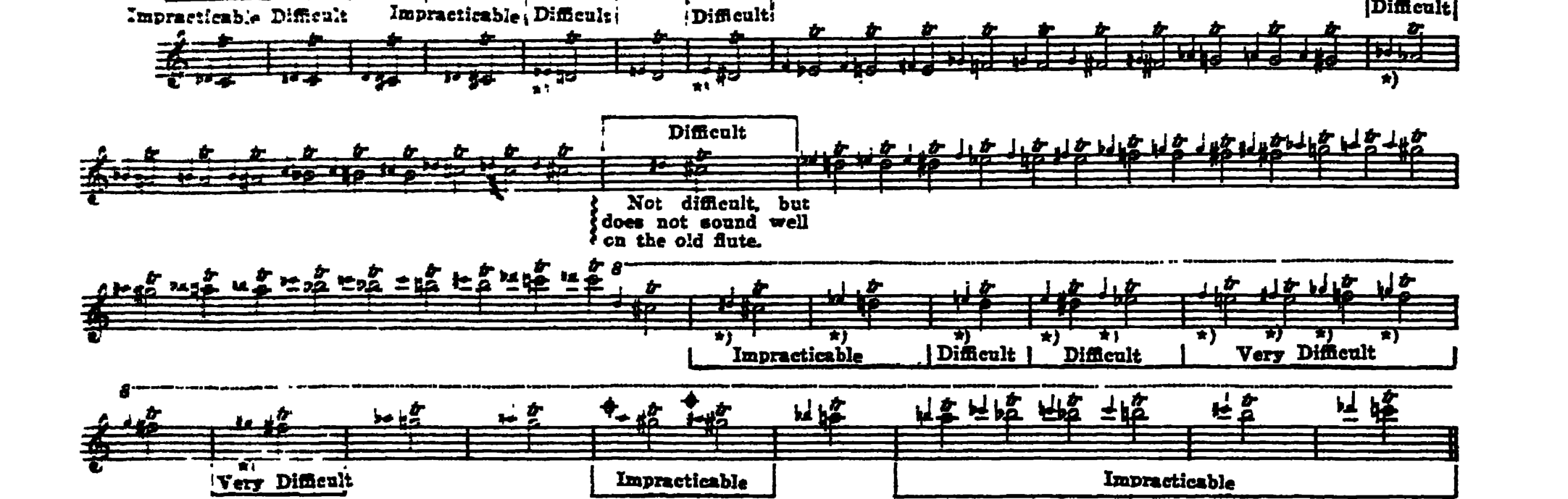
3 The trills marked * are all practicable today; the two marked are impracticable on the old flute unless a special key is provided for them.
Up to the trill 5 the modern mechan-
ism also permits the execution in piano.
On the dute built according to Boehm's system all trills are practicable up to the extreme high range (i.e. from low I)» to the highest C); moreover, their intonation is much purer.
The thute is the most agile of all wind instruments, It is just as suitable for fast diatonic or chromatic passages ——slurred or detached—as for arpeggios and figures with wide jumps, e.g.

Even repeated notes. like those played staccato on the violin, can be played by means of doxble-tonguing:

A special effect on the flute is the Flattercunge (flutter-tonguing). (Cf. my “Don Quixote”). It is applicable to the oboe and clarinet. The player pronounces “drrrrr” during 1 moderately fast chromatic » scale, The effect is something like the sound of birds fluttering through the air, or — in pp — like the soft.§ chuckling of frolicsome girls in the distance.
le keve of DG. C.F, A. E, Bh, E® and their relative minors are the favorite keys on the flute; the others are much more dificult, 3 On the contrary, keys with flats are casier.
However, on Boehm flutes the key of D? is almost as easy ox DD.
The sound of the flute is soft in its mediom range, rather piercing in its high notes, and very characteristic
in its low register. The medium and high tones have no especially characteristic expression They are suitable for the most varied melodies and accents; however, they do not possess the artless gaiety of the oboe or the noble tenderness of the clarinet. One might, therefore, assume that the flute is an instrument almost devoid of expression, and that it may be used anywhere and for any purpose because of the facility with which it executes rapid passages or sustains the high tones so useful in the orchestra for filling out the high harmonies.
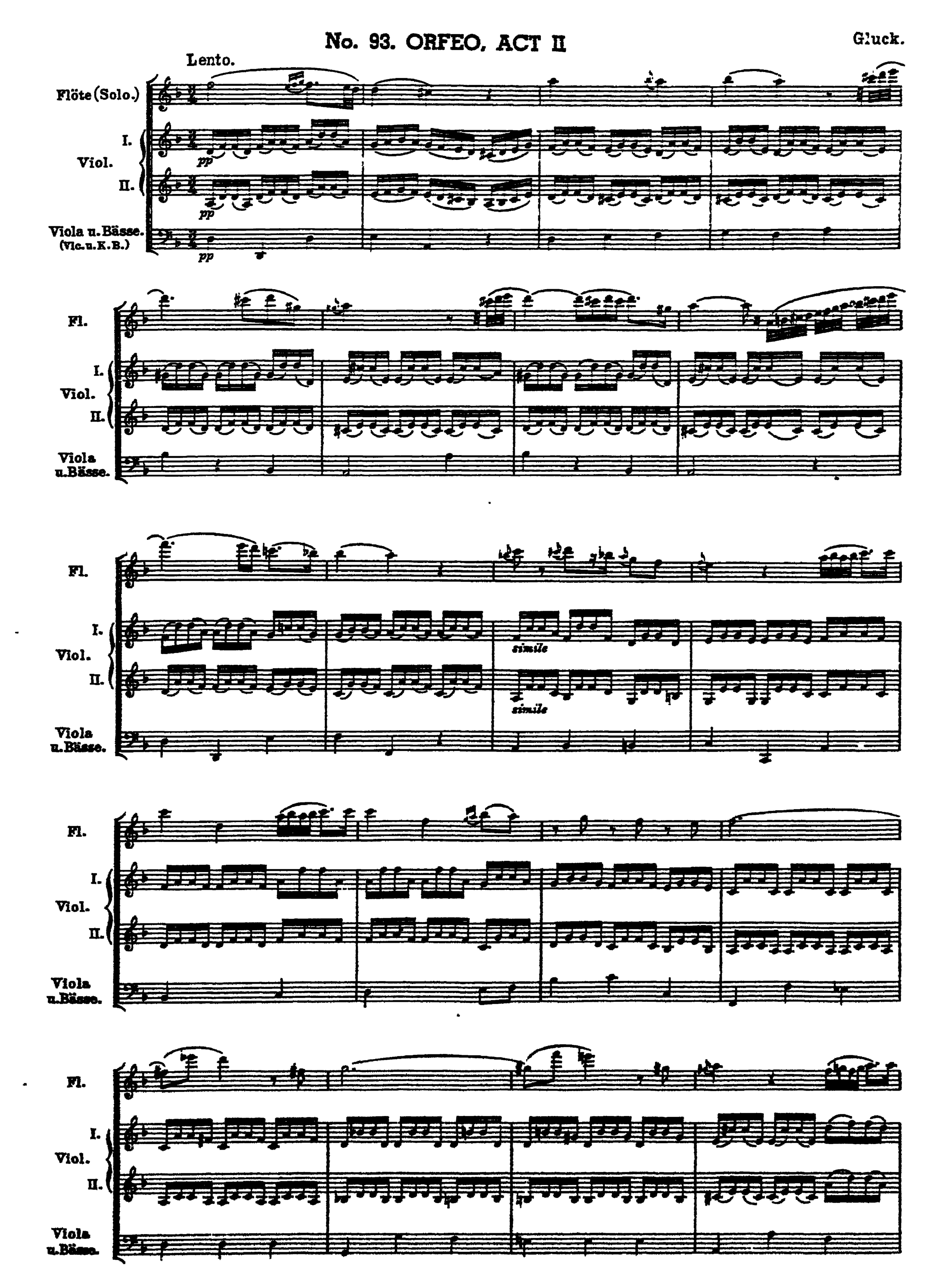
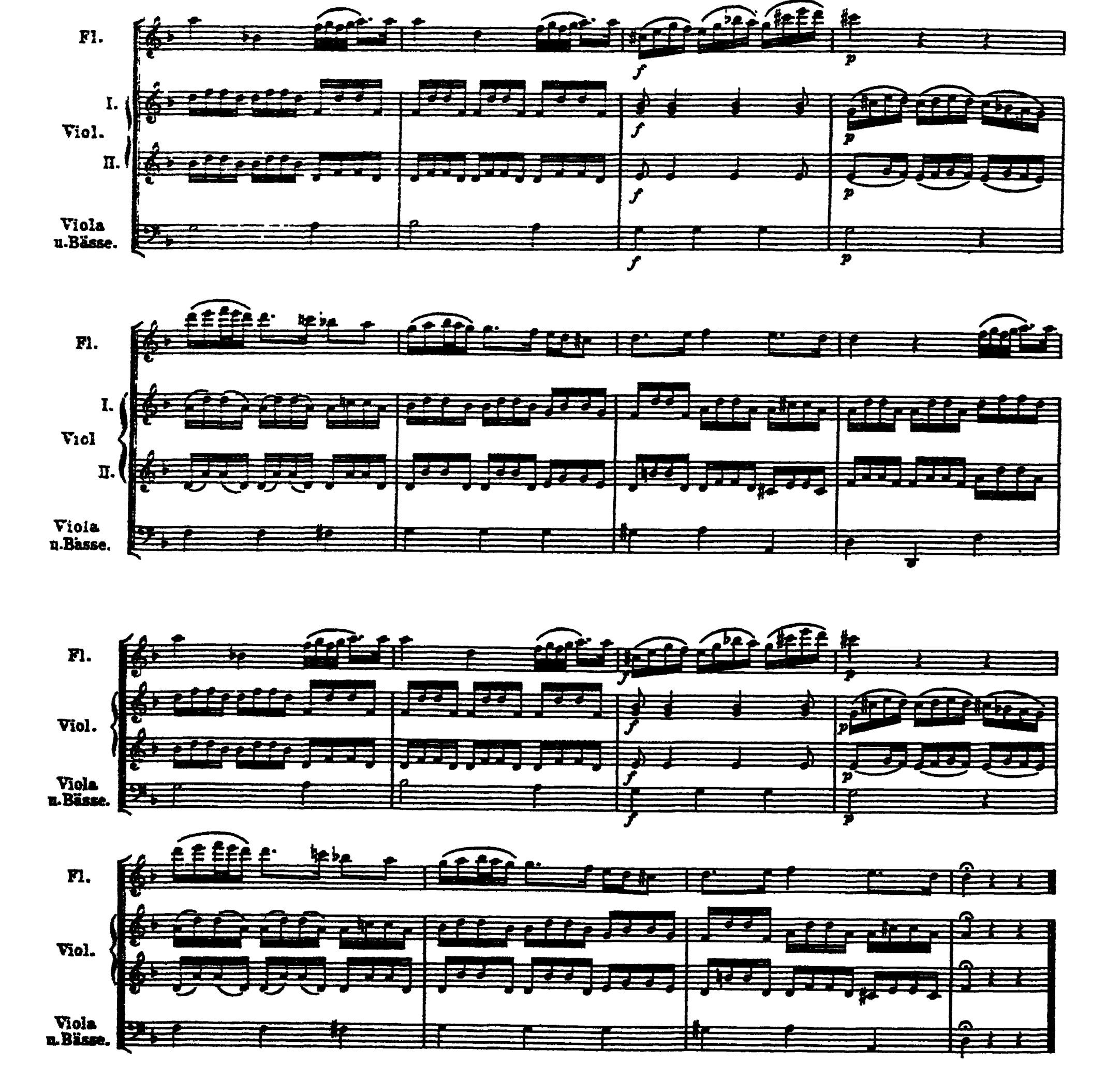
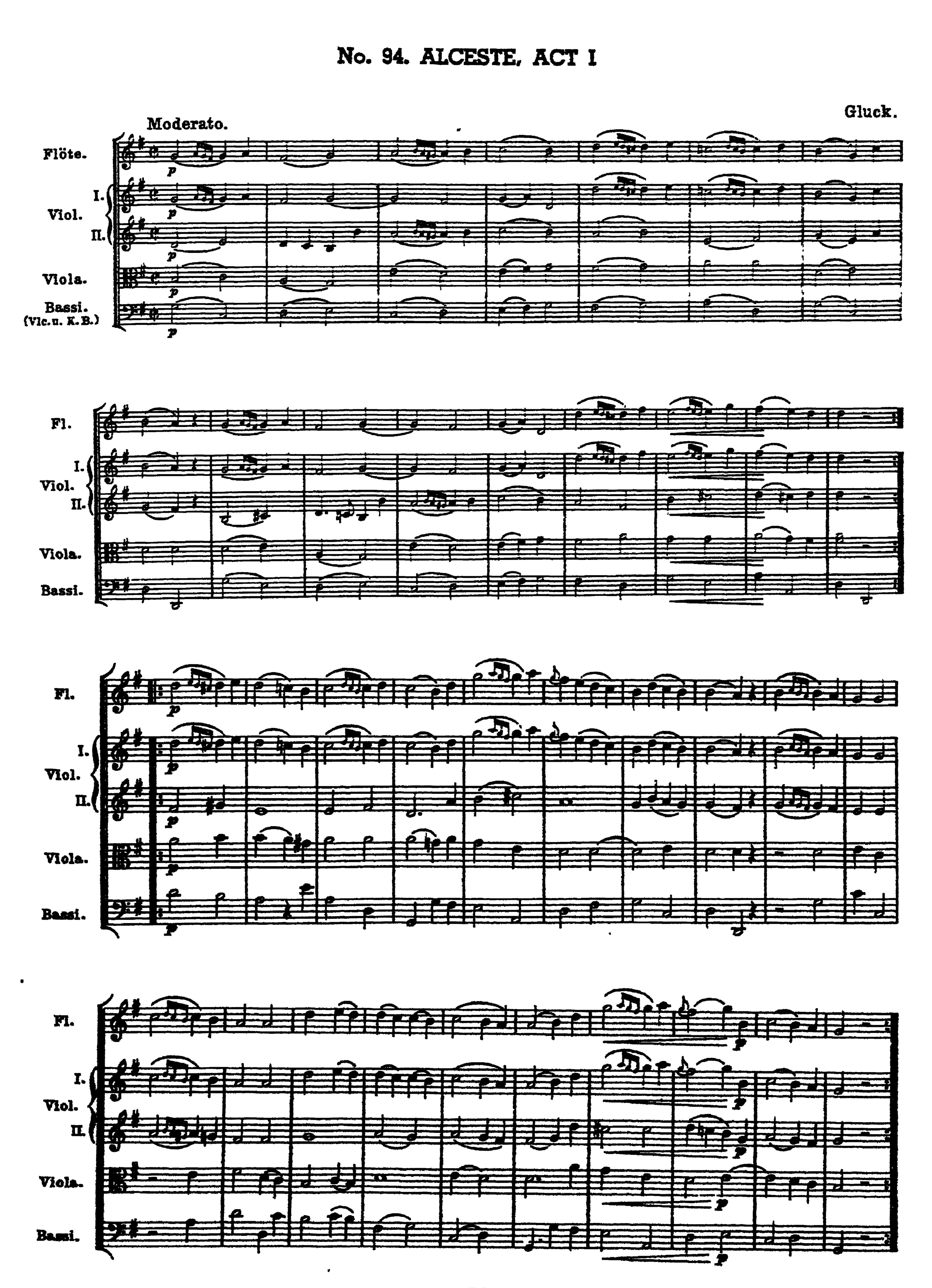
Generally speaking, this is true; yet a closer scrutiny will show that the flute is endowed with a character peculiarly its own and with a special aptitude for expressing certain feelings, in which it is matched by no other instrument. For instance, if one desires to give an expression of desolation to a sad melody, combined with a. feeling of humility and resignation, the weak medium tones of the flute, especially in C# minor and D minor, will certainly produce the intended effect. As far as I know, only one master knew how to avail himself of this pale tone-color—Gluck. When listening to the D-minor melody of the pantomime in the Elysian-Fields scene in “Orfeo”, one is immediately convinced that only a flute could play this melody appropriately. An oboe would be too child-like. and its tone not sufficiently clear. The English horn is too low. A clarinet would doubtless have been more suitable, but it would have been too strong for some of the passages; for even its softest tones cannot be reduced to the weak and veiled sound of the medium F and of the B> above the stave, which imparts so much sadness to the flute in the key of D minor where these motes frequently occur. Finally, neither the violin, nor the viola, nor the violoncello— solo or in groups—could express this sublime lament of a suffering and despairing spirit. It required precisely the instrument selected by the composer. Moreover, Gluck’s melody is conceived in such a way that the flute can follow every impulse of this eternal grief, still imbued with the passions of earthly life. The voice starts almost inaudible, seemingly afraid to be overheard; then its sighs softly and rises to the expression of reproach, of deep pain, to the cry of a heart torn by incurable wounds; gradually it sinks back into a plaint, a sigh and the sorrowful murmar of a resigned soul. Gluck was, indeed, a great poet! (Example 93.)
An effect remarkable for its tenderness can be achieved by two flutes playing successions of thirds in the medium range in the keys of E and A®, which are so favorable to the soft timbre of this instrament. A beantiful example of this can be found in the cavatina of the
duet in “La Vestale”: “Les Dieux prendront pitié”. The tones BO, Ab, G, F and Eb, linked together in the flutes in this fashion, have something of the sound of a harmonica. Thirds in the oboes, English horns or clarinets could not produce a similar effect,
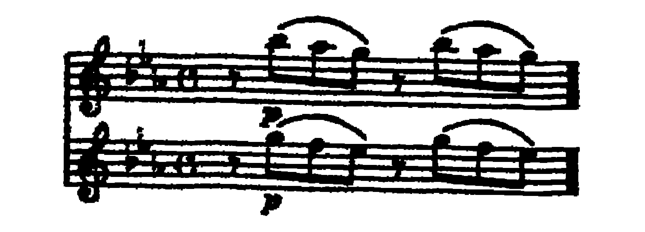
Very few composers know how to employ the low tones of the flute advantageously. However, Gluck in the religious march in “Alceste” and later Weber in numerous passages of “Freischuetz” have shown how effective they are in harmonies of a serious or dreamy
character. As mentioned above, these low tones blend very well with the low tones of the English horns and clarinets, providing the more subdued shade of a dark color.
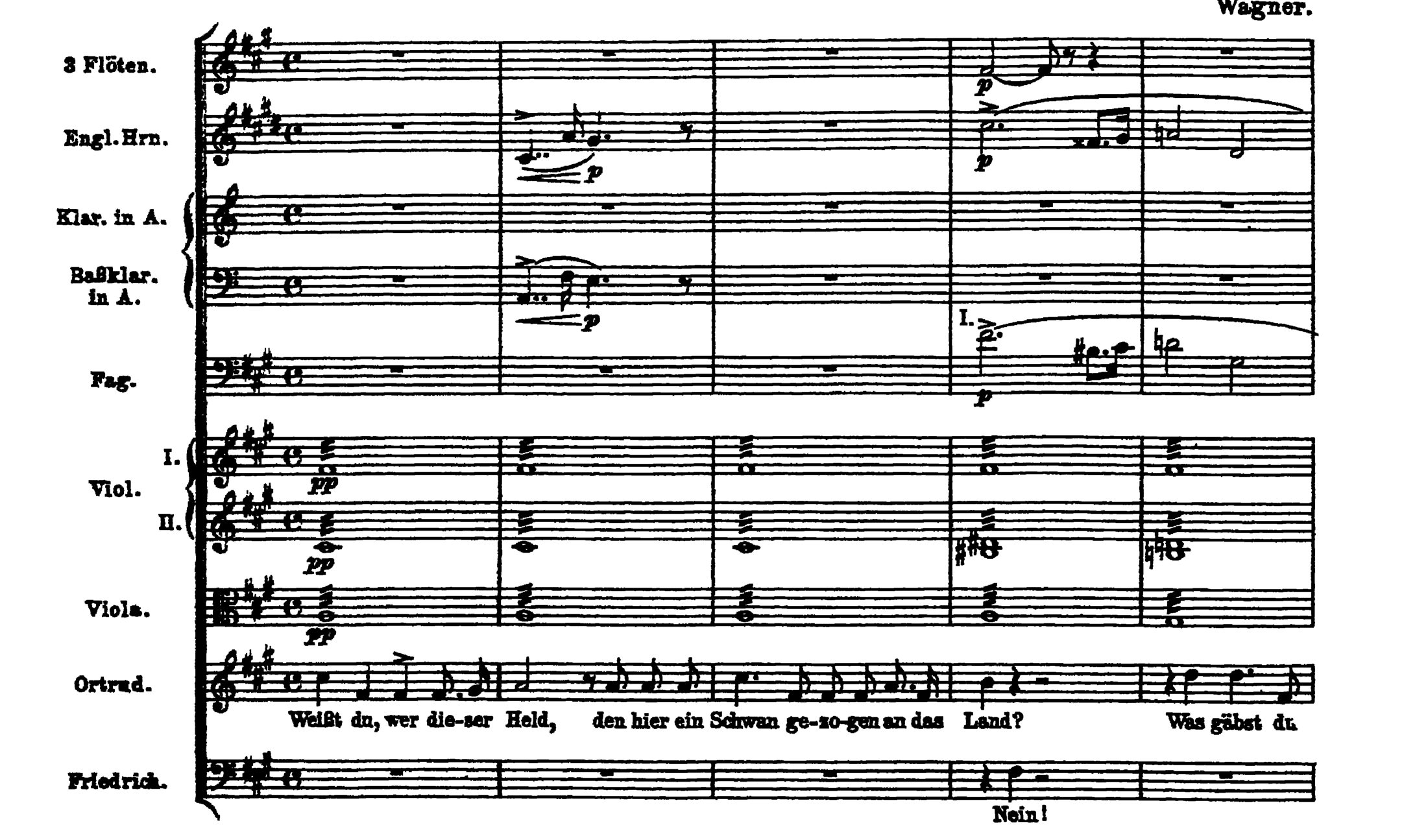
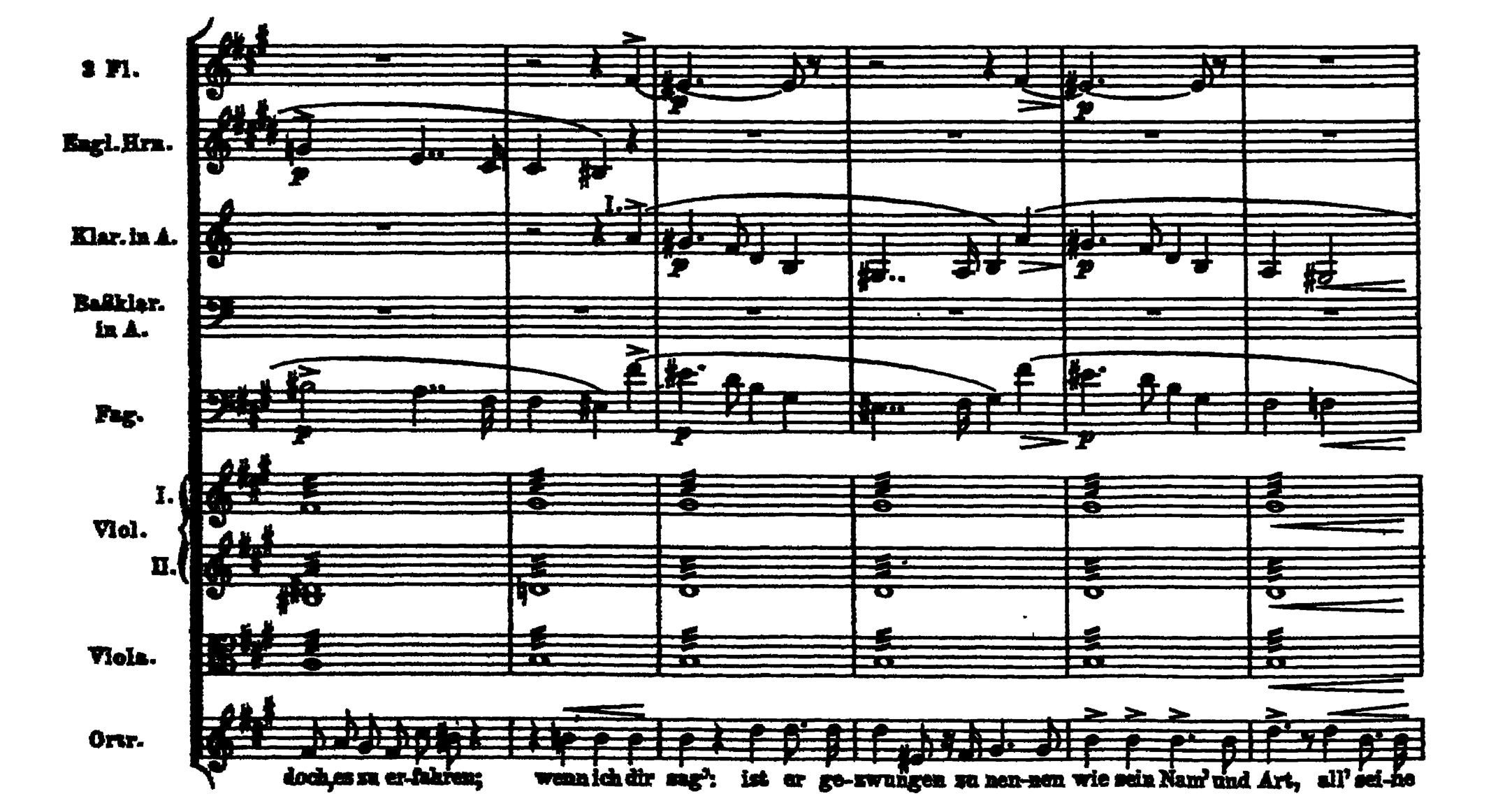
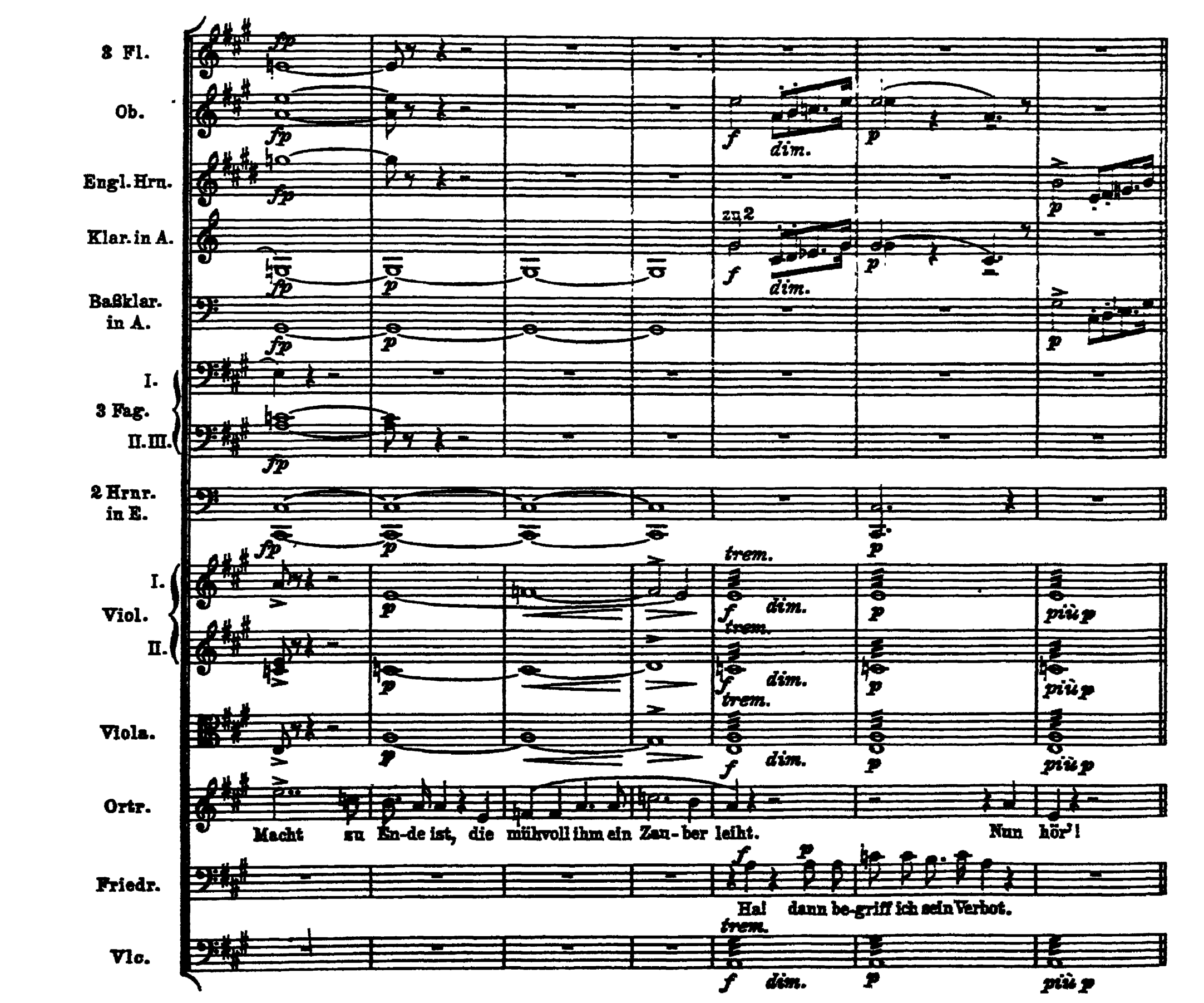
Cf. the passage in the second act of “Lohengrin” sono as the bass for the oboes and English horns (Exin Ortrad’s scene. where three flutes sustain an E uni- ample 95).
No. 95. LOHENGRIN, ACT I
Ptr. an et de a ee tk tT or 1h ee Tt tt ot tt ____ er 1 _e_s_)
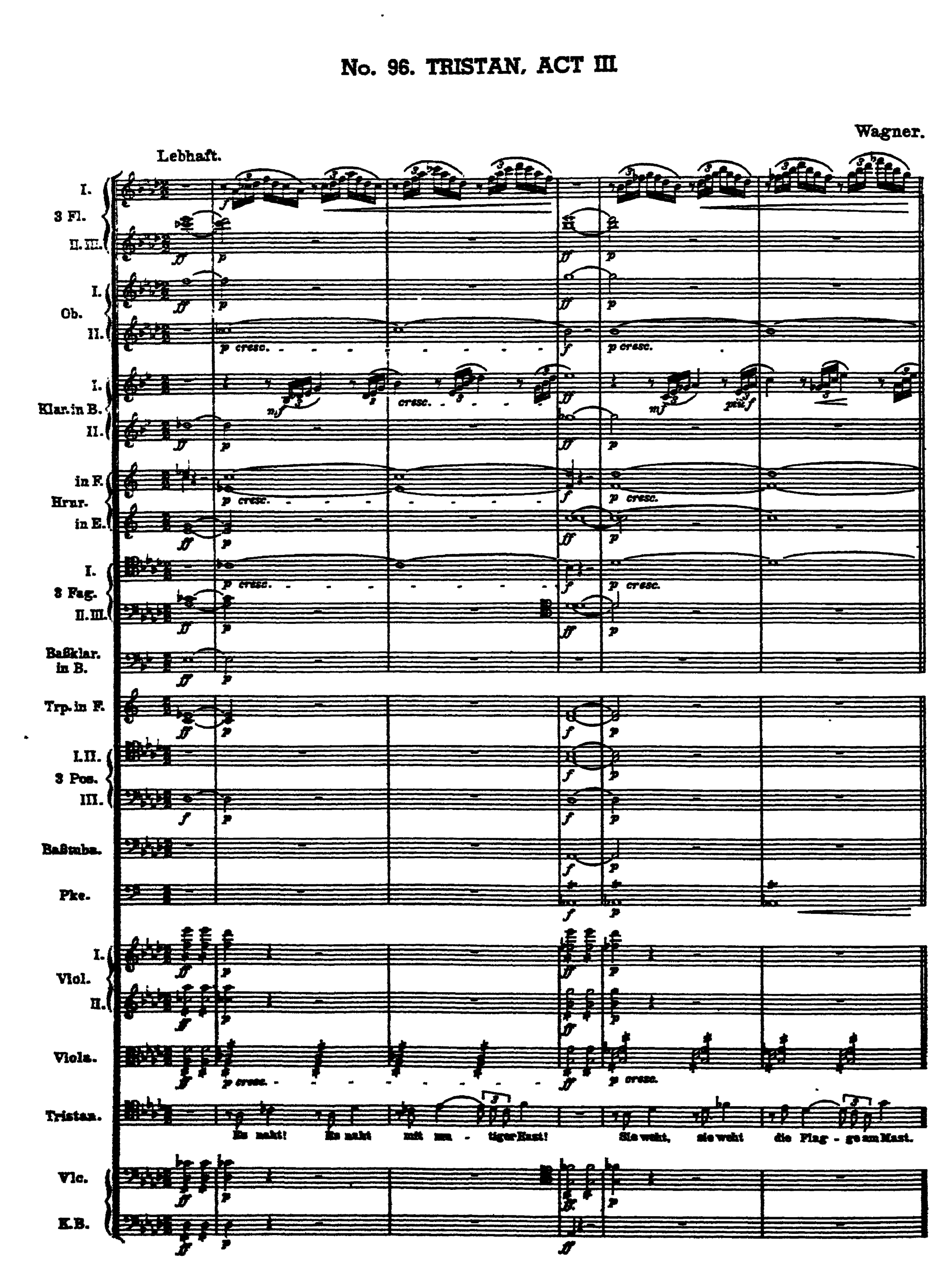
In his later works Wagner employed the finte very rarely, but always very characteristically, as, for instance, in the third act of “Tristan”—the fluttering of the flag on Isolde'’s boat (Example 96); in the sec-
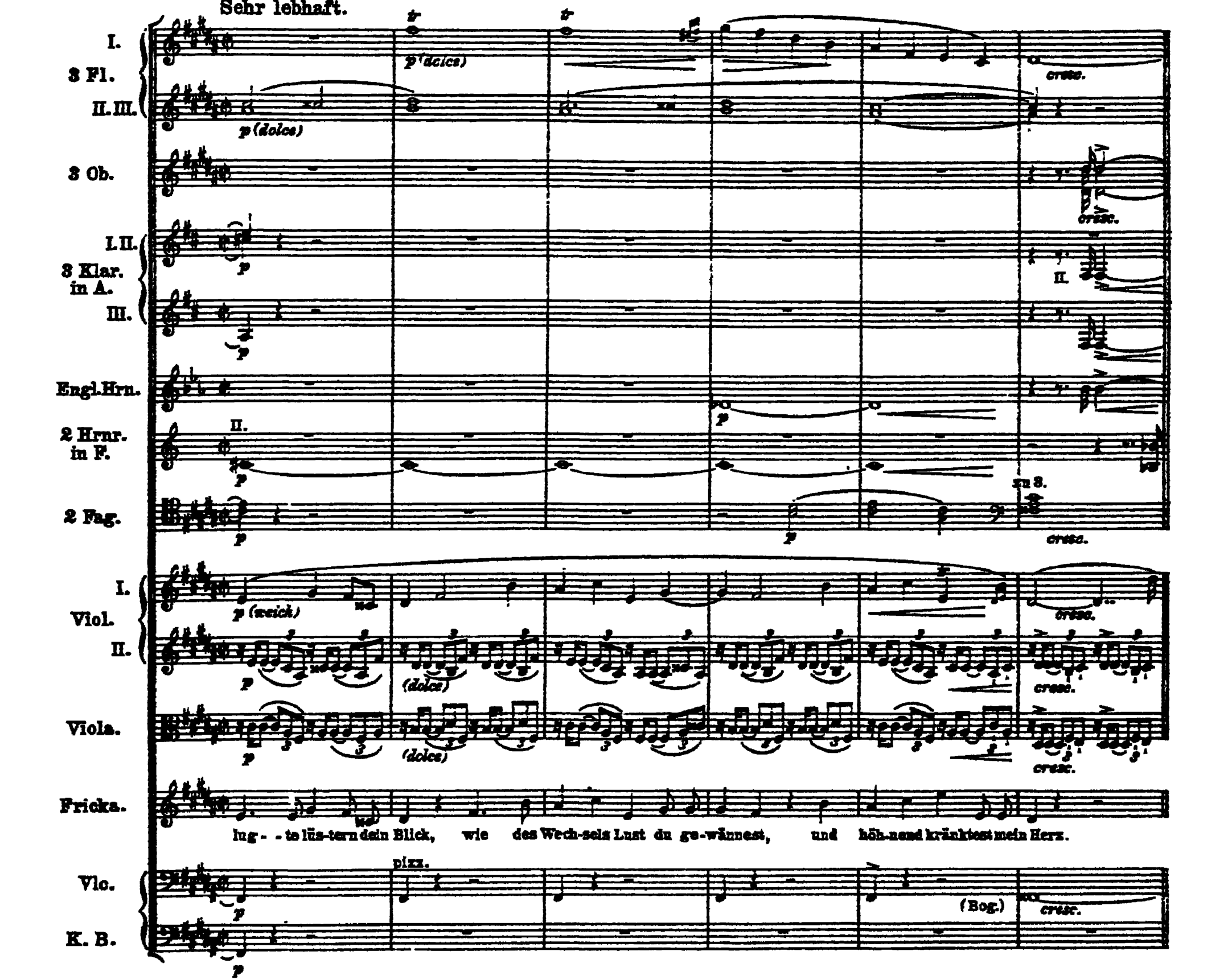
ond act of ‘“Walkuere”——the expression of frivolous voluptiousness with Fricka'’s words, “wie des Wechsels Lust du gewoennest” (Example 97); in the third act of ““Tannhsenser”—the expression of holiness.
No. 97. WALEUERE, ACT 0
One can see from these brief examples how raried are the expressive possibilities of even so soft and relatively neutral an instrument as the fiute—in the hands of a great musical poet utilizing it for his symbolic language.
Compare also the previously quoted example from Weber's “Freischuets” (Example 82, p. 80). There is something wonderfully dreamy in the low, sustained tones of the two flates as Agathe, during her prayer. beholds the tree tops in the silvery light of the moon.
The modern masters generally keep the flutes too persistently im the higher ranges. They always seem afraid that they will not be sufficiently clear amidst the mass of the orchestra. Consequently the flutes predominate in the ensemble instead of blending with it; the instru-
mentation thus becomes hard and sharp rather than sonorous and harmonious.
(very trae indeed!)
The flutes constitute a family just as numerous as that of the oboes and clarinets. The large flute—with which this chapter deals—is the one most frequently used. In normal orchestras it is generally used in two parts, although soft chords sustained by three flutes would frequently produce wonderful effects. The combination of one high flute with four violins in a high, sustained five-part harmony sounds very charming. Although it is natural to assign the highest tones of the harmony to the first flute, there are many occasions where an inverse arrangement would be equally satisfactory.