 Playable Books
Nikolai Rimsky-Korsakov · section 5 of 100
Wood-wind
Read and hear this section in the playable edition → OrchestrationCecil Forsyth · the flute
 Treatise on InstrumentationHector Berlioz · the fluteOrchestrationCecil Forsyth · the oboeTreatise on InstrumentationHector Berlioz · the oboeOrchestrationCecil Forsyth · the English hornTreatise on InstrumentationHector Berlioz · the English hornOrchestrationCecil Forsyth · the clarinetTreatise on InstrumentationHector Berlioz · the clarinetOrchestrationCecil Forsyth · the bassoonTreatise on InstrumentationHector Berlioz · the bassoon
Apart from the varying number of players, the formation of the string group, with its five constituent parts remains constant, satisfying the demands of any orchestral full score. On the other hand the group of wood-wind instruments varies both as regards number of parts and the volume of tone at its command, and here the composer may choose at will. The group may be divided into three general classes: wood-wind instruments in pair's, in three's and in four's, (see table on page 13).
Arabic numerals denote the number of players on each instrument; roman figures, the parts (1st, 2nd etc.). Instruments which do not require additional players, but are taken over by one or the other executant in place of his usual instrument, are enclosed in brackets. As a rule the first flute, first oboe, first clarinet and first bassoon never change instruments; considering the importance of their parts it is not advisable for them to turn from one mouth-piece to another. The parts written for piccolo, bass flute, English horn, small clarinet, bass clarinet and double bassoon are taken by the second and third players in each group, who are more accustomed to using these instruments of a special nature.
Wood-wind in pair's | Wood-wind in three's | Wood-wind in four's
(II—Piccolo). | (III—Piccolo). | 1 Piccolo (IV).
2 Flutes I. II. | 3 Flutes I. II. III. | 3 Flutes I. II. III.
| (II—Bass flute). | (III—Bass flute).
2 Oboes I. II. | 2 Oboes I. II. | 3 Oboes I. II. III.
(II—Eng. horn). | 1 Eng. horn (III). | 1 Eng. horn (IV).
| (II—Small clarinet). | (II—Small clarinet).
2 Clarinets I. II. | 3 Clarinets I. II. III. | 3 Clarinets I. II. III.
(II—Bass clarinet). | (III—Bass clarinet). | 1 Bass clarinet (IV).
2 Bassoons I. II. | 2 Bassoons I. II. | 3 Bassoons I. II. III.
| 1 Double bassoon (III). | 1 Double bassoon (IV).
The formation of the first class may be altered by the permanent addition of a piccolo part. Sometimes a composer writes for two piccolos or two Eng. horns etc. without increasing the original number of players required (in three's or four's).
Note I. Composers using the first class in the course of a big work (oratorio, opera, symphony, etc.) may introduce special instruments, called extras, for a long or short period of time; each of these instruments involves an extra player not required throughout the entire work. Meyerbeer was fond of doing this, but other composers, Glinka for example, refrain from increasing the number of performers by employing extras (Eng. horn part in Rousslân). Wagner uses all three classes in the above table (in pair's: Tannhäuser—in three's: Tristan—in four's: The Ring). Note II. Mlada is the only work of mine involving formation by four's. Ivan the Terrible, Sadko, The Legend of Tsar Saltan, The Legend of the Invisible City of Kitesh and The Golden Cockerel all belong to the second class, and in my other works, wood-wind in pair's is used with a varying number of extras. The Christmas Night, with its two oboes, and two bassoons, three flutes and three clarinets, forms an intermediate class.
Considering the instruments it comprises, the string group offers a fair variety of colour, and contrast in compass, but this diversity of range and timbre is subtle and not easily discerned. In the wood-wind department, however, the difference in register and quality of flutes, oboes, clarinets and bassoons is striking to a degree. As a rule, wood-wind instruments are less flexible than strings; they lack the vitality and power, and are less capable of different shade of expression.
In each wind instrument I have defined the scope of greatest expression, that is to say the range in which the instrument is best qualified to achieve the various grades of tone, (forte, piano, cresc., dim., sforzando, morendo, etc.)—the register which admits of the most expressive playing, in the truest sense of the word. Outside this range, a wind instrument is more notable for richness of colour than for expression. I am probably the originator of the term "scope of greatest expression". It does not apply to the piccolo and double bassoon which represent the two extremes of the orchestral compass. They do not possess such a register and belong to the body of highly-coloured but non-expressive instruments.
The four kinds of wind instruments: flutes, oboes, clarinets and bassoons may be generally considered to be of equal power. The same cannot be said of instruments which fulfil a special purpose: piccolo, bass flute, Eng. horn, small clarinet, bass clarinet and double bassoon. Each of these instruments has four registers: low, middle, high and extremely high, each of which is characterised by certain differences of quality and power. It is difficult to define the exact limits of each register; adjacent registers almost blend together and the passage from one to another is scarcely noticeable. But when the instrument jumps from one register to another the difference in power and quality of tone is very striking.
The four families of wind instruments may be divided into two classes: a) instruments of nasal quality and dark resonance—oboes and bassoons (Eng. horn and double bassoon); and b) instruments of "chest-voice" quality and bright tone—flutes and clarinets (piccolo, bass flute, small clarinet, bass clarinet).
These characteristics of colour and resonance—expressed in too simple and rudimentary a form—are specially noticeable in the middle and upper registers. The lower register of the oboes and bassoons is thick and rough, yet still nasal in quality; the very high compass is shrill, hard and dry. The clear resonance of the flutes and clarinets acquires something nasal and dark in the lower compass; in the very high register it becomes somewhat piercing.
Note to Table B. In the following Table B the top note in each register serves as the bottom note in the next, as the limits to each register are not defined absolutely. The note G fixes the register of flutes and oboes, C for the clarinets and bassoons. In the very high compass those notes are only given which can really be used; anything higher and not printed as actual notes are either too difficult to produce or of no artistic value. The number of sounds obtainable in the highest compass is indefinite, and depends, partly on the quality of the instrument itself, partly on the position and application of the lips. The signs resonance are not to be mistaken for crescendo and diminuendo; they indicate how the resonance of an instrument increases or diminishes in relation to the characteristic quality of its timbre. The scope of greatest expression for each typical instrument is marked thus, bracket under the notes; the range is the same in each instrument of the same type. Table B. Wind group. These instruments give all chromatic intervals. Table B [Enlarge]


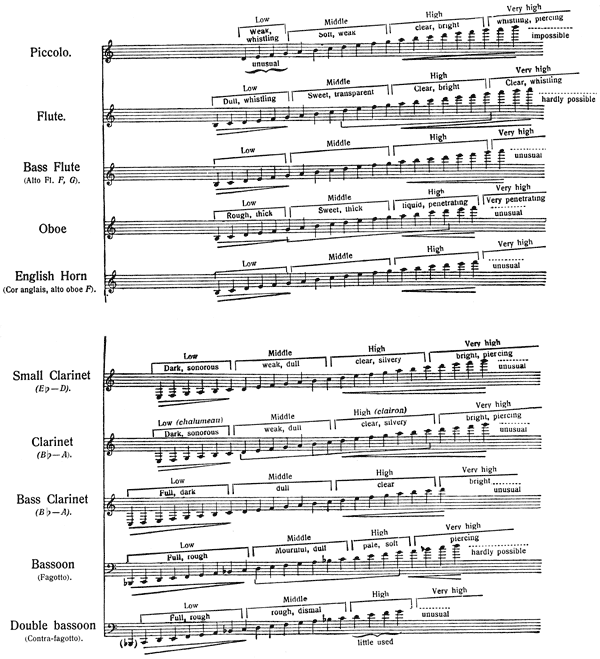
Note. It is a difficult matter to define tone quality in words; we must encroach upon the domain of sight, feeling, and even taste. Though borrowed from these senses, I have no doubt as to the appropriateness of my comparisons, but, as a general rule definitions drawn from other sources are too elementary to be applied to music. No condemnatory meaning however should be attached to my descriptions, for in using the terms thick, piercing, shrill, dry, etc. my object is to express artistic fitness in words, rather than material exactitude. Instrumental sounds which have no musical meaning are classed by me in the category of useless sounds, and I refer to them as such, giving my reasons. With the exception of these, the reader is advised to consider all other orchestral timbres beautiful from an artistic point of view, although it is necessary, at times, to put them to other uses. Further on, a table of wind instruments is appended, outlining the approximate limit of range, defining different qualities of tone and indicating the scope of greatest expression (the piccolo and double bassoon excepted).
Flutes and clarinets are the most flexible wood-wind instruments (the flutes in particular), but for expressive power and subtlety in nuances the clarinet supersedes them; this instrument can reduce volume of tone to a mere breath. The nasal instruments, oboe and bassoon, are less mobile and supple; this is accounted for by their double reed, but, having to effect all sorts of scales and rapid passages in common with the flutes and clarinets, oboes and bassoons may be considered melodic instruments in the real sense of the word, only of a more cantabile and peaceful character. In very quick passages they often double the flutes, clarinets or strings.
The four families are equally capable of legato and staccato playing and changing from one to the other in different ways, but distinct and penetrating staccato passages are better suited to the oboes and bassoons, while the flutes and clarinets excel in well-sustained legato phrases. Composite legato passages should be allotted to the first two instruments, composite staccato passages to the latter pair, but these general directions should not deter the orchestrator from adopting the opposite plan.
In comparing the technical individualities of the wood-wind the following fundamental differences should be noted:
a) The rapid repetition of a single note by single tonguing is common to all wind instruments; repetition of a single note by means of double tonguing is only possible on the flute, a reedless instrument.
b) On account of its construction the clarinet is not well adapted to sudden leaps from one octave to another; these skips are easier on flutes, oboes and bassoons.
c) Arpeggios and rapid alternation of two intervals legato sound well on flutes and clarinets, but not on oboes and bassoons.
Wood-wind players cannot manage extremely long sustained passages, as they are compelled to take breath; care must be taken therefore to give them a little rest from time to time. This is unnecessary in the case of string players.
In the endeavour to characterise the timbre of each instrument typical of the four families, from a psychological point of view, I do not hesitate to make the following general remarks which apply generally to the middle and upper registers of each instrument:
a) Flute.—Cold in quality, specially suitable, in the major key, to melodies of light and graceful character; in the minor key, to slight touches of transient sorrow.
b) Oboe.—Artless and gay in the major, pathetic and sad in the minor.
c) Clarinet.—Pliable and expressive, suitable, in the major, to melodies of a joyful or contemplative character, or to outbursts of mirth; in the minor, to sad and reflective melodies or impassioned and dramatic passages.
d) Bassoon.—In the major, an atmosphere of senile mockery; a sad, ailing quality in the minor.
In the extreme registers these instruments convey the following impressions to my mind:
| Low register | Very high register
a) Flute— | Dull, cold | Brilliant
b) Oboe— | Wild | Hard, dry
c) Clarinet— | Ringing, threatening | Piercing
d) Bassoon— | Sinister | Tense.
Note. It is true that no mood or frame of mind, whether it be joyful or sad, meditative or lively, careless or reflective, mocking or distressed can be aroused by one single isolated timbre; it depends more upon the general melodic line, the harmony, rhythm, and dynamic shades of expression, upon the whole formation of a given piece of music. The choice of instruments and timbre to be adopted depends on the position which melody and harmony occupy in the seven-octave scale of the orchestra; for example, a melody of light character in the tenor register could not be given to the flutes, or a sad, plaintive phrase in the high soprano register confided to the bassoons. But the ease with which tone colour can be adapted to expression must not be forgotten, and in the first of these two cases it may be conceded that the mocking character of the bassoon could easily and quite naturally assume a light-hearted aspect, and in the second case, that the slightly melancholy timbre of the flute is somewhat related to the feeling of sorrow and distress with which the passage is to be permeated. The case of a melody coinciding in character with the instrument on which it is played is of special importance, as the effect produced cannot fail to be successful. There are also moments when a composer's artistic feeling prompts him to employ instruments, the character of which is at variance with the written melody (for eccentric, grotesque effects, etc.).
The following remarks illustrate the characteristics, timbre, and employment of special instruments:
The duty of the piccolo and small clarinet is, principally, to extend the range of the ordinary flute and clarinet in the high register. The whistling, piercing quality of the piccolo in its highest compass is extraordinarily powerful, but does not lend itself to more moderate shades of expression. The small clarinet in its highest register is more penetrating than the ordinary clarinet. The low and middle range of the piccolo and small clarinet correspond to the same register in the normal flute and clarinet, but the tone is so much weaker that it is of little service in those regions. The double bassoon extends the range of the ordinary bassoon in the low register. The characteristics of the bassoon's low compass are still further accentuated in the corresponding range of the double bassoon, but the middle and upper registers of the latter are by no means so useful. The very deep notes of the double bassoon are remarkably thick and dense in quality, very powerful in piano passages.
Note. Nowadays, when the limits of the orchestral scale are considerably extended (up to the high C of the 7th octave, and down to the low C, 16 ft. contra octave), the piccolo forms an indispensable constituent of the wind-group; similarly, it is recognised that the double bassoon is capable of supplying valuable assistance. The small clarinet is rarely employed and only for colour effects.
The English horn, or alto oboe (oboe in F) is similar in tone to the ordinary oboe, the listless, dreamy quality of its timbre being sweet in the extreme. In the low register it is fairly penetrating. The bass clarinet, though strongly resembling the ordinary clarinet, is of darker colour in the low register and lacks the silvery quality in the upper notes; it is incapable of joyful expression. The bass flute is an instrument seldom used even today; it possesses the same features as the flute, but it is colder in colour, and crystalline in the middle and high regions. These three particular instruments, apart from extending the low registers of the instruments to which they belong, have their own distinctive peculiarities of timbre, and are often used in the orchestra, as solo instruments, clearly exposed.
Note. Of the six special instruments referred to above, the piccolo and double bassoon were the first to be used in the orchestra; the latter, however, was neglected after Beethoven's death and did not reappear until towards the end of the 19th century. The Eng. horn and bass clarinet were employed initially during the first half of the same century by Berlioz, Meyerbeer, and others, and for some time retained their position as extras, to become, later on, permanent orchestral factors, first in the theatre, then in the concert room. Very few attempts have been made to introduce the small clarinet into the orchestra (Berlioz etc.); this instrument together with the bass flute is used in my opera-ballet Mlada (1892), and also in my most recent compositions, The Christmas Night, and Sadko; the bass flute will also be found in The Legend of the Invisible City of Kitesh, and in the revised version of "Ivan the Terrible".
Of late years the habit of muting the wood-wind has come into fashion. This is done by inserting a soft pad, or a piece of rolled-up cloth into the bell of the instrument. Mutes deaden the tone of oboes, Eng. horns, and bassoons to such an extent that it is possible for these instruments to attain the extreme limit of pianissimo playing. The muting of clarinets is unnecessary, as they can play quite softly enough without artificial means. It has not yet been discovered how to mute the flutes; such a discovery would render great service to the piccolo. The lowest notes on the bassoon,
Music: B1 and on the oboe and Eng. horn Music: B3


are impossible when the instruments are muted. Mutes have no effect in the highest register of wind instruments.