Playable Books
C. H. Kitson · section 3 of 10
Chapter I. First Species
Read and hear this section in the playable edition →1. In all purely technical exercises there is a given vocal part in semibreves called the Canto Fermo (fixed song). This begins with Tonic or Dominant, and invariably ends by proceeding from Supertonic to Tonic:

2. To such a Canto Fermo (termed for short, the C. F.) another vocal part is to be added above or below, as directed, also moving simultaneously in semibreves:


This added part is termed the Counterpoint.
3. Harmonic intervals available
In writing a Counterpoint to the C. F. in First Species (note against note) the only harmonic intervals available are:
(a) Unison; only in the first and last bars.
(b) Octave.
(c) Perfect fifth.
(d) Major or minor third.
(e) Major or minor sixth.
(a), (b), and (c) are termed perfect concords; (d) and (e) are termed imperfect concords.
4. The Beginning
(a) The C. F. will start with Tonic or Dominant, generally the former.
(b) The Counterpoint must form with its first note a Perfect Concord:


If the C. F. be the higher part, and if it begins with the Tonic, do not add the fifth below it:
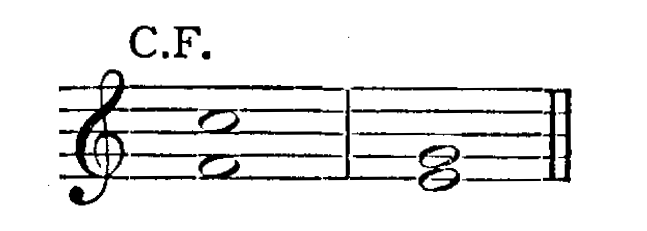
This would give the impression that the key was F major.
5. The Ending or Cadence
As the C. F. proceeds from Supertonic to Tonic, the Counterpoint must proceed from Leading Note to Tonic:
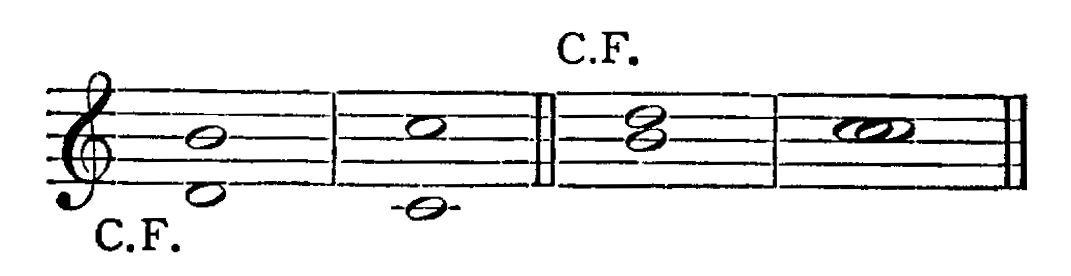
Intermediate notes can be harmonized with perfect or imperfect concords. The latter should predominate.
6. Laws of Harmonic Progression
(a) Consecutive octaves or fifths are forbidden:
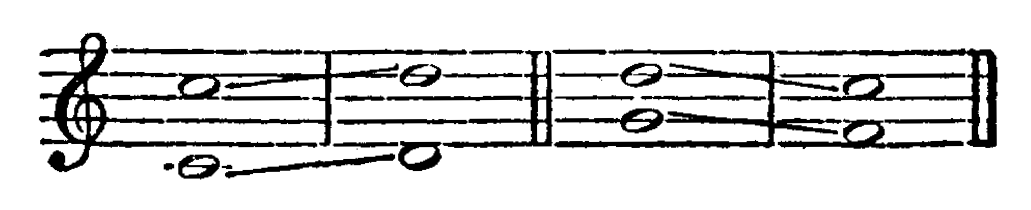
(b) The octave or fifth should only be approached in similar motion if the higher part moves by step, and if the chords involved are primary triads (I, IV, and V):

(c) If both parts move by step, the interval of the augmented fourth must not occur between them in consecutive chords:

(d) Chromatic semitones are not available:
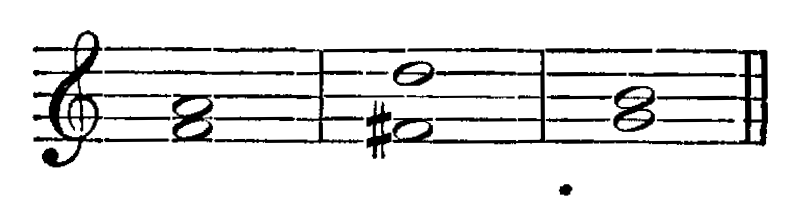
(e) As a rule not more than three consecutive thirds or sixths should be used in similar motion, else the Counterpoint becomes a mere duplication of the C. F. at another interval:

(f) The parts should not overlap:
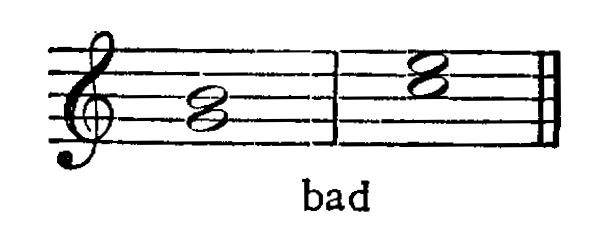
(g) The parts may cross in moderation, in order to produce better melody:
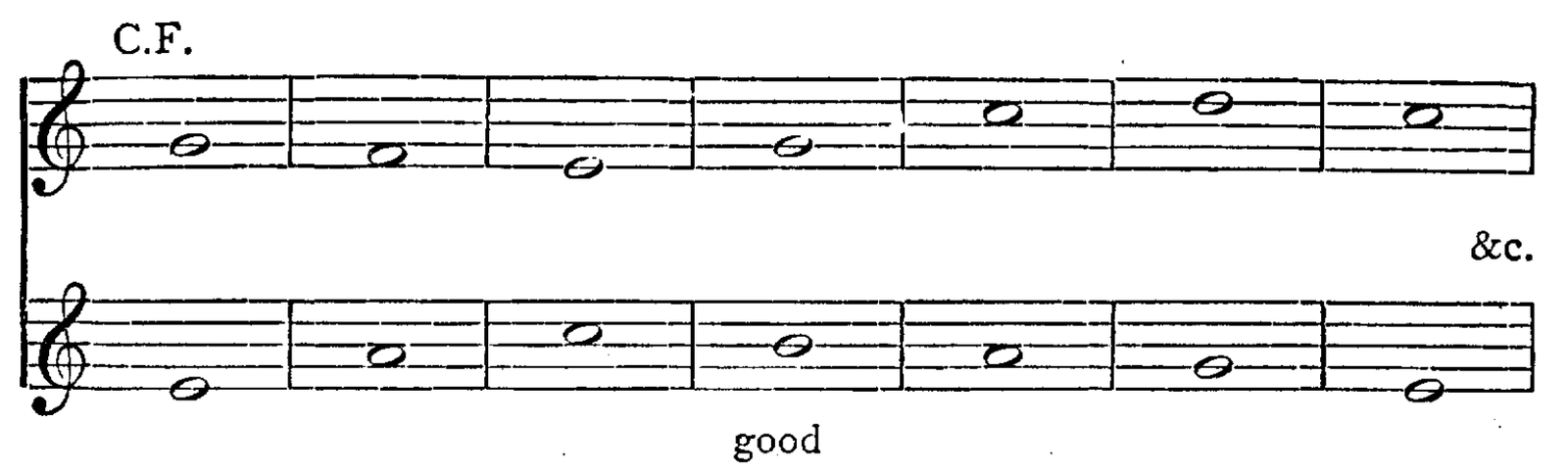

(h) Do not double the Leading Note.
7. Laws of Melodic Progression
(a) A part may not leap any interval greater than an octave.
(b) A part may not leap a seventh.
(c) A part may not leap a major sixth.
(d) A part may not leap any diminished or augmented interval.
(e) The leap of an octave or minor sixth should be preceded and followed by a note inside that interval:


(f) More than two consecutive leaps in the same direction should be avoided:
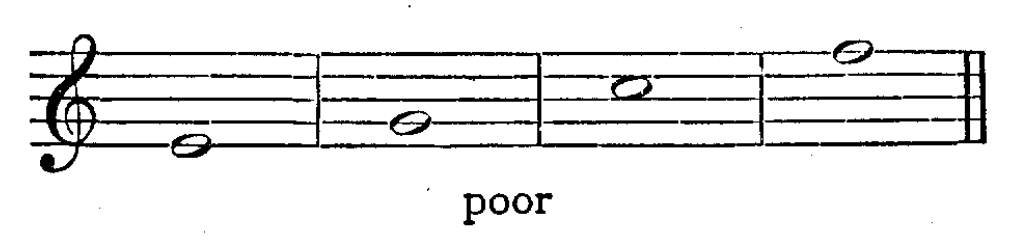
(g) The extremities of two consecutive leaps in the same direction may form a minor seventh, if the next move be in the opposite direction:

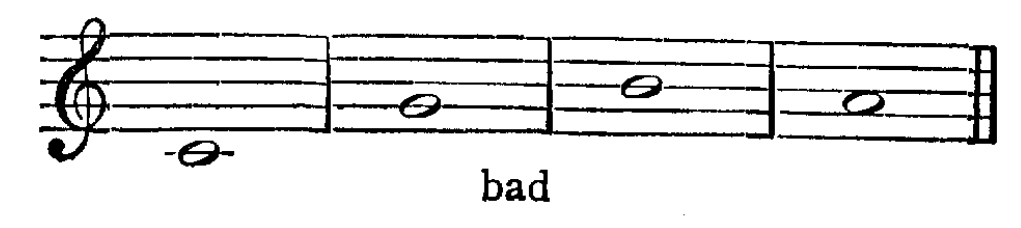
(h) Excessive conjunct movement is as bad as excessive disjunct movement. Beware of melodic tautology:



8. The harmonic implication of two-part writing
(a) In First Species Counterpoint only consonances are available.
(b) Any such intervals in two parts are incomplete forms of triads.
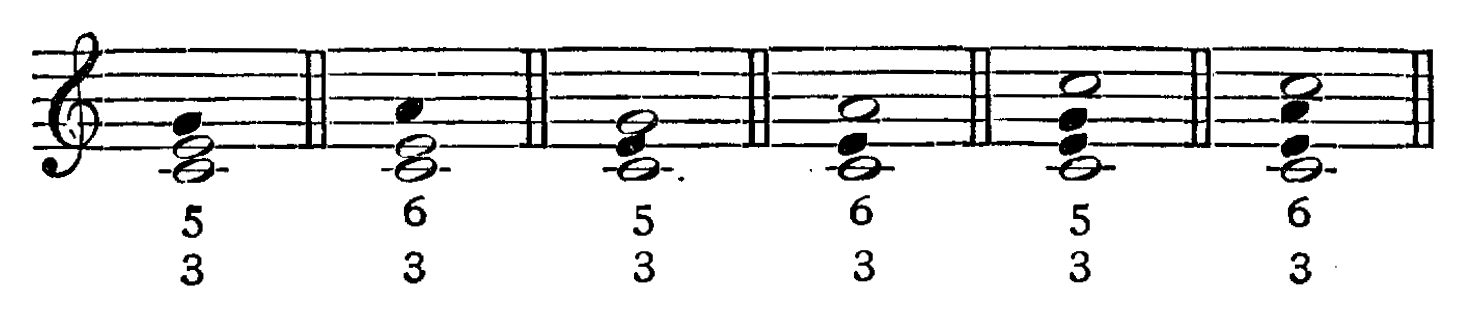
(c) The triads that are available as consonances are the major or minor common chord with its first inversion, and the first inversion of the diminished triad:

(d) It follows that the interval C–E can imply C E G or C E A; the interval C–G can only imply C E G; C–A can only imply C E A; and C–C can imply C E G C, or C E A C.
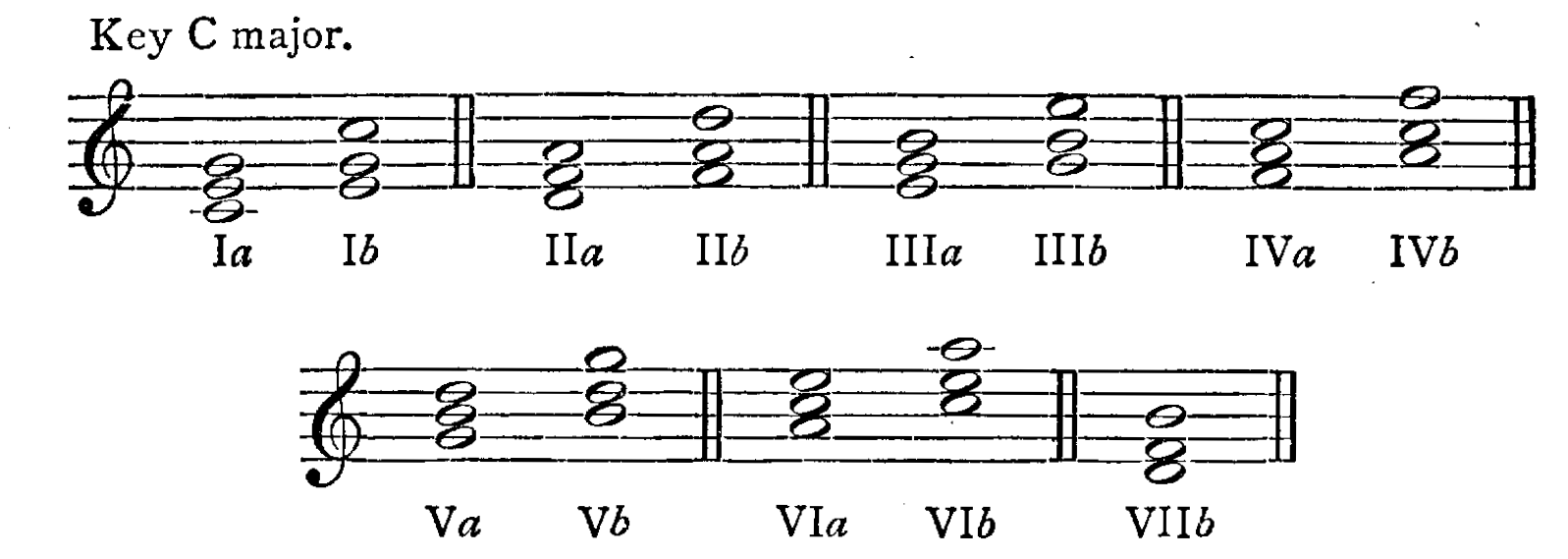
(e) Using the term Ia to imply the Tonic common chord in root position Ib, the same in its first inversion, IIa, Supertonic in root position, IIb, the same in its first inversion, &c., the available resource (as consonances) in the major key is:—Ia, Ib, IIa, IIb, [IIIa, IIIb], IVa, IVb, Va, Vb, VIa, VIb, VIIb.
(f) In the minor key, the harmony is normally derived from the harmonic minor scale:

This gives the following resource:

Thus if the harmony be derived exclusively from the harmonic minor scale, the notes of this scale will be figured as follows:

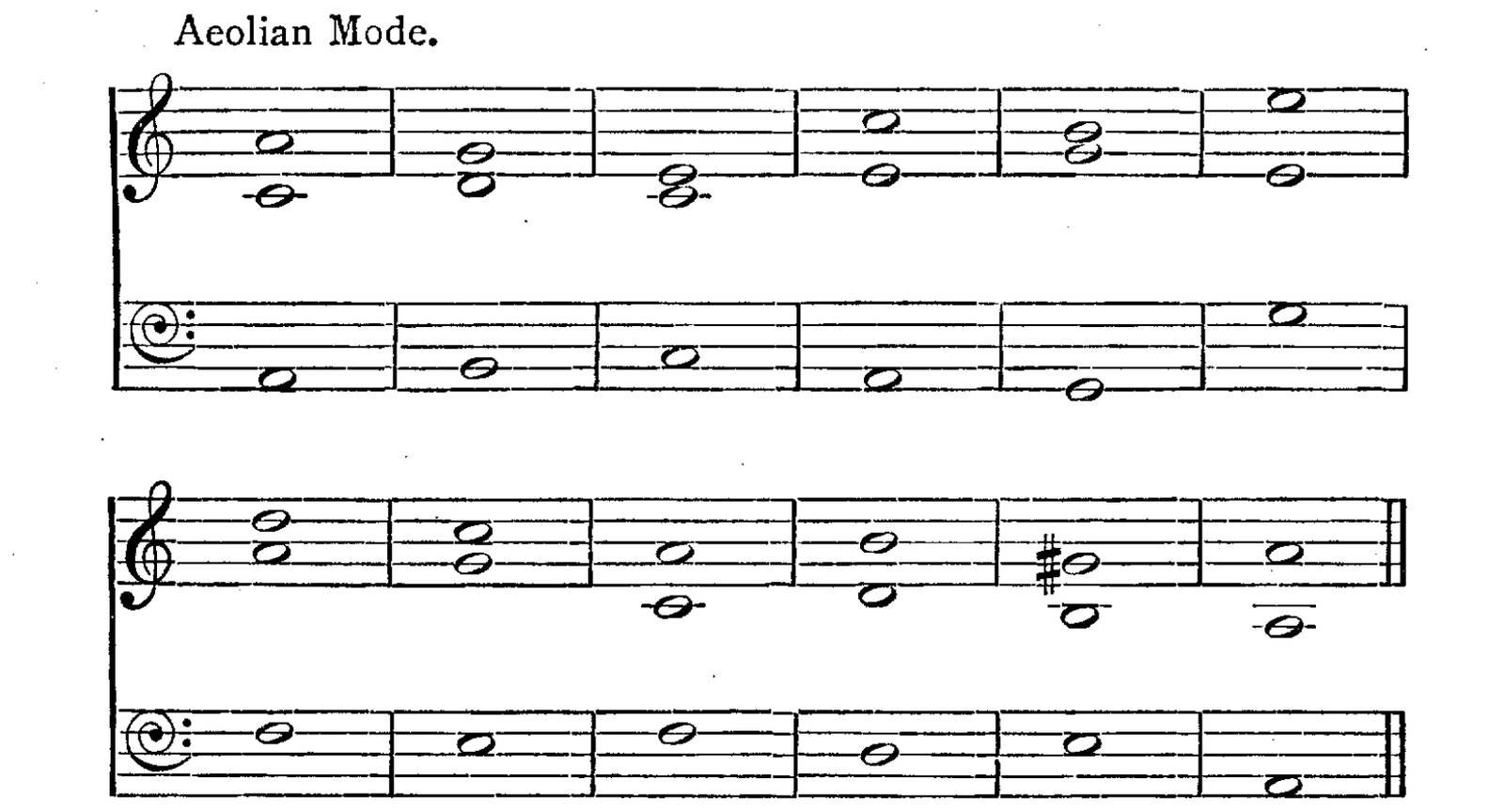
The pupil should get a firm grasp of this harmony before utilizing harmony derived from the melodic minor scale, else he will confuse a minor key with its relative major. This is what to our ears happens with the Aeolian Mode, which is the scale of A minor with F♮ and G♮, except that G♯ is used at the Cadence, and C♯ in the final chord (if any C is used at all).
(g) Harmony is derived from the melodic minor scale thus:
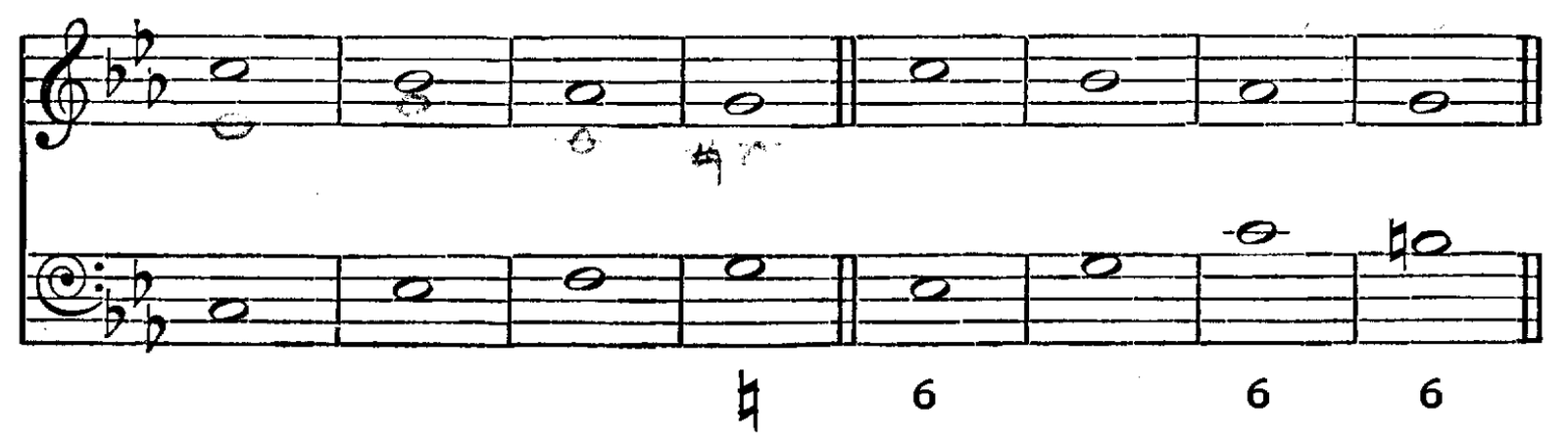
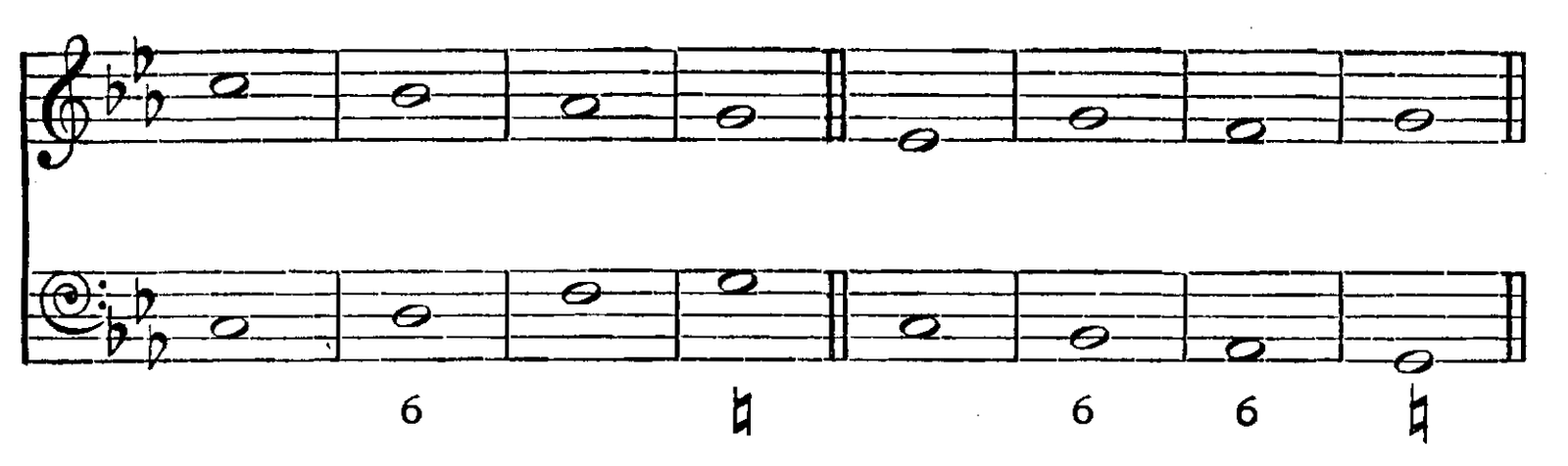
(i) The minor seventh of the scale can be used as a part of a chord if it occurs in a part coming down the scale:

The B♭ is used to avoid the augmented second from B♮ to A♭.
B♭ can be harmonized as the root, third, or fifth of a diatonic triad. The next chord but one (bar 4 in above) should, if possible, have the normal V (G B♮ D):
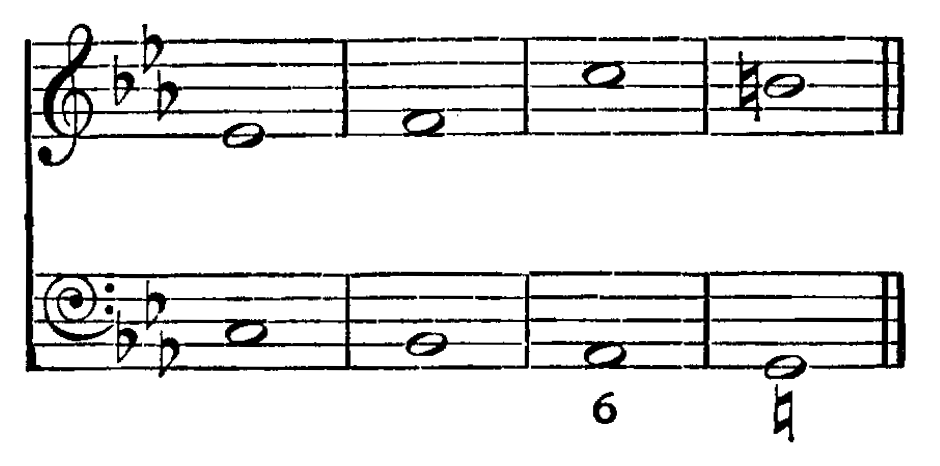
(ii) Similarly the major sixth of the melodic minor scale can be employed, if it is proceeding up the scale:

A♮ can be the root of A C E♭ (first inversion only).
A♮ can be the third of F A C.
A♮ can be the fifth of D F A.


(1) Note when the major sixth of the minor scale is in the bass, it can only be harmonized as 6/3. A C E♮ cannot be used, as E♮ does not occur in either forms of the scale. It is only used for the final chord as a Tierce de Picardie.
If the minor seventh of the minor scale be used as a harmony note in any other way than as shown above, presume a modulation to the relative major for a few bars:
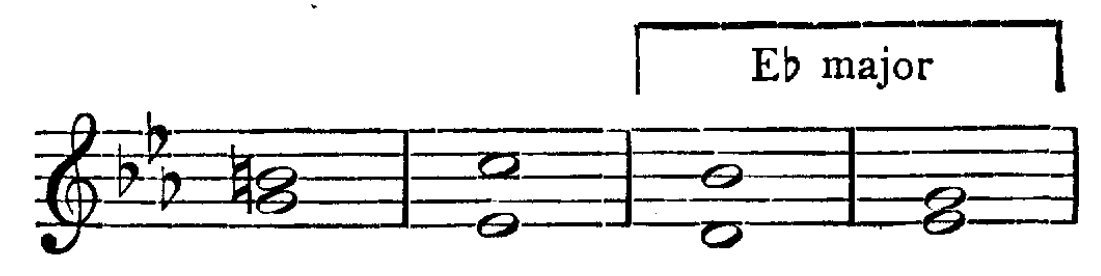
But it is unwise to insist upon a rigid adherence to the harmonic implication in the following cases:
(α) Major Key (C).
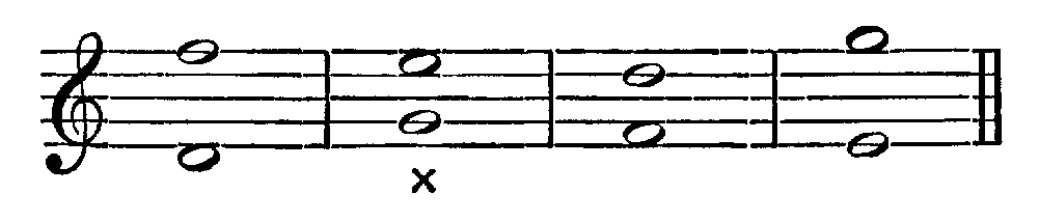
Whatever be the harmonic implication, the combination is a concord, and the effect is good.
(β) Minor Key (C minor).

If the implied available harmony were completed here, the passage could not stand:

But the passage is quite good in effect in two parts: it is technically correct, and one may mentally supply any sounds one pleases. They are not there:

Trouble would arise in three parts.
9. Elementary Principles of Chord Progression
Good contrapuntal effect depends largely upon the judicious choice of harmony. Thus if the C. F. be the lower part, figure it as a bass in accordance with the resource available. If it be the higher part, add the lower part as a bass and figure it. As it is assumed that the pupil has studied harmony up to diatonic sevenths, including modulation, and the use of diatonic passing and auxiliary notes, this will cause him no difficulty. But it may be well to restate certain important points.
(a) The beginner should avoid IIIa or IIIb unless he is sure of his effects.
The third of the scale will therefore generally be figured 6, the fifth 5/3. The seventh can only be figured 6.

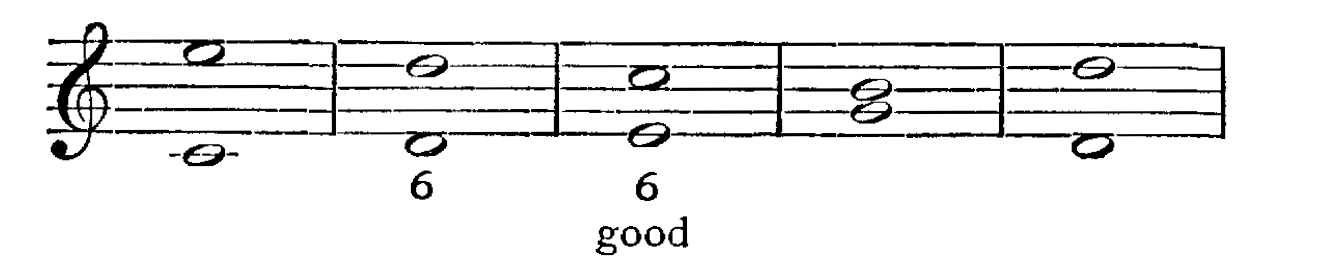
(b) VIIb requires care in the choice of a chord to follow it. Follow it by Ia, Ib, or VIa in the major key, by Ia or Ib in the minor key:

Avoid such progressions as:

A 5/3 on D is much better in effect.
(c) Roots rising a second (both chords being in root position) are good except when involving III or VII:
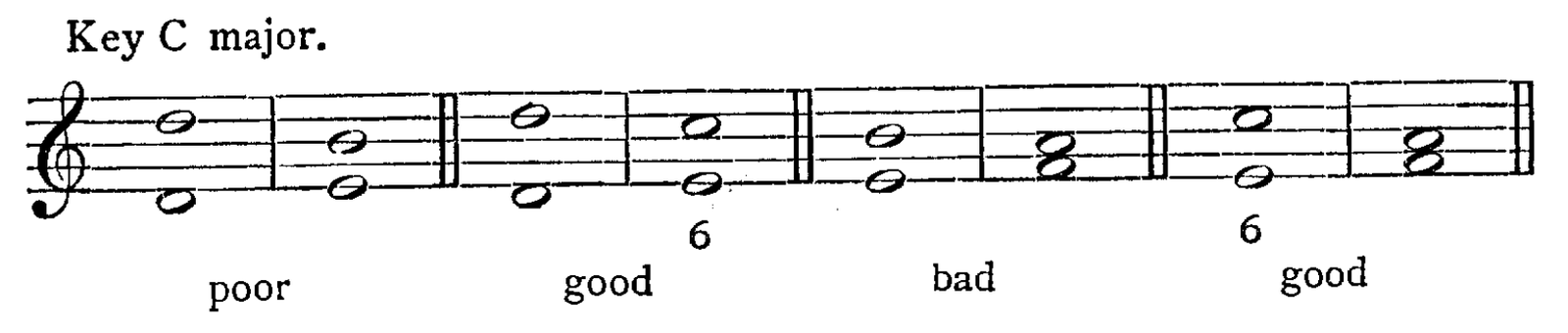
(d) Roots falling a second (both chords being in root position) are poor, except VI to V:

(1) could stand in two parts because C–C might imply C E A C. The context must decide such things.

Note here the force of paragraph (a).
(e) Roots rising or falling a third (both chords being in the root position) are good. But again beware of III.

(f) Roots rising or falling a fourth or fifth are good (both chords being in root position).
(Root rising a third is the same as root falling a sixth. Root falling a third is the same as root rising a sixth. Root rising a fourth is the same as root falling a fifth. Root falling a fourth is the same as root rising a fifth.)
Thus IIIa to VIa is good if properly preceded:

In the minor key, if the harmony be first derived from the harmonic minor scale, there is little chance of going astray, as the chords are limited. Thus in C minor the following figuring is fixed:
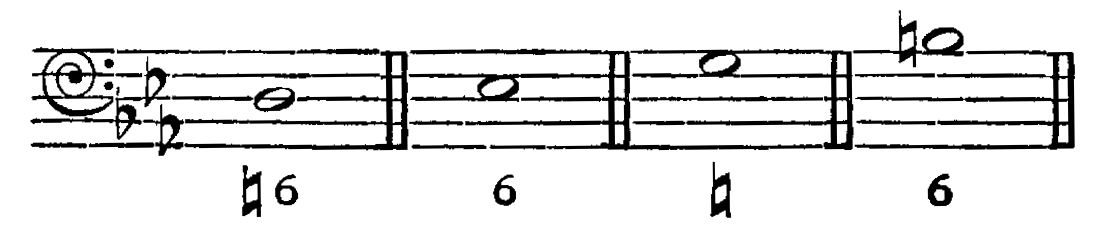
10. A note in First Species may be repeated consecutively once. It is generally better to avoid it in the bass, except from a strong to a weak accent:

11. Diatonic modulation may be used in moderation if the C. F. strongly suggests it:

12. The good or bad choice of harmony depends to some extent on the accentuation of the chords. Therefore in First Species regard the semibreve as indicating 1/1, and group the progressions in duple or triple time as you think fit.
The example in paragraph 11 will be shown below in three different groupings, the effects in which are not all equally good (– = strong accent; ◡ = weak accent).



Note.
(a) The difference in effect between roots rising a third with the accentuation – ◡ and ◡ –. But the differentiation does not always hold good.
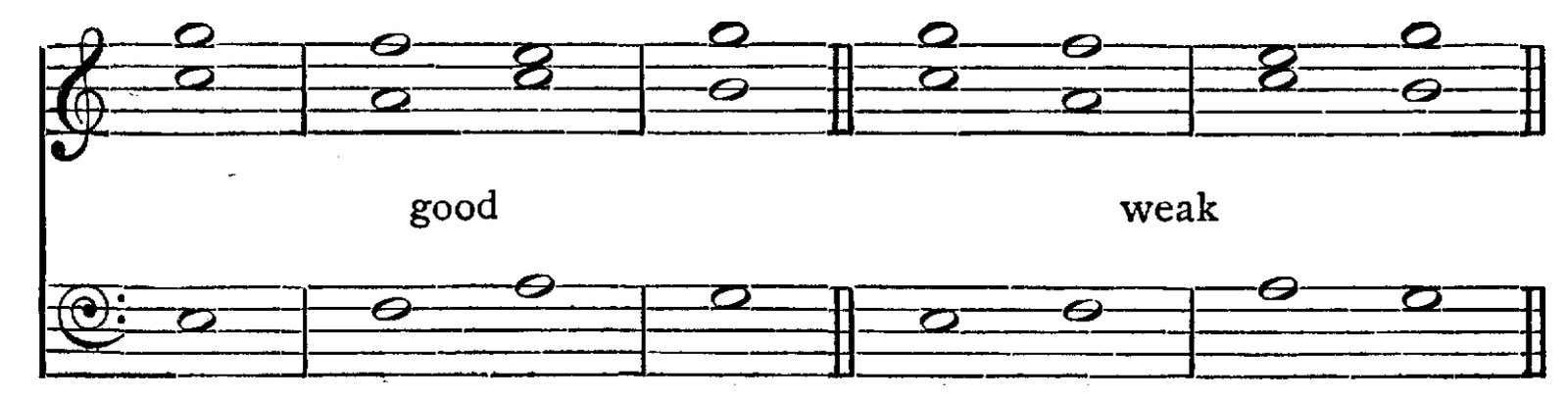
(b) The same in reference to V to VIIb.
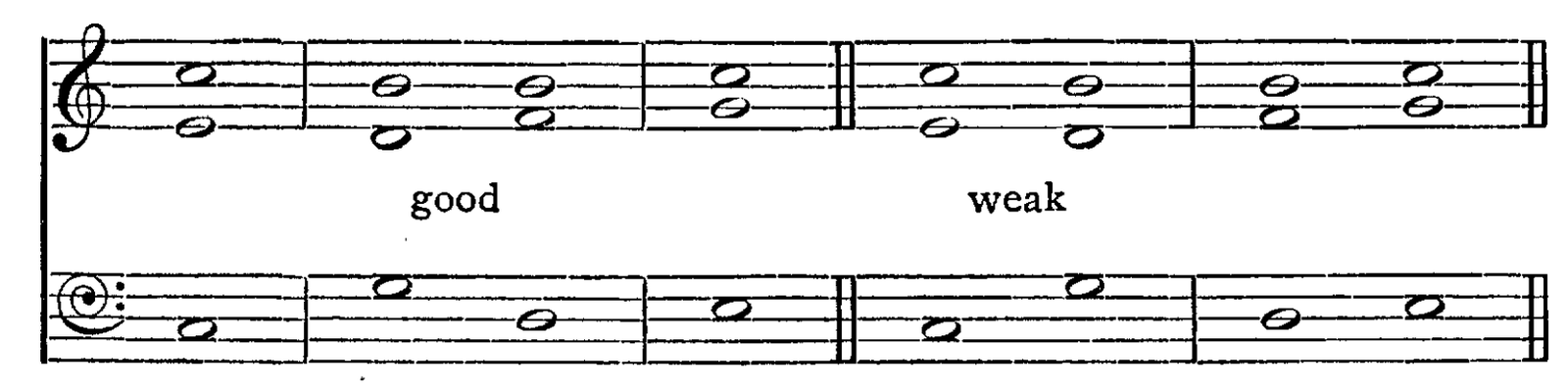
(c) Except at the start the same chord should not be repeated ◡ to –.
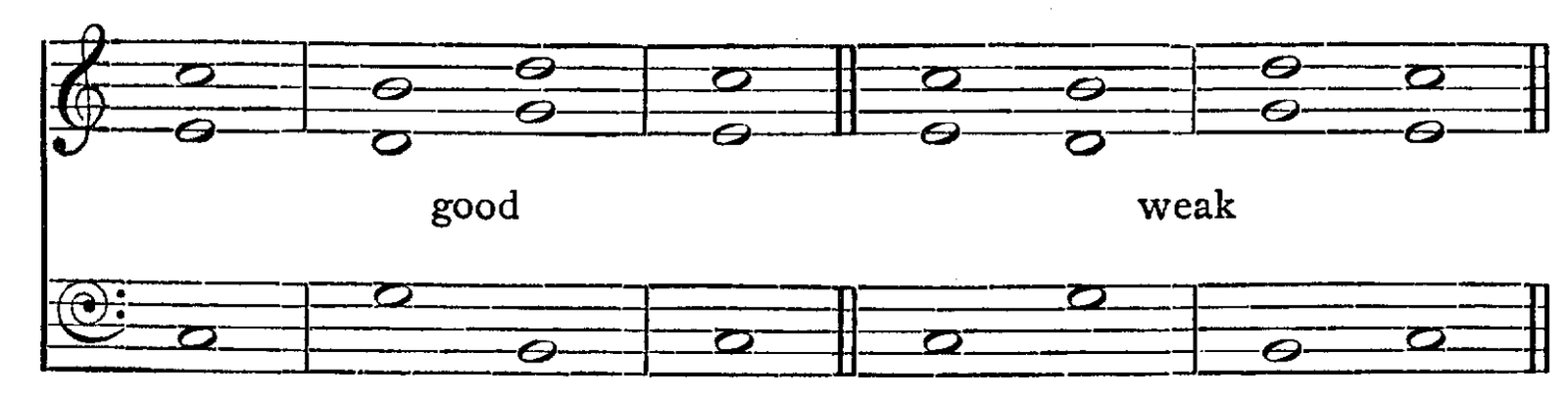
Exposed fifths or octaves with both parts leaping are harmless between two positions of the same chord:

13. First Species in three parts
This will cause no further difficulty.
Note.
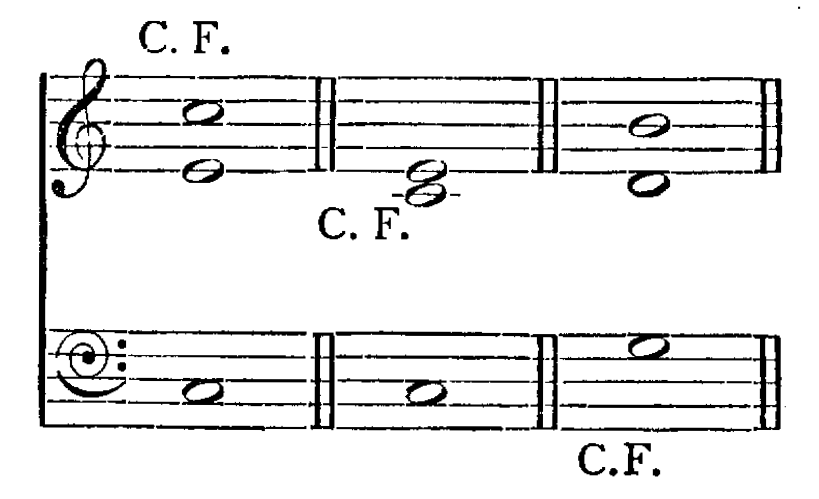
(a) The first chord must be in the root position, and it is sufficient if one part forms a perfect concord with the C. F., which may be at the top, bottom, or in the middle:
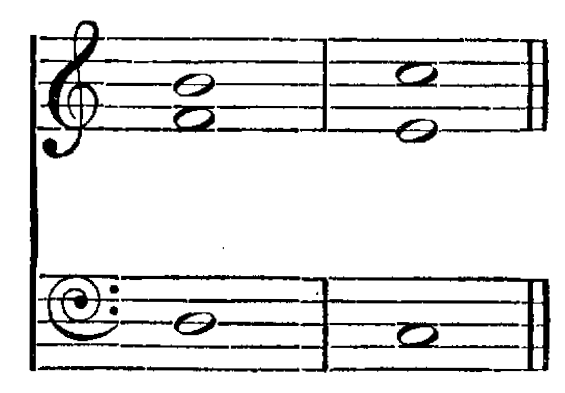
(b) At the Cadence, if the C. F. be in the bass, the penultimate chord must be a 6/3 on the supertonic:
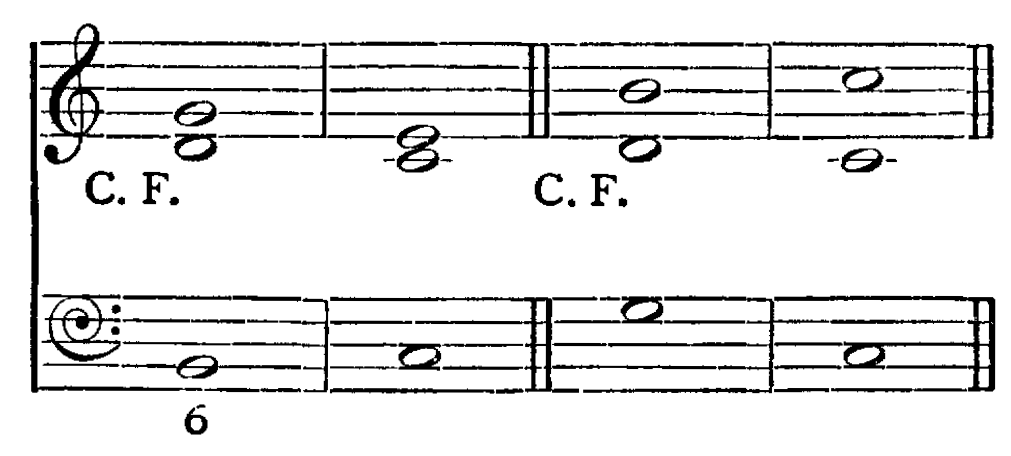
If the C. F. be a higher part, the penultimate chord must be a 5/3 on the dominant, or 6/3 on the Leading Note. The final chord must always be in root position:
(c) Make the harmony as complete as is compatible with good melodic lines in each part.
In the examples the part in crotchets without a stem shows the working in three parts.
It is not always possible to avoid an exposed consecutive between a mean and an extreme part with the higher part leaping. It should be avoided if both parts leap, except between two factors of the same chord.
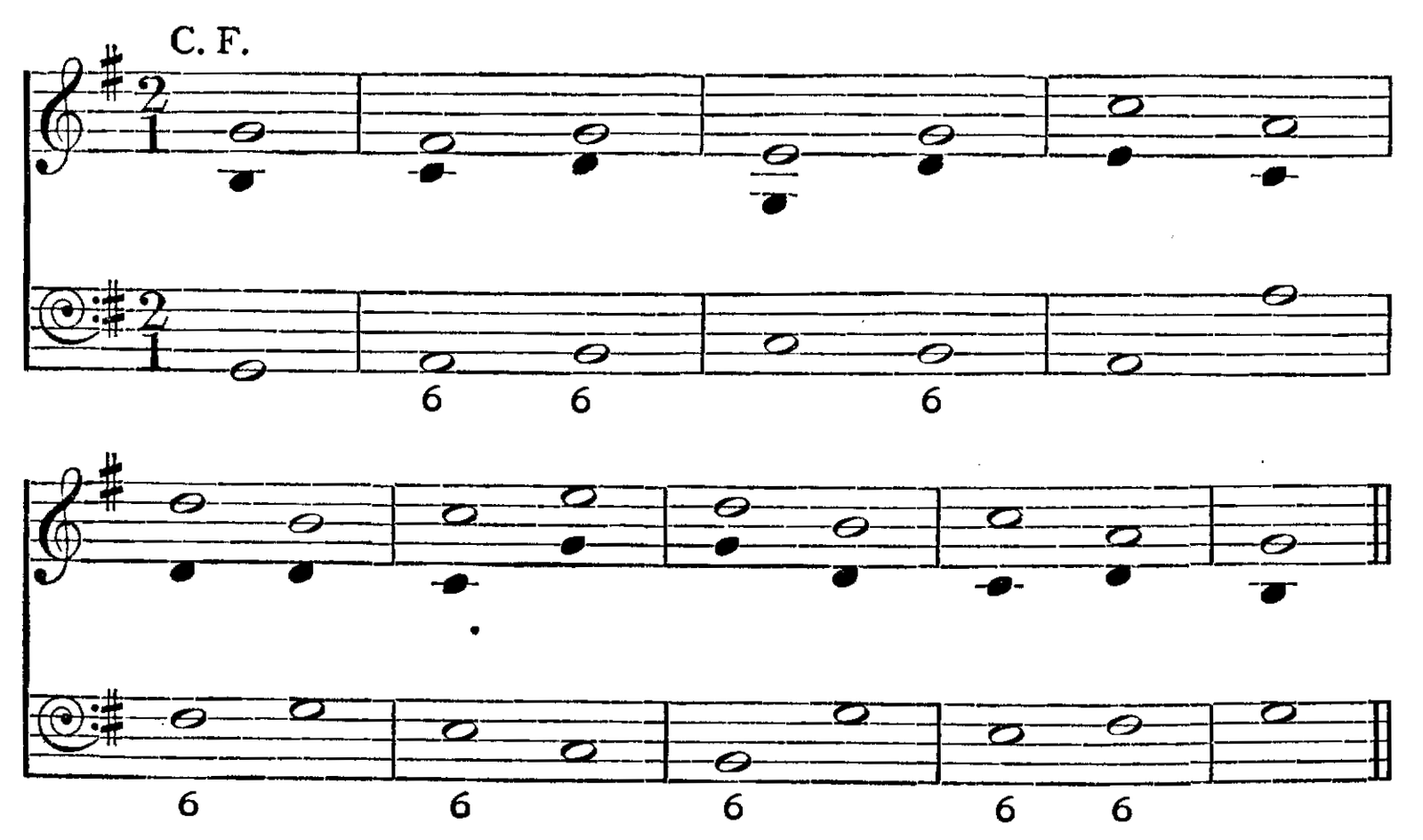
14. The acid test of good two-part writing is that a satisfactory third part can be added, producing sound chord progressions.
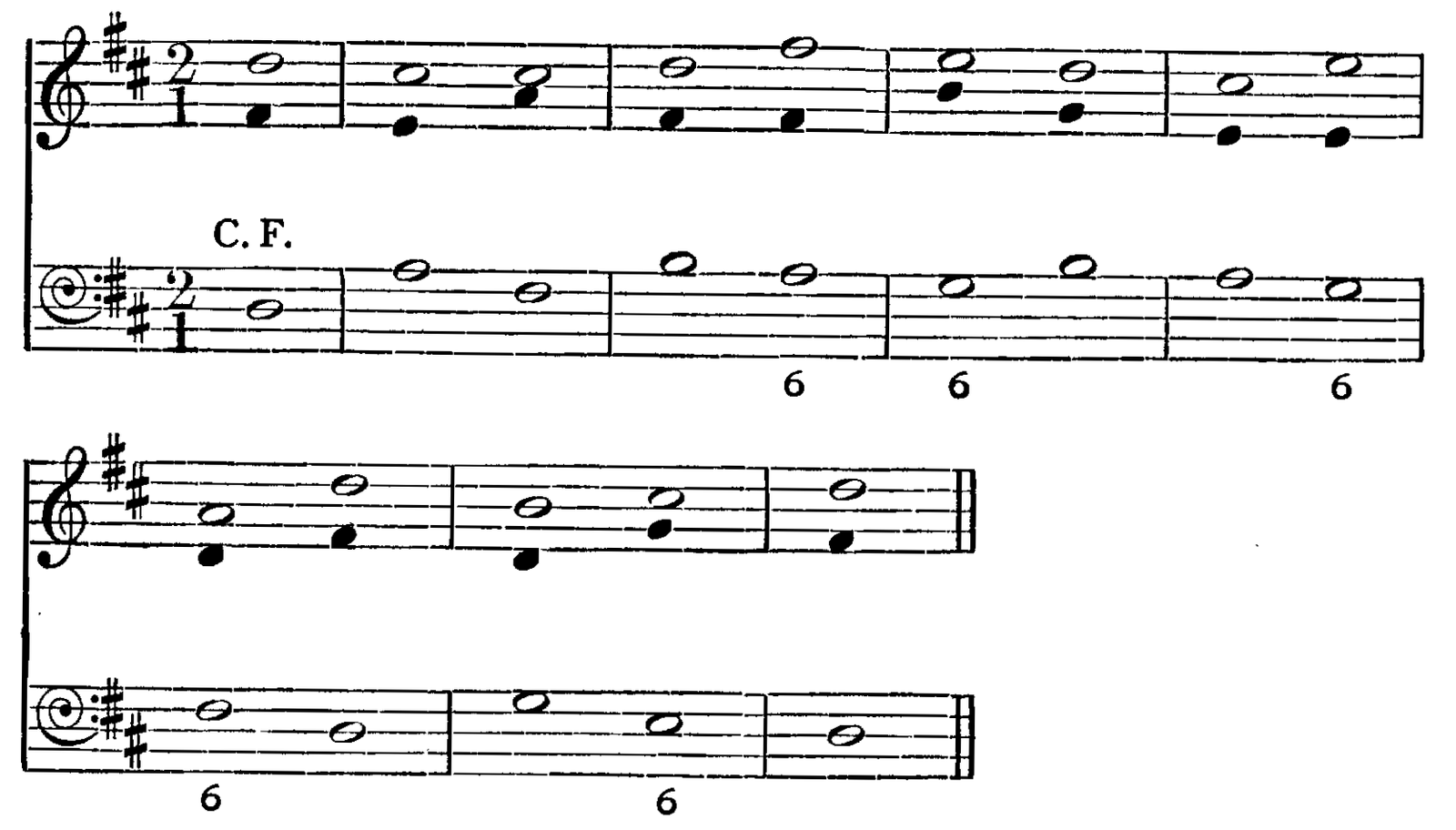
Examples
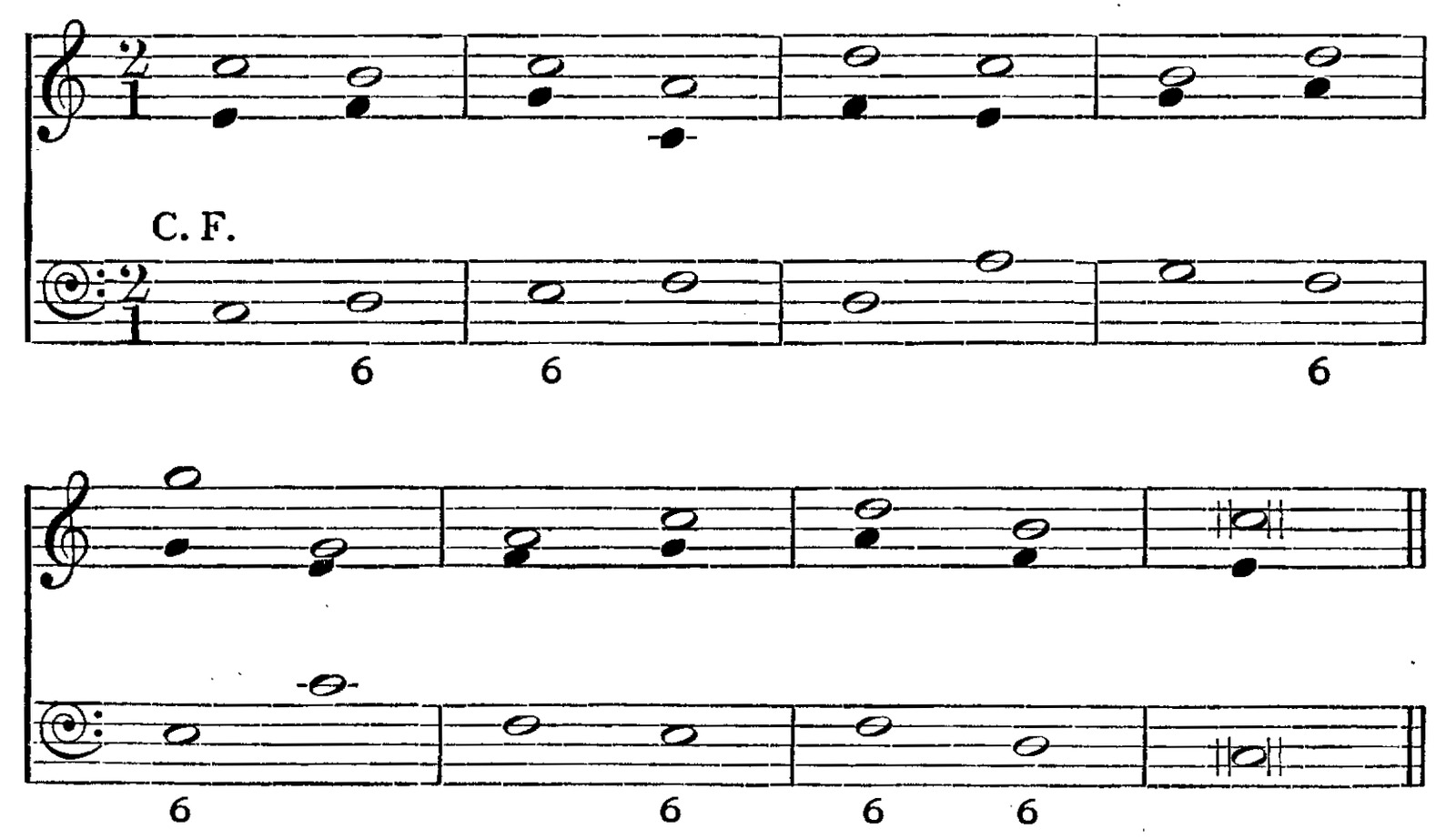
1. Major Key, avoiding the use of IIIa and IIIb:
2. Major Key, introducing IIIa and IIIb:
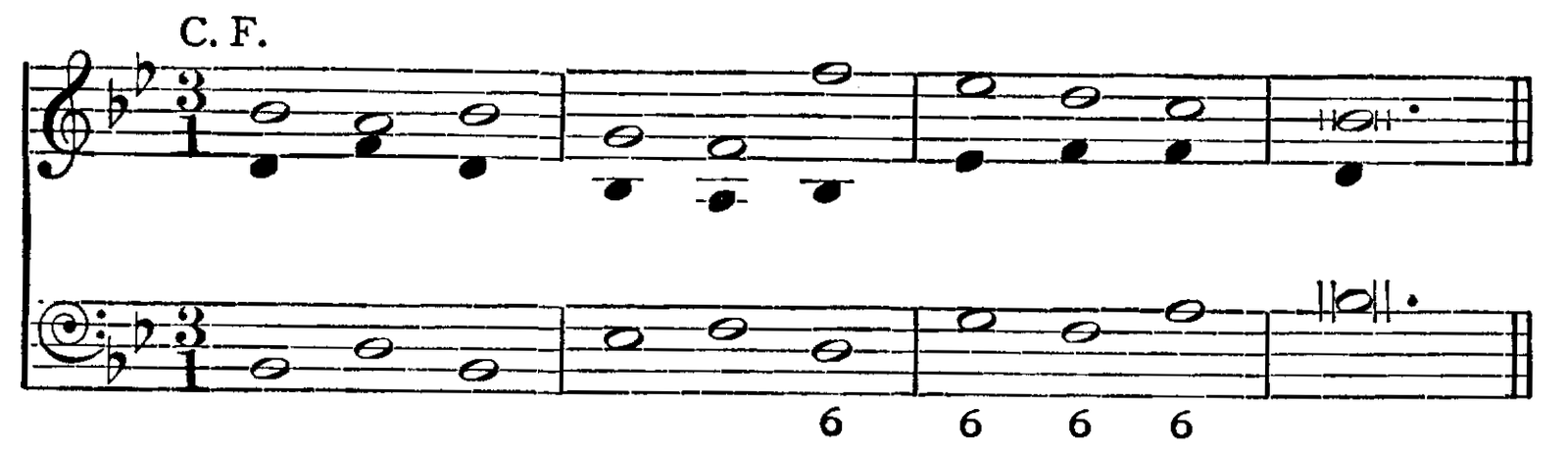
3. Minor Key. Harmony derived from harmonic minor scale only:
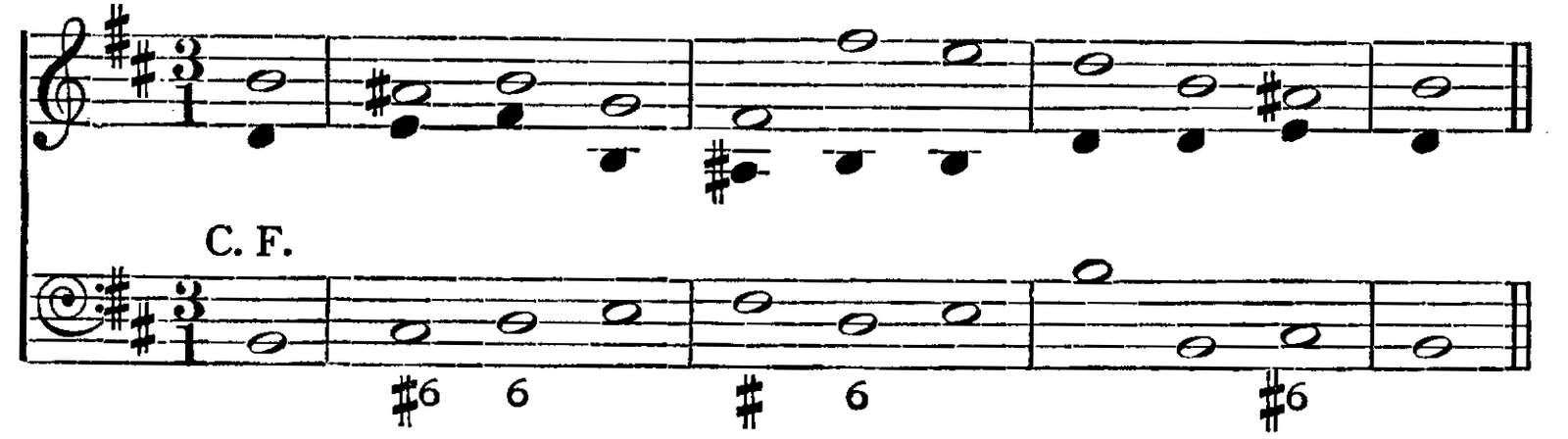
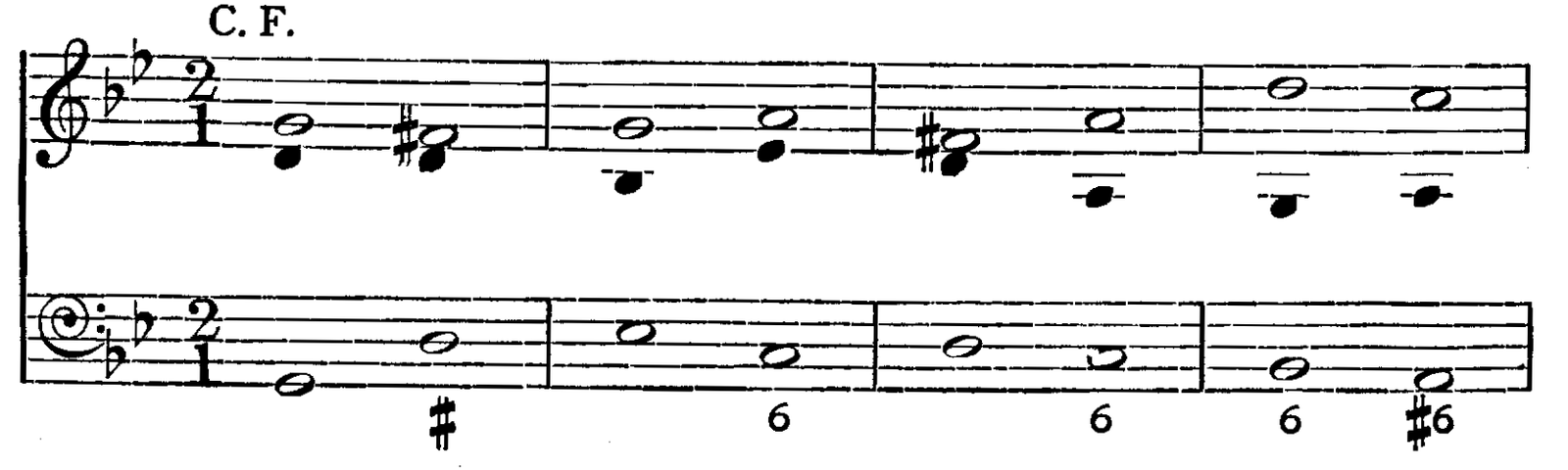
4. Minor Key, with some chords derived from the melodic minor scale:
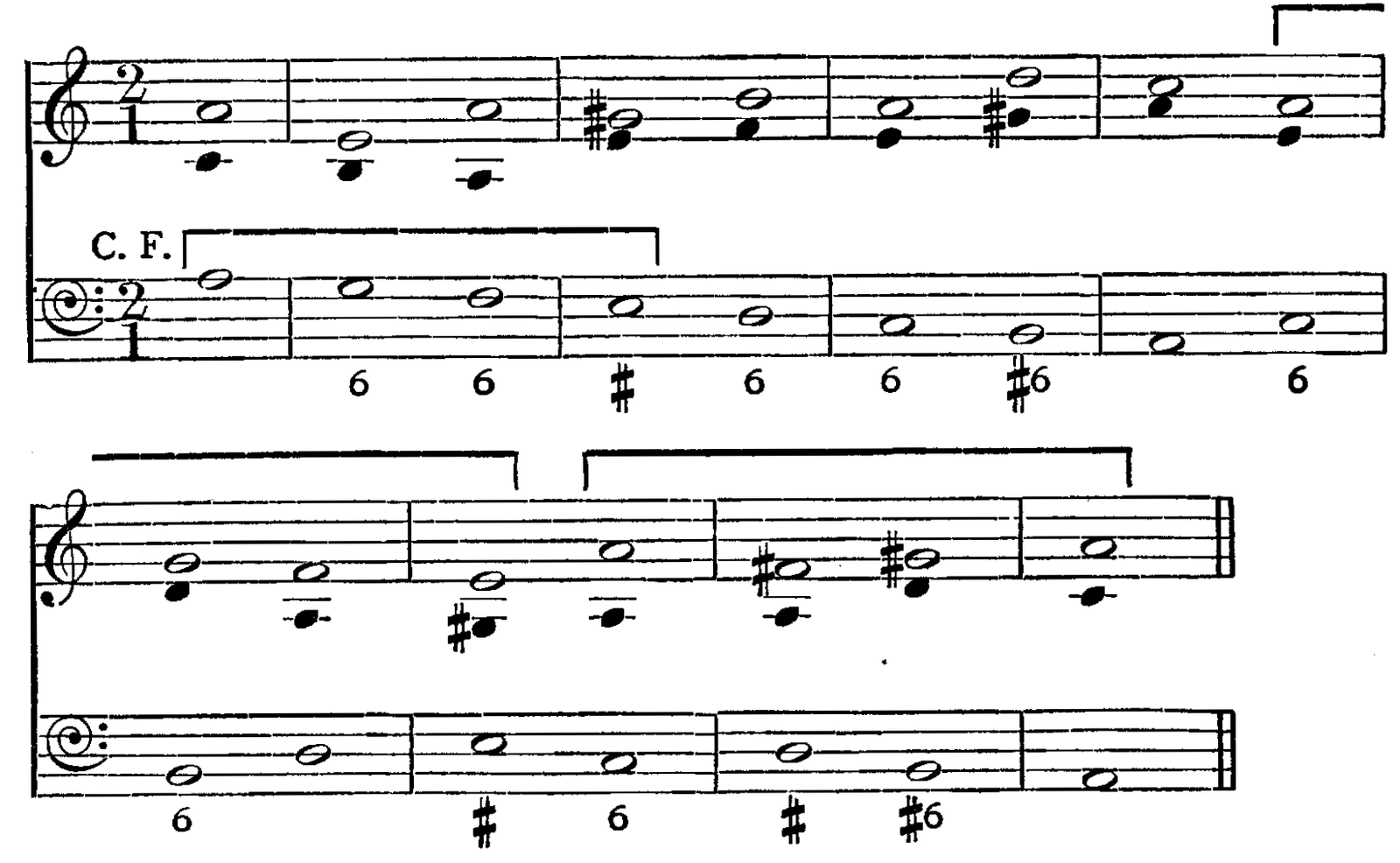
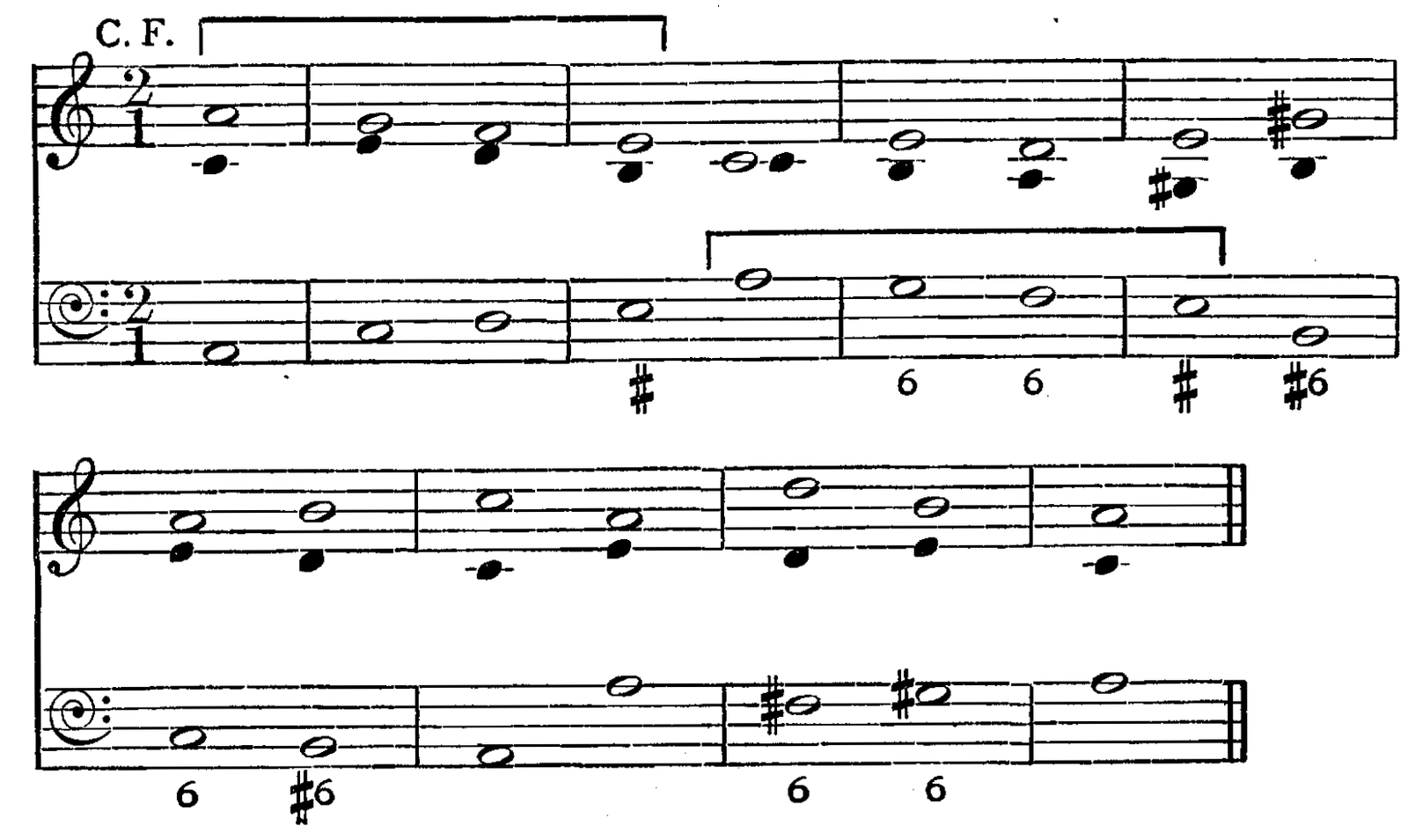
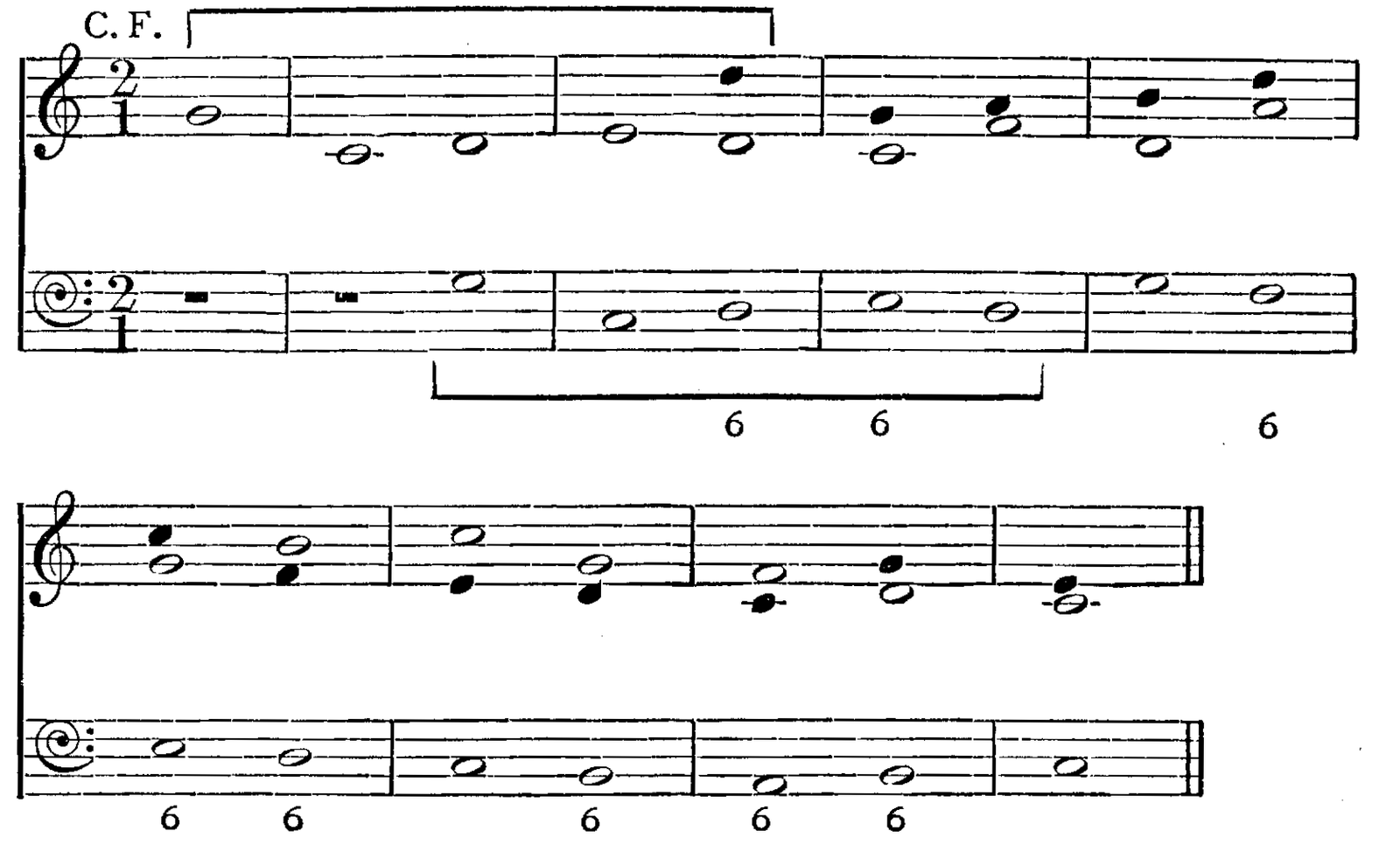
5. The Counterpoint may defer its entry for a bar or two, and then imitate the C. F. for a few bars at any convenient pitch:
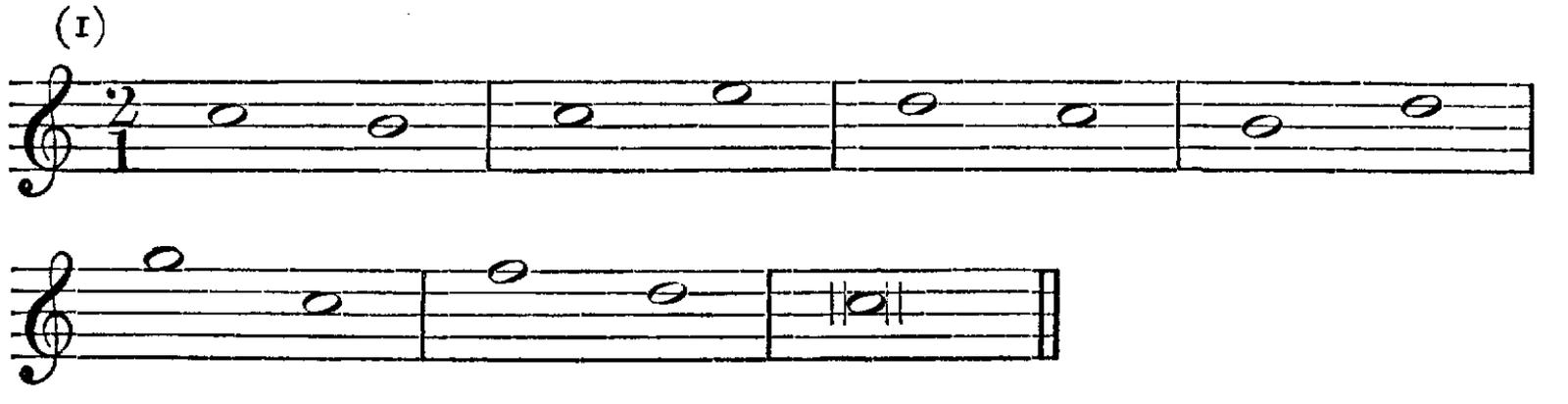
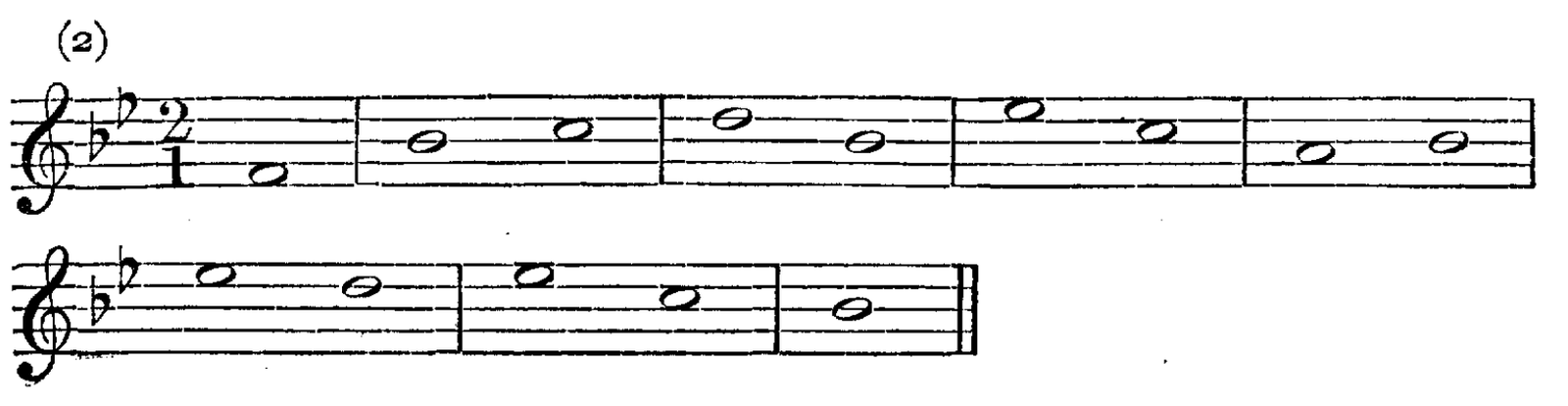
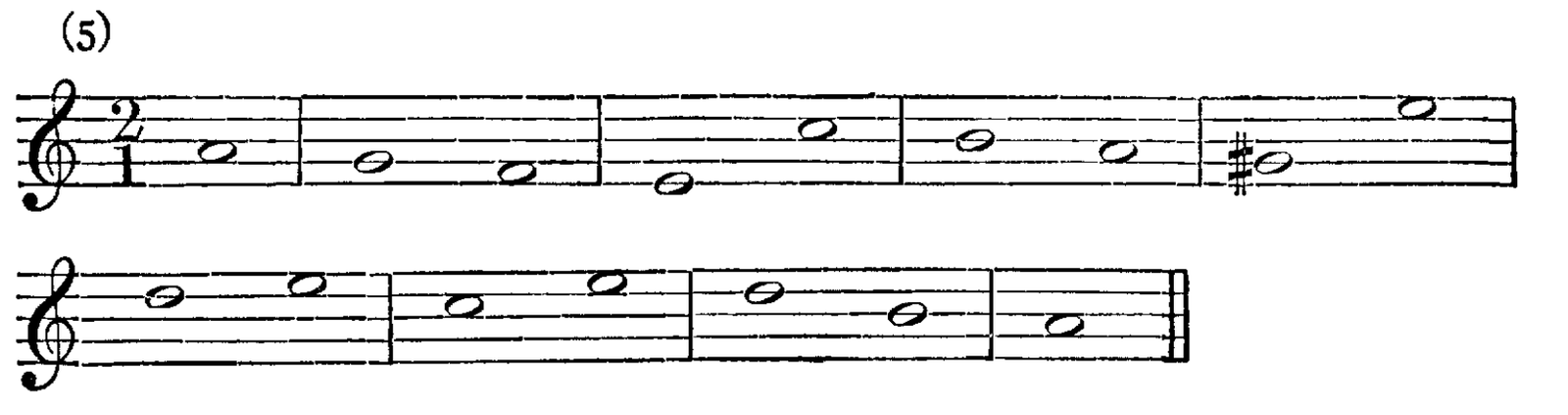
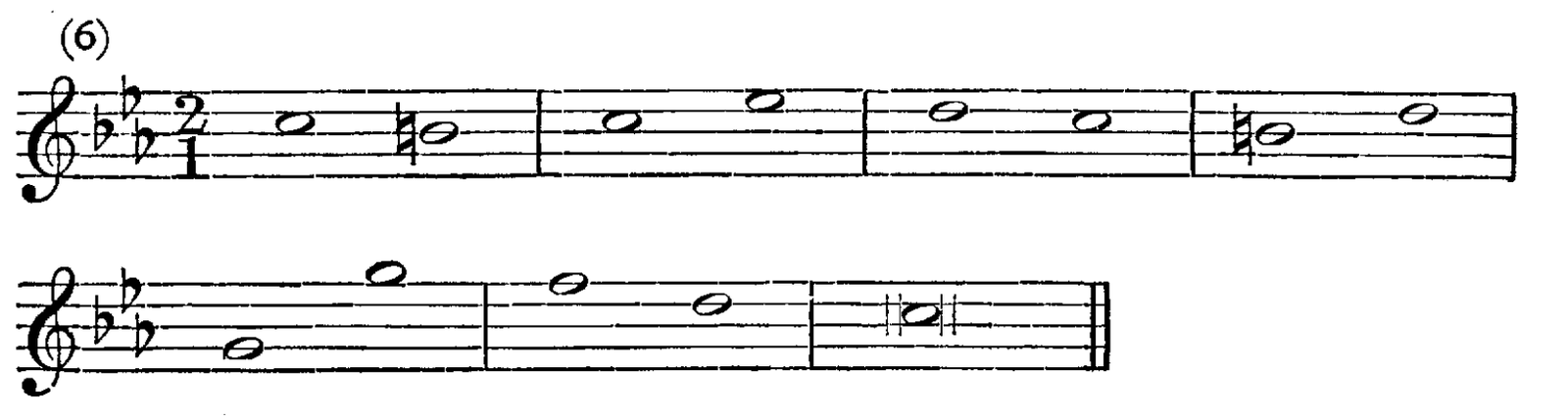
Exercises
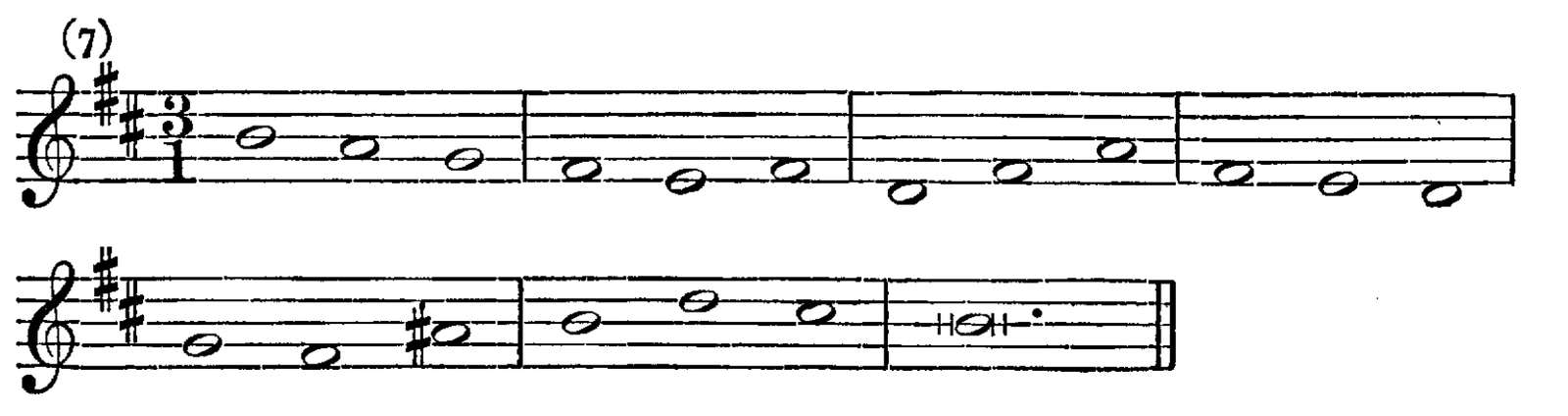
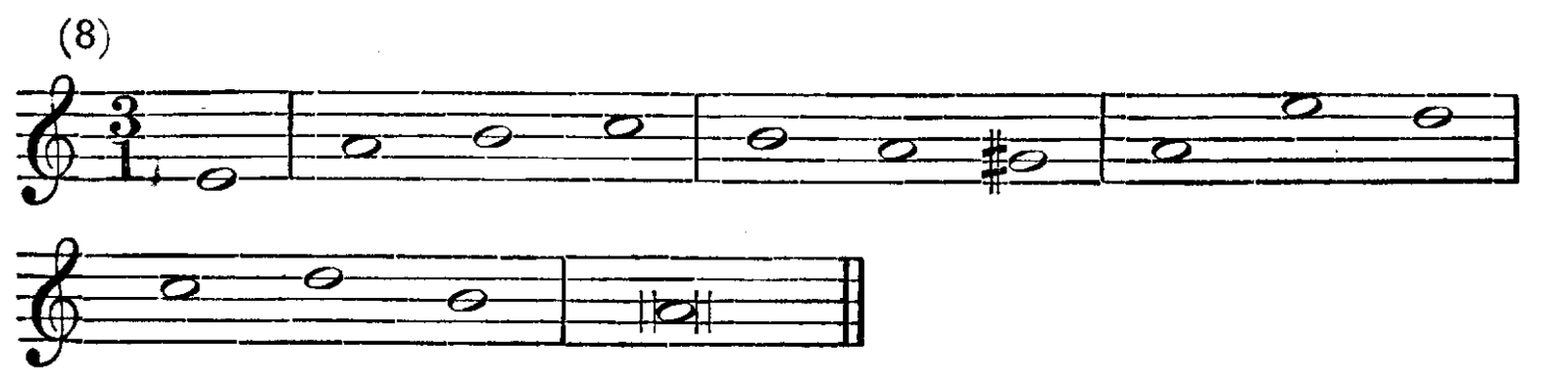
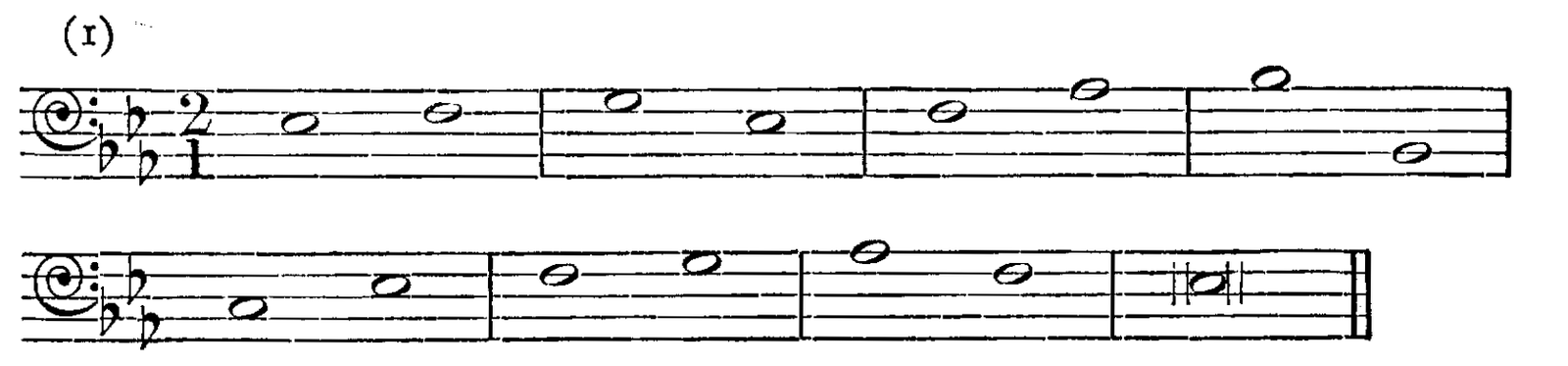
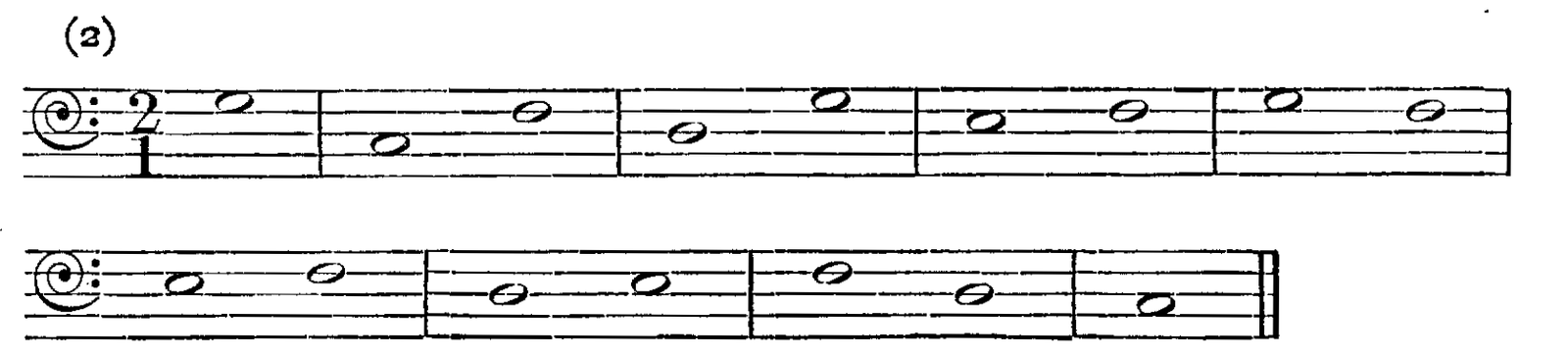
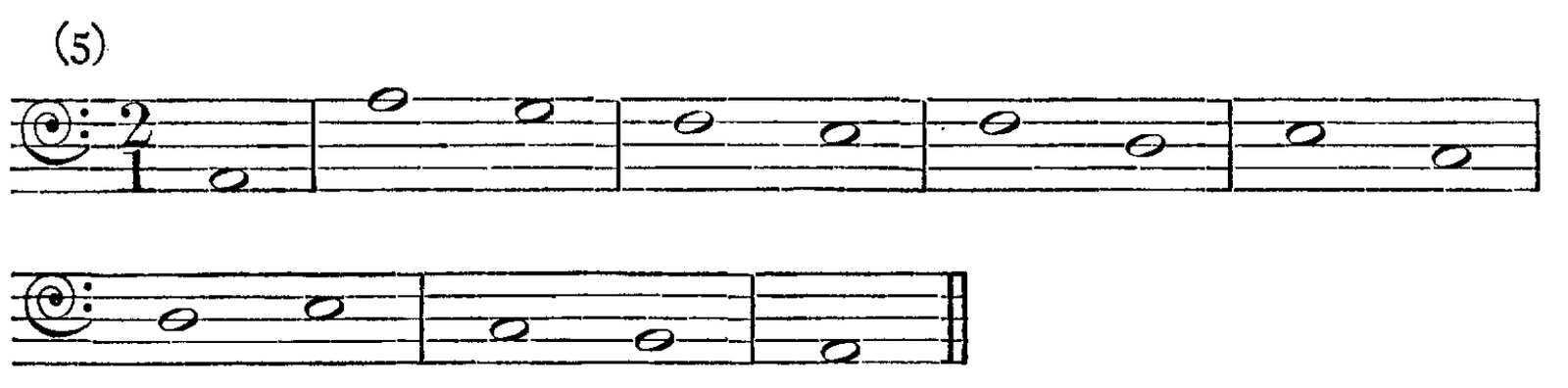
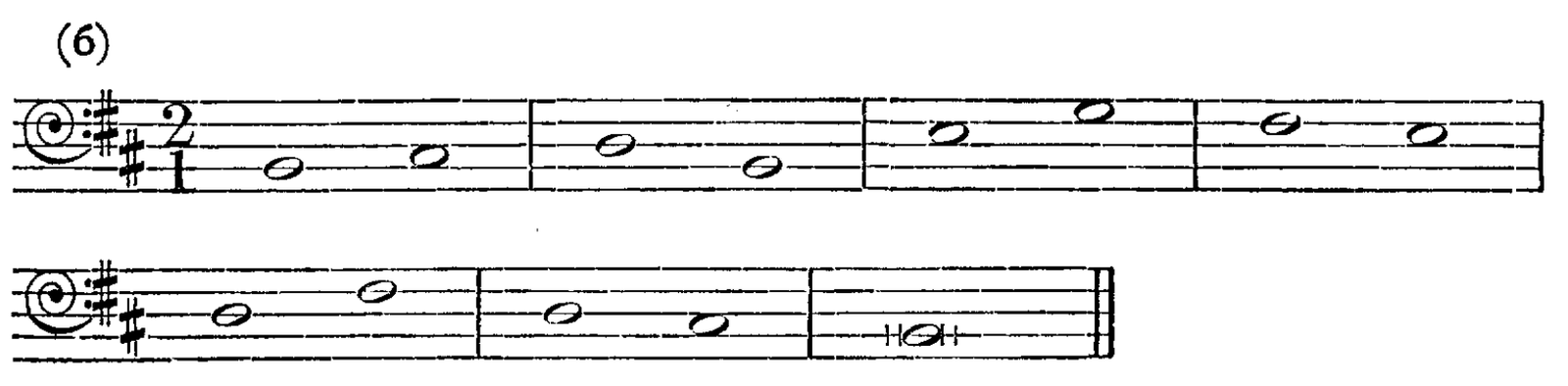
A. Figure the following Bass Canti Fermi, and add (1) Soprano, Alto, or Tenor in First Species, (2) two upper parts in First Species:




B. Add (1) Alto, Tenor, or Bass to the following Canti Fermi in First Species, (2) Alto and Bass in First Species: