 Playable Books
Johann Joseph Fux · section 5 of 32
Fourth species counterpoint: syncopation and suspensions
Read and hear this section in the playable edition →Try it yourself: write ligatures over the barline, and Aloysius marks your line →
 Theory of HarmonyArnold Schoenberg · suspensions
 Practical Manual of HarmonyNikolai Rimsky-Korsakov · suspensions
 Treatise on HarmonyJean-Philippe Rameau · suspensions
 Guide to the Practical Study of HarmonyPyotr Ilyich Tchaikovsky · suspensions
 Exercises in Elementary CounterpointPercy Goetschius · syncopation and the tie
 Complete Method for Rhythmical ArticulationPasquale Bona · syncopation and the tie
Fourth lesson
On the fourth species of counterpoint
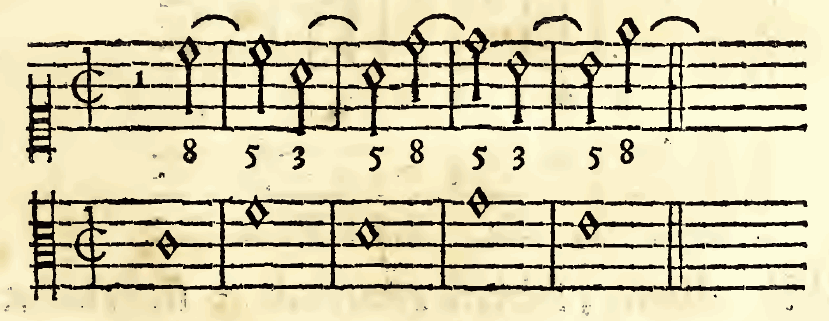
This species consists of two minims against a semibreve, placed at one and the same pitch and joined by a curved line; the first must fall on the arsis and the second on the thesis. This species is customarily called Ligatura, or Syncopation, and is of two kinds: consonant and dissonant.
A consonant ligature is one in which both minims, on the arsis and on the thesis, are consonant. Examples will make the matter clear.
Consonant ligatures
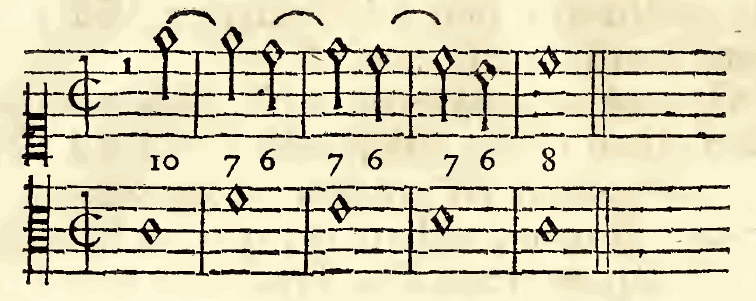
Dissonant ligatures: the first note, namely that on the arsis, is consonant—as it always must be—while the second, on the thesis, is dissonant, as may be seen in the following example.
Dissonant ligatures
Furthermore, since dissonances occur here not accidentally or through diminution, as in the preceding species, but substantially and on the thesis, and since, being displeasing to the ear, they cannot offer anything agreeable of themselves, they must derive their pleasantness from the consonance immediately following, into which they resolve. Therefore we must now speak
On the resolution of dissonances
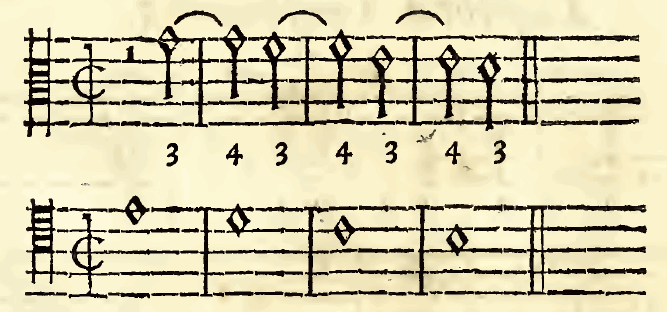
Before I undertake to explain how dissonances are to be resolved, it helps to know that tied notes, as though bound in chains, are nothing other than a delay of the following note; afterward they seem to emerge into freedom, as though released from servitude. For this reason dissonances must always be resolved into the nearest consonance by moving downward by step, as is clearly seen in the following example:
With the delay removed, this example takes the following form:
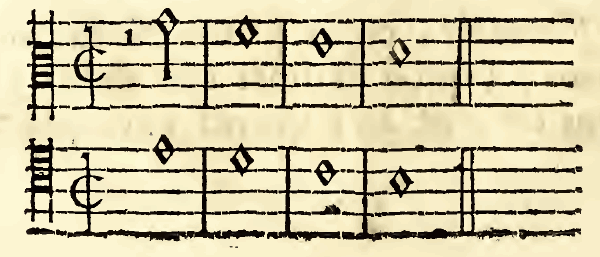
From this it follows that it will be easy to know into which consonance any dissonance must resolve: namely, the one found immediately on the thesis of the following measure when the delay is removed. Hence, when the cantus firmus is in the lower part, a second must resolve to a unison, a fourth to a third, a seventh to a sixth, and a ninth to an octave. This principle is so firmly grounded in truth that, for this reason, it is not permitted to proceed by ligature either from a unison to a second or from an octave to a ninth, as may be seen in the following examples.
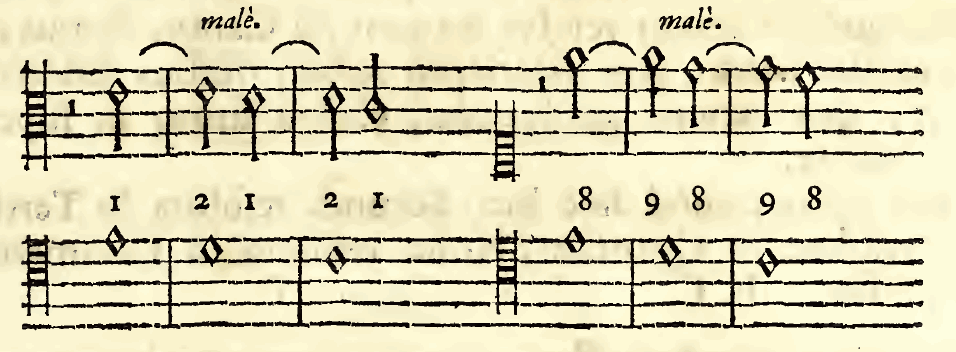
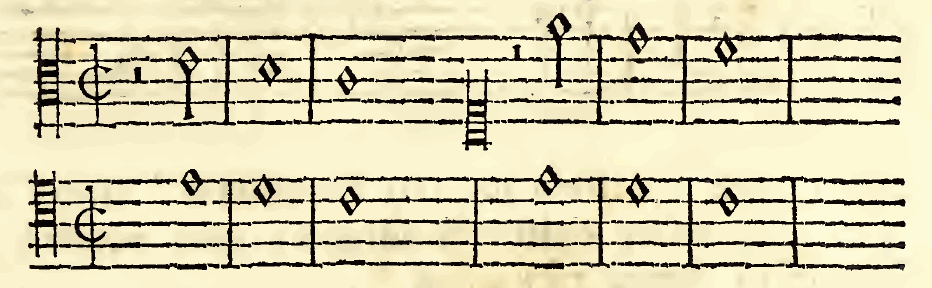
With that delay removed, you will see an immediate succession of two unisons in the first example and two octaves in the second, in this way:
The contrary is the case if the progression is from a third to a second and from a tenth to a ninth, in this way:
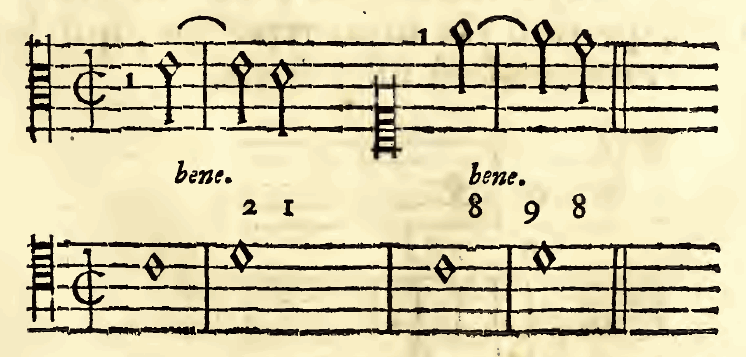
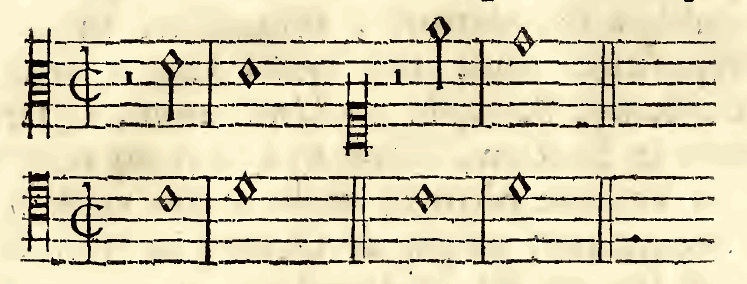
These cases are correct, because they would remain valid even with the delay, or ligature, removed, namely in the following way:
Having shown which dissonances may be used and how they must be resolved when the cantus firmus is in the lower part, it remains to explain which dissonances have a place, and how they must be resolved, when the cantus firmus is in the upper part.
I say, then, that here one may use a second resolved to a third, a fourth resolved to a fifth, and a ninth resolved to a tenth. For example:
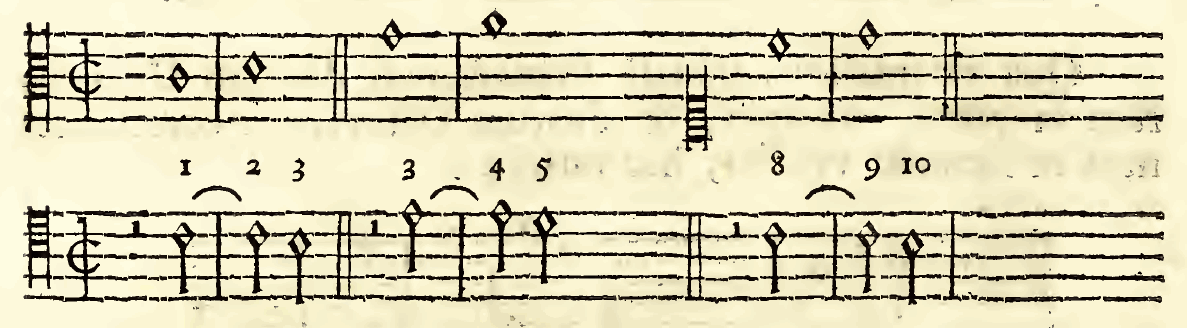
Joseph. Why do you omit the seventh here? Can it therefore not be used when the cantus firmus is in the upper part? Please tell me the reason.
Aloysius. I admit that I deliberately omitted the seventh here. Scarcely any other reason can be offered than the weighty authority of the classical masters, to which great importance must be attached in practice; scarcely any of them can be found to have used a seventh resolved in this way to an octave.
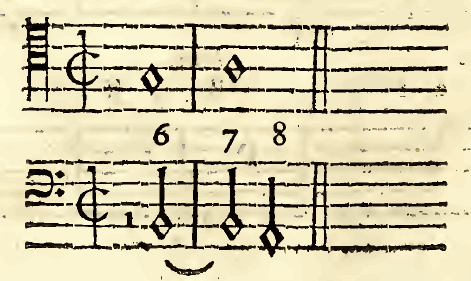
One might perhaps say that a seventh resolved in this way is not acceptable because it resolves to a perfect consonance, namely an octave, from which it can derive very little harmony—were it not that, in the same masters, the second, which is the inverted seventh, is frequently found resolving to a unison. From the unison, as the most perfect of consonances, the dissonance can derive still less harmony. In this matter I think we should defer to the usage established by authoritative masters. Let us examine an example of the seventh inverted into a second and resolved to a unison:
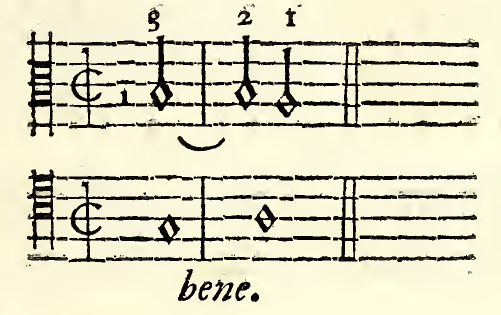
Joseph. Before I proceed to the exercise, may I ask, with your permission, whether a delay, or ligature, in a dissonance can also occur in ascent? For the following examples seem to have an equal rationale:
Aloysius. You raise a question harder to untie than the Gordian knot, which you, still standing at the threshold of this discipline, cannot grasp, and which must therefore be resolved elsewhere. Although, if the delay is removed, the thirds seem to have an equal rationale both in ascent and in descent, it will nevertheless be explained in its proper place, as I said, that a difference lies beneath. Meanwhile, by my authority as your teacher, I tell you that all dissonances must be resolved by descending to the nearest consonance. As for the penultimate measure of this species, it must conclude with a seventh resolved to a sixth if the cantus firmus is in the lower part; but if the cantus firmus is in the upper part, it must end with a second resolved to a minor third, proceeding from there to a unison.
Joseph. Must each measure be given its own ligature?
Aloysius. Certainly, wherever it is possible. But you will sometimes encounter a measure in which there is no room for a ligature; in that case the measure must be filled with untied minims until the opportunity to make a ligature presents itself. Come, and apply yourself to ligatures.
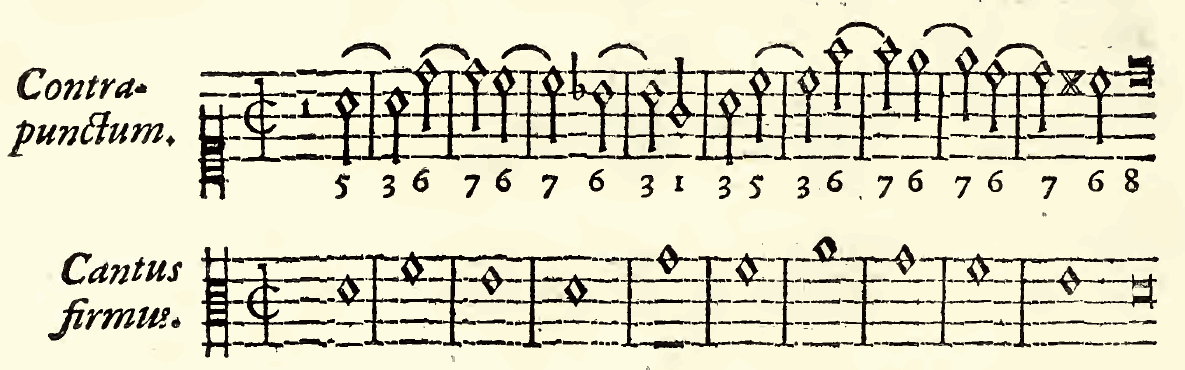
You have done well, indeed; but why did you omit the ligature in the fifth measure? It could have been made if, after that third, you had used a fifth. That would have been the first note of the ligature, and, remaining on the same staff line, you would have had another ligature on the thesis of the following measure, namely a sixth. For I said that no opportunity should be passed over.
Joseph. I certainly could have, but I deliberately omitted it to avoid an irritating repetition, for immediately before, in the third and fourth measures, I had placed the same ligatures.
Aloysius. You have exercised quite prudent judgment, for no little allowance must be made both for the melodic line and for the grace of the progression. Continue.
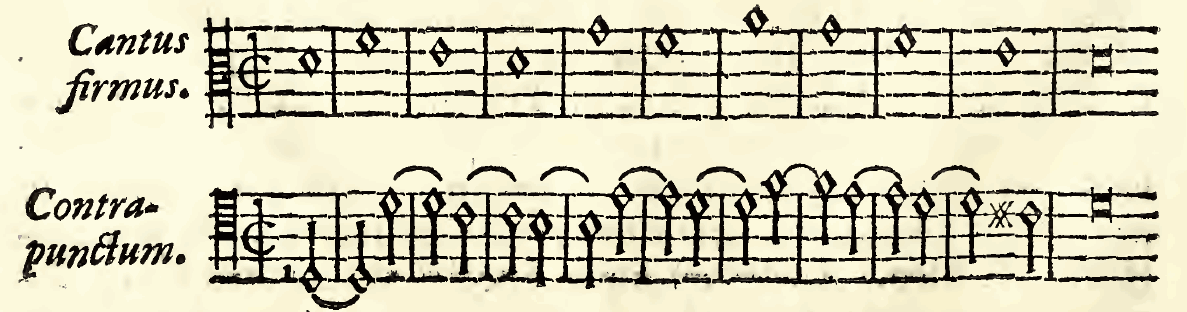
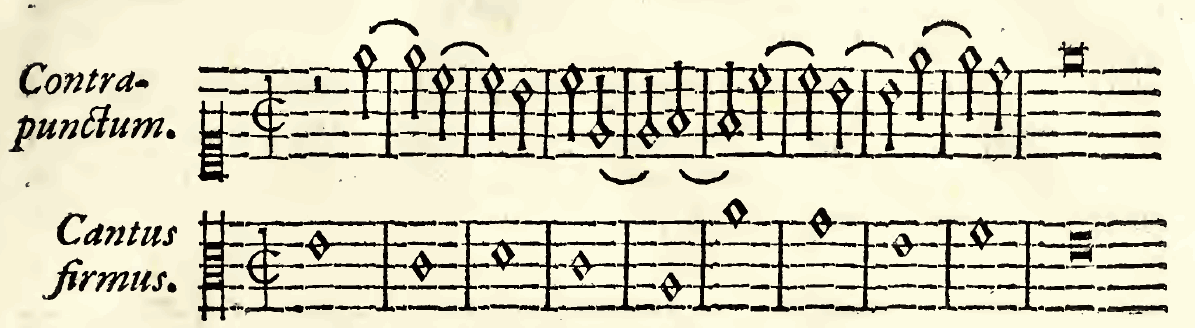
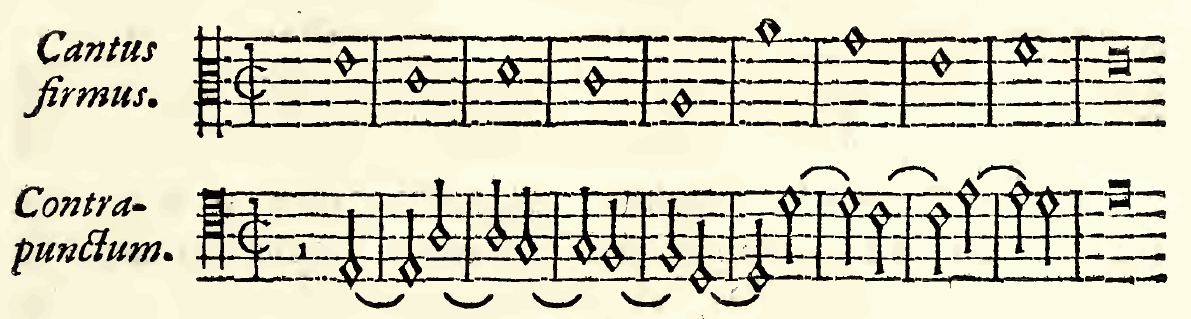
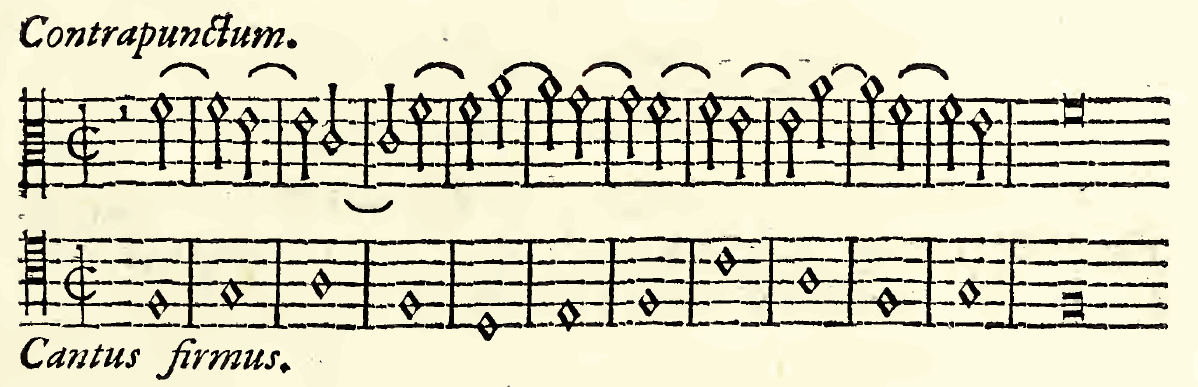
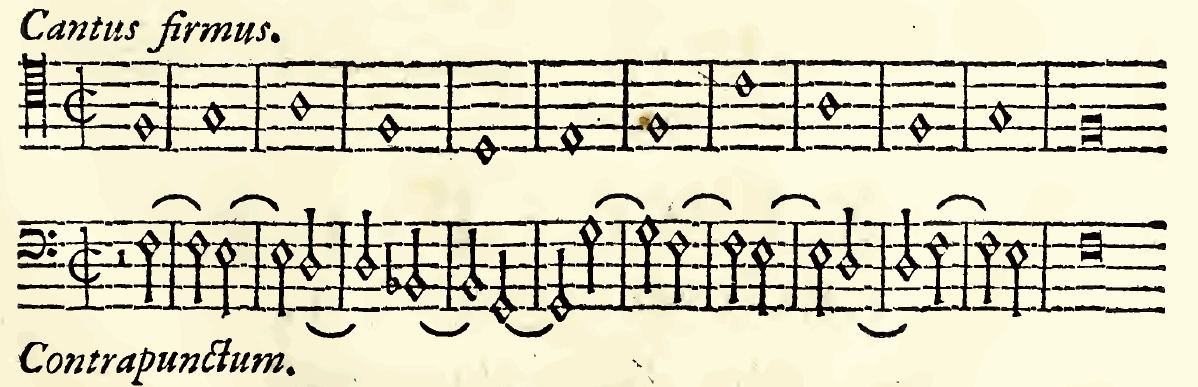
Aloysius. Let these examples suffice for now. Since ligatures add no small seasoning to musical harmony, I recommend not only that you work through the cantus firmi of the remaining three modes in this way, but also that you find others and practice extensively in this species; you will never practice it enough.
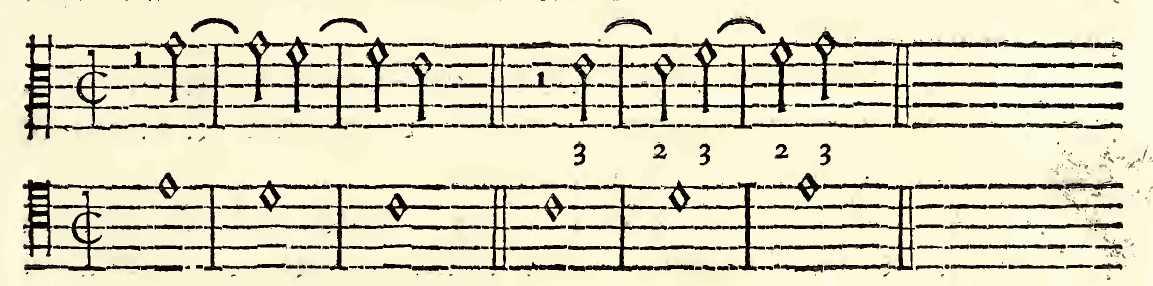
With a view to the grace of the next species, I state here in advance that the ligatures discussed thus far can also be made in another way. These forms do not overturn their substance at all, but they give the harmony a swifter motion. For example:
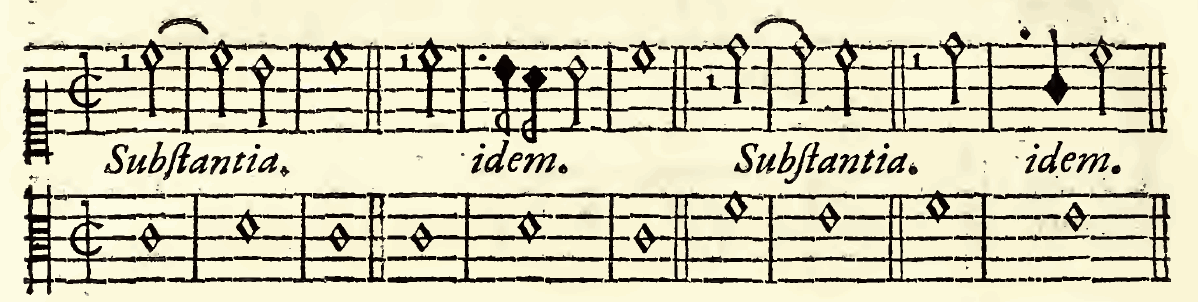
From these it is clearly understood that the first and third cases are the substance; those following, where “the same” is added, are variations used for the sake of either the melody or the motion. A ligature is also customarily broken in the following way:
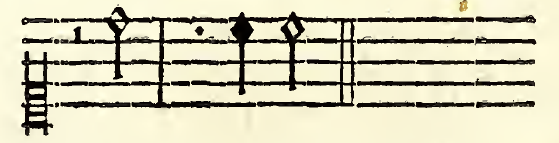
Furthermore, two fusae may sometimes be mixed into the following species. They must be placed in the second and fourth parts of the measure, however, and never in the first and third.

With these things understood, let there be