Playable Books
C. H. Kitson · section 8 of 10
Chapter VI. Two Parts in Fifth Species against the Canto Fermo
Read and hear this section in the playable edition →1. As this is a book for beginners, no attempt can be made to deal exhaustively and separately with all the contingencies of Combined Counterpoint. These must be studied from a larger treatise; and it is my opinion that good florid work is best arrived at through this means. Nevertheless a large number of students only need simple Counterpoint (e. g. all parts in the First Species except one) and Combined Florid (two or more parts in Fifth Species against the C.F.). In this chapter an attempt is made to give an adequate technique, without going through all the various combinations, such as First, Second, and Third Species, First, Second, and Fourth.
2. The two florid parts should be contrasted in rhythm, and crotchet movement should be fairly maintained, varied by the occasional addition of quavers.
3. All the notes struck together on the first beat of the bar will be concordant. They will be combined here and there with a suspended discord. This must be reserved for special discussion. Let us begin with the case in which all three notes present are concords. The next important thing to consider is the second or weak accent (second minim). Now the beginner is strongly advised to make every second minim a concord. When he studies the combination of First, Second, and Third Species, he will see there exceptional uses of second minims as unessential notes. But their use in florid Counterpoint is so rare, that they can be here ignored. Further, no part may use a discord on the third crotchet, except a part using four crotchets in the bar. Again there are a few exceptions. But the rule should be kept by the tiro.
4. Consider first the simplest case, one part moving in crotchets, and another in minims, using concords on the first and second minims:
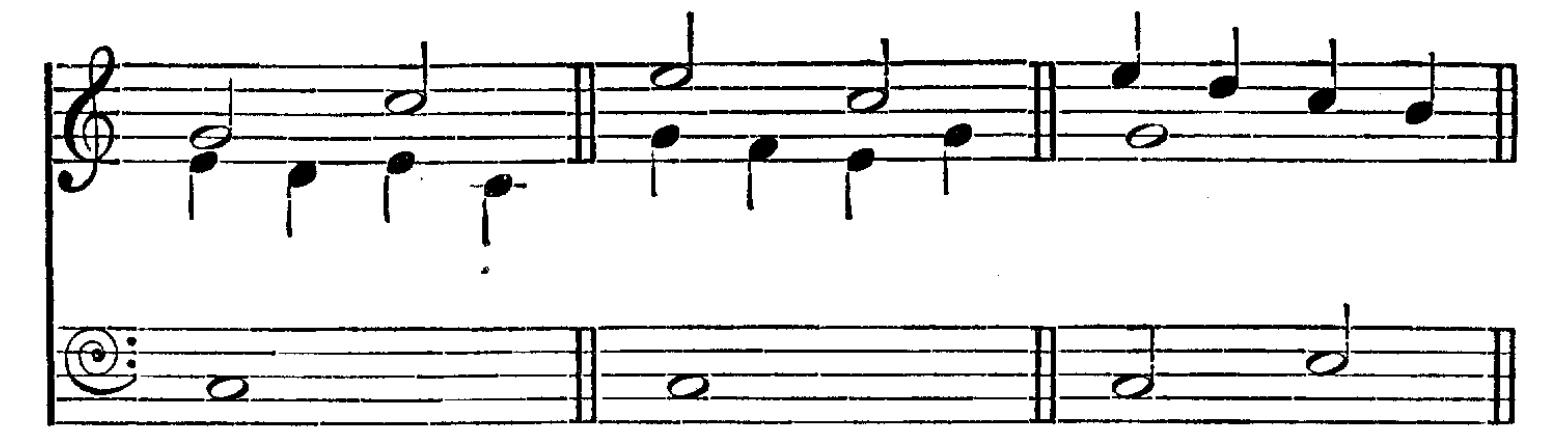
This should not cause any trouble. The two upper parts may strike a fourth on the second minim if both are harmony notes. Avoid 7 to 8 or 9 to 8 between any two parts.
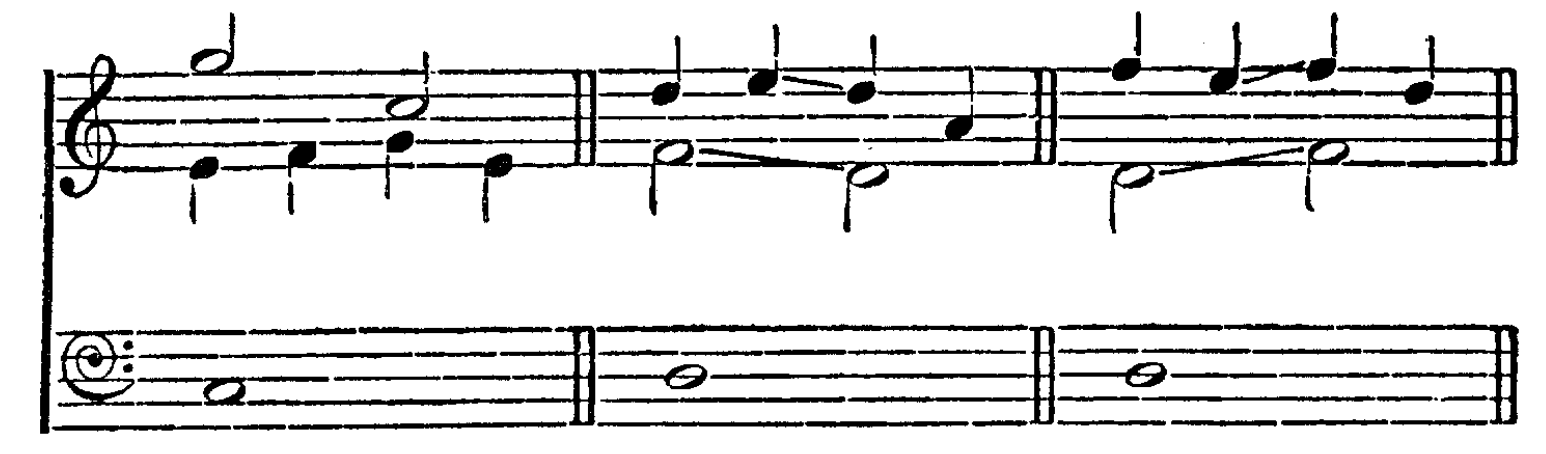
Suppose, however, the Third Species uses a passing note on the third crotchet, the same rule holds good, the only discord allowed between it and the second minim is the fourth. But the leap of an octave in the Second Species counts as First Species.
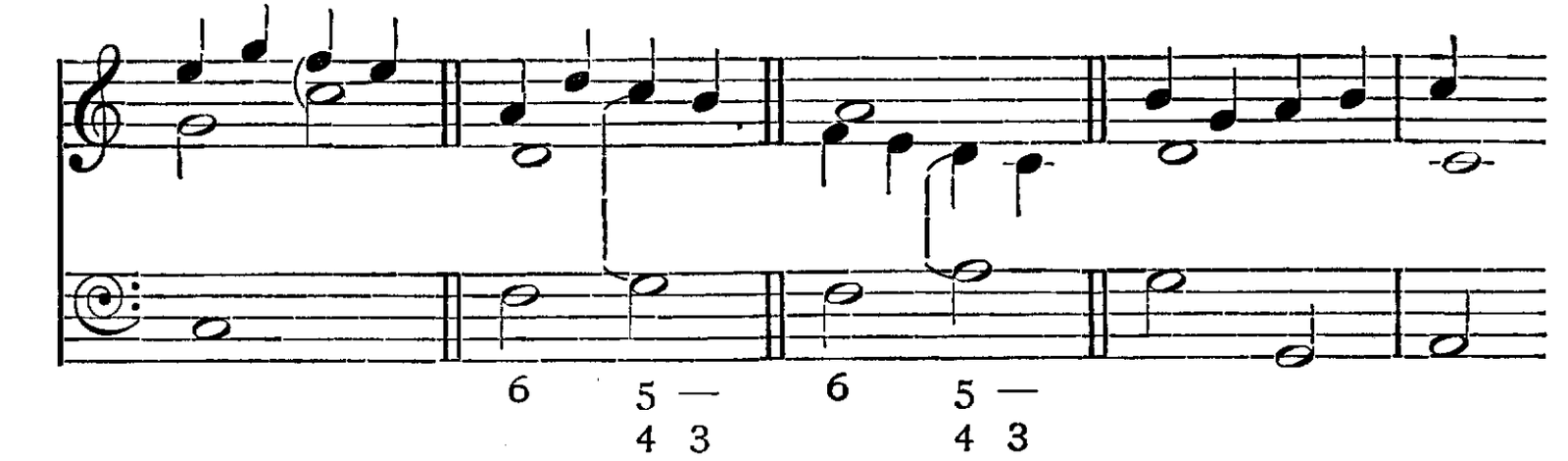
An unessential note in the Third Species will sometimes form a concord with the essential minim:
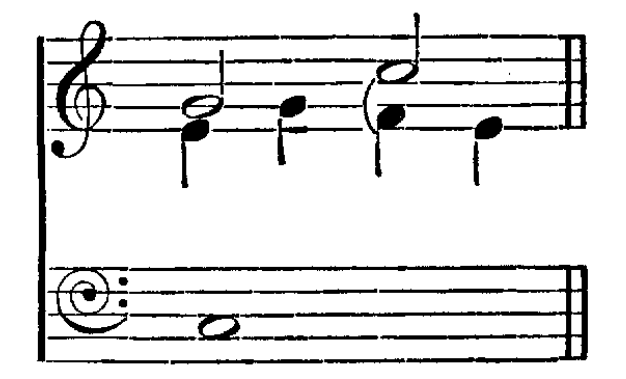
Two harmonies in a bar may be freely used, especially when the Second Species is conjunct.
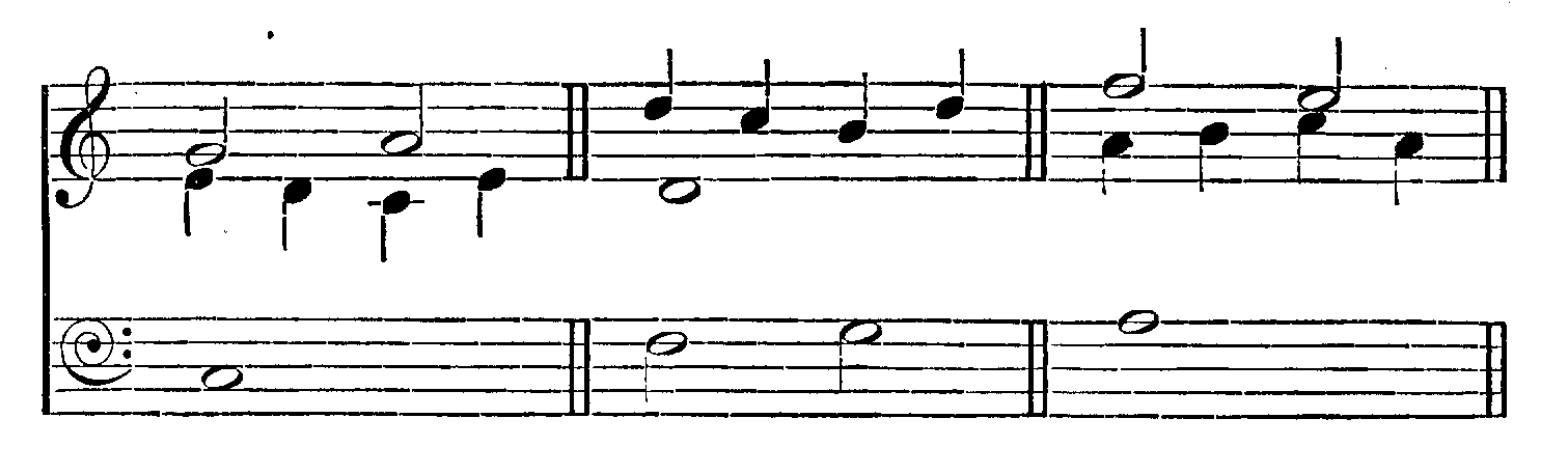
Exercises
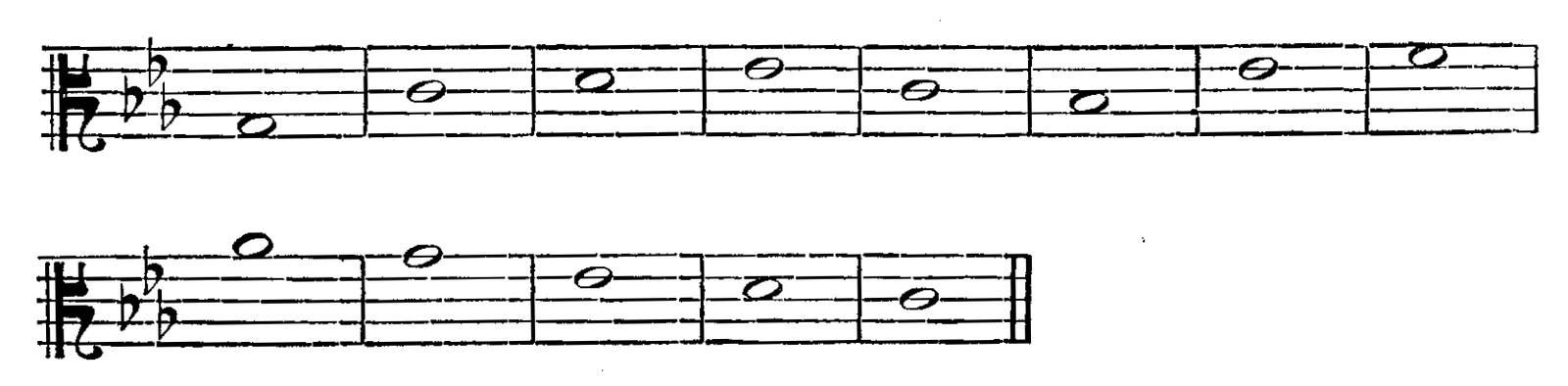
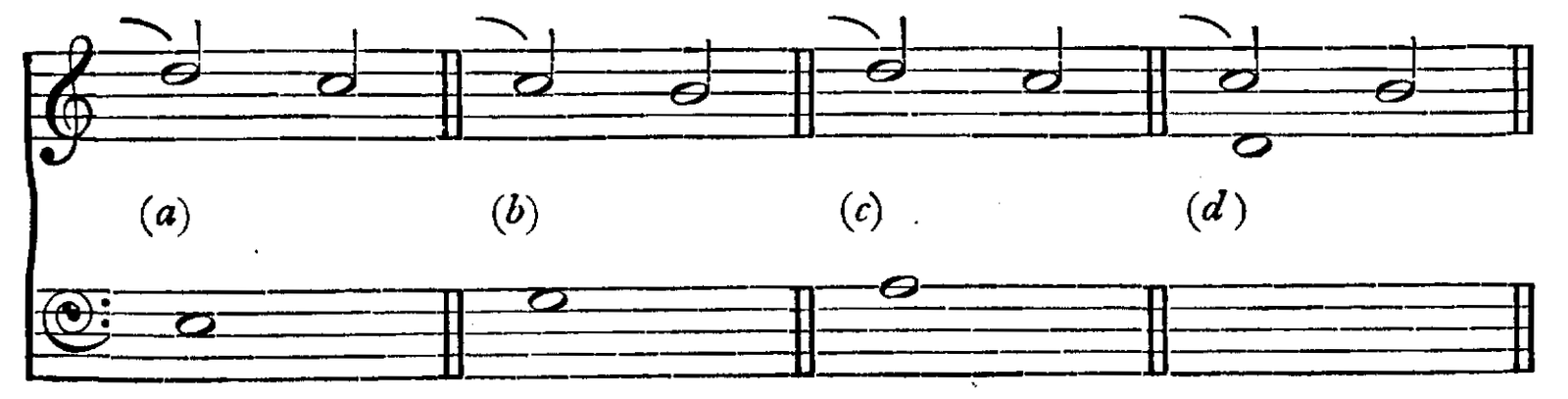
(1) Write a Soprano in Second Species, and an Alto in Third Species above each of the following notes, in as many ways as you can, and indicate what the C. F. and the Counterpoints will have on the first beat of the next bar thus:
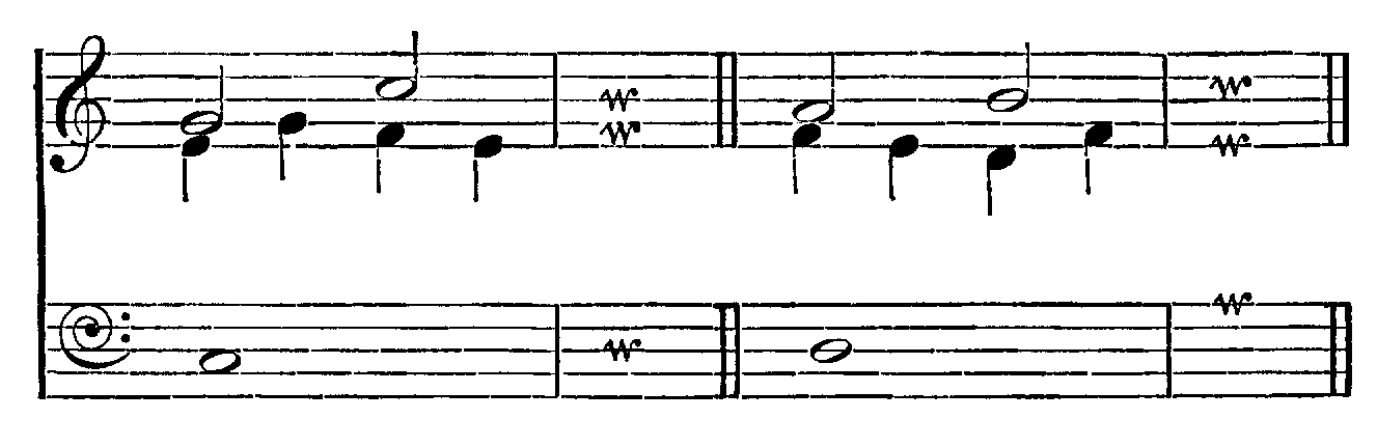


(2) Add a Soprano in Second Species, and a Bass in Third Species, indicating what the first notes of the next bar will be.


(3) To the notes given in (2) add Soprano in Third Species, Bass in Second Species.
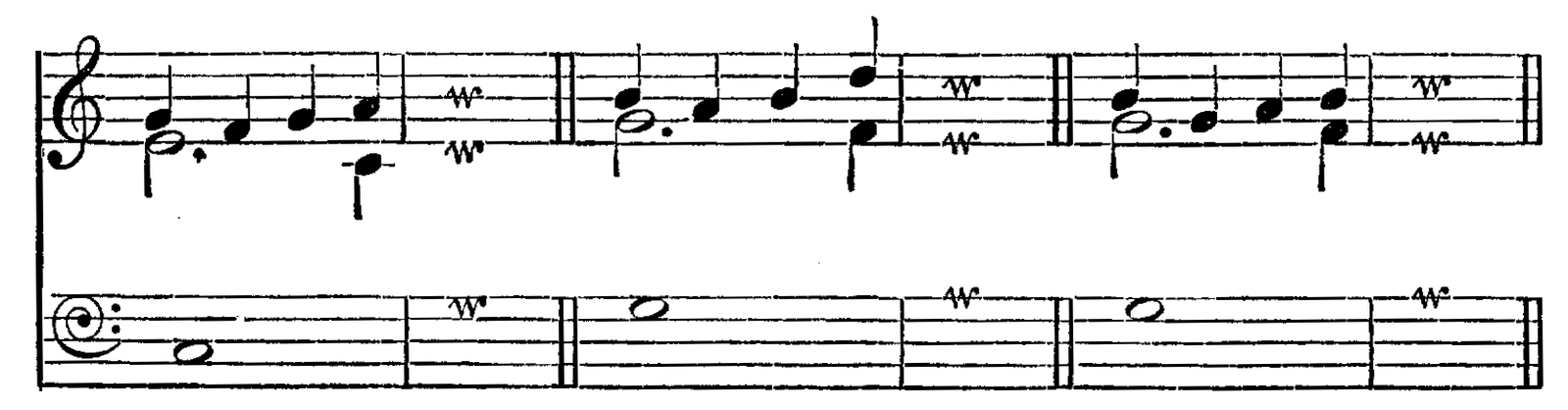
5. A simple variation of this occurs when the Third Species is accompanied by a dotted minim and a crotchet.
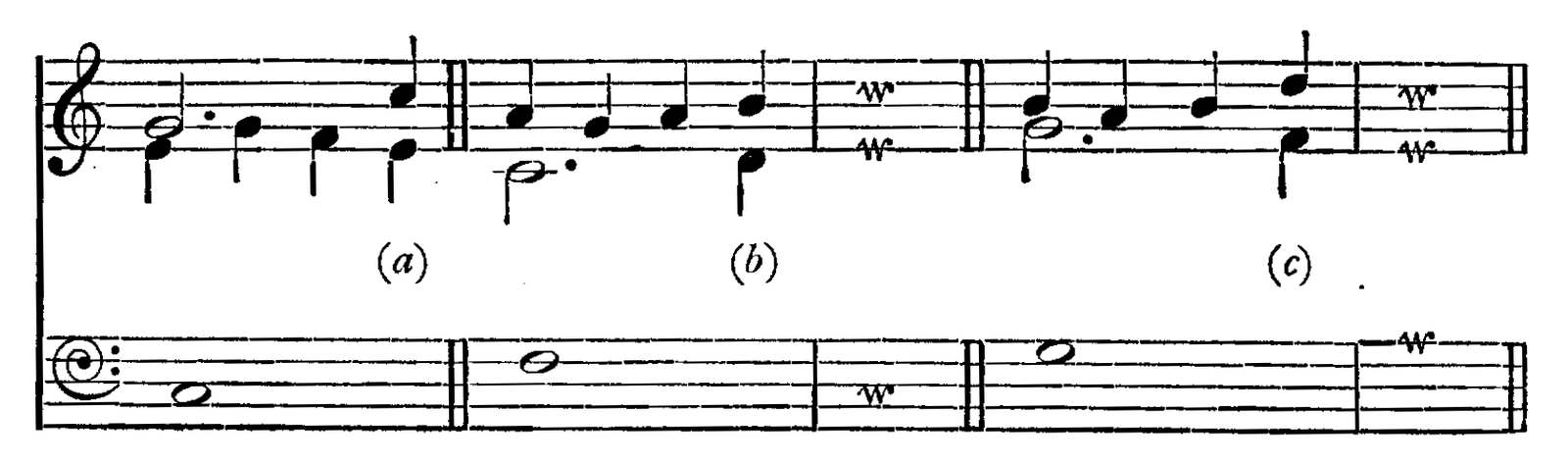
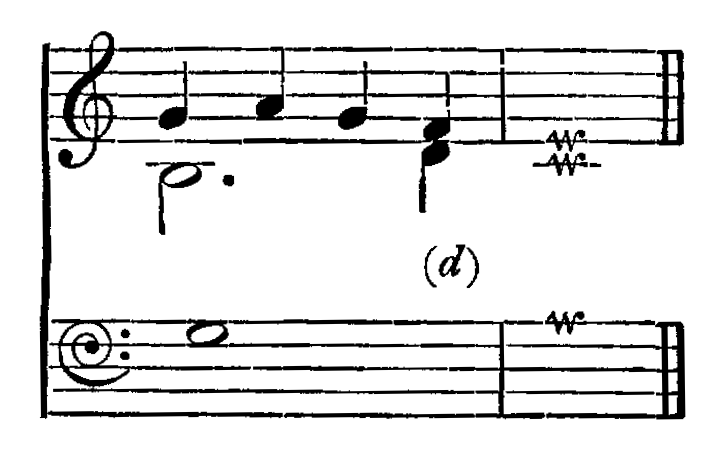
At (a) both notes are essential.
At (b) both notes are unessential.
At (c) and (d) there is a combination of essential and unessential notes. The latter must of course be approached and quitted by step.
Cases of (a) will cause no difficulty.
In cases of (b) the unessential notes will form the harmonic interval of a third or sixth, and should generally be quitted in similar motion.
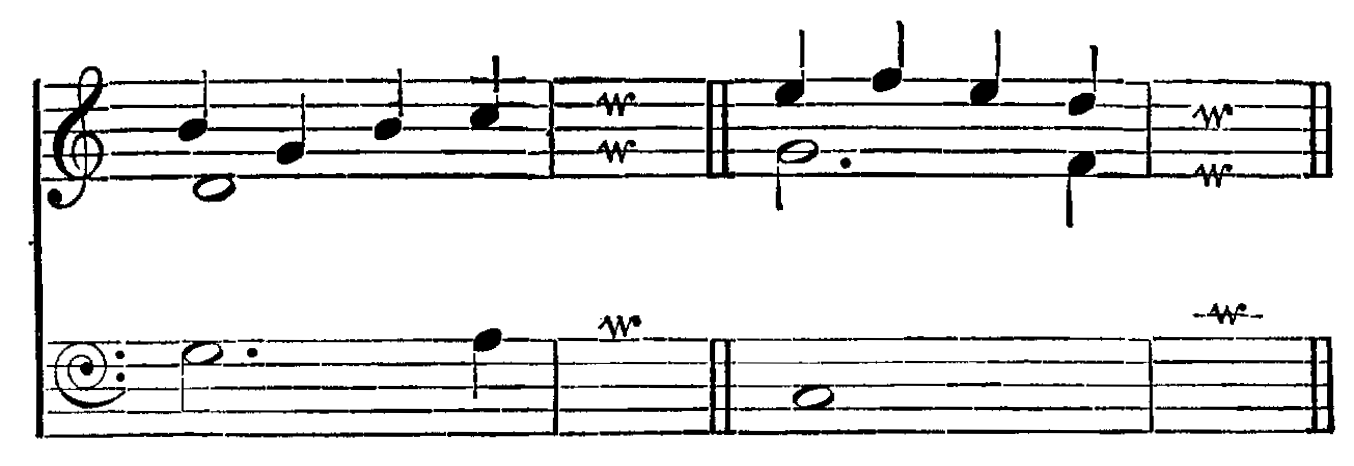
Or the same passing note may be taken in the two parts by contrary and conjunct movement:
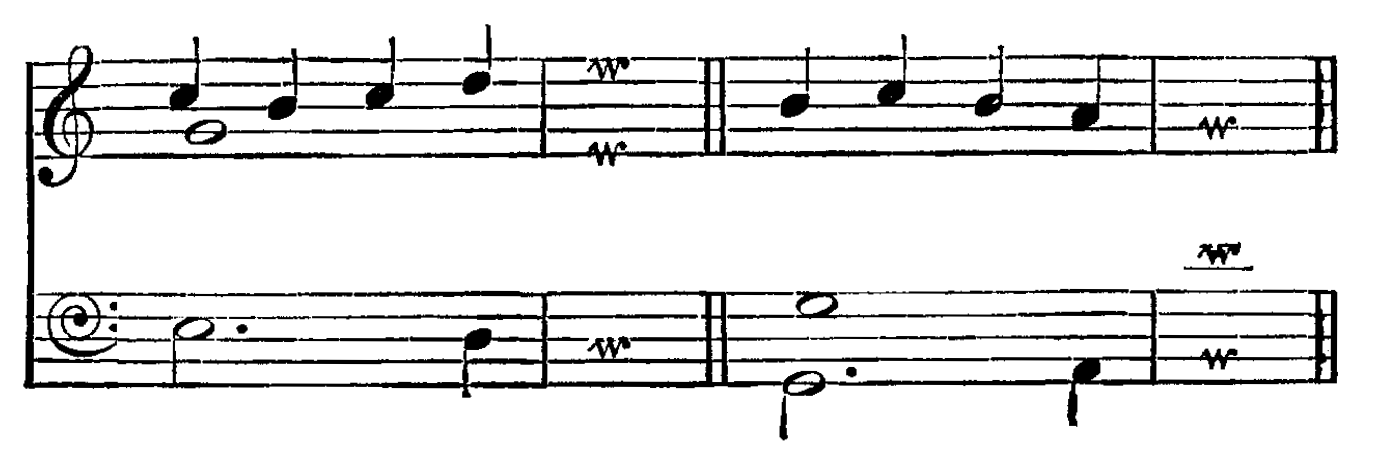
Occasionally, a new concord, or part of a fundamental discord may result:
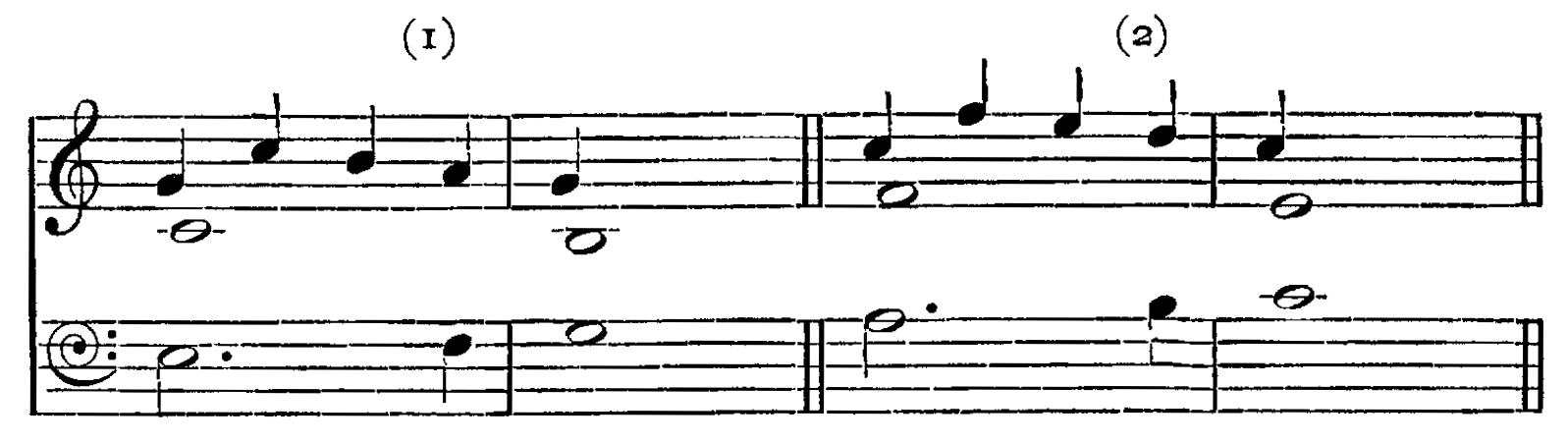
It is possible to regard A and F at (1) as two unessential notes; it is better to regard them as forming the chord of F major, and they could both be quitted by leap if the C.F. allowed of it. At (2) the combination forms an incomplete dominant seventh. In this case both D and B must be approached and quitted by step. It is necessary to appreciate these harmonic effects, otherwise when more parts are added, harmonic confusion will result. And hence the general recommendation, that true unessential thirds or sixths should move in parallels. The beginner should approach and quit them in similar motion.
In cases like (c) and (d), where one note is essential and the other unessential, the unessential note should not be the second or fourth from the root of the chord, except between two positions of the same chord, and the combination should be concordant in itself, unless the parts proceed by contrary and conjunct movement. Thus we may get:
(1) Root of chord + sixth from root.
(2) Fifth of chord + seventh from root.
(3) Third of chord + seventh from root.
Exercises
The same as in paragraph (4) except that for Second Species substitute dotted minim followed by a crotchet.
6. Two parts will sometimes move together in crotchets either for a whole bar or for half a bar.
We have just considered the possibilities on the fourth crotchet.
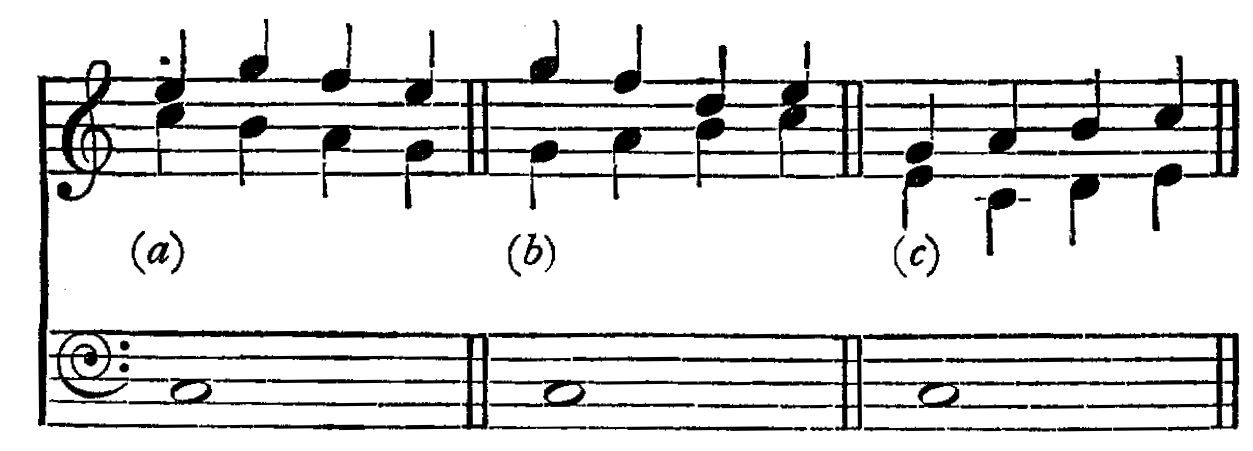
In the large majority of cases both notes will be essential on the third crotchet. If they are not, they should both be unessential (forming a third or sixth), and then proceed to essential notes generally in the same direction on the fourth crotchet:
The use of a combination on the second crotchet requires care.
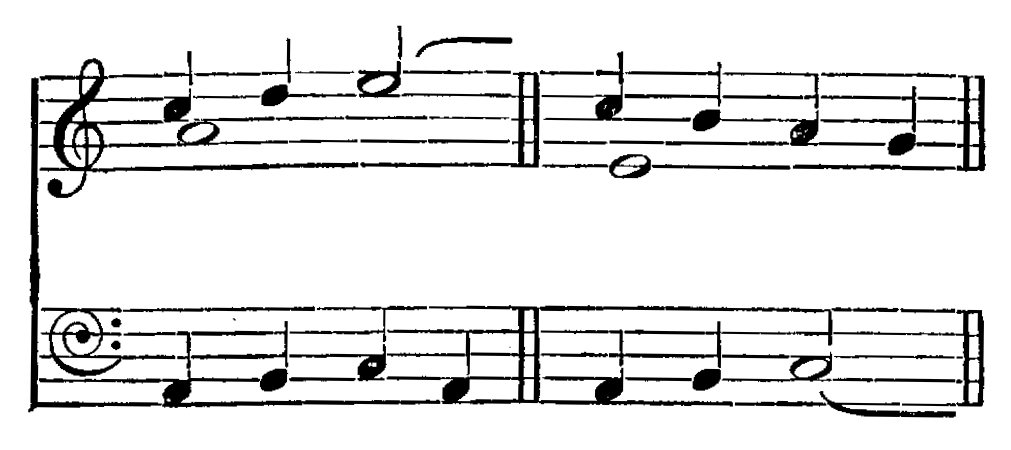
When we employ parallel thirds or sixths, or the same unessential note in both parts, the effect is always satisfactory:
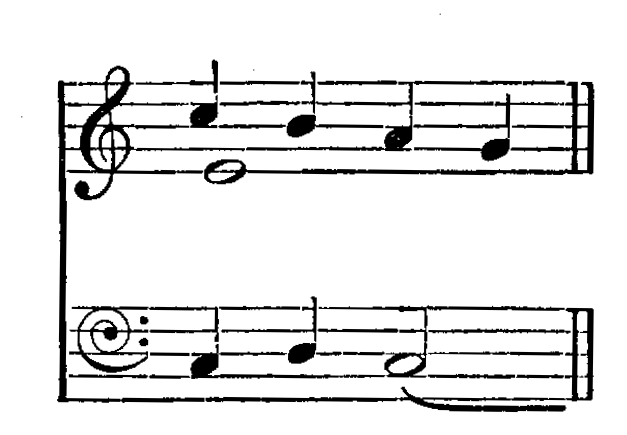
An unessential third or sixth may be taken by contrary motion; it is usually better quitted in similar motion.
The interval of the augmented fourth formed by the fourth and seventh of the scale gives a strong impression of dominant harmony, therefore only use it over a bass which is the root of the dominant chord, or the root of the Tonic as a pedal:
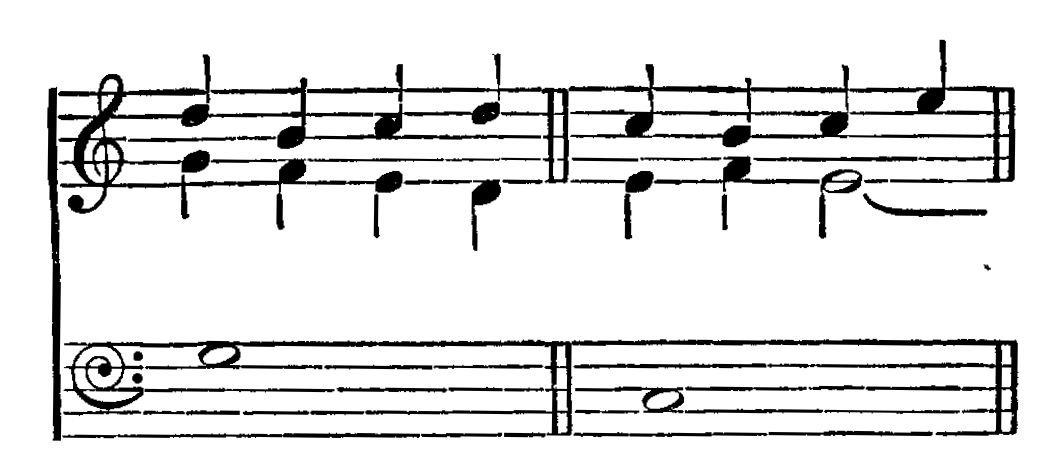
If this fourth (F to B in Key of C) or its inversion is used with the bass as one of the parts, the only good stationary upper part is the fifth of the scale (G).
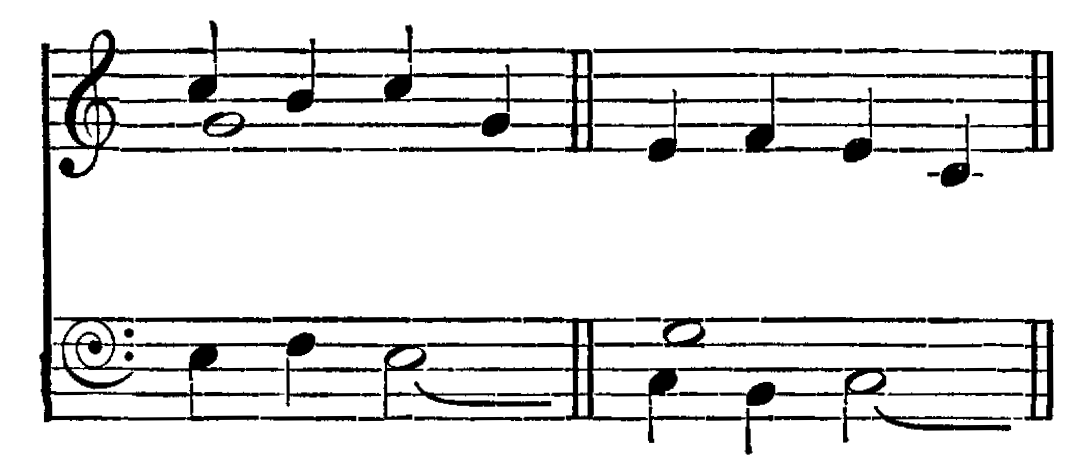
Sometimes a harmony and unessential note are combined on the second crotchet. In this case a discord may be struck with the harmony note leaping (a) and (c):—
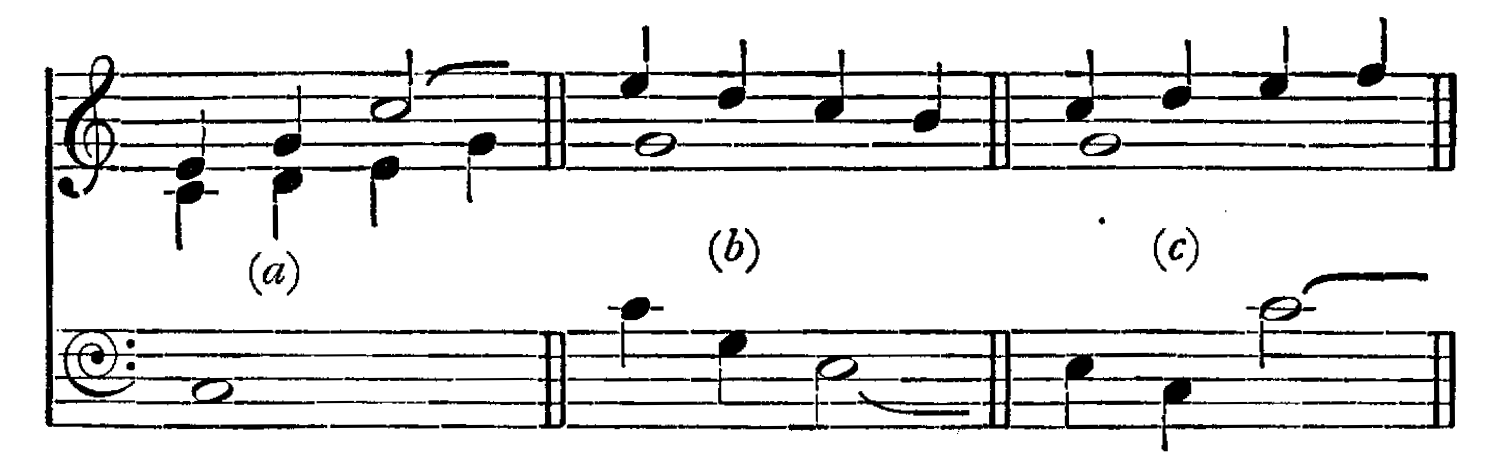
Care must be taken not to write these things mechanically, but to judge the effect accurately. Anything causing the effect of the confusion of two chords is bad; and there are varying degrees of harshness.
Exercises
Take the same notes as set in paragraph (4) and add the two parts, both moving in crotchets, as far as the third crotchet.
7. The use of quavers
The beginner is advised to employ quavers as sparingly as possible.
There are obviously no complications when used by themselves:
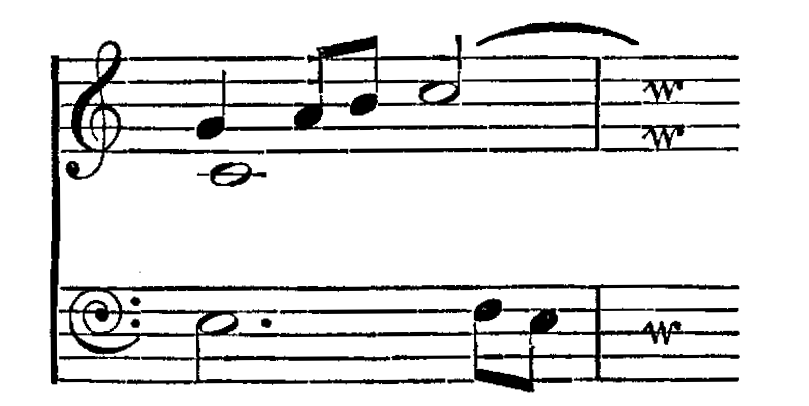
But when combined with crotchet movement their use requires great care.
In all cases the first quaver and the crotchet must be concordant. But harmonic considerations require further limitations.
Case I. The combination on the second crotchet.
(a) The bass a semibreve.
The crotchet and the first or second quaver must form a good passing chord over a pedal:
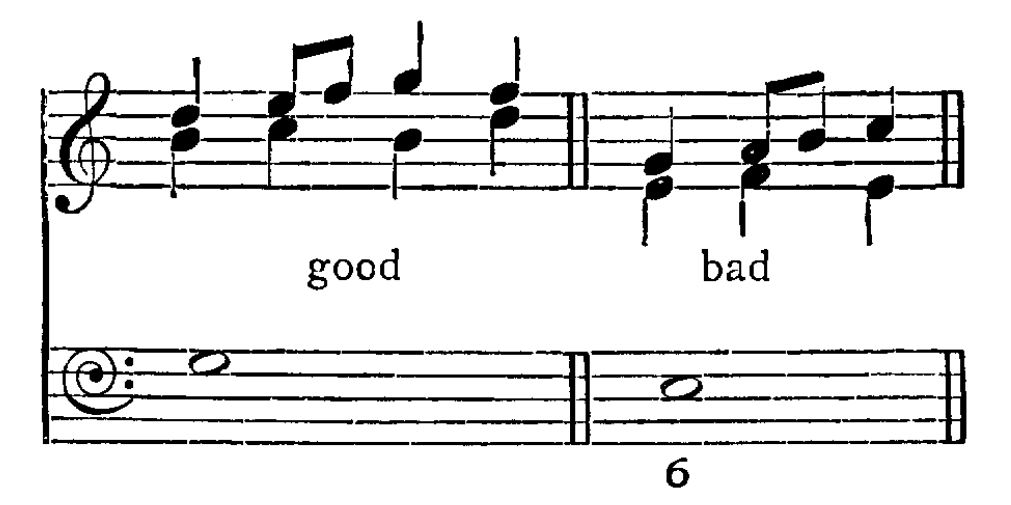
In such cases the bass should be the root of the chord.
(b) When the semibreve is not in the bass, it should form a factor of the passing chord formed by the crotchet and first or second quaver; and the passing chord must be satisfactory to the ear.
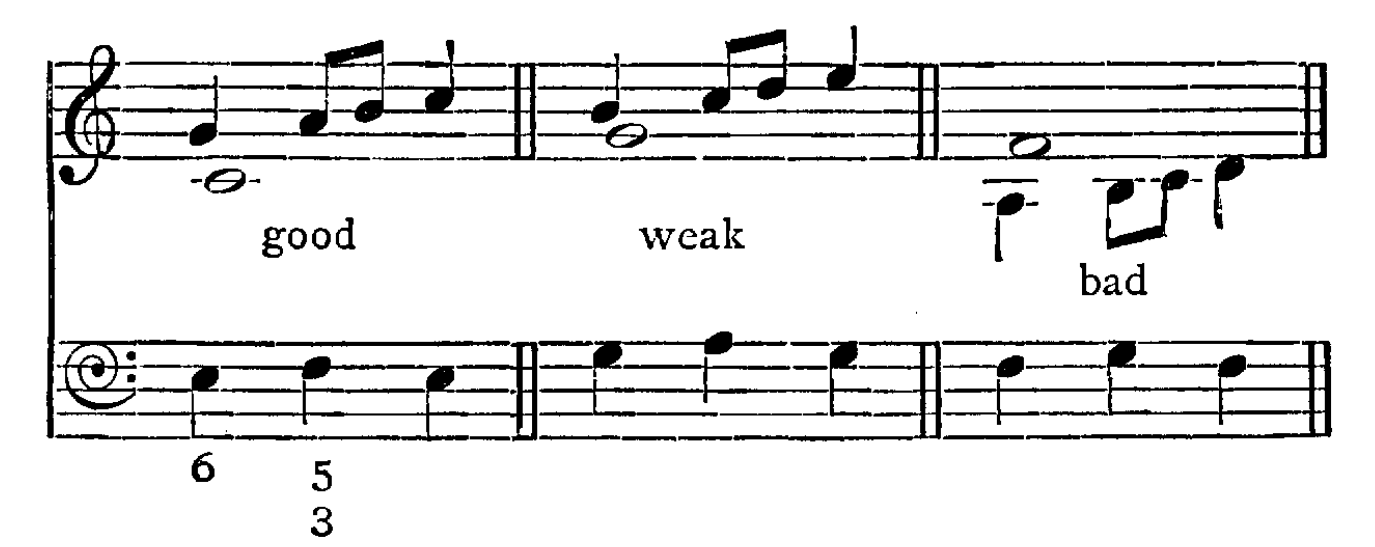
Case II. The combination on the fourth crotchet.
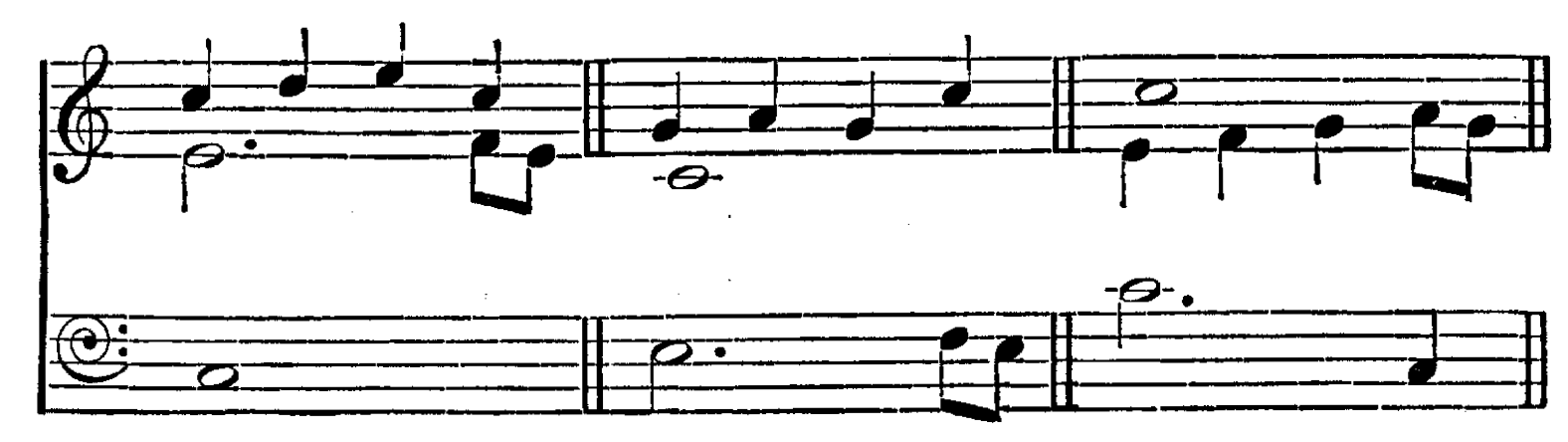
Whether the semibreve be in the bass or not, it and the crotchet and one of the quavers must form a good chord (either the same chord as has been used as the centre for the bar, or a new passing chord) to the next bar. The addition of the seventh to the 5/3 or 6/3, whether fundamental or diatonic, will of course produce a good harmonic effect.
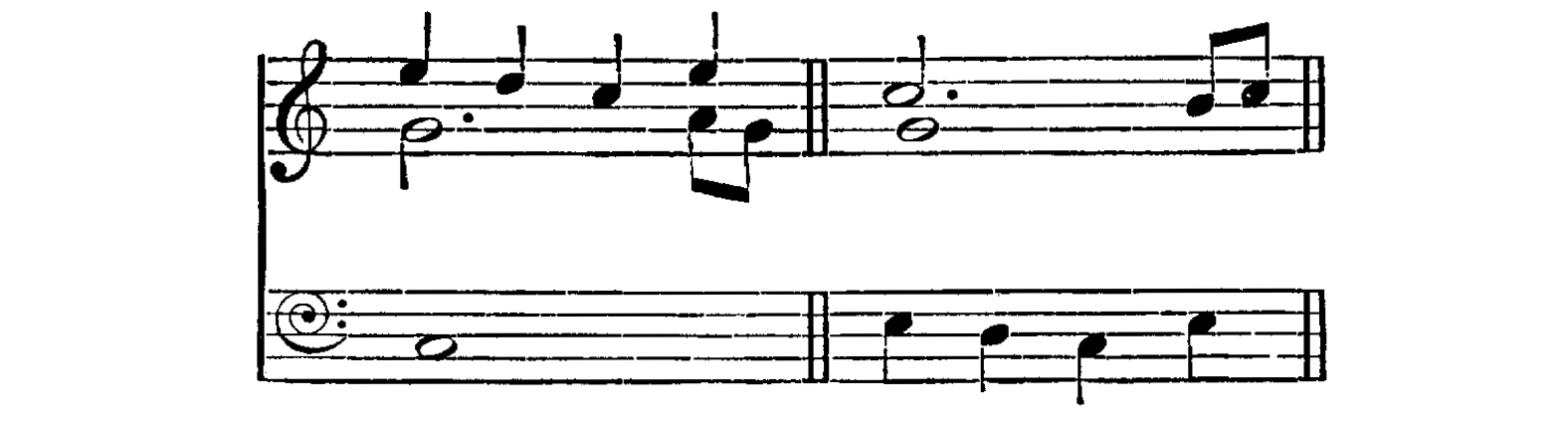
The following is a good rule: let one of the quavers be essential, let the crotchet avoid the second or fourth from the root of the chord of the bar, and let the first quaver be concordant with the crotchet.
(a) Crotchet as root of chord.
(b) Crotchet as third of chord.
(c) Crotchet as fifth of chord.
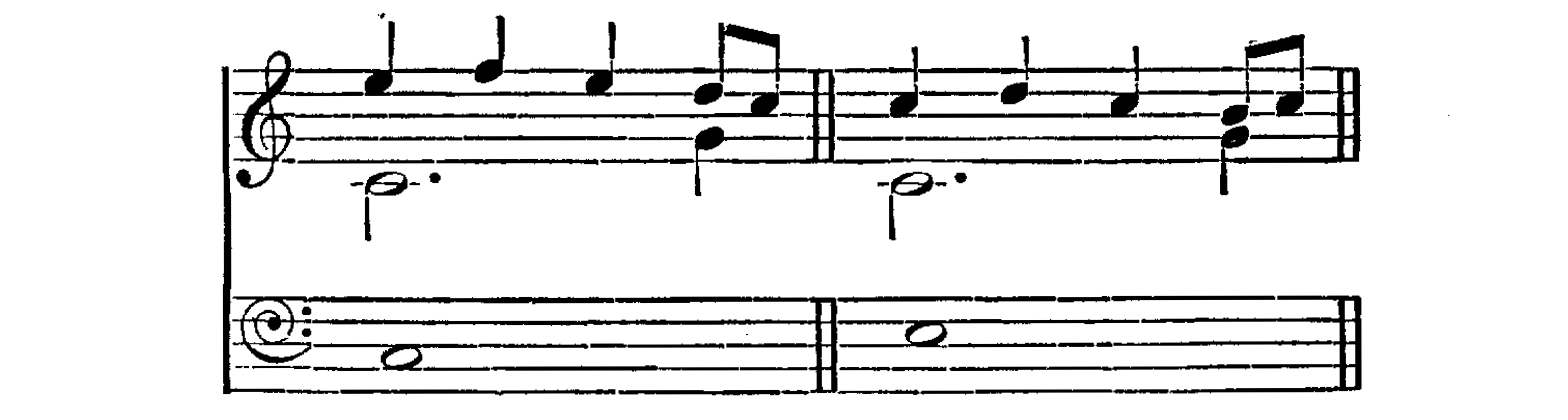
(d) Crotchet as sixth from root (unessential or forming new chord).
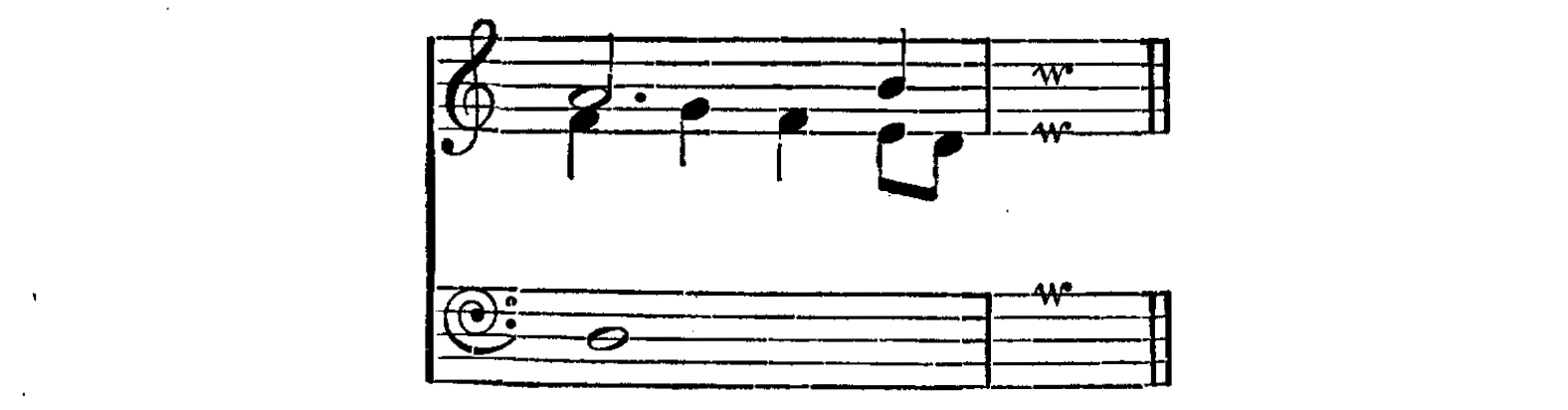
(e) Crotchet as seventh from root (unessential).
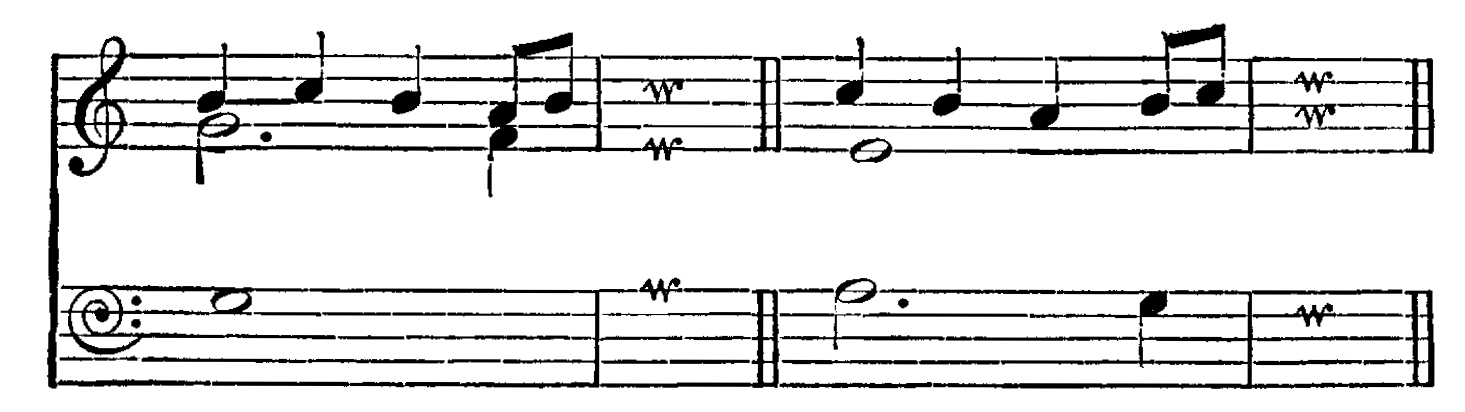
Sometimes an entirely new passing chord will be produced:
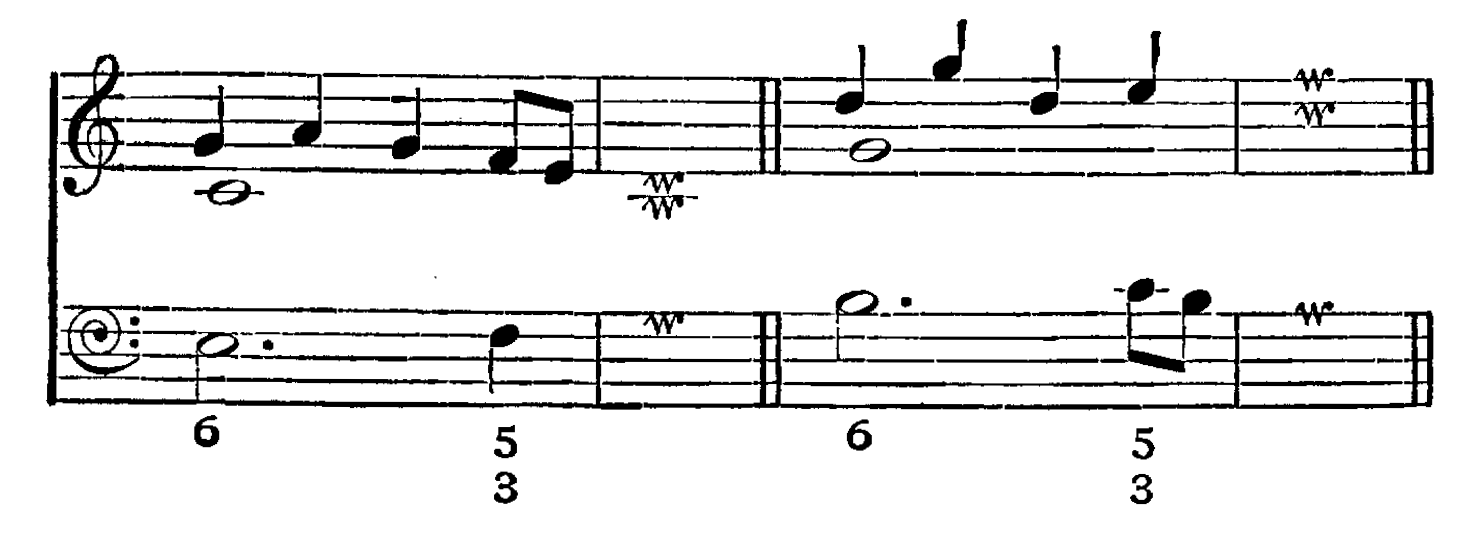
or a passing fundamental discord:
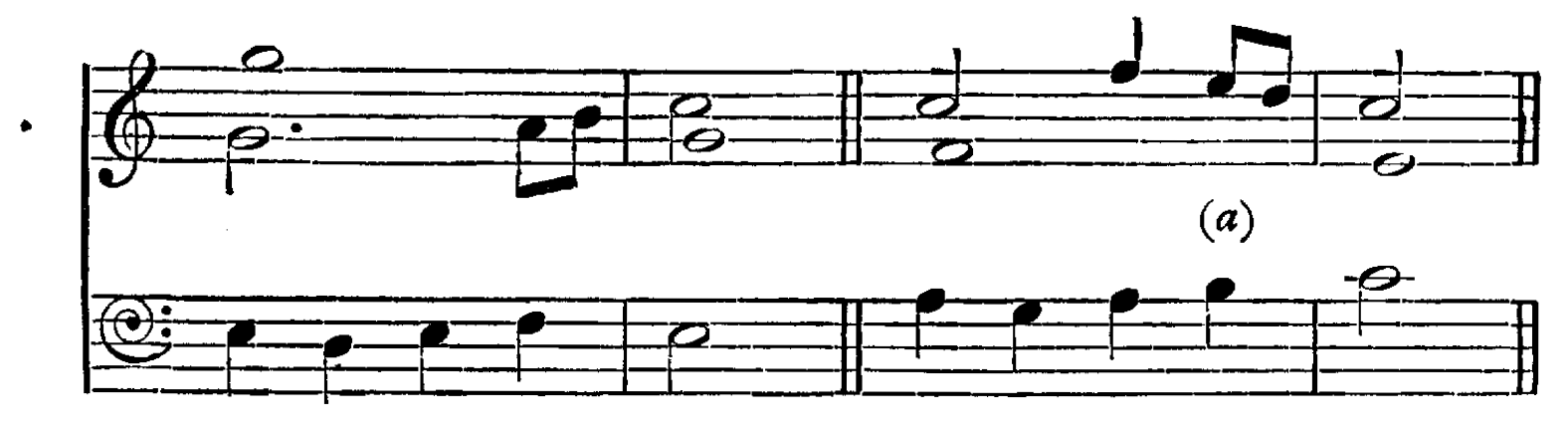
(a) Very rare percussion of discord, even by contrary and conjunct movement.
Exercises
(1) Take each note of the scale of G major, and G minor as a semibreve bass, and wherever possible use the movement
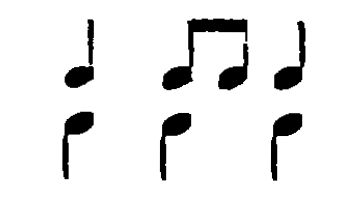
for the first, second, and third crotchets:
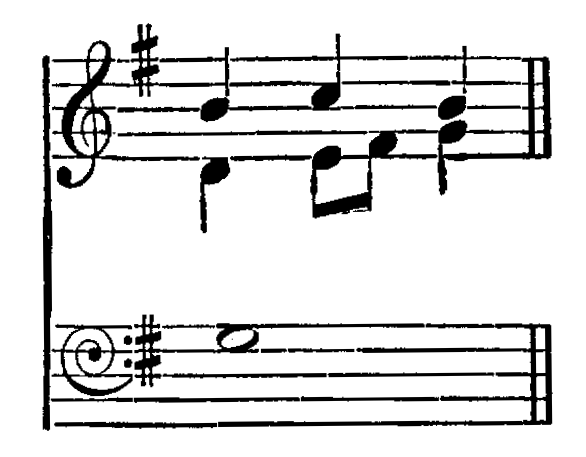
Such a movement will be found to be musically impossible in some cases, and it is good for the pupil to make the experiments.
(2) Use the same movement over the same notes in the bass from the third and fourth crotchets, and indicate the first notes of the next bar.
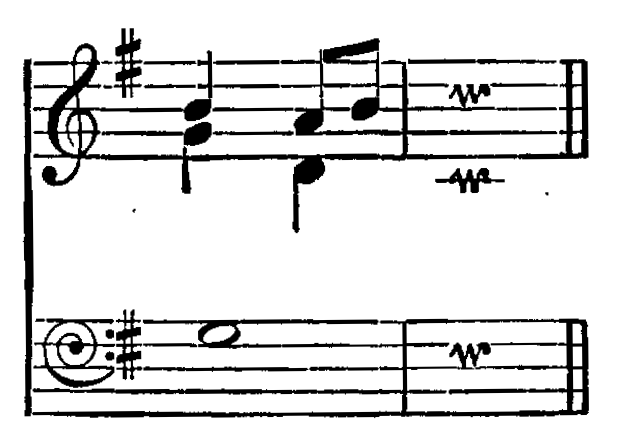
(3) Take the same notes as Alto or Soprano part, and go through the same two processes:
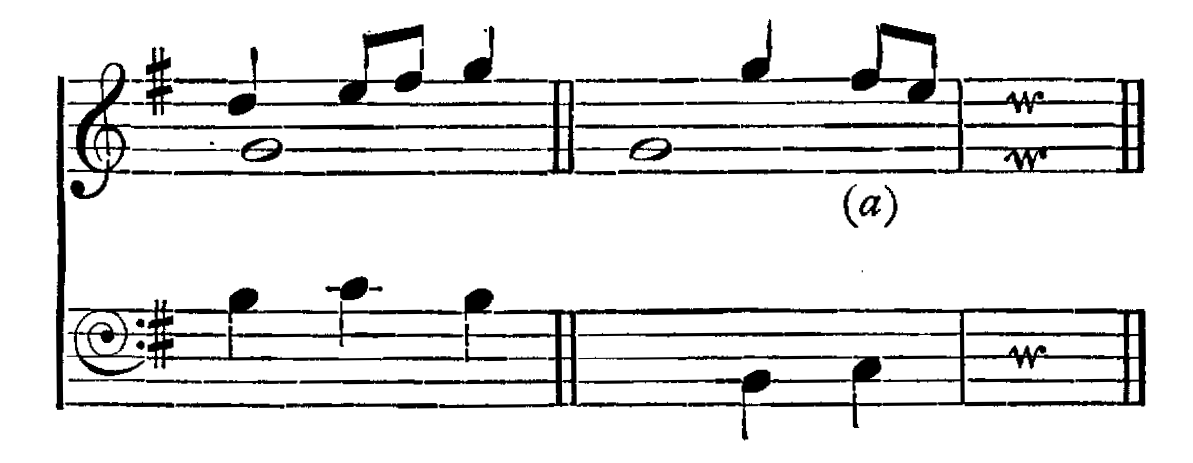
(a) This discord of the fourth by contrary and conjunct movement, though not violating any vital principle, is exceedingly rare in the case of a crotchet and quaver. It is common with a minim and crotchet. It is not a question of musical effect, but of convention.
8. Suspensions
(a) A suspended discord must resolve into a concordance on the third crotchet.
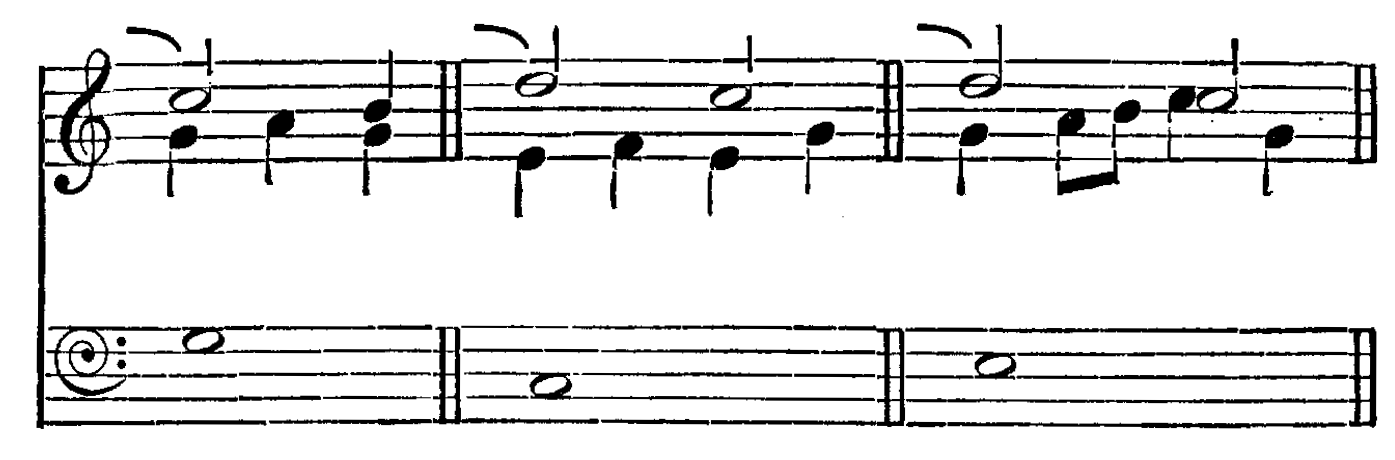
Sometimes a florid part when accompanying a suspended discord uses a passing note after a minim, and then resolves into concordance:
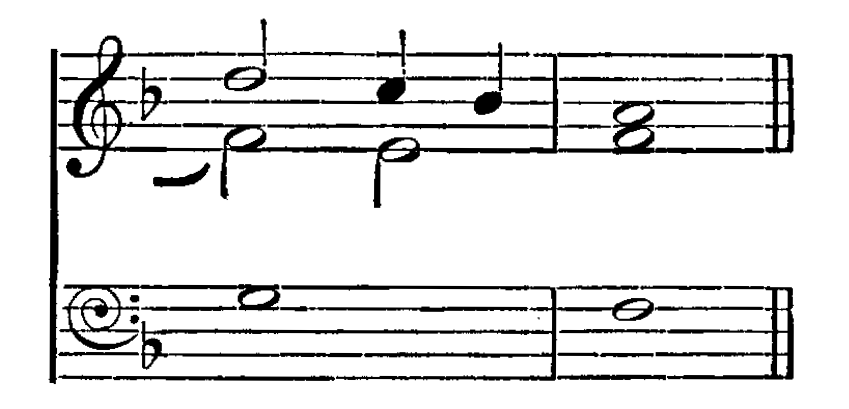
The beginner is advised to use this sparingly.
(b) A suspended discord can resolve into a different harmony from that which accompanies it (5/3 or 6/3).
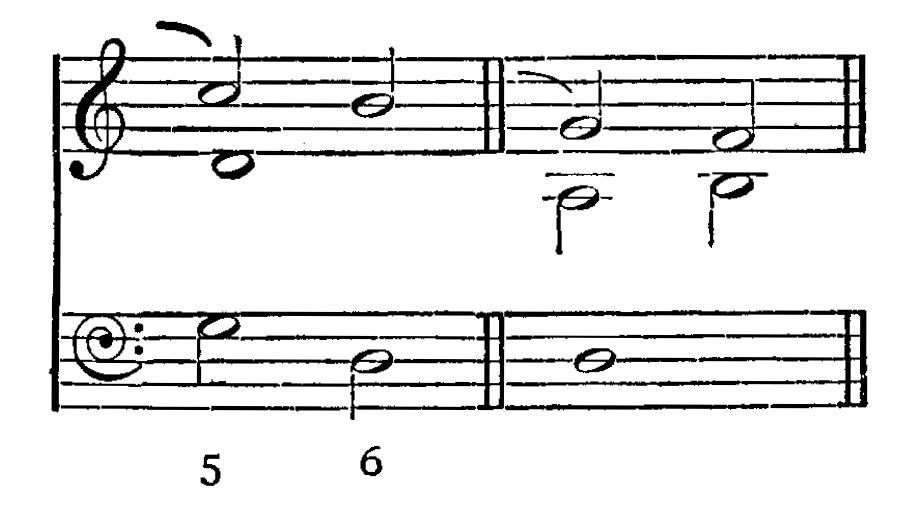
(c) The 6/4 with the fourth prepared can be used, resolving into the 5/3 on the second minim.
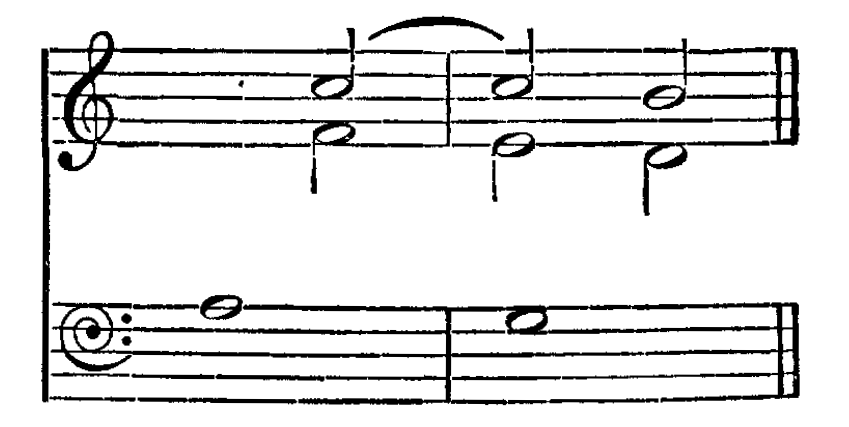
(d) Prepared diatonic sevenths can be used in root position. first and third inversion, resolving on the second minim into a chord whose root is a fourth higher (concordances only).
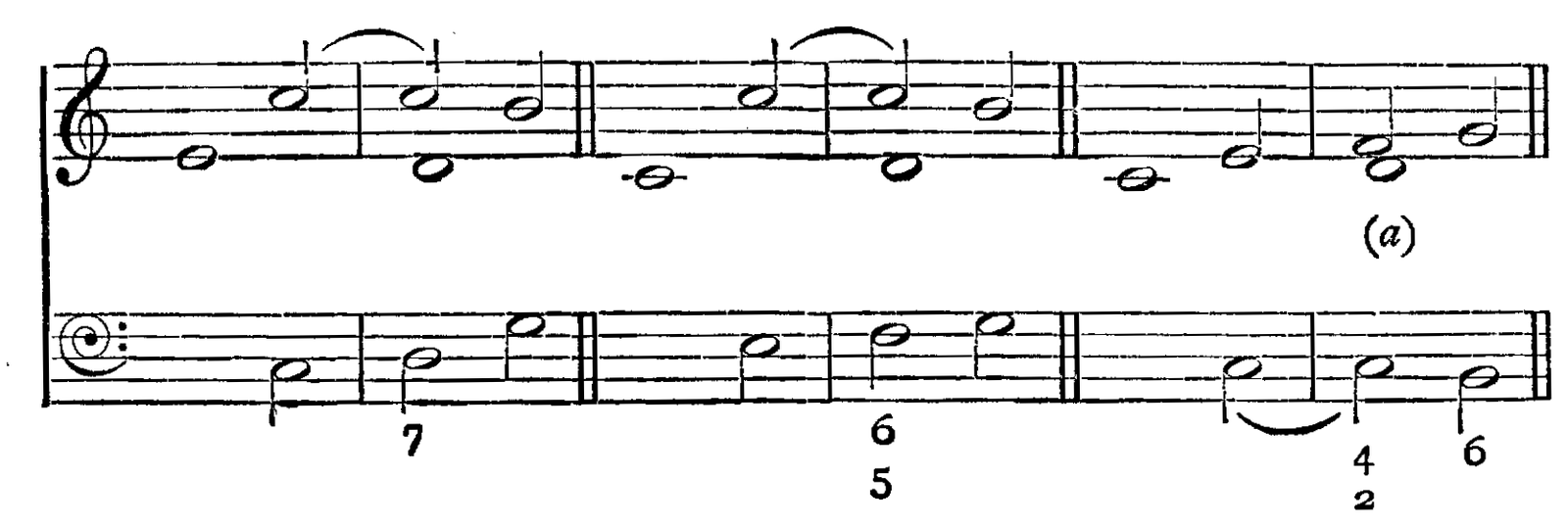
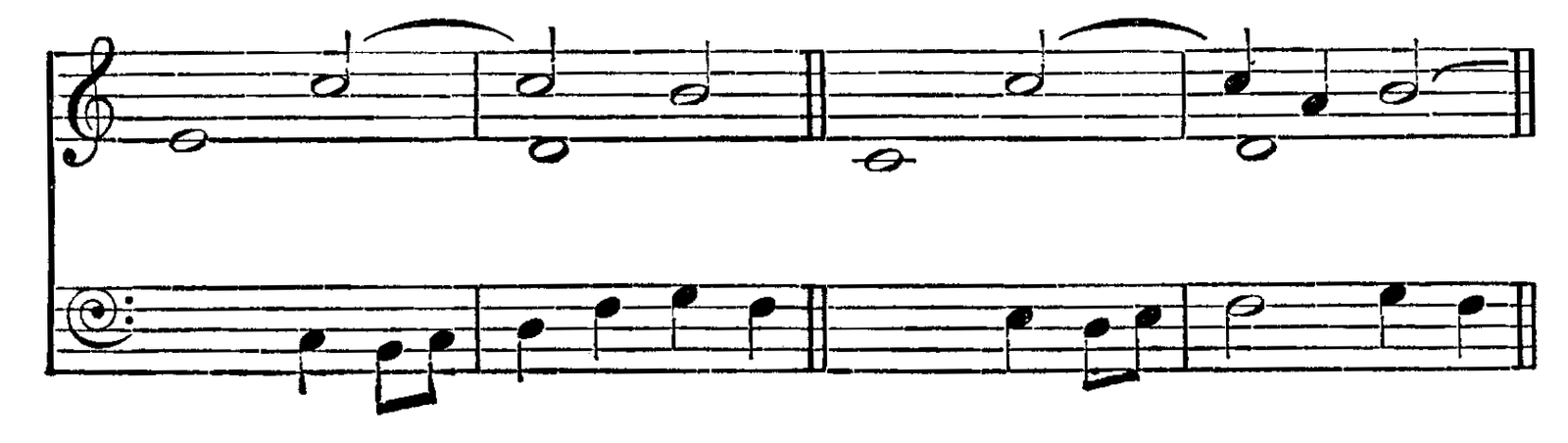
(a) When the suspended discord is in the bass, the two upper parts must be concordant.
In these, either or both parts can be elaborated:
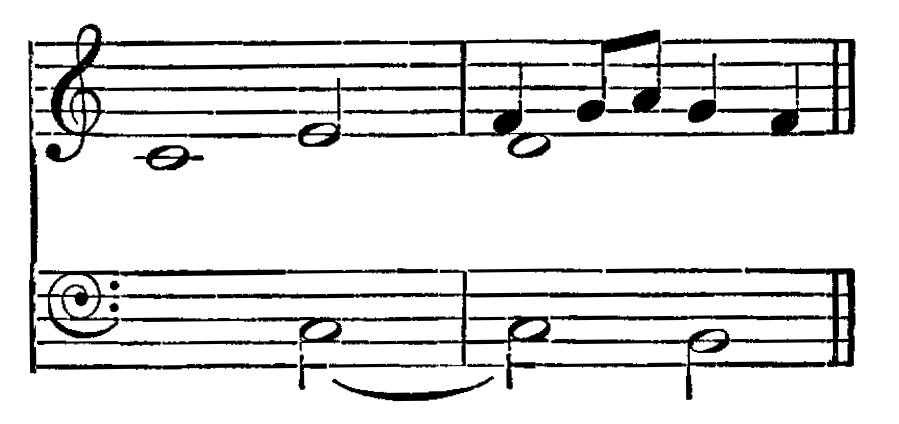
(e) 7 6 may be accompanied by 5 6.
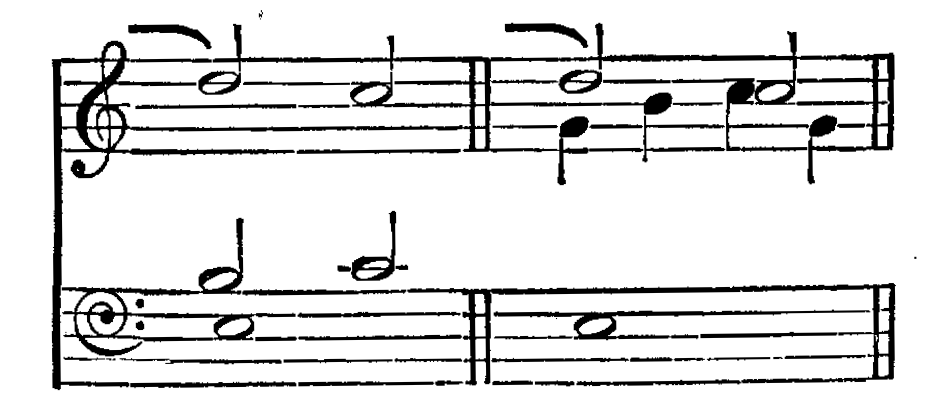
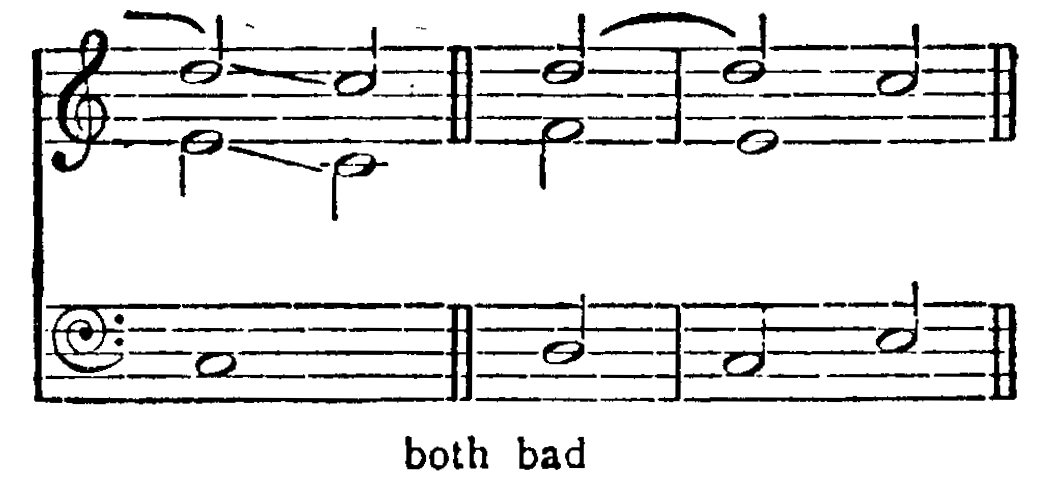
(f) No two parts should approach an octave by similar motion when one of them is resolving a discord, nor should the octave prepare the ninth:
Exercises
(1) Add an Alto in crotchets, or crotchets and quavers.
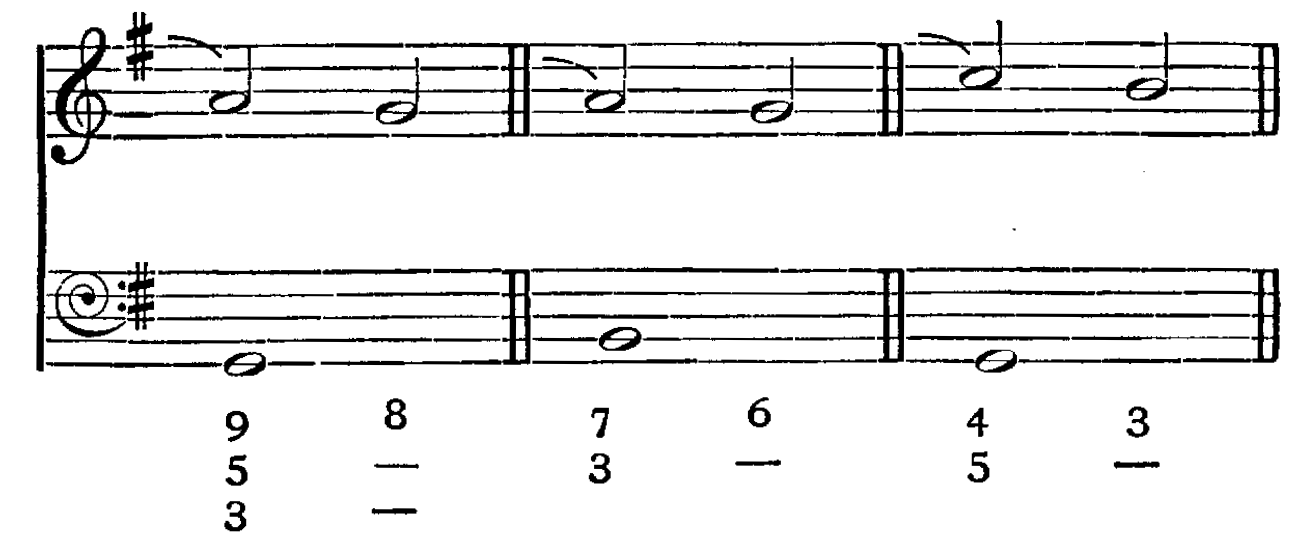
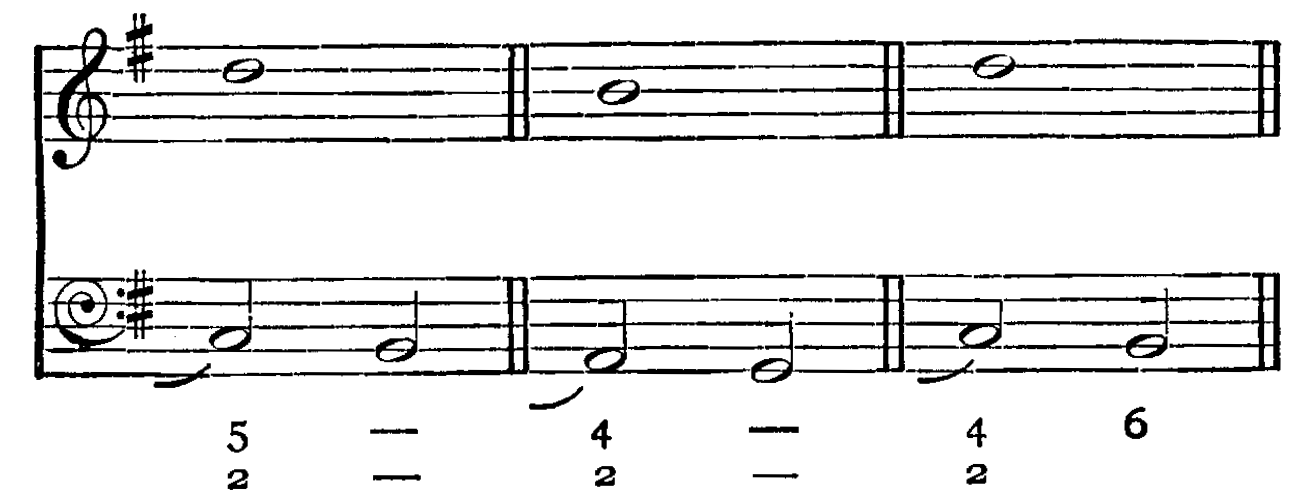
(2) Add to (a), (b), and (c) a middle part using two conjunct minims, to (d) a bass using the same.
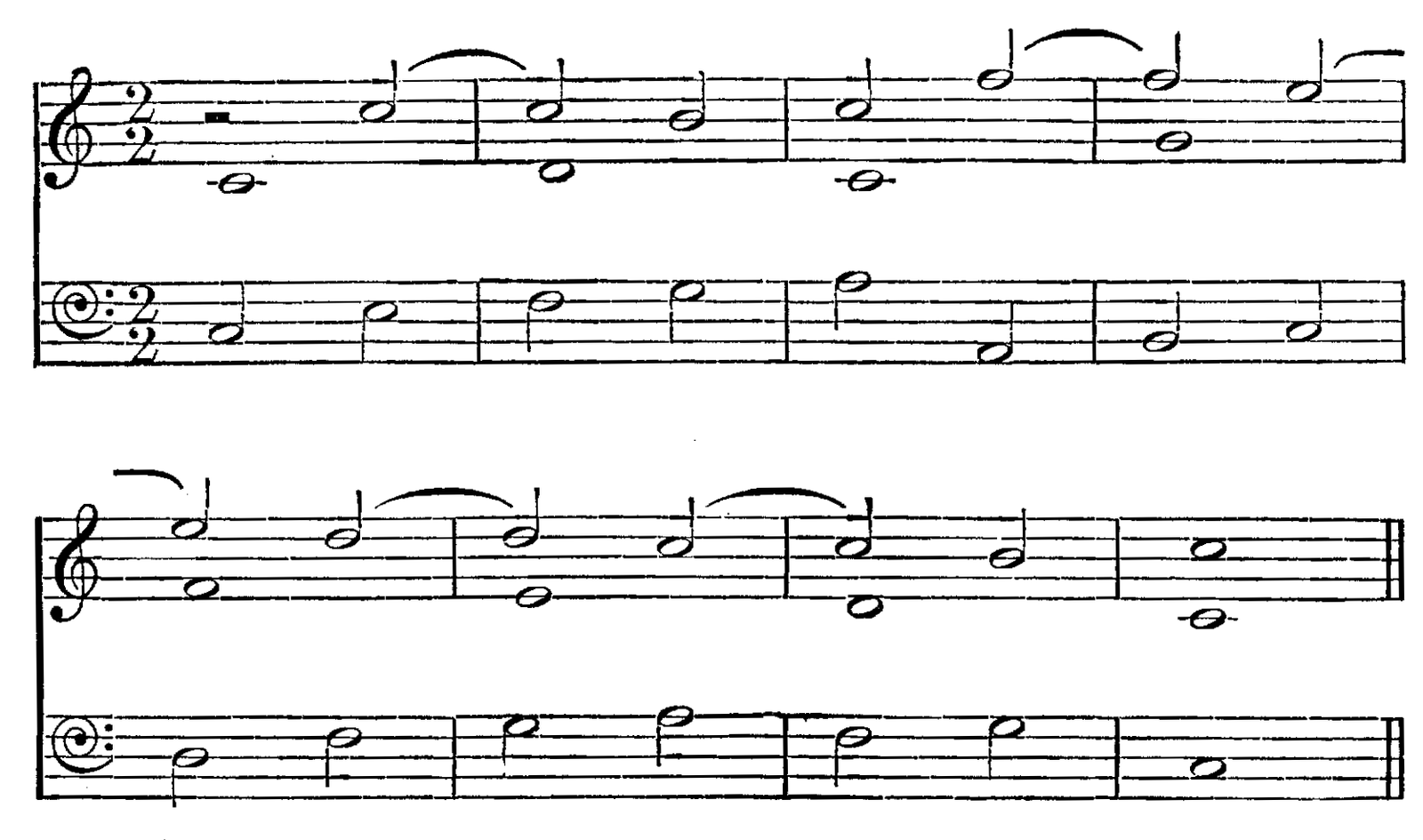
Elaborate either or both the parts, using minims, into florid idioms.
(3) Elaborate the bass into florid idiom:
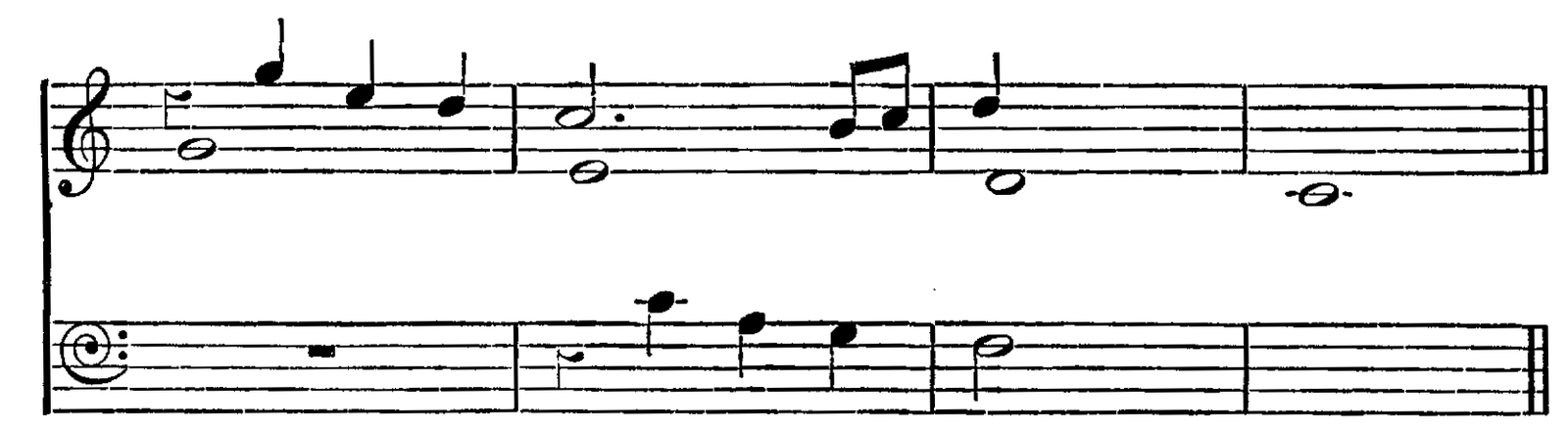
In florid counterpoint the parts should enter imitatively, using either the opening of the C. F. in some shorter notes (not necessarily even notes), or an independent figure.
(a) Imitation of opening of the C. F.:
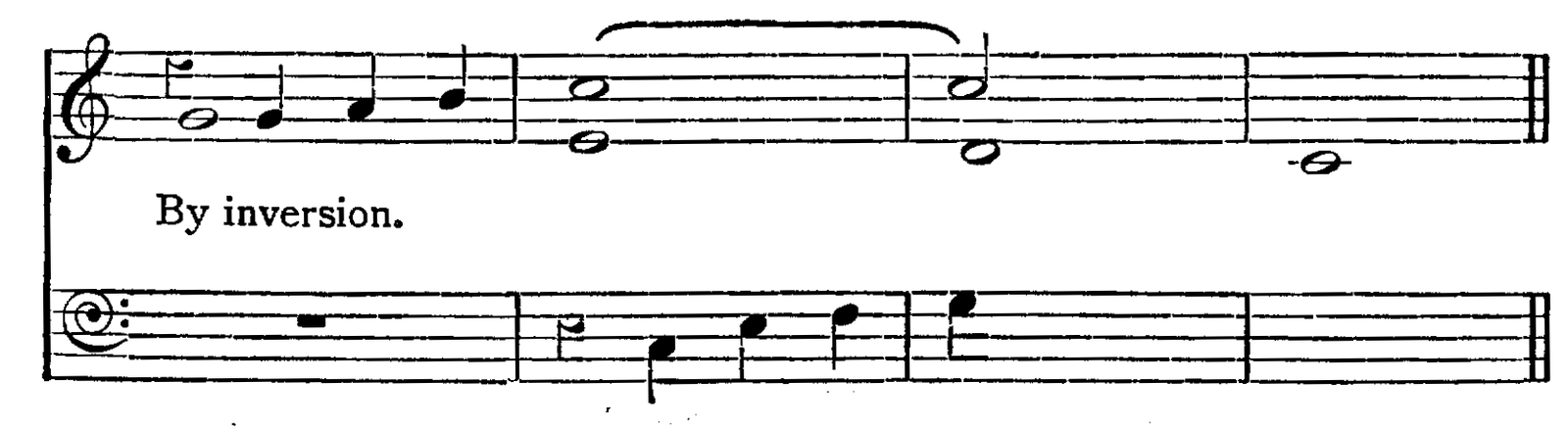
(b) The counterpoints using independent figures:
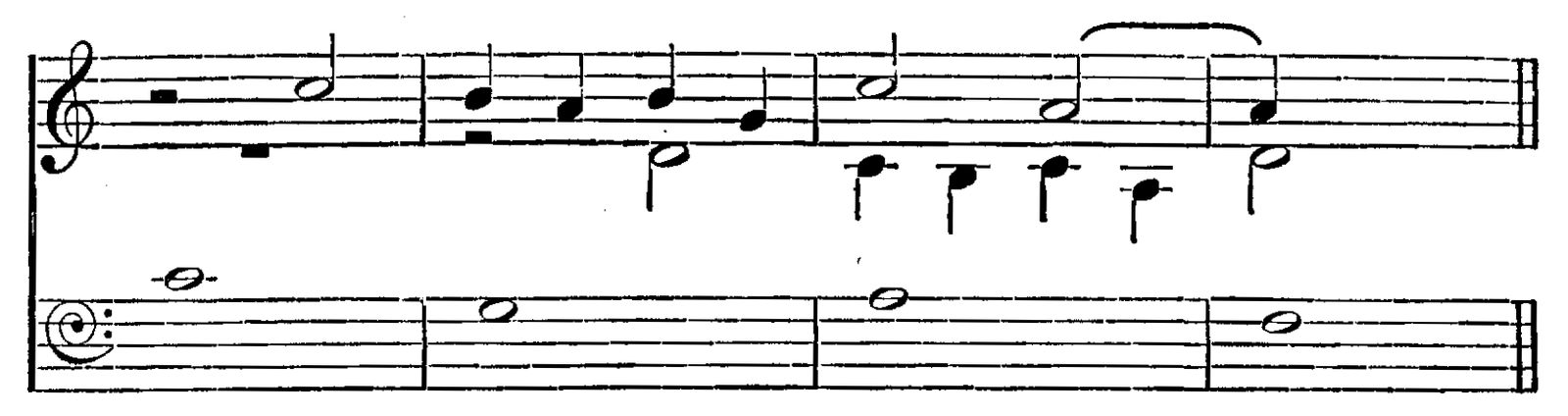
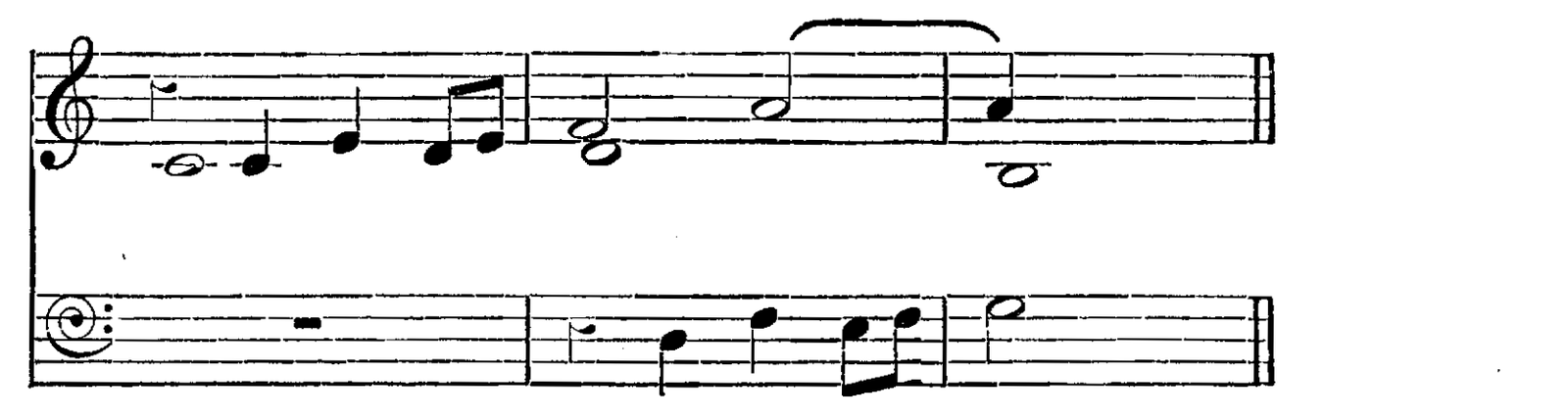
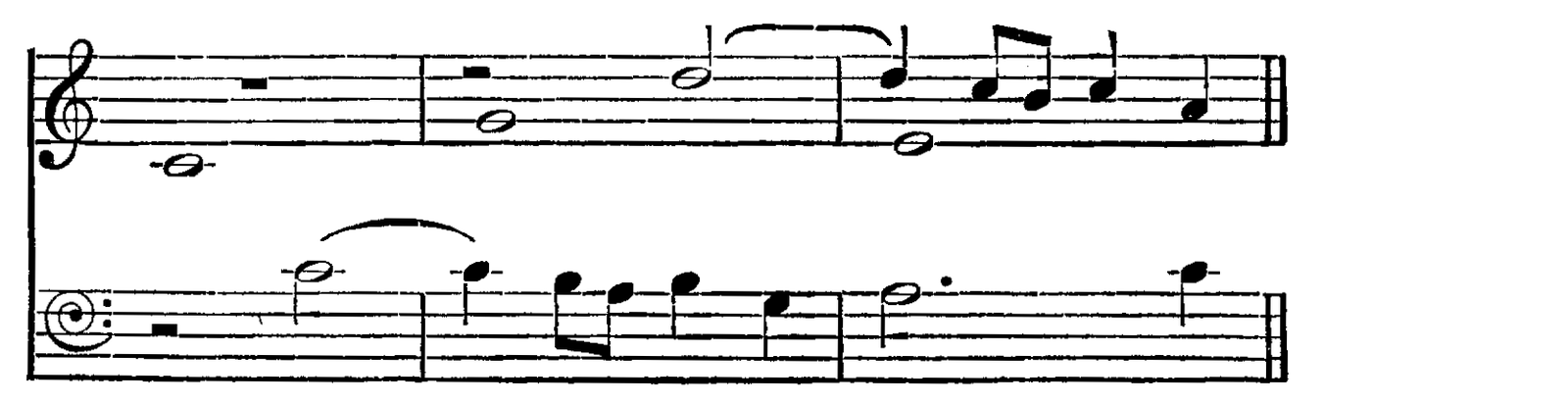
Aim at contrast in the rhythm of the parts. Do not let them move simultaneously for any length of time. Rarely use two groups of quavers together, or two groups in the same bar. When you have written a part for two bars sing it through, and having decided the most natural way for it to proceed for the next bar or two, try to make it do so. Then fill in the other part, and consider it from the same point of view. Avoid monotony or aimlessness. Vary the range, the rhythm, and the nature of the movement (conjunct or disjunct).
There is no valid reason why any procedures that the employment of words would necessitate should not be allowed in technical work. Repeated minims inside the bar would often give the music more point,

and get rid of the dilemma that a semibreve may not be tied to a crotchet:

Further, there is much to be gained in allowing:

(a) Constantly occurs with words, and stresses the discord. (b) marks the beginning of a new phrase. These procedures should be included in florid parts.
Examples
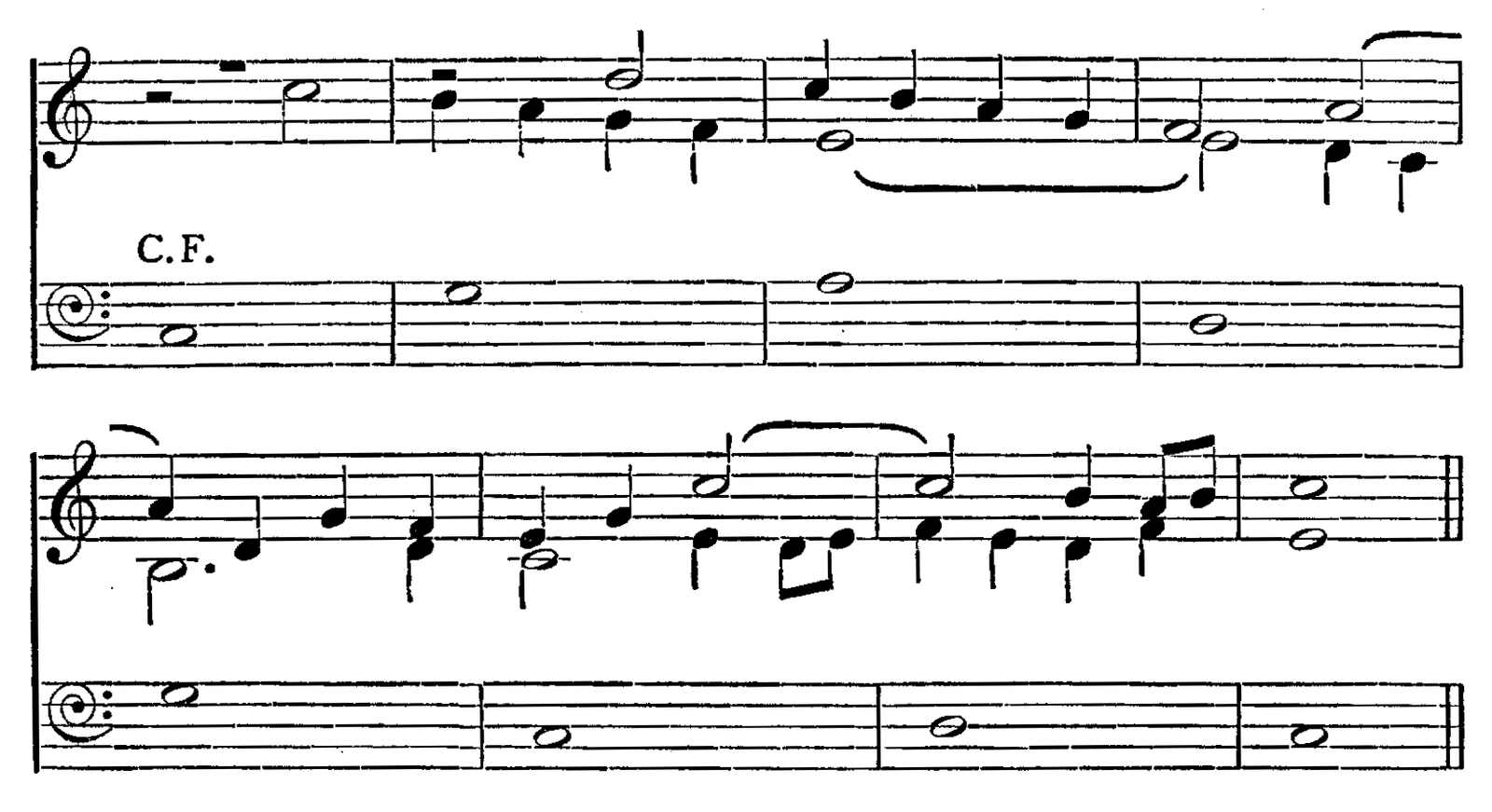
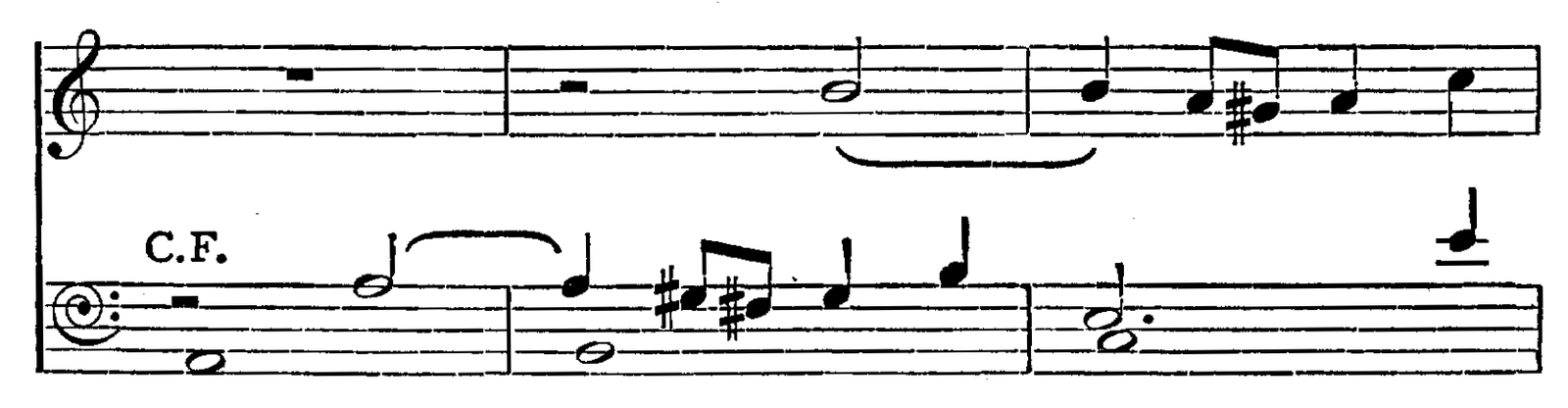
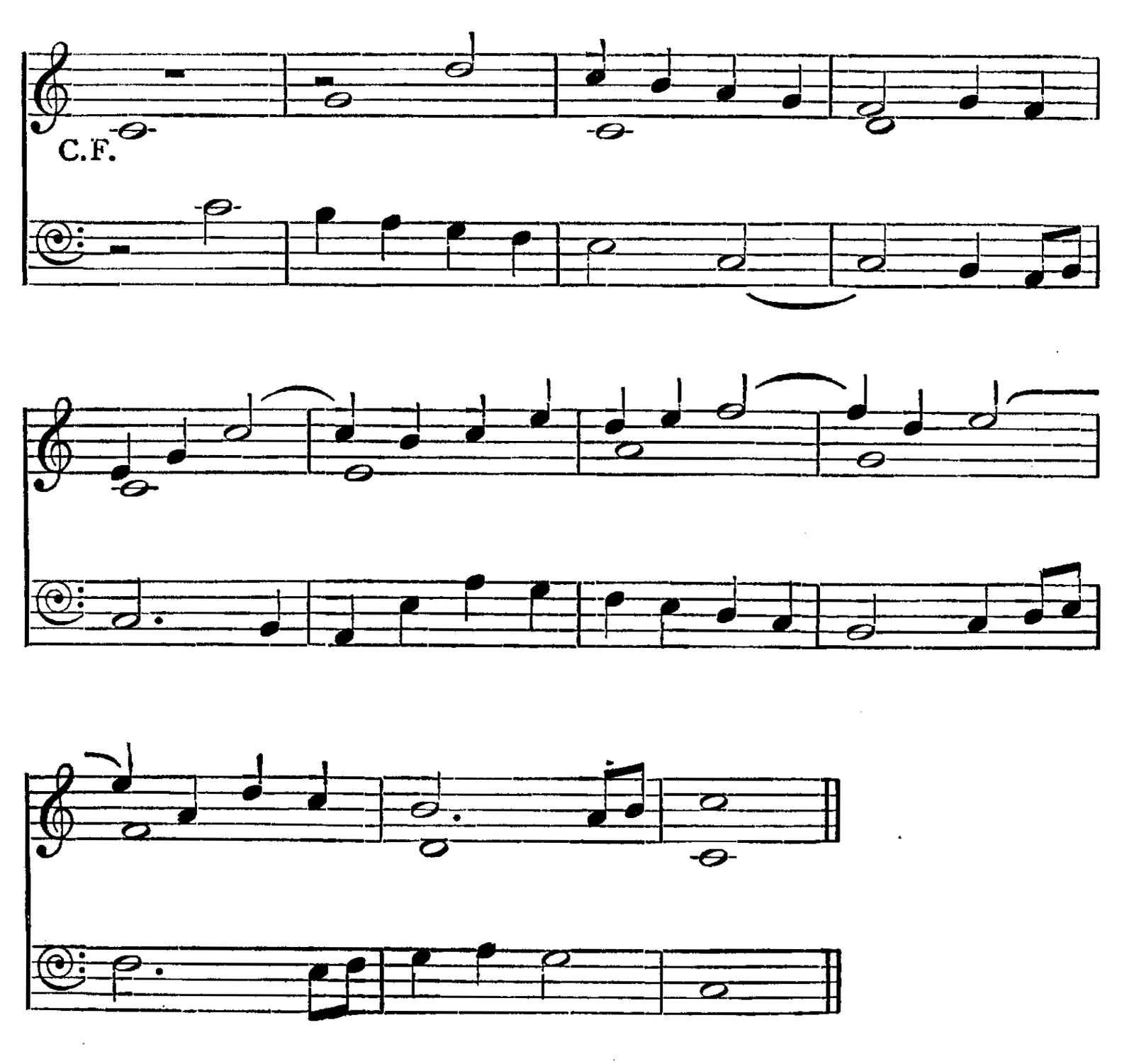
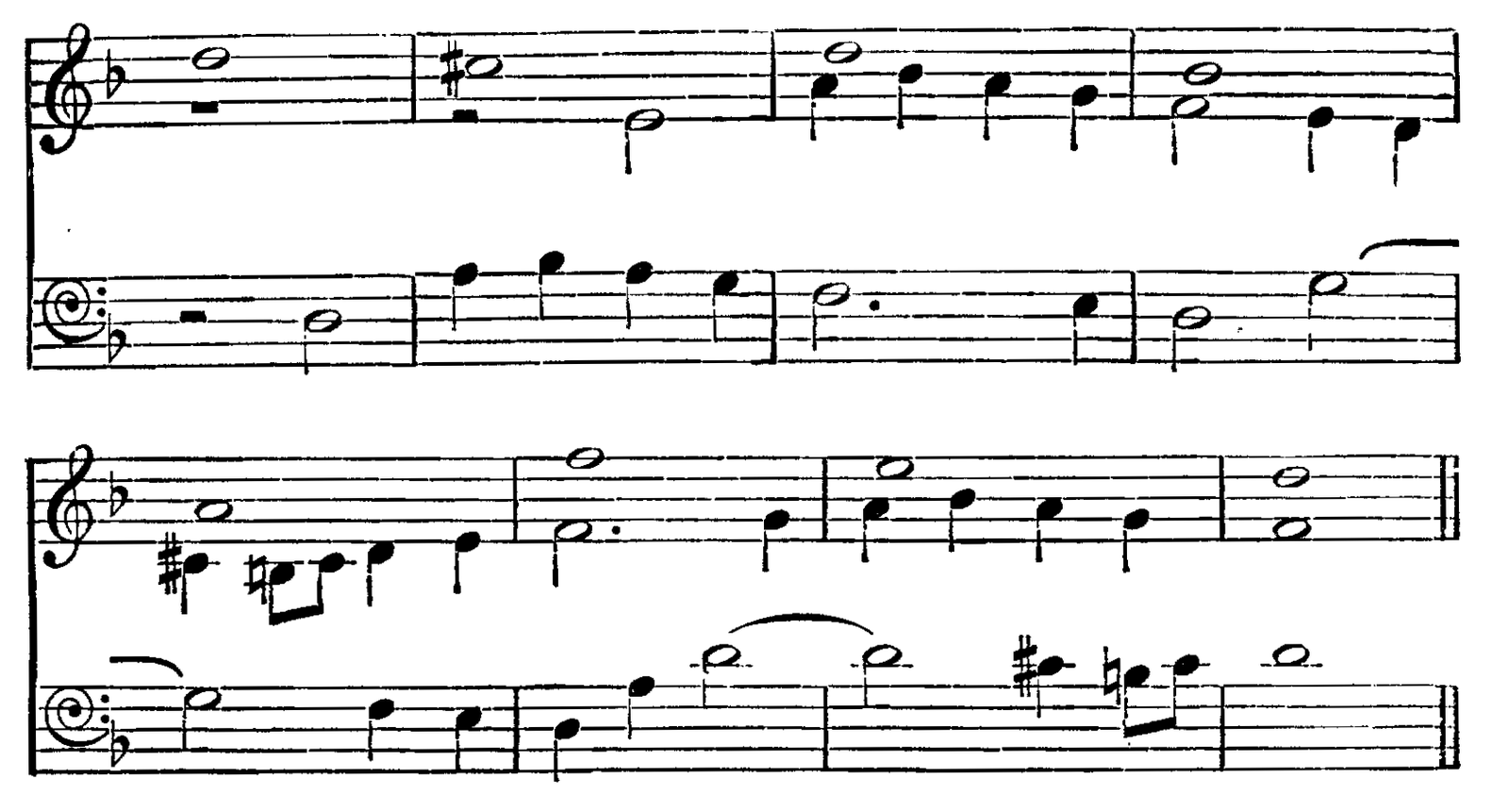
A short study in the use of the Nota Cambiata figure derived from Gibbons’s Hosanna.
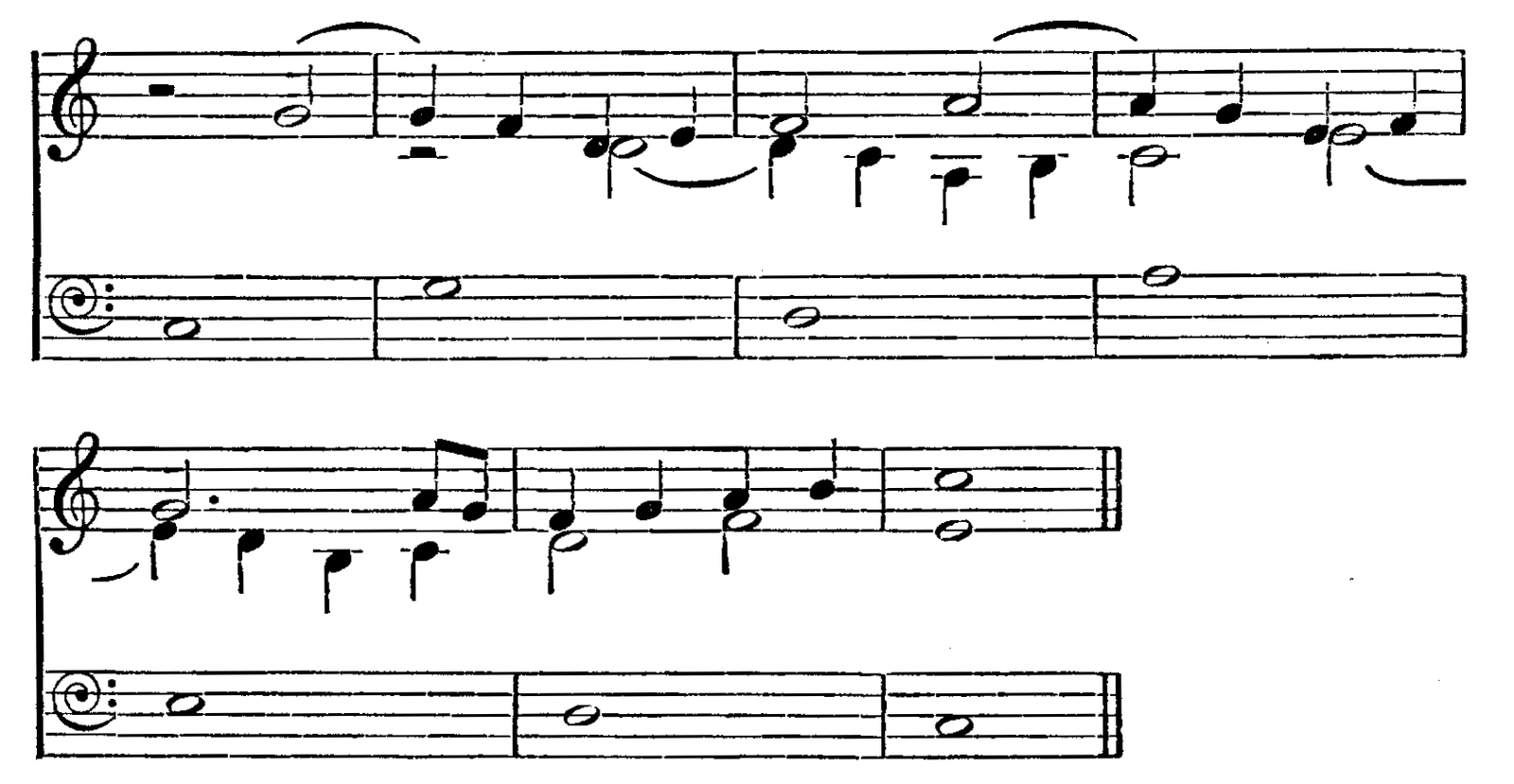
When some proficiency has been gained, a Canon on the C. F. may be attempted.
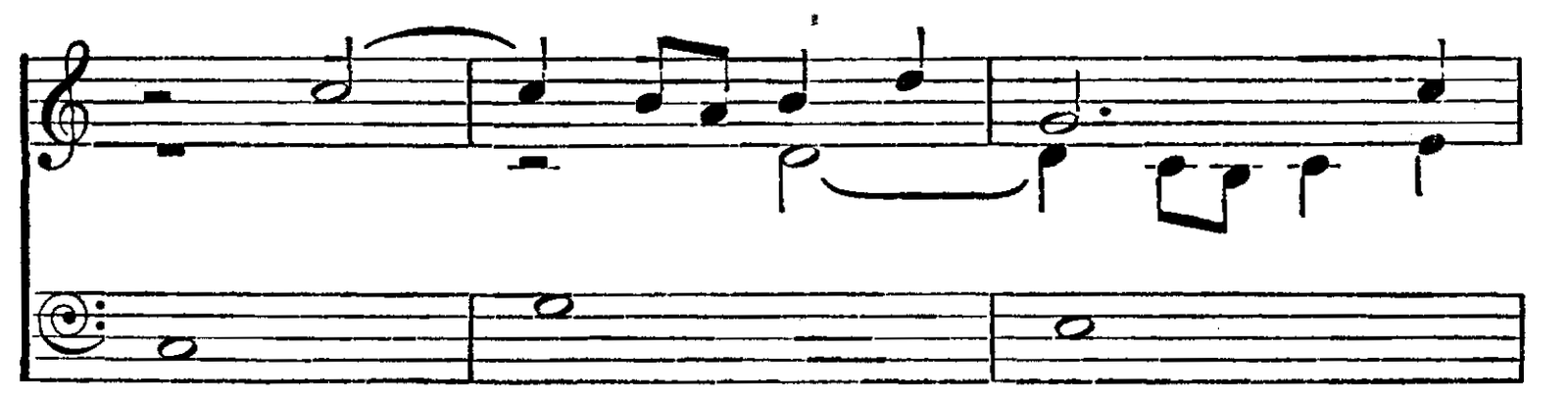
(a) In accordance with the practice of the period, and no evil effect is felt.
Exercises
(1) Add Soprano and Alto, both in Fifth Species.
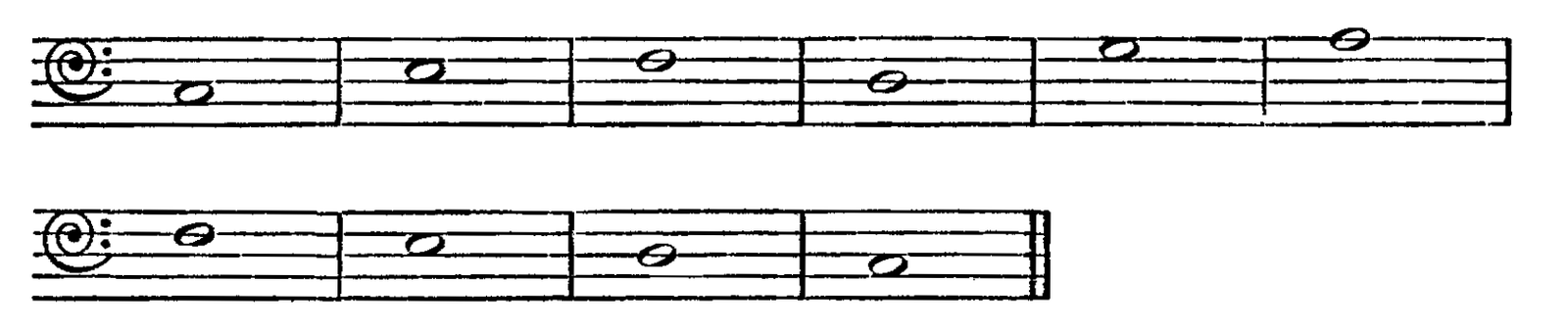
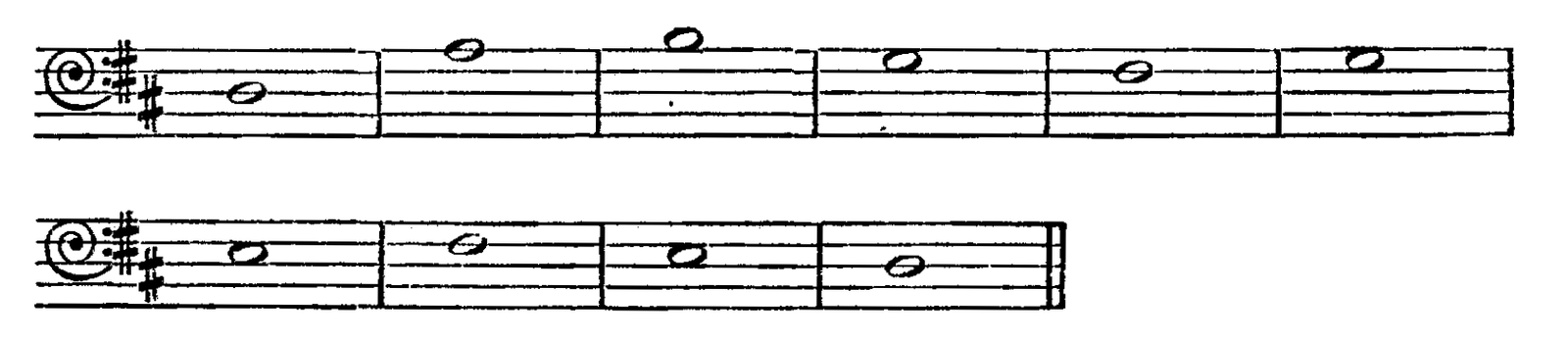
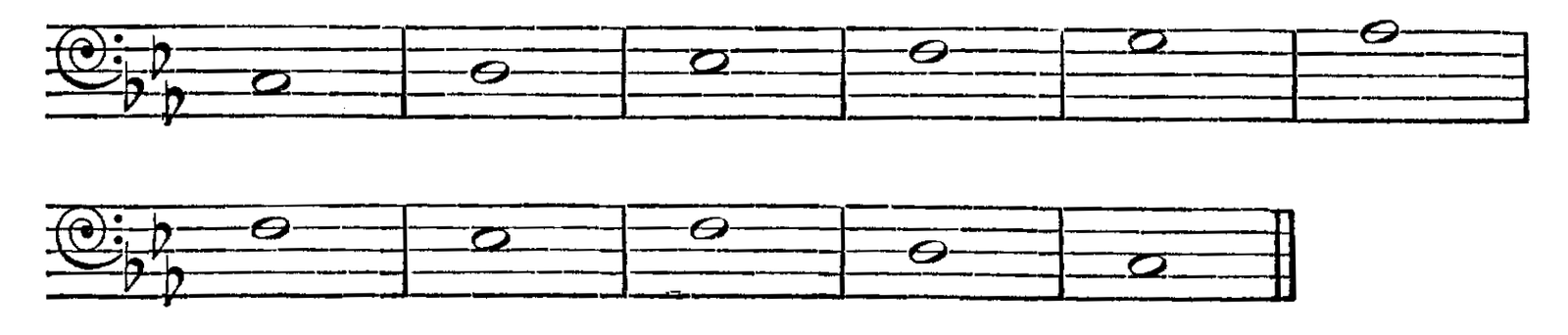
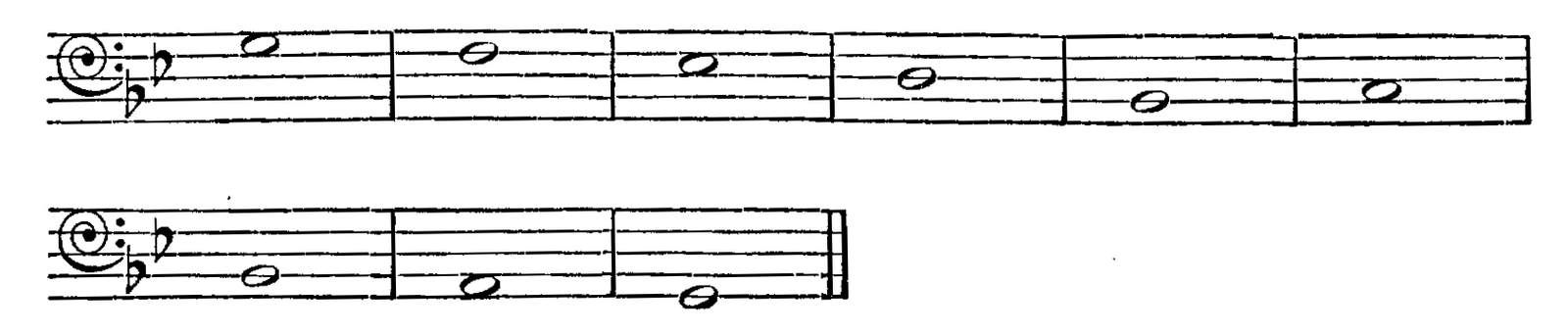
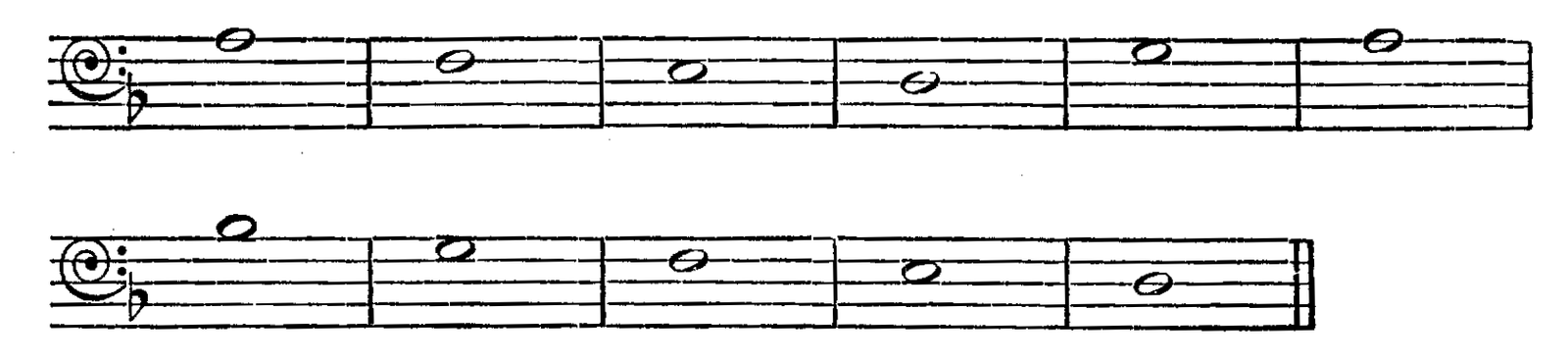
(2) Add Alto and Bass, both in Fifth Species.
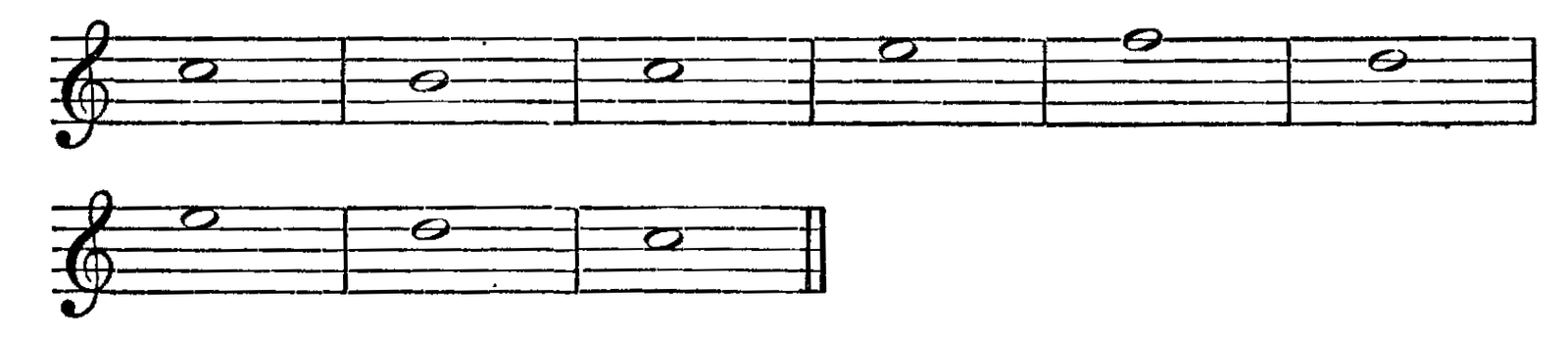
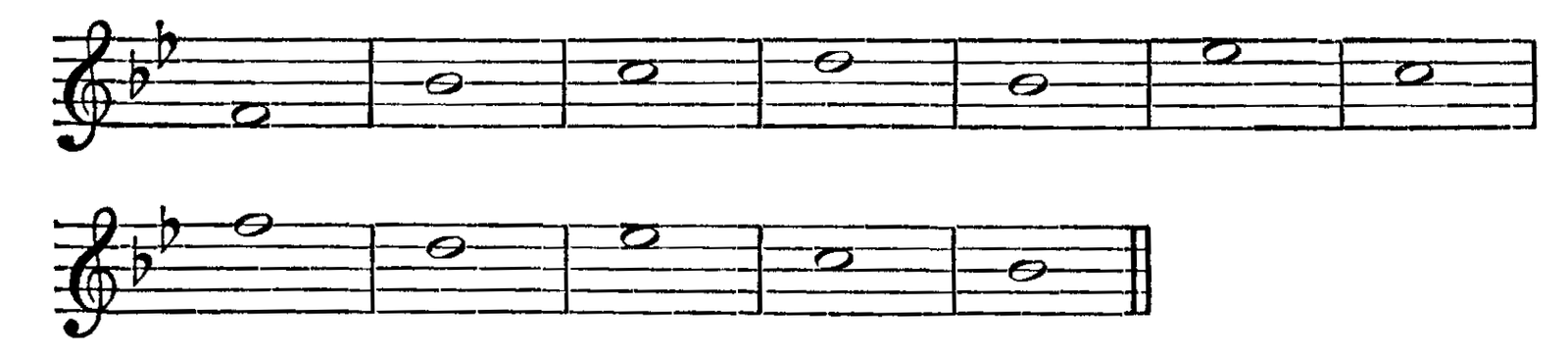
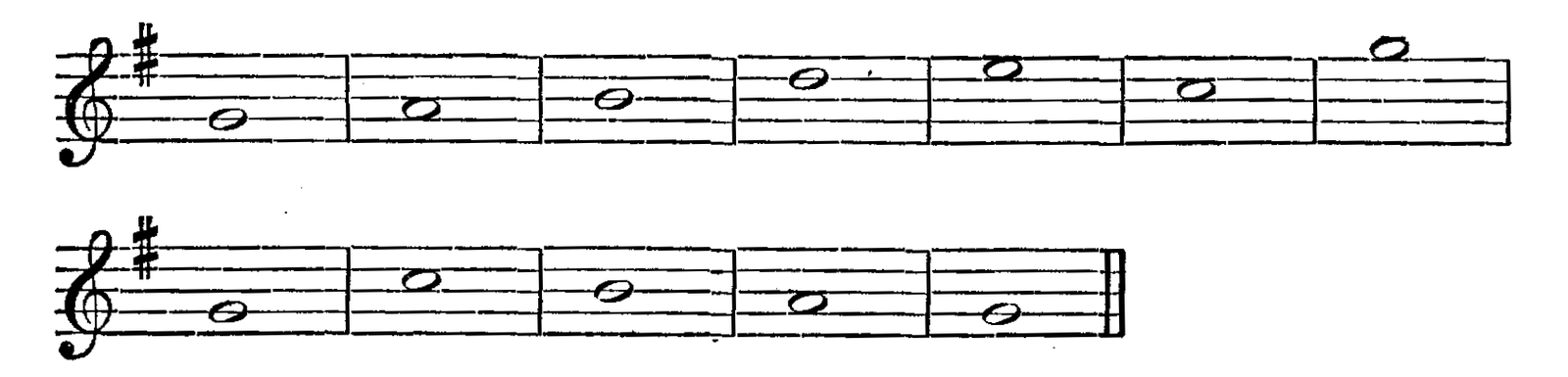
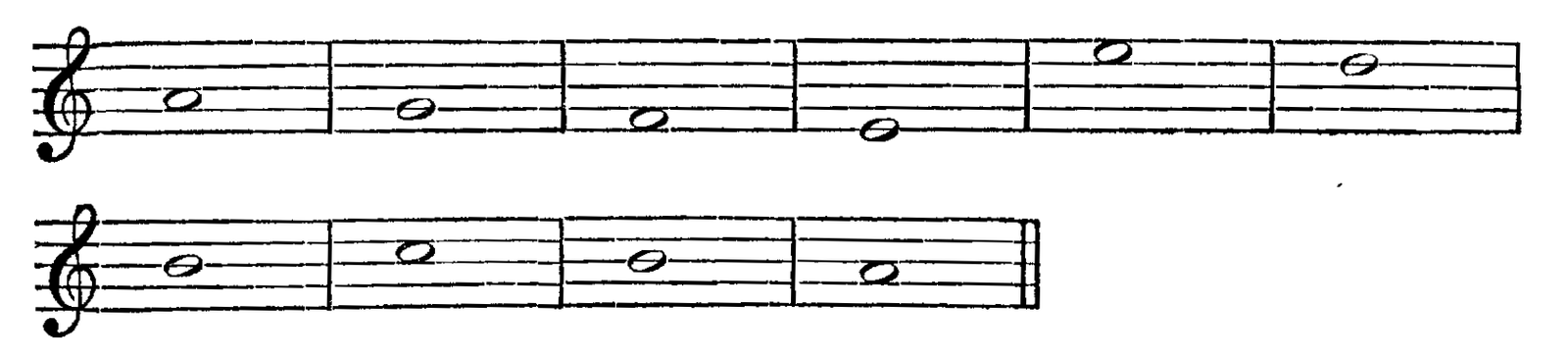
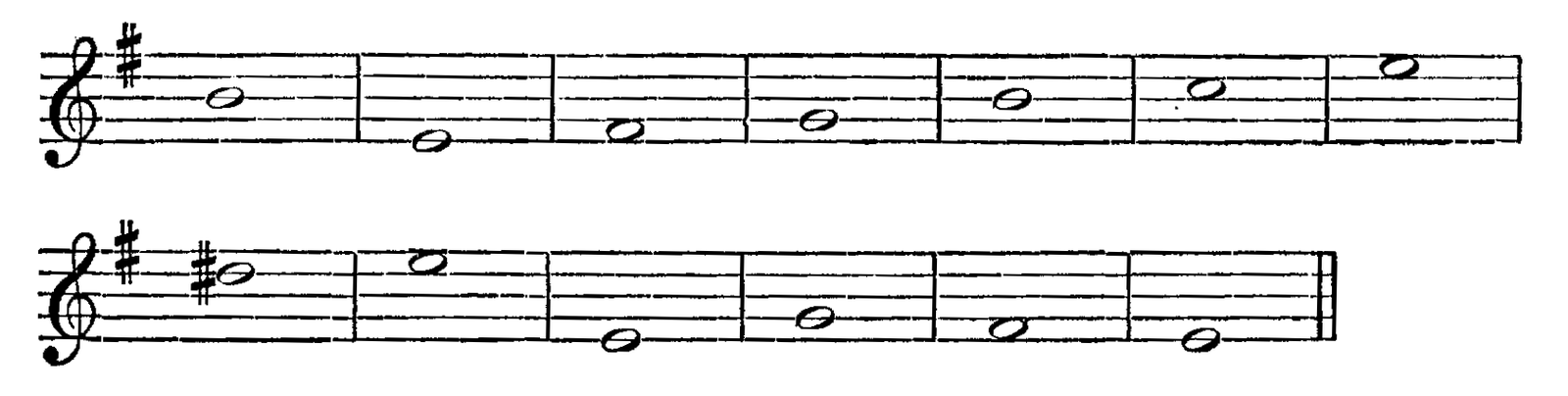
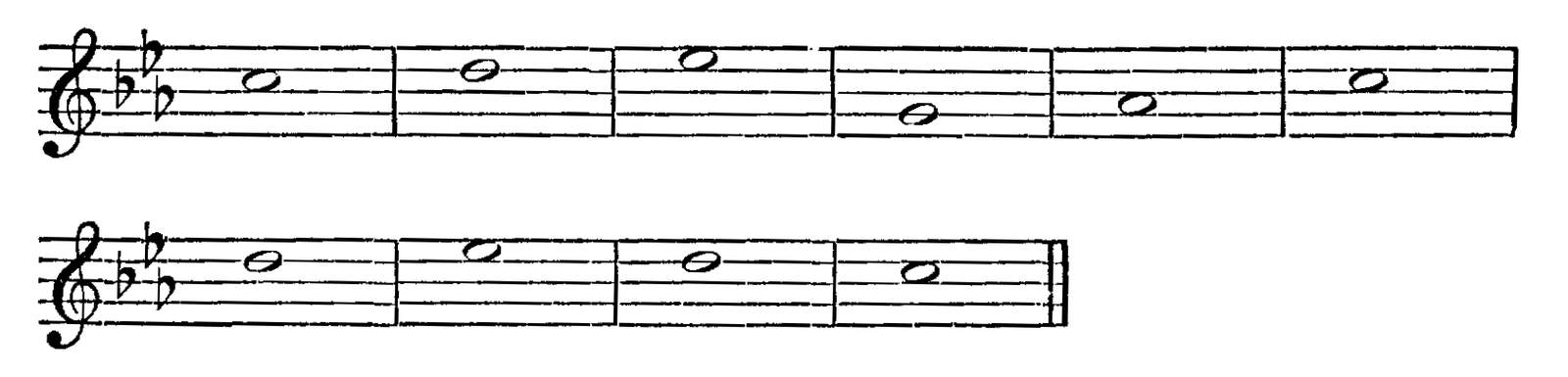
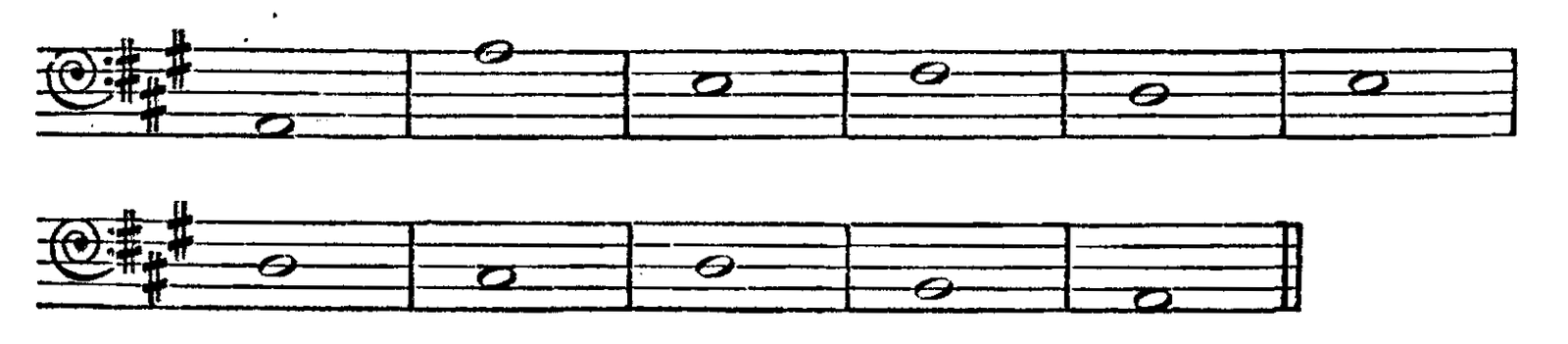
(3) Add Soprano and Bass, both in Fifth Species.