 Playable Books
Benjamin Cutter · section 5 of 7
Part three. modulation in general, the altered chords, etc
Read and hear this section in the playable edition →Section 29. Altered Chords
Altered Chords, which have already been touched upon, may be known by their resolutions. An Altered Chord moves to a principal chord of the key in which it, the altered chord, is chromatic.
Any step of a scale, major or minor, may be changed chromatically, some of the changes being the result of passing tones, others being chord changes made to heighten the effect of the chord itself. Thus, in the latter case, the natural tendency of the supertonic seventh chord toward the dominant, or toward its chord of introduction, the tonic six-four, is increased in the major mode, if by lowering the fifth of the supertonic chord this supertonic be made somewhat more dissonant.
It must ever be borne in mind that many chords are definable as Altered Chords only through their surroundings.
What, for example, might cause the mental effect of a modulation in a slow tempo, must be regarded as a chromatic alteration in a rapid movement.
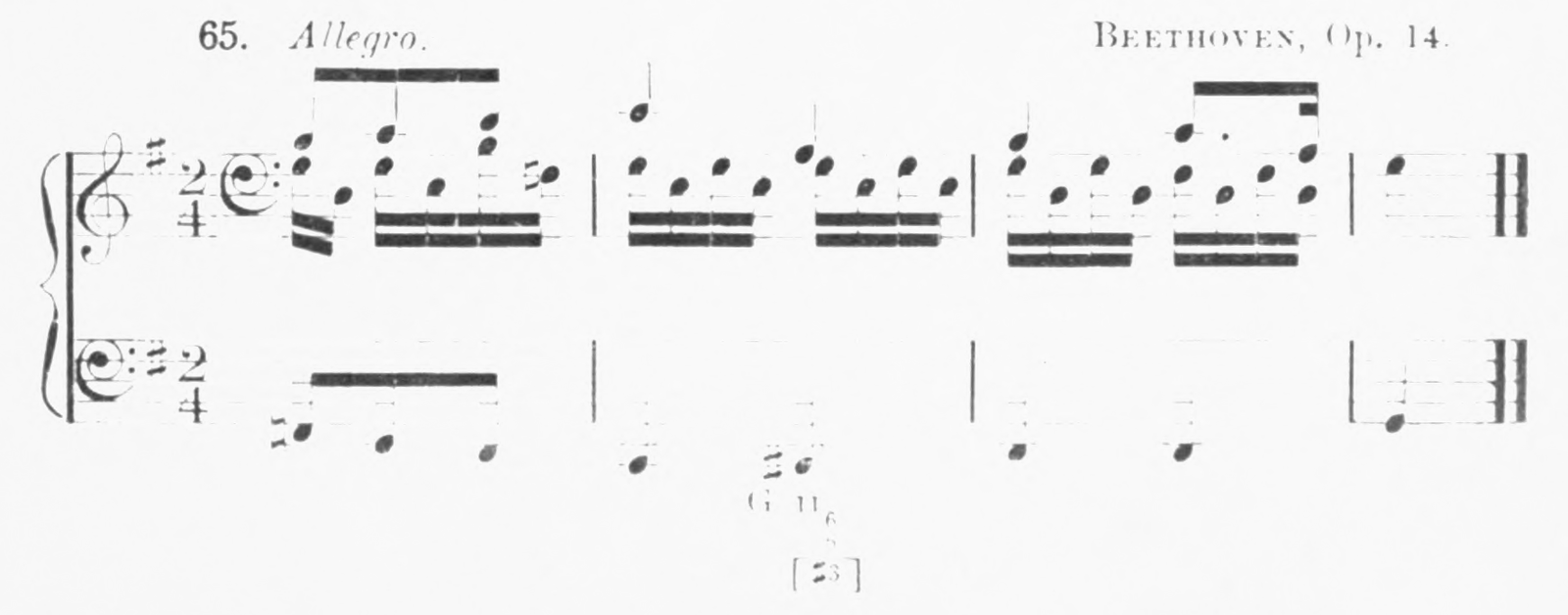
Section 30. The Supertonic Seventh with Sharp Third
Ex. 65 · Allegro. Beethoven, Op. 14.
Ex. 66 · Andante con moto. Mendelssohn, Song without Words.
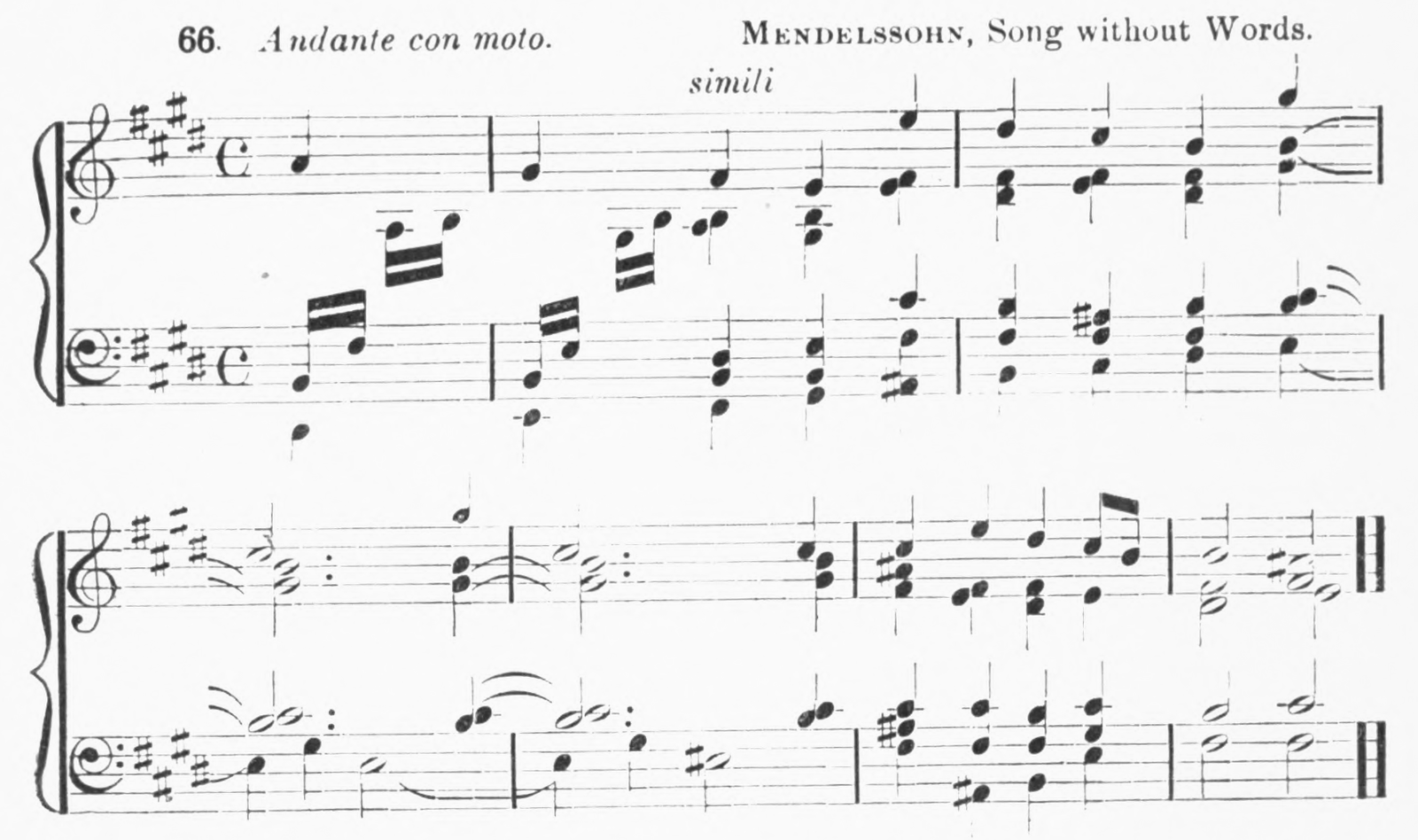
References. Beethoven, Op. 7, II, 19, 23; Op. 10, No. 2, I, 57; Op. 10, No. 3, II, 5; Chopin, Prelude 13, più lento, m. 7; Schumann, Op. 12, No. 3, m. 1.
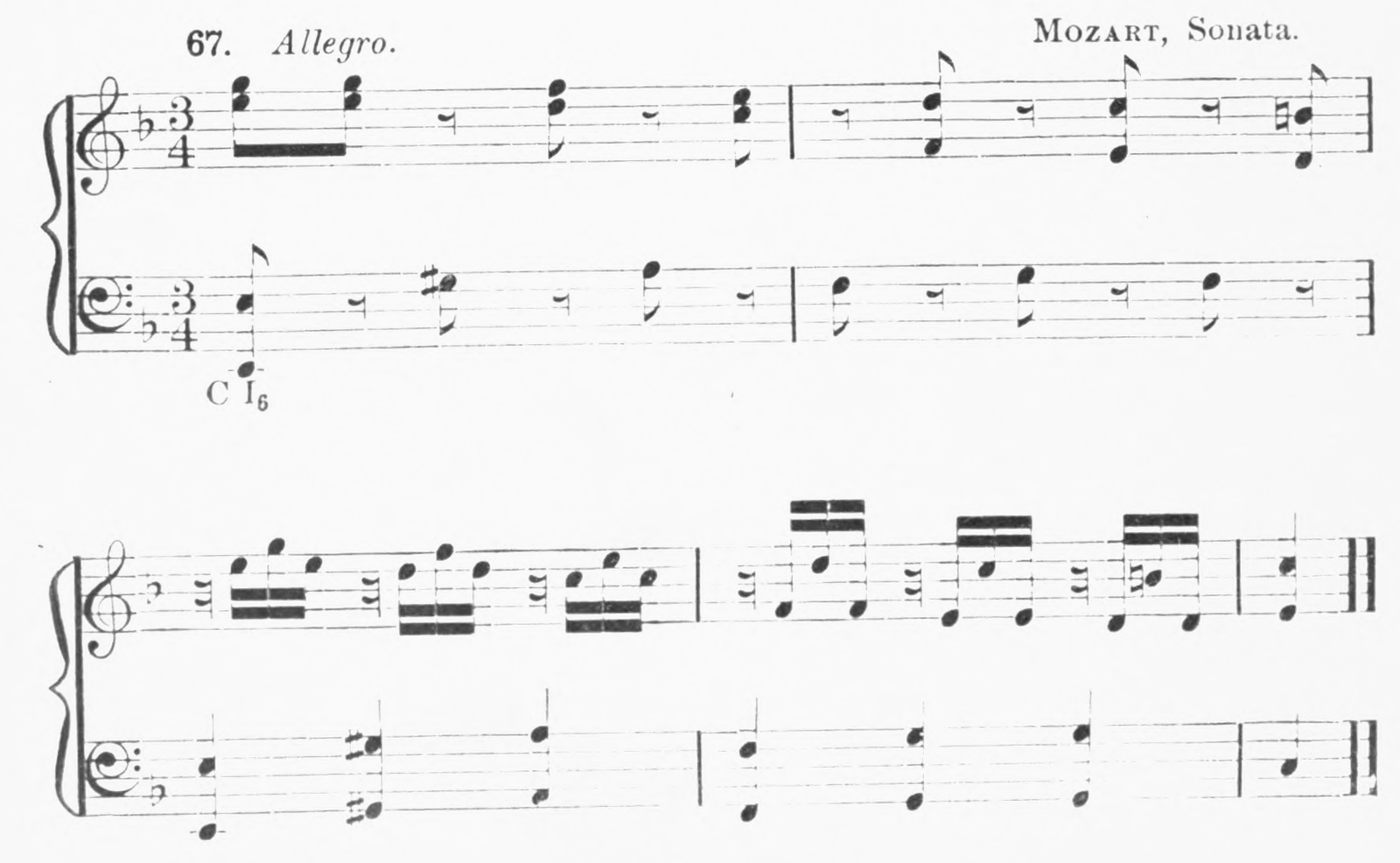
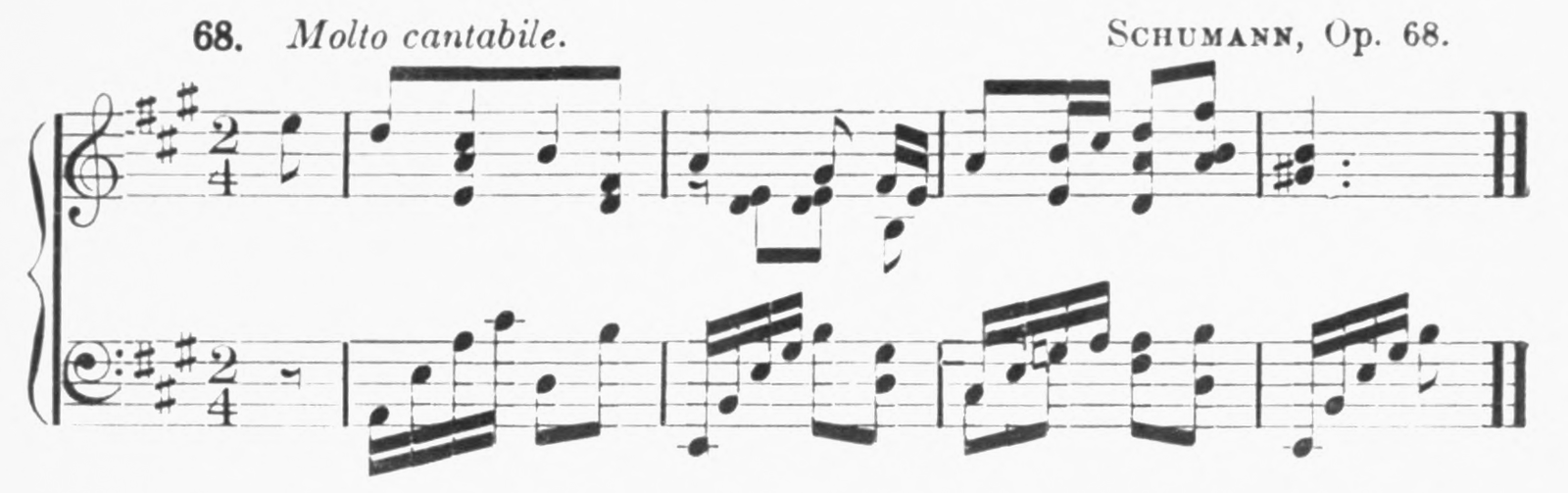
Section 31. Other Altered Steps
Made so by their surroundings.
Ex. 67 · Allegro. Mozart, Sonata.
Ex. 68 · Molto cantabile. Schumann, Op. 68.
Ex. 69 · Andante. Brahms, Op. 45.
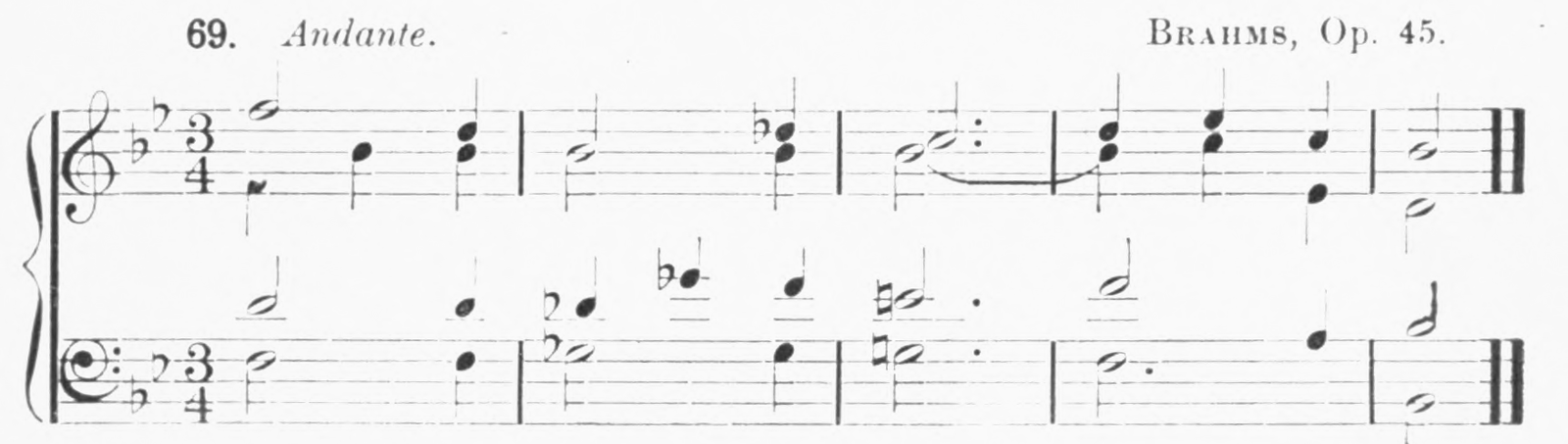
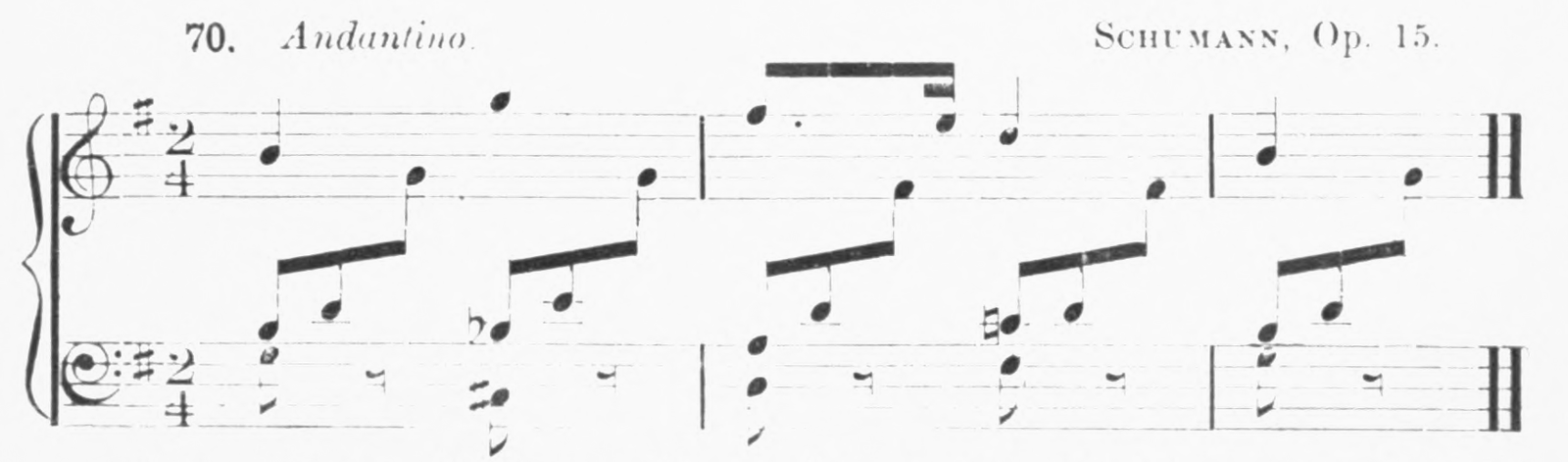
Ex. 70 · Andantino. Schumann, Op. 15.
References. Beethoven, Op. 10, No. 1, III, 37; Grieg, Op. 6, No. 4, m. 3; Czerny, Op. 299, No. 27; Cramer, Etude 9, m. 50; Etude 19, m. 7; Chopin, Nocturne No. 2, m. 11; No. 6, m. 81; Schumann, Op. 68, No. 17, m. 13 and 17; No. 26, m. 3; No. 28, m. 3, 7, 20; No. 30, m. 2, 3, 7; No. 38, m. 3; No. 39, m. 27; Bizet, L’Arlésienne, Suite I, First Movement, Tempo I; Wagner, Tannhäuser, 211, 220, 238, 254; Flying Dutchman, 13.
Section 32. Apparent and Real Modulations
These Apparent Modulations may often be regarded as intensifications of secondary scale steps, through the precedent use of their apparent dominant or diminished seventh chords—as has already been stated: or, as a series of dominant seventh chords preceding a cadence, the roots involved being usually the iii, vi, ii, V, I (see Appendix, No. 1).
Whether or not real modulations are present, each analyst must decide for himself. At all events, the succession iii, vi, ii, V, with or without sevenths, and in whatever form, is one which confirms the ultimate tonic; it is one in which, however strong these questionable key impressions may be, the total impression is one of pushing on to the close in that final tonic harmony which rounds out the whole. This feature of the thing leads many to say “altered chords” where the man of the old school says “modulation.”
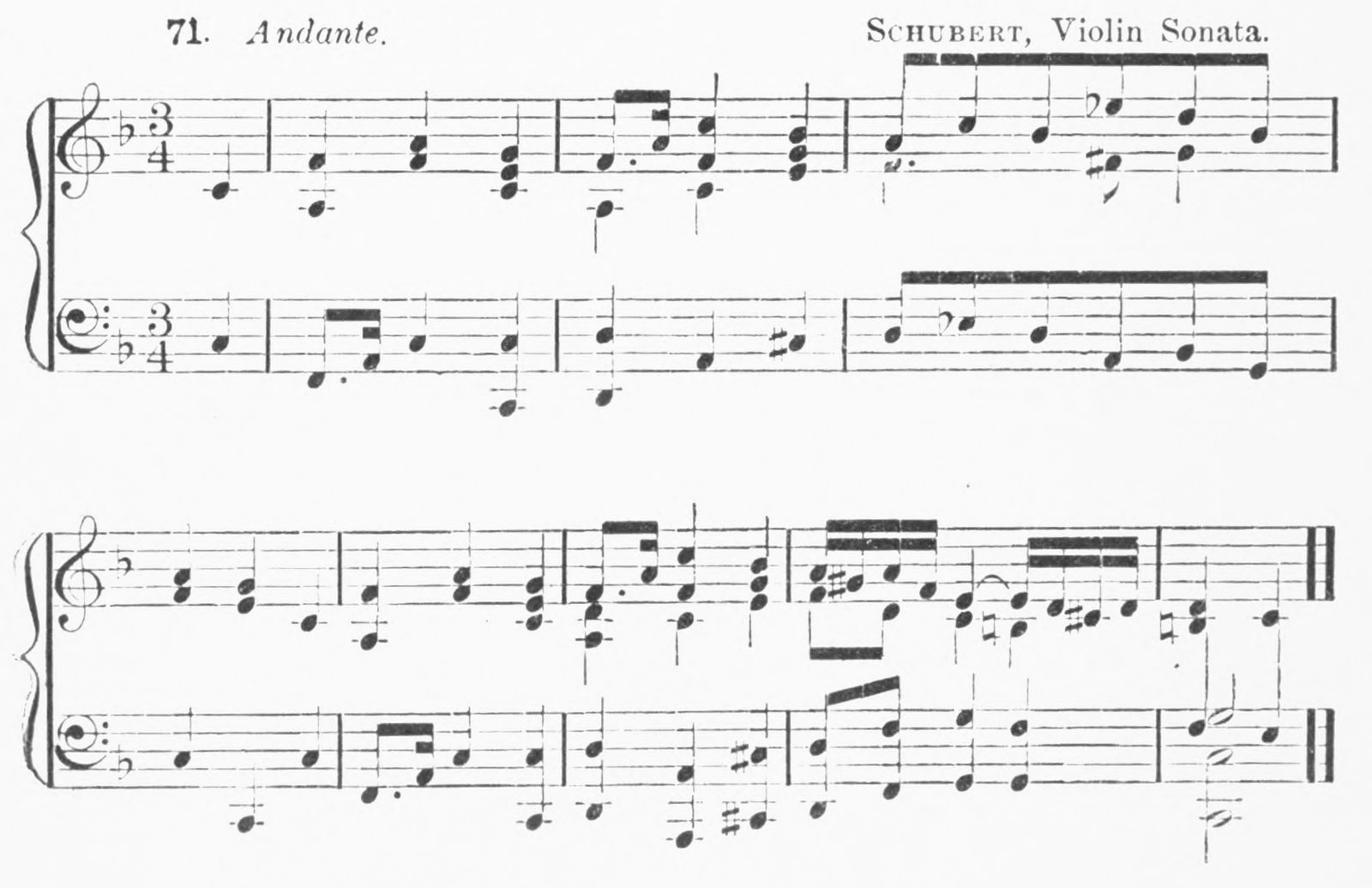
Ex. 71 · Andante. Schubert, Violin Sonata.
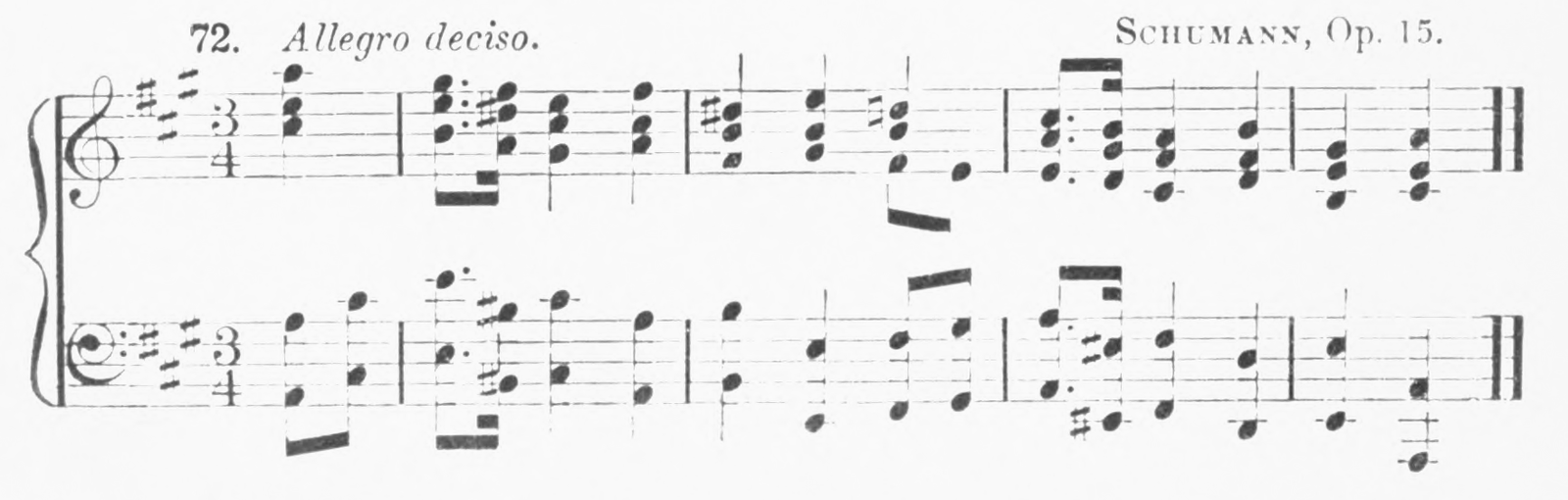
Ex. 72 · Allegro deciso. Schumann, Op. 15.
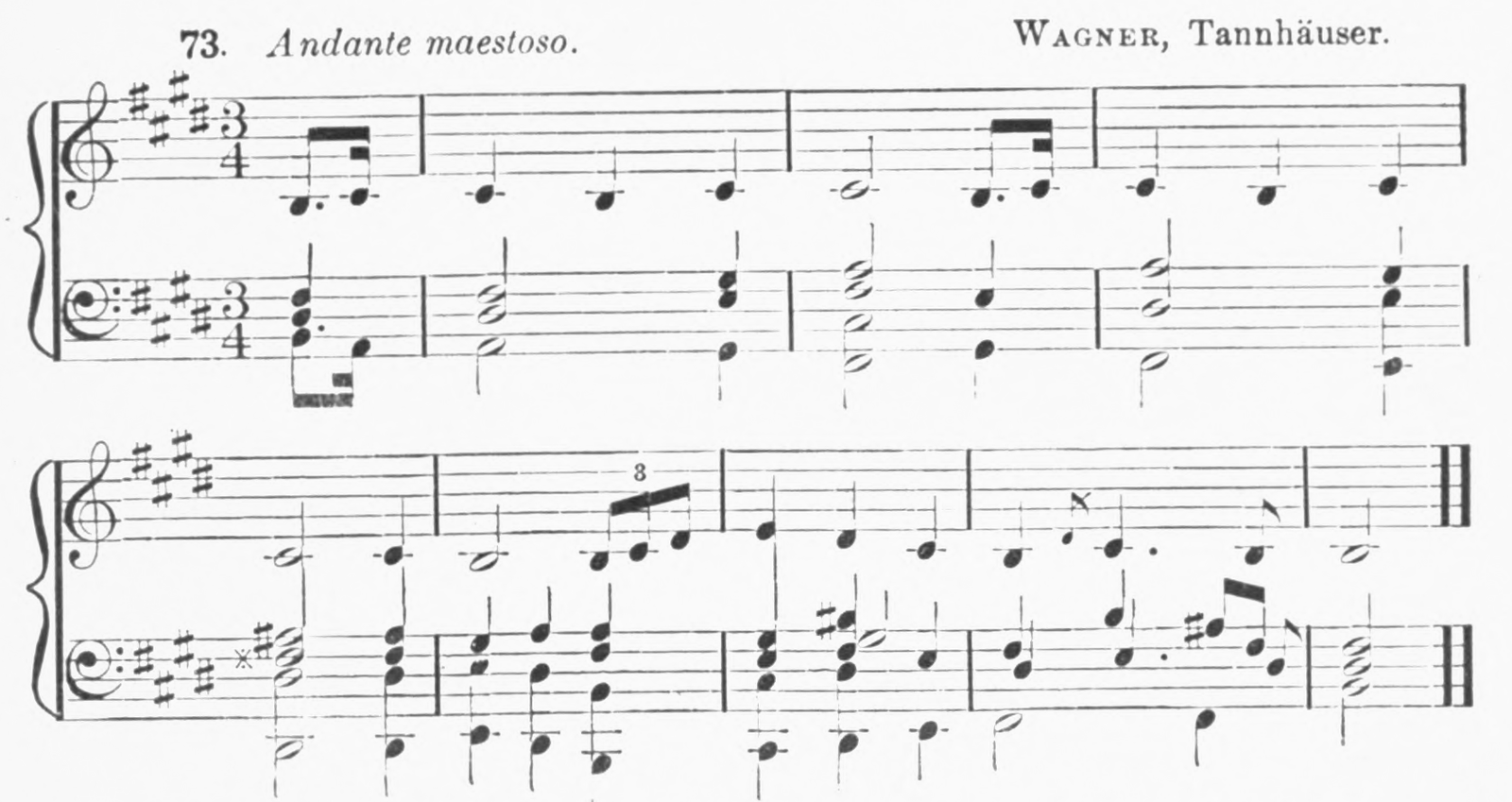
Ex. 73 · Andante maestoso. Wagner, Tannhäuser.
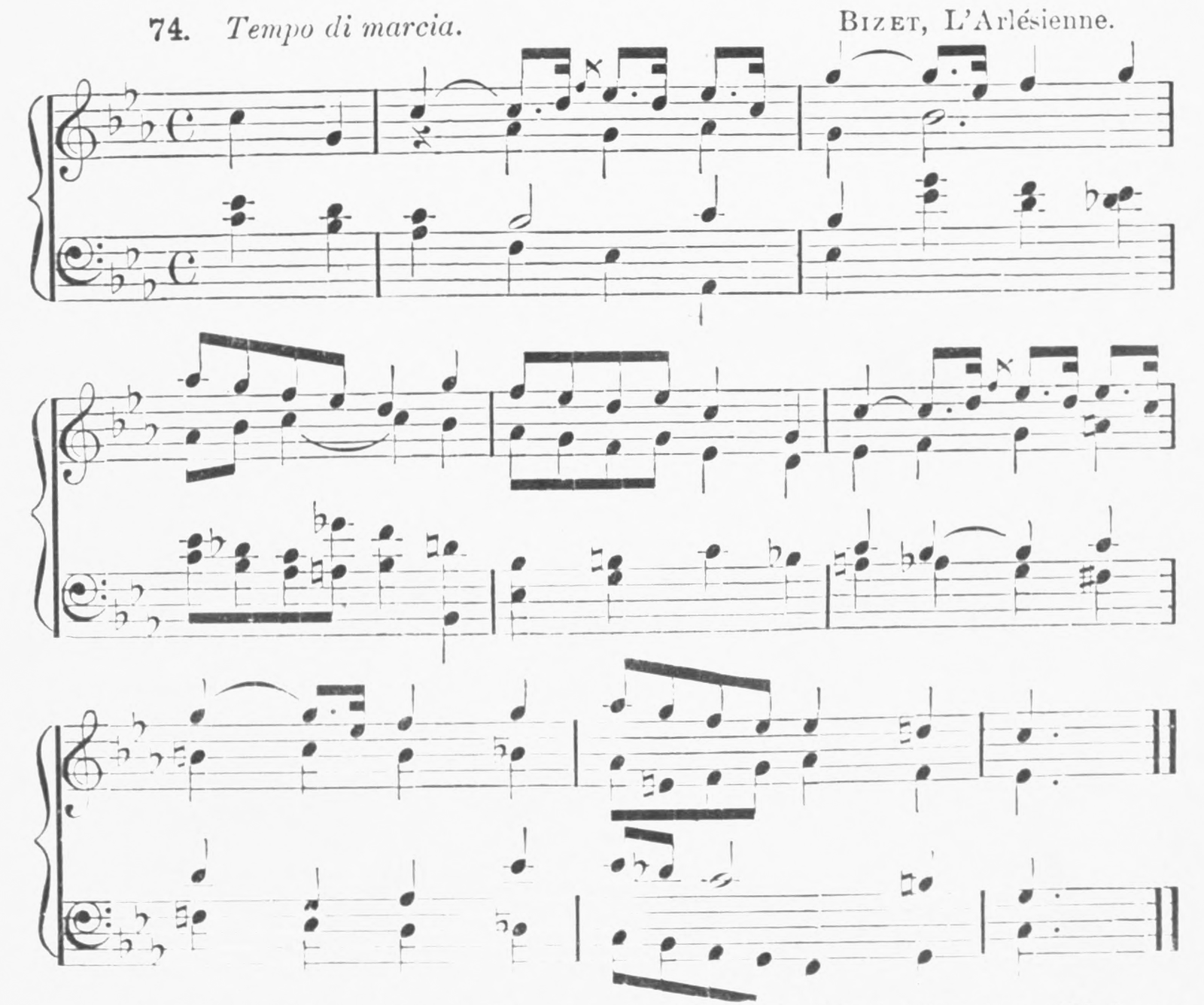
Ex. 74 · Tempo di marcia. Bizet, L’Arlésienne.
References. Wagner, Tannhäuser, 121, 236; Flying Dutchman, 75 (poco ritenuto), 100.
Section 33. Consecutive Dominant Sevenths
Mark each chord according to its apparent key.
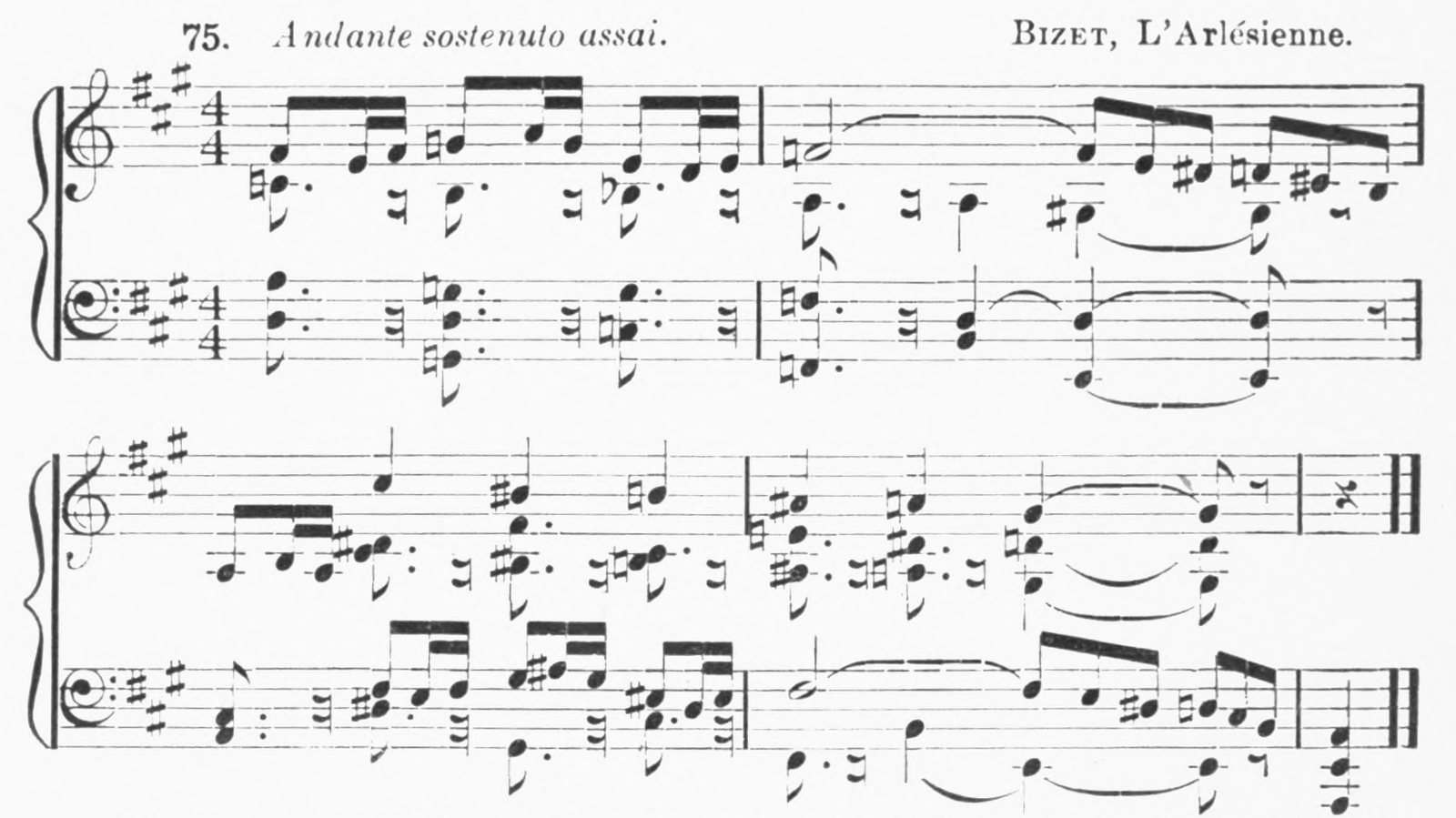
Ex. 75 · Andante sostenuto assai. Bizet, L’Arlésienne.
References. Beethoven, Op. 10, No. 3, III, 17; Op. 22, II, 34; Chopin, Prelude No. 8, m. 7; Cramer, Etude 18, m. 9.
Section 34. Enharmonics
Enharmonic notation is the use of that double notation which may be applied to any tone; thus F♯ may be written G♭, or E, F♭. Enharmonics are used:—
As a means of modulation;
As a means of simplifying the reading or playing of a passage, which, if written out logically, would pass through a remote and difficult key;
As the result of careless or wilful notation.
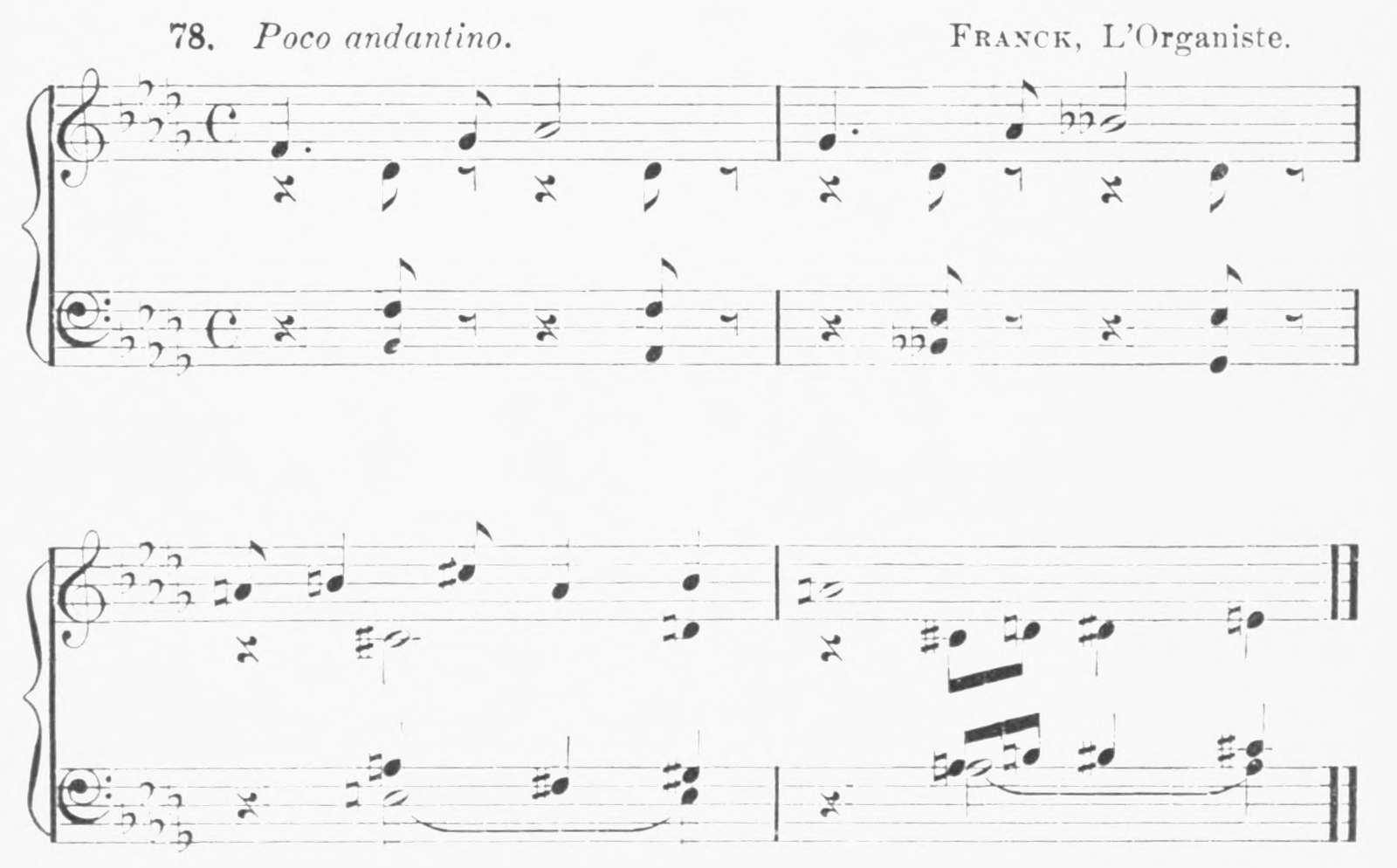
It is probable that no feature in Analysis causes trouble equal to that given by Enharmonic Notation, especially by that careless and illogical kind last mentioned, which is remarkably common in modern music. Countless cases exist in which the ear hears one thing,—the impression of a key, an impression consistent and undisturbed,—while on the paper the eye beholds another thing—two contradictory keys. In a passage in sharps, for instance, stands a flat chord, and the mind through the eye is aware of a hitch, unwarrantable and without reason, while to the ear all is smooth and satisfactory. Such a passage will oblige the student to find and to change mentally the enharmonics to their correct and legitimate notation, if he would account for things satisfactorily.
General Rules are these:—
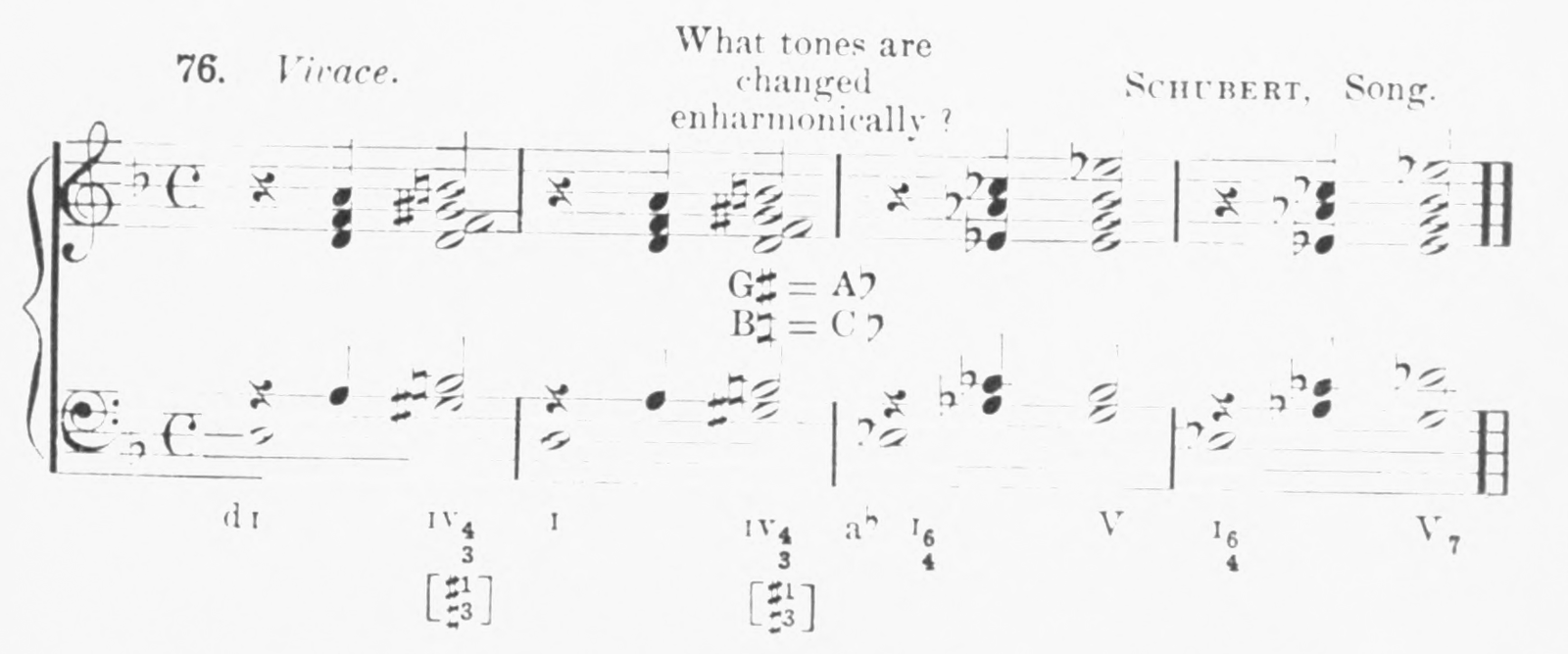
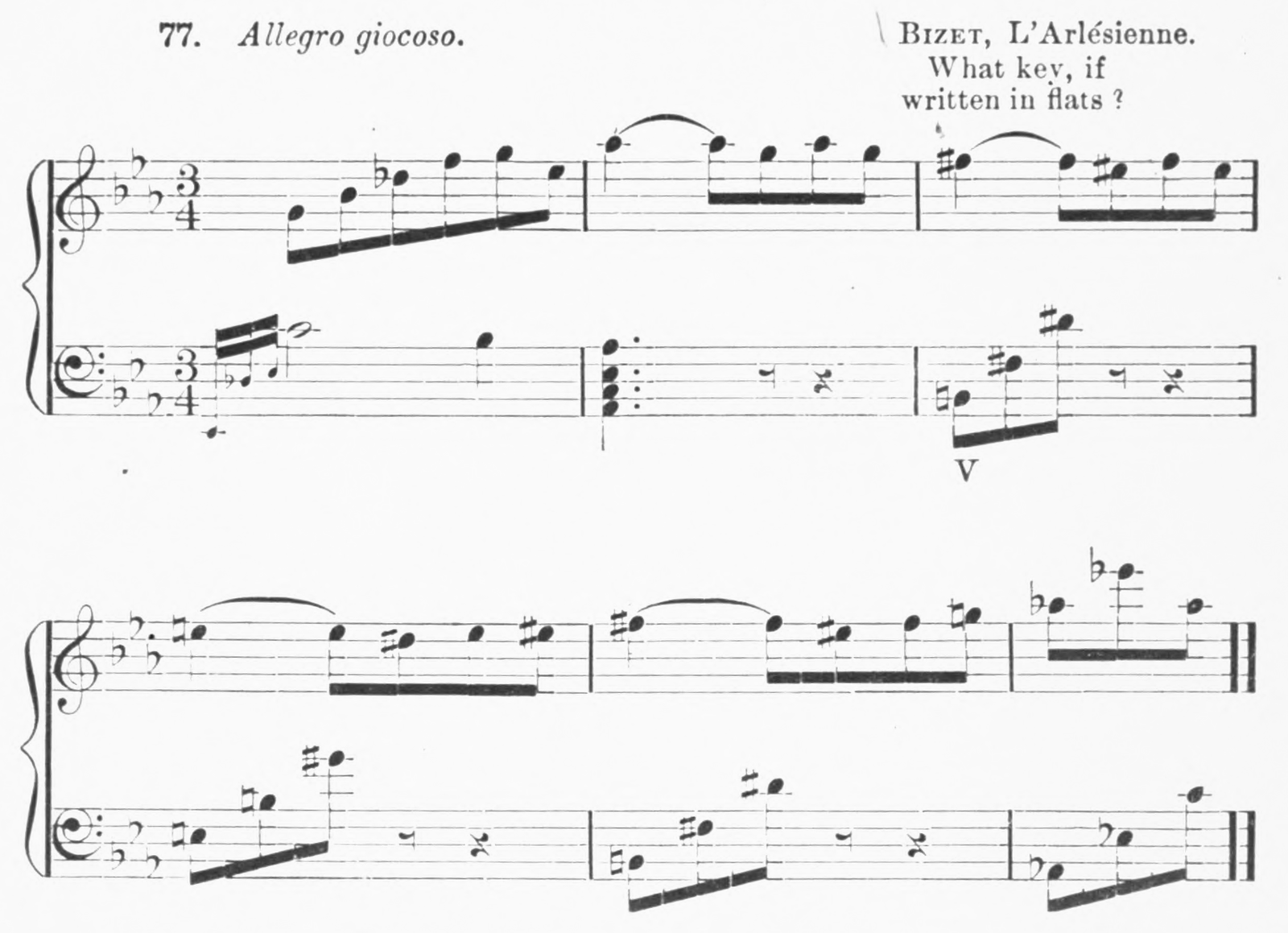
When a passage, in flats, for instance, goes into sharps, and stays there permanently, the chord where the change of accidentals occurs will contain the tone or tones enharmonically altered; in such a case a definite modulation is made and is to be recognized as such (see Ex. 76);
When, for example, in a passage in sharps, a few measures are written in flats and are followed by sharps again, this passage in flats should be regarded as an enharmonic notation of the sharp strain, and in marking it two methods may be employed: (a) the chords may be marked as they appear to the eye, and “Enh. Not. of such and such a key” be added, or, the better way, (b) the chords may be marked as they sound and hang together, not as they are notated, and “Enh. Not.” be added (see Ex. 77);
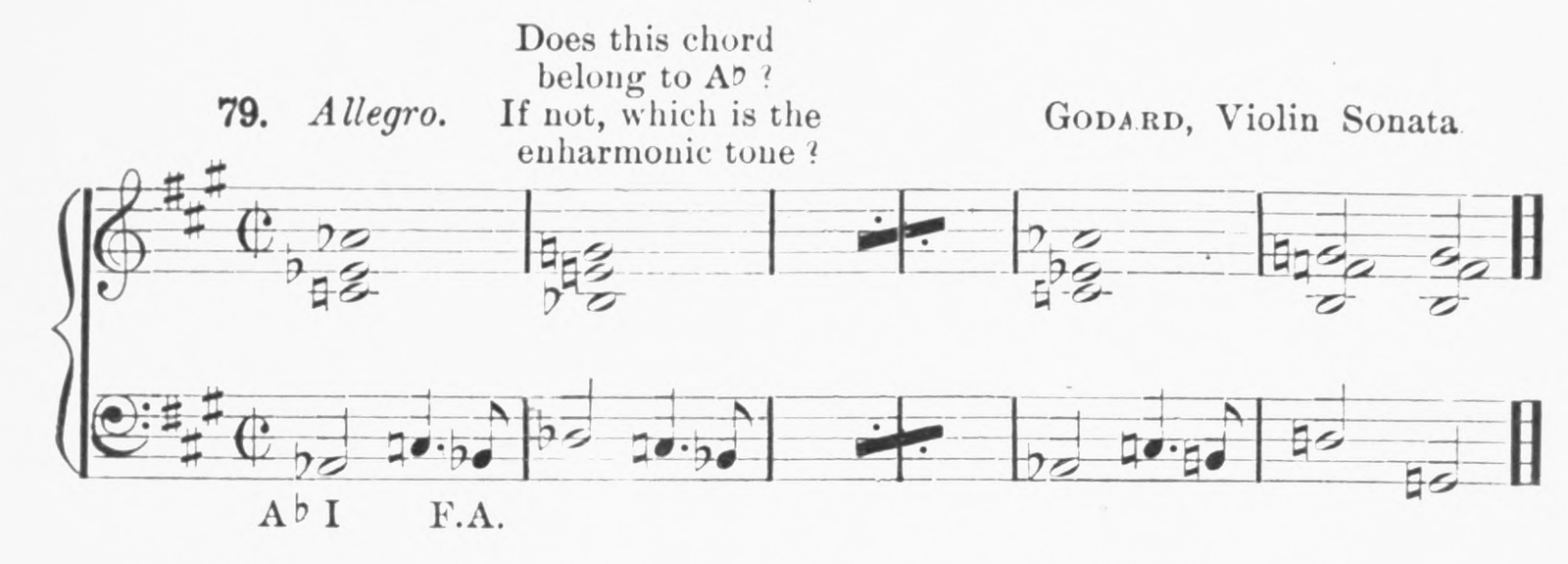
When an occasional contradictory chromatic intrudes, it may be readily changed for its rightful equivalent by spelling the chord in question and finding the tone foreign to the scale (see Ex. 79).
In marking the exercises it may be necessary to use words instead of signs. The author has indicated above some of the exercises the question the scholar is to ask himself, and below the manner of marking.
Ex. 76 · Vivace. Schubert, Song.
Ex. 77 · Allegro giocoso. Bizet, L’Arlésienne.
Ex. 78 · Poco andantino. Franck, L’Organiste.
Ex. 79 · Allegro. Godard, Violin Sonata
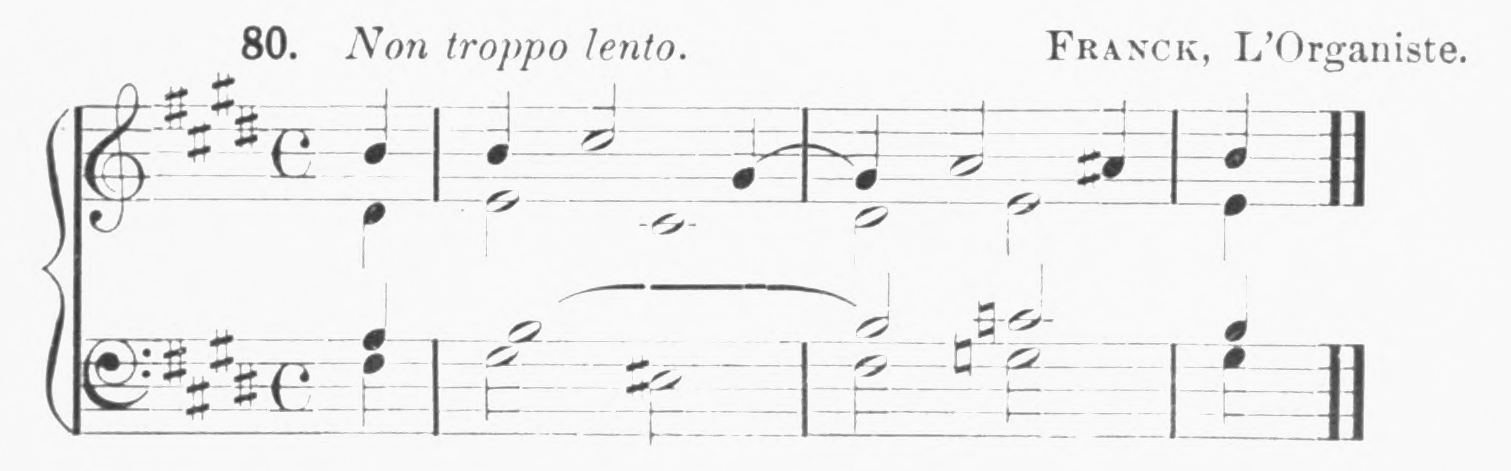
Ex. 80 · Non troppo lento. Franck, L’Organiste.
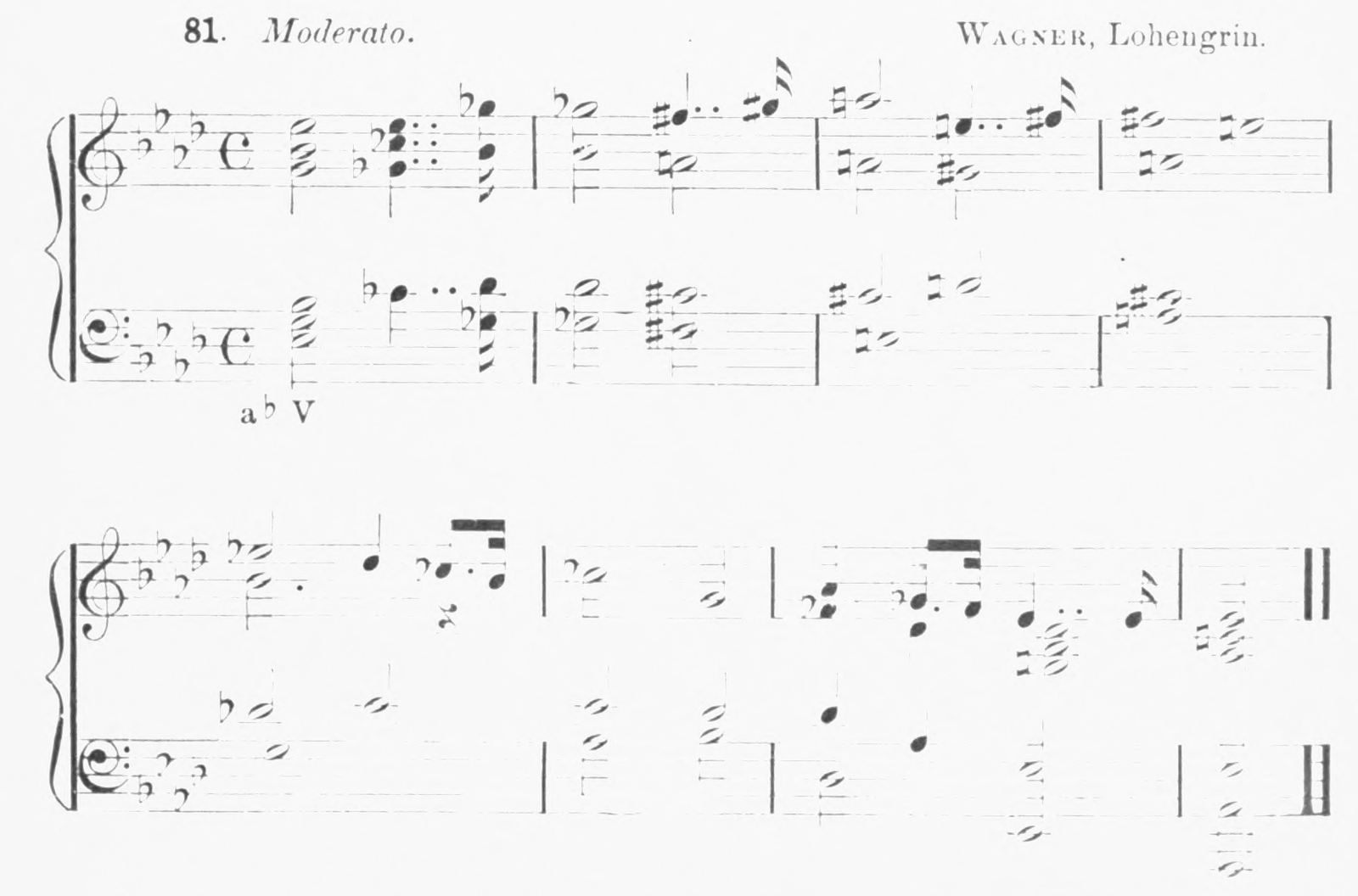
Ex. 81 · Moderato. Wagner, Lohengrin.
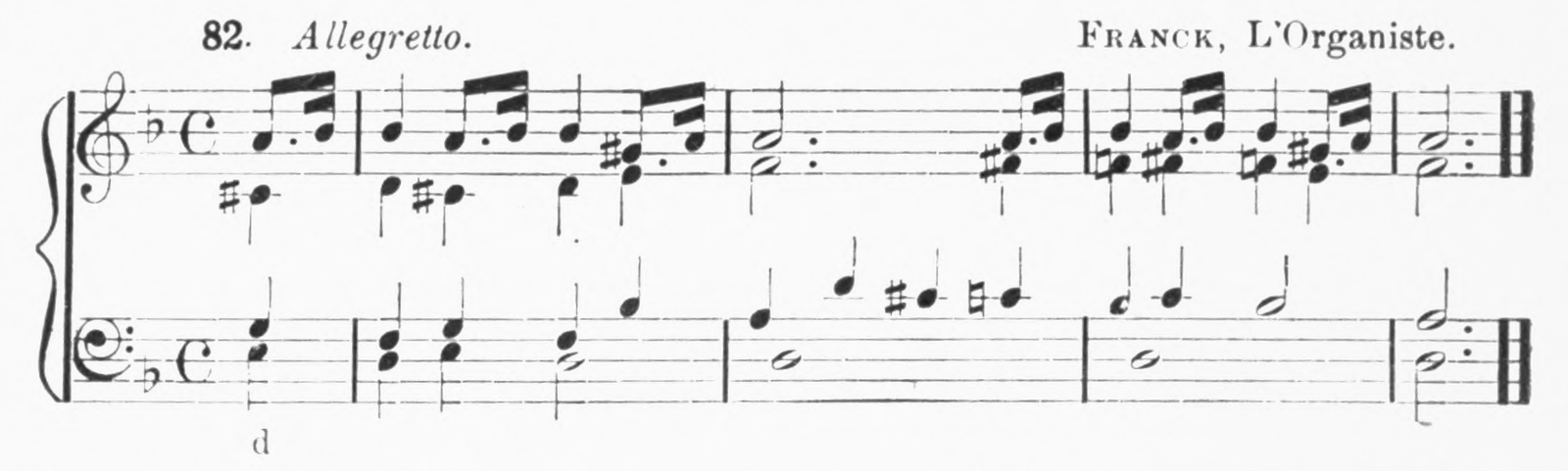
Ex. 82 · Allegretto. Franck, L’Organiste.
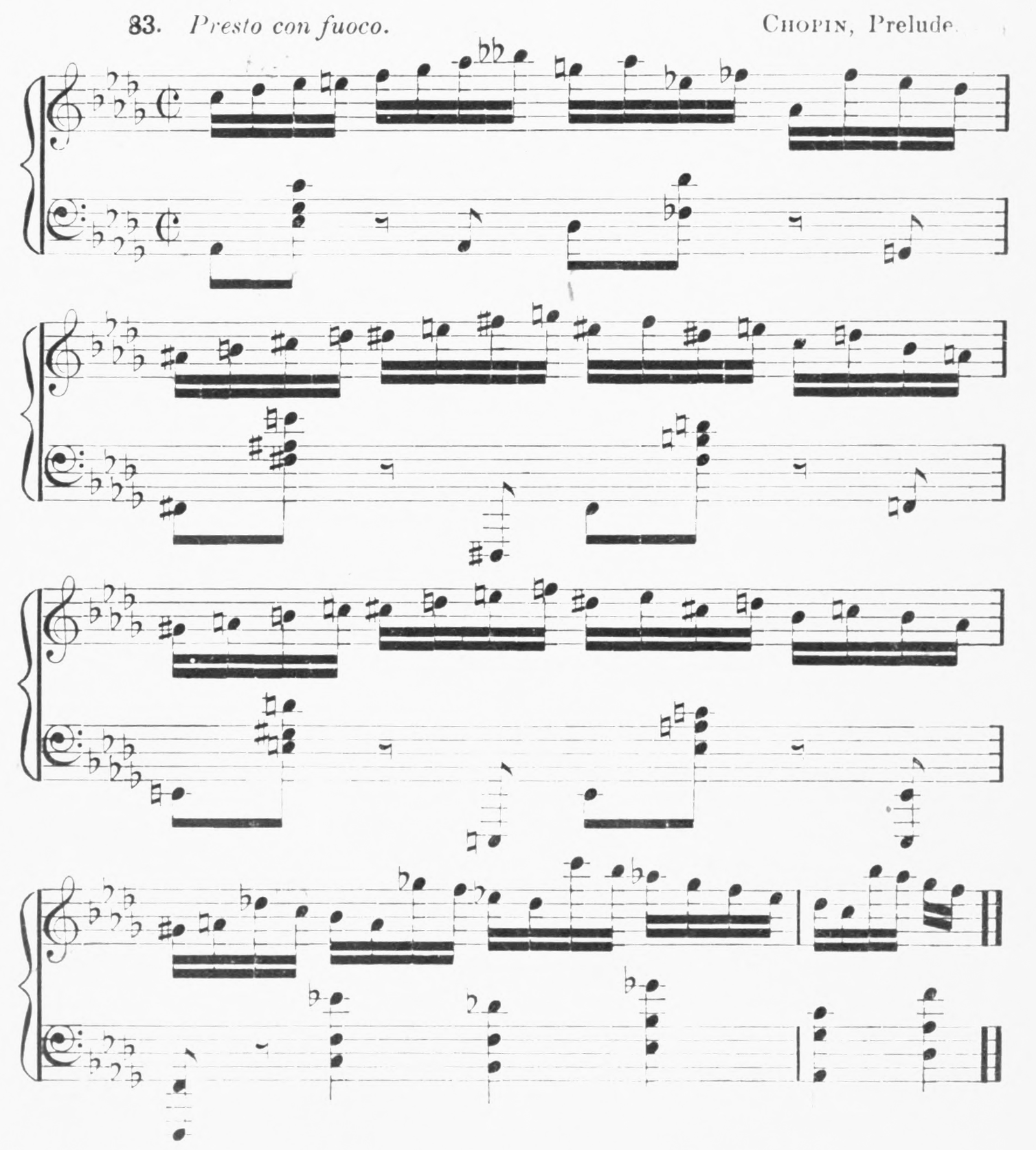
Ex. 83 · Presto con fuoco. Chopin, Prelude.
References. Schumann, Op. 12, No. 2, m. 17; No. 8, m. 1; Chopin, Nocturne No. 9, m. 62; Prelude 12, m. 12; Prelude 8, m. 22; Prelude 19, m. 21, Wagner, Lohengrin, p. 14, 19, 22; Tannhäuser, 144, 246; Flying Dutchman, 41.
Section 35. Modulation through the Six-Four
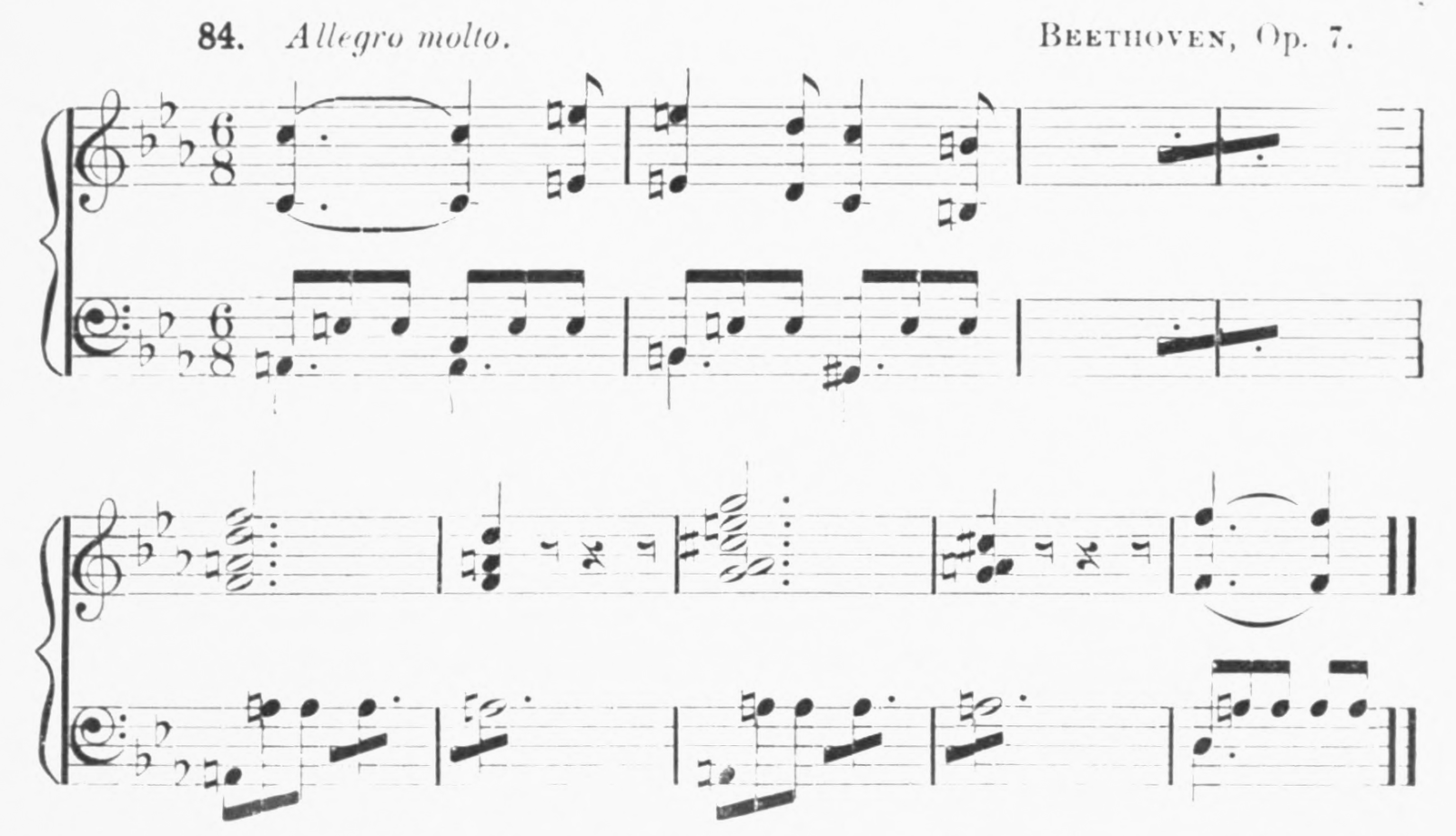
Ex. 84 · Allegro molto. Beethoven, Op. 7.
References. Chopin, Polonaise No. 3, m. 41; Wagner, Tannhäuser, 224.
Section 36. Assumption of Key
A modulation may be made by assuming, taking, a new key. The chord taken may be a tonic or a dominant, preferably the former, and a regular progression will confirm the key effect. This procedure is often made in sequence form, and by hitches of a third.
Ex. 85 · Allegro. Schubert, Sonata.
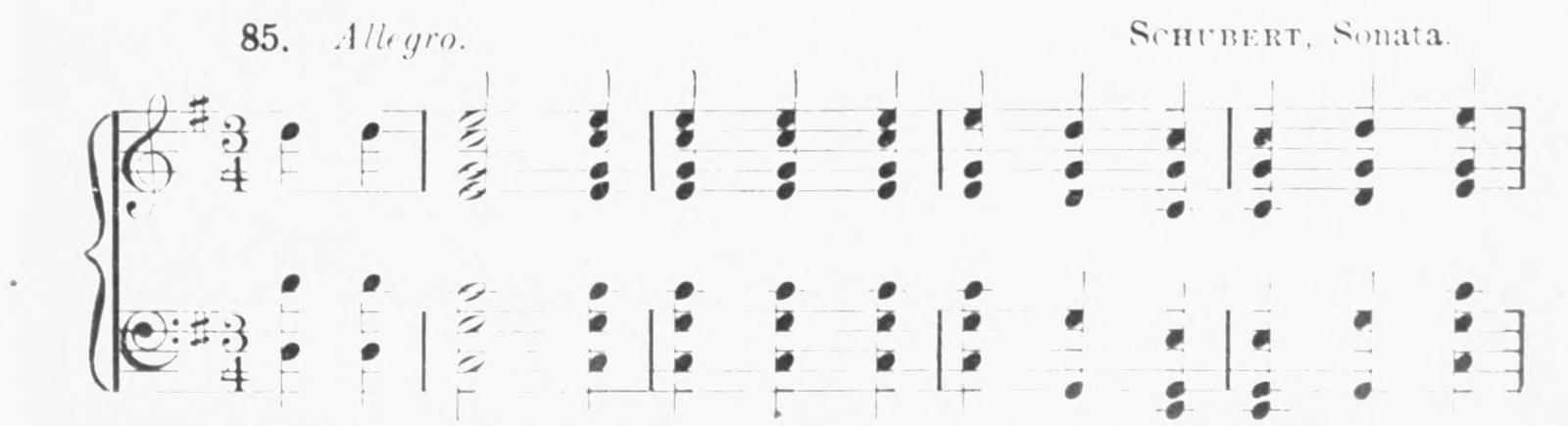
References. Beethoven, Op. 10, No. 3, I, second part, m. 92; Chopin, Prelude 9; Wagner, Tannhäuser, pp. 7, 49, 245; Flying Dutchman, 36, m. 13.
Section 37. Incomplete Modulation
A progression is sometimes made to a foreign major triad, which triad, by reason of its place at the end of a phrase or section, holds the mind in suspense, and thus performs the function of a dominant harmony. Although the apparent modulation be not completed, it is well to mark such a chord as modulatory, including as many of the preceding chords as may rationally belong to the key. This kind of a progression occurs many times in Wagner as a vi V, or IV V. Remember Principle No. 5.
Ex. 86 · Allegro ma non troppo. Schubert, Quintet.
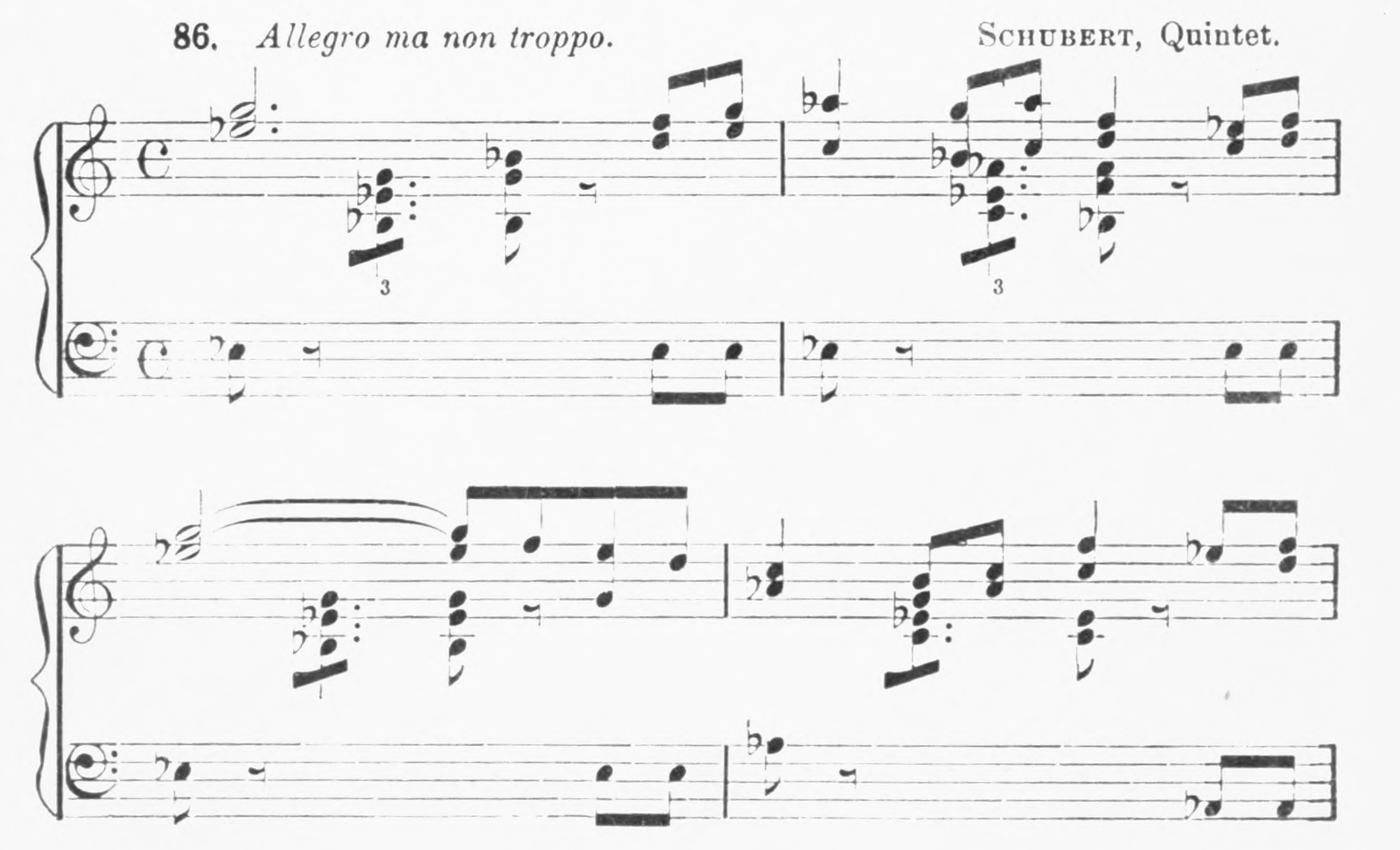
References. Wagner, Tannhäuser, 124, 233, 234; Flying Dutchman, 3.
Section 38. The Deceptive Resolution
Ex. 87 · Poco animato. Wagner, Götterdämmerung.
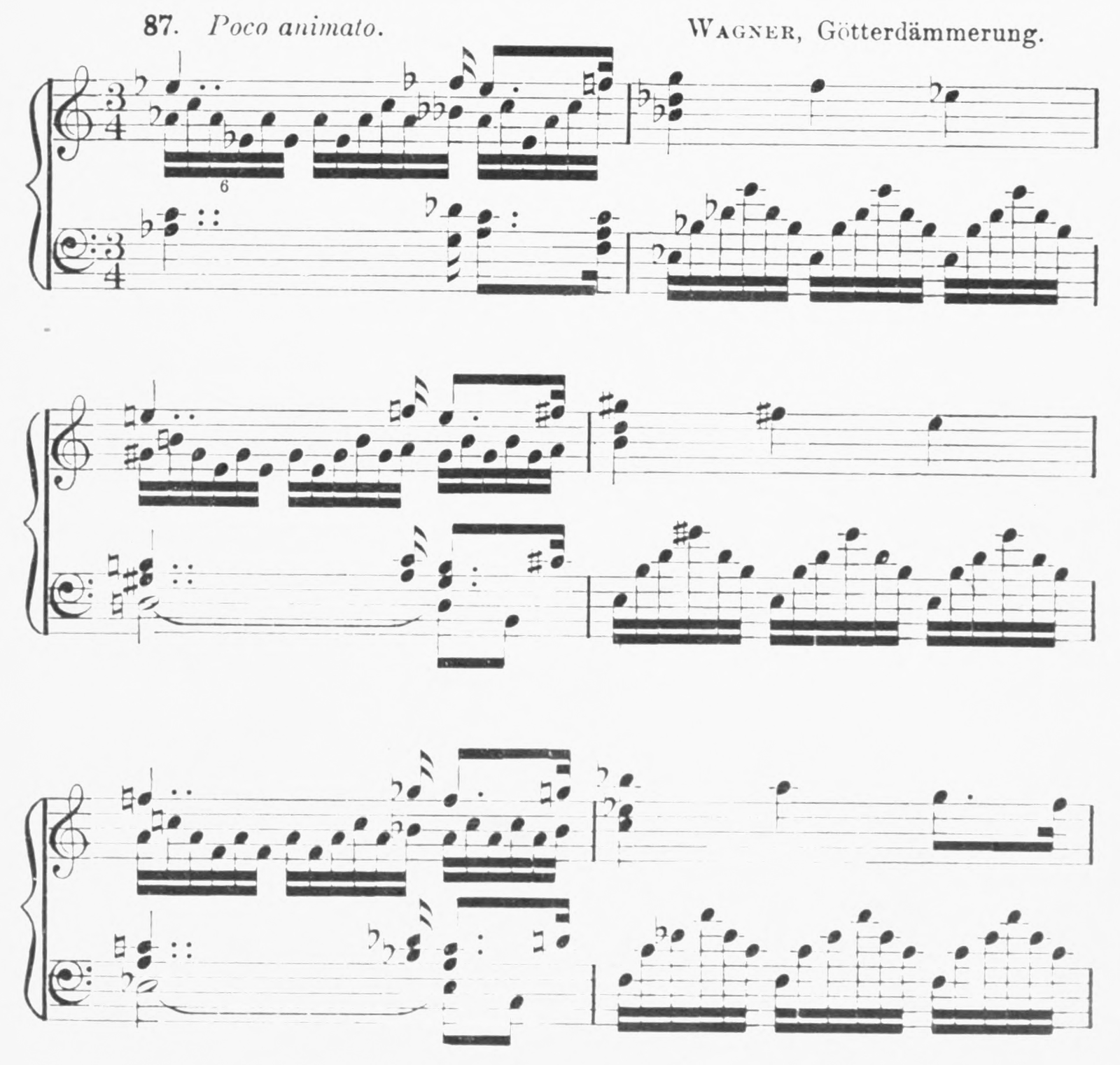
References. Beethoven, Op. 7, II, 20; Chopin, Prelude No. 13, m. 15; Prelude, Op. 45; Schumann, Op. 12, No. 8, Coda; Wagner, Lohengrin, p. 51, m. 2; also pp. 64, 65; Tannhäuser, pp. 4, 37, 146, 157, 256; Flying Dutchman, 119, 227.
Section 39. Passing Diminished Seventh Chords
These usually rise or fall by seconds, major or minor, most often the latter. Composers notate them very irregularly. The roots appear here and there, as is shown in the Examples below, and often in a very arbitrary manner. A general rule of notation is as follows: When these chords move along the chromatic scale, every fourth chord should have the same root. This is also shown below. In phrases of this nature, no firm hold is felt of any key, except at the ends of the phrase or section—everything is passing, fleeting, which lies between these bounds.
Mark each and every chord according to its notation, or, what is better, mark the chords at the ends of each phrase or section, and pass over the other chords.
Ex. 88 · Largo e mesto. Beethoven, Op. 10.
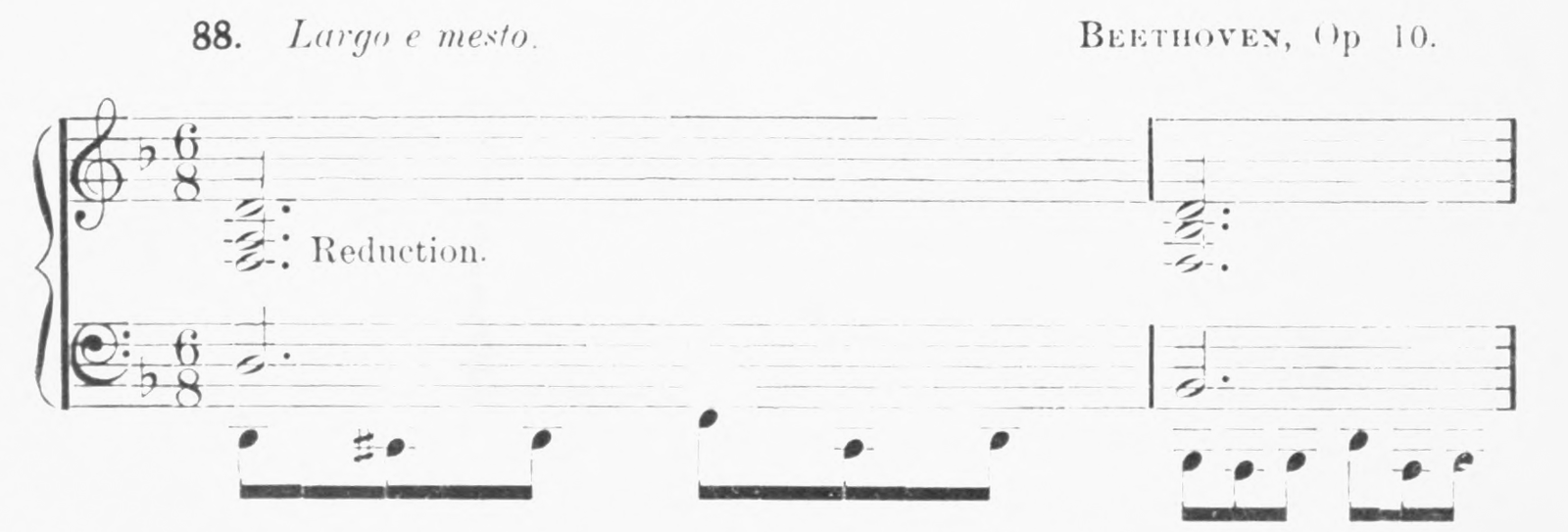
* See Principle No. 5.
Ex. 89 · Allegro ma non troppo. Liszt, Les Préludes.
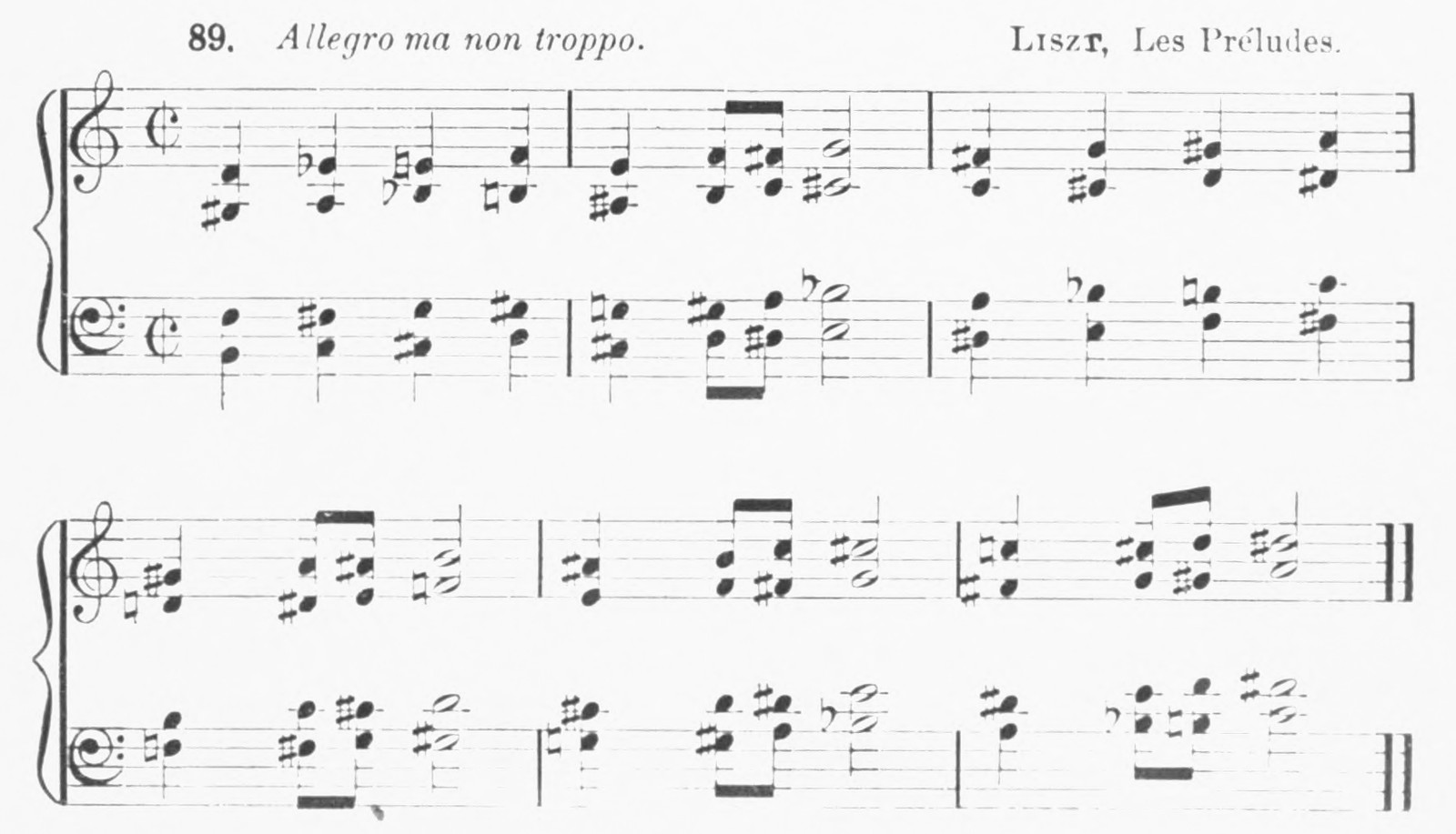
References. Chopin, Prelude 19, m. 29; Schumann, Op. 6, No. 18; Bizet, L’Arlésienne, Suite No. 1, I, Un poco più lento: Wagner, Tannhäuser, pp. 5, 11, 47, 146, 238, 240; Flying Dutchman, 213.
Section 40. The Diminished Seventh on the Raised Fourth Step
Ex. 90 · Vivace. Cramer, Etude.
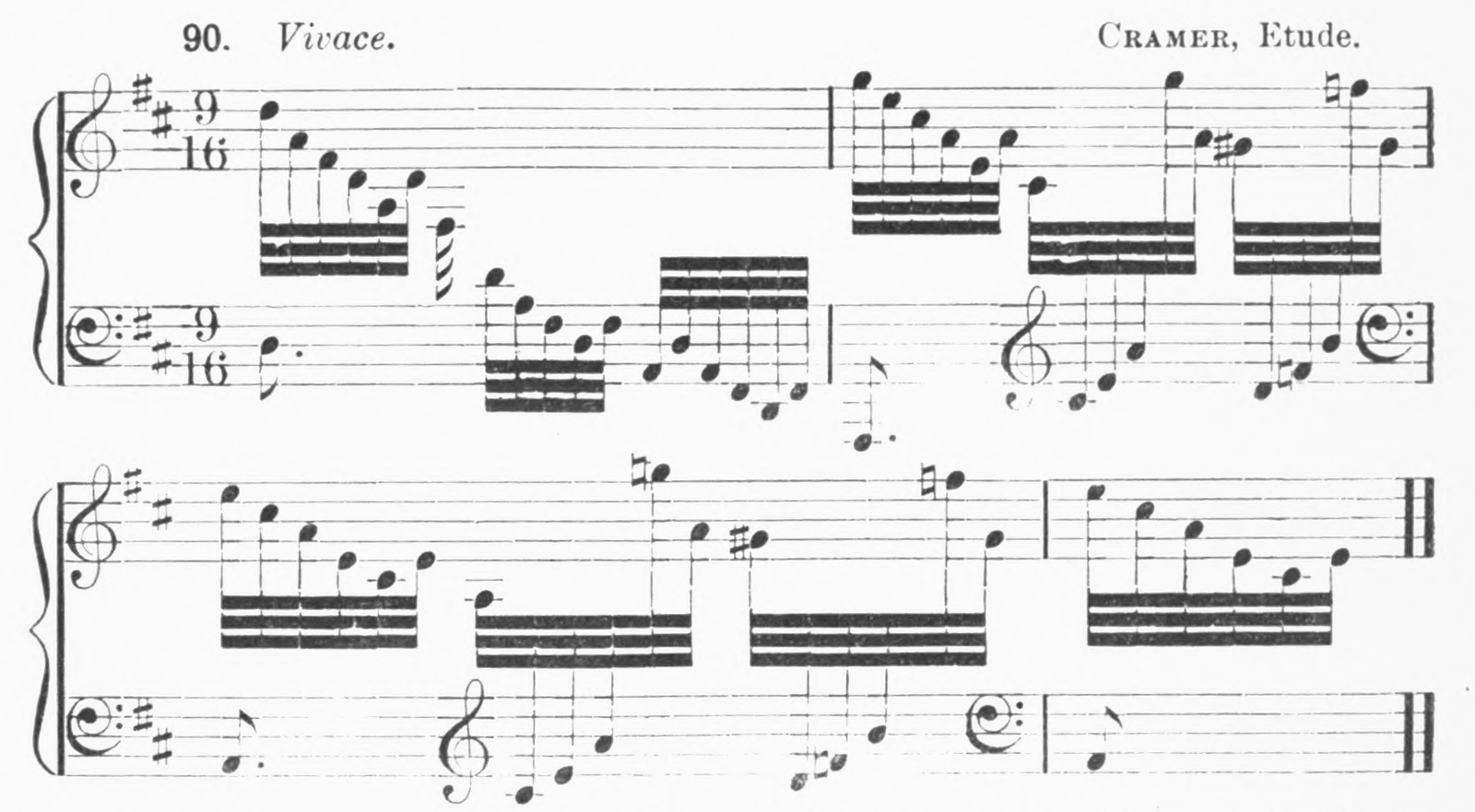
References. Beethoven, Op. 10, No. 2, I, 46; Cramer, Etude 1, m. 19; Etude 8, m. 27; Wagner, Flying Dutchman, 11, 123.
Section 41. Secondary Seventh Chords in General
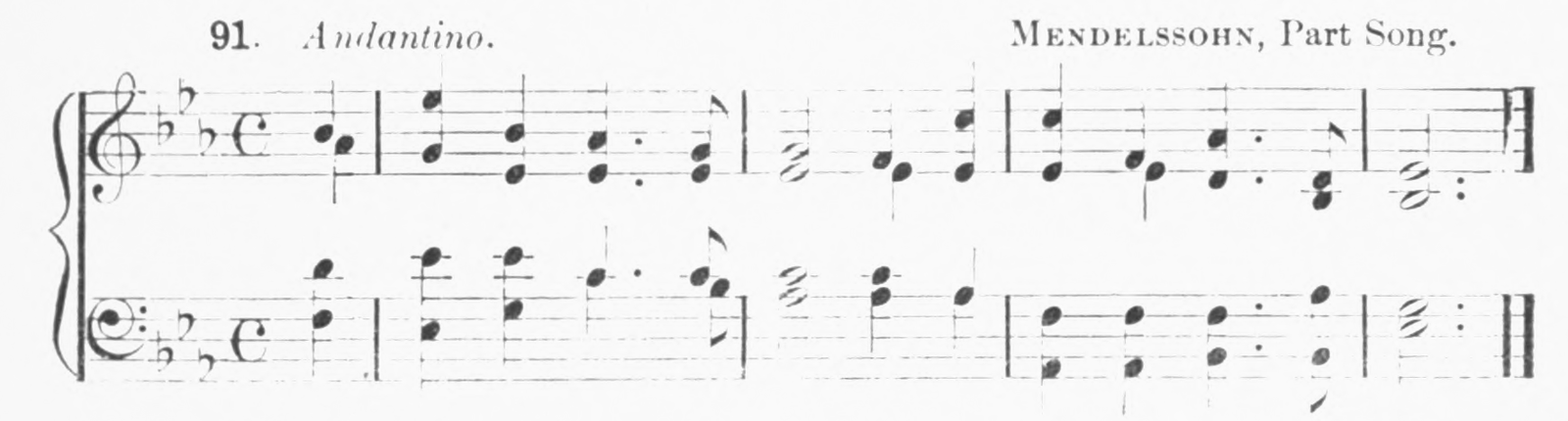
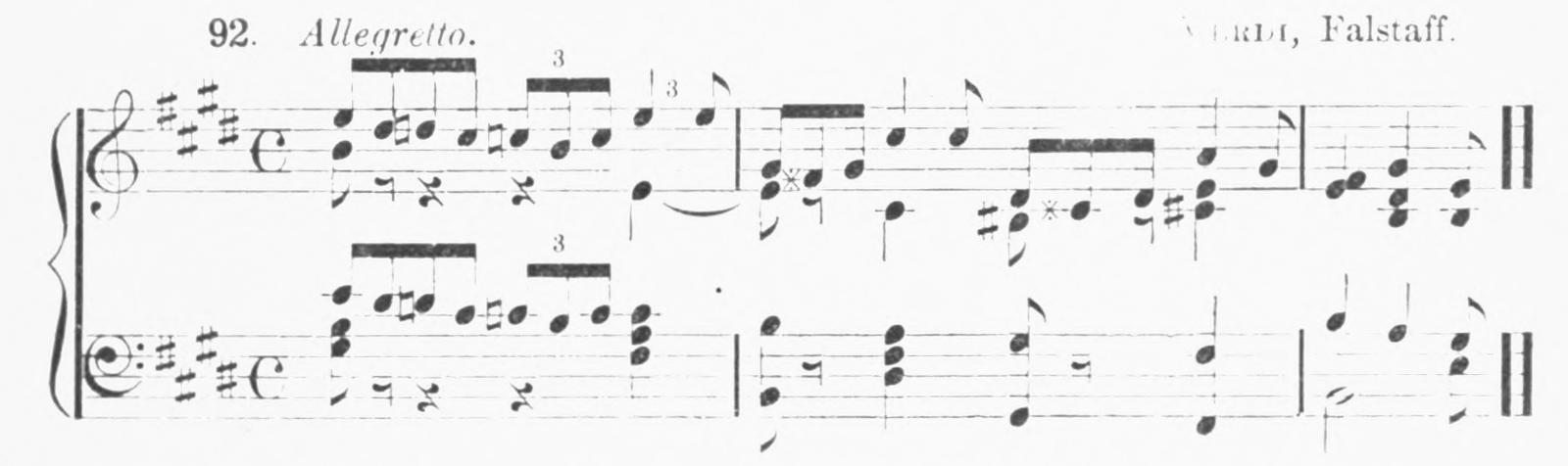
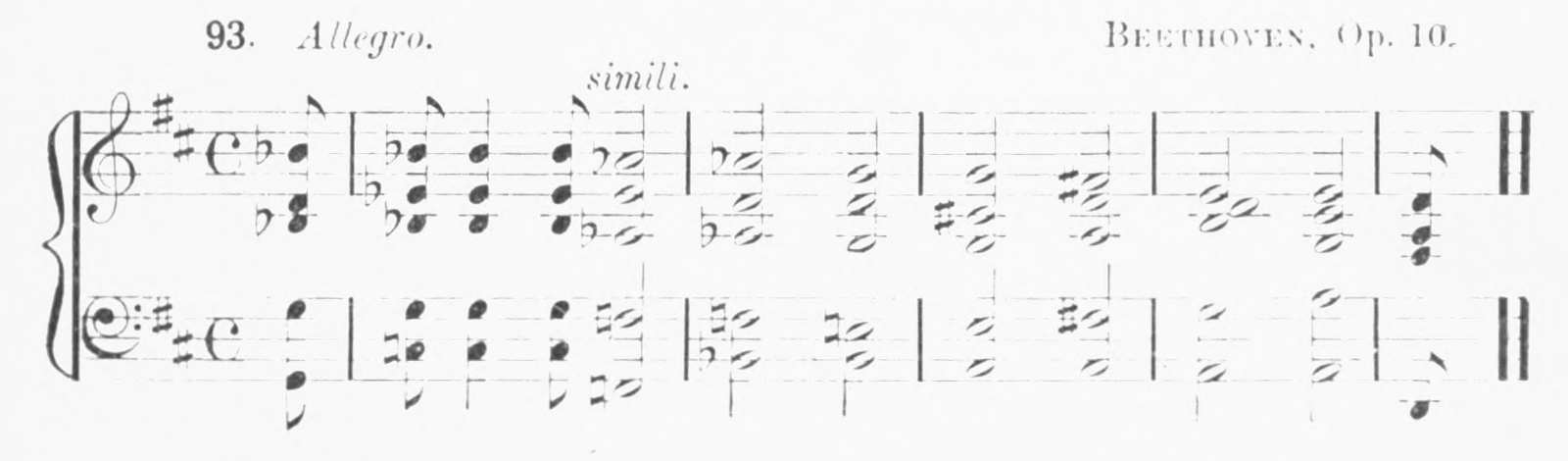
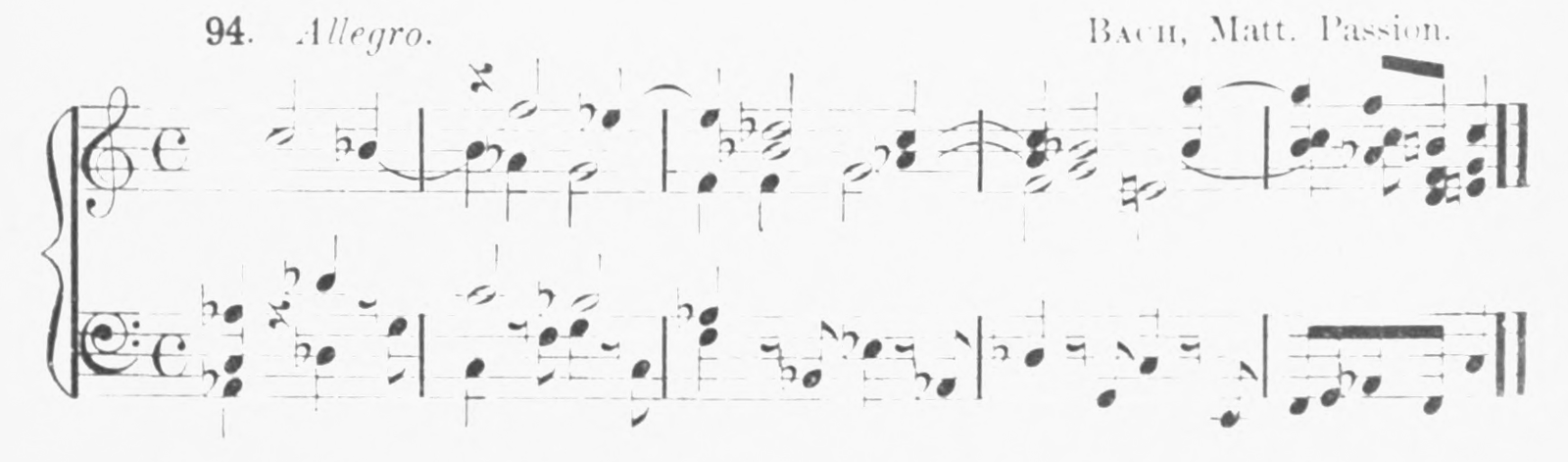
Extended successions of secondary seventh chords often give trouble as regards the definition of key. Some passages, as in Exercise 91, when shorn of the passing tones, suspensions, etc., which form many of the apparent secondary seventh chords, present a very simple structure; in which case the analyst must decide whether or not to mark all the combinations as real chords. Other passages, as in Exercises 93 and 94, present a series of secondary sevenths, often unmistakable in key, which turn suddenly, by the fact that any one chord may belong to several tonalities, into another key, possibly into a key quite remote. And, finally, other passages, on close examination, will be found to be made of alternations of supertonic seventh and dominant seventh, a favorite device in the restless music of this day, especially since the advent of Tristan.
When used in succession, or in clusters, so to speak, secondary sevenths gravitate toward a dominant harmony or toward a supertonic, though the latter case is rare. This leading chord defines the key of the preceding chords. Consequently it is necessary, as in Exercise 93, before fixing on a decision, to survey the entire passage in question and, having found the dominants, to figure from them, to possibly reason backward to the first and opening chord.
Ex. 91 · Andantino. Mendelssohn, Part Song.
Ex. 92 · Allegretto. Verdi, Falstaff.
Ex. 93 · Allegro. Beethoven, Op. 10.
Ex. 94 · Allegro. Bach, Matt. Passion.
References. Schumann, Op. 6, No. 4, m. 30; Op. 6, Nos. 8, 13, 18, 1; Cramer, Etude, No. 1, m. 16; Grieg, Op. 12, No. 5; Chopin, Prelude, No. 2.
Section 42. The Augmented Sixth Chords
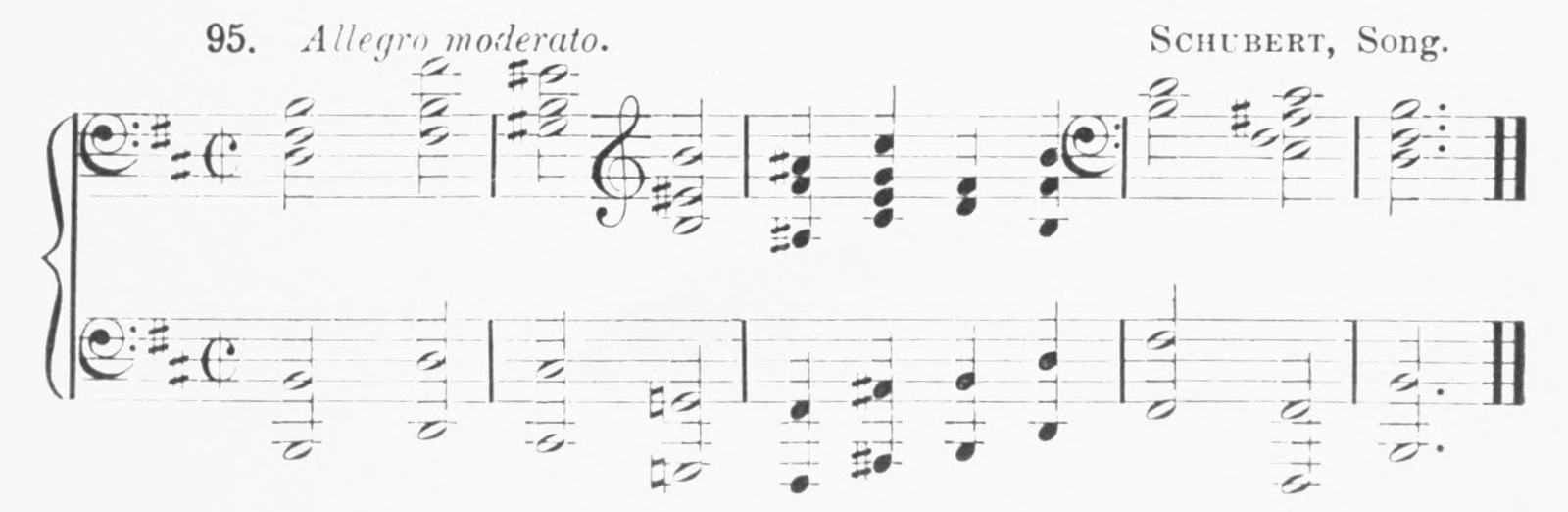
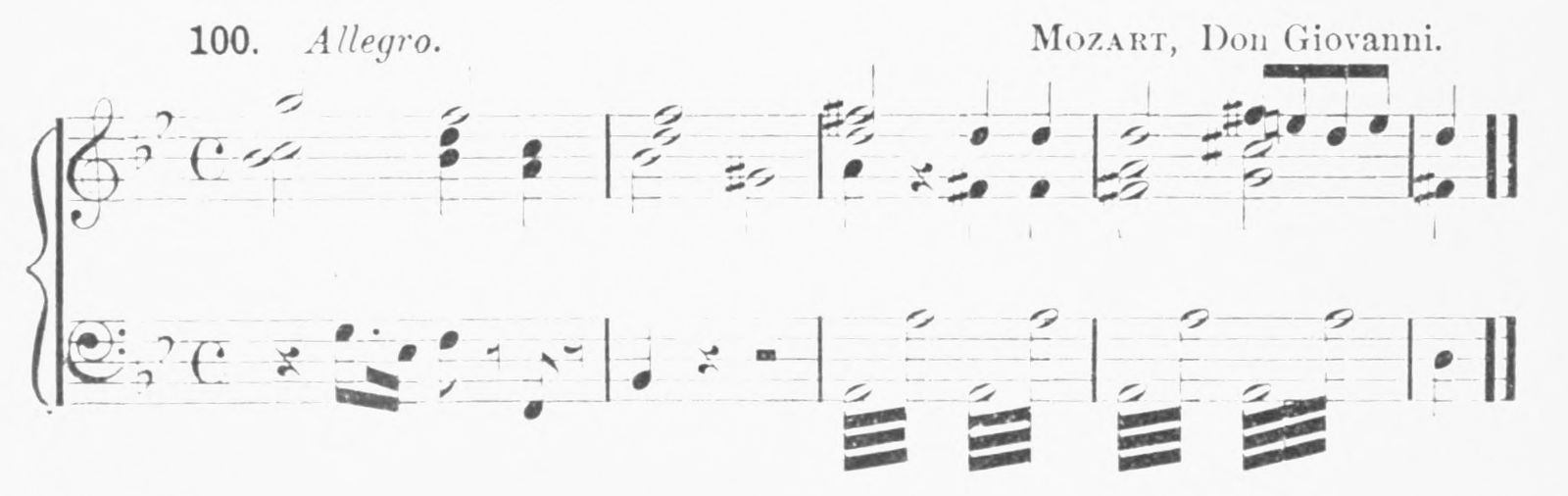
The inversions of those chords which by alteration, and before inversion, contain a diminished third, and which after proper inversion are known as the Augmented Sixth (6+), the Augmented Six-Five (6+/5), the Augmented Six-Four-Three (6+/4+/3), and the Doubly Augmented Fourth (4++ or 6+/4++/3), are common in music of all kinds as harmonies used to strengthen the key impression, or to enrich the chord structure, or to produce modulations.

They often give especial trouble to the scholar in Analysis,—trouble due in part to a neglect to learn the chords thoroughly in the Harmony Course, and in part because the 6+/5 and the 4++, through enharmonics, are used interchangeably, causing confusion to the unversed. To illustrate: the interval of an augmented sixth, A♭ F♯, when the tendencies of its tones are followed, resolves to G G, the flatted tone falling, the sharped tone rising. If this principle of chromatic leads be followed out strictly with all the chromatic tones involved, the Augmented Six-Five—A♭ C E♭ F♯—and the Doubly Augmented Fourth—A♭ C D♯ F♯—will resolve to different harmonies, the tone E♭ falling to D, or being held over, the D♯, its enharmonic equivalent, leading up to E. But composers of all schools write the one sound in two ways—E♭ or D♯—quite as they please, and carry the tone up or down regardless of rule or reason. As already said, this embarrasses the novice in Analysis.
In illustration, examples of correct and incorrect notation will be given. It may be said, however, that cases occur, as in the one quoted from Mozart, where the 6+/5 may be quitted naturally and most sensibly as an 6+/5, although sounding as a 4++—in which case we behold a simplification of notation.
Find the root and write the proper numeral, and then modify it by the proper figures and accidentals.
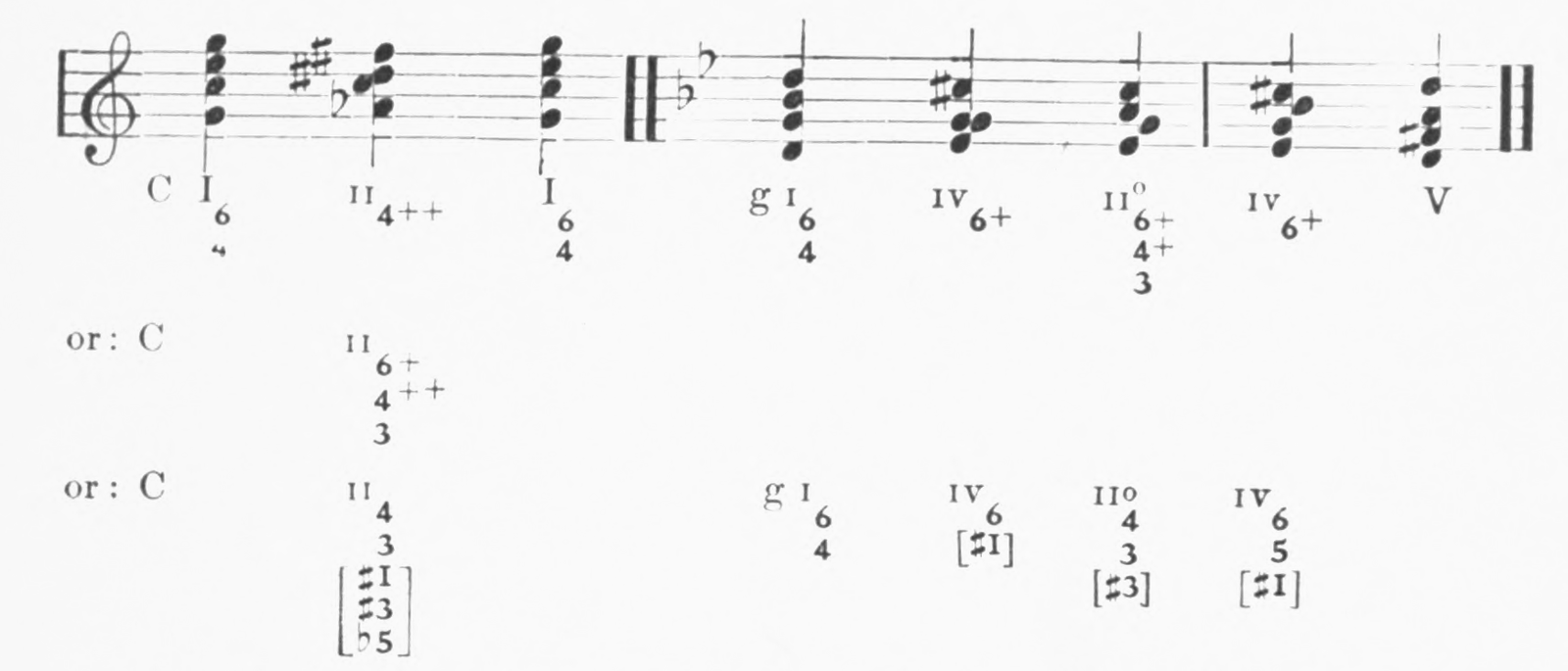
Sometimes one figuring may be used, sometimes the other.
Ex. 95 · Allegro moderato. Schubert, Song.
Ex. 96 · Agitato. Wagner, Lohengrin.
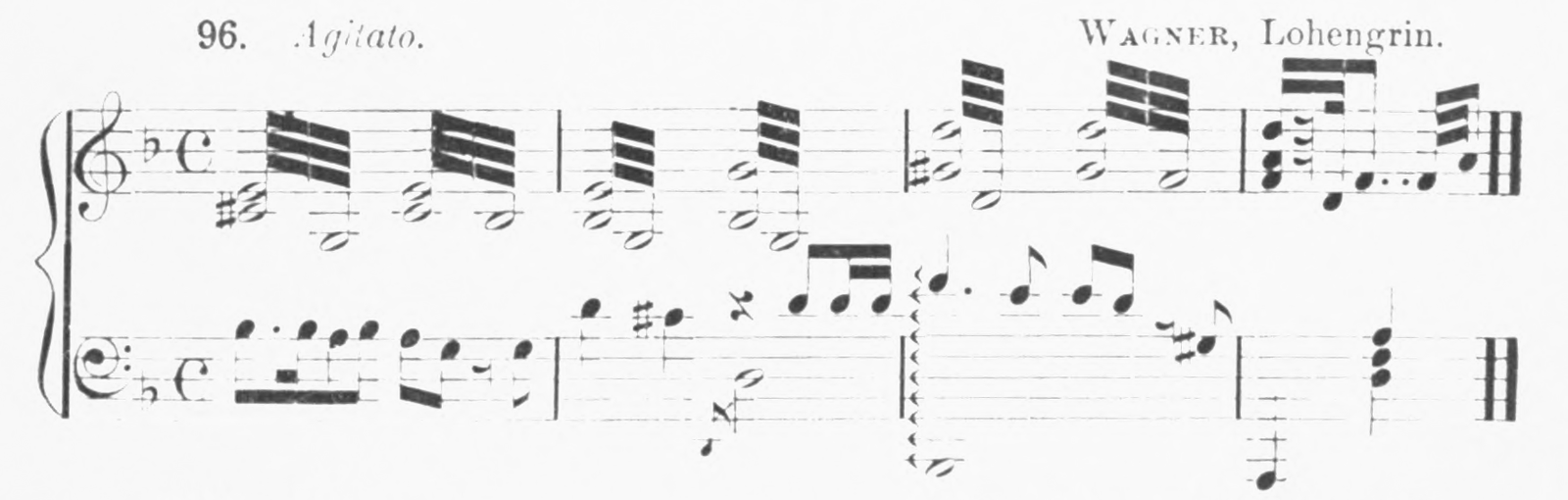
Ex. 97 · Allegretto. Franck, Violin Sonata.
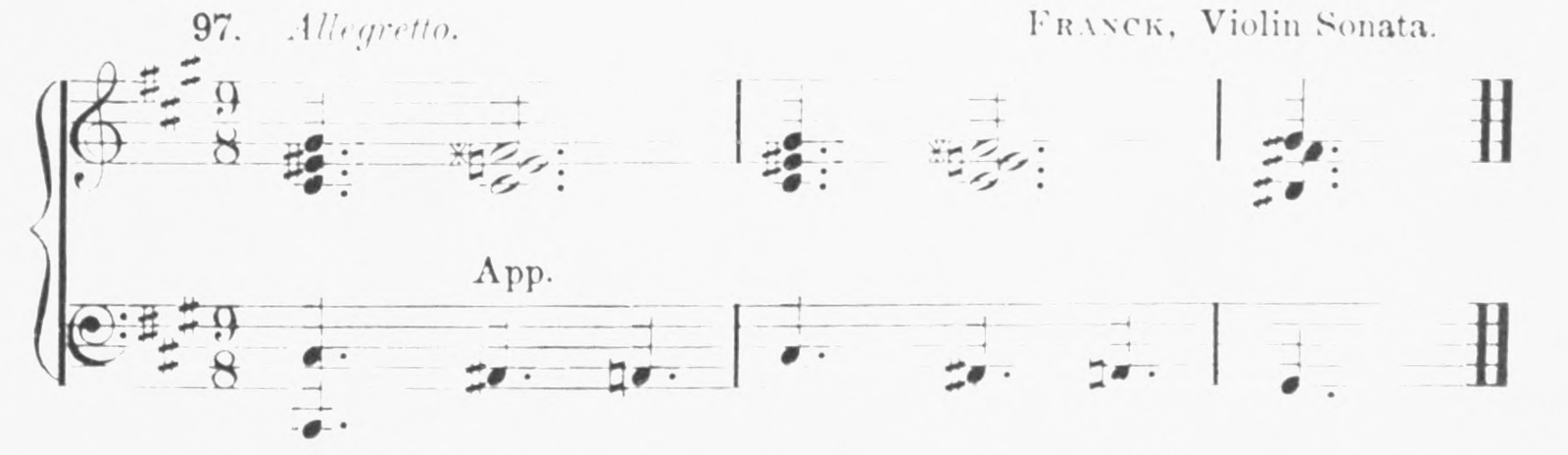
Ex. 98 · Andante. Paukner, Bohemian Air.
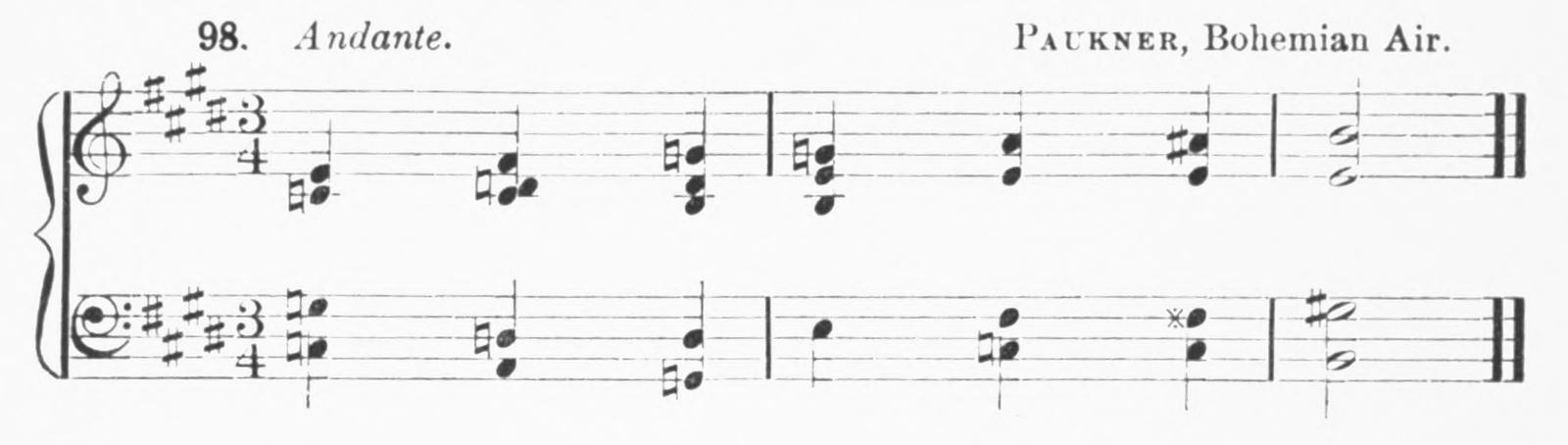
Ex. 99 · Andante. Wagner, Lohengrin.
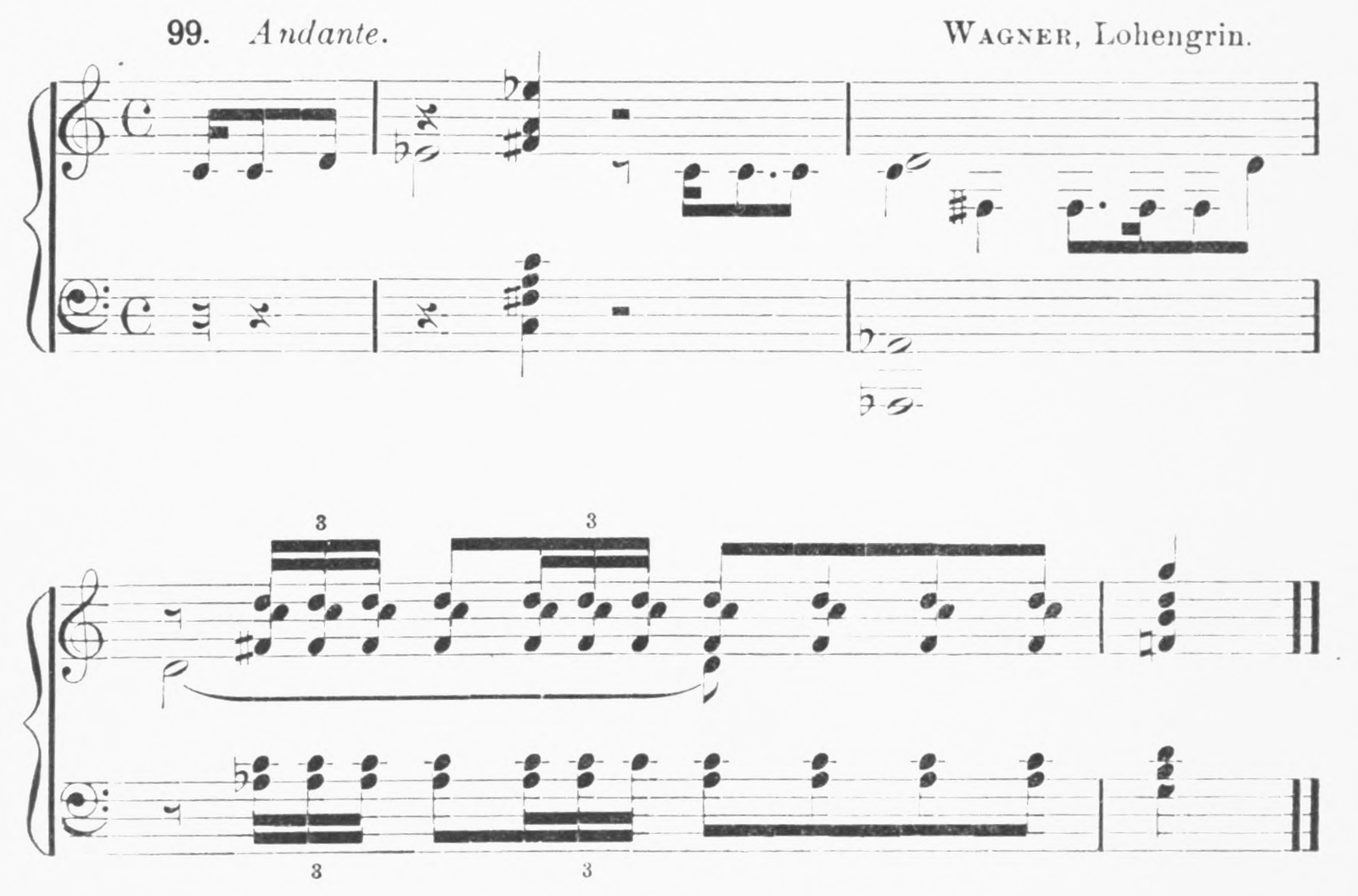
Ex. 100 · Allegro. Mozart, Don Giovanni.
Ex. 101 · Allegro molto. Beethoven, Op. 7.
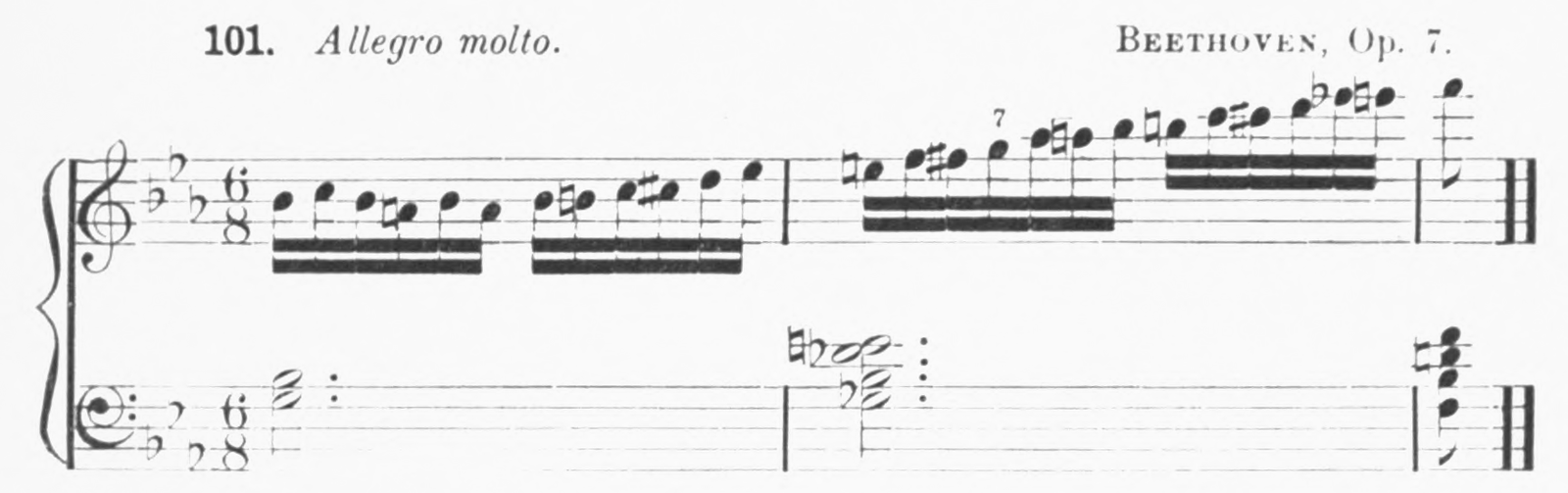
References. 6+ Beethoven, Op. 2, No. 1, IV, 8; Op. 10, No. 2, II, 15; Wagner, Lohengrin, pp. 3, 5, 15; Tannhäuser, 4.
6+/5 Beethoven, Op. 7, I; Chopin, Prelude 12, m. 36; Cramer, Etude 17, m. 19; Etude 19, m. 20; Wagner, Lohengrin, pp. 9, 16, 50, 93, 166, 189, 190; Tannhäuser, 31, 224, 239.
6+/4+/3 Beethoven, Op. 13, III, 46; Chopin, Prelude 20, m. 6; Prelude 21, m. 32; Schumann, Op. 6, No. 1, m. 16; Op. 15, m. 2; Wagner, Flying Dutchman, 162, 175.
6+/4++/3 Schumann, Op. 6, No. 14, m. 28; Op. 6, No. 17, m. 34; Chopin, Polonaise, No. 1, m. 30; Wagner, Tannhäuser, 58.
6+/5 as 4++ Beethoven, Op. 7, I, m. 98; Wagner, Lohengrin, pp. 12, 23, 62; Flying Dutchman, 128, 138.
Section 43. Modulation down a Minor Second by an Augmented Chord
The V7, and its enharmonic equivalents, the 5+/6 and the 4++ (thus, G b d f; g b d E♯; g b C𝄪 e♯), were often used in modulating down a semi-tone by composers of Chopin’s day. The progression appears to have become hackneyed, and for a time abandoned, to be revived with tremendous power by Wagner in his Tristan.
The use of enharmonics makes the analysis at times a little difficult and puzzling. Measure 4 in Exercise 102 is a good instance; in some editions the f♮ is adhered to throughout the measure—but, as the “identity of a chord depends on its resolution” and this chord goes into B major, it is a B major chord, altered, and nothing else.
Ex. 102 · Presto. Chopin, Prelude.
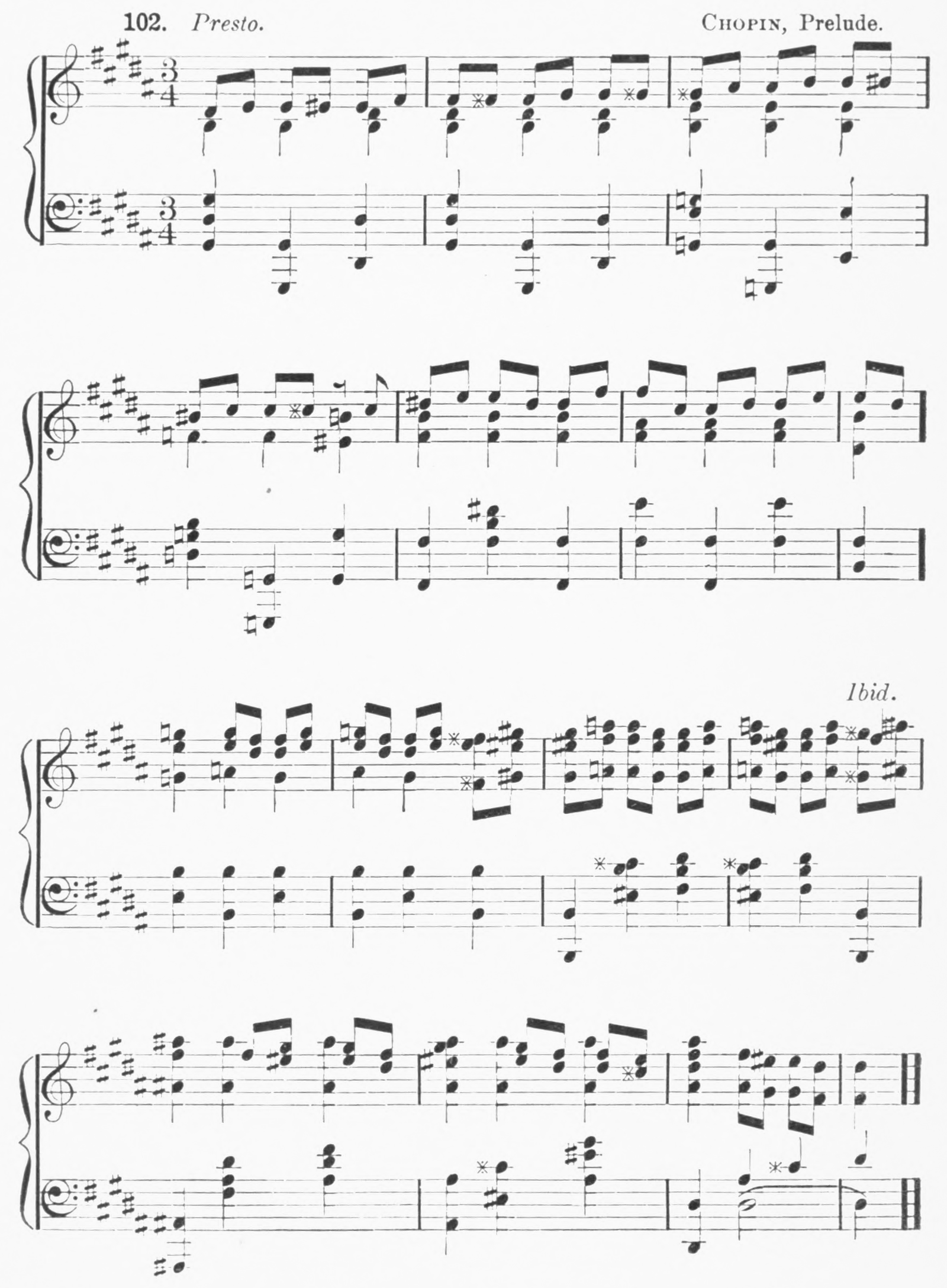
Reference. Chopin, F♯ minor Prelude.
Section 44. Chords with a Diminished Third or Hidden Augmented Sixth
These are the chords of the preceding section in some other form. The Augmented Sixth may be found in any two upper voices, or its equivalent, the Diminished Third, may be present. In figuring use numerals, and accidentals enclosed in brackets to show the alterations.
Ex. 103 · Allegretto. Franck, Violin Sonata.
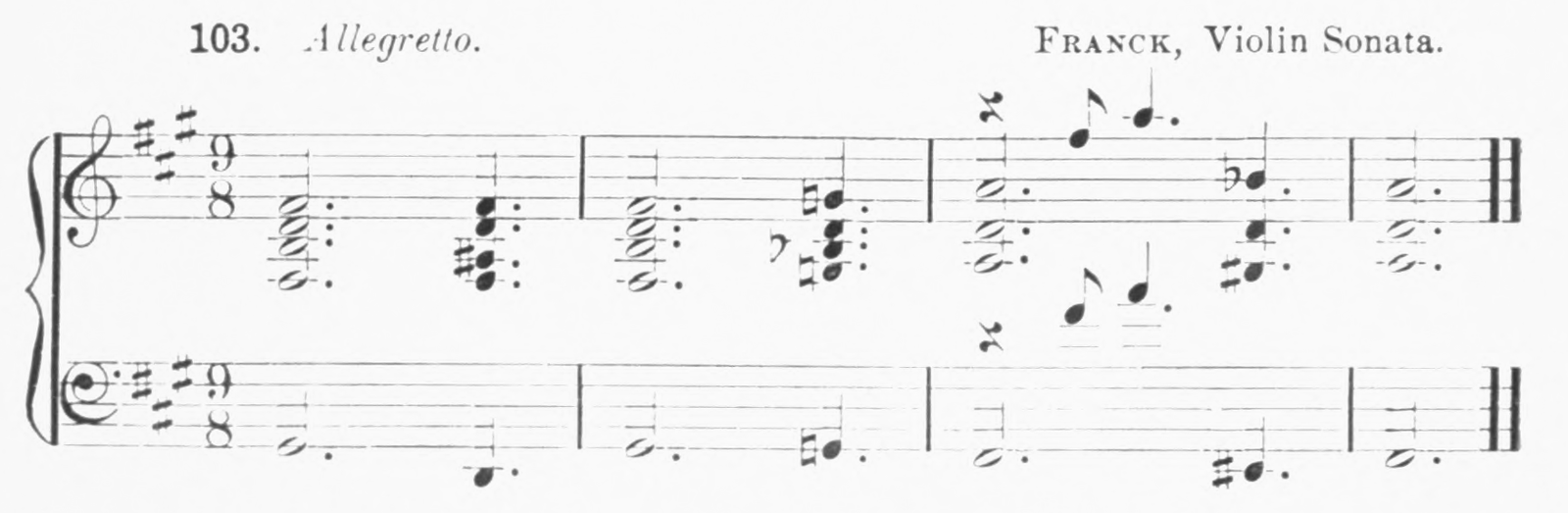
References. Chopin, Prelude No. 4, m. 23; Prelude 17, m. 20, 22; Prelude 22; Wagner, Tannhäuser, 231, 239, 240; Flying Dutchman 2, 22.
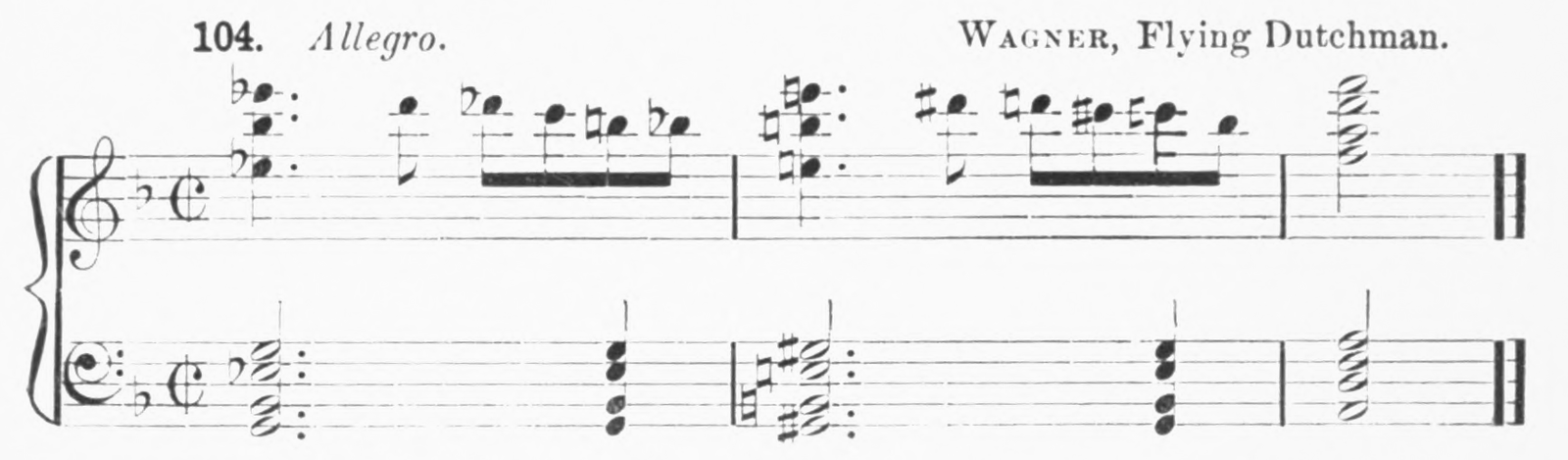
Section 45. The Flat Second and Sixth Steps
The first inversion of the supertonic triad containing this lowered—the Flat Second—step is commonly known as the Neapolitan Sixth. Although most frequent in this form, this altered supertonic may be used with any member in the bass and in either mode, in major requiring two alterations. It may be used at the beginning of a phrase, often misleading the student (Principle No. 5 must be borne in mind), or in its course; and a transient modulation is often made through the Neapolitan Sixth, or without it, to the key of its root, to the key of the Flat Second—sometimes of beautiful effect—which key is quickly abandoned for a resumption of the reigning tonic key.
Signs: ii [♮ or ♭1 / ♮ or ♭5], ii° [♭1], ii6 [♮ or ♭1], N6, ii6/4 [♮ or ♭1 / ♮ or ♭5], ii°6/4 [♮ or ♭1]

The Flat Sixth Step at times occurs, although less frequently than the Flat Second Step. It is easy to recognize.
Ex. 104 · Allegro. Wagner, Flying Dutchman.
Ex. 105 · Allegretto. Dvořák, Dance.
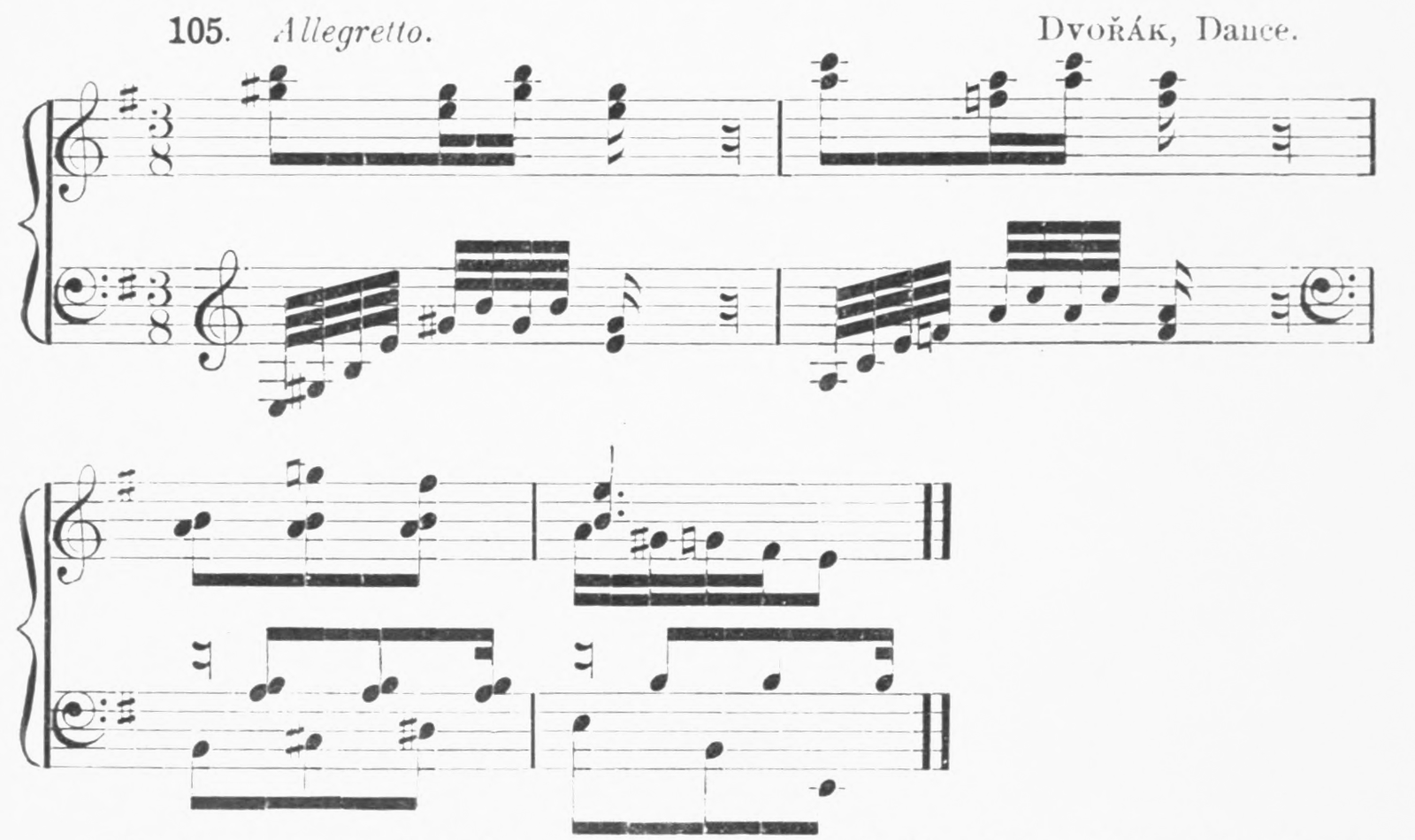
References. Beethoven, Op. 27, No. 2, I, 21; Grieg, Op. 6, No. 4, più Allegro: Schumann, Op. 6, No. 5, m. 12 and 22; Op. 68, No. 29, B♭ strain and Coda; Cramer, Etude 3, m. 24; Etude 9, m. 6, 60; Etude 10, m. 22.—See also, for modulation to Key of Flat Second, Chopin, Prelude 16, m. 7 from end; Bizet, L’Arlésienne, Suite No. 1, II, m. 29. Flat Sixth, Wagner, Tannhäuser, p. 86.
Section 46. The Flat Seventh Step
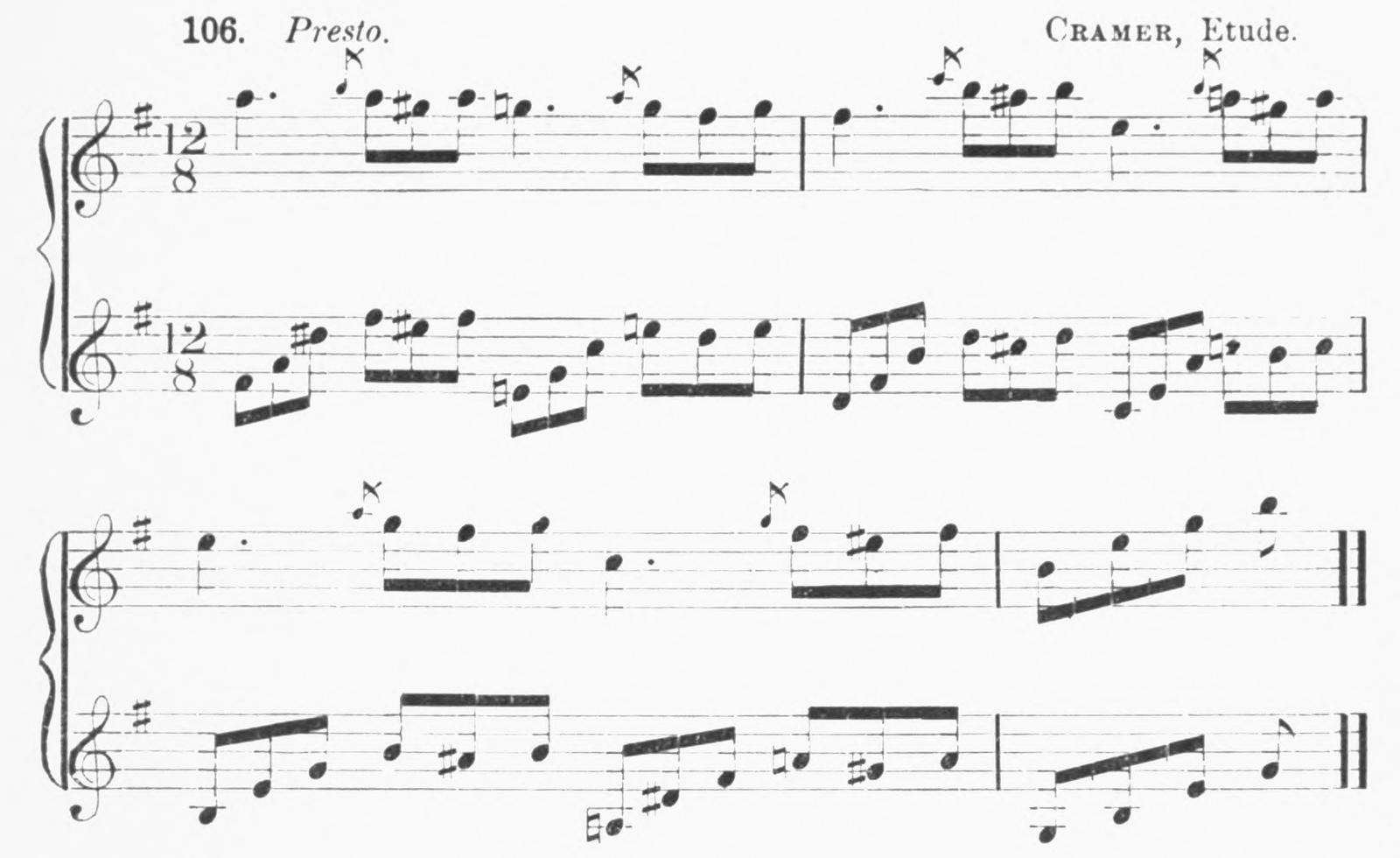
Occurs most frequently in the minor mode, and often as a means of softening the harshness inseparable from the augmented second formed by the descending seventh and sixth steps of the harmonic minor scale. It is apt to mislead the student. May be found in sequential passages, and as the root of an independent chord.
Signs: V [♭3], or V7 [♭3], or vii° [♭3], etc.

Ex. 106 · Presto. Cramer, Etude.
Section 47. Embellishment of the Tonic Six-Four in a Cadence
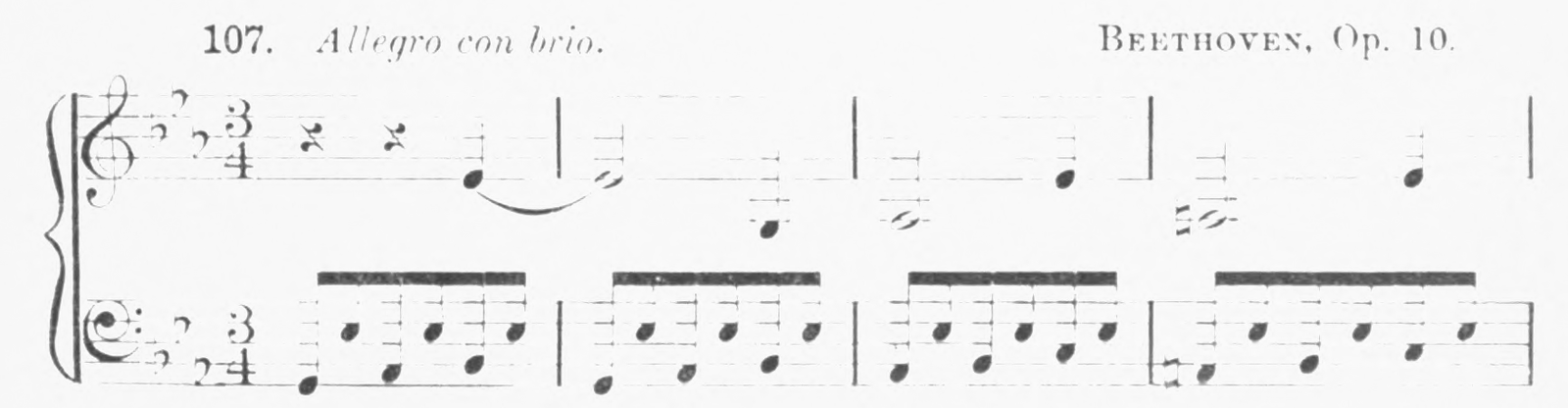
The tonic six-four moves most naturally into a dominant cadence. The suspense attendant on this six-four chord is often heightened, by composers of many schools, by embellishing, so to speak, this six-four chord before its resolution into the dominant, by harmonies diatonic or chromatic. Since they merely intensify the key effect, such chromatic harmonies may most properly be marked as altered, i.e., as non-modulating.
The same procedure is at times made with the dominant chord.
Examples are especially frequent in the works of Mozart and Beethoven.
Ex. 107 · Allegro con brio. Beethoven, Op. 10.
Section 48. Consecutive Tonics
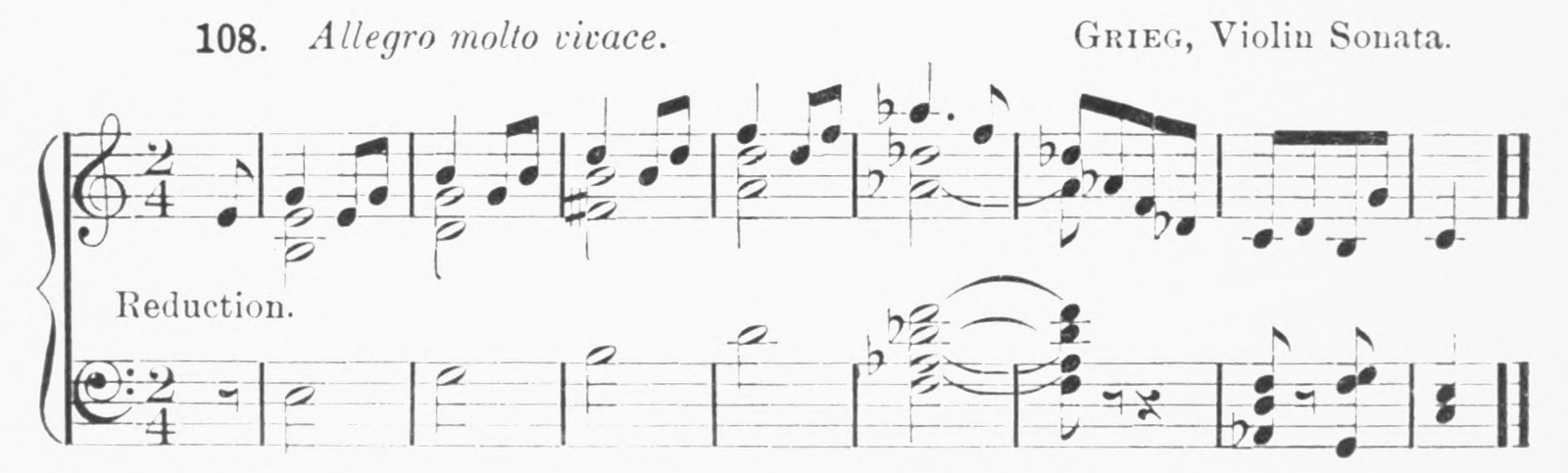
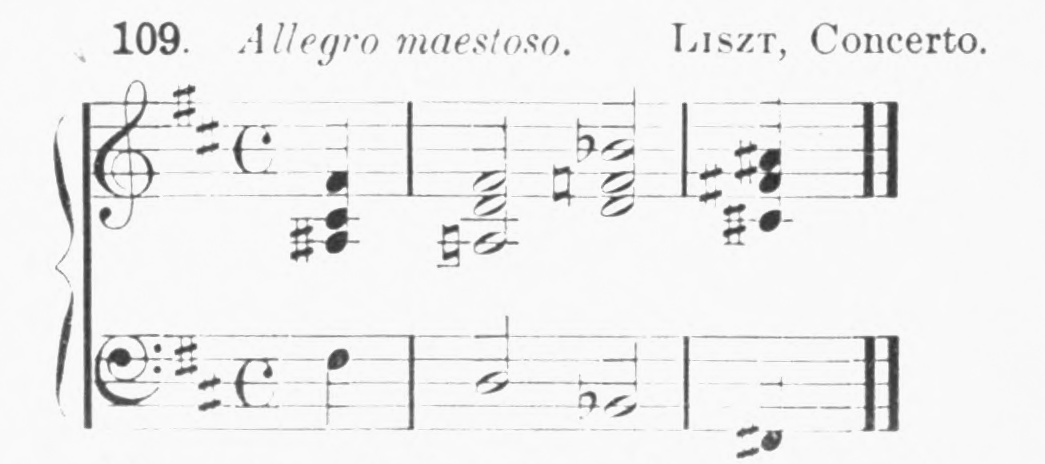
Progressions are not unusual which may be explained only on the supposition that consecutive tonic impressions are possible, and are intended by the composer. Such progressions are generally made agreeable by the use of common tones, sometimes enharmonically expressed; but cases are not unknown in which the common and connecting tone is dispensed with altogether.
Ex. 108 · Allegro molto vivace. Grieg, Violin Sonata.
Ex. 109 · Allegro maestoso. Liszt, Concerto.
References. Grieg, Op. 6, No. 3, m. 34; Chopin, Prelude 8, m. 23; Wagner, Tannhäuser, 236, m. 5.
Section 49. Chromatic Passing Chords and Passing Sequential Figures
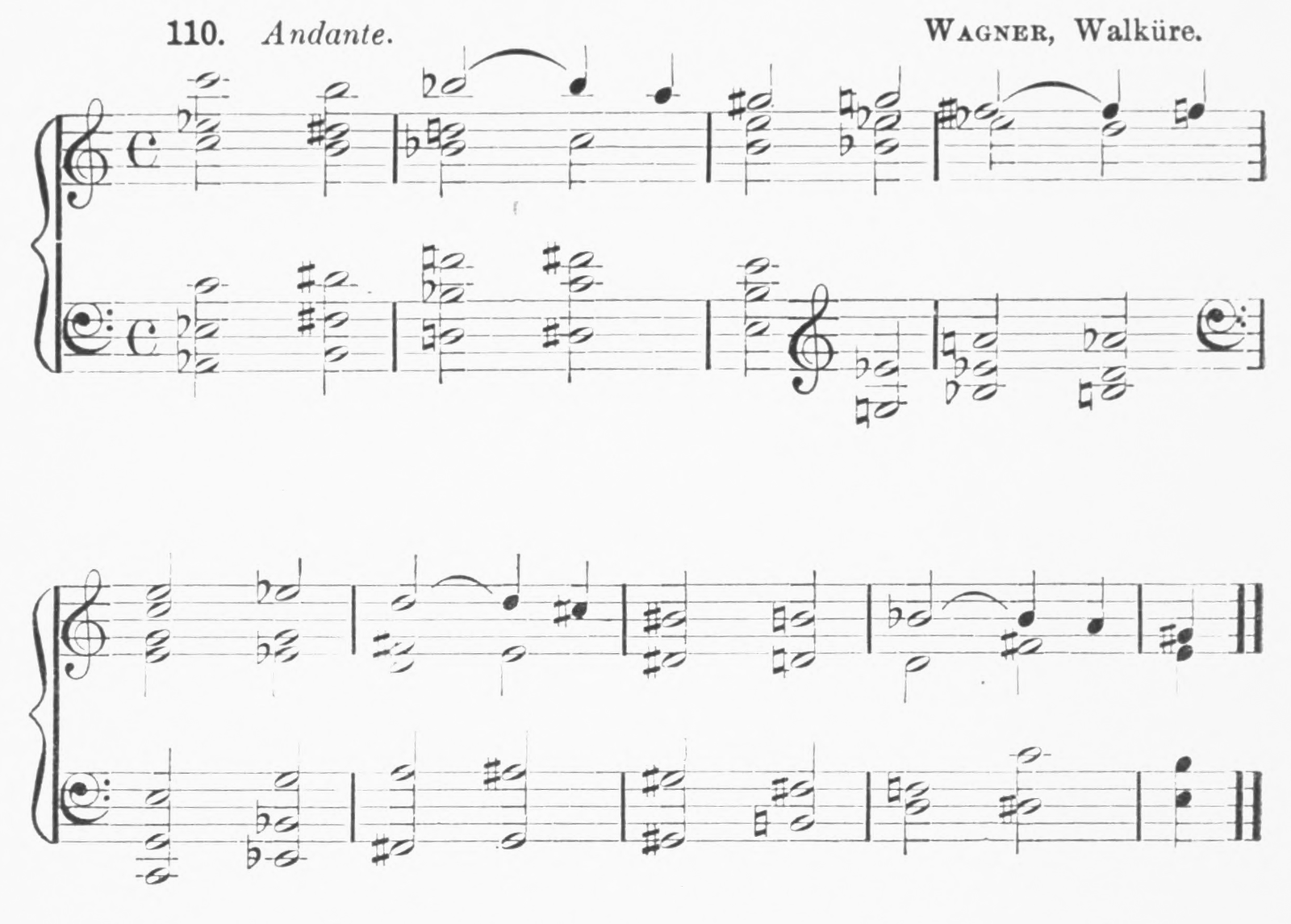
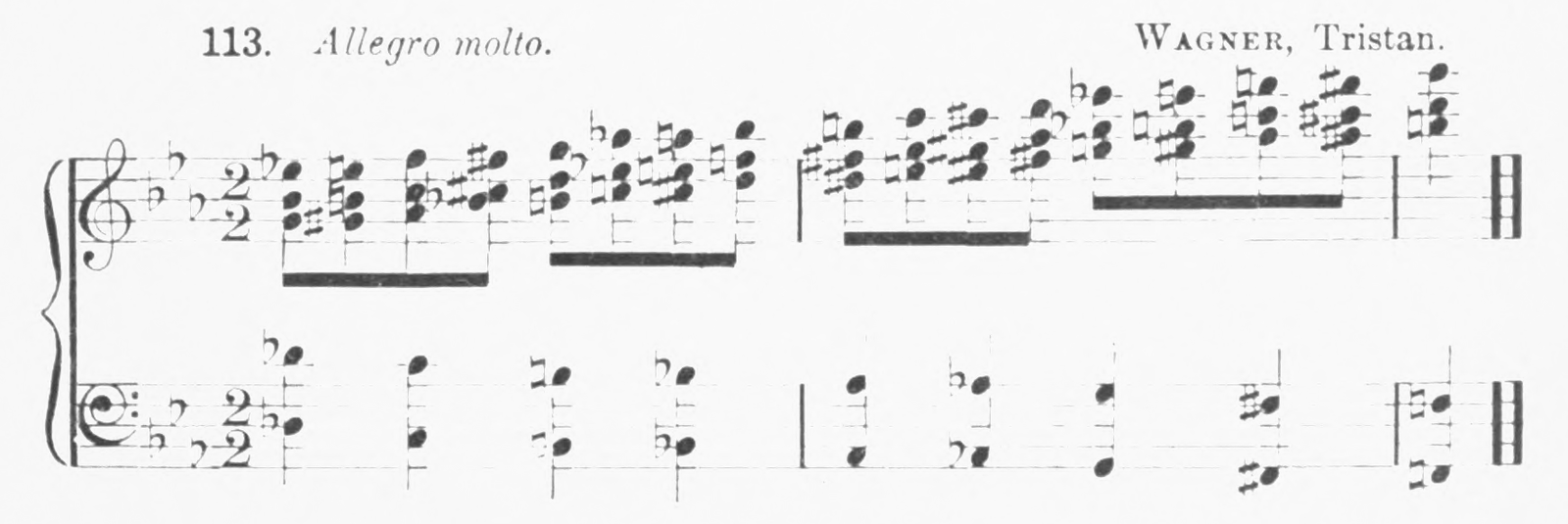
A logical outgrowth of passing tones in a single voice is the union of several voices in passing chords moving in one direction. Furthermore, as two single voices may move from one consonance through contrary motion to another consonance, and the satisfactory outcome of the passage may compensate for all the transitory harshnesses, so, proceeding logically from this premise, modern composers have made bold to employ chords in the same manner.
The two outside voices are written, and any combination which seems good to the composer is used in harmonizing each tone, the chord being usually fitted to the soprano. Not infrequently the most intolerable dissonances result—combinations, indeed, which may not be reduced to thirds, which are not chords.
On the other hand, such a passage may contain successions of the most ravishing beauty—due to the euphonious setting of each individual chord, and to the mental surprise and to the delight of the harmonic sense at each unexpected change.
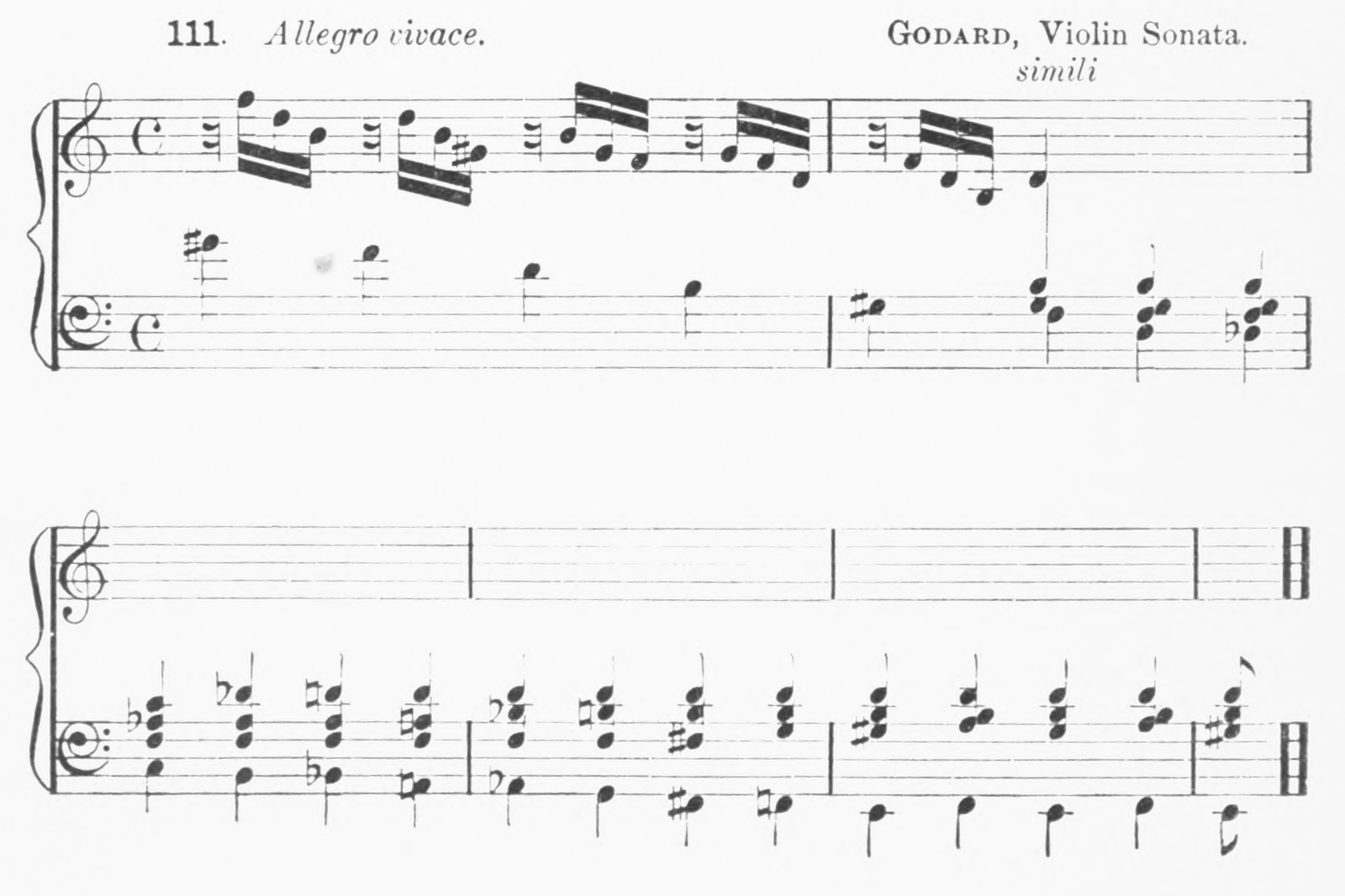
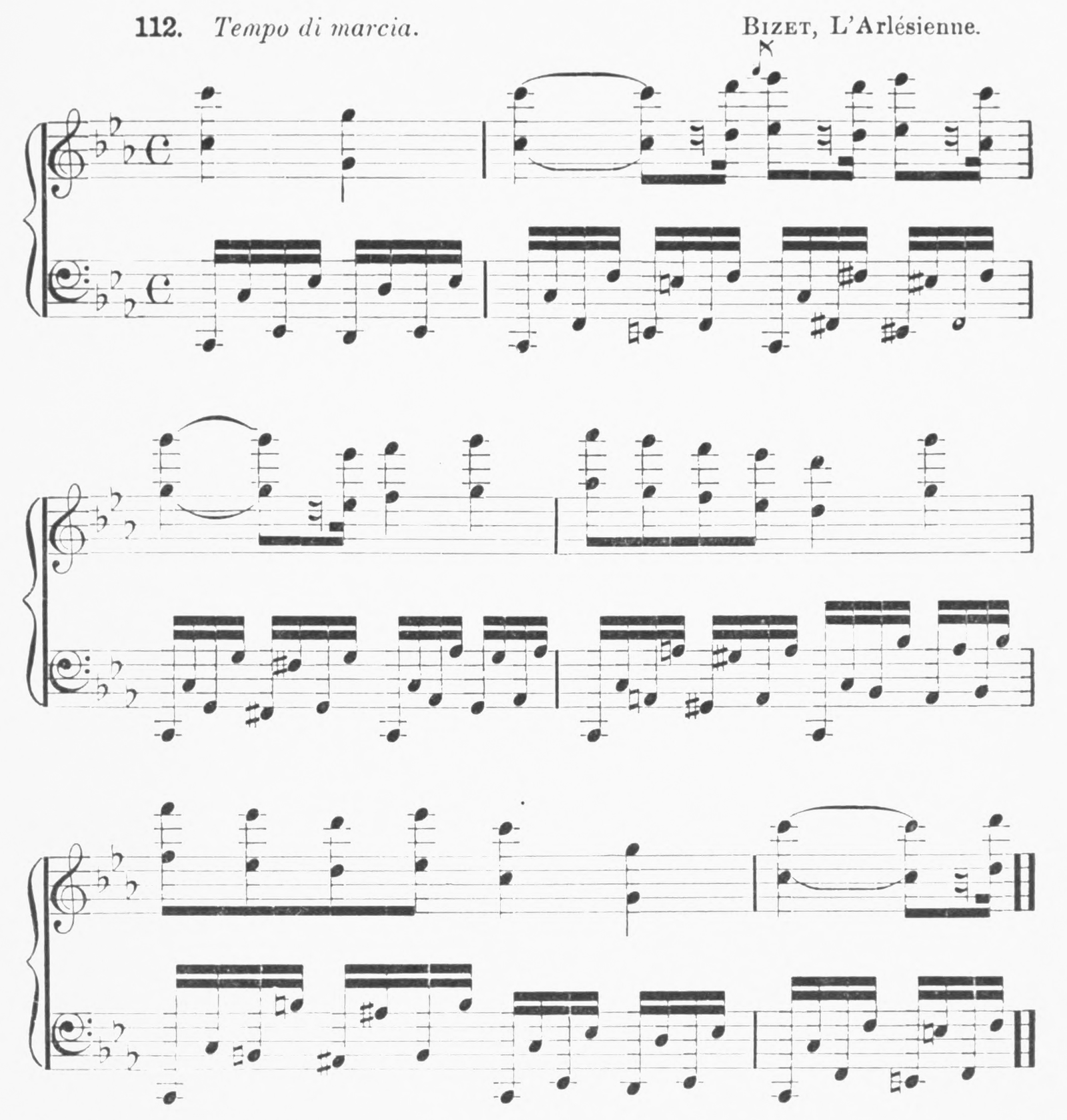
More than this, the extension of this spirit to the sequence sometimes occurs in modern music, as in the example by Bizet, where on an organ-point a sequential figure—its motive, a chord tone with an embellishment—is carried out obstinately through the rising scale, its principal tone at times consonating, at times dissonating sharply, the whole thing ending, however, satisfactorily with a good tonic impression.
In marking, much judgment must be used. If the chords be disconnected but yet long enough to give the ear a series of strong impressions, then they will fall under the head of Consecutive Tonics, with possibly two or more occasional chords in one key. When enharmonics are used with one general chord or key impression, the task is to fix upon the places where this impression is made, to mark them, and then, as these places govern the impression of the whole, to account for the rest as best one may—passing tones, etc.
Ex. 110 · Andante. Wagner, Walküre.
Ex. 111 · Allegro vivace. Godard, Violin Sonata.
Ex. 112 · Tempo di marcia. Bizet, L’Arlésienne.
Ex. 113 · Allegro molto. Wagner, Tristan.
Section 50. The Sequence
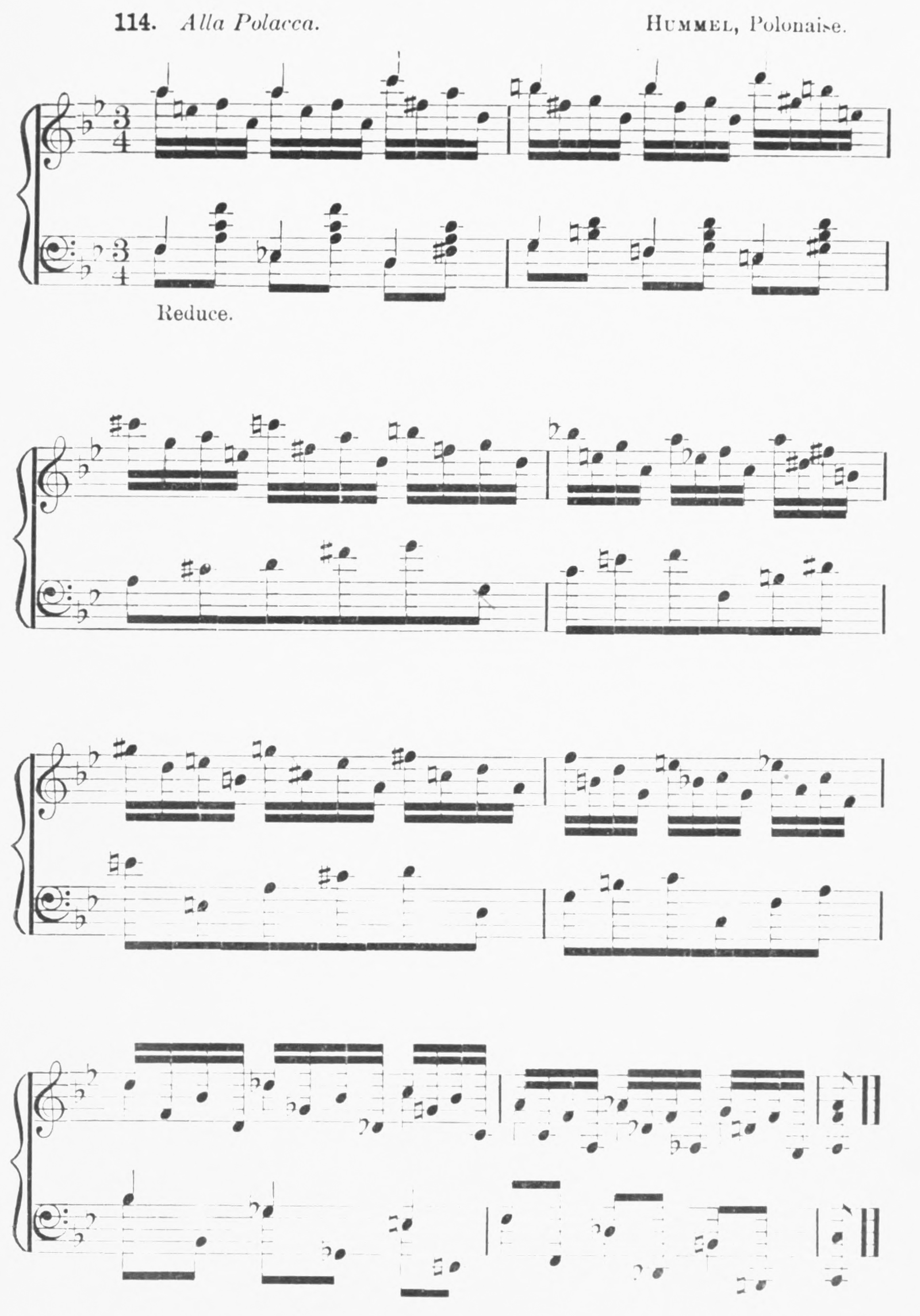
The Sequence is the continuous transposition, more or less regular, of any group of notes or chords, and consists of a Motive, or Model, and Repetitions, or Transpositions, of this Model. These transpositions may be one or more in number, and the Sequence may be diatonic or chromatic throughout, or a mixture of the two, or may modulate.
When diatonic—when based on the notes of the key in which it begins—and when carried out far enough, the diminished or augmented chords of the key cause harshnesses which are more or less marked according to the position of the dissonances involved. These harshnesses add to the interest of the Sequence, and, as is usual, may be compensated for by the outcome of the whole passage in bland principal harmonies.
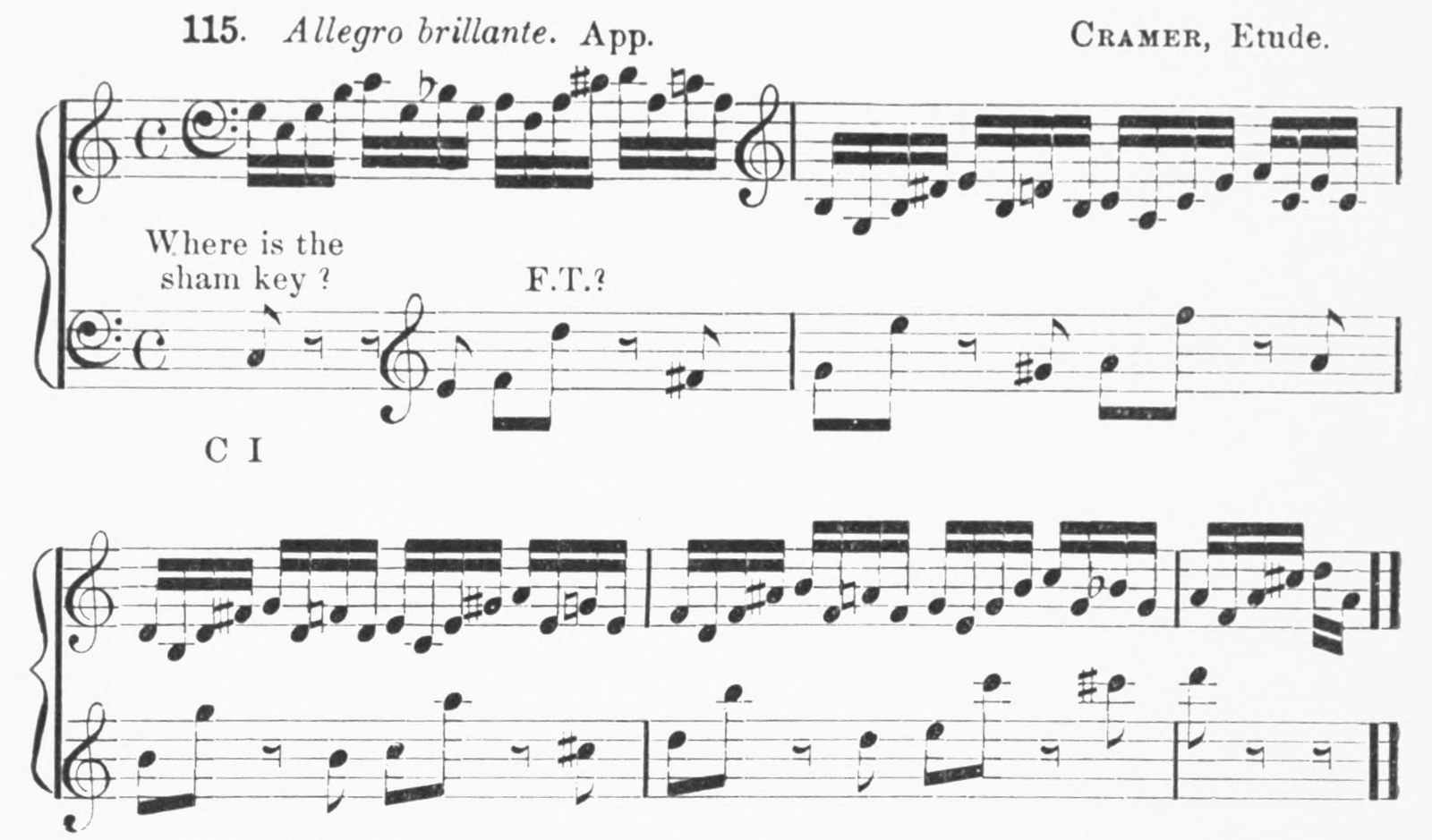
In a modulating Sequence of some length, especially in instrumental music, composers often raise or lower, arbitrarily, some tone in an occasional Repetition. This causes an irregularity which, by breaking the monotony, adds to the interest of the whole. These irregularities, interrupting the continuous rise or fall of definite keys, often produce what the author calls sham keys; for while the roots of an apparent dominant and tonic may be present, the tones which go with them do not form the intervals which characterize these chords, and the impression on the mind may be defined as that of a key, but marred in some way, strikingly incomplete.
Furthermore, a sequence may be based on a succession of passing thirds or sixths; or on a long sequential passage made up of several different Motives with their Repetitions.
The interval of transposition depends on the will of the composer. The Sequence may rise or fall by seconds, may move by fifths, and may go up or down the chromatic scale on the basis of one sustained chord (see Cadenza), in which case some of the Repetitions will move about or on foreign tones—in other words, the essential tone of the Repetition may be a passing tone.
To mark Sequences: No fixed rule can be given; the nature of the passage must be considered. It is thought that he who reaches this point in the book will be able to use his learning and judgment rightly.
Ex. 114 · Alla Polacca. Hummel, Polonaise.
Ex. 115 · Allegro brillante. Cramer, Etude.
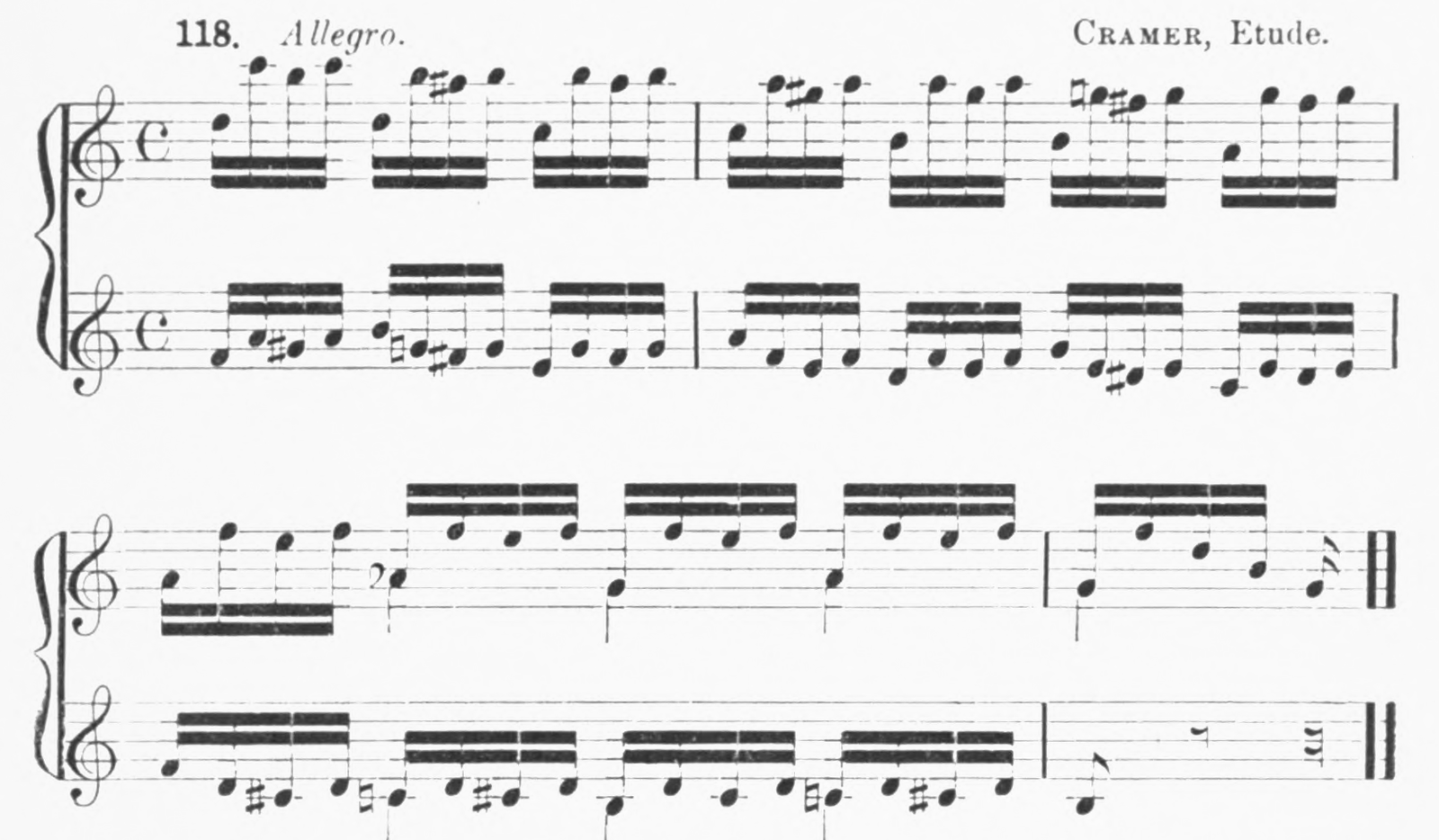
Ex. 116 · Allegro. Cramer, Etude.
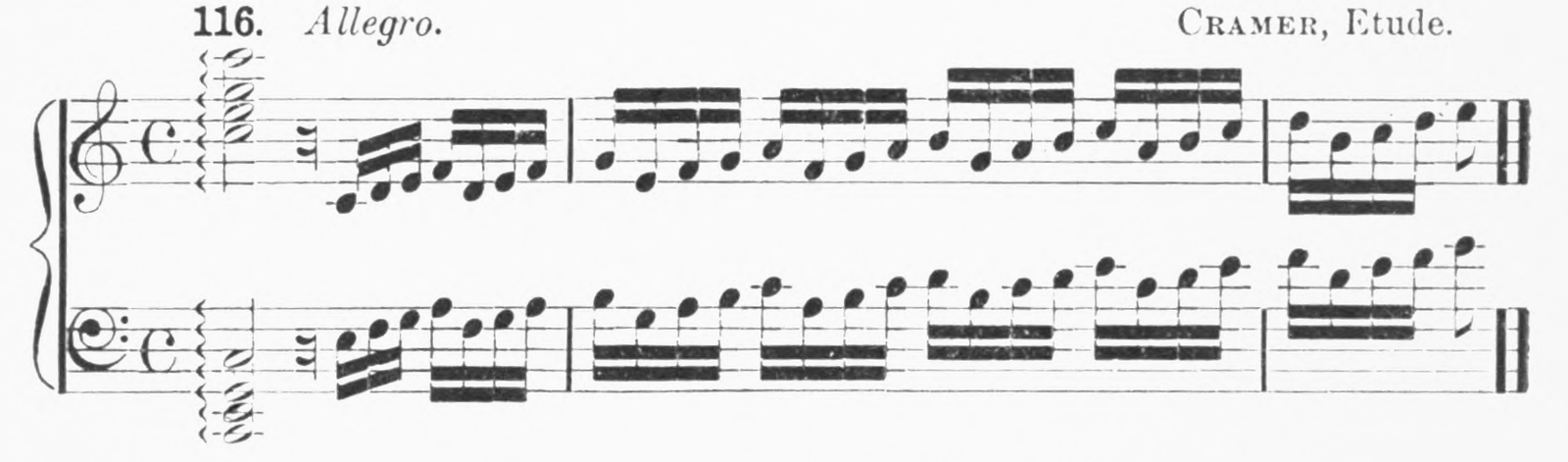
Ex. 117 · Energico ma non troppo Allegro. Sinding, Violin Suite.
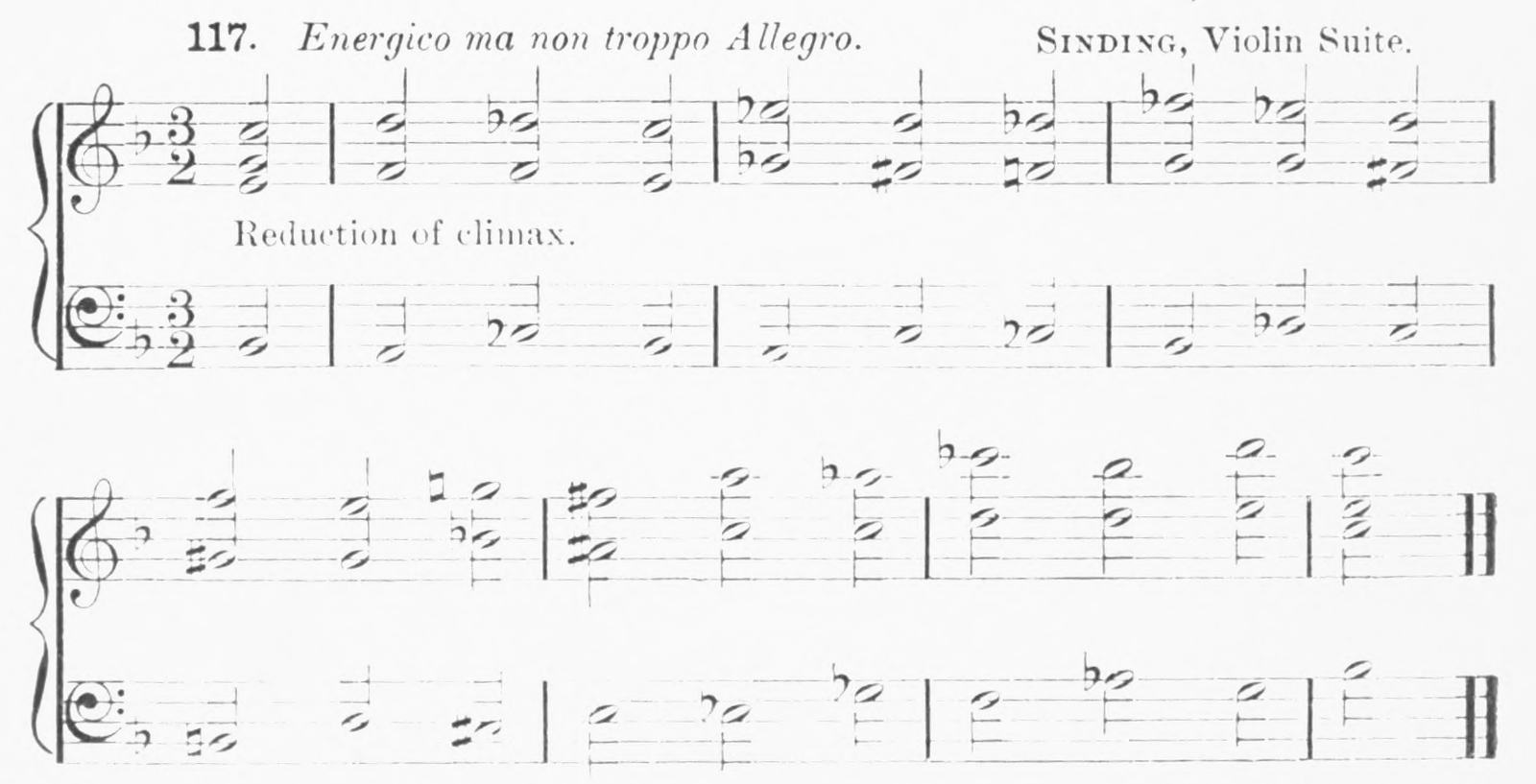
Ex. 118 · Allegro. Cramer, Etude.
References. Beethoven, Op. 10, No. 1, I, 32; Chopin, Prelude 9, m. 9; Prelude 20, Prelude 21, m. 32; Cramer, Etude 5, m. 23; Etude 1; Etude 8, m. 13; Etude 14, m. 26; Schumann, Op. 6, No. 2, m. 7.
Section 51. Two Simultaneous Harmonies
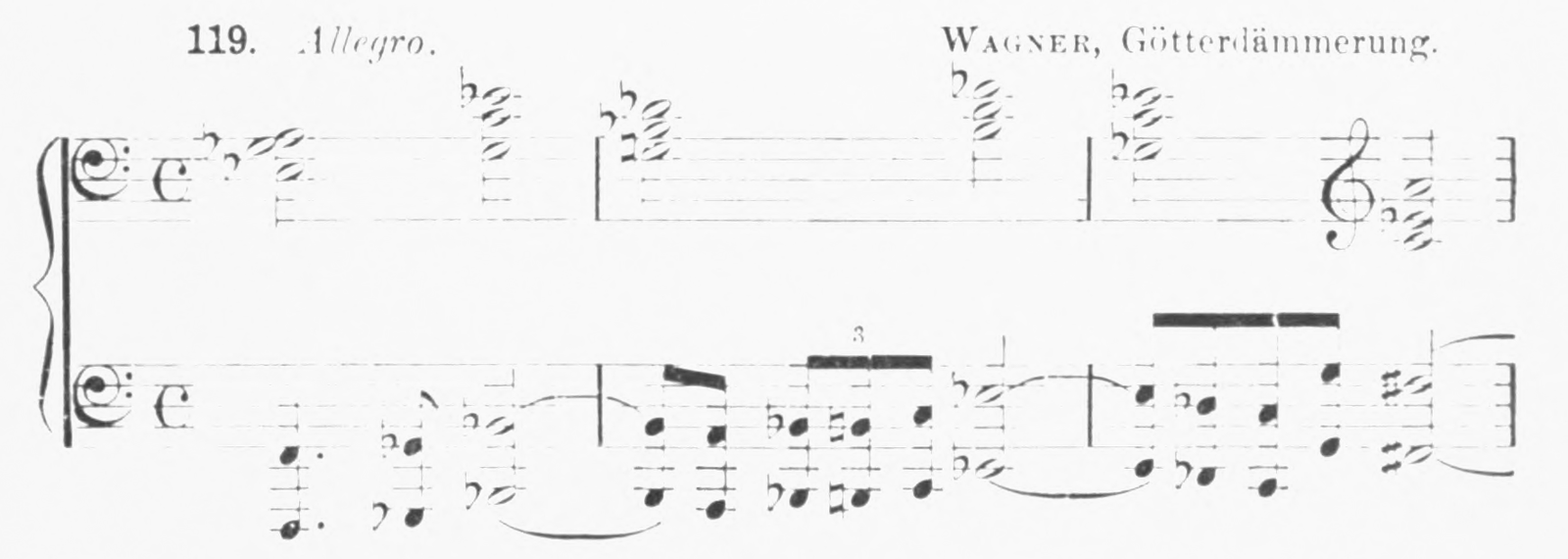
Cases occur occasionally in modern music in which two distinct harmonic bodies are used at one time, the one over the other. It may be possible to define the upper chord as composed of foreign tones, or it may be necessary to define it as an independent regularly resolved harmony.
Ex. 119 · Allegro. Wagner, Götterdämmerung.
Reference. Bizet, L’Arlésienne, Suite No. 2, I, ending.
Section 52. The Skip Resolution
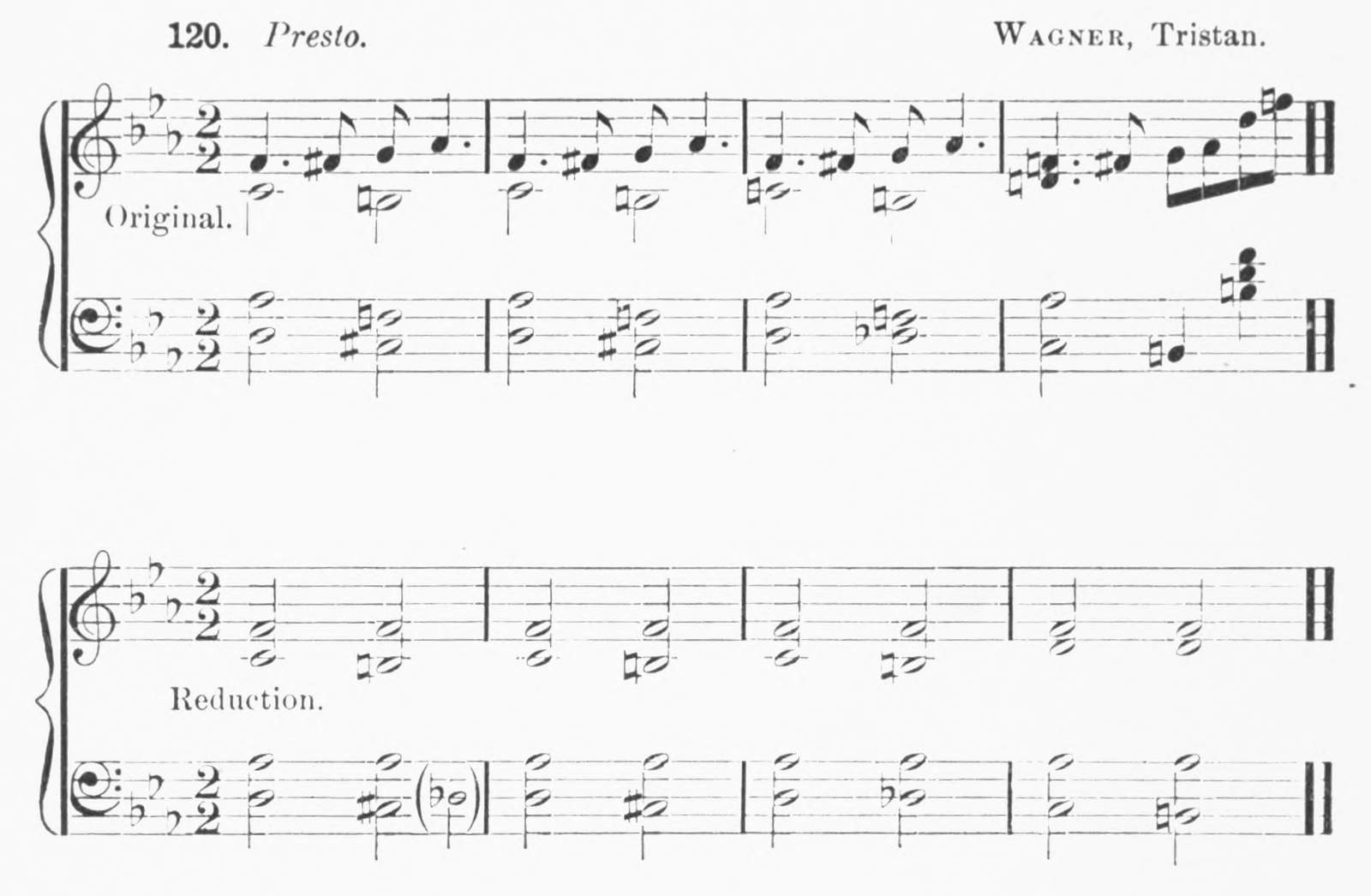
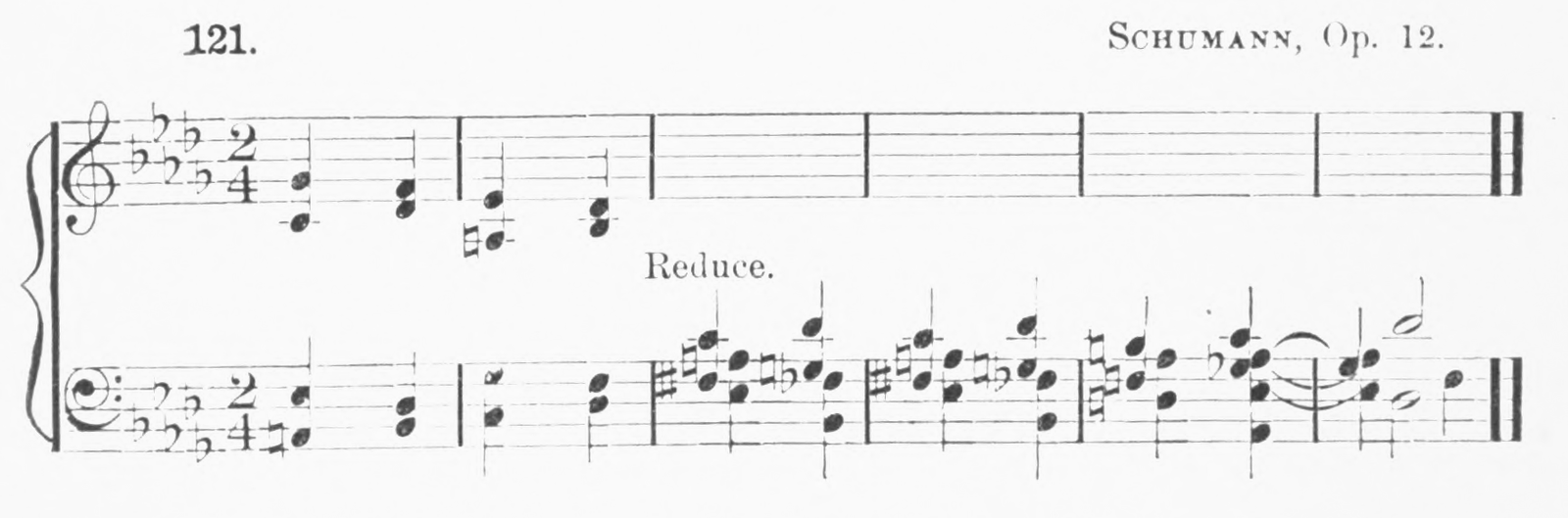
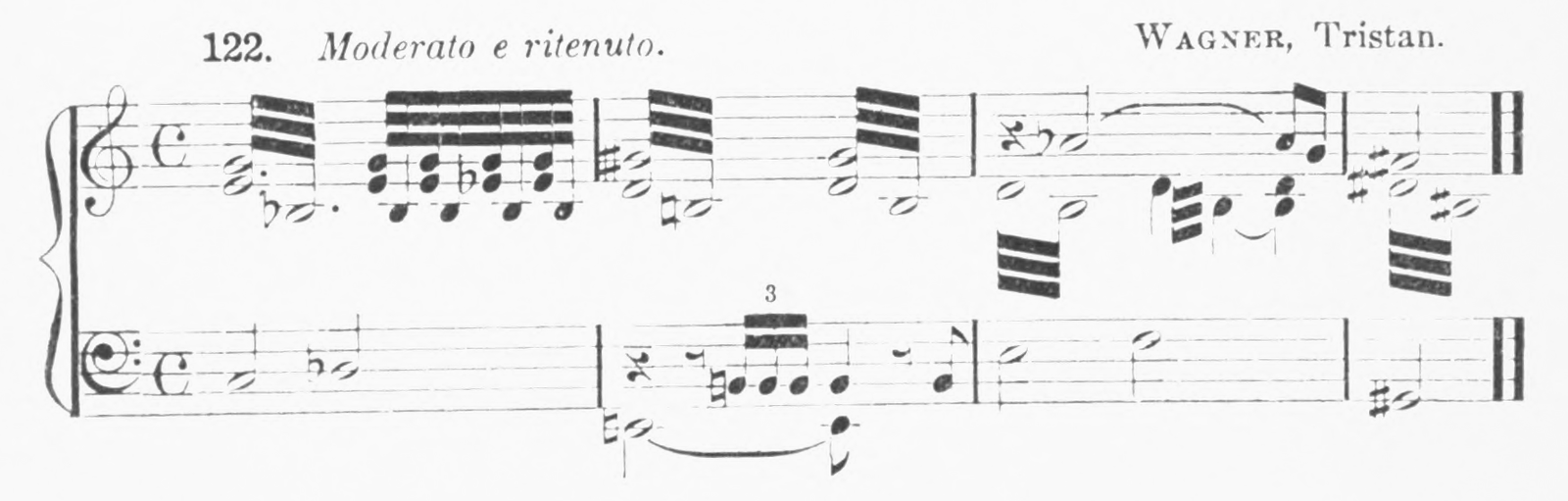
The normal, the strict, resolution of a chromatic tone, and of three members of the V7 and of the subordinate sevenths, and of all of the members of the leading tone sevenths, major or minor, is by moving a second. To the violation of these strict resolutions, modern music owes some of its most startling progressions. The principle is simple; the one lined F♯, for instance, instead of going to the one lined G, is carried to some other tone, the rightful tone of resolution, G, appearing in some other voice, above or below. This procedure causes a dislocation of the resolution; and it is also often responsible for a progression which not only startles the ear, but baffles the ear in ear-analysis, and may be made out only through examination with the eye. A chromatic passage, in itself closely united, correctly written, and consequently stout in its coherence, is by this means torn asunder, and the rightful, the primary, phrase may be found only when the passage is rewritten, and the voices resolved by rule, an F♯ moving a second to G, an E♭ to D. Cases occur occasionally in which a hitch becomes necessary even in this Reduction. Moreover, enharmonics may complicate the affair, and cross relations are exceedingly common.
In marking passages of this sort, the chords should be figured as they stand in the original, and the phrase may be reduced in writing to the primary form. The legitimacy of this primary form, so called by the author, is well shown by Exercise No. 120, the outcome of the first four measures in the diminished seventh of C minor, toward which the whole progression tends, being most satisfactory.
Ex. 120 · Presto. Wagner, Tristan.
Ex. 121 · Schumann, Op. 12.
Ex. 122 · Moderato e ritenuto. Wagner, Tristan.
Section 53. The Church Modes, and Unusual Cadences
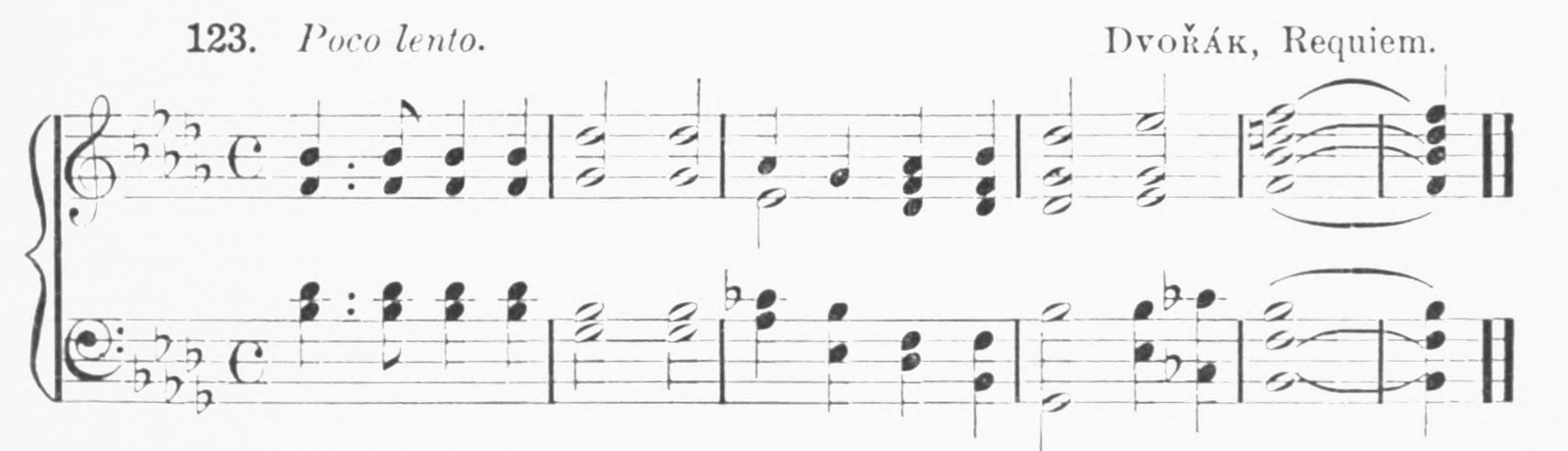
The Church Modes may be defined, briefly, as scales in which the customary order of semitones is changed. These alterations often make the ordinary cadences impossible, and produce, moreover, progressions which startle the harmonic sense accustomed to the modern major and minor modes or scales. To treat this matter exhaustively is needless; the bounds of this work also forbid the presentation of material sufficient to teach the many fine distinctions between the several Modes. The quickest and the best way is to regard such successions as triad progressions, pure and simple—which in reality they are—and to mark them as such.
Place as many chords as possible in one key. No better rule can be given.
Ex. 123 · Poco lento. Dvořák, Requiem.
Ex. 124 · Andante. Ibid.
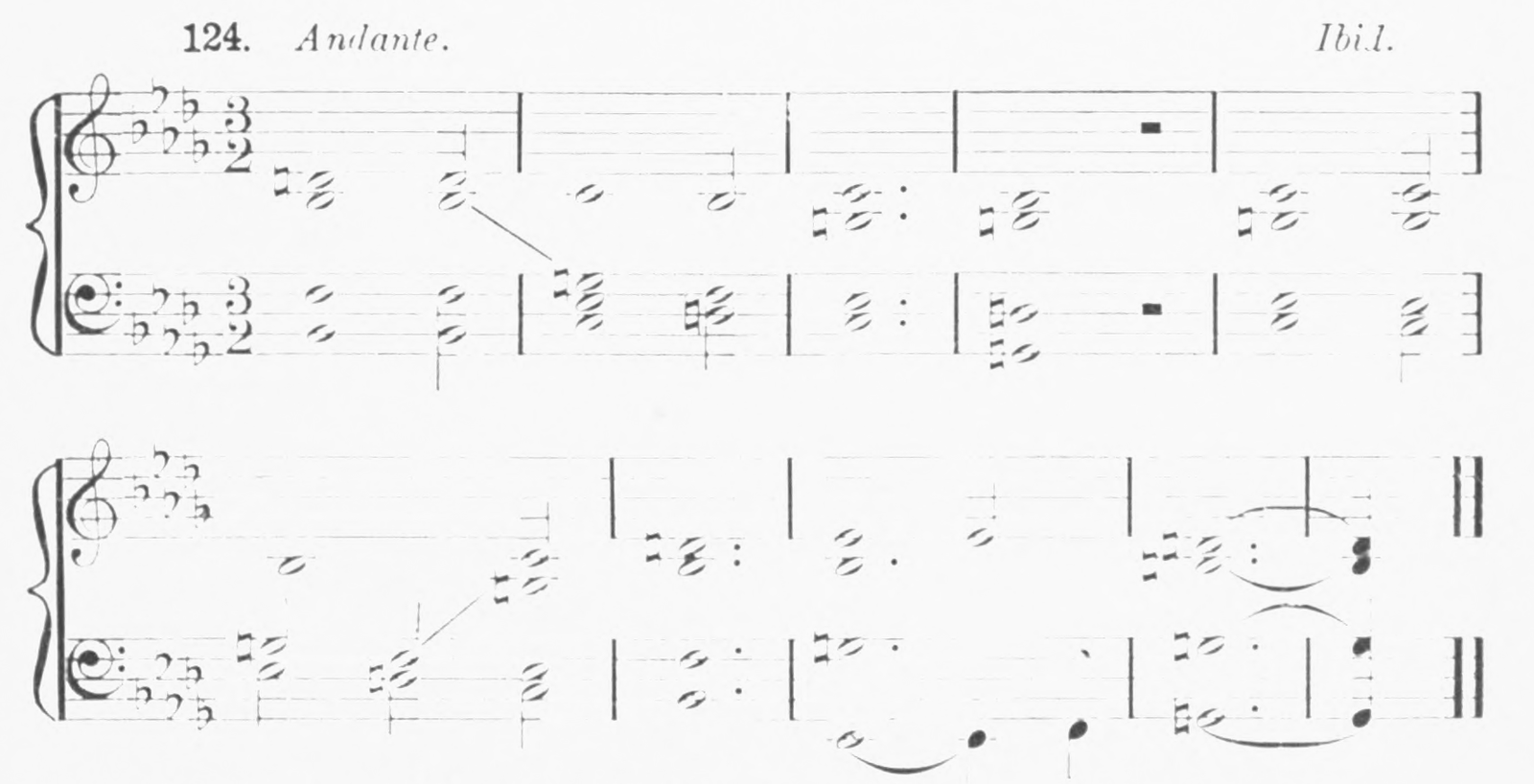
Reference. Wagner, Tannhäuser, 259.
Section 54. Two-part Writing
May be divided into two classes:
A melody in either voice, with a broken chord accompaniment;
Two equally important parts or voices.
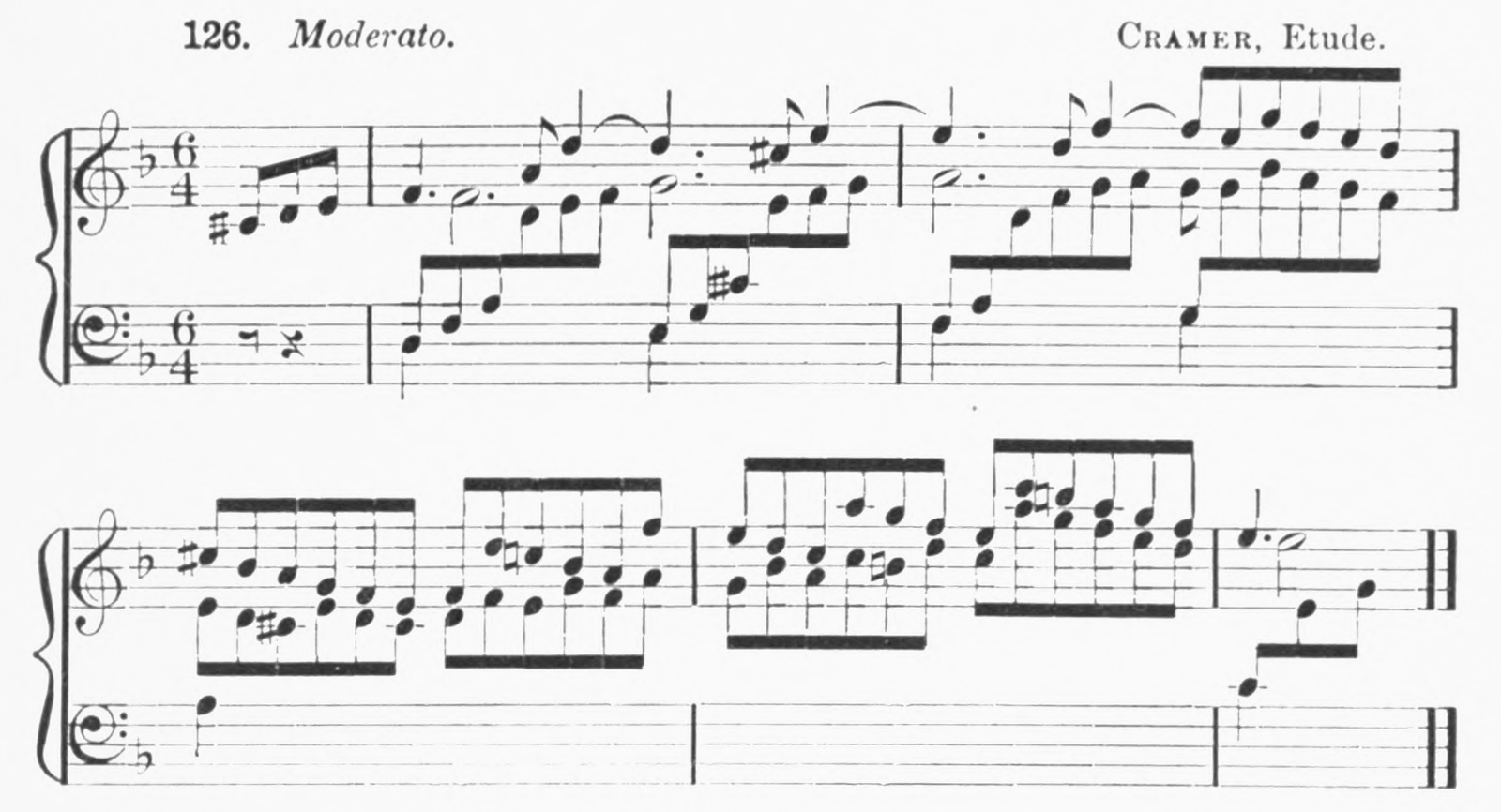
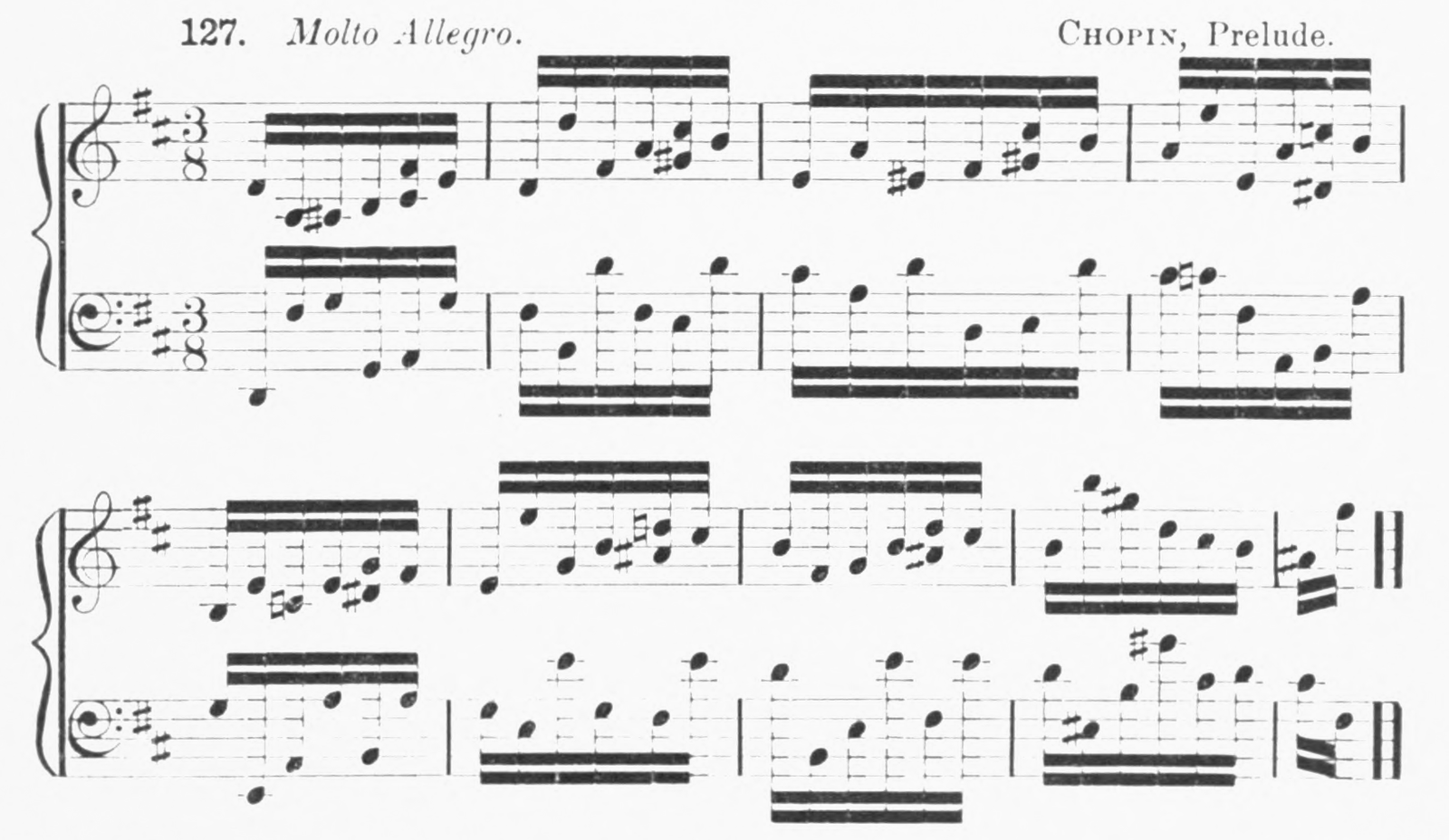
In the former case the chords are dissolved in the accompaniment, and though they are at times invested with foreign tones, they are so plain before the eye that no example is needful here. In the latter and more difficult case, the most essential members of the principal chords, and those chromatic tones which define the modulations, must be sought for, must be picked out. It should not be forgotten that a chord may be dispersed over several counts in the measure, and that in many a rapid passage it is the sum total of a number of notes which gives the chord impression, if the chord be dissolved.
Generally by playing simultaneously those tones which define the chord structure, Two-part Writing may be resolved to fairly complete harmony, although sometimes badly disjointed in the resolutions. In deciding on modulations, the tempo must be borne in mind. It is well to remember that the principal chords predominate, in order that the key effects may be strong and unmistakable.
Ex. 125 · Con moto. Cramer, Etude.
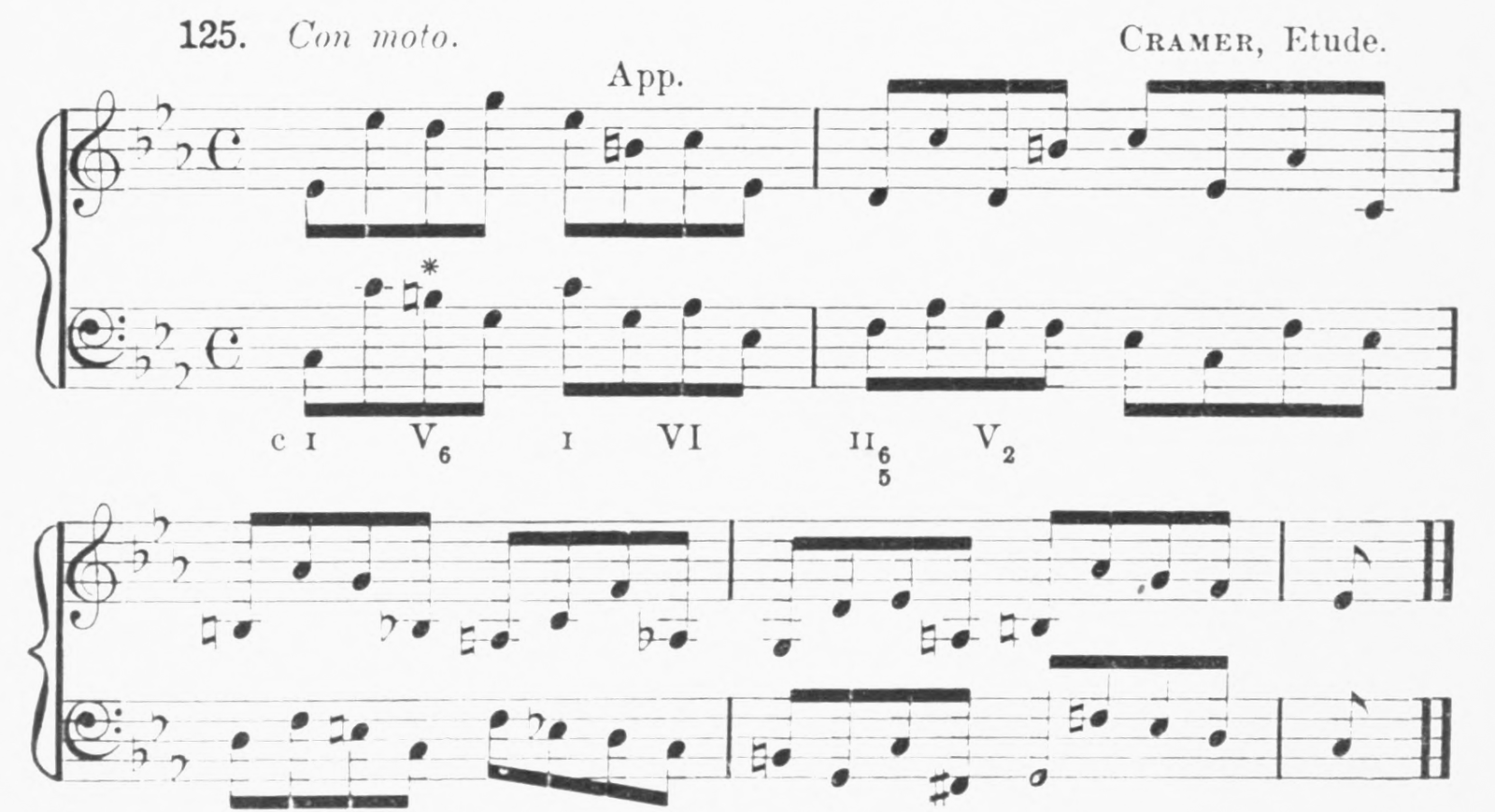
* See Principle 14.
Ex. 126 · Moderato. Cramer, Etude.
Ex. 127 · Molto Allegro. Chopin, Prelude.
Section 55. One-part Writing and the Cadenza
They appear in various forms:
1. As the ornamentation of one single and prolonged chord, usually the tonic six-four or the dominant;
2. As the investment in foreign tones of a plain chord structure, easily picked out;
3. As the sequential ornamentation of a chromatic scale, moving generally above one single chord;
4. As the sequential development of some harmonic motive of several members, sometimes readily defined, again difficult of explanation, although clear in its outcome.
The marking must follow the characteristics of the passage. No definite rule may be given applicable to all cases. Following the above classification, these general ideas are suggested:
Fix on the chord, mark it once below the staff, and then give each foreign tone its sign;
Define the chords, and then mark as in No. 1;
Fix on the motive of the sequence and mark it, and then mark those principal notes, so-called, over which the sequence moves, whether they be chord tones or foreign tones, the unessential tones in each transposition of the figure being marked only in the motive or model (see Sequence);
Define and mark the motive, with its possible modulations, and then follow the working out (the task will be simplified if a bracket be drawn over the motive and over each repetition).
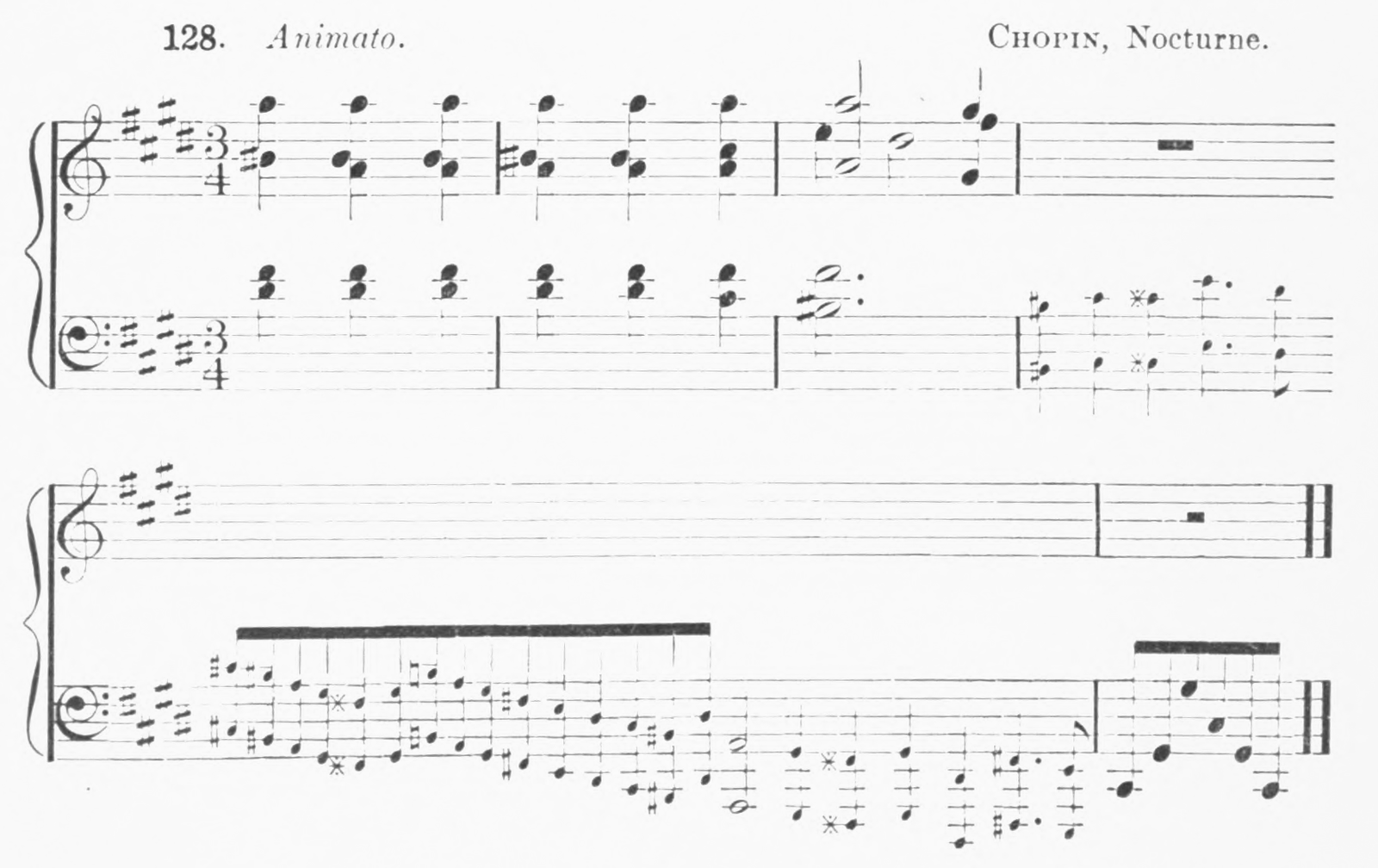
Ex. 128 · Animato. Chopin, Nocturne.
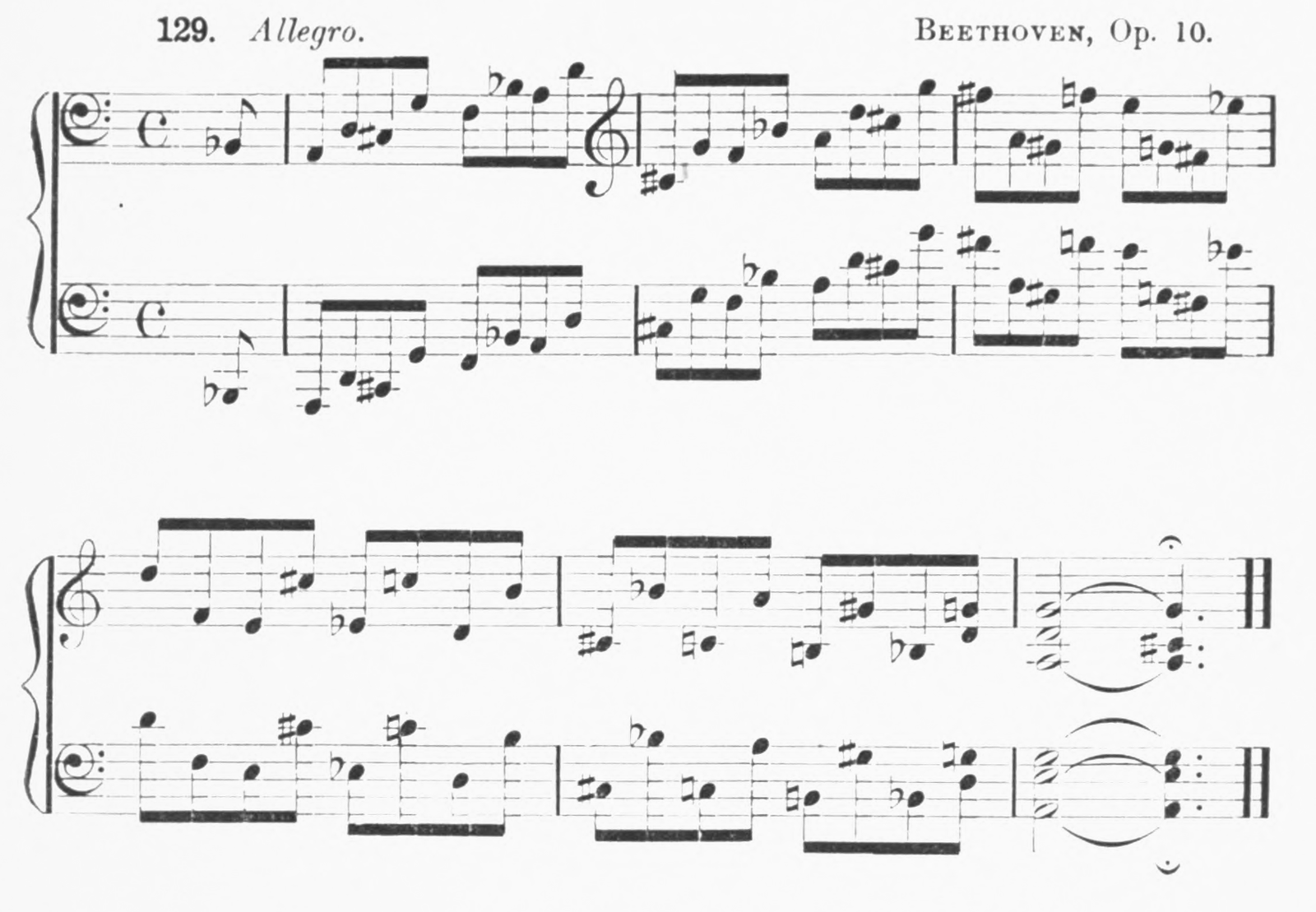
Ex. 129 · Allegro. Beethoven, Op. 10.
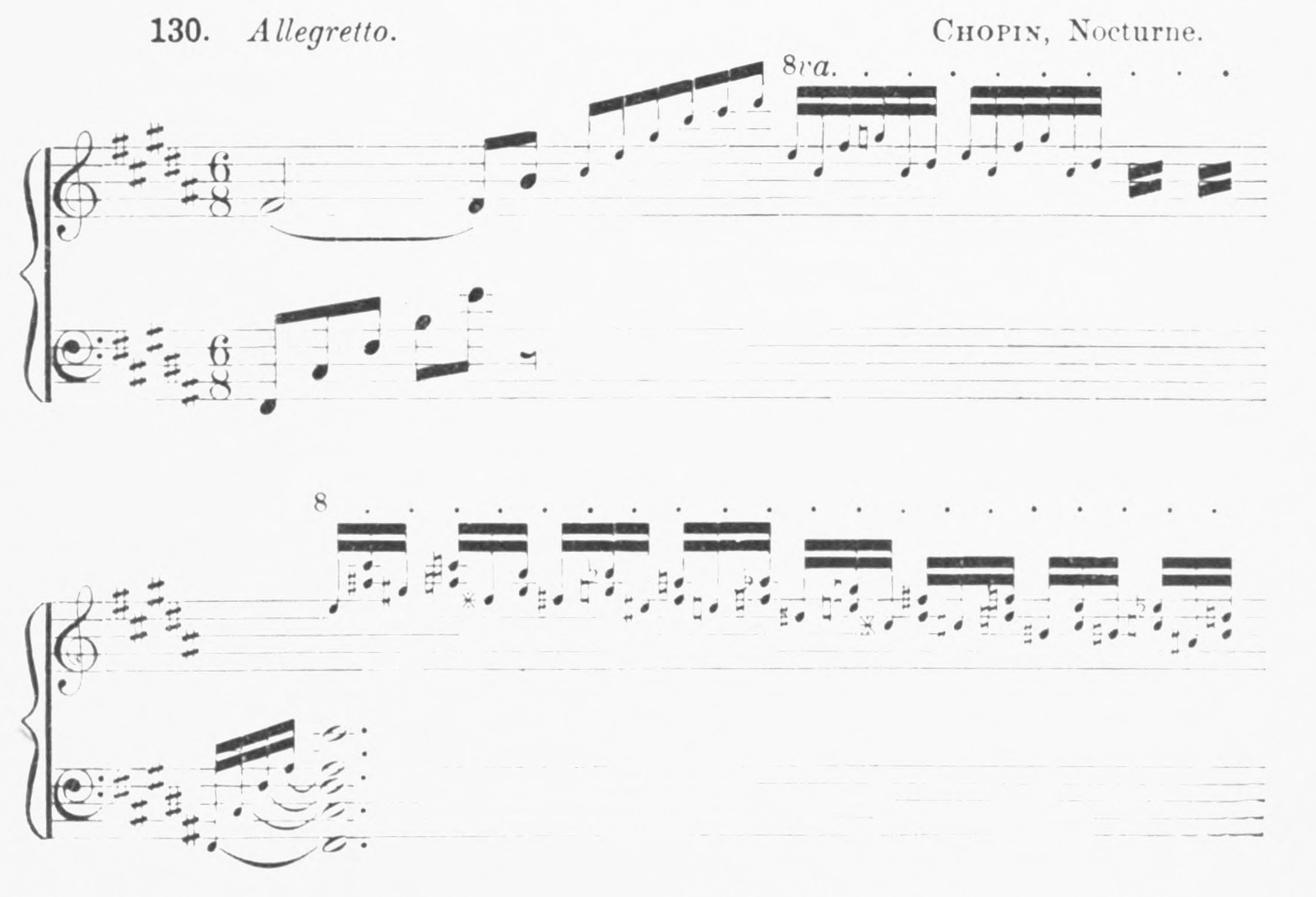
Ex. 130 · Allegretto. Chopin, Nocturne.
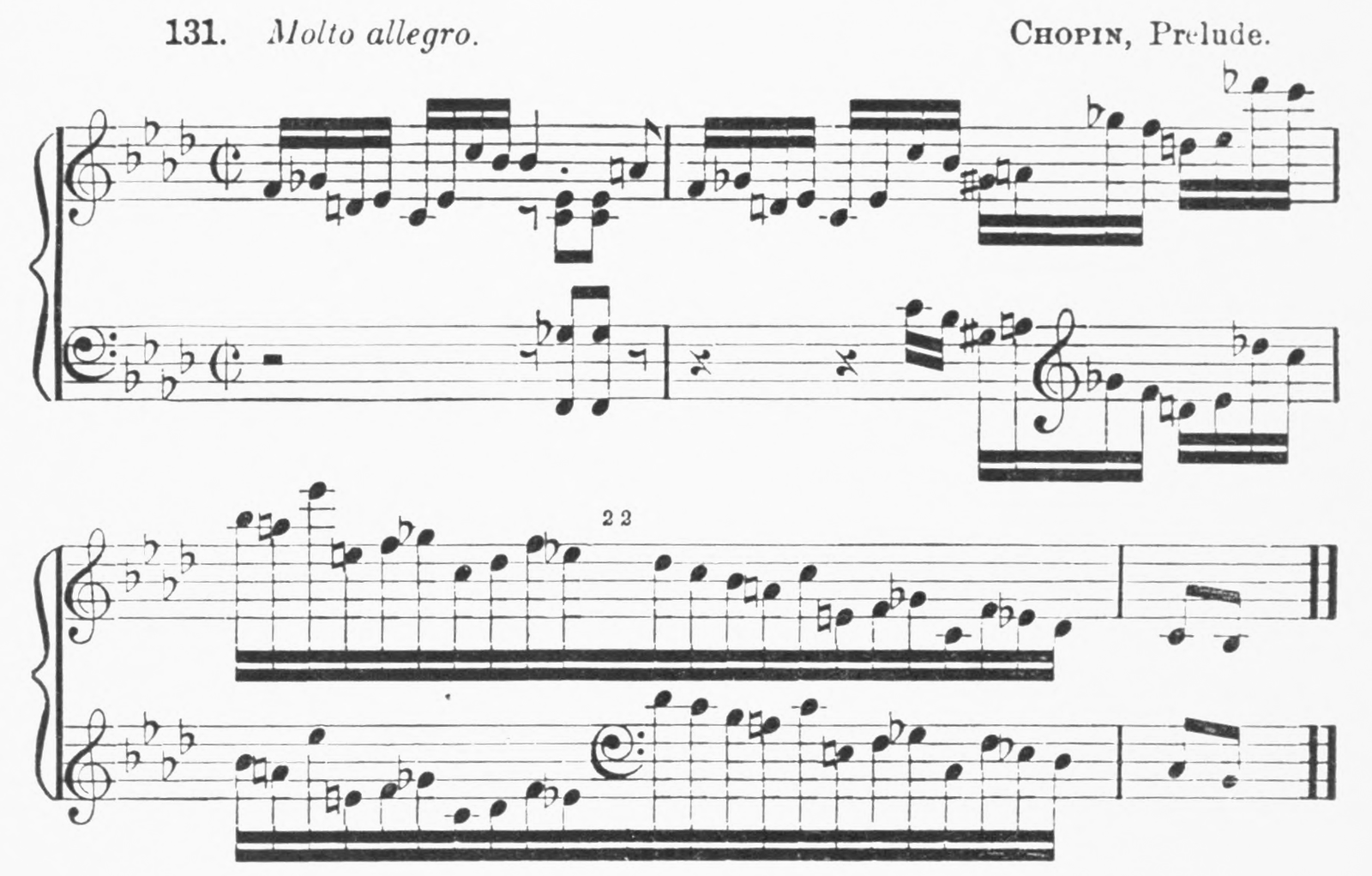
Ex. 131 · Molto allegro. Chopin, Prelude.
Section 56. Reduction (continued); its Application in Memorizing and in Sight Playing
One purpose underlying the writing of this book was that of making Playing by Memory and Playing at Sight easier to learn through an application of Harmonic Analysis. Although the bounds here are too narrow to allow an exhaustive discussion, it is thought that the student may be shown how to command his material and heighten his usefulness.
In studying thus far he will have seen that all music is either plain or figurate, and that a piece of figurated music is always built on a plain harmonic structure. He must have learned that this harmonic structure is a concrete thing; that it may be taken hold of, as it were; may be played by itself, giving a good idea of the whole. He must have begun to realize that in playing from memory there is given to the player a greater assurance, if he knows that at a certain point he is to use such and such a chord, or to go to such a key, or that a certain cadence begins with the Neapolitan Sixth—than if he does not know it. It costs him no unusual effort to remember this Neapolitan Sixth; no more than it costs him to remember that going down a certain street Mr. Y.’s house will be passed before Mr. W.’s. The effort was needed in learning to know and to recognize in the first place this especial chord; when once learned it became a part of the mental furniture, ever ready for use.
Experience shows that when a piece of music is committed to memory through a knowledge of the harmonic structure, there is a certainty of performance unknown when the piece is committed—as is usually the case—by many repetitions. In this latter instance—that of many repetitions—automatic impulses are made on the sub-consciousness; impressions on that part of the nervous system which controls habitual acts; and experience shows, also, that if in performance anything happens to disturb the performer, or if, as is often the case, the physical forces perchance take an ebb, the thread is suddenly broken, and a repetition of the piece will cause, generally, according to what seems to be a law of the mind, a second break-down at the self-same place—a thing some of our readers may possibly have observed.
If, however, to these impressions stored in the sub-consciousness through many repetitions, there be added impressions stored in another way and on the consciousness, namely, volitional impulses, subject to the call of the will in its demands on the motor nervous system—as is, for instance, the mental picture of a certain progression occurring in a certain place—then the surety of performance in playing from memory is heightened very greatly; for these two parts of the human make-up will play the one into the other; the one will help the other; and the chances are that where the one fails the other will be ready to carry on the process. Too much stress cannot be laid, then, on making an effort to memorize through a knowledge and use of Harmonic Analysis.
The piano player must know, for instance, the keys which mark the beginning of each strain he is to play. If there is a peculiar progression, this he must know thoroughly; for example, it will help him in memorizing Chopin’s Eighth Prelude to know that in the eighth measure the figure moves down the chromatic scale through successive dominant sevenths, and that at the end of this group is a dominant seventh chord with a suspended root in the bass, and occupying not one count, like the other chords, but two counts. This seems much to remember. If the habit has been formed of thinking of such things, it is little. For after some practice the student will be able to keep such matters in his mind and to help himself as he plays, and the mental habit once started will grow readily. And if he says: “This savors of pedantry,” let him remember that of such minutiae are pieces of music made. A good artisan cannot be unmindful of the material in which he is working; nor can the musician. He is not to remember every tone, every little tone. The sub-conscious part of his nervous system does that; and a wise provision of nature it is, too. He is to learn, first, to remember a few details and to hold himself in readiness to produce them as he plays—a series of rising diminished sevenths, or a sequence. After a time his mind, through the motor nerves, the will part, will stand ready to assist, as said before, and by looking ahead and seeing those features which it has grasped and retained, will give him a number of guiding points, beacons, by the way. We can only say, in closing this portion of our discussion, that it is wonderful how well and easily, how surely and quickly, the mind will begin to work if this sort of thing be practised regularly and persistently.
Going farther in our contention, it is a wonderful help to the sight player if in a piece of figuration he is able to see through the mass of notes and to behold the backbone, the framework of the whole affair. He will then possess a grip on the piece; he will play with an ease and a surety unknown to that sight player who regards the maze of printed notes as mere signs which his eye must see and decipher, perhaps painfully, in their succession, and which his fingers are to interpret one after the other. There is such a thing as “the Glance.” It is possessed in greater or less degree by all good sight readers. In its lowest form it is a natural gift unaccompanied by any knowledge of harmony, and those who possess it are able to read music within their technical skill without hesitation. This group is a small one. A larger group is that formed of those of more or less theoretical knowledge; it contains those, for example, who, on seeing a group of notes such as that in Exercise 16, recognize the chord and play it as a chord, as a form of arpeggio. Such a player has an enviable advantage over him of the first group. This group is a large one. We place in the third group those who with great natural gifts have by long study reached the end of sight playing, in the shape of playing from the modern orchestral score. This is a possession attained by comparatively few. It is to the middle class that we now speak.
Aside from the great advantage over the natural sight player possessed by him who can look at a chord passage and read and interpret it as a whole—as in the case of Exercise 16, mentioned above—there is an element little made of in general teaching, which, if carried out far enough, will produce excellent results—that of playing a Reduction, of seeing the chord structure as one plays the actual notes before him.
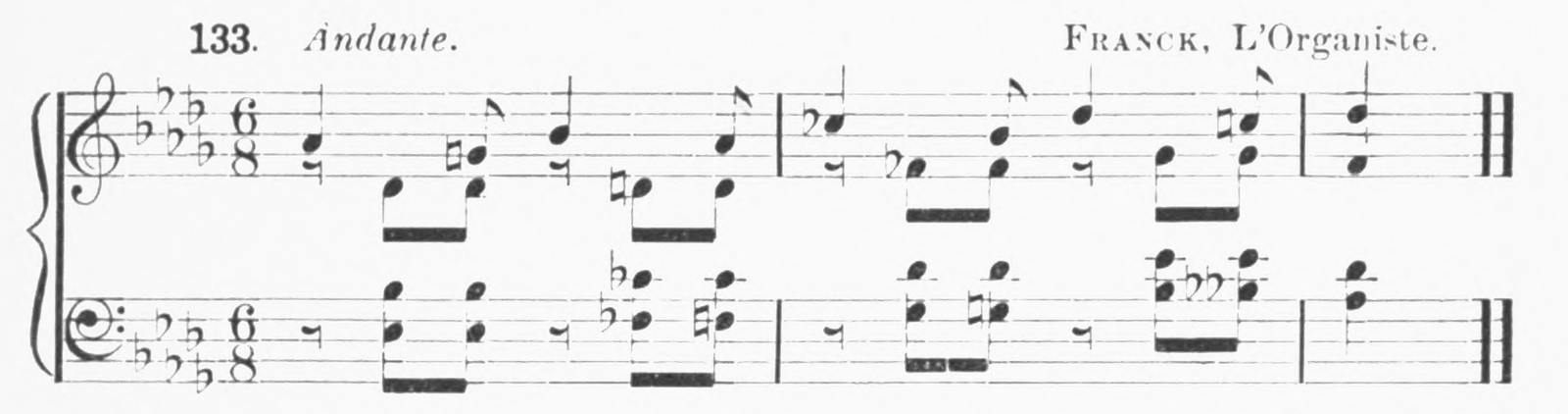
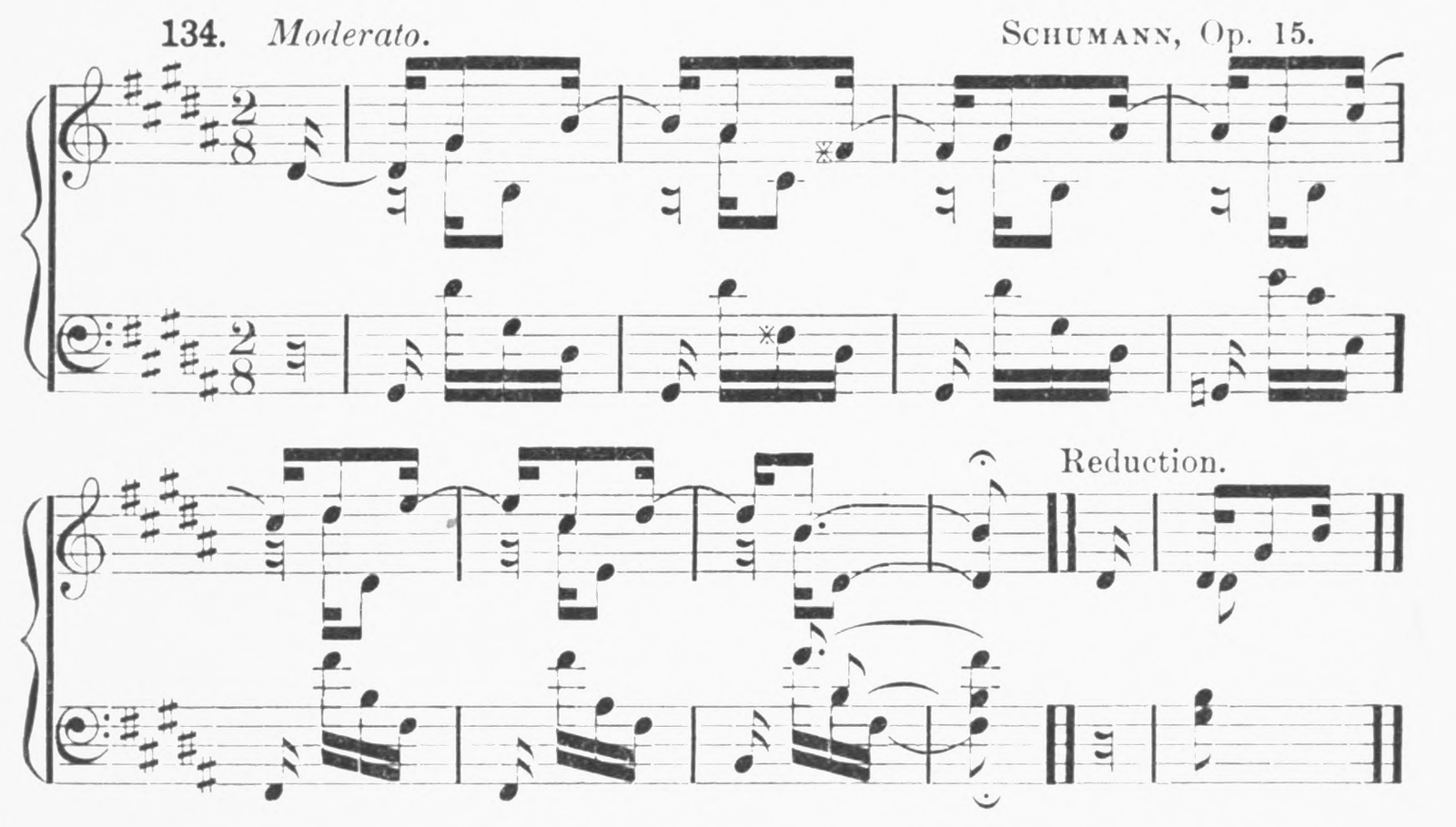
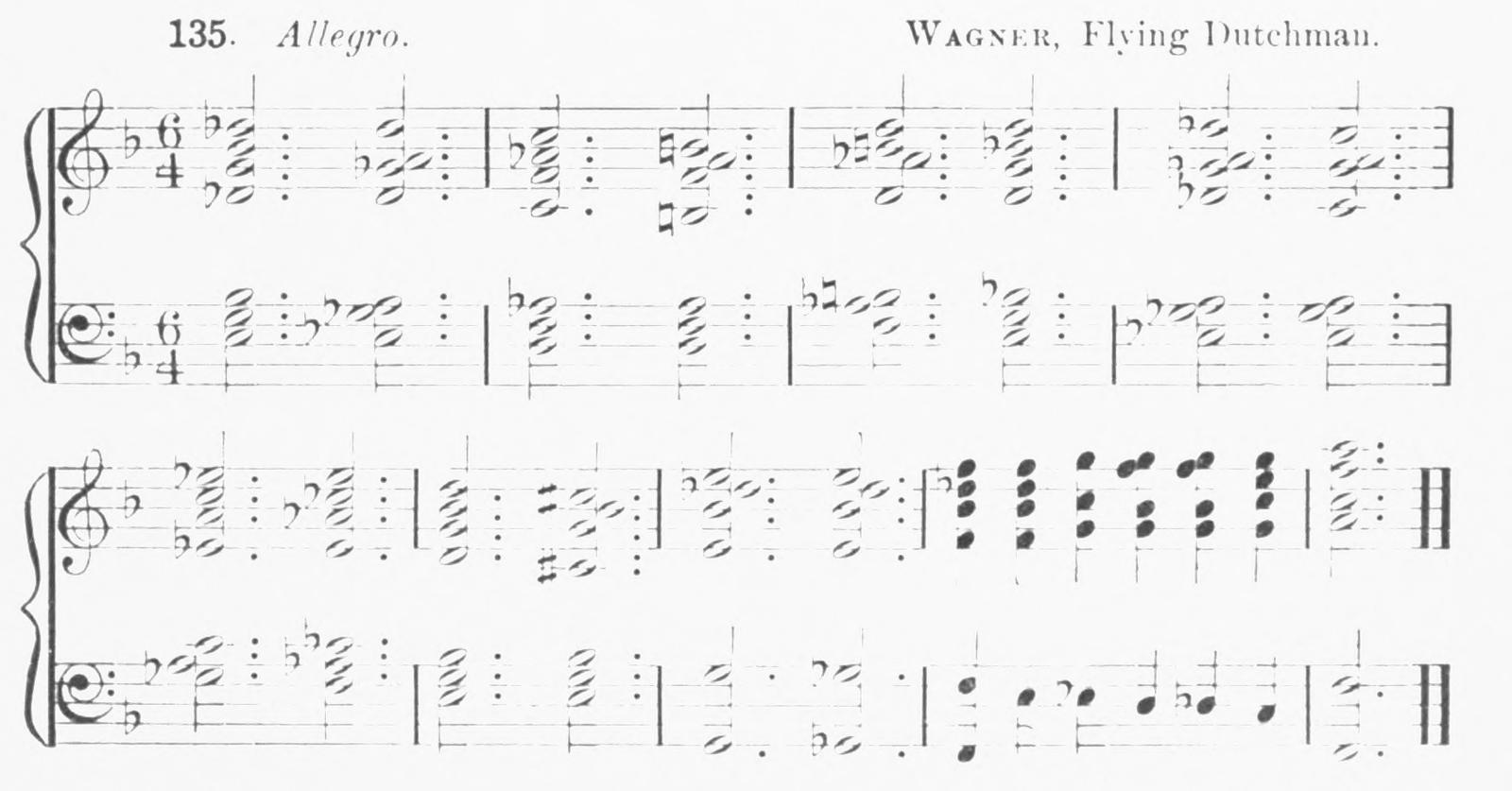
And as material well fitted to give one this mental habit, we recommend the Fifty Selected Studies of Cramer. We add below Examples showing how these Reductions should be made, and a List giving the order in which they may be practised. It will be seen, on studying the Examples, that the voices must be kept in vocal compass, and should be quietly led, although occasional breaks in the leading may be unavoidable in the compression of a very florid structure. These reductions should be played over and over until they are easy and a habit has been formed which enables one to see the framework in playing at sight. In other words, one must learn to play chords, and we suggest that the practice of this thing be persevered in until one has acquired a mastery. It will be found profitable to practise in this way on pieces of all kinds.
List. Nos. 2, 3, 6, 9, 16, 17, 20, 30, 24, 27, 28, 37, 38, 41, 44, easy, the chord element being plain to the eye; 1, 5, 8, 18, 21, 26, 39, 32, 47, 19, 39, 34, 31, 40, 22, 4, more difficult; these contain sequences and figuration more or less involved.
Reductions of the cramer studies
Ex. 132 · Allegro.
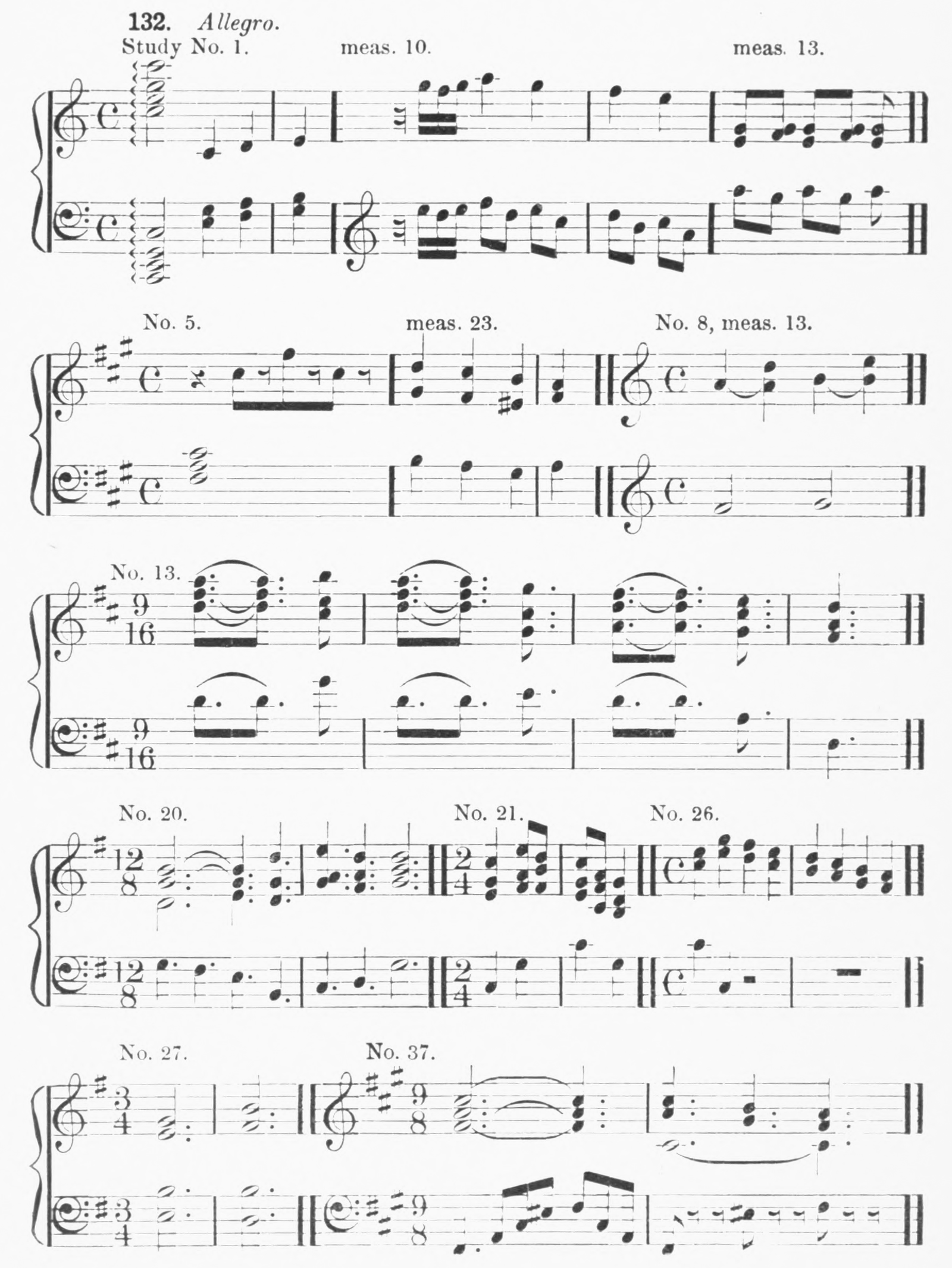
Reductions—to be written
Ex. 133 · Andante. Franck, L’Organiste.
Ex. 134 · Moderato. Schumann, Op. 15.
Ex. 135 · Allegro. Wagner, Flying Dutchman.
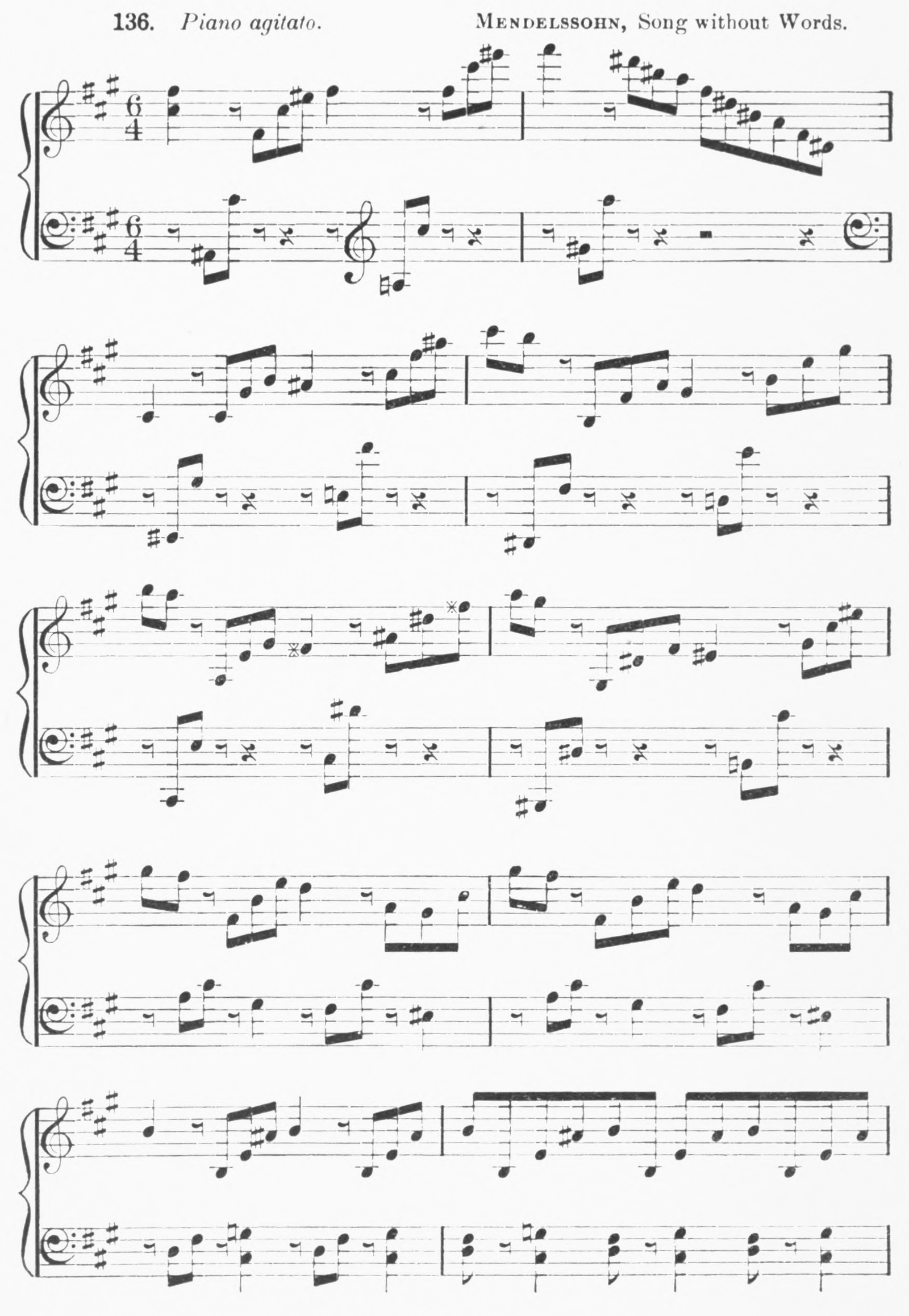
Ex. 136 · Piano agitato. Mendelssohn, Song without Words.
Ex. 137 · Allegro. Chopin, Prelude.
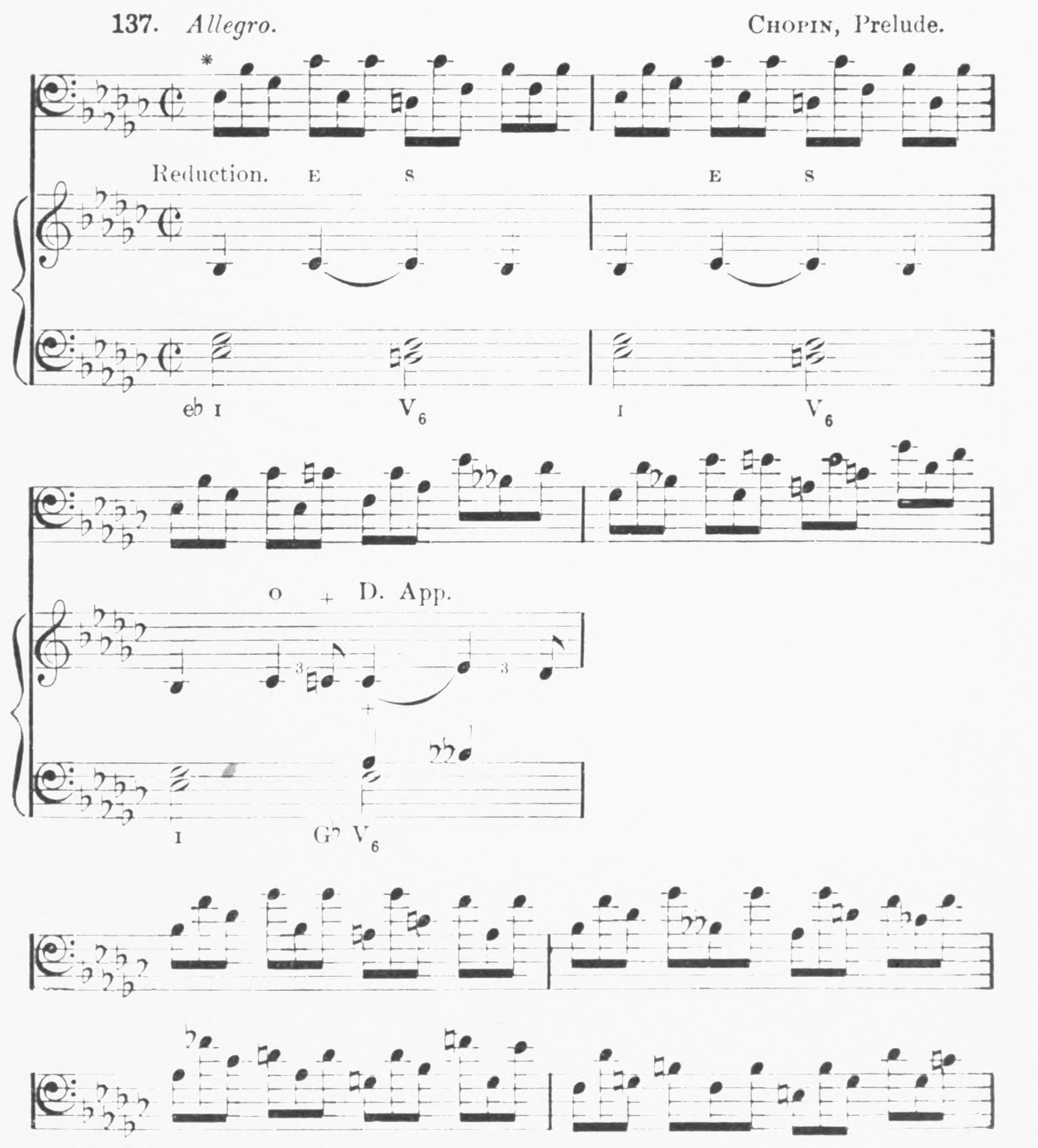
* In the original the left hand doubles this right-hand part in the lower octave.
Section 57. Full Table of Signs
A capital letter shows a major key; a small letter shows a minor key; a large Roman numeral shows a major triad, and a small Roman numeral a minor triad. The sign + shows the augmentation of a triad, and the sign ° the diminution of a triad.
Triads in Major. Triads in Minor. I i ii ii° iii III+ IV iv V V vi VI vii° vii°
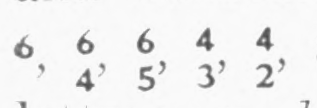
The inversion of triads and of seventh chords, both principal and subordinate, will be indicated by the customary figurings: 6, 6/4, 6/5, 4/3, 4/2, attached to the respective Roman numerals. Or, the letters a, b, c, d, meaning root-form, first, second, and third inversions, may be used with these same numerals; thus: Ia, Ib, Ic, ii°⁷a, ii°⁷b, ii°⁷c, III+b, iii⁷c, etc. The diminished seventh chord, in its various forms, will be marked: vii°7°, vii°6/5, vii°4/3, vii°4/2, or: vii°⁷°a, vii°⁷°b, vii°⁷°c, vii°⁷°d.

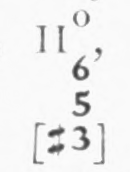
Altered Chords. These may be indicated by writing below the proper Roman numeral, and the sign of inversion, if there be an inversion, figures accompanied by the proper accidentals, these being placed in brackets. Thus, ii°6/5 [♯3] means: supertonic six-five, with 5 [=3] diminished fifth, and sharp third.
The Appoggiatura, App.; Double or Triple Appoggiatura, D. or T. App.
The Appoggiatura Chord, App. Chd.
The Free Tone, F. T.
The Accented Passing Tone, O; the Unaccented Passing Tone +.
The Embellishment, E.
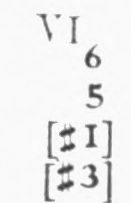
The Embellishing Chord, E. Chd., or E. Chd. vi6/5 [♯1] [♯3]
The Suspension, S.
The Anticipation, A.
The Free Anticipation, F. A.
The Retardation, R.
The Organ Point: Tonic, T. O. P.; Dominant, D. O. P.; Mediant, M. O. P.; Double, Dbl. O. P.
Section 58. Special Remarks to the Teacher
The value of this course of instruction may possibly be heightened by the following application: The text-book is used as a book of reference; the teacher selects a piece of proper difficulty,—say, for those who have worked through Part I and Part II, the Beethoven Piano Sonata, Op. 10, No. 2, movement I, and directs the class to give attention in analyzing to the following features which occur in the movement: Suspensions, Appoggiaturas, Altered Chords, Sequences, Augmented Chords. This procedure focusses the mind on certain definite features and makes the work of learning very direct; it also gives the student, generally, several examples of the same thing,—several Suspensions, for instance.
To lay out a course in this line would be difficult. The judgment of the teacher must be called into play, and a certain amount of this work will be very beneficial. But it should not cause the student to neglect the General Exercises in Part IV, which contain characteristic and individual passages.