Playable Books
Arnold Schoenberg · section 37 of 66
On the Diminished Seventh Chord
Read and hear this section in the playable edition → Practical Manual of HarmonyNikolai Rimsky-Korsakov · the leading-note seventh chord and the diminished seventh chord
 Treatise on HarmonyJean-Philippe Rameau · the leading-note seventh chord and the diminished seventh chord
 Guide to the Practical Study of HarmonyPyotr Ilyich Tchaikovsky · the leading-note seventh chord and the diminished seventh chord
The systematic introduction of nondiatonic chords into the key can be continued, in keeping with the earlier procedure, by trying to transplant the diminished seventh chord, too, to places where it does not occur naturally. For this, the first thing to consider is to place it on those degrees that recall a VII of minor in that their root (like the seventh tone of minor) makes a minor-second step upward into the next diatonic root. In major these are: the III (in C major, E) and the VII (B); in minor, the II (A minor, B), the V (E), the VII (G-sharp). That would give (apart from the one on VII in minor, which is already known) two chords: E–G–B-flat–D-flat and B–D–F–A-flat. Then one could, after all, also draw on the alterations of the roots of the degrees, since they occur in the secondary dominants and there are actually seventh tones, by erecting, for example, on C-sharp (the third of the secondary dominant on A) a diminished seventh chord C-sharp–E–G–B-flat, on D-sharp (the third of the secondary dominant on B) D-sharp–F-sharp–A–C, and so on. But the assumption of raising (or lowering) the roots, or of replacing them by such raised and lowered ones, is awkward, because it departs too far from the model: the triad built up on the root from overtones. This, which also speaks against the derivation of some of the diminished triads shown earlier, explains why they are not accorded the significance of complete chords, and favours the view that a root is missing. And this view seems to me more practical and more fruitful here as well. For the most important and simplest function of the diminished seventh chord is not its resolution by the root’s leap of a fourth upward (VII to III), but the deceptive-cadence-like one: root a step upward (VII to I). It is in this function that it is found most often. But theory, which has recognized the root progression of a fourth as the simplest and most natural, cannot here admit the step of a second upward as the most natural. It therefore does better to trace the resolution of this chord, too, back to the root progression of a fourth upward, by assuming: the diminished seventh chord is a ninth chord with omitted root. That is: for example, on the note D (as root) a (secondary) dominant D–F-sharp–A–C is built with an added minor ninth E-flat; or on G the chord G–B–D–F–A-flat, on E, E–G-sharp–B–D–F, and so on.

The root (D) of the ninth chord thus arising is omitted, and a diminished seventh chord F-sharp–A–C–E-flat remains. If this now goes (as a quasi VII degree) to G–B-flat–D (into the quasi VIII) or, if it arises from a secondary dominant, to G–B–D, then the omitted root D does in fact carry out the leap of a fourth upward, D–G. This agrees with the view of the deceptive cadence and is the logical continuation of the system of observation that has chords arise through building in thirds, since it proceeds from the seventh chord to the ninth chord by adding a further third.
![Plate A2 [to page 231 ff.] [137C, continued] d) with artificial diminished seventh chords — V, I?, V … V? e) with artificial augmented triads — V, IV, V … V? D)](/schoenberg-harmony/images/sh-043-plate-a2-ex137.png)
In this way one can obtain nondiatonic diminished seventh chords on all degrees in major and minor. For the time being only those degrees are to be excluded on which the step of a fourth upward of the (omitted) root does not land on a diatonic note. For example, on the IV in major: in C major F, which would have to go to B-flat but leads to B. Or in A minor the IV (D), where G-sharp, as VII, should follow. Later, when we have spoken about the Neapolitan sixth and have got further in the use of the diminished seventh chord, this too will work.
The diminished seventh chord can be brought in without any preparation at all. It will, to be sure, be good to let it arise through stepwise or chromatic progressions of the voices, but that is not absolutely necessary. For it has the following properties:
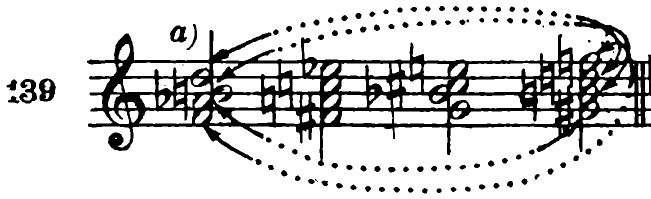
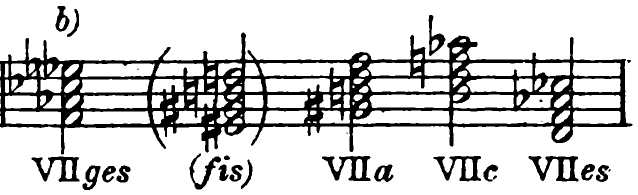
It consists of three equal intervals that divide the octave into four equal parts, minor thirds. If one places another minor third above its highest or below its lowest note, no new sound enters the chord; rather, the added note is the repetition of one already present in the higher or, respectively, lower octave. This division can be undertaken from every note of the chromatic scale. But the first three chromatically successive lowest notes already produce all the diminished-seventh sonorities there are. For example: F, A-flat, C-flat, D; then F-sharp, A, C, E-flat; and G, B-flat, C-sharp, E. The next division, from G-sharp (A-flat), yields the same notes as the one from F, namely A-flat, C-flat, D, F; the one from A: A, C, E-flat, F-sharp; and so on. Thus, in sound and constituents, there are only three diminished seventh chords. But since there are twelve minor keys, every diminished seventh chord must belong to at least four minor keys as VII degree. The sonority F–A-flat–C-flat–D can accordingly mean (139b): VII degree in G-flat (F-sharp) minor if F (E-sharp), VII in A minor if G-sharp, VII in C minor if B, VII in E-flat minor if D is taken as the root; or, if it is understood as a ninth chord with omitted root, V in these keys. (That the spelling must then change, and B be written as C-flat, G-sharp as A-flat, goes without saying.) Each of its notes can therefore be root, and consequently also each can be third, diminished fifth and diminished seventh. If one inverts the chord, the result is not, as with a major or minor chord, an entirely new picture of the construction; rather, minor thirds (augmented seconds) always remain. Thus, when this chord appears without context or in an unclear one, it will be unclear to which key it belongs. Its G-sharp can be an A-flat, its B a C-flat, and so on, and only from the continuation can one tell whether a note was a leading tone and whether it was a rising or a falling one. That the ear cannot decide earlier and gladly adapts itself to any solution now makes it possible to let something follow it other than what corresponds to its introduction. A diminished seventh chord containing G-sharp can, for example, follow a triad without that triad’s G having to go to G-sharp. For the ear is ready to take it as A-flat, and, despite this interpretation, allows the continuation to treat the note in question as G-sharp after all and lead it to A. The law of the cross-relation can therefore be suspended for the diminished seventh chord up to a certain degree. Nevertheless one will not make leaps here without need either, but will present melodically (that is, approaching a scale) whatever at all offers the possibility.
The sonority B–D–F–A-flat can be a ninth chord with omitted root:
in C major, on degrees III, V
in C-sharp (D-flat) major, on degrees I, VI
in D major, on degrees II, VII
in E-flat major, on degrees III, V
in E major, on degrees I, VI
in F major, on degrees II, VII
in F-sharp (G-flat) major, on degrees III, V
in G major, on degrees I, VI
in A-flat major, on degrees II, VII
in A major, on degrees III, V
in B-flat major, on degrees I, VI
in B major, on degrees II, VII
in C minor, on degrees V, VII
in C-sharp (D-flat) minor, on degrees I, III
in D minor, on degrees II, (VI.)
in E-flat minor, on degrees V, VII
in E minor, on degrees I, III
in F minor, on degrees II, (VI.)
in F-sharp (G-flat) minor, on degrees V, VII
in G minor, on degrees I, III
in A-flat minor, on degrees II, (VI.)
in A minor, on degrees V, VII
in B-flat minor, on degrees I, III
in B minor, on degrees II, (VI.)
VI in D, F, A-flat and B minor (bracketed), and further IV in D, F, A-flat and B major and minor, it will also be able to be later on. But even now 44 meanings are already at our disposal. And it will turn out later that the relations this chord has to the keys are much richer still: that it is really at home alone in none, belongs alone to none; but that it has, so to speak, the right of domicile everywhere and yet is settled nowhere—a cosmopolitan or a vagabond! I call such chords vagrant chords, as I have mentioned once before. They belong to no key exclusively; rather, without changing their shape (not even inversion is necessary; the imagined relation to a root suffices), they can belong to many, usually almost all, keys.
We shall then also recognize later that almost all chords can be treated as vagrant to a certain degree. But there is an essential difference here between the truly vagrant chords and those that are made so only by artificial means. The former are so by their very nature. Their inner construction makes it clear from the outset that they are different from the latter—something that can be clearly observed here already in the diminished seventh chord, which consists of nothing but minor thirds, and later in the augmented triad. Their most characteristic feature is the great dissimilarity they have to those simplest imitations of the overtone series: the absence of the perfect fifth. It is peculiar: these chords do not arise directly by the path of nature, and yet they fulfil its will. They actually arise only from the logical further development of our tonal system—that is, through inbreeding, through inbreeding among the laws of that system. And that it is precisely these consistent results of the system that finish off the system itself, that the end of the system is brought about with such inescapable cruelty by its own functions—this recalls the thought that death is the result of life; that the juices that serve life also serve dying at the same time. And that it was the vagrant chords that had to lead to the suspension of tonality will no doubt become clear in the further course of things.
We do not use the diminished seventh chord to carry out more remote modulations, but only as an easement along the way and to promote the smoothness of connections that would otherwise easily sound harsh. Attention must, however, be drawn to this: the diminished seventh chord, whose effect can be very decisive, is capable of giving a setting something very soft, something soppy. For its decisive effect as the motor of modulation stems not so much from its power to turn as from the indefinite, hermaphroditic, immature quality of its shape. It is itself undecided, has many tendencies, and anyone can gain power over it. On this its effect rests: whoever wants to mediate must not himself be personally too distinct. But used sparingly, it too is of excellent effect.
One thing we shall hold to most strictly: we do not use the diminished seventh chord as is generally customary, like a universal remedy from the household medicine chest—aspirin, for example—that cures all ills. Rather, as a ninth chord with omitted root, it is for us always nothing other than the special form of a degree. Only where this degree, by the standards we have for it, could also otherwise be set—unaltered, as a secondary dominant or in other modifications—only there do we set a diminished seventh chord, where suitable. The root progression remains decisive, as before. The student has to design his exercises in accordance with it, and the decision whether a step is better carried out by this or that form, by a secondary dominant or a diminished seventh chord or otherwise, belongs to a second consideration.



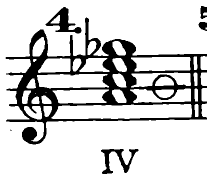



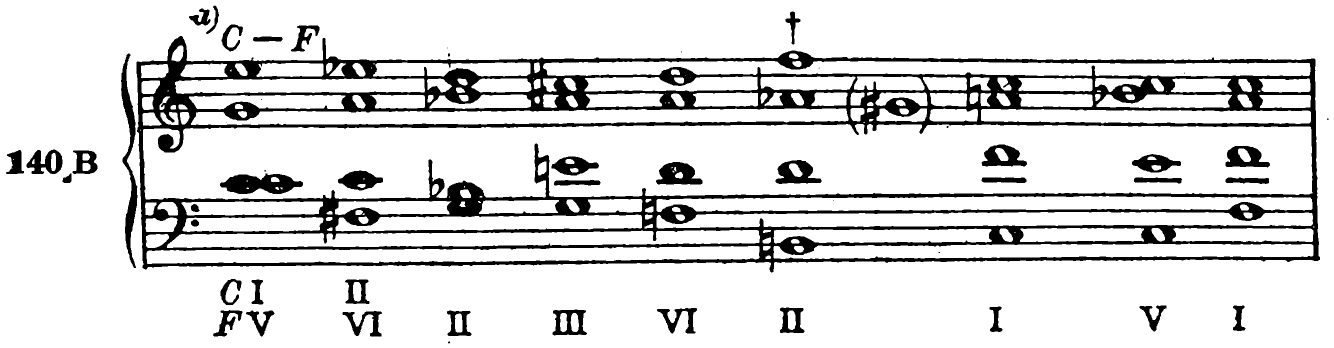
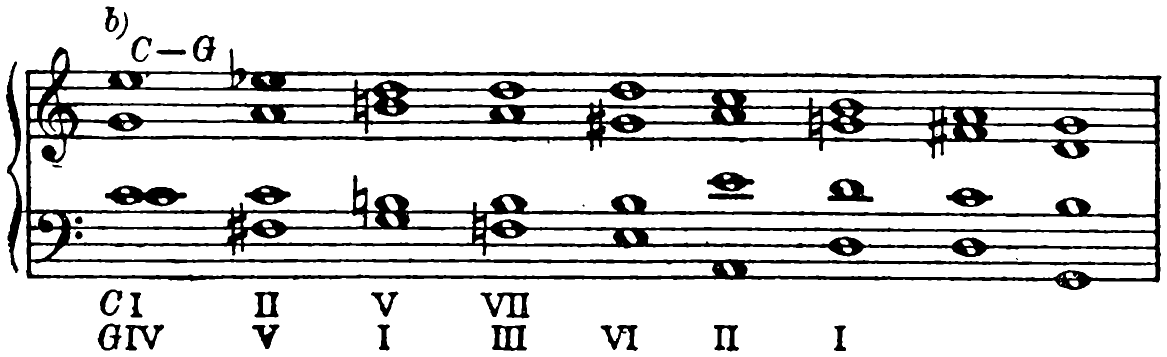
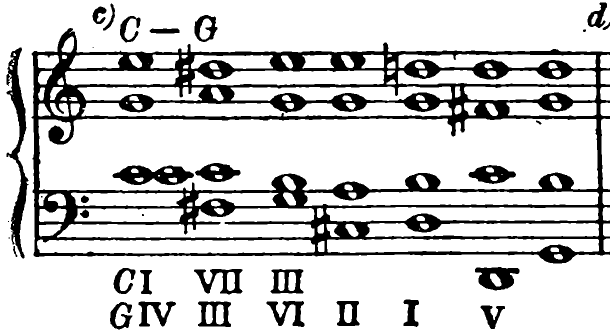
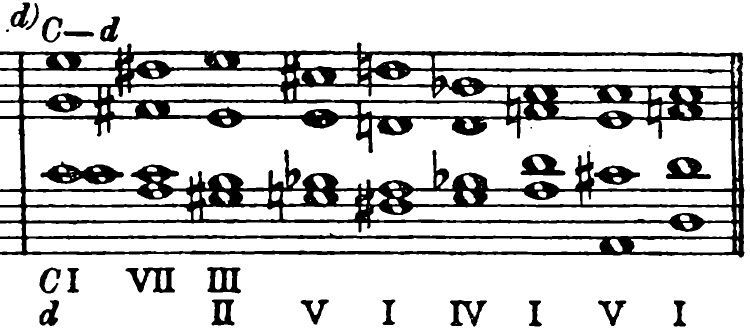
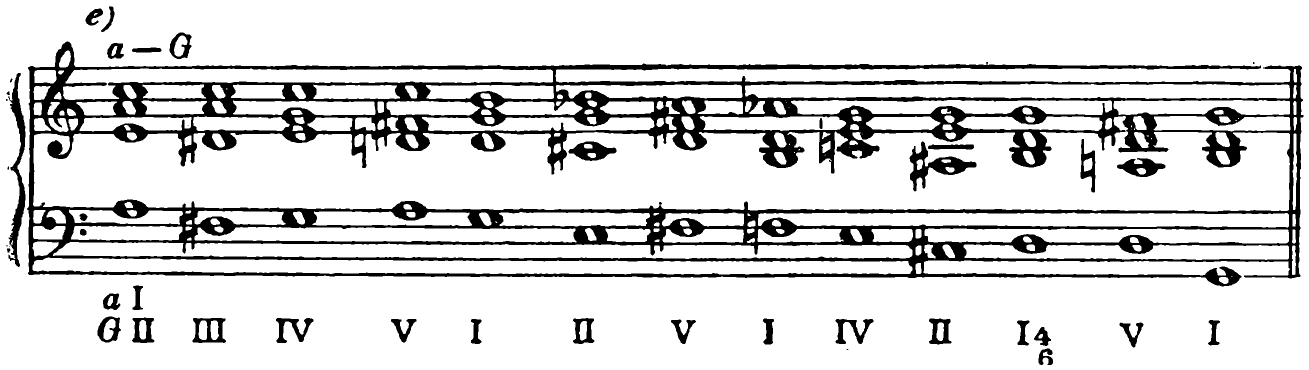
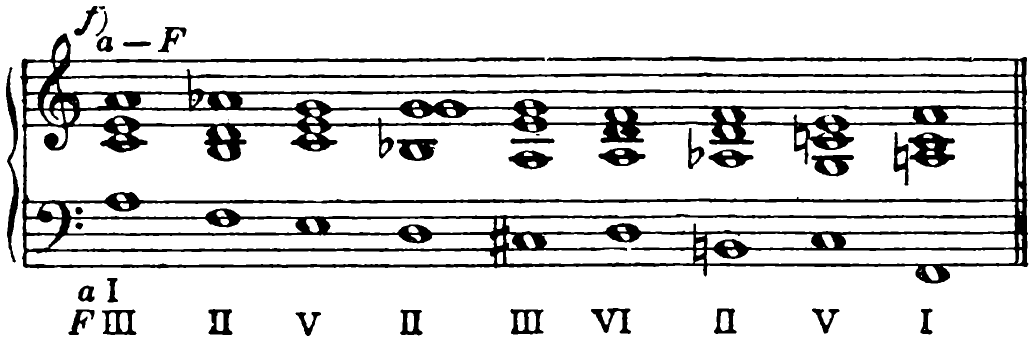
In 140A the diminished seventh chords were connected to all the degrees. Some of this is worthless, some superfluous. The student will notice a number of augmented and diminished leaps (140A*). Here they lose their questionable character, for they are often almost unavoidable, and the possibilities of enharmonic reinterpretation of the diminished seventh chord soften them.
In 140B the chord F-sharp–A–C–E-flat (or D-sharp) was used in four different ways, a different chord following it each time. In a) it is VI and connects with a II; in b) it is V going to I; in c) III going to VI; in d) VII going to III. But in a), at †, the diminished seventh chord B–D–F–A-flat standing on the II degree of F connects with the I of F. This diminished seventh chord is here, of course, designated as the II degree (imagined root G), which introduces the six-four chord of I. Now, however, the A-flat goes to A, a path that according to our view so far only a G-sharp could take, whereas an A-flat would have to go to G. If, however, one were to write G-sharp instead of A-flat, disregarding the derivation of the chord, and assume that the ninth chord of the VII degree of F major (with omitted root) is present, the connection would read VII–I⁶₄; which is an improbable assumption, for the VII proves (as will be shown on page 291) unsuitable for introducing the well-known six-four chord of the cadence. And of course it is not the VII but the II, and the problem is explained as follows: if here, with omission of the six-four chord of I, the V followed the diminished chord directly, any doubt as to whether it is II would be excluded; this becomes even clearer if, under the same conditions, it is a matter of the minor key of the same name, F minor. In minor, however, its meaning as II degree is incontestable even when the six-four chord of I follows it. On the strength of these three analogous cases one must assume that here, too, no other root progression underlies it, and the treatment as G-sharp of the tone that arose as A-flat is explained by the spontaneous ambiguity of all the tones of the diminished seventh chord and the enharmonic interchangeability that rests on it: the A-flat, which arose as the ninth of the II degree, is for the ear the same as G-sharp and behaves as if it derived from a VII of F major. From its derivation it thereby obtains the justification for the root progression (II–I⁶₄); from the ambiguous real sound, on the other hand, the permission for the melodic step.
Musical example 141a shows connections with the three most usual steps of the imagined fundamental: fourth upward, second upward, second downward. Which case is present can be recognized from the movement of the voices: with the leap of a fourth upward all four voices move (the chord of resolution contains nothing but new tones); with the deceptive-cadence step of a second upward one tone is common and the others move; with the step of a second downward two tones stay where they are and only one is new. So it is not very hard to keep these well apart. The student should know which degrees he is connecting. For the constructive value of the degree progressions it was possible to give directions, judgements about the function and effect of the progressions. If one disregards the relations to the degrees, there are nothing but individual cases, and one would have to assess each case separately. What value an awareness of the degrees has, quite apart from all theory, the student will grasp only when, and not until, he finds himself having to account for the construction of a musical shape destined for development, for the purpose of harmonic variation.
In 141a those resolutions were left out that do not lead into diatonic chords. For the time being they are not yet usable.




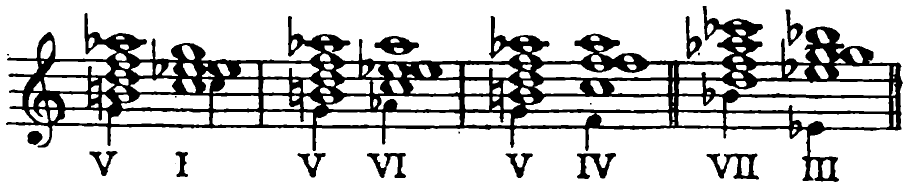
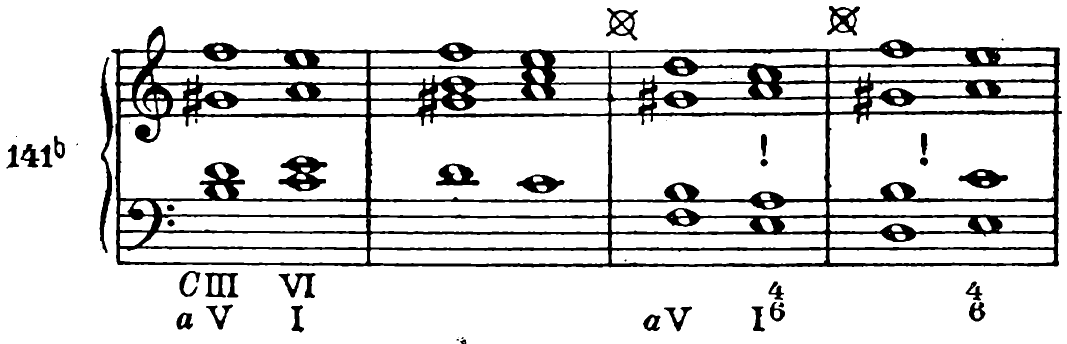
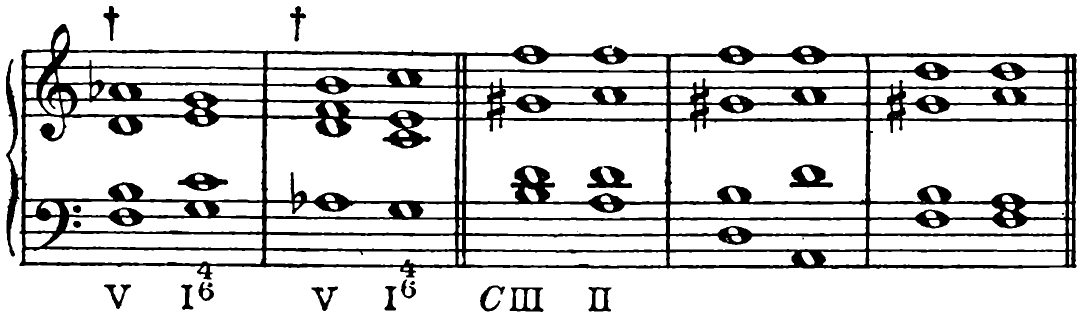
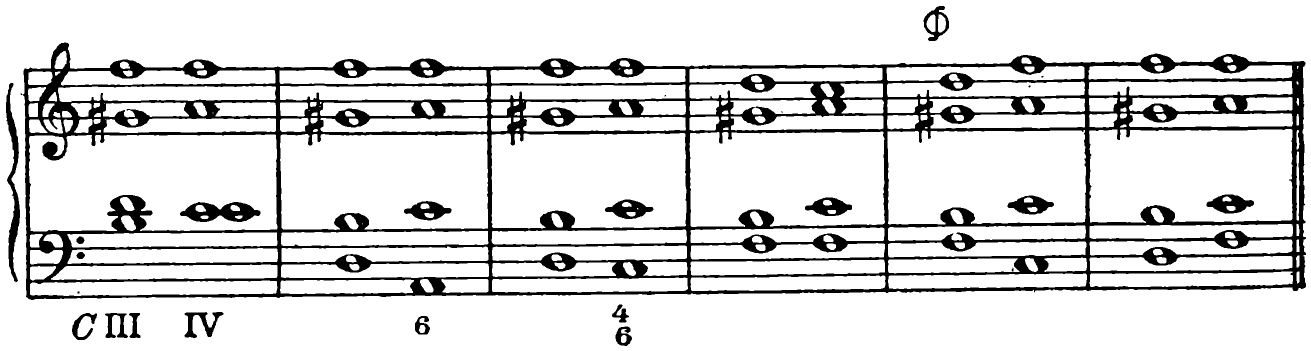
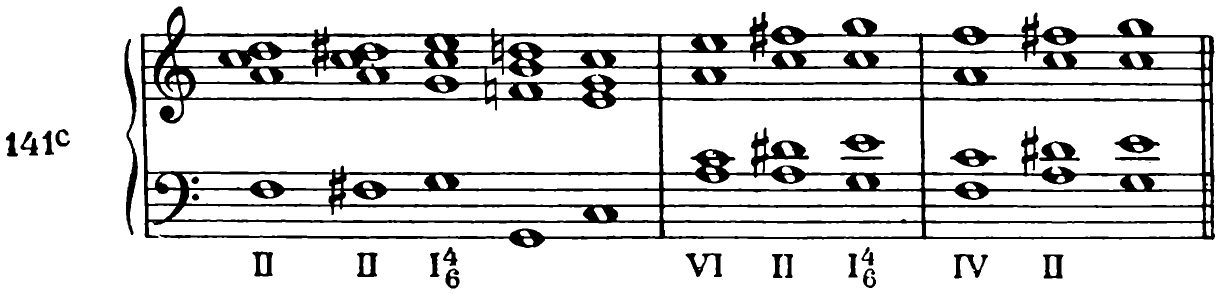
In 141b connections and deceptive cadences are also shown from inversions and into inversions. All of this works very well and will become still freer later. Only two connections should the student not make: those at ⊗ and at † respectively. The explanation for this follows later (page 291). At ⦶ the six-four chord was entered by a leap. This rests on the cliché effect already often mentioned, and will be applicable especially to the cadential six-four chord of the I degree.