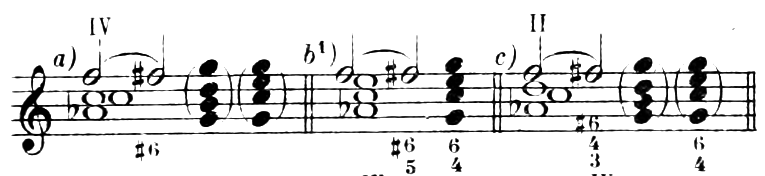
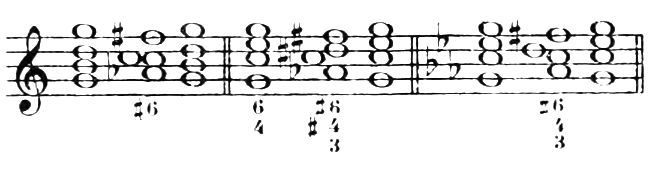
§ 82. — 1) To give a clear idea of the augmented sixth chords, we shall form them on the VIth degree of the harmonic major and minor modes, so that these altered chords, which derive from the IInd and the IVth degree of these two modes, will always have the VIth degree as their bass note.
REMARK. — They can also resolve to the sixth chord of the IIIrd degree, in major as in minor.
a) Augmented sixth chord; enharmonic with the incomplete dominant seventh chord; it can occur in major and in minor.
b¹) Doubly augmented fifth-and-sixth chord; enharmonic with the dominant seventh chord with an augmented fifth; it can occur only in major.
b²) Augmented fifth-and-sixth chord; enharmonic with the complete dominant seventh chord; it can occur only in minor.
c) Augmented third-and-fourth chord; enharmonic with the dominant seventh chord with a diminished fifth; it can occur in major and in minor.
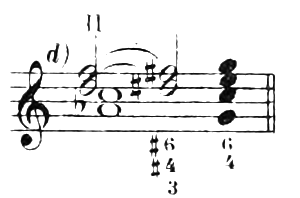
d) Doubly augmented third-and-fourth chord; enharmonic with the dominant seventh chord; it can occur only in major.
2) All the chords set out above, which, through the enharmonic equivalence of their augmented sixth, give the same sound as the dominant seventh chord, serve as a means of enharmonic modulation.
3) The names of these chords derive from the inversion of their fundamental chords.
4) The notes forming the augmented sixth must never be doubled.
5) Apart from their role as chromatic passing chords and as a means of modulation, they can also be used independently when they are prepared by the chord of resolution itself:
REMARK. — Using augmented sixth chords and augmented fifth chords as independent, non-modulating sonorities is rather poor, because the effect of these chords in exercises is vague and bombastic; the student may nevertheless use them as passing chords.
 Playable Books