Playable Books
Pyotr Ilyich Tchaikovsky · section 29 of 36
Chapter XXVII. Chords of the augmented Sixth
Read and hear this section in the playable edition →

§ 98. IV. These are nothing more than the inversions of certain chords resolving into the tonic triad, and’ having the 2-nd degree of the scale chromatically lowered.
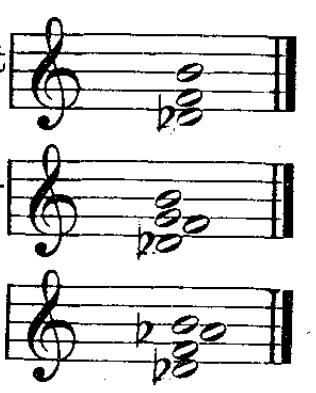
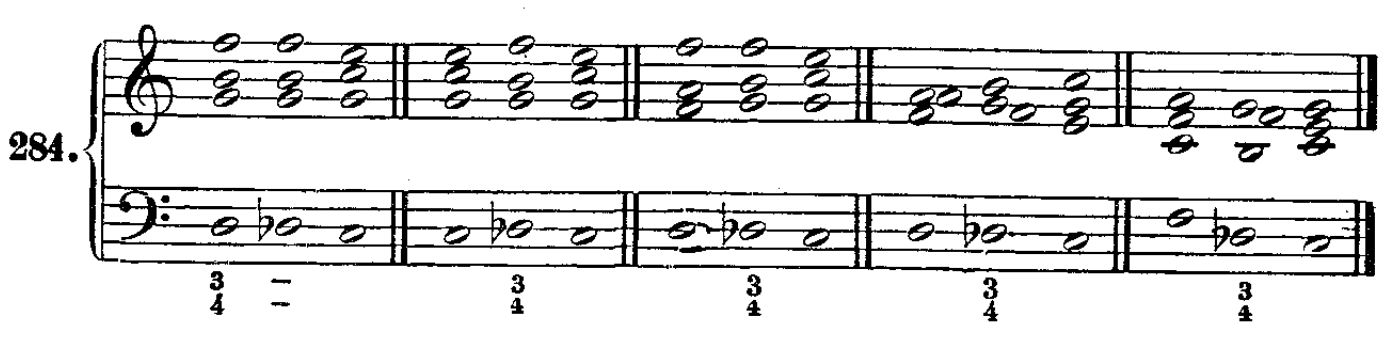
a) The augmented chord of the sixth (originally the first 5 inversion of the diminished triad).
b) The augmented chord of the fourth and third (origi-X nally the second inversion of the Dominant-seventh chord). (S35 c) The augmented chord of the sixth and fifth (originally; the first inversion of the diminished seventh chord). § 99. a) The augmented chord of the sixth resolves into the tonic triad.
It is prepared either by its original form or by the tonic triad appearing in the same position as in the resolution; the triads of the 4-th and 2-nd degrees (the latter with third doubled) can also serve.
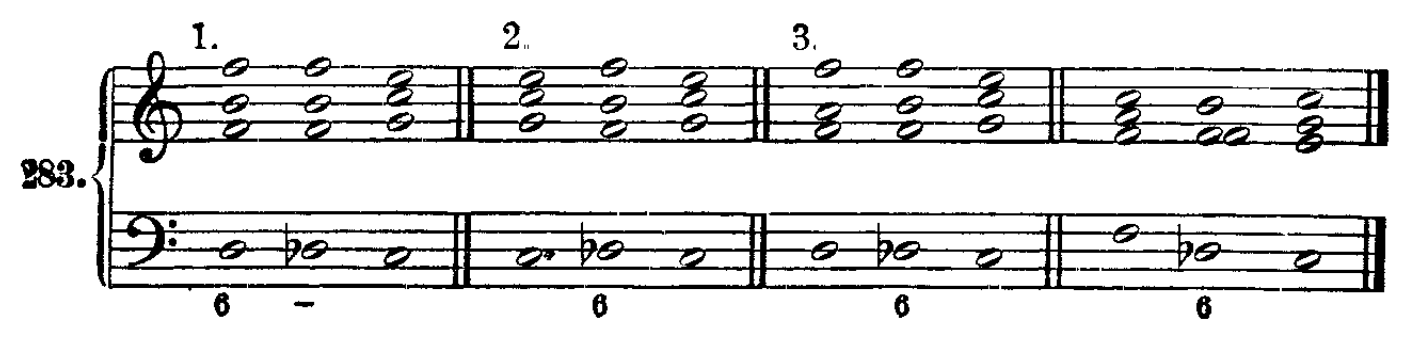
In this chord no interval except the fifth (which forms the third with the Bass) can be doubled.
§ 100. b) The augmented chord of the fourth and third is likewise resolved into the tonic triad, being prepared by the same chords, as the augmented chord of the sixth; here the fifth of the triad on the 2-nd degree may also be doubled.
§ 101. c) In the resolution of the augmented chord of the sixth and fifth into the tonic triad parallel fifths arise.
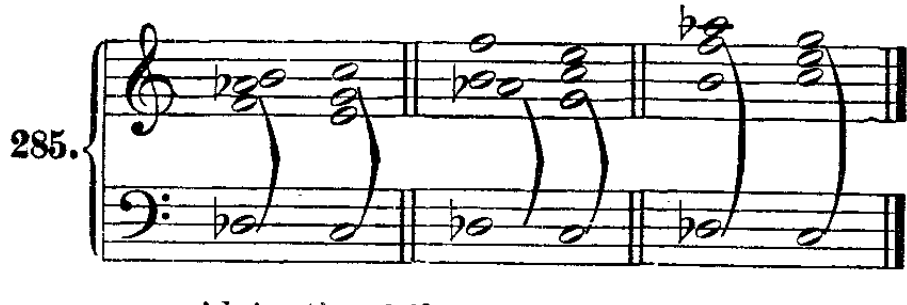
These we can avoid in the following two ways:
A) The seventh (which forms the fifth with the Bass) undergoes a preliminary resolution into the fundamental of the Dominant-Seventh chord— as was the case in certain other resolutions—giving rise to the augmented chord of the fourth and third
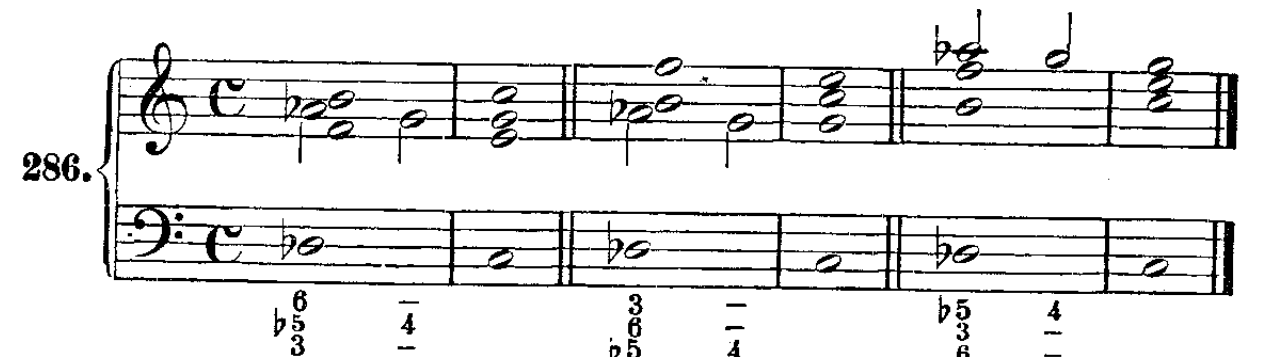
B) Two voices (the seventh and the fifth) are suspended, forming a chord of the sixth and fourth.
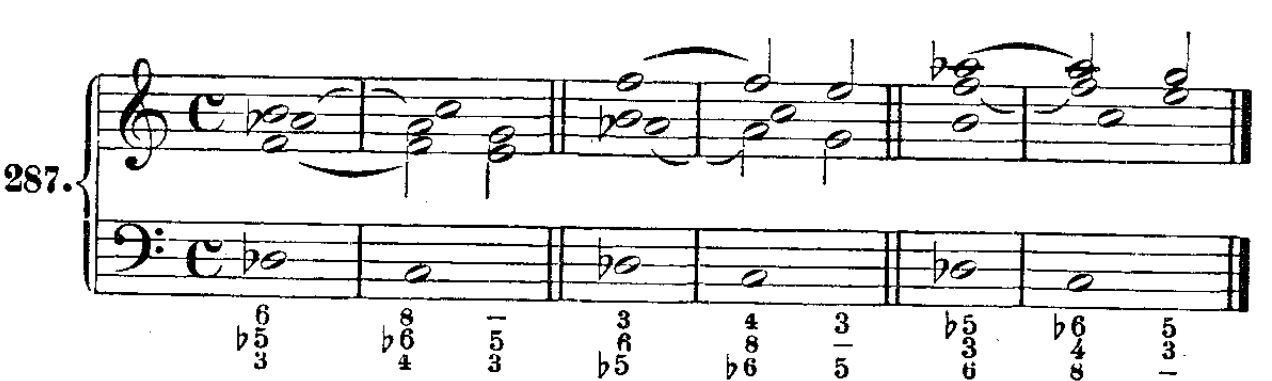
The augmented chord of the sixth and fifth is used either as passing chord or as an actual chord; in the former case it is prepared by its original form, in the latter by the sub-dominant triad *).
*) It cannot well be prepared by the triad of the 2-nd degree, as parallel fifths must necessarily occur.
§ 102. Modulations by means of the three chords just treated are permissible only, if these chords are most carefully prepared and then only, if the key to be reached is not too distant.
§ 103. These three chords nearly always resolve into major triads, since their resolution into minor (which occurs at rare intervals) does not fully satisfy the musical ear. This is probably the reason why some theorists insist upon their resolution not into the tonic but into the dominant triad and regard them as being erected not on the altered 2-nd degree, but on the altered 6-th degree, in major, and on the natural 6-th degree, in minor. According to this view we would have to consider the chords in the above examples appearing in C-major as being in F-major or F-minor, as the case demands. This would, however, be decidedly fallacious. A chord of the augmented sixth on the 6-th degree is nothing else than a modulatory degression into the key of the Dominant; this degression is indeed so unnoticeable, that without the help of a prolonged cadence we scarcely get the impression of a modulation. As soon as the resolution of this chord into the dominant triad is amplified by the insertion of a prolonged cadence, the ear feels the modulating force of the chord.
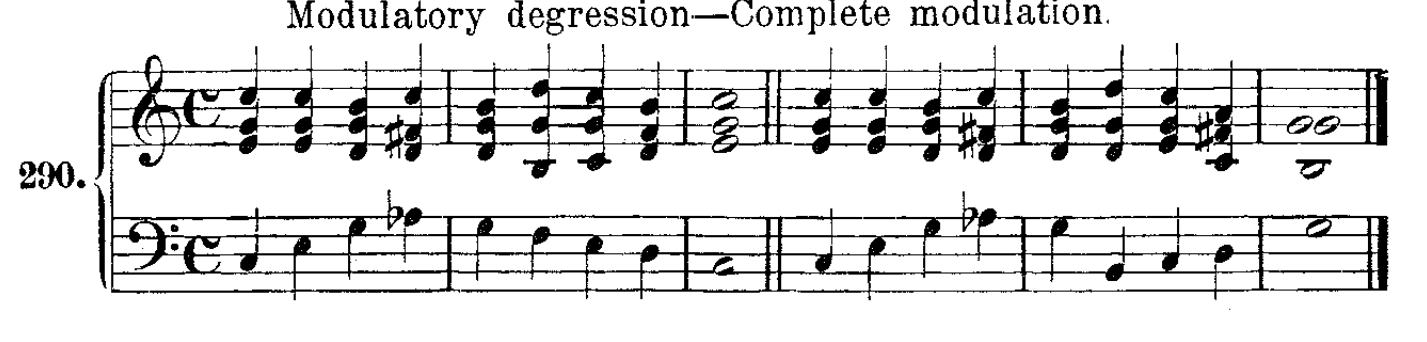
§ 104. There is still a fourth chord of the augmented sixth, which is frequently applied in cadences of the first class. This chord is found not on the 2-nd degree, but on the chromatically lowered 6-th degree; itis an augmented chord of the fourth and third with doubly augmented fourth. It is derived from the second inversion of the chord of the seventh on the 2-nd degree preceding the tonic six-four chord (vide; the cadence of the first class) — in consequence of chromatic passing notes in three voices *).
a ae chord is often confused with its enharmonic equivalent, the chord of the sixth an.
§ 105. The augmented chord of the sixth and fifth is the enharmonic equivalent of the Dominant-Seventh chord of the key lying a diminished fifth below the key in question; also of the chord treated in the last paragraph, which belongs to the key of the sub-dominant.
The following modulation from C to B presents this chord in its different enharmonic forms.
§ 106. The Dominant-Seventh chord, the chord of the diminished seventh, and the doubly augmented chord of the fourth and third on the 6-th degree can occur in still other forms; the former two, for instance, with lowered second degree. These chords occur but rarely. The leading-tone must always lie above the altered interval, so that instead of a diminished third an augmented sixth is formed; or, the intervals of the diminished third must be transplanted into different octaves forming a diminished Tenth. The same applies to the inversions of the augmented chord of the fourth and third.
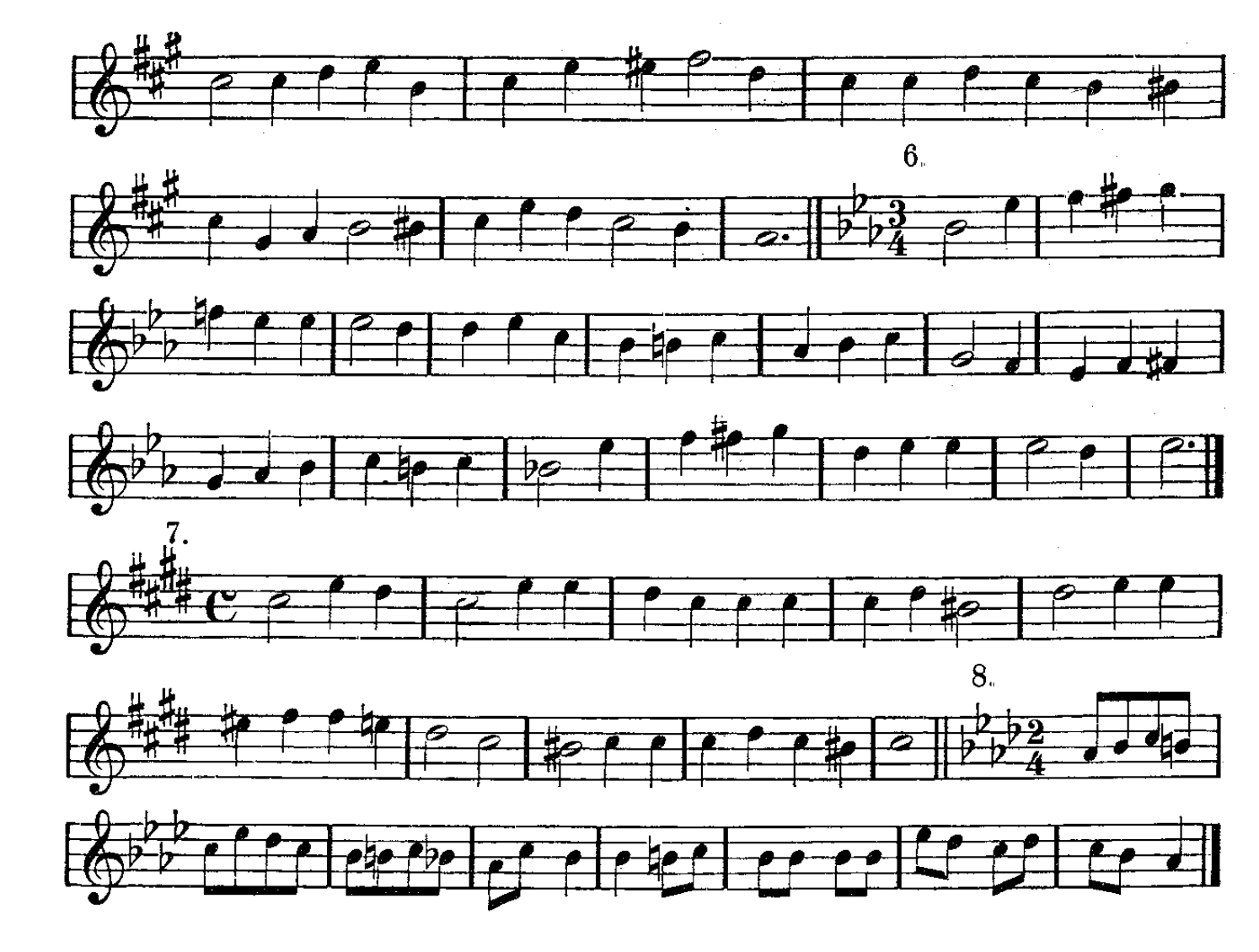
Exercise. Practise the preparation and resolution of the chords of the augmented sixth, and then proceed to the harmonization of the following Basses and melodies.