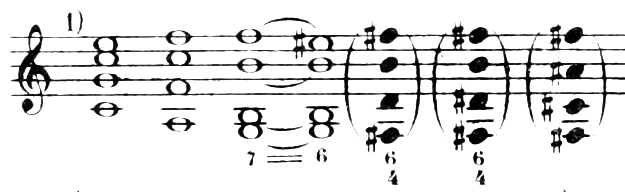
§ 84. — 1) To modulate enharmonically from one key to another — say, with C major (Do) as the starting point — one takes its dominant seventh chord, complete or incomplete (in the latter case the doubling of the third is indispensable), and regards it as the enharmonic equivalent of one of the augmented-sixth chords, whose resolution on the triad or on the six-four chord will give the modulation to the remote keys of F♯ major, B major or B minor:
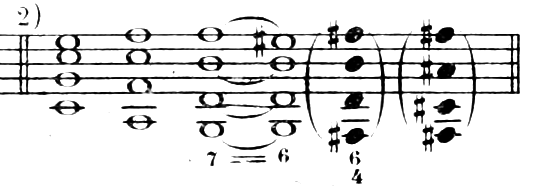
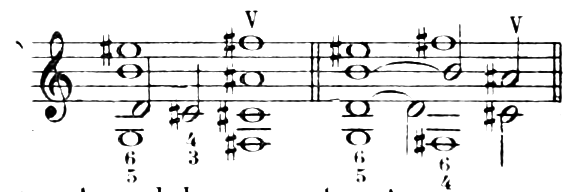
2) In resolving the augmented six-five chord on the dominant triad (ex. 2), in order to avoid parallel fifths one first transforms it into the augmented four-three chord, or else resolves it beforehand on the six-four chord:
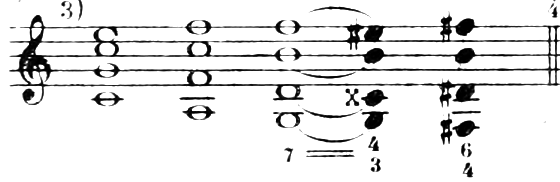
3) Through the enharmony of augmented-sixth chords one can modulate to other keys by passing first through one of the keys neighbouring the starting key, so as to obtain the dominant seventh chord of that neighbouring key; for example:
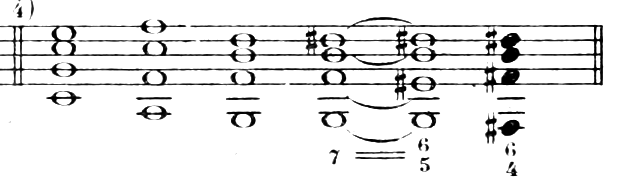
4) Augmented-sixth chords modulate to sharp keys; their use is therefore good when the number of flats is to be reduced suddenly, or the number of sharps increased suddenly:
REMARK. — The enharmony of the dominant seventh chord with the chord of the doubly augmented four-three is not shown in the example above, which is not usually done in practice; nevertheless, the resolution of the dominant seventh chord of D♭ major on the six-four chord of C major is explained by this implied enharmony.
 Playable Books



![Example: from C major (Do) through D♭ major to A♭ major (La[♭]); the dominant seventh of D♭ (A♭–G♭–C–E♭, figured 7, marked N.B.) resolves directly on the six-fo](/rimsky-harmony/images/rh-104-ex07.png)