 Playable Books
Johann Joseph Fux · section 2 of 32
First species counterpoint: note against note
Read and hear this section in the playable edition →Try it yourself: write note against note on Fux's cantus firmi, and Aloysius marks your line →



First lesson
On Note against Note
Joseph. Through your kindness, my first question has been answered. Now please explain what this first species of counterpoint, note against note, is.
Aloysius. I shall explain. It is the simplest composition for two or more voices, with notes of equal value, consisting entirely of consonances. It does not matter what kind of notes they are, provided that all have the same value. Since, however, the semibreve offers an easier way of understanding, I have thought it advisable for us to use it in these exercises. Let us therefore begin, with God’s aid, with composition for two voices, setting as the foundation a cantus firmus either devised by one’s own judgment or taken from some chant book. For example:
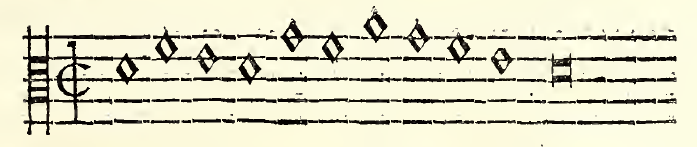
Above each of these notes, let its particular consonance be supplied in the melody, observing the principles of motion and the rules set out at the end of the preceding book. Use contrary or oblique motion for the most part, since by using them we cannot easily fall into error. Greater caution will be needed in proceeding from one note to another by similar motion; because the danger of error is greater there, greater attention must also be paid to the rules.
Joseph. From my knowledge and understanding of the rules, everything you have just said seems familiar to me. But I remember that you made a distinction: some consonances are perfect, others imperfect. It seems to me necessary to know whether some distinction must also be made in using them.
Aloysius. Be patient; I shall explain everything. There is indeed a great difference between perfect and imperfect consonances, as we shall discuss elsewhere. Here, however, apart from the manner of motion and the requirement to use more imperfect consonances than perfect ones, their use is quite equal, except at the beginning and the end, each of which must consist of a perfect consonance.
Joseph. Dear Master, please explain the reasons why more imperfect consonances than perfect ones should be placed here, and why the beginning and the end must consist of a perfect consonance.
Aloysius. Your eagerness, which I nevertheless commend, makes it almost necessary for me to explain certain things out of their proper order. I shall explain, however, though not everything, lest your understanding become confused at the outset, overwhelmed by so many different matters. Know, then, that imperfect consonances are more harmonious than perfect ones, for a reason to be given elsewhere. Consequently, if a composition in this species, for only two parts and already extremely simple, were filled with perfect consonances, it would necessarily be empty and devoid of all harmony. As for the beginning and the end, take this explanation: the beginning is a sign of perfection, and the end of repose. Since imperfect consonances both lack perfection and cannot bring the ending to a close, the beginning and the end must therefore consist of perfect consonances. Finally, note that if the cantus firmus is in the lower part, a major sixth must be given to its penultimate note; if it is in the upper part, a minor third.
Joseph. Is that everything required for this species of counterpoint?
Aloysius. Not everything, certainly, but enough to lay the foundations. The rest will become clear through correction. Set yourself to work, then, and, with the cantus firmus placed as the foundation, try to build counterpoint above it in the soprano clef, in the manner explained thus far.
Joseph. I shall do what I can.
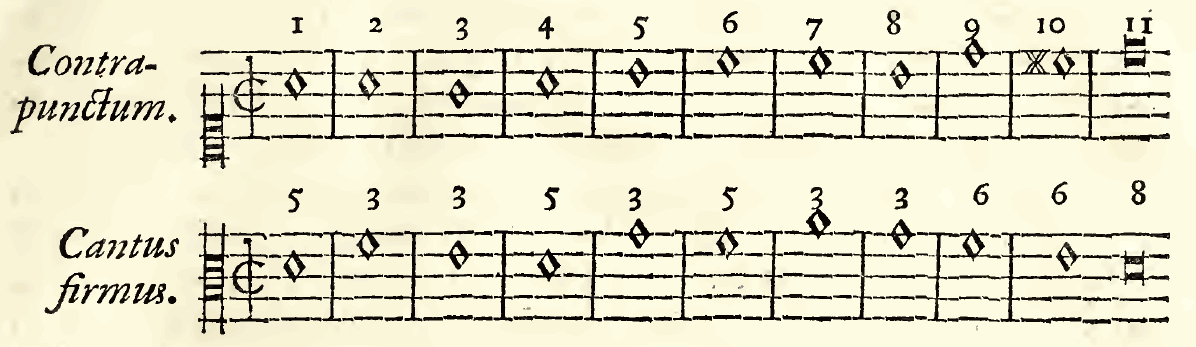
Aloysius. You have hit the mark exactly. I admire both your insight and your attentiveness. But for what purpose have you placed numbers both above the soprano and above the alto?
Joseph. With the numbers placed above the alto I wished to identify the consonances I used, so that, keeping before my eyes the motions from one consonance to another, I would stray less from the correct manner of proceeding. Those placed above the soprano—for example, 1, 2, 3, 4, 5, 6, 7, and so on—indicate only the numbering of the notes, so that I could show you, revered Master, that if I hit the mark, it happened through reason and not by chance. You instructed me to begin with a perfect consonance, which I did by placing a fifth. From the first note to the second, that is, from a fifth to a third, or from a perfect to an imperfect consonance, I proceeded by oblique motion, although it could have been done by any of the three motions. From the second note to the third, namely from a third to a third, or from an imperfect to an imperfect consonance, I used similar motion, according to the rule which says: from an imperfect to an imperfect consonance by any of the three motions. From the third note to the fourth, or from the third, an imperfect consonance, to the fifth, a perfect one, I proceeded by contrary motion, according to the rule which says: from an imperfect to a perfect consonance by contrary motion. From the fourth note to the fifth, or from a perfect to an imperfect consonance, I proceeded by similar motion, as the rule permits. From the fifth to the sixth note, that is, from an imperfect to a perfect consonance, I used contrary motion, as the rule commands. From the sixth note to the seventh I went by oblique motion, which is not liable to error. From the seventh to the eighth, or from an imperfect to an imperfect consonance, I continued by similar motion, as the rule permits. From the eighth note to the ninth, being from an imperfect to an imperfect consonance, any motion is possible. From the ninth to the tenth note the same principle of correctness applies; here the tenth note, that is, the penultimate one, forms a major sixth, as you instructed, because the cantus firmus is in the lower part. From the tenth note to the eleventh I followed the rule which prescribes that, if one wishes to proceed from an imperfect to a perfect consonance, it should be done by contrary motion. The eleventh note, being the final one, has a perfect consonance, as you instructed.
Aloysius. You have reasoned excellently in this matter. I therefore bid you hope that, if you have fixed those three motions and the four distinct rules so firmly in your memory that even a slight reflection on them keeps you from going astray, an easy path to further progress has now been laid for you. Now proceed: leaving the cantus firmus as it is in the alto, place a tenor below it as the counterpoint part, with this difference, however: just as in the preceding example you measured the consonances upward from the cantus firmus, now measure them downward from that same cantus firmus to the foundation.
Joseph. This seems harder for me to do.
Aloysius. So it appears. I recall observing this difficulty in other pupils too. But it is not so great if, as I said, you attend to the fact that the consonances must be determined by counting from the cantus firmus down to the foundation.
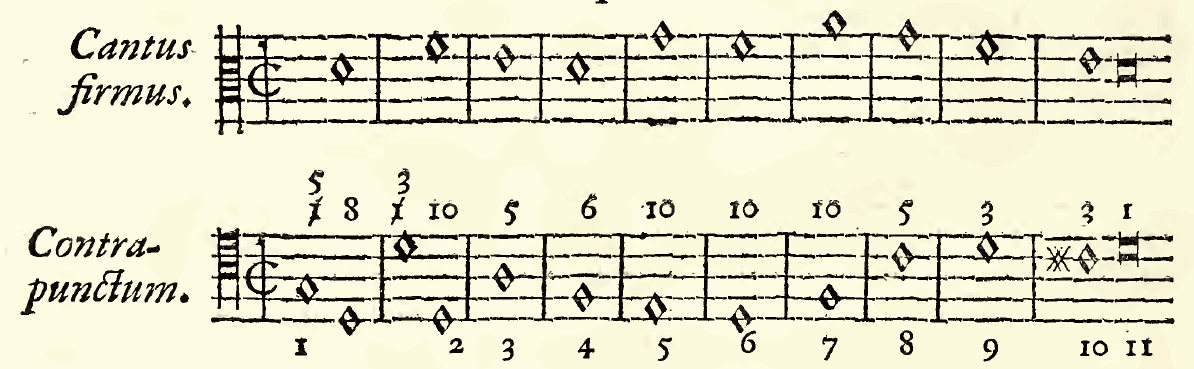
Joseph. Why, revered Master, have you marked the first and second notes with the sign of an error? Did I not begin with a fifth, a perfect consonance? From it I indeed proceeded to the second note, namely a third, by similar motion, but as permitted by the rule which says: from a perfect to an imperfect consonance by any motion. Free me at once, I beg you, from this distress of mine that weighs upon me, for I am blushing all over.
Aloysius. Put aside your distress, dear son. The first error did not occur through your fault, for you had not yet been given the precept that the counterpoint must be fitted to the same mode as the cantus firmus, which I now wish to make known to you. Since the cantus firmus of the preceding example is in D, la, sol, re, as its beginning and end show, whereas you began in G, sol, re, ut, it is clear that you made your beginning outside the mode. Therefore, in the correction I placed an octave instead of the fifth; it is in the same mode as the cantus firmus.
Joseph. I am glad that this error, which I now keep in mind, arose from my ignorance rather than my carelessness. But what is the reason for the second error marked at the second note?
Aloysius. The error is not in the second note in relation to the first, but in the second note in relation to the third: you proceeded from a third to a fifth by similar motion, contrary to the rule which says: from an imperfect to a perfect consonance by contrary motion. This error is easily corrected by having the second note remain below on D, la, sol, re by oblique motion, forming a tenth. In that case, the progression from the second note to the third, namely from a tenth to a fifth, or from an imperfect to a perfect consonance, takes place by contrary motion, as the rule prescribes. Nor do I wish you to be distressed over this small error; it is scarcely possible for a beginner to be so attentive as to fall into no error at all. Practice is the teacher of things. Meanwhile, I bid you be content that you have done the rest correctly, especially that, with the cantus firmus in the upper part, you gave the penultimate note a minor third, as I advised a little earlier.
Joseph. So that henceforth I may attend to this rule more carefully and commit it more firmly to memory, please explain why it is not permitted to go from an imperfect consonance to a perfect one by similar motion. It does not seem a matter of such importance.
Aloysius. I shall explain. Because in that case two fifths follow one another in succession, one of which is expressed, or open, while the other is covered, or hidden. I shall now show in an example how the latter becomes manifest through diminution.
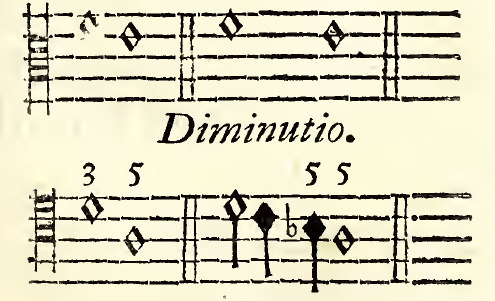
This freedom to make a diminution cannot be taken away from a skilled singer, especially one singing alone. The same must be understood of the progression from an octave to a fifth by similar motion, in which case, for the same reason, two fifths would follow one another immediately, as the following example shows.
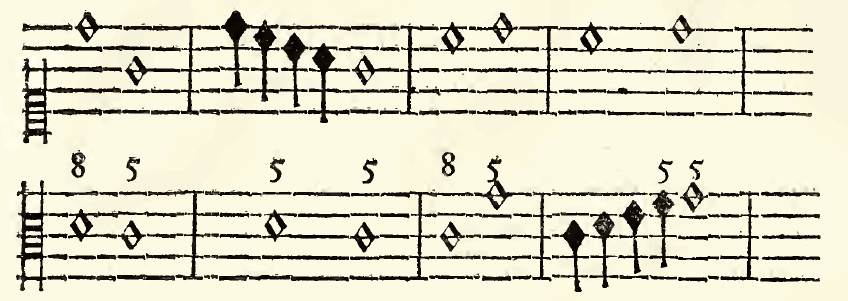
You see, then, how, by filling in the leap of a fifth through diminution, two fifths become apparent, one of which had previously been hidden in the diminution. From this it can be inferred that the lawgivers of any discipline have established nothing in vain, nothing that is not founded on reason.
Joseph. I see, and I marvel.
Aloysius. Now proceed, and, working through the same lesson, go through all the modes contained within this octave, following step by step in their natural order. You began on D; next come E, F, G, A, C.
Joseph. Why did you omit B, which lies between A and C?
Aloysius. Because it does not have the consonance of a fifth, and therefore cannot constitute a mode, as we shall explain more fully in its proper place. Let us look at an example.
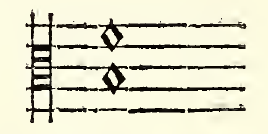
Since it consists of only two whole tones and as many semitones, this is a false and dissonant fifth; whereas a true, or consonant, fifth must consist of three whole tones and a semitone, as was stated in Book One.
Joseph. Can this false fifth not be made into a consonant fifth by adding either a flat to the lower note or a sharp to the upper one, as in this example?

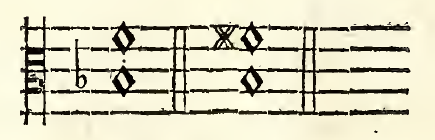
Aloysius. It can, but in this case, since this fifth lies outside the diatonic genus, it would no longer be a natural mode—the only modes to be treated now—but a transposed mode; these will be discussed in their proper place.
Joseph. Is there some difference between these modes?
Aloysius. A very great difference indeed. For the varying position of the semitones in each octave also gives rise to a different manner of melodic composition, but that does not concern you now. Come, then, resume your exercise and construct counterpoint above the cantus firmus which I am now about to prescribe for you on E.
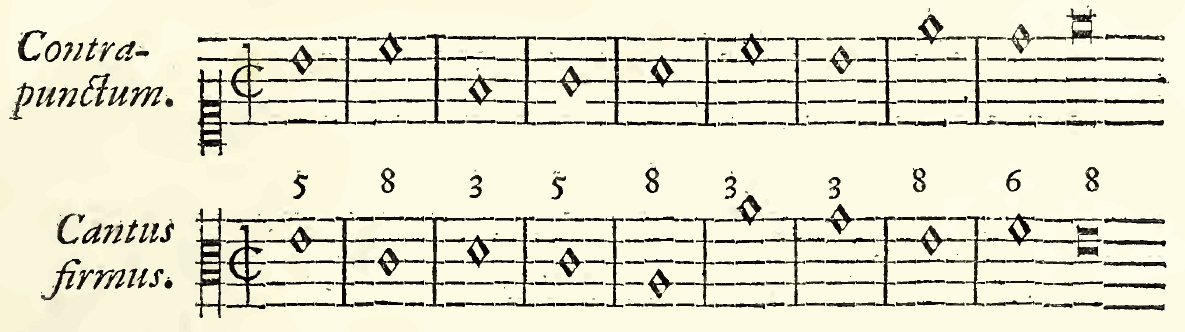
You have done it exactly right. Now, with the cantus firmus placed in the upper part, compose the counterpoint below in the tenor.
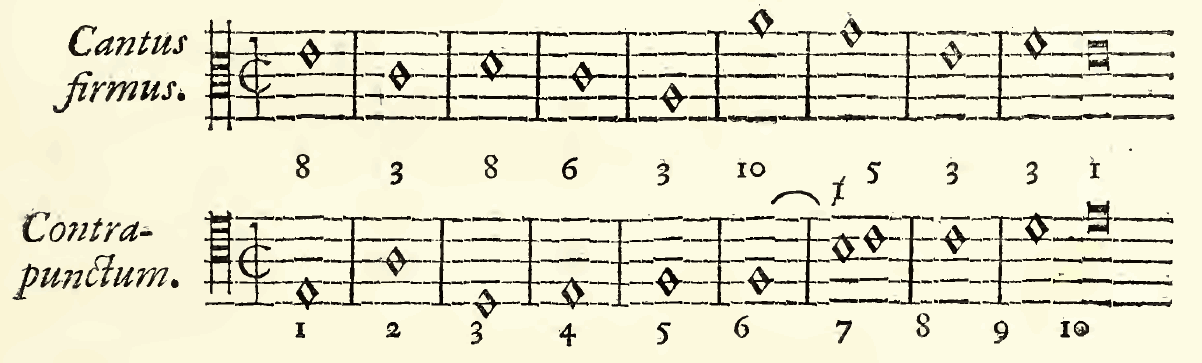
Joseph. Have I fallen into error again, then? If this happens to me in a two-voice composition, and in the simplest species, what will happen in compositions for three voices, four voices, and still more voices? Please tell me what kind of error is indicated by the little line drawn from the sixth to the seventh note, with a cross placed above it.
Aloysius. Do not take badly an error which you could not avoid because you had not yet been warned about it; nor should you torment yourself in advance with fear of composition for more voices, for practice will gradually make you much more circumspect and fluent. I do not doubt that you have often heard that familiar saying: “mi against fa is the devil in music.” This is what you did by proceeding from the sixth note, fa, to the seventh, mi, by the leap of a major fourth, or tritone, an interval difficult to sing and unpleasant to hear, which must never be used in counterpoint. Be of good cheer, and proceed from the mode on E to the mode on F.
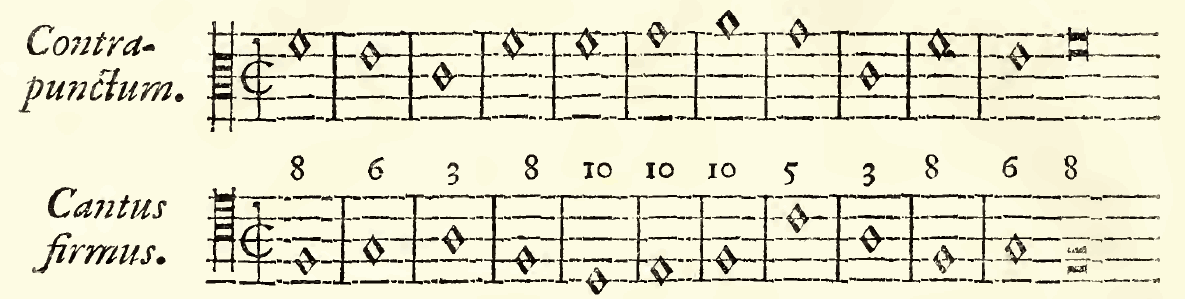
Good, from beginning to end.
Joseph. This time you have prescribed the cantus firmus for me in the tenor. Does that make any difference?
Aloysius. Nothing else, indeed, except that the different clefs should become ever more familiar to you. Here, however, note that neighboring clefs should always be joined, so that simple consonances may more easily be distinguished from compound ones. Now place a bass below the cantus firmus, and form the counterpoint in it.
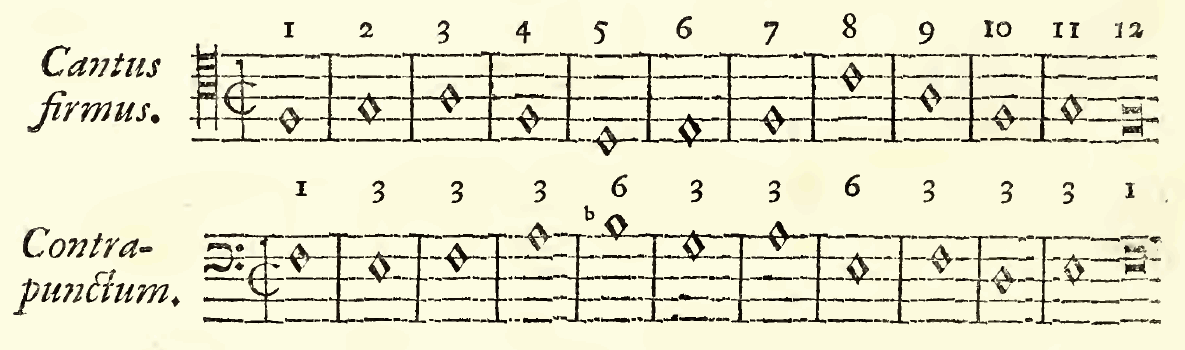
Good, indeed; but why did you cross above the cantus firmus with the counterpoint from the fourth note through the seventh, inclusive?
Joseph. Because otherwise I would have had to proceed continually by similar motion up to that point, with a less graceful melodic line.
Aloysius. You did this with excellent attention to the rules, especially in treating the cantus firmus in this case as the lower part and foundation, and measuring the consonances above it. Let us proceed to the mode on G.
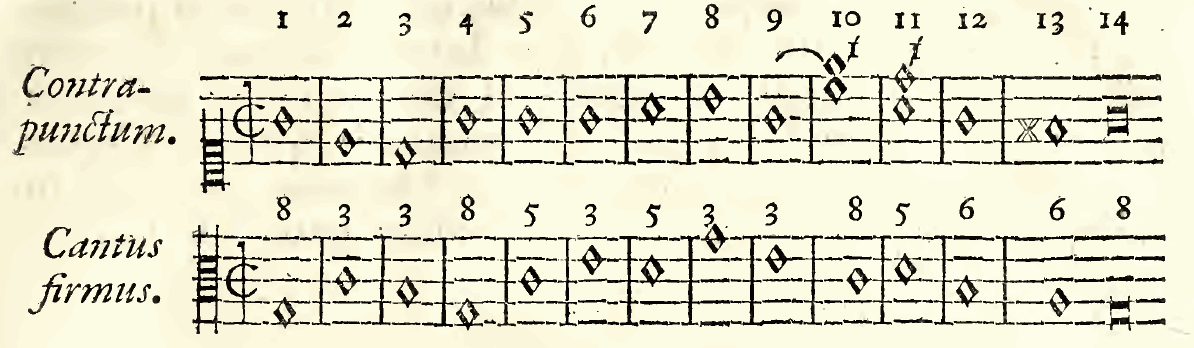
Joseph. I completed this counterpoint with the greatest care I could, yet once again I see two signs indicating errors: from the ninth note to the tenth, and from the tenth to the eleventh.
Aloysius. You seem impatient to me; nevertheless, I am greatly pleased by your eagerness not to depart from the rules. But how do you expect to avoid those small matters about which you have not yet received a precept? From the ninth note to the tenth you used the leap of a major sixth, which is forbidden in counterpoint, a kind of composition in which everything must be very easy to sing. Then, from the tenth note to the eleventh, you proceeded from a tenth to an octave with the parts converging—that is, with the lower part ascending and the upper part descending by step. This octave, called an Octava Battuta by the Italians and Thesis by the Greeks, is forbidden because it falls at the beginning of the beat. Yet, having investigated this matter long and thoroughly, I have been unable to discover either the reason for the fault or the distinction explaining why the octave of this
example should be approved,
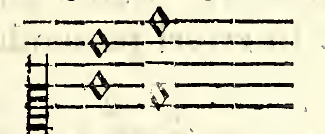
while that of the following should be rejected:
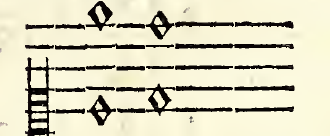
since the octave in both examples is reached by contrary motion. A different view must be taken of a unison produced in the same way,
namely from a third to a unison, for example:
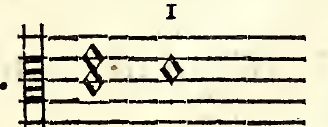
in which case the unison, consisting as it does in a ratio of equality, is heard very little, and seems almost swallowed up and lost. For this reason, in this species of counterpoint, except at the beginning and the end, it must never be used.
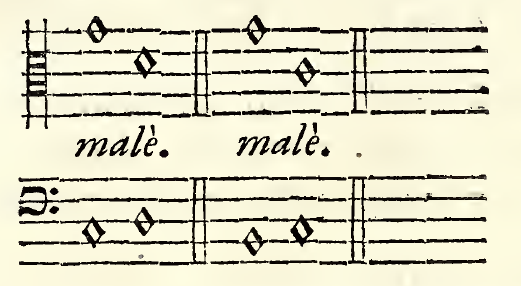
To return, however, to the octave mentioned above, which is called battuta, I leave you free either to avoid it or to use it, for it matters little. But if the parts converge by a leap from some more distant consonance into an octave, I think this should not be tolerated even in composition for several voices. For example:
I wish this to be understood with still greater force of the unison as well. For example:
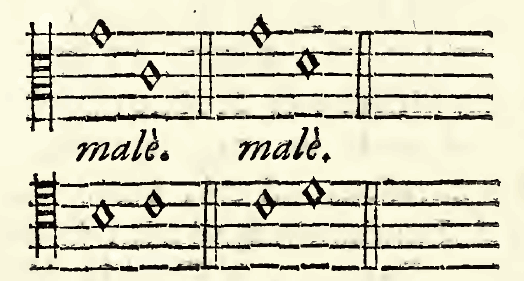
In composition for eight voices, similar leaps will scarcely be avoidable, especially in the basses and in the parts that take their place, as will be explained in its proper place. It still remains to place the counterpoint of the last example in the lower part.
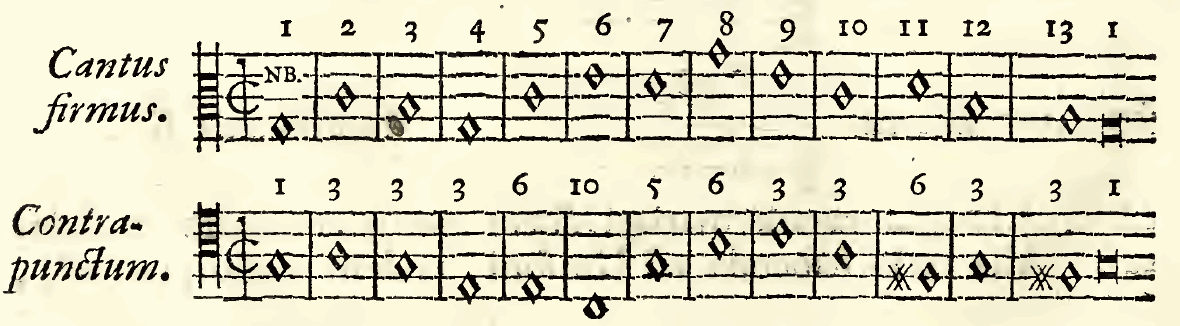
Joseph. What does the NB placed at the first note of the counterpoint mean?
Aloysius. It indicates that otherwise a leap from a unison to another consonance is bad, as is a leap into a unison in the same way, as was said a little earlier. But since that leap occurs in the cantus firmus, which cannot be altered, it must therefore be tolerated here. It would be a different matter if you were bound by no obligation to a chant melody and were free to do as you wished. But why did you put a sharp on the eleventh note, seeing that it is not very usual to use one in the diatonic genus?
Joseph. I thought it appropriate to place a sixth there. When I was learning the art of singing, I heard that fa tends downward, whereas mi tends upward. Since the progression from that sixth to the third takes place by ascent, I therefore added a sharp to make that ascent more firmly established. Moreover, the F of the eleventh note, if placed without a sharp, would create a somewhat adverse relation with the F of the thirteenth note with its added sharp.
Aloysius. You have made an excellent observation. I now think that every stumbling block has been removed. Proceed, then, to the two remaining modes, A and C.
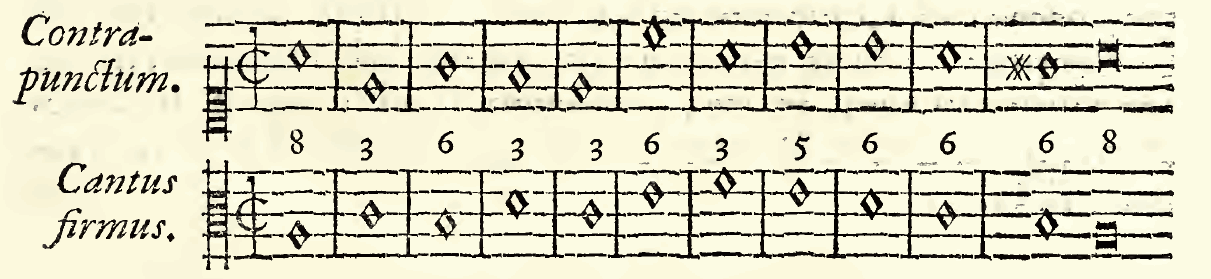
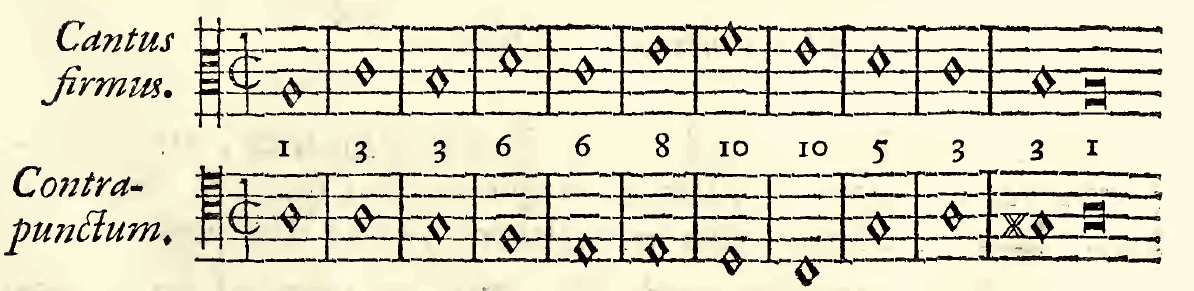
From the last two examples it is apparent that you now know everything necessary to know for this species. We must now pursue the second species.