 Playable Books
Johann Joseph Fux · section 3 of 32
Second species counterpoint: two notes against one
Read and hear this section in the playable edition →Try it yourself: write two minims against each note, and Aloysius marks your line →
 Theory of HarmonyArnold Schoenberg · passing notes
 Practical Manual of HarmonyNikolai Rimsky-Korsakov · passing notes
 Treatise on HarmonyJean-Philippe Rameau · passing notes
 Guide to the Practical Study of HarmonyPyotr Ilyich Tchaikovsky · passing notes
 Exercises in Elementary CounterpointPercy Goetschius · two notes against one
Second lesson
Or the second species of counterpoint
Before I undertake to explain this second species of counterpoint, it must first be understood that we are at present working in duple time, whose beat or measure consists of two equal parts: one in the lowering of the hand, the other in its raising. The lowering of the hand is called Thesis in Greek, and its raising Arshis; for greater convenience I have decided to use these two words henceforth in this exercise. This second species is made by placing two minims against one semibreve. One of them, falling on the thesis, must always be consonant; the other, on the arsis, may also be dissonant if it moves by step from the preceding note to the following one. But if it proceeds by leap, it must necessarily be consonant. In this species of counterpoint a dissonance can occur only through diminution, that is, by filling the intervening space between two notes a third apart. For example:
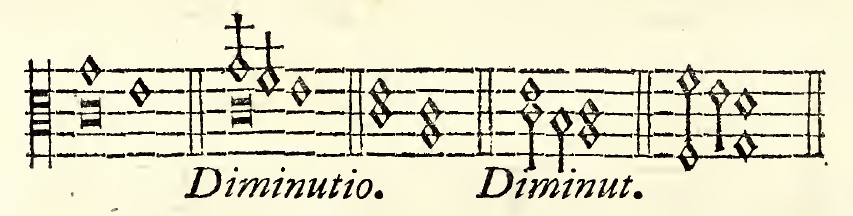
Nor need one consider whether that inserted note of diminution is consonant or dissonant; it is enough that it fills the empty space left between the two notes a third apart.
Joseph. Must the precepts about motion and progressions given for the first species of counterpoint also be observed here?
Aloysius. Most certainly, except for the penultimate measure. In this species its first note must have a fifth and its second a major sixth if the cantus firmus, or chant melody, is in the lower part. But if the cantus firmus is in the upper part, the first note of the penultimate measure should have a fifth, and the second a minor third. An example will make the matter clear.
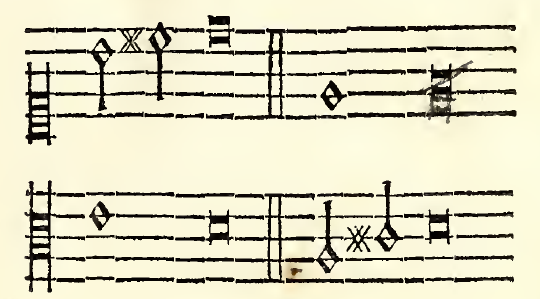
For greater ease, it will help to consider the ending before you begin to write. Now let us proceed to the work step by step, using the cantus firmi given above.
Joseph. I shall do so. But I beg your patience if I should happen to fall into errors, for my understanding of this matter is still very confused.
Aloysius. Do as well as you can; I shall take nothing amiss. Correction will easily dispel the darkness of uncertainty.
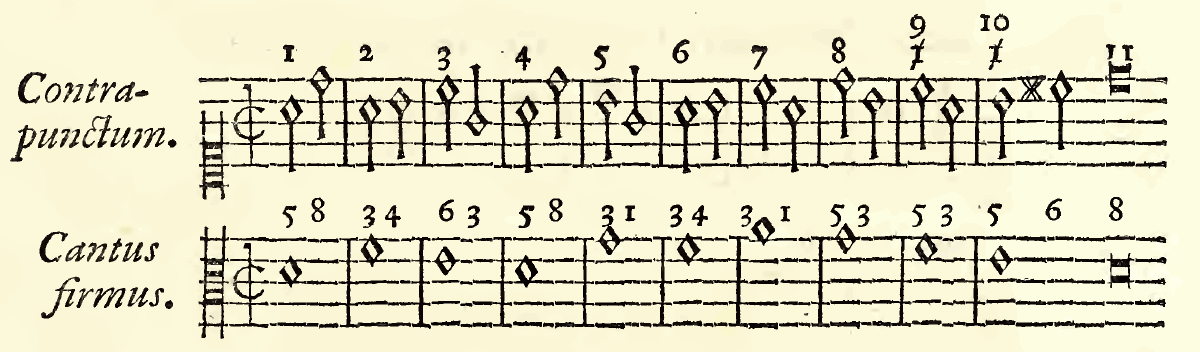
Joseph. My fear of error was not groundless, for I see two marks of censure: the first on the first note of the ninth measure, the second on the first note of the tenth measure. I understand neither, for in both places I proceeded from an imperfect to an imperfect consonance by contrary motion.
Aloysius. You reason correctly, for there are two errors with one and the same explanation. I am not surprised that you do not know it, since you have not yet been taught it. Note, then, that a leap of a third cannot make either two fifths or two octaves permissible, because the intervening note on the arsis is treated almost as though it had not been added. Owing to its short value and the smallness of the interval, it cannot modify the sound enough to prevent the relation of two fifths or octaves from being perceived by the ear. Let us examine the preceding examples, beginning at the eighth measure.
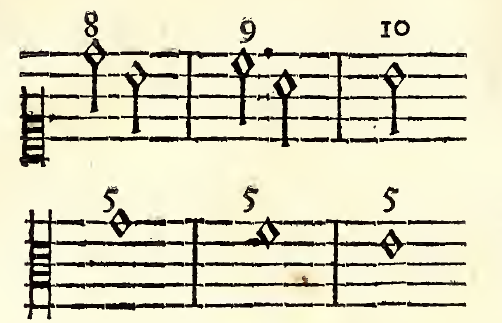
For if that intervening note, or the note on the arsis, is treated as not having been added, it is clear that those cases plainly take the following form.
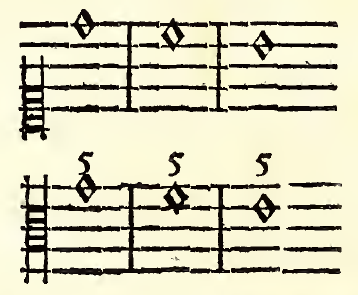
The same judgment must be made concerning octaves.
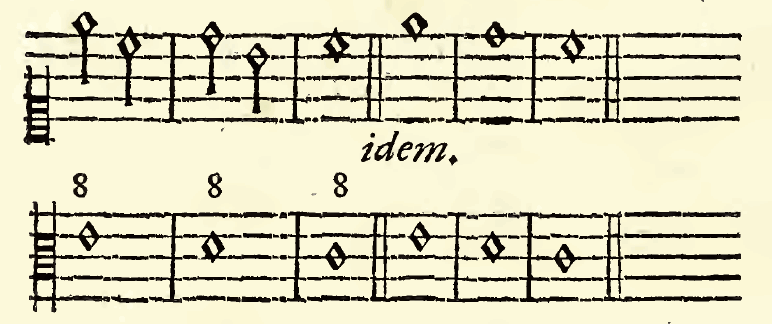
A different view must be taken of a leap spanning a larger interval—for example, a fourth, fifth, or sixth. In this case the distance from the first note to the second seems to make the ear forget, as it were, the sound of the first note on the thesis in relation to the second note likewise on the thesis. Let us examine the preceding example of octaves, whose succession is made permissible by the intervening leap of a fourth.
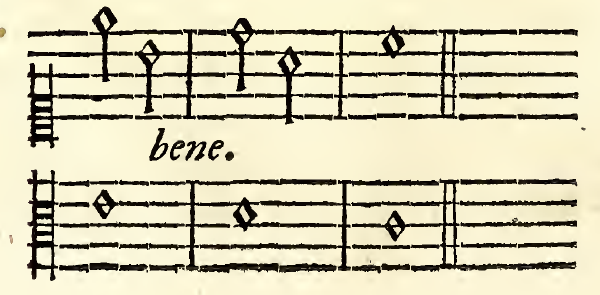
For the same reason, that leap of a fourth is why I did not mark the progression from the third measure to the fourth in your preceding exercise as an error; for if the intervening note were disregarded, the case would take this form.
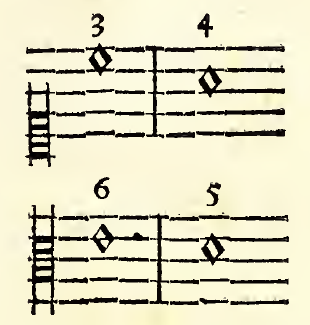
This progression is contrary to the rule which says: from an imperfect to a perfect consonance by contrary motion. The leap of a fourth removes this error in the following way:
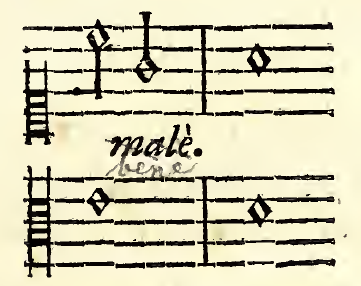
Let your preceding exercise now be corrected.
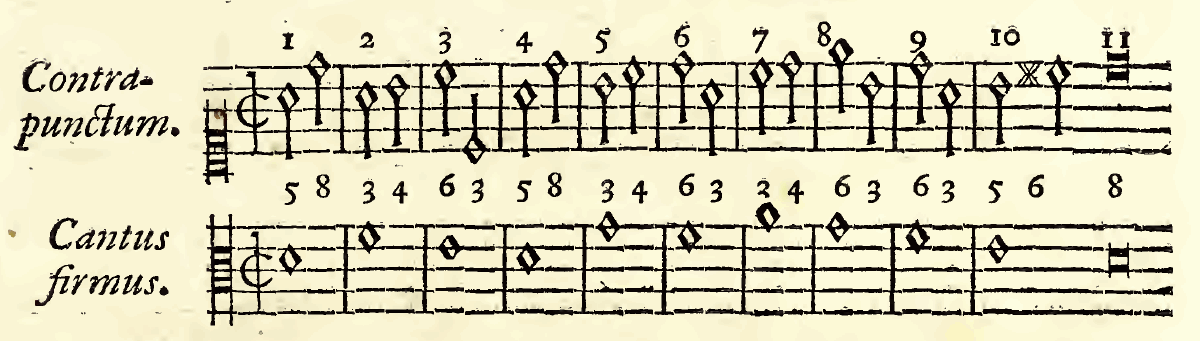
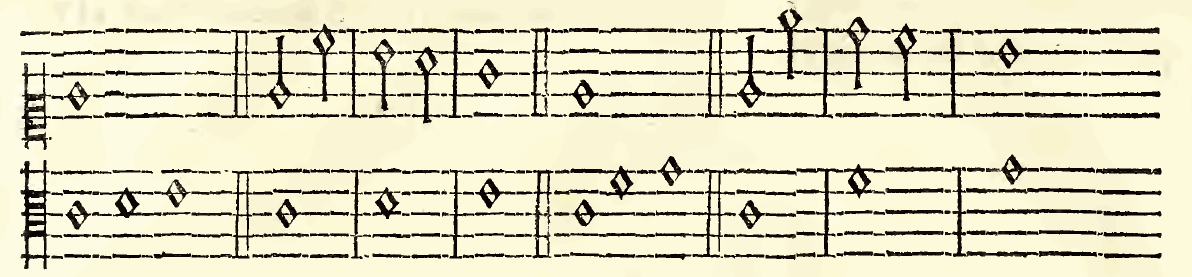
I now see that you retain well enough what has been said thus far. Before you undertake this same exercise with the counterpoint in the lower part, however, I shall set before you certain observations that will make the task easier and are very useful to know. The first is that a rest of half a measure may be placed instead of the first note. The second is that if the two parts happen to be so close and so tightly joined that one scarcely knows where to go, and you have no opportunity by contrary motion to proceed, this can be achieved by the leap of a minor sixth—which is permitted—or of an octave, as in the following examples:
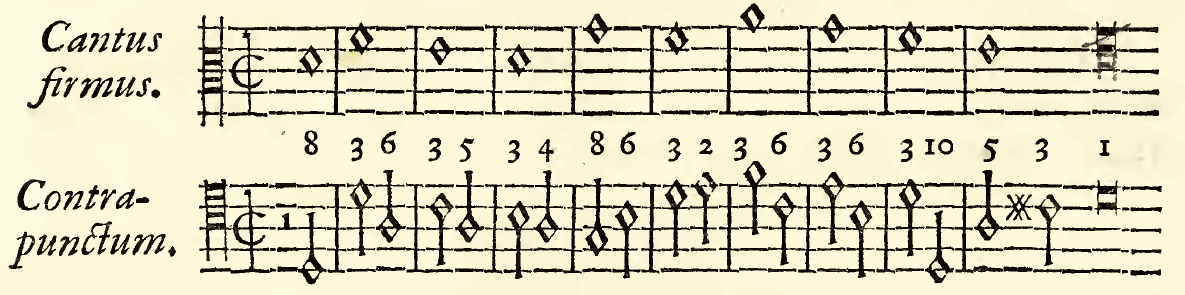
Now proceed and construct the counterpoint of the preceding exercise in the lower part.
Now take up again all the cantus firmi prescribed in the first species of counterpoint, and go through the remaining five modes, constructing the counterpoint both above and below.
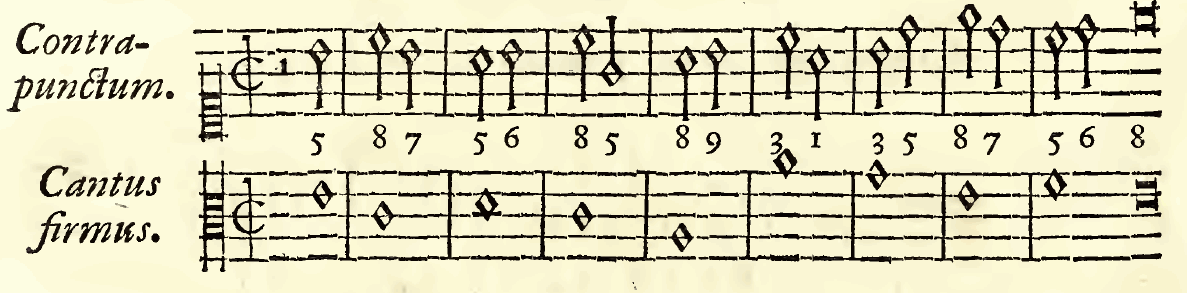
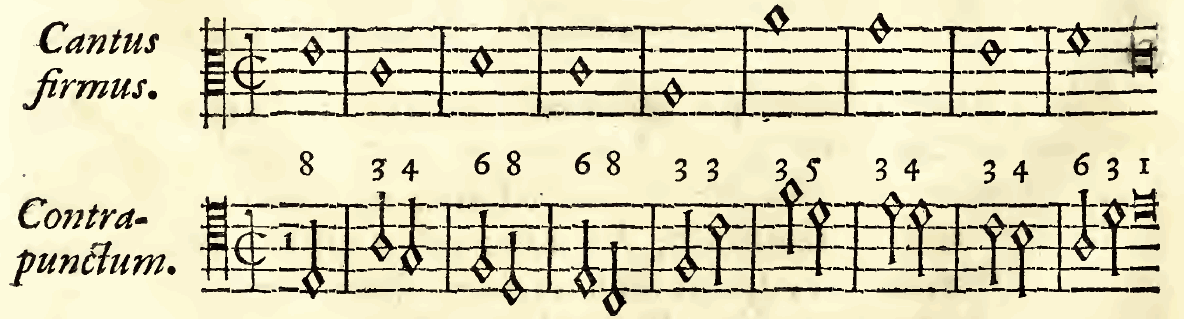
Joseph. I remember that you instructed me a little earlier that, when the counterpoint in this species is in the lower part, the first note of the penultimate measure must be given a fifth. But it is clear that in this instance of this mode there is no place for the fifth, since it is dissonant, on account of mi against fa. I therefore judged that a sixth should be used instead of the fifth.
Aloysius. I am extremely pleased by this observation of yours. Proceed now, and pursue the remaining four modes with the same exercise.
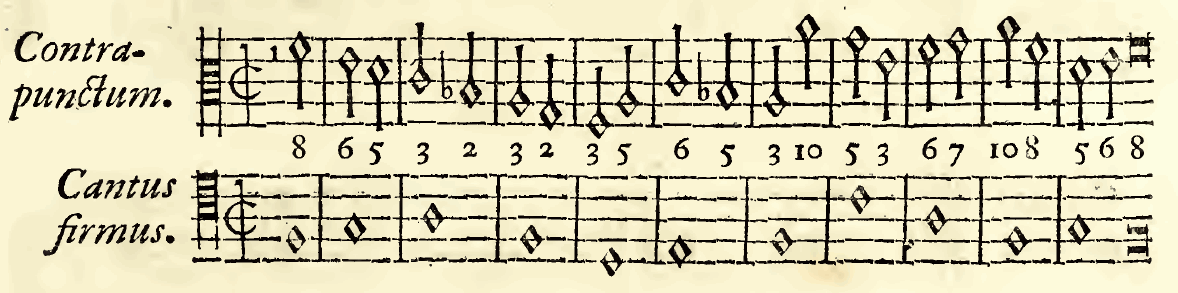
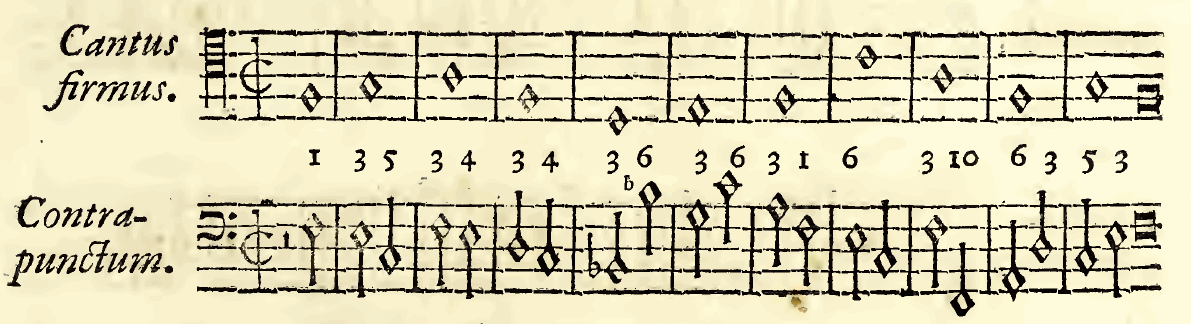
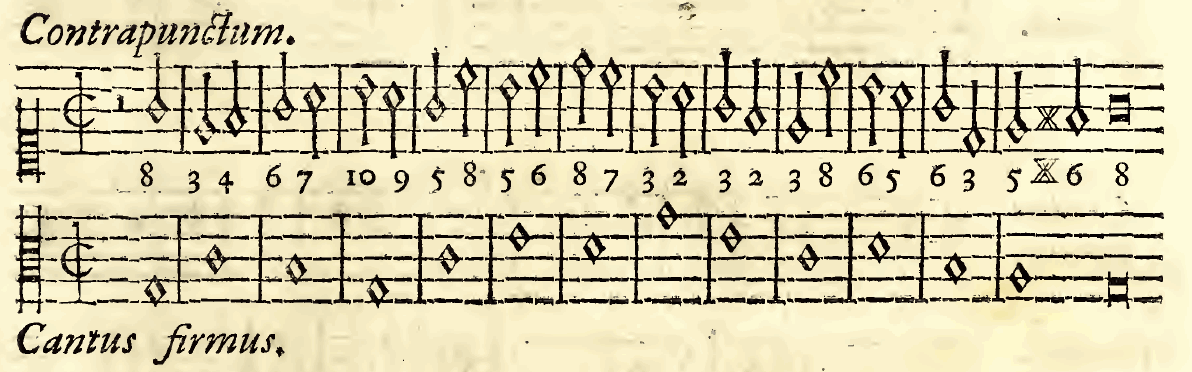
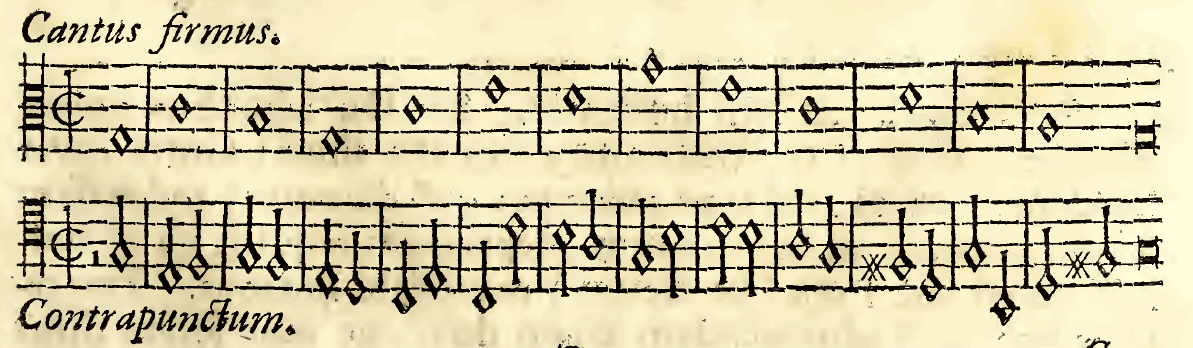
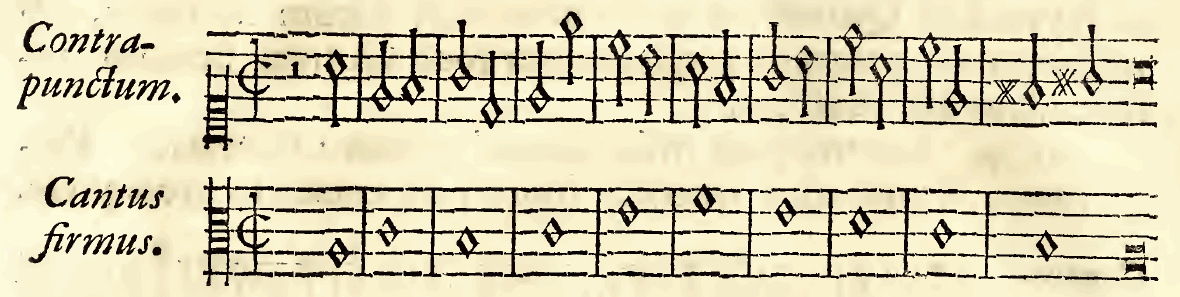
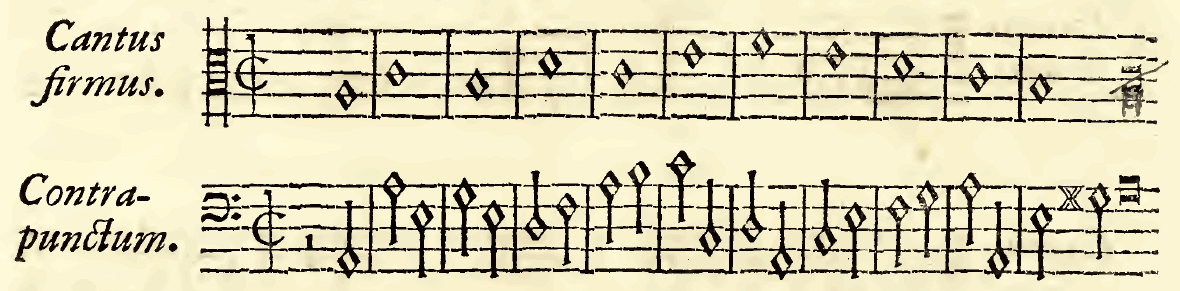
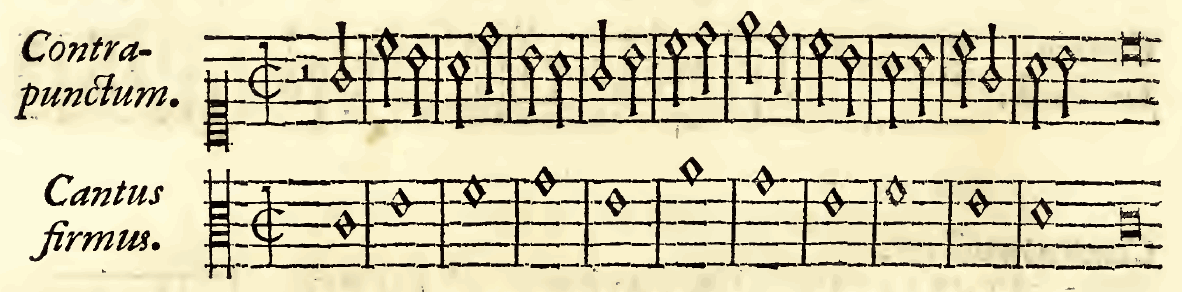
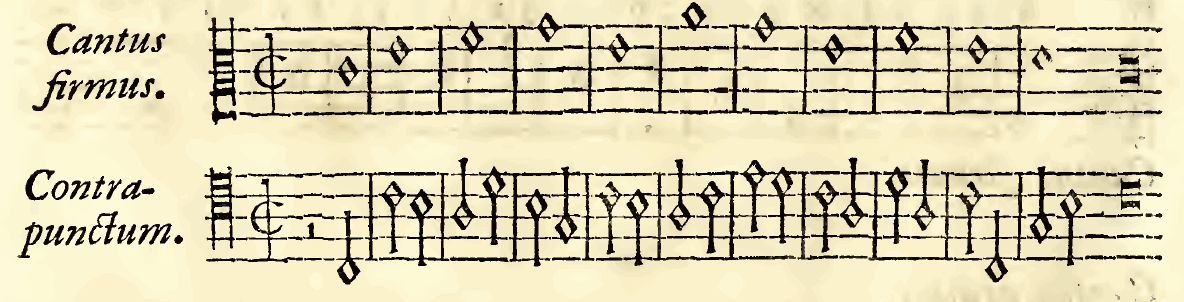
You have managed the task quite well. Thus the gods sell everything for toil. You should also remember the saying: “A drop hollows a stone, not by force, but by falling often.” By this we are taught that tireless work in study is required to acquire knowledge, so that we should let no day pass without a line, as the saying goes. Furthermore, I thought it right to advise you here to take account not only of that measure on which you are working, but also of those that follow.
Joseph. Indeed it is so, revered Master. For in composing the preceding counterpoint exercises I should scarcely have known what to do unless, before deciding to write, I had looked ahead one or two measures and considered what would fit there.
Aloysius. I am wonderfully glad to see you so perceptive, and I urge you again and again to strive, with the care and perseverance you have begun to show, to overcome the weight of the difficulty. Do not allow yourself either to be overwhelmed by the harshness of the burden or to be drawn away from diligent study by flattering thoughts that you already know much. By doing this you will gradually perceive, with joy, a light arising in the darkness and the veil of obscurity being partly lifted for you. Here we should also speak of triple time, in which three notes are placed against one. But because the matter is easy and therefore of little difficulty, I do not think it worthwhile to establish a separate lesson for it. It will soon be evident that a few examples suffice for understanding it.
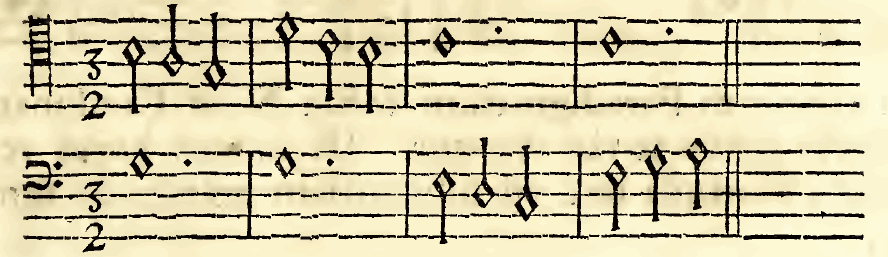
Here the middle note may be dissonant because all three move by step. It would be otherwise if one or another of these three leapt, in which case it is clear from what has already been said that all three must be consonant.