 Playable Books
Pyotr Ilyich Tchaikovsky · section 28 of 36
Chapter XXVI. Chords of the augmented Fifth
Read and hear this section in the playable edition →

§ 90. In consequence of the frequent recurrence of chromatic passing notes in certain cases, several such combinations of passing notes and harmonic notes have become steriotyped, and are looked upon as actual chords.
The following chords can be regarded as combinations of this sort.
I. The augmented triad.
Il. The Dominant-Seventh chord with augmented fifth.
Ili, The chord of the seventh with the augmented fifth and major seventh. IV. The chords of the augmented sixth.
In this chapter we shall discuss only the first three.
§ 91. I. The augmented triad is derived from the major triad by raising the fifth of the latter a half-tone. In major we can consequently have three such chords:
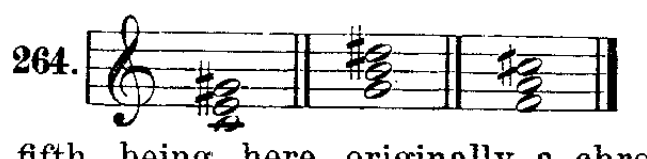
ray a 264. Ye +f $e—{. BEY oe ee The augmented fifth, being here originally a chromatic passing note, must in the resolution of the chord progress half a tone upwards; accordingly the augmented triad on the tonic can resolve only into the triads of _ the 4-th, 2-nd and 6-th degrees.
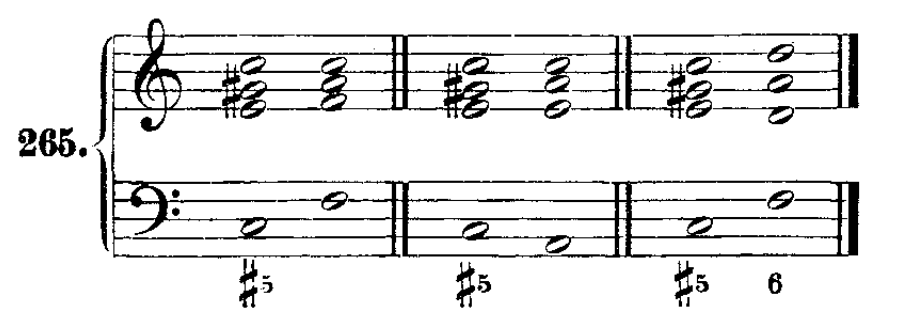
The augmented triad on the Dominant must be resolved into the triads of the tonic, the third or the 6-th degree.
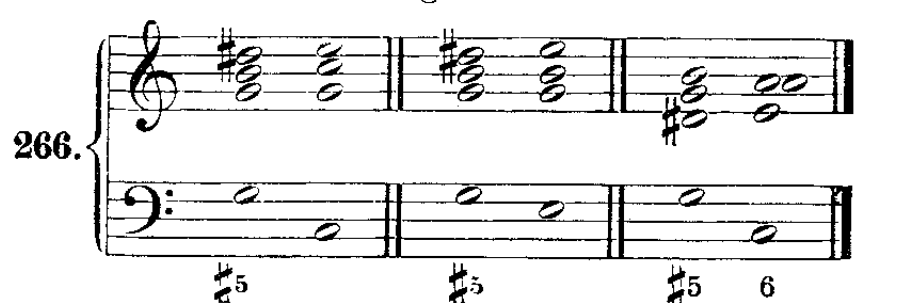
The augmented triad on the sub-dominant resolves into the triads of the 2-nd and 5-th degrees, and very rarely into that of the 7-th degree. val
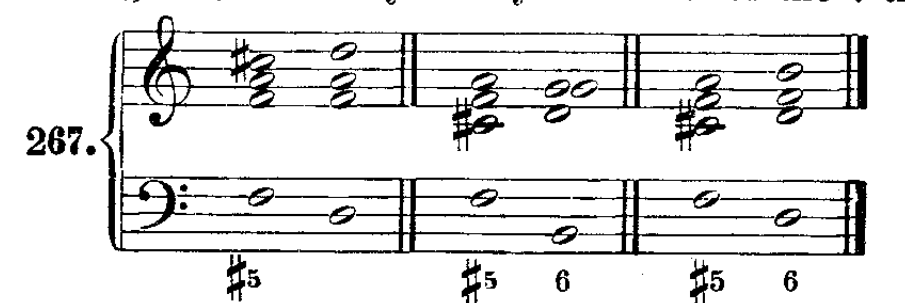
It can, however, also resolve into the first and third inversions of the Dominant-Seventh chord, besides certain forms of the chord of the minor
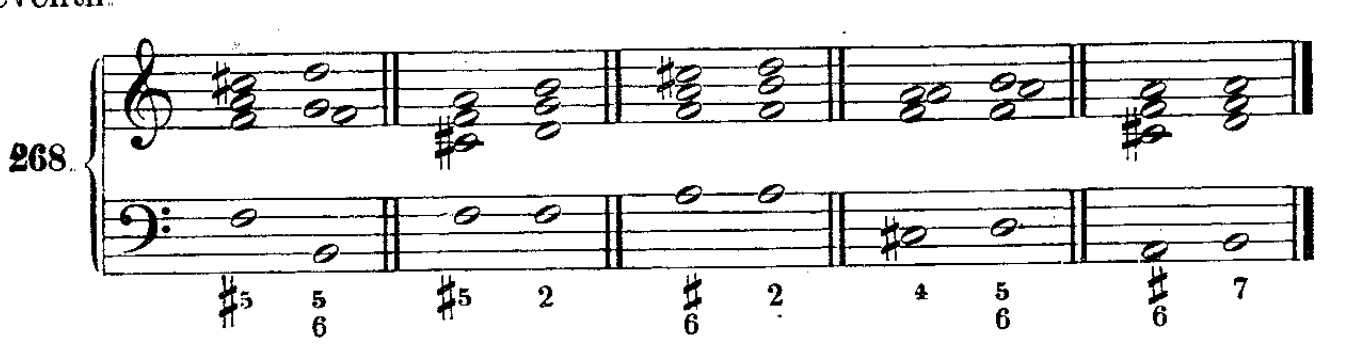
It goes without saying, that the fifth of the augmented triad can never be doubled. In most cases this triad is regarded as the Dominant of the following triad; accordingly the augmented triad on the tonic is usually found before the sub-dominant, that of the dominant before the tonic; the augmented triad on the sub-dominant modulates into the key lying a whole tone below it.
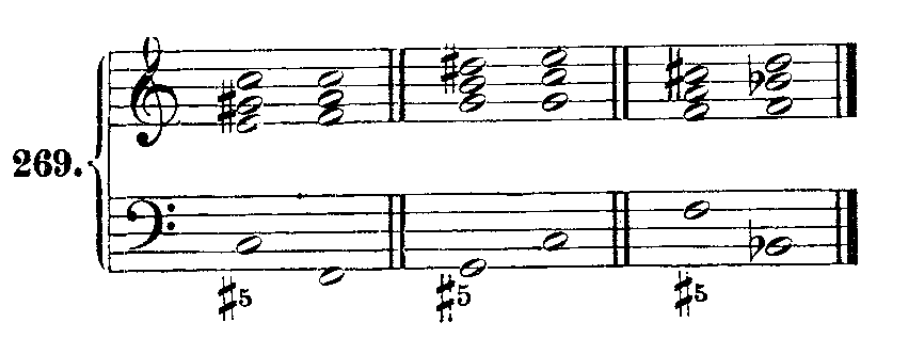
§ 92. The augmented triad must be prepared. It can be employed either as passing chord, in which case it is prepared by the original form of the triad, — or as a chord in itself, in which, case it is prepared by a chord connecting smoothly with it—frequently by the same chord into which it is resolved.
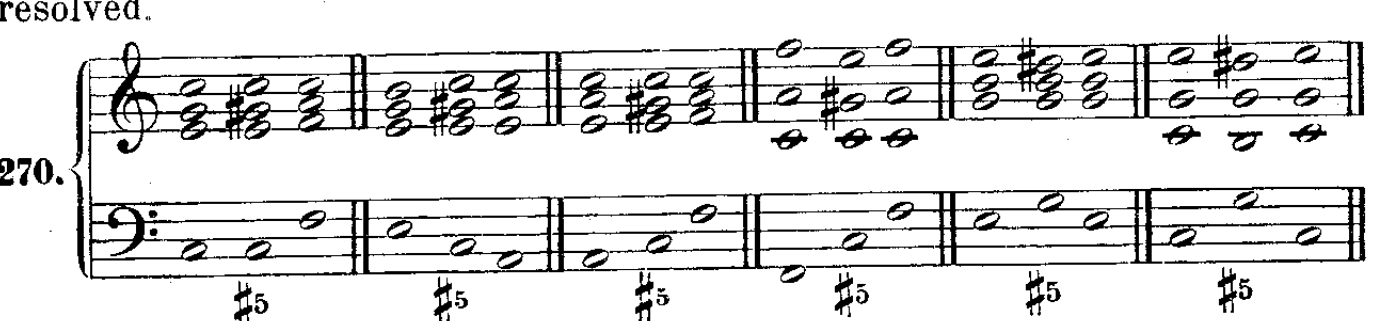
The inversions of the augmented triad occur less frequently than the fundamental form; they appear mostly as passing-chords. with doubled fundamental or third.
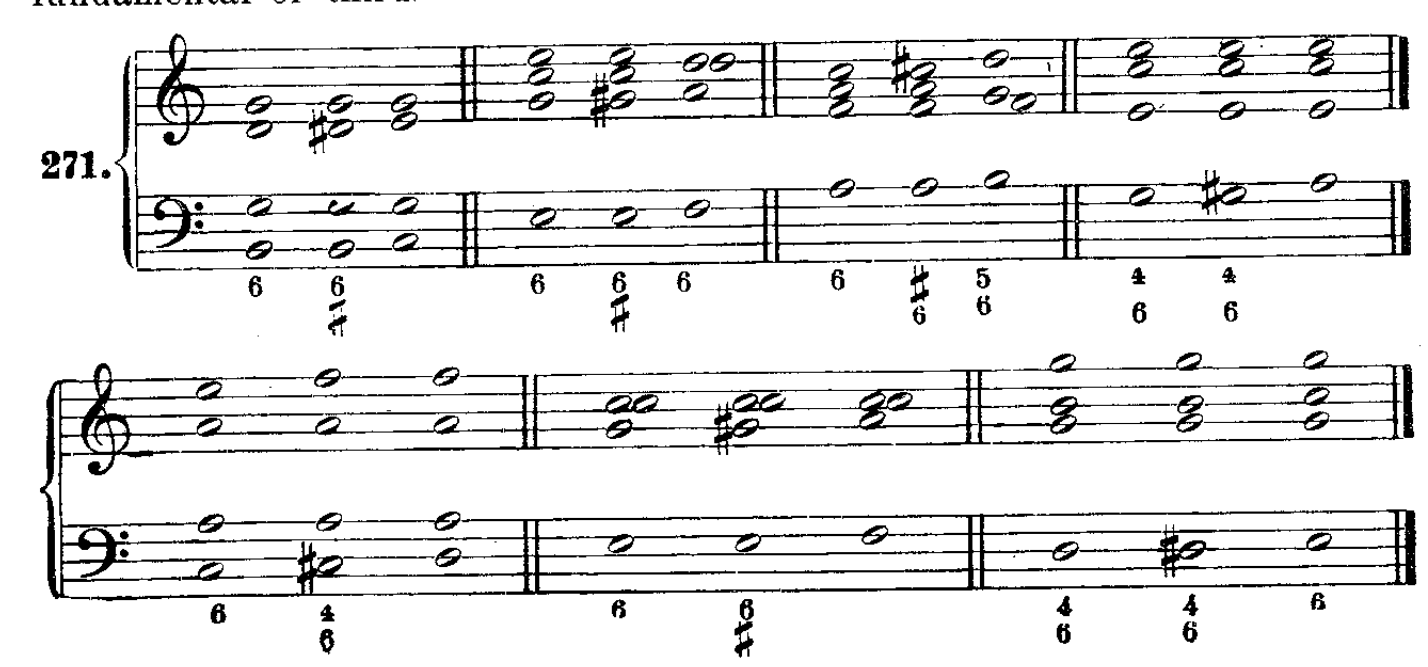
§ 93. Of the two major triads in minor only the one of the 6-th degree is used with augmented fifth; it is subject to the general rules.
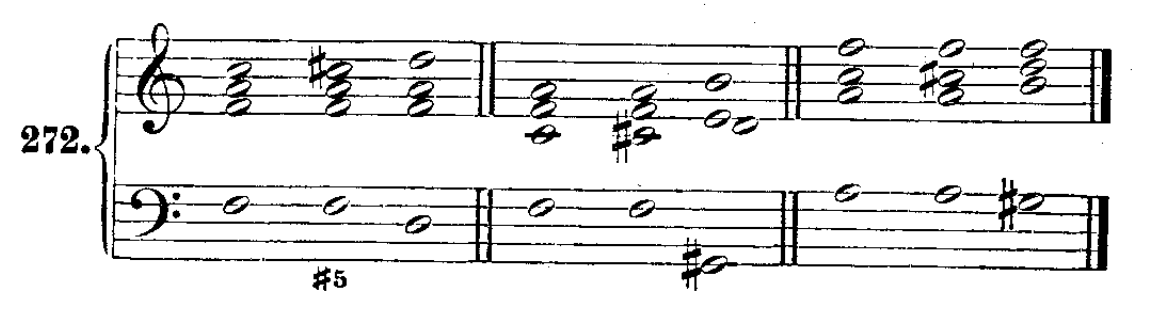
The augmented triad on the Dominant in minor is incapable of resolution..
The diatonic augmented triad of the minor scale has been mentioned in an earlier chapter.
§ 94. The augmented triad, if regarded as dominant, serves for purposes of modulation.
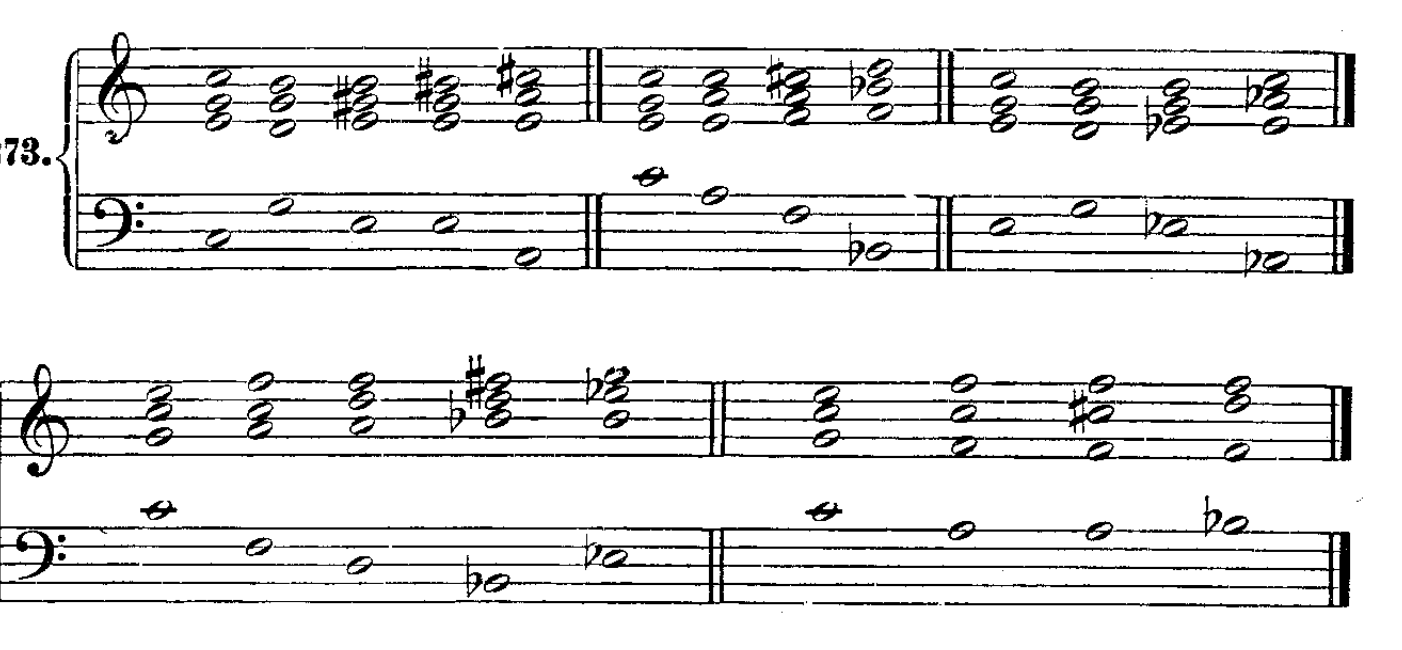
§ 95. Since the augmented triad consists of two major thirds erected one on the other, each triad is (as in the case of the diminished Seventh chord) the enharmonic equivalent of two other augmented triads, so that its inversions can, by enharmonic alteration of the intervals, be transformed into the fundamental form of some other augmented triad. In the same manner, the fundamental form of an augmented triad can be transformed into either one of the two inversions of two other augmented triads.
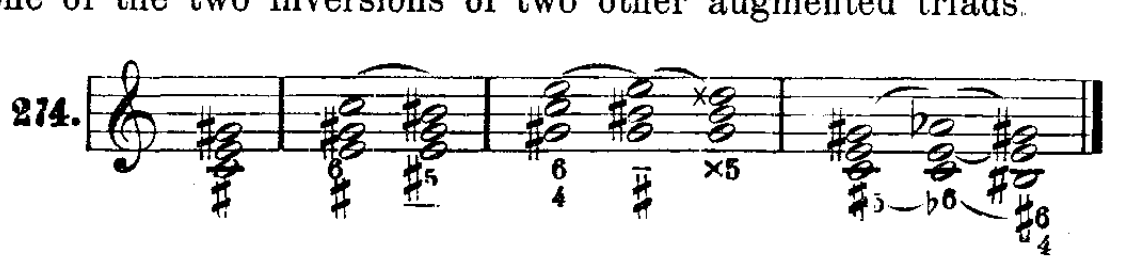
This feature of the augmented triad is also useful in modulation. If we regard each of its intervals in turn as the leading tone of the following Dominant-Seventh chord, we are enabled to make three different modulations,
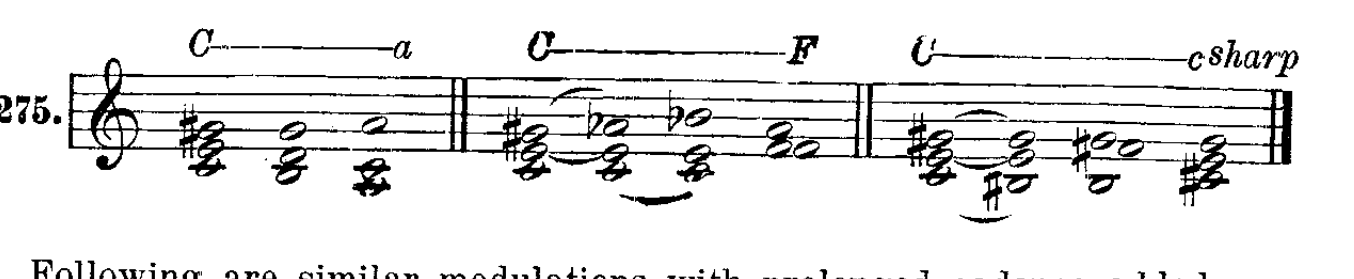
Following are similar modulations with prolonged cadence added.
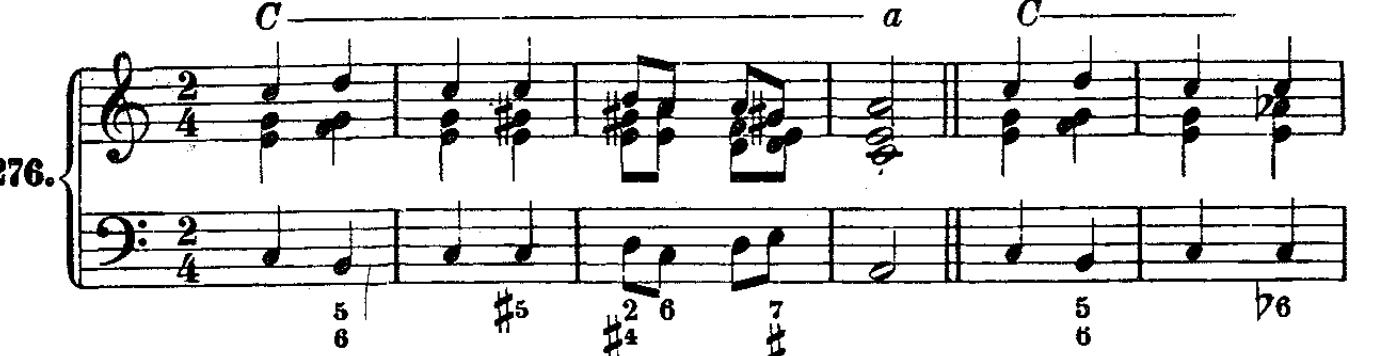
Exercises, Practice the preparation and resolution of augmented triads in all keys, and work out modulations by means of the enharmonic properties of these triads.
§ 96. I. The chord of the Dominant-Seventh with the augmented fifth is used only in major, and is subject to general rules; its fifth, being a chromatically altered interval, must be led a half-tone upwards. The preparation of this chord is effected by means of the triad on the 2-nd degree *).
Other chords of the key cannot be used in this capacity, as difficulties would arise in the voice-leading.
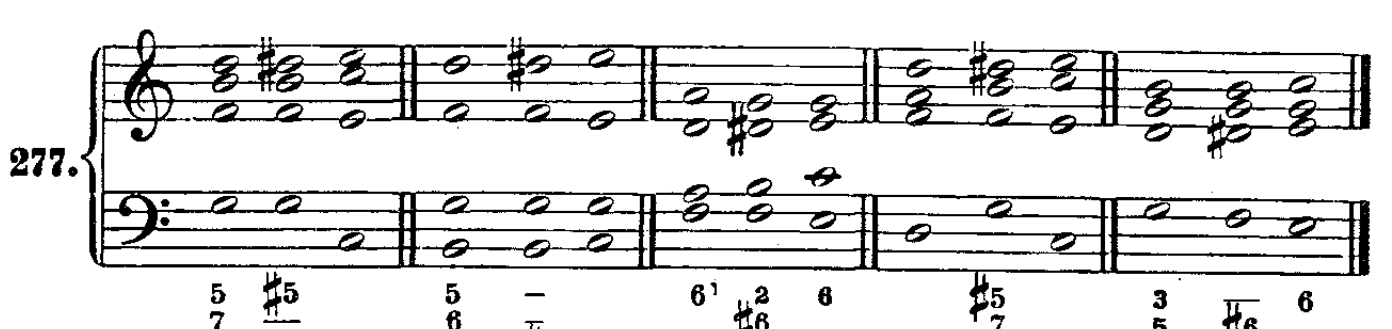
For the sake of euphony we should choose a position of this chord in which the augmented fifth lies above the seventh and forms with the latter interval an augmented sixth. The inverse relation of these two tones, the diminished third, is to be avoided. For which reason the second inversion of the Dominant-Seventh chord with altered fifth is not in use.
*) The augmented triad can also serve this purpose.
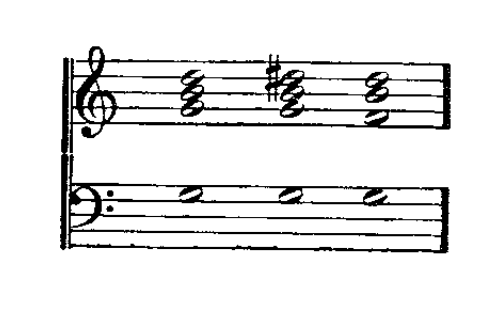
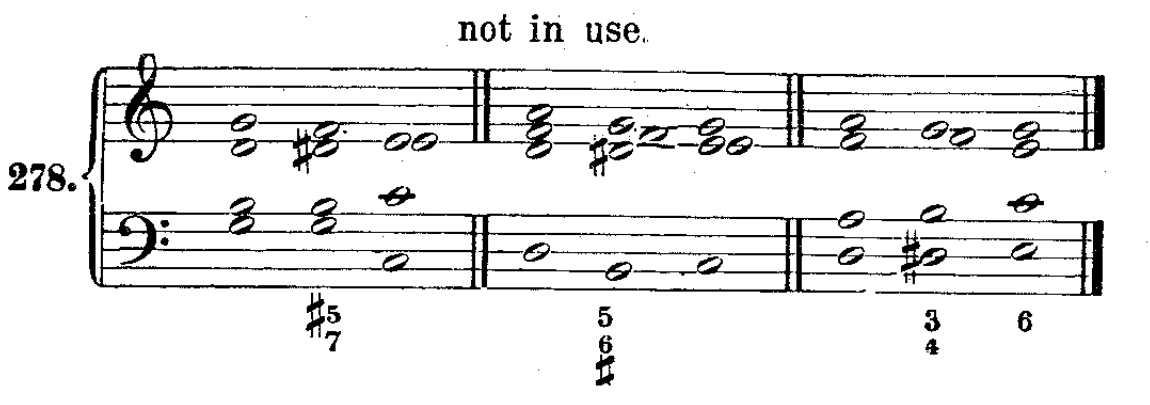
§ 97. III. The chord of the seventh with augmented fifth and major seventh is found on the 1-st and 4-th degrees, in major, and on the 6-th degree in minor. The one on the 1-st degree is most used. It is generally prepared by the tonic triad, sometimes also by the triads of the 3-rd and 5-th degrees, it is resolved into the sub-dominant triad, the altered fifth being led upwards.
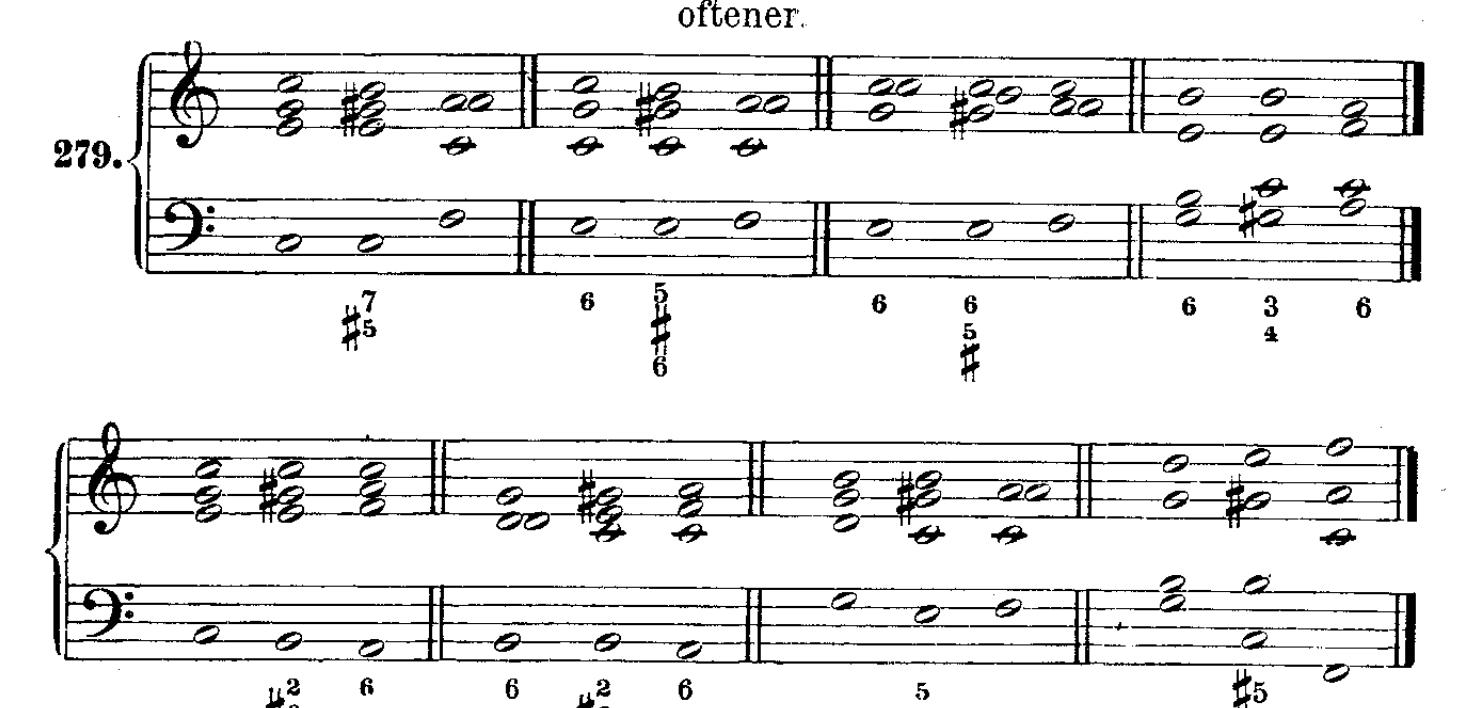
Note. The chord of the seventh with augmented fifth, on the 3-rd degree in minor, has been treated in an earlier chapter.
The chord of the seventh with altered fifth on the 4-th degree in major, and that on the 6-th degree in minor occur but rarely, as their resolution is into the diminished triad. Their preparation can be effected solely by means ot the triad of the 4th degree in major and that of the 6-th degree in minor.
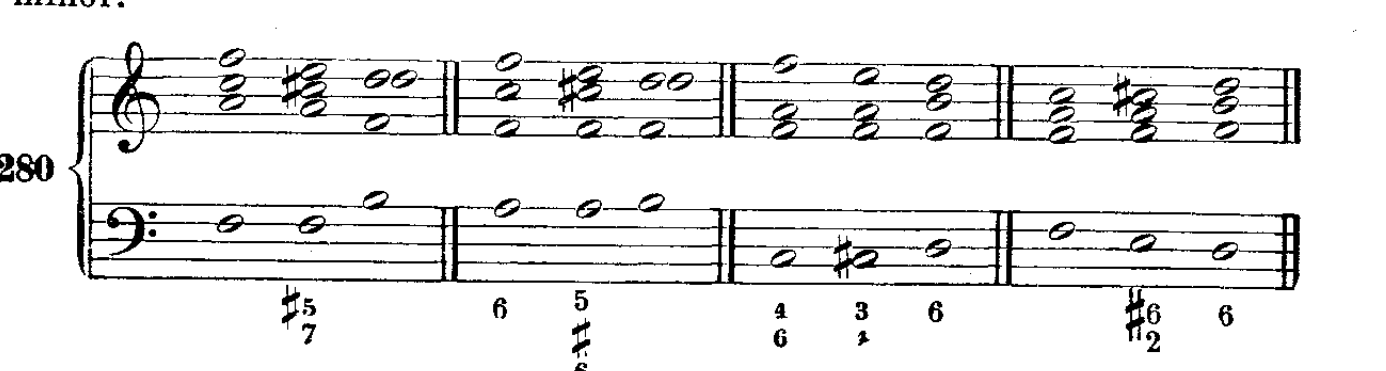
Sometimes they resolve downwards by a pure fifth instead of by a diminished fifth and therefore modulate, from major, into the key lying a major second below the original key, from minor inte the key lying a minor second above.
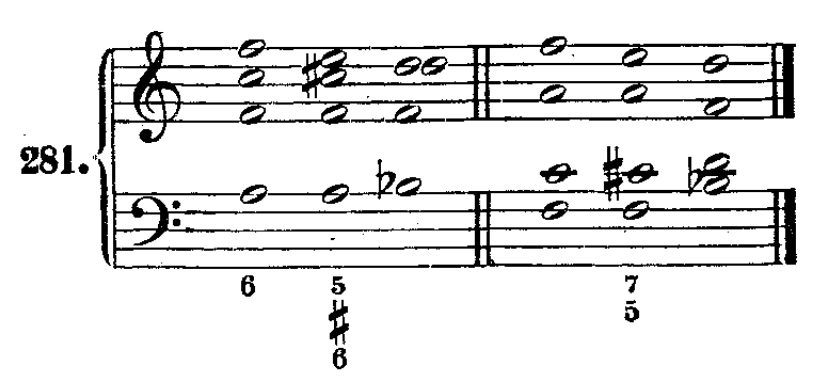
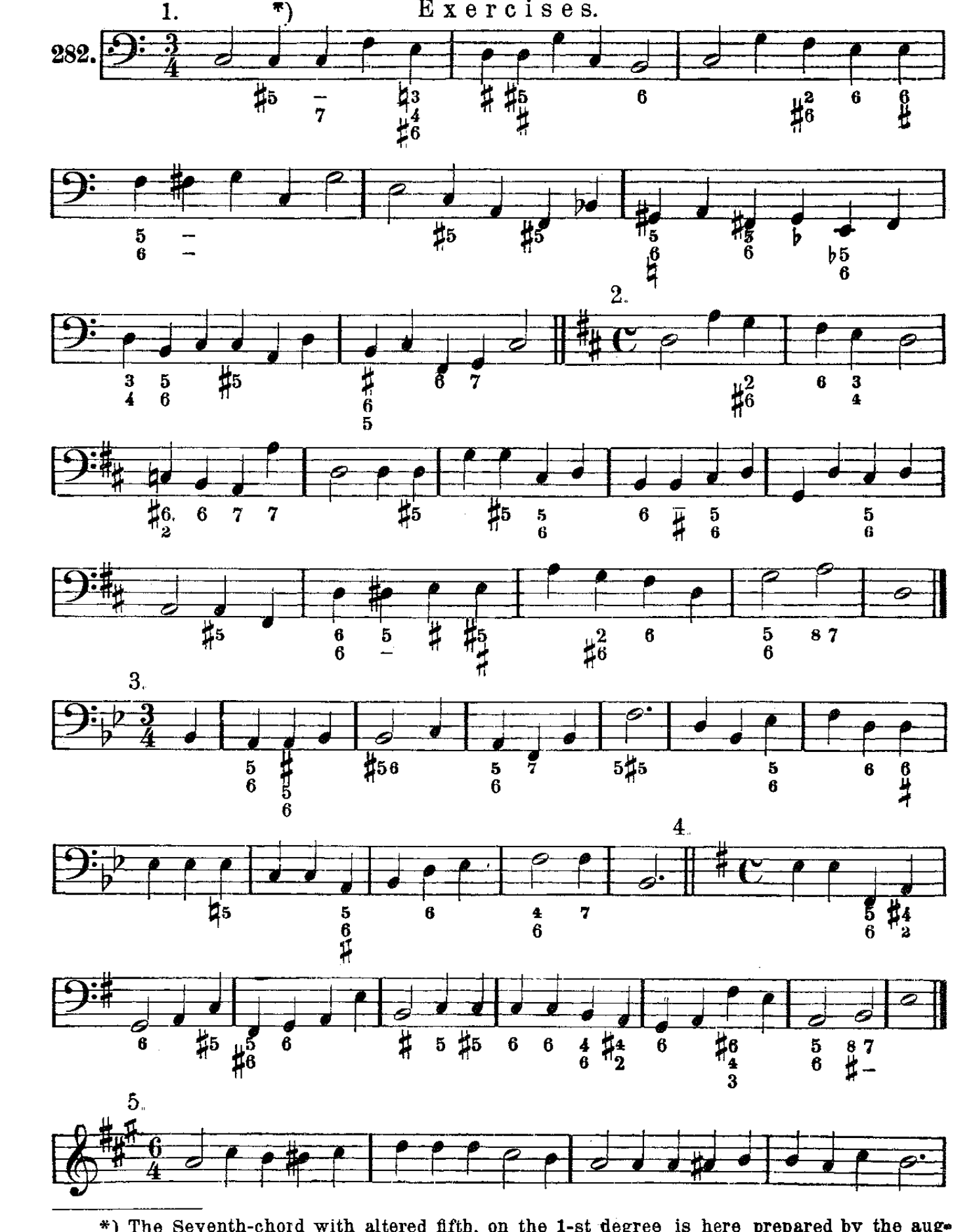
rc} *) The Seventh-chord with altered fifth, on the i-st degree is here prepared by the auge mented triad of the same degree,