 Playable Books
Arnold Schoenberg · section 53 of 66
Suspensions and Other Nonharmonic Tones
Read and hear this section in the playable edition →



All these so-called nonharmonic notes—suspensions, passing notes, neighboring notes, anticipations—should therefore appear in our exercises as products of melodic events. Their appearance, and the dissonances that invariably accompany them, are thus justified by the driving force of a motive or an equivalent rhythm, but often by certain fixed formulas, the conventional figures already mentioned so often. Apart from whether they correspond to the underlying unconscious feeling that every combination is possible, we see here again how the familiar effect of certain fixed, stereotyped turns, whose satisfactory resolution is guaranteed by memory and anticipated by the ear, permits necessity to fulfill itself outside the too-narrow rules. The cliché permits their introduction because one has become accustomed to the cliché; gradual habituation favors freer use. This produces new clichés. Thus method uses habit to generate new methods through habit. One such conventional figure looks, for example, like this:
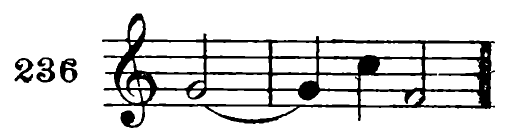
If this G now clashes harshly with some other tone, the ear expects a resolution because that is what it is accustomed to. But the voice leaps away from the dissonance to C. This too is familiar, for one knows that C will afterward leap back to F, the resolving tone, just as a situation in a comedy may become very serious for a moment. But one has read “comedy” on the playbill and knows it will not become so dangerous: they will end up together after all. This effect therefore rests on the memory of similar forms. For example, this motive has occurred often in a piece; one therefore knows that after the large upward leap, a downward leap will restore the balance. This can also be applied to melodic events other than conventional figures. Any motive occurring often and clearly enough in a piece may occasionally be placed on a dissonance, provided the final tone clearly brings the satisfactory consonant resolution. This is a form frequently found in the counterpoint of Mahler and Strauss. As can be seen, it is entirely justified without going as far as I do, for it rests on the same principle as the conventional figures. Naturally, carrying out such experiments belongs to counterpoint, not harmony. But I do not wish to undertake this discussion without that prospect, and it is important to me to have shown here the similarity between the conventional figure, the motivic cliché, and the free motive. If even the complicated phenomena can thus be explained easily, though outside the system, nonmusically but psychologically, then naturally the simple ones can be dealt with in a few instructions. I think it suffices to describe what they are and mention a few cases and possibilities; the pupil must then know how to use them.
Suspension and passing note can be traced to the simplest melodic form: the scale, the segment of a scale.

A suspension delays a step of a second in one voice while the harmony changes. To be characteristic as such, it is usually required to be dissonant. This does not seem absolutely necessary, however, for the A in 238 is undoubtedly a suspension if the arriving degree I appears as a goal, as at a close.
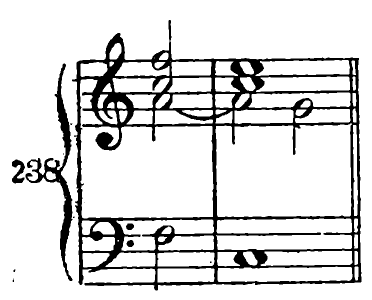
The more frequent form is indeed the one in which it really is dissonant; only then is it sufficiently conspicuous. Moreover, we are concerned with dissonances, with methods of introducing more distant overtones. The suspension may enter prepared or unprepared.
The pupil may prepare it at first, but later may also introduce it unprepared, as a “free suspension.” Preparation occurs as with any other dissonance: the dissonant tone was present in the preceding chord in the same voice. If the suspension is to be dissonant, it may be the second, seventh, ninth, or fourth above the root of the chord in which it occurs. As a melodic event that is ultimately to produce a step of a second, the suspension may resolve upward or downward.
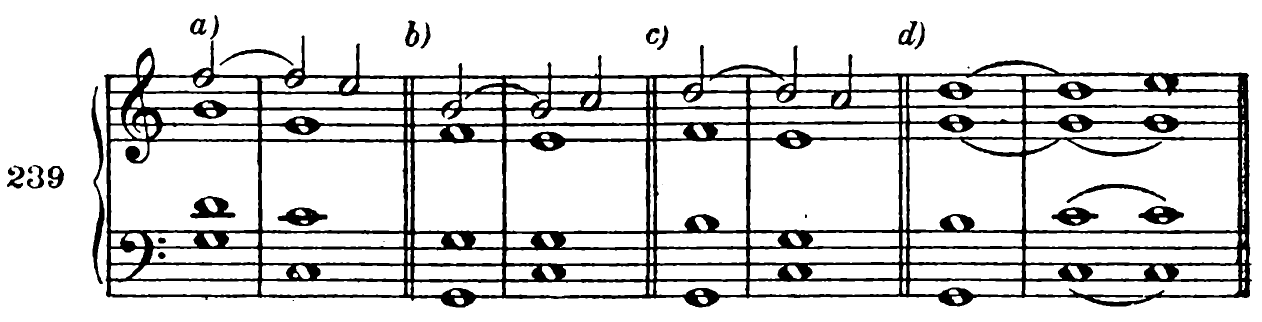
An ascending leading tone will generally not be used as a downward-resolving suspension, and a descending one will scarcely be used as an upward-resolving suspension. Nevertheless, even this occurs.
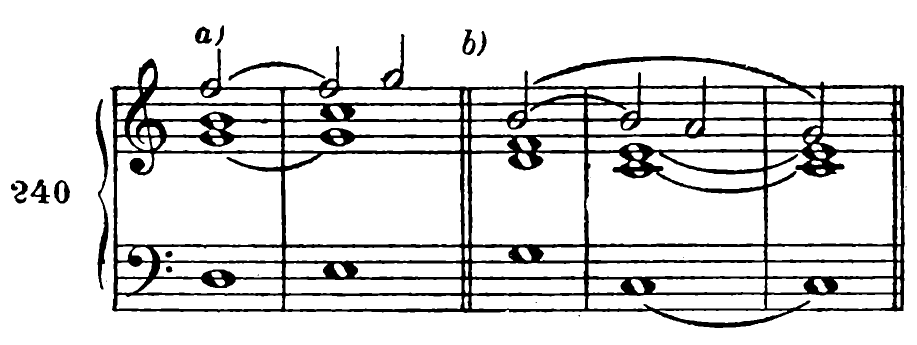
One law demands that the resolving tone of a suspension must not sound simultaneously with the suspension.
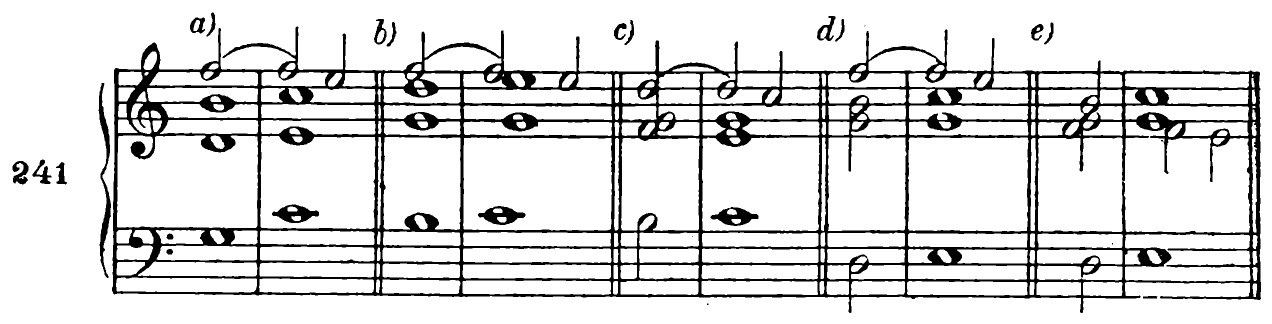
But this occurs so often that today no serious objection will be raised against it. It is, nevertheless, not very favorable on the piano in close position. Yet in Bach's choral writing it occurs countless times—and naturally on the piano and elsewhere as well.
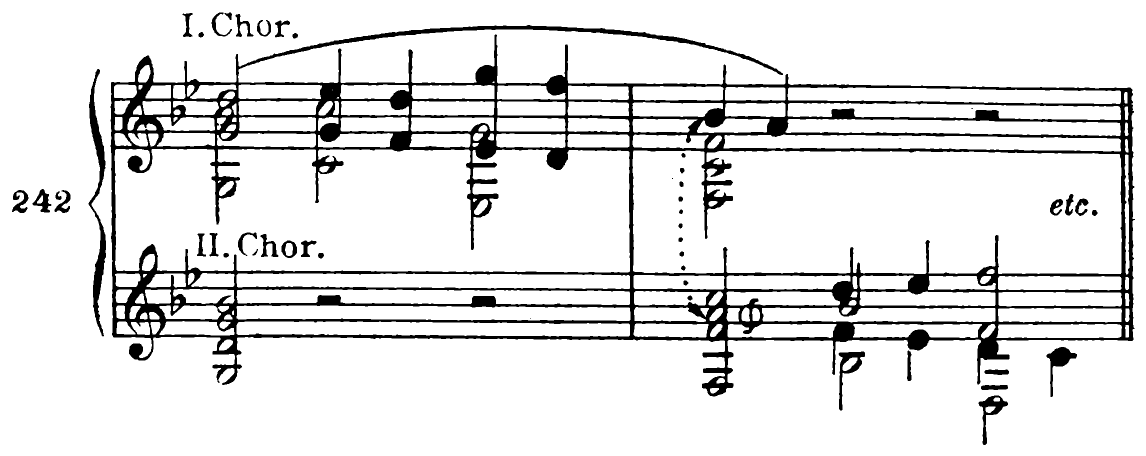
From the motet “Komm Jesu, komm”: first soprano and second alto at the circle-and-line sign. The bass was permitted an exception even to the strictest form of this rule (241c, d, e).
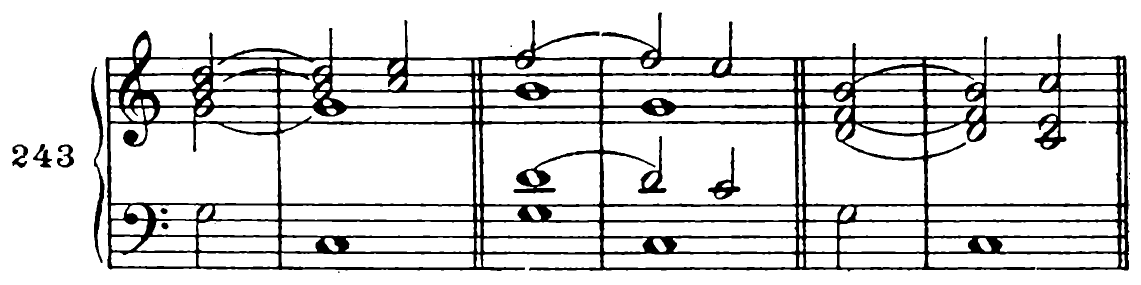
Two or more voices may also be suspended.
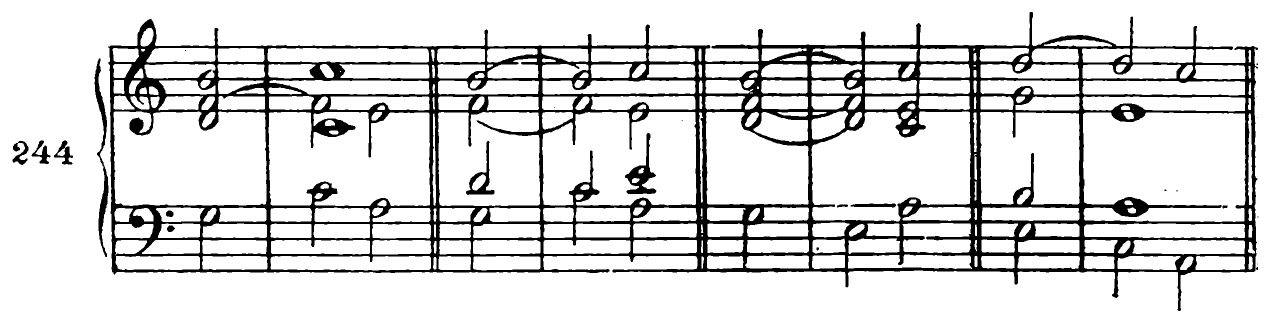
The harmony may also move on while the suspension resolves, so that the resolving tone stands over a different harmony from the one to which the suspension related.
Naturally, the suspension should produce nothing that would otherwise be forbidden: no parallel octaves or fifths! But one may also leap away from a suspension in the form of a so-called interrupted resolution, which supplies the resolution after one or more intervening notes. Without knowing all the familiar conventional figures, one may freely use any remembered formula for this purpose.
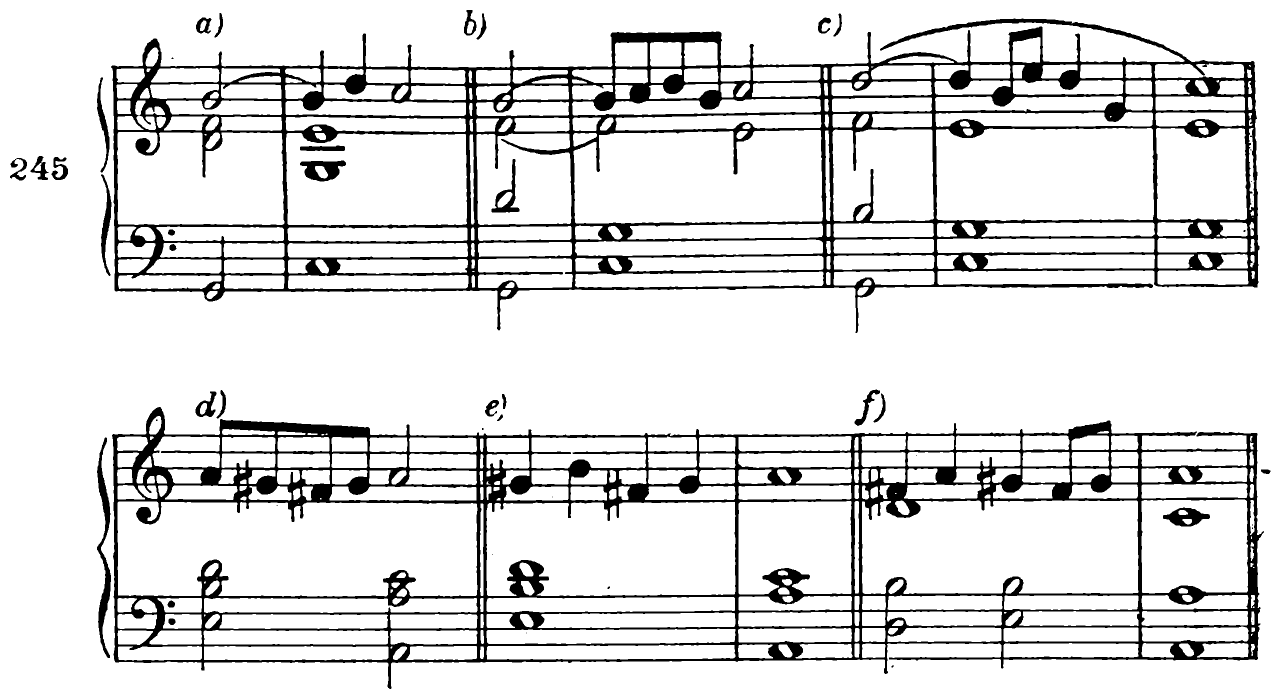
These intervening notes will generally circle or play around the resolving tone, staying melodically close to it; or they will be tones consonant with the chord of resolution; or a mixture of both (245c).
I would like to mention a few very familiar formulas because they partly suspend the turning-point laws in minor (245d, e, f). As can be seen, they interrupt the seventh tone's progression to the eighth by returning to the sixth.
The free suspension approaches the neighboring note. For the prepared suspension there was initially a rule that it should occur on the strong beat. As an exception (!) it was also allowed on the weak beat. Eventually, however, the exception appears almost more often than the rule. Naturally, the free suspension may also occur on the weak beat. It is then scarcely anything essentially different from a neighboring note. Resolution is important in both cases. Yet even primitive dance music offers cases such as 246, where, for example, D leaps without further ado to B-flat.
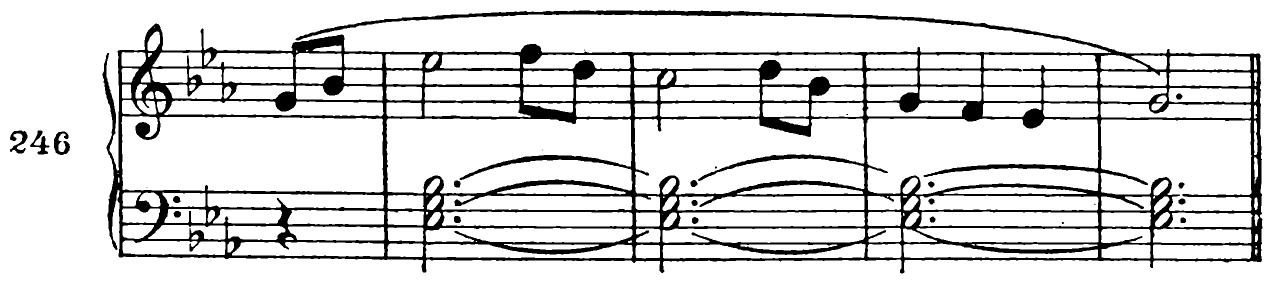
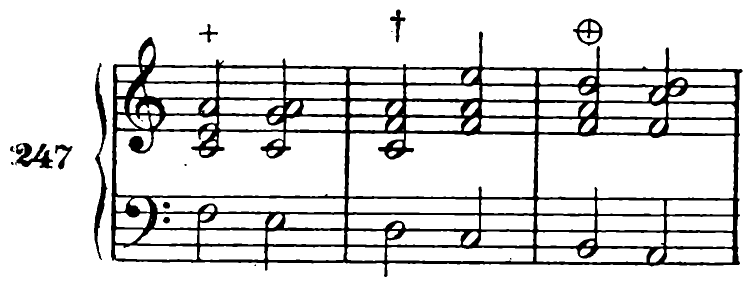
D and B-flat are neighboring notes circling C, but C itself is “nonharmonic.” With the same justification one may naturally leap away from suspension notes. Thus the dissonances in Schumann's “Ich grolle nicht,” marked by the cross, dagger, and circled cross in 247, are either unresolved seventh chords or suspensions. They may be regarded as either. But it is enough if they are sevenths. The pupil will do well at least to suggest the resolution, perhaps in the manner of an interrupted resolution.
We have already mentioned the passing note several times. It is the scalar melodic connection that fills a melodic interval of at least a third with the intervening tones, so that an interval of a fourth contains two passing notes.

What is essential is that the figure's starting and ending tones are consonances. If passing tones connect a fifth, probably not all three intervening tones can be dissonances.
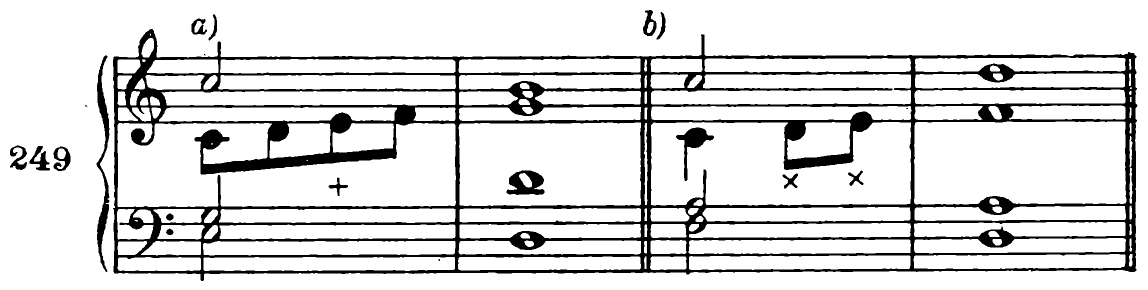
The E in 249a is consonant; in passing motion across a fourth, both passing tones may be dissonant (249b). Passing notes can also occur in several voices simultaneously.
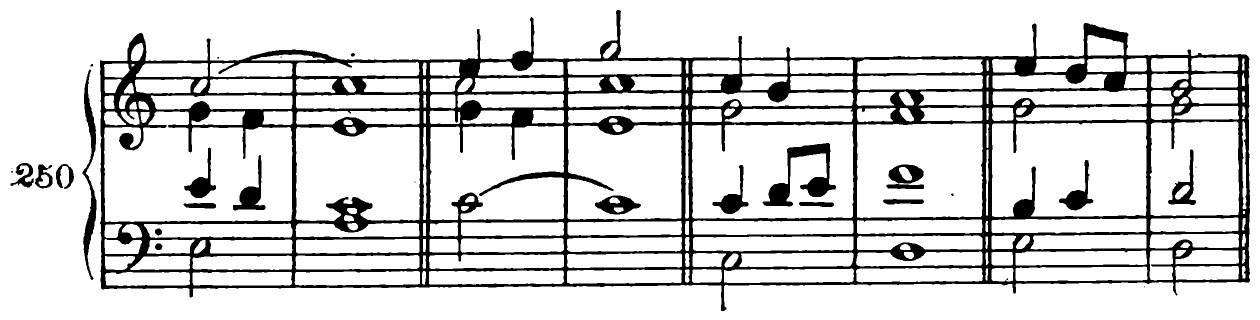
Parallel octaves and fifths that arise through passing notes are to be judged exactly as they are elsewhere.
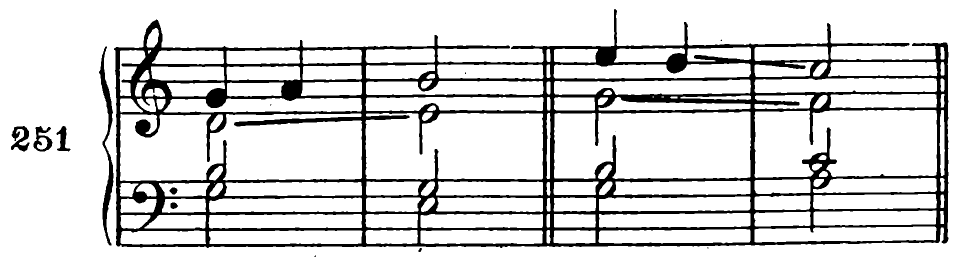
The older theory holds that they are not cancelled by the passing motion and are not concealed by the suspension. And that is correct: they are just as bad, and just as little bad, as unconcealed ones. The student is often inclined to attach a suspension to a passing note. This too the strict, the all-too-strict, style does not permit. But there is really nothing to be said against it, and it does in fact occur everywhere in masterworks.
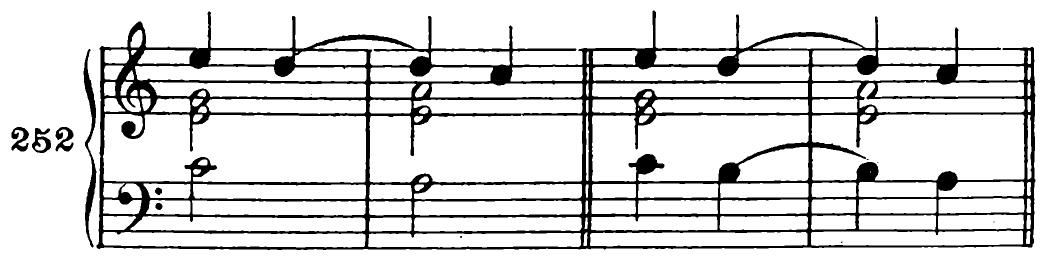
Often, through the passing motion of several voices, entirely new chords arise, which one could just as well regard as independent as regard as passing. In reality they are independent, too, and only the theory of passing notes, which wants to push through its accidental harmonic formations, declares them dependent.
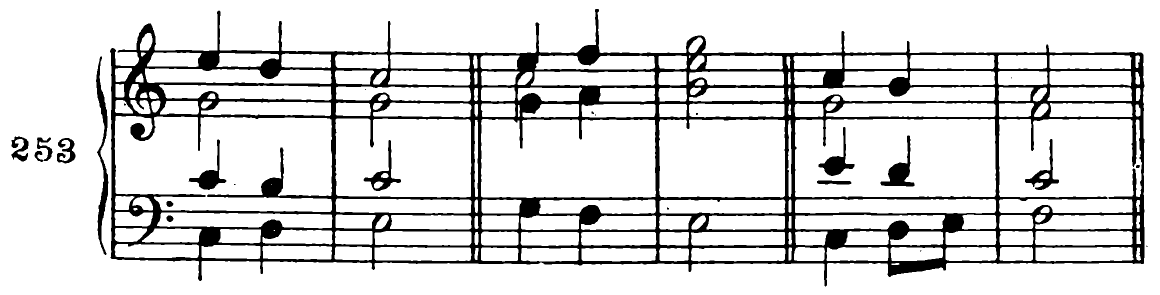
The passing notes can of course also be borrowed from the chromatic scale. That cannot cause the student any difficulty if he thinks of our secondary dominants and keeps in view the meaning of passing notes as a simple melodic form (a segment of the scale).
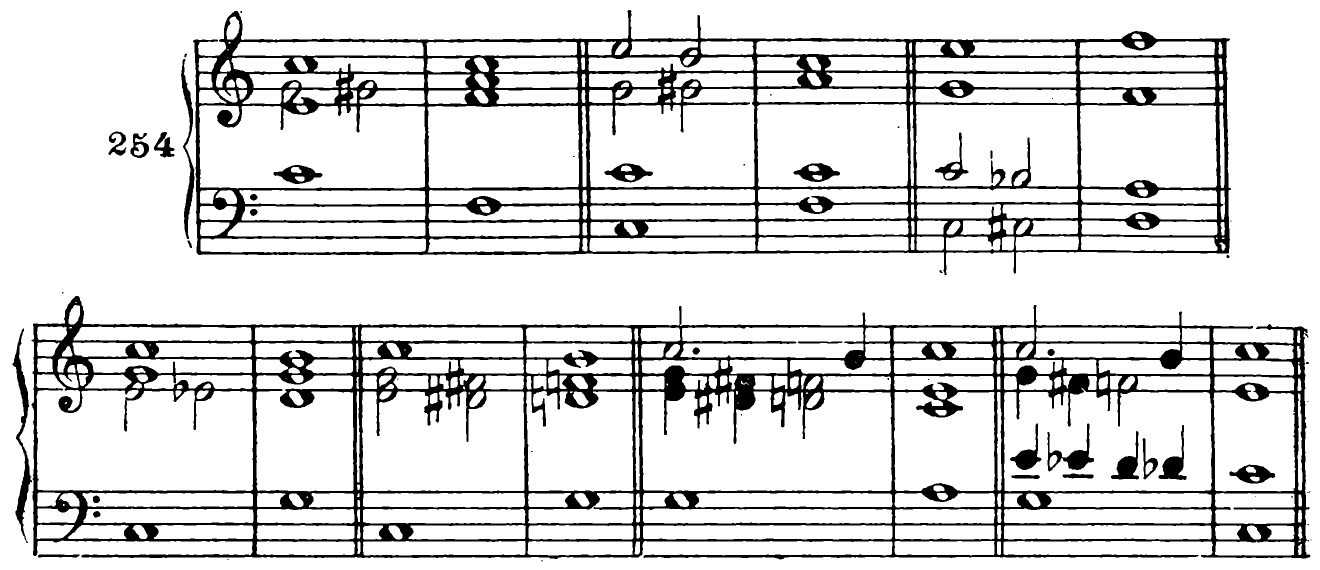
The passing note renders excellent service with vagrant chords, where, for example, a reinterpretation arising through a passing note makes it possible to combine two turns of phrase such as those at 255 a and b into a single progression (255 c).
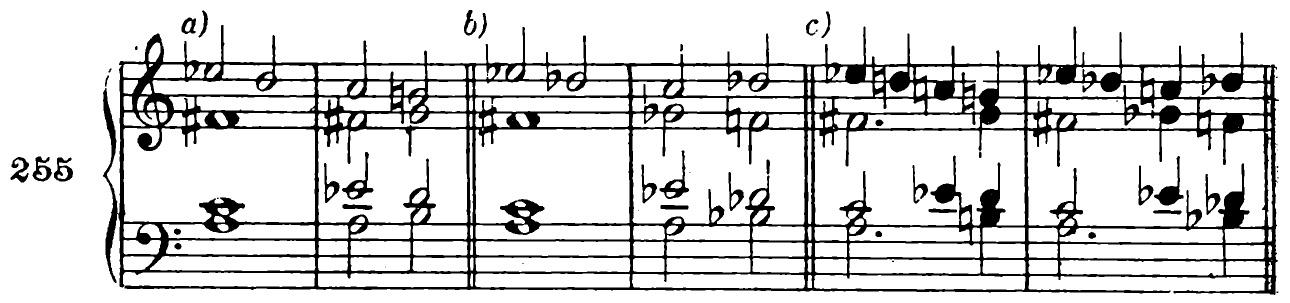
A kind of modulation that is excellent; or 256 a.
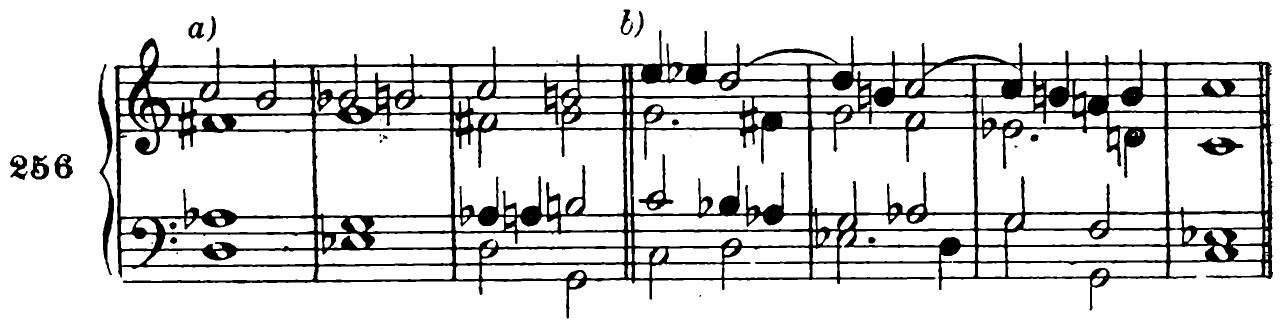
This also works without vagrant chords (256 b), where the transition from major to minor is greatly favored by the chromatic introduction of the E-flat and by the notes B-flat and A-flat that appear in passing.
This passing motion, too, occurs often:
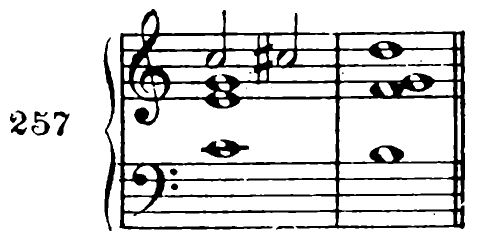
And even these passing motions:
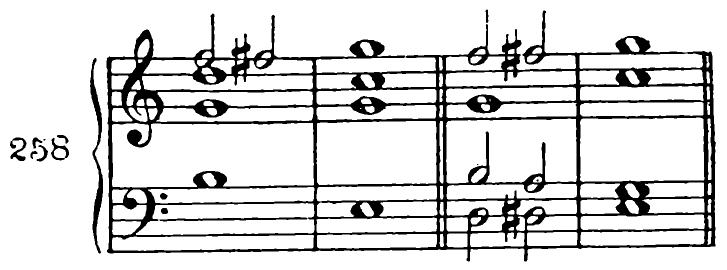
Naturally, the more closely the student keeps to the primal form, to the scale, and especially to the chromatic scale, the bolder the combinations he will be able to write.
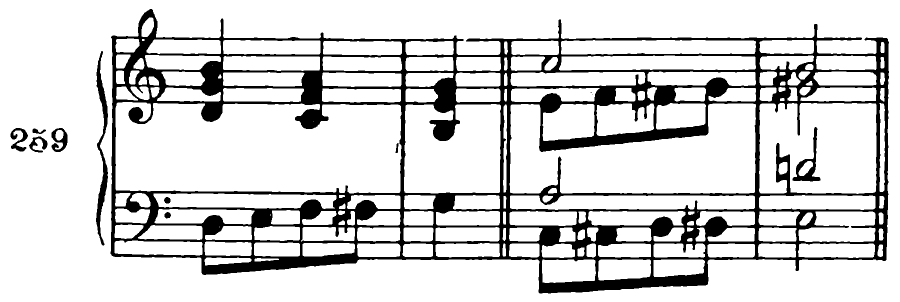
When altered or vagrant chords are involved, the effect will mostly even be rather mild. Very often vagrant chords can be led by passing notes into unaltered ones, and conversely unaltered ones into vagrant ones, which can be applied very well in modulations, but also to enrich the cadence.
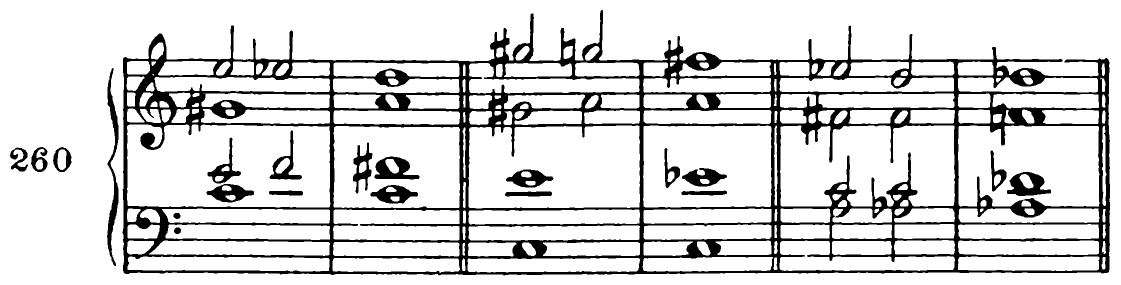
Here and in many other cases one sees chords arising through passing notes that are known as more stable forms. This shows once again how unjustified that classification is which assumes accidental harmonic formations; how it merely makes a virtue of necessity by refusing to recognize as chords those chords it cannot accommodate in the system. From those chords that have already been admitted, and that likewise spring from nothing other than such melodic needs, one can again see how correct this observation is. That happens only out of necessity. But the virtue is accordingly slight as well.
To enumerate everything that can occur is naturally impossible. The student will do best, as I have already said, to establish at first the primal form of the passing motion, the scale-wise segment of melody; naturally, chromatic segments of the scale as well. I dispense with an exercise such as almost all textbooks set: embellishing after the fact, with suspensions and passing notes, a setting drafted in half or whole notes. This exercise is ridiculous; inartistic in the highest degree. This embellishing with ornaments, “tattooing,” as Adolf Loos says, is childishness. I have no objection if the student occasionally makes a correction to a finished setting in which passing and suspension notes already occur, notes that came to him as harmony at the same time as the melody; if, for example, he improves an awkward-sounding connection with a passing note, or a stalling of the rhythm with a suspension. There is not much to object to in that. But what the student must strive for is the ability to invent these nonharmonic notes right along with the rest of the harmony. That is not nearly as hard as it looks; an intermediate exercise is therefore utterly superfluous. After all, the student need not bring in an excessive number of passing and changing notes as long as they do not yet occur to him. Admittedly, the pedagogical purpose that the generally customary exercise can serve is certainly not objectionable: it forces the student always to think of the fundamental harmonies and not to forget them over the nonharmonic notes. Nevertheless I could not bring myself to set it, for it is too mechanical for the student, who at this stage must already possess a fair degree of harmonic skill; the real merit, even in successful solutions, is too slight, and all the more disturbing is the falseness that lies in it: outwardly enriching a trifling idea with ornaments that do not suit it. I would sooner recommend experimenting very often, on paper or at the piano, looking for turns of phrase and connections, and then working what has been found into a little piece. Working out: that is a better exercise than embellishing, for it requires the ability to introduce correctly and to continue correctly.
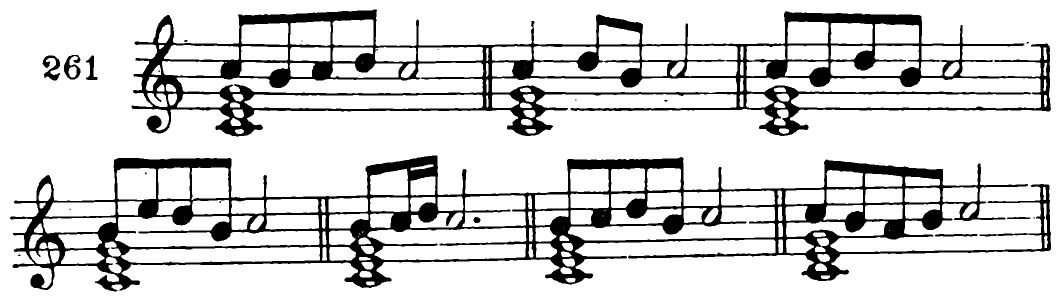
The changing note is best explained as a written-out grace (Manier) or as a motive. Usually, at least in its simplest forms, it belongs to a figure that consists of one or more nonharmonic notes and circumscribes a consonant note.
Such a changing note is, if one likes, already the trill, or the trill with a termination (Nachschlag), which, written out, looks like this:
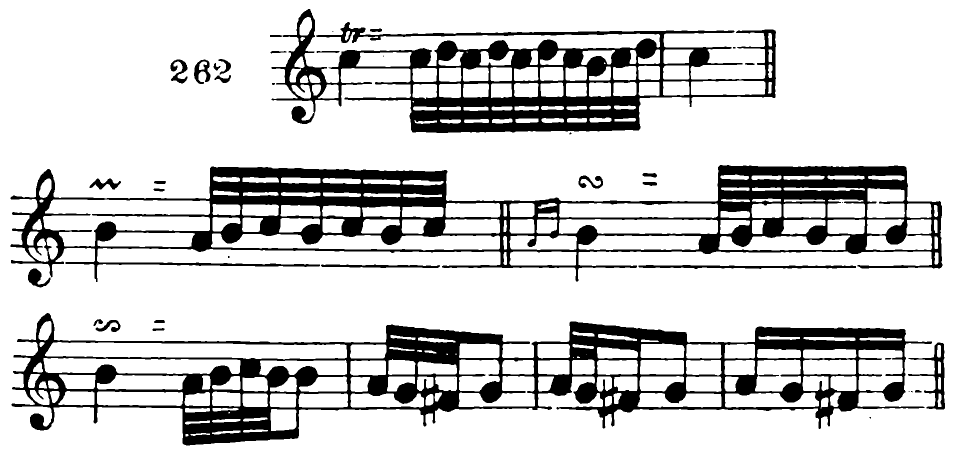
In the graces (Manieren) (I take those cited here from Heinrich Schenker’s essay “Ein Beitrag zur Ornamentik”) the student will find numerous models for such standing formulas, which, performed slowly, are unquestionably changing notes, even if one will not grant that they are so in rapid succession as well. Admittedly, these are almost without exception cases where a note is circumscribed by the nearest neighbouring notes. But the changing note need not necessarily do that, as the case of the interrupted suspension shows, which springs from an amalgamation of suspension and changing note. Customary forms of the changing note include, among others, the following:

Naturally, chromaticism can also be drawn on to form changing notes, at first perhaps with some caution.
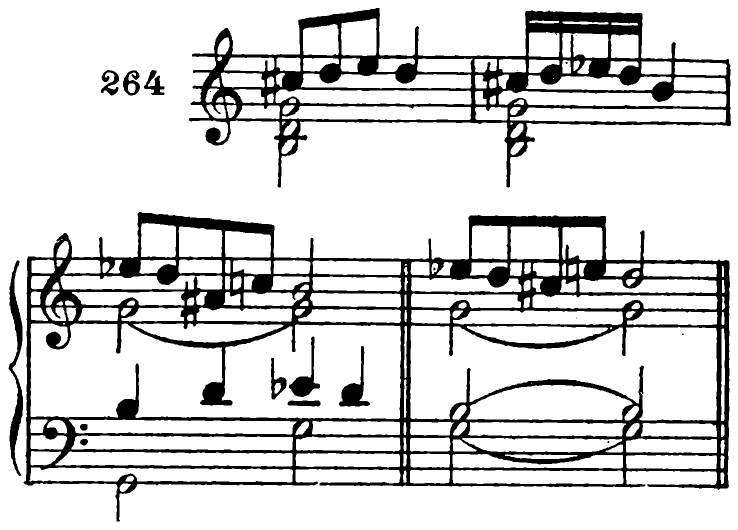
The anticipation rests on the idea opposite to that of the suspension. If with the latter one or more voices are delayed during a change of harmony, with the former it is the other way round: they come too early, so to speak.
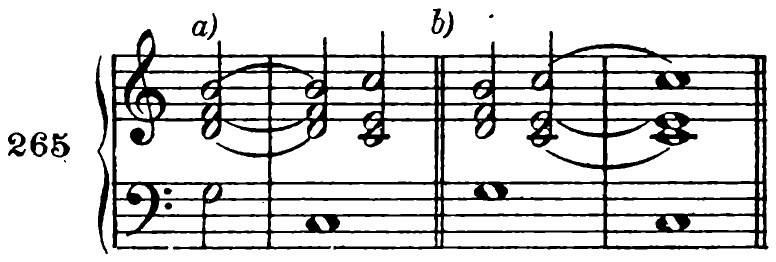
In 265a and b, where a is a suspension and b an anticipation, the two pictures are placed side by side for comparison. Like the suspension, the anticipation can take place either in one voice only or in several. Beyond this there is nothing whatever to say about it.
Once the student has become familiar with nonharmonic notes in the way recommended earlier, putting this possibility to use cannot give him trouble for long, and he does not need that exercise which I condemn: making a skeleton feign flesh and blood by draping rags of clothing over it. On the contrary, he will thereby be enabled to introduce the sonorities that arise in this way with the same foresight with which he sets down his harmonies. They will thus cease to be chance and begin to be law, a law he simply cannot put into words. That a real master never did anything so inartistic, not even under the protection of the excuse of a harmonic sketch to be worked out later, ought really to be recognized by anyone who has once looked closely at a Bach chorale. I set down here the one from the St. Matthew Passion that I have already quoted once:
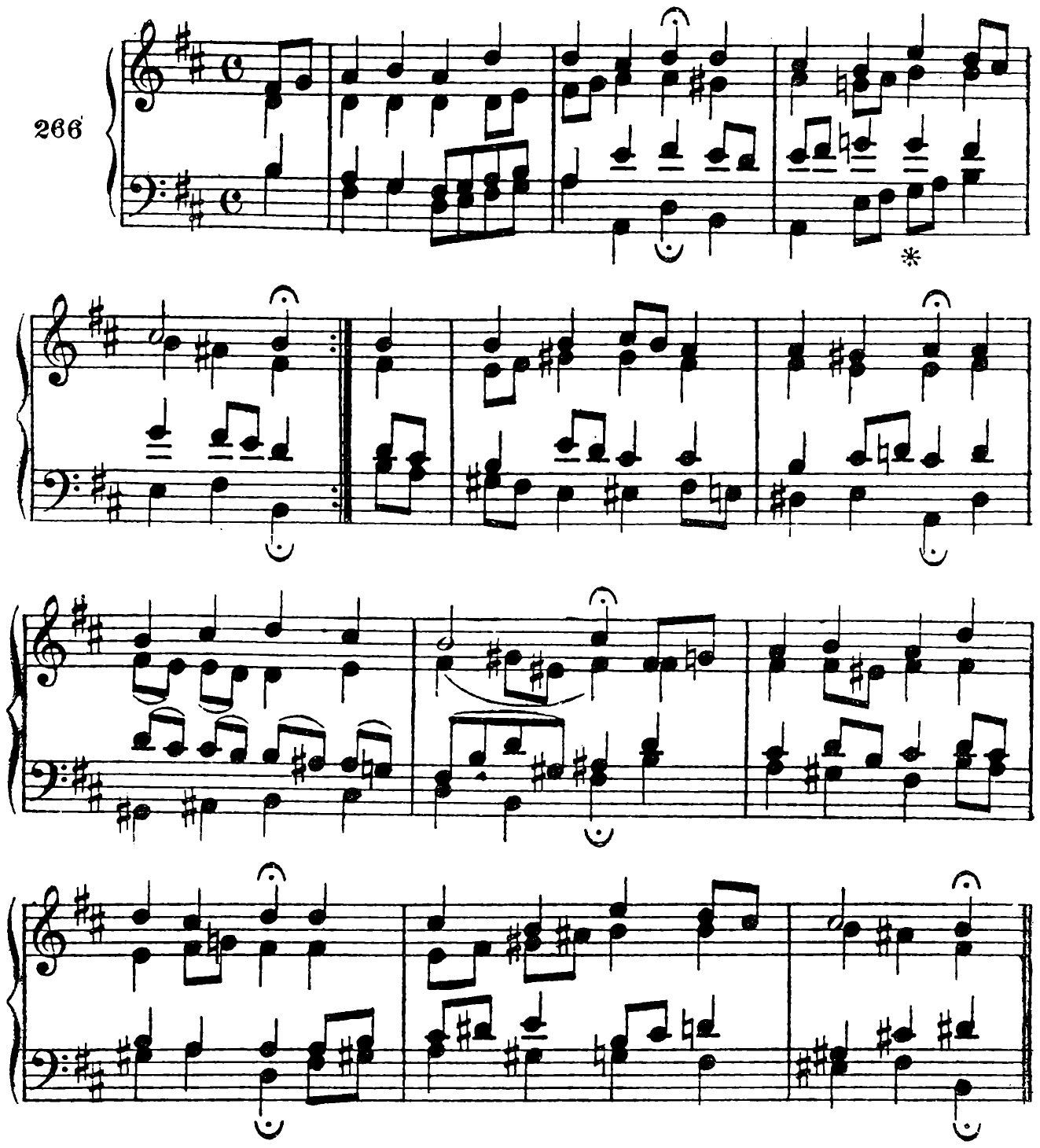
I think the first glance should show that the point here is not to dress up a harmony that would otherwise be too meagre or too uninteresting, bringing it to a shine with external finery. Take out each individual voice and look at it by itself. You will find they are all melodies, often just as beautiful as the chorale melody itself. And that is surely a different purpose from this external one! Then try leaving out what you take to be incidental changing notes. Mostly the result becomes almost impossible, or at least so bumpy that it could be by a lover of ornaments, but not by Bach; perhaps not always quite impossible, for although what one takes for decoration was born together with the rest, enough remains that is good. Certainly, one can live after losing one’s little toe, but it is no longer a well-built foot. Take, for instance, right in the first line the passing notes in the bass, tenor and alto. Surely it is clear that these are chords; for their harmonic purpose is this: to harmonize a melody that comes three times (see the repeat sign and the penultimate line) in such a way that the harmonization, which could easily turn out rather poor in degrees, nonetheless gives the main features of the key (I, IV, V) in strong strokes, yet does not become so rich that a later repetition cannot be richer still and have a surprising effect. Therefore the degrees of the subdominant region are dealt with on weak beats, so that they bind less; but they move faster and come twice, which again makes up for their relative weakness. In this way unequal forces are held in balance: by letting them act on unequal lever arms. Or how, in the second line, the tonic key is introduced hesitantly. Even at the penultimate moment (*) an A in the bass behaves as if major were to come. The reason is clear: the chorale wavers between D major and B minor, as the cadences indeed show; too firm a B minor would hardly be favourable at the beginning. The decision comes later. So the A has the purpose of postponing! So it is not an ornament!! In the third line: here the eighth notes, which at first appeared as an imitation of the first four notes of the melody, have turned into a smaller independent motive that governs the figuration of the whole middle section, and so is not a mere ornament either, but a component of the construction, of secondary importance, yet a component all the same. In the next lines it now becomes so rich that I would rather not even attempt to describe it. It can no longer be discussed briefly. In a true work of art the relation of the chords to one another, regardless of whether their fundamental meaning is more or less evident, whether they appear with more weight or are merely carried along by the “gracefully” striding voices, is so firm and so well founded in constructional necessity that the voices forming them, however much they incidentally adorn the whole, however animated and intertwined their lines may be, can nowhere seriously be regarded as purposeless decoration. One could no more leave them out than one could leave out something similar in an iron structure. But the undertaking of adding the supposedly merely beautiful only later is one an ornamenter ought first to try out in practice on an iron structure before recommending it to a student, and during construction he should stand underneath it; he will recommend it no more. Only in art*) is one so unscrupulous, where no piece of iron that has fallen on one’s head takes over the justification for the diminished intelligence. One might object that these are only exercises; of course, later on the student is not supposed to do it that way any more. But these are immoral exercises, and one cannot learn morality by practising immorality. One would really have to regard the example the teacher gives as a deterrent example. But that is asking too much of the student and too little of the teacher.
*) Understanding of the constructive or other practical purpose of ornaments seems unfortunately to be slight in other crafts too, and leads some to thoughtless omission, others to senseless application. Thus a new watch had to fall out of my hand several times before I realized that it slipped through my fingers because, though modern, it was too smooth, and that the cases of my old watch were engraved so that their somewhat rough surface would cling better to the hand. In contrast to this hostility to ornament stands the bookbinders’ delight in ornament. They apparently regard the binding as nothing but a decoration of the book, and it perhaps pleases them, as an “artistic” binding, only when they may regard as much as possible of what cost them effort as decoration, that is, as senseless. So they glue, for example, a “ready-woven” headband onto the ends of the book, which looks even “more beautiful” than the sewn-on “hand-worked” one, but naturally does not fulfil its purpose of holding the book together at top and bottom. The purpose is unclear to them and therefore unimportant. And this goes very far, so far that there is even the word “aufkaschieren”. To protect the ends of paper, cloth and thread against friction and coming loose, they were concealed (kaschiert, from cacher, to hide), which was done by gluing one or more layers of paper over them. If today one glues a sheet of paper onto the pasteboard, which easily becomes fuzzy through friction, that is called “aufkaschieren”!