 Playable Books
Pyotr Ilyich Tchaikovsky · section 25 of 36
Chapter XXIII. Suspensions
Read and hear this section in the playable edition →



69. A suspension is the harmonic formation that arises, when not all the voices of a chord enter simultaneously; one or more of the voices enter later (are suspended), causing dissonances, which find their resolution in the chord itself.
Suspensions may be found in any of the four voices, at points, where the voice in question moves upwards or downwards by a step. We have, then,
1, Suspensions in a downward direction, u. Suspensions in an upward direction.
§ 70. The suspension downward appears where the voice progresses down by a step; this step may be either a major or a minor second. The suspension must be prepared and resolved. By the preparation of a suspension we mean that the note forming the suspension must be contained in the same voice of the preceding chord. The resolution of a suspension (since it is a dissonance) consists in leading this note one step downwards.
Consequently the suspension invariably falls on the accented beat, while its resolution occupies the beat relatively unaccented.
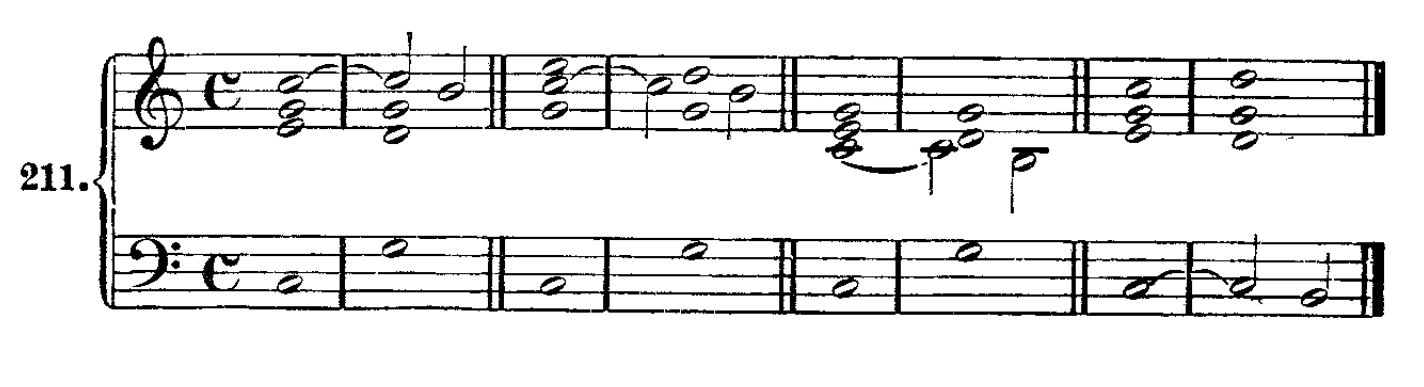
In three-divisioned time the resolution falls on the second unaccented beat, except in cases where a new chord enters on this beat.
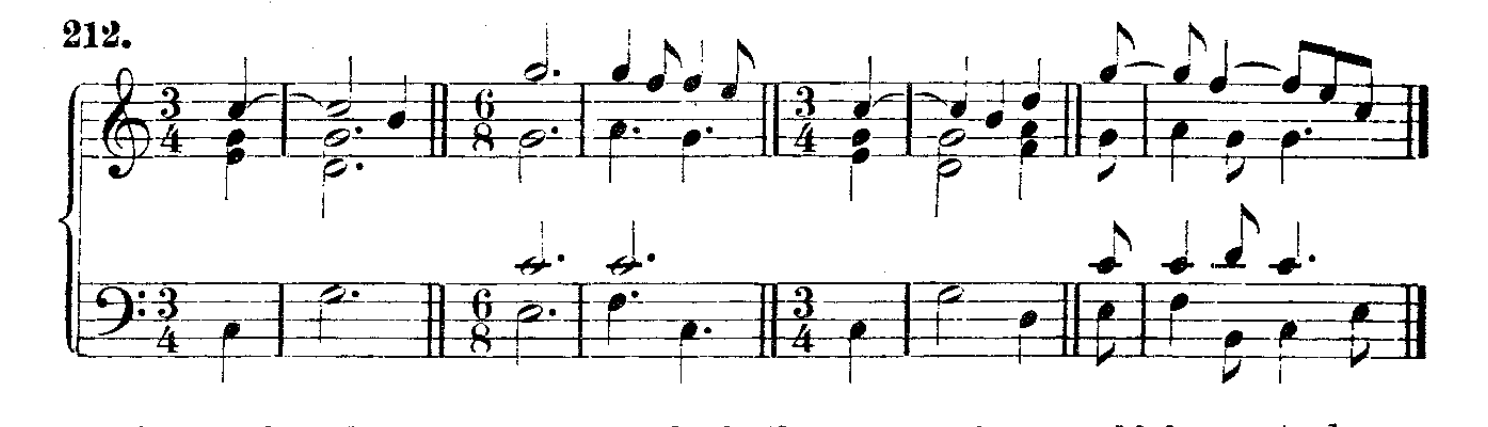
§ 71. Should the tone, into which the suspension would have to be resolved, be already contained in one of the three upper voices, no suspension can take place. The reason for this is that the musical ear tolerates the dissonance of a suspension only when it resolves into a tone which the ear positively demands, and which is not yet present in the chord. This rule is not applied to the Bass, because the presence of the tone of resolution in this voice does not hinder the resolution of the suspension.
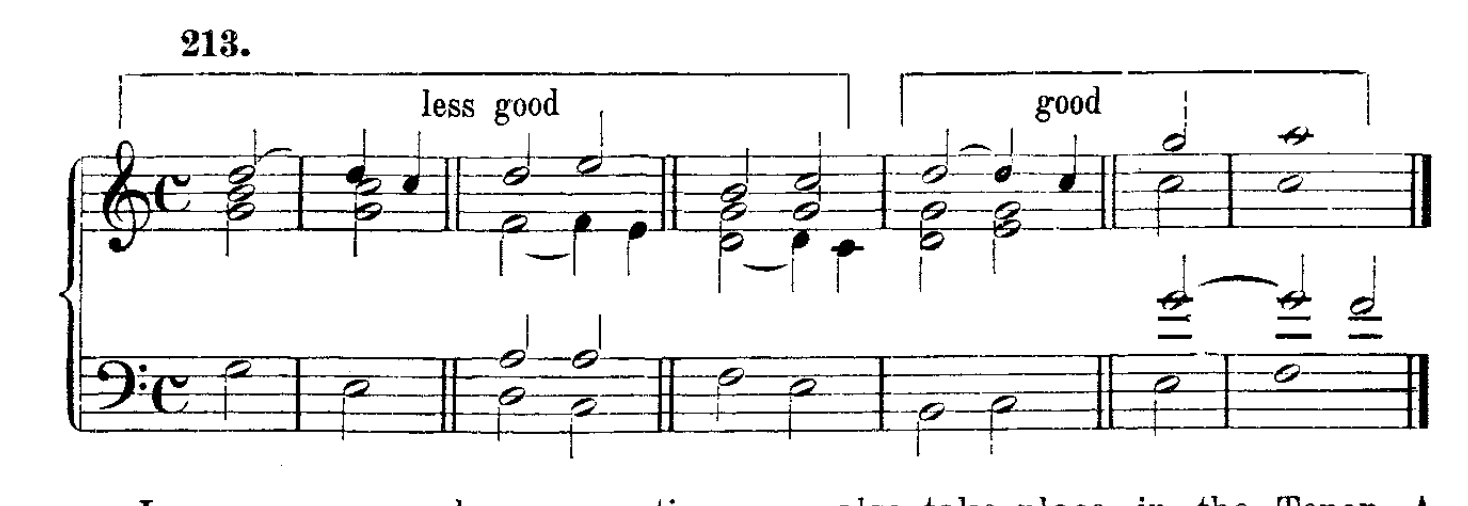
In rare cases such an exception may also take place in the Tenor. A suspension in the upper voice of a chord of the sixth may, for instance, be resolved into a tone already contained in the tenor, if this tone represents the doubling of the fundamental or of the fifth, and if, further, the voices in question are separated by the interval of a ninth instead of a second.
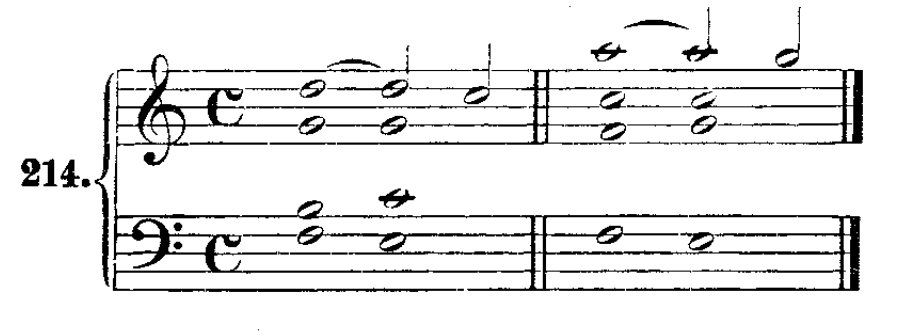
§ 72 In the Bass itself suspensions occur more rarely, since, in triads in fundamental form, and in chords of the six-four, the Bass is nearly always doubled in one of the upper voices, rendering the observance of the above rule impossible.
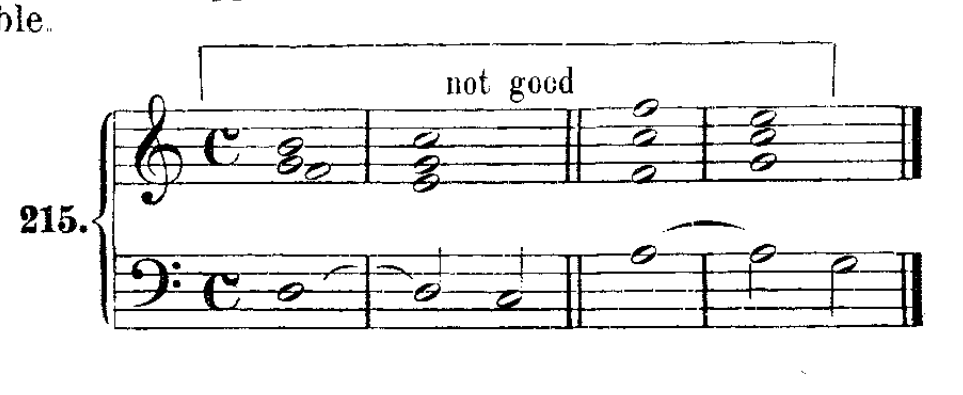
Consequently suspensions in the Bass can occur only in those rare cases, where the Bass—note is not doubled.;
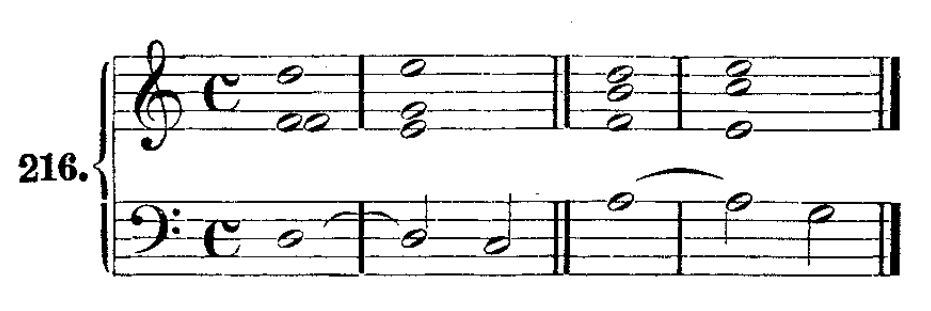
A suspension in the Bass sounds very good, if that voice has the third (7-th step of the scale) of the chord.
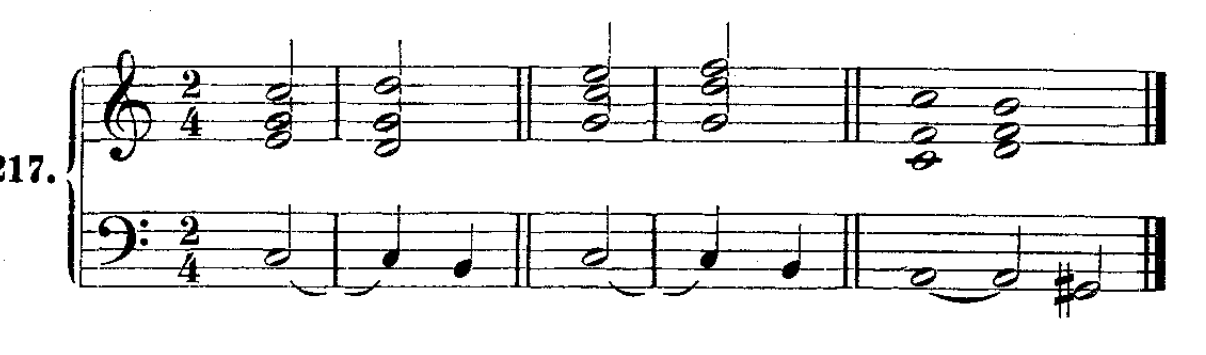
If, however, the voice-leading demands, that the third of such a chord be doubled, a suspension in the Bass is of course forbidden.
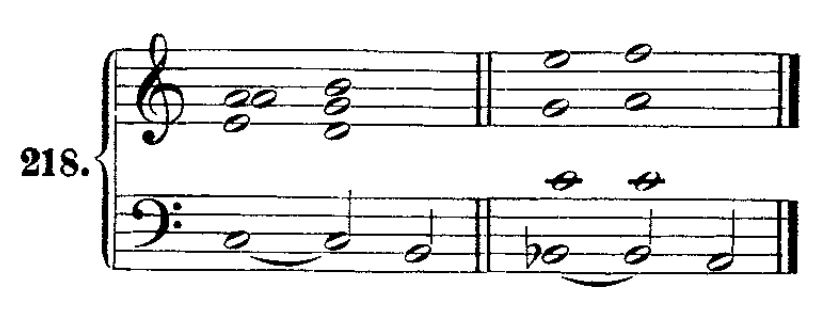
A suspension in the Bass is frequently found in the fundamental form of the Dominant-seventh chord as well as in its first two inversions; in the chord of the second, however, the suspension looses its dissonant character, as through the suspension itself the chord of the second becomes changed into the triad of the Dominant *).
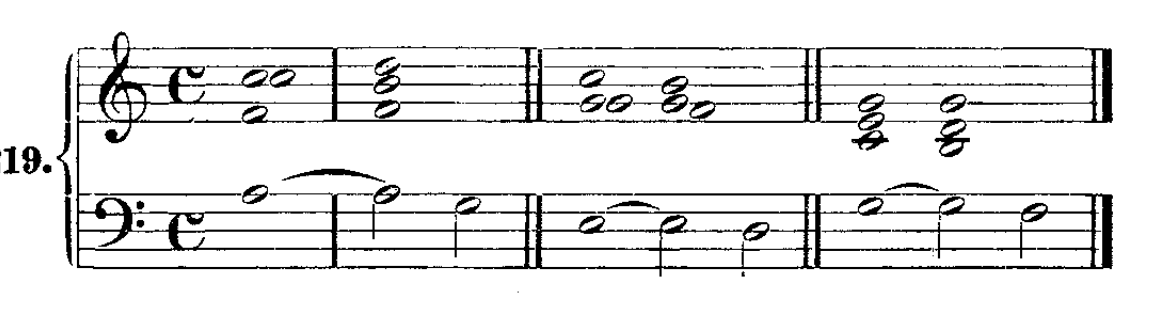
In the other chords of the seventh—with the exception of those on the 2-nd and 7-th degrees—the suspension in the Bass sounds very harsh and is but seldom found.
§ 73. Suspensions can also occur in two or three voices at once.
*) The suspension of the seventh does not have the effect of a Suspension in any case, even when occurring in some other voice.
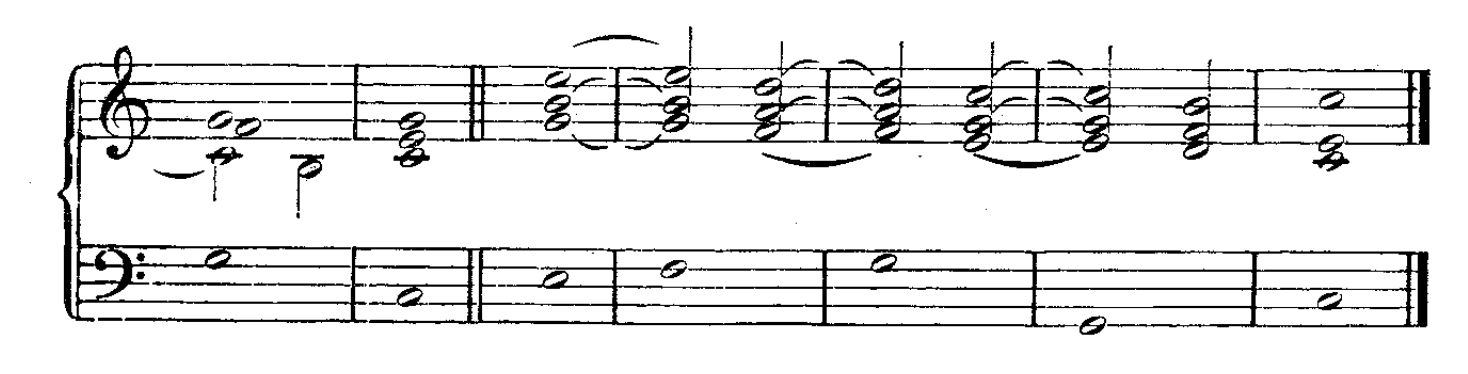
The suspensions marked with crosses give rise to the sort of six-four chords of which we spoke in § 47 division 4.
Suspensions in two voices at once are permissible only when the two voices progress in parallel thirds or sixths. Parallel fourths, if not accompanied by a third voice in parallel motion, sound almost as disagreeable as parallel fifths.
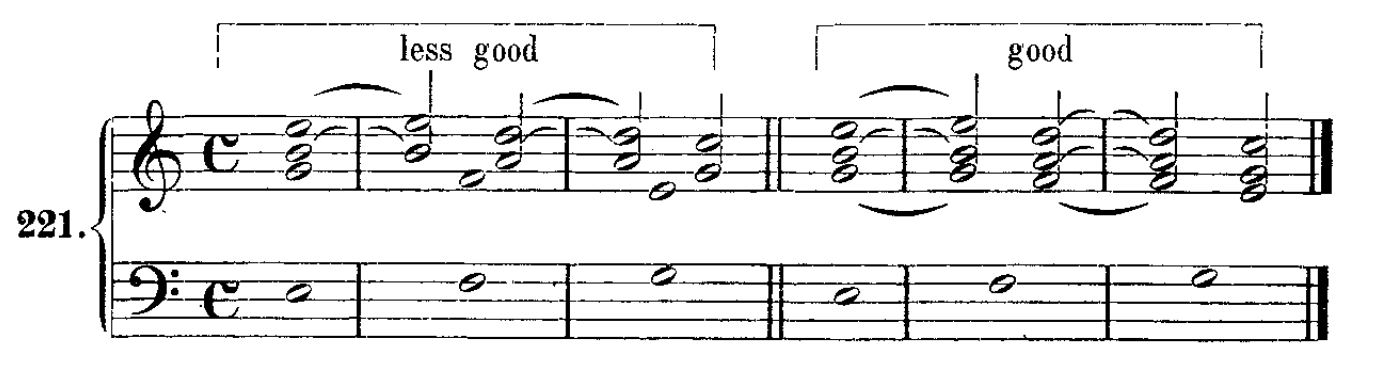
Note. Before proceeding to the solution of the following exercises, a few words concerning the figuring of suspensions. In the fundamental form of triads it is sufficient to designate by figures the voice, in which the suspension is contained, though a more minute designation would not be amiss.
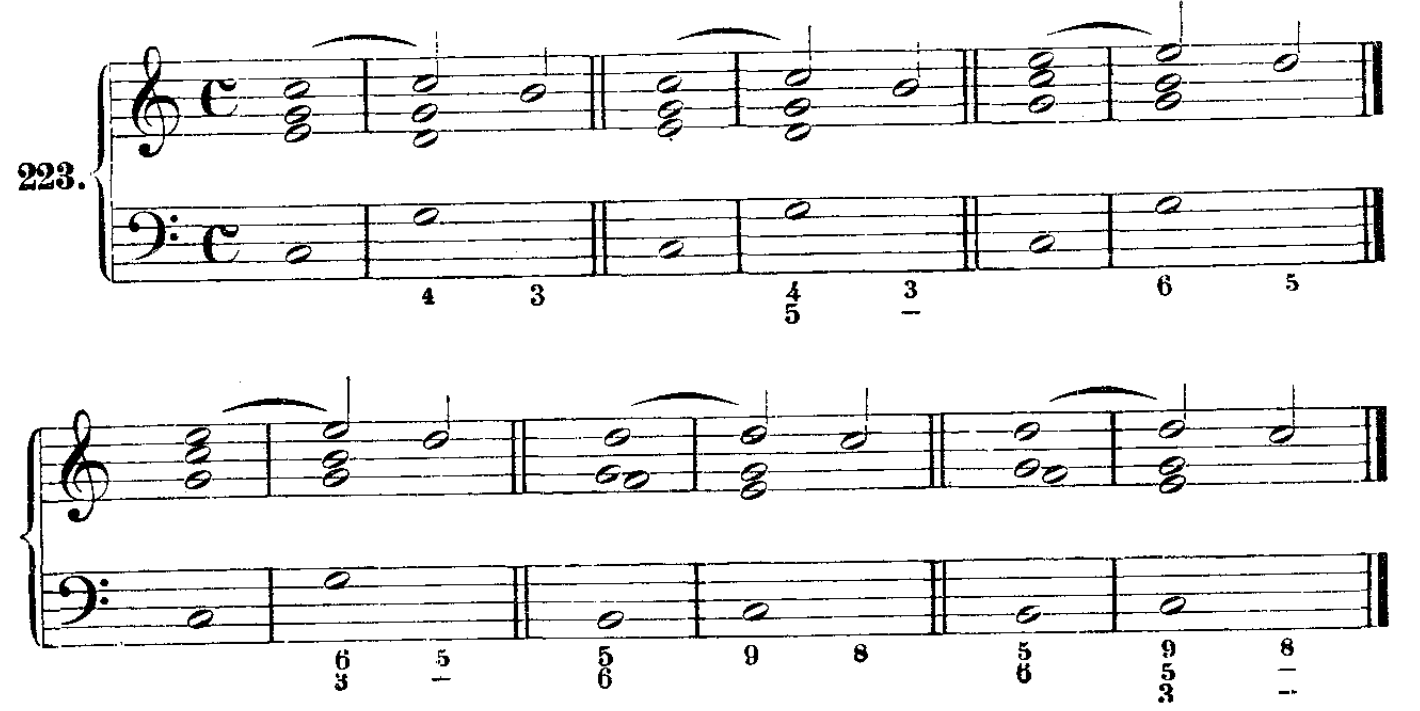
___In the inversions of triads and in chords of the seventh both the suspension and the chord itself must be clearly designated.
Suspensions in two and three voices:
Suspensions in the Bass can be figured in two different ways: a) all the intervals that result from the suspension are indicated by figures, while under the Bass note of the resolution a horizontal line is placed; b) under the chord of resolution are written the figures properly indicating it, while oblique lines are placed under the suspension.
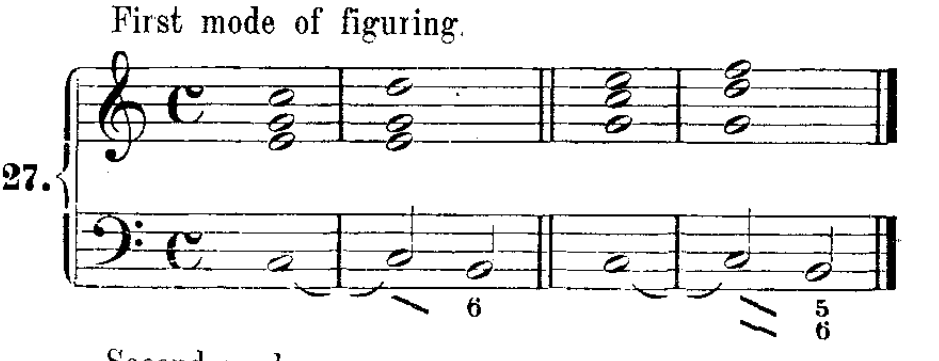
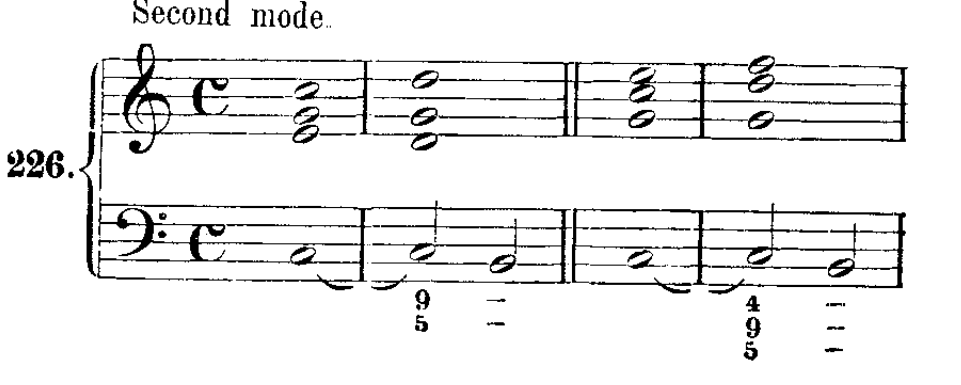
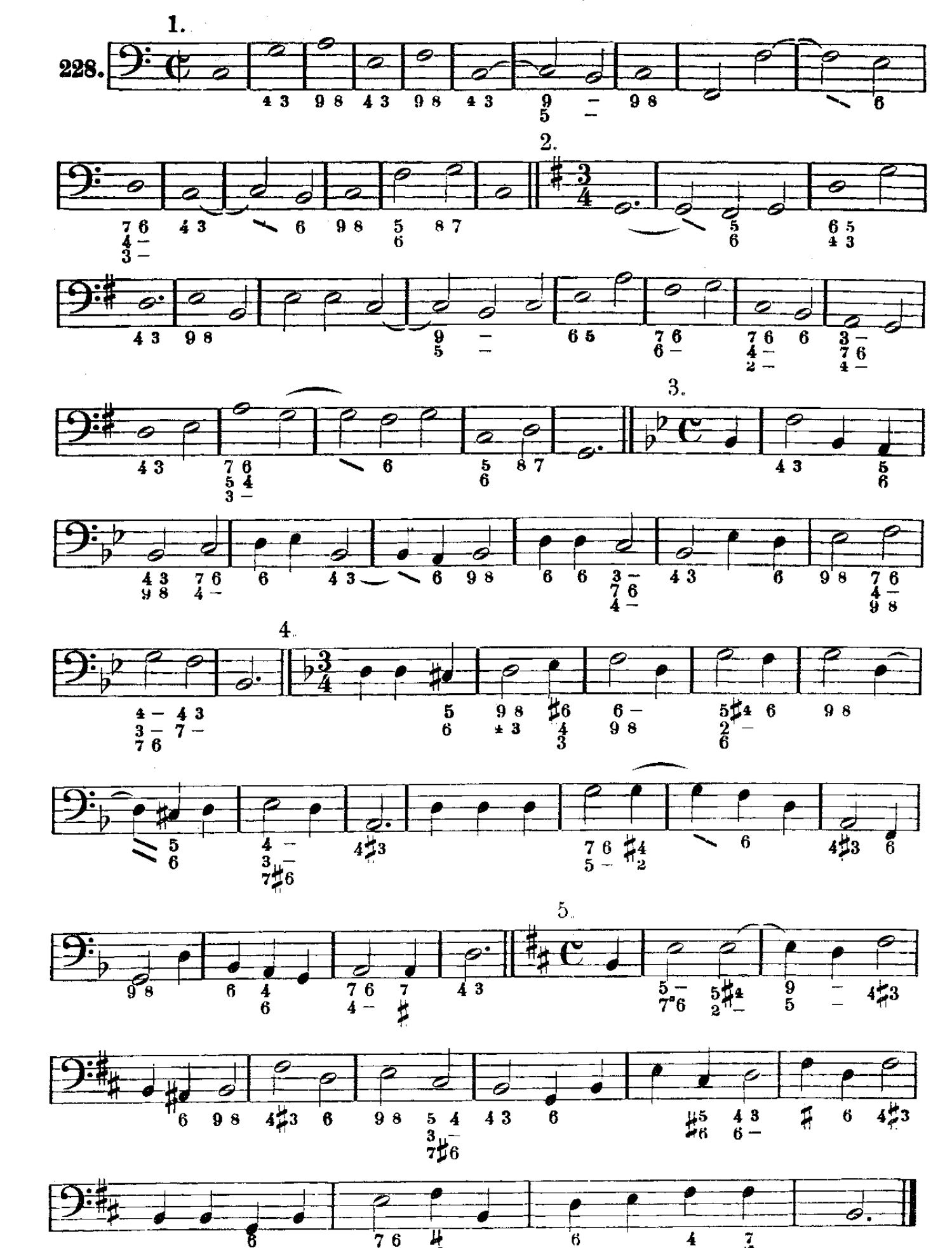
5 s employed mostly at points where the leading-tone
75, 2) The suspension in an upward direction is less natural. The ear can, for the most p wards into a conson art, tolerate a dissonance only when it progresses downance. For this reason suspensions upwards occur but sel-
, and only in rare ca ses tend to enhance the beauty of the harmony.
The suspension upwards i moves into the tonic
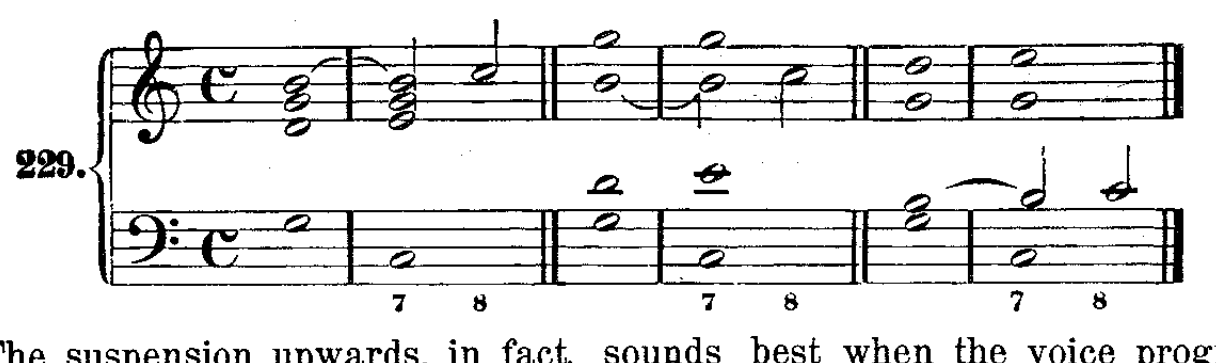
The suspension upwards, in fact, sounds best when the voice progresses a minor second.
In the Bass this suspension is extremely rare, occurring only where the Bass-tone is not doubled in an upper voice.
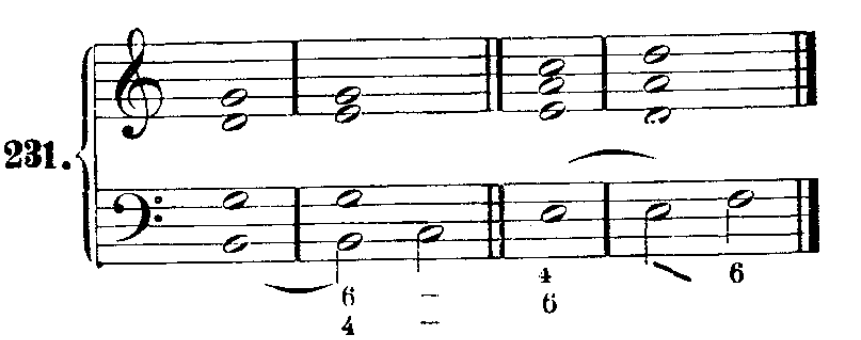
§ 76. A combination of the two kinds of suspension in one and the same chord, has at times a very pleasant effect.
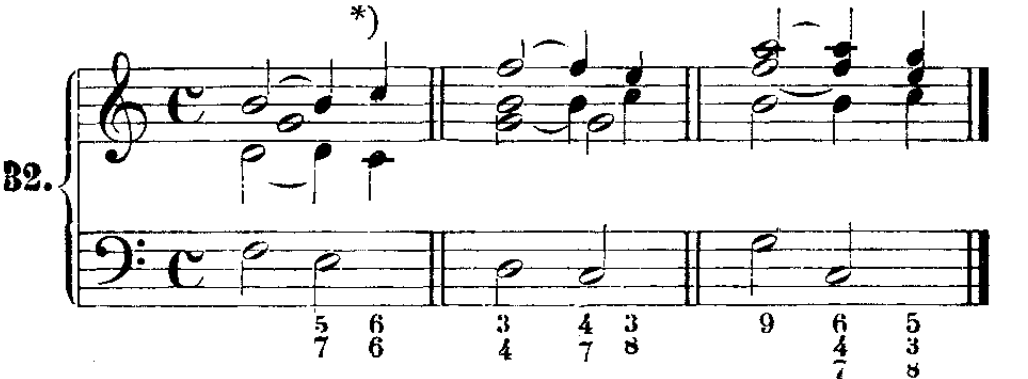
*)In these cases neither of the two suspensions could appear separately (see rule given in § 71).

§ 77. There are several exceptions to the rule governing the preparation and resolution of suspensions:
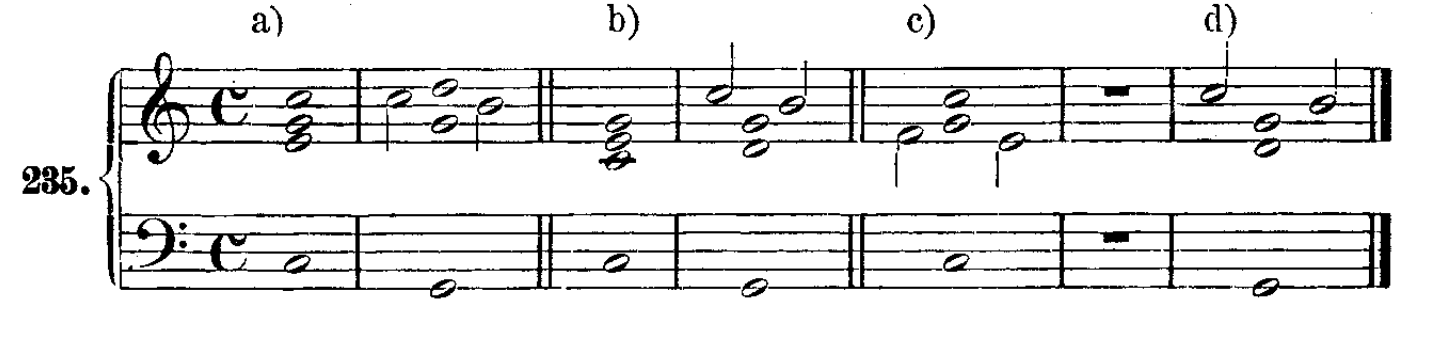
In case a) the preparation of the suspension, while appearing in the same octave, is effected by a different voice; at b) the preparation appears: neither in the same voice nor in the same octave; at c) there is no preparation at all, as the suspension constitutes the first chord of a piece of music; at d) the suspension enters seemingly without preparation—this is, however, not the case, as in the bar preceding the pause the tone forming the suspension is contained in the same voice and in the same octave.
The following exceptions may occur in the resolution of suspensions.
1) Between suspension and resolution one or more notes belonging to the chord—(harmonic notes) are interposed.
In example d) the suspended tone, before being resolved, is repeated after the harmonic notes.; 2) The suspension resolves by a skip into a tone, other than the one demanded by rule: e. g.
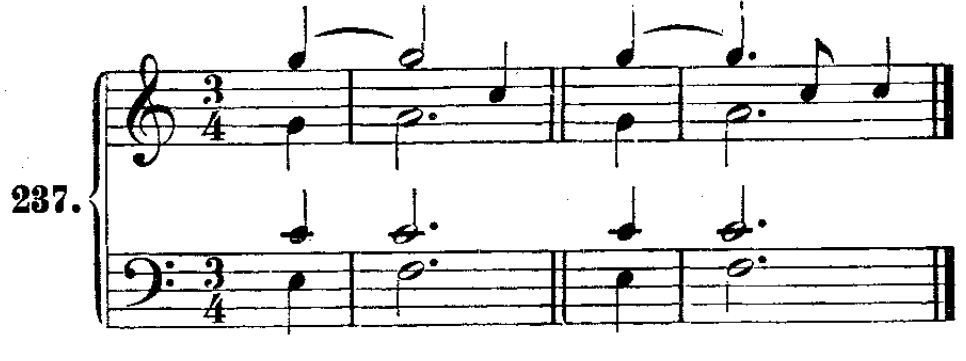
3) While the suspension resolves in the proper way, the other voices combine to form a new chord.
The student should bear in mind these exceptional forms of suspension, even using them in his exercises, whenever his fancy or musical instinct may prompt him to do so.
Special exercises for these suspensions are superfluous.