 Playable Books
Arnold Schoenberg · section 52 of 66
“Nonharmonic” Notes
Read and hear this section in the playable edition → Gradus ad ParnassumJohann Joseph Fux · passing notes
 Practical Manual of HarmonyNikolai Rimsky-Korsakov · passing notes
 Treatise on HarmonyJean-Philippe Rameau · passing notes
 Guide to the Practical Study of HarmonyPyotr Ilyich Tchaikovsky · passing notesPractical Manual of HarmonyNikolai Rimsky-Korsakov · neighbor notesGuide to the Practical Study of HarmonyPyotr Ilyich Tchaikovsky · neighbor notes
 ArrivalMayank Sanganeria · neighbor notes
I now come to one of the weakest points of the old harmonic system: the point where it suddenly abandons its manner of presentation and, as I said in Chapter I, has another system patched onto it—a system that is really none at all—in order to find some halfway accommodation for the best-known phenomena. It is curious that no one has yet noticed this: harmony, the theory of harmonies, concerns itself with notes foreign to harmony! Matters foreign to harmony surely belong in a textbook of harmony as little as matters foreign to medicine—tellingly, no such word exists—belong in a textbook of medicine. Whatever belongs in such a textbook is in it precisely because it is not foreign to medicine; otherwise it would not be in it. By the word “nonharmonic” (harmony-foreign) notes I can only understand the assertion that a number of notes are unsuited, or unsuited under certain conditions, to form harmonies: that such notes, because by their nature they lack the capacity to form harmonies, that is, sounds heard together, are being designated as something that has nothing to do with music and is therefore expelled from the art and from its theory. For the theory of harmony can concern itself only with harmonies, with simultaneous sounds, and could say nothing about what is foreign to harmony, or could say only that it has nothing to do with it. Either there are no nonharmonic notes, or they are not foreign to harmony.
But nonharmonic notes (the name, as one sees, is wrong at the very least) are supposed to be accidental additions to the chords of the system; the combined sound they produce supposedly cannot be understood as a chord, because it is impossible to relate it to a root. A second of their characteristics is then the fact that they give rise to more or less dissonant sounds, that is, to something that requires a resolution or some other justification through melodic means. What is supposed to be essential about them, however, is the accidental nature of their occurrence: that they appear only sporadically, less often than the other sounds.
First of all, then: nonharmonic notes do form simultaneous sounds; they are therefore not foreign to harmony. On the contrary, the events that arise through their participation are harmonies, like everything that sounds at the same time.
But they are supposed to be accidental harmonies; that would mean harmonies whose appearance does not come about of necessity, whose occurrence follows not the laws of musical logic but, quite the opposite of that logic, shows itself just when—according to that logic—one would least expect it. Something like a meteor or a shooting star, then, which is certainly there, but is apparently there by chance, because we did not know beforehand the moment of its occurrence and cannot comprehend it.
But this chance occurs, surely, too often for one to regard it as really independent of the laws. Every melody, insofar as it does not merely take the notes of the chord lying beneath it (a case that is relatively rare), and if it moves even somewhat faster than the harmony beneath it, must continually produce such sounds. And something that happens so often surely cannot be called chance; rather, one should try to recognize the regularity in it. One can ascribe it to chance that this or that particular person was passing below when a brick fell from the roof (although even that need not be chance, but may have been determined beforehand); but one can no longer call it chance that the brick strikes the very person who is passing at the decisive moment. For if the brick falls (which is perhaps chance) and someone passes below (which is perhaps also chance), then it is no longer accidental but, on the contrary, entirely lawful that he is struck, and no one could expect otherwise. Thus, when two chances act together, something entirely lawful can come about. Now there is this to consider as well: that the brick fell is chance at most in relation to the misfortune it caused—but not in itself. For its falling happened as the necessary consequence of two causes: the carelessness of whoever should have secured it, on the one hand, and the law of gravity, on the other. And that the man passed below is no chance either: he had to take this route for some reason or other, and since he walked at a certain pace, he, who had previously been so far from the future scene of the accident, had to be there at the corresponding moment. The only thing accidental about it is (perhaps!) the coincidence of the two circumstances, for we know no law governing that. It depends, then, on the point of view one chooses when one calls something chance.
Perhaps it is so here too. Perhaps here, too, the incalculable chance is to be seen merely in the circumstance that a voice moving against the sustained harmony gives rise to simultaneous sounds which one cannot call lawful: sounds which the author, so to speak, did not mean, did not intend, from which he expects no harmonic effect, which are of no consequence in relation to the essential harmonic foundations and have no influence on the further unfolding of the harmony. If that is so—in which case, however, he would have had to mean only his melody and his harmony, each separately by itself, and not as sounding together, although he wrote it down otherwise—then one still could not speak of accidental harmonic formations. For that is still not what they are, because the two causes through which they arise proceed according to law; because it is not by chance but of necessity that these two causes act simultaneously; and because from the nature of the whole one can not only foresee their occurrence but even calculate it precisely in advance. But one might perhaps speak of inessential, uninfluential harmonic formations, which they are at least to the extent that they apparently have no influence on the further development of the harmony. Even that is not entirely correct, to be sure, for it is improbable that in a well-formed organism such as the work of art anything happens that is without any influence at all on the whole. And even when I look at the most primitive case, that of the waltz, where the harmonic development, if one may call it that, is hardly influenced by such simultaneous sounds, if only because this harmonic scheme is there almost before the melody that produces those sounds, I find even here some things that make it at the very least unjust to assign these sounds a special position. For in the first place, any other chord, too, can find itself in the position of seemingly having no influence on what follows. This is evident in recitatives, where a chord is often given a continuation that does not correspond to it and that becomes intelligible, at most, through the unaccompanied vocal line in between. Or in this waltz scheme itself, where the repetition of tonic and dominant is followed at one time by cadential chords and at another not, so that the ensuing cadence cannot in any case be regarded as brought about by the preceding harmony. On the other hand, unless one simply assumes that the harmonic scheme of the waltz really existed before the melody, one must admit that these little events, taken together, at least determine the moment at which a change of harmony is to occur—which can, after all, be called an influence of these events on the harmonic course, even if not in the usual sense. Thus chords other than these accidental harmonies can also be seemingly without influence on the further harmonic development; and conversely, it has not been proved that these accidental harmonies really are without influence. And let this be stressed right away: this does not lie in their nature alone; it lies in their nature alone just as little as does their having influence. It lies solely in the way they are used. One can place them at one time so that they seem to stand there quite without consequence, and at another, conversely, so that everything seems to proceed from them. It must therefore also be possible to exploit these simultaneous sounds differently. And if one does manage, on occasion, to establish their apparent lack of influence, then it is not only wrong to consider it thereby proved that they must always be without influence; on the contrary, it would be more correct to investigate by what artistic means it became possible to neutralize their influence. But this in no way testifies against their capacity to form chords of the same significance as the other chords.
But what does that amount to?
Let us first examine what the nature is of the kind of chord that one does not call an accidental or uninfluential harmonic formation, whose own legitimacy and capacity for independent action are acknowledged. Its first characteristic is taken to be this: a chord is a simultaneous sound of at least three different notes; hence also of four, five, six, etc. notes. But the “etc.” is not right, for theory hardly acknowledges five notes, since ninth chords already arouse “doubt in the soul” of the theorists instead of reflection in their brains. There is supposed to be a limit here, then; what it is, by whom and why it was set, one is not told, to be sure, but one understands between the lines what is meant. Likewise it is passed over in silence what those simultaneous sounds are that contain more than five notes. That they are not chords, no one doubts; at most one says: accidental harmonic formation. Which presupposes that the others are not chance. I have already shown, with the uninfluential harmonies, that they are chance probably only when viewed very superficially and from a wrongly chosen standpoint. What, then, if I were to show with yet another case that even the chords recognized by the system can be chance, if one is unscrupulous enough to refuse to see anything more in them either? That they can be without influence I have already indicated. I do not want to hand the burden of proof for this to examples from more modern compositions, nor to rely on the fact that leitmotifs resting on one or two chords are set down (impressionistically) without having harmonic consequences; nor do I want to rely on older examples, such as the “threefold chord” from The Magic Flute—all of them cases of lack of influence that one could also call accidental, if one wished to be similarly imprecise. But I want to speak of counterpoint, of polyphony, of which it is said: here the chords arise only as accidents of the voice leading and, since responsibility for what sounds together is borne by the melodic element, they are without significance for the construction. There you are!
That, of course, is also only half true, for they are not really without influence; but they are relatively without influence—exactly like the accidental harmonic formations produced by nonharmonic notes.
If, then, accidentalness or lack of influence is not a characteristic lying in the nature of these things but at most one of the manner of treatment, then nothing remains of this first definition that could exclude the simultaneous sounds of more than five notes—except the argument that it is not their occurrence but their composition that is accidental. The composition of the major triads may be regarded as explained by appeal to the model of the overtone series. But even if one accepts the inversion of the idea of the triad and the undertones as an explanation of the minor triads, any such justification is already inapplicable as soon as one thinks merely of diminished and augmented triads and seventh chords, of simultaneous sounds acknowledged as chords. These have nothing more in common with the explained triads than their construction in thirds, which is surely insufficient. The concept of alteration, however, is no explanation but merely a statement of the facts: that notes in chords can be altered, or better, replaced by others, is certainly correctly observed; but a unified basic idea that would explain the functions even superficially is entirely lacking.
It is therefore highly unclear what such a chord is really supposed to be, since the coherence-forming capacity to provoke consequences appears to be a possibility of our technique rather than of the chord’s nature, and the model of the first overtones explains at most the major triad but nothing else. And our harmony surely contains a good deal more than that. What is the seventh chord, the ninth chord, etc.?
One sees that this gets us nowhere. These are neither definitions nor explanations. Not even the nature of the chord is described precisely enough; by what, then, is one to recognize what is not a chord?
I mean in general, so that really no doubt remains. For that a number of simultaneous sounds, for whose relation to what nature has given no fixed, direct formula and no simple, universally valid law is named, should be called chords, while the great majority of simultaneous sounds, which occur just as often, are not—that surely cannot pass for a system.
But there are still some characteristics for distinguishing these two groups that must be mentioned, which have not yet been considered, and one that is kept quiet, to be sure, but plays the greatest role in the secret society of theorists and aestheticians. The latter is beauty, the limit of beauty. I will deal with it later. The others are: 1. historical origin; 2. the treatment evident from works of art; and 3. a most ridiculous reason, but one that has had greater influence than people would like to suppose: the graphic image.
Historical origin. Whether chords were produced by voice leading or voice leading first became possible through our knowledge of chords is of no importance here, for—whichever came first—both spring from one drive: to bring the material given by nature, the tone, into the right relation to the receiving organ and to everything that comes into connection with the receiving organ, secondarily and tertiarily, by association or physically. That is, since the natural, inanimate material does not change, to adapt the receiving organ to what nature has given in such a way that the recognition and penetration of its essence may, if possible, succeed completely. Both procedures answer to this drive, since both, albeit by different paths, fulfil the purpose of producing the most faithful possible imitations of the material; and these imitations are the more perfect, the more knowledge (whether intuitive, by ear, or thinking, analysing) succeeds in perceiving all the characteristics by differentiating them. Thus one sees the tone-poets of all ages recognizing ever new secrets and producing ever more faithful images. Every newly attained stage makes further penetration possible. The primitive ear hears the tone as something indivisible, but physics recognizes it as something composite. Meanwhile, however, musicians had already found that it is capable of continuation, that is, that motion lies within it; that it harbours problems that struggle; that it lives and wants to propagate itself. They had overheard in it the octave, the fifth and the third.
Here they should have stopped, had it gone according to the will and the talent of the theorists! But that they did not do: they had recognized the scale; they did not, to be sure, understand how to find its fundamental, but they did what people must do when they want to find something: they reflected, they combined. They did what has led onto every wrong path, but perhaps also to many a truth—what people must and should always do where intuition will not help them further: they made use of the crutch for walking and the spectacles for seeing; they took mathematics and combination to their aid. Thus a wonderful system came into being; measured against our mental powers it is wonderful, but compared with nature, which works with higher mathematics, it is childlike.
Here they really did stop. That should not have happened, for until just before, one had been on the right path, that is, on the path. For now it is no longer the natural model that generates the new; instead the laws beget, in inbreeding and incest, those forms to which the pallor of the ideas, their fathers and mothers, clings as a mark of transience. Until just before, one was on the right path, when, following the command of the material, one imitated the overtones. But now the system was tempered, and the system tempered the burning urge to search. An armistice had been concluded. But one did not rest in order to rearm; one rested and rusted. The tempered system was an expedient; an expedient of genius, for the need was dire and the help great. It was a simplification of genius, but it was an expedient. No one who had wings would rather fly with a machine. The machine, too, is an expedient of genius; but if we could fly by mere wishing, we would gladly do without the machine. It should never have been forgotten that the tempered system was only an armistice, which must last no longer than the imperfection of our instruments makes it necessary; that we will have to come to terms with the tones that really sound again and again, and that we will have no peace from them or from ourselves—from ourselves too, for we are the seekers, the restless ones, who will not tire until they have found—until we have solved the problems that lie in them. It may well be that it is closed to us actually to reach this goal. But more certain than that is that we will have no peace before then; that the searching mind will not stop pursuing these problems until it has come to terms with them in a way that has really come as close as one can come. I therefore hold—in contrast to those who, in lazy pride in the achievements of others, hold our system to be the last word, the definitive thing found—I hold, in contrast to them: we are only at the beginning. We must go further!
Historical origin is therefore, from a certain point in time on, decidedly ill-suited to explain the real meaning of the phenomena: namely, from the moment when it partly neglects the model of nature by putting artificial, tempered tones in place of the real ones; from the moment when it expels nature from art by calling the overtones unmusical, by declaring that the chorus singer who intones a major third correctly is singing musically out of tune. To be sure, at the same moment all those chords that make up our present system become possible. Yet, as I have already shown earlier, these chords also carry within them what will one day overthrow the system—as was indeed mentioned in connection with the diminished seventh chord. But historical origin cannot explain unambiguously even in its earlier stages, for it is itself no single line. At one time it arrives at chords through voices; at another it lets the voice develop over the chords. Now if one is short-sighted enough—and one is—always to regard only the particular result as the goal, to take the chord at one time and the melody at another as the motor of the motion, then the possibility of recognizing the whole disappears. And instead of perceiving that both serve only one purpose—to penetrate what nature has given—one takes now the one, now the other to be the essence of music; whereas in reality it is not even a third thing, but a fourth, not to be discussed further here.
If, then, the historical origin of those simultaneous sounds called accidental harmonies shows merely the way in which such sounds were first used by composers, it is unsuited, for four reasons, to confirm the conclusion that these sounds are accidental:
1. Because historical origin is something other than what natural origin would be; because, accordingly, a natural origin would yield formations that correspond to the laws of nature.
2. Because historical origin has certainly, in some way, followed the will of nature after all, even if by paltry detours; for our mind can produce nothing that would be entirely different from nature. And if we assume that nature has laws, then even this human product cannot be accidental but only lawful.
3. Because historical origin tells us, at all, only in what order and by what path those harmonies made their way into music, but not in what relation they stand to the chief purpose of our activity; because, therefore, these harmonies may very well have arisen as accidental harmonic formations and nevertheless be just as lawful and fundamental as the others, whose fundamental character we have already recognized.
4. Because all the other chords of our system arose, after all, in a similar way to these simultaneous sounds. Namely: they too, used sparingly and cautiously at first, occurring as inconspicuously as possible, become everyday, self-evident events of every harmonic texture as soon as the ear is familiar with them. They are detached from the context in which they otherwise occur and used as independent chords, as I have shown with the diminished triad and the seventh chord.
And with this we have arrived at the second characteristic I adduced for these uninfluential harmonies: the treatment evident from works of art. From this, however, we will be able to draw no conclusions other than from what was dealt with before, if only because it shows more of how the thing came about than of what it means. That need not be so, if artists always had the courage to go back to the original source. But it is so. And since it is so, one must understand it—and one can, without being unjust and in full reverence for those great spirits who have walked this path—by becoming aware that their work was necessary just as they created it, and that art, as I said, is in reality a fourth thing, which these great ones always gave, even where they served less the ultimate purpose of nature with respect to the material.
The treatment of these accidental simultaneous sounds in works of art differs from that of the acknowledged chords in the following way. The acknowledged chords are either consonances or dissonances. As consonances they are entirely free, subject at most to the requirements of root progressions. As dissonances they are supposed to be prepared and resolved, but development has brought it about that both requirements are increasingly disregarded. But suppose the condition of resolution really existed, and non-resolution were only apparent, or merely a stylistic piquancy whose fundamental presupposition is resolution. Then the following difference would indeed have to be noted: dissonant chords resolve, that is, they are followed by a new chord corresponding to the character of the dissonance and to the requirements of the degrees; but accidental harmonic formations show something different on resolution. A note D, for example, occurring against the chord C–E–G as a suspension or passing note, resolves; but the chord C–E–G lying beneath it stays where it is and does not change. Here the sound C–E–G really does look like the principal thing, the unchanging thing, and the note D like an inessential, accidental, changeable addition. It might even be that there is no parallel case for this in harmony, and still that would not necessarily prove that C–E–G–D is not a chord. I find that this is merely the historical origin of this simultaneous sound, and proves only that this was its earliest appearance and the first way it was treated. And that the manner of treatment changed once the individual case became general and familiar, I have indeed often shown. I need only recall the case for which the rule says that the harmony may change at the same moment as a suspension resolves, so that a new chord catches the note of resolution (musical example 244); and it turns out that this is not even an unconditional characteristic of the treatment of a nonharmonic note. But there are parallel cases. For example, when the seventh chord D–F–A–C resolves, by the falling of the C, into D–F–A–B. Anyone troubled that D–F–A–B is also a seventh chord can imagine the matter thus: D–F–C (a seventh chord with the fifth omitted, which certainly exists!) resolves to D–F–B♭. Here the underlying harmony does not change. But it will be said that the root changes, which is not the case with the suspension. I recall once more, for the moment, that this need only be a difference in manner of treatment, which is not binding for the harmonic meaning. But then I ask: how does one prove that the root does not change as well when a suspension resolves? We have often seen that the old theory, to explain simpler matters, assumes an imagined root lying lower down, and we have accepted this explanation because it really is necessary if one wishes to keep to roots. Perhaps here, too, an imagined root is to be assumed that makes a step. And if we could believe in such a root in the other case, we may do so here as well. That we cannot determine such a root here may have many causes—above all, perhaps, that it has not yet been attempted. But then, if I attempted it and, for example, based the sound C–E–G–D on a root A or F, because there would then be a voice leading that can be new to us only because we have not yet tried similar interpretations; because, that is, under what is probably too narrow a conception of our view of roots, the case bears too little resemblance to the other objects of that view. But is the resemblance really so slight? Are there not, even in cases of undoubted root progressions, pictures that closely resemble what we refuse to acknowledge here?
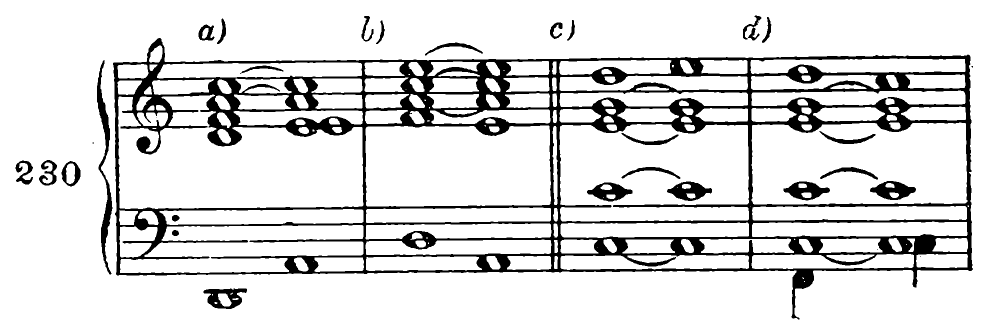
Do 230a and b not look very similar to 230c and d? And here one does see the roots! And these (230a and b) are surely chords! Not suspensions!
I do not think it necessary to elaborate on this further, although much more could be said about it. It is enough to recognize that the first manner of treatment tells us only that this is how it was done earlier—which must make it clear to everyone, however, that for precisely that reason it will be done differently later. The one is the preliminary work through which the actual task, the second, first becomes possible.
There now remains one more characteristic of the uninfluential harmonies, whose discussion might almost seem like a joke, but unfortunately is not. For I maintain: the system of triads was extended to four- and five-note chords only for this reason, and only where the picture of construction in thirds could be continued by adding yet another and yet another third. In fact, then, out of the graphic representation of the sounds; out of the visual impression: dot, space, dot, space, dot, space.... Only those sounds that could be traced back to this picture were admitted into the system; for that a seventh chord is a more complicated simultaneous sound than, say, a chord C–E–G–D is self-evident, as I shall show later. Nevertheless the seventh chord is a chord, and this sound is none! That a musician may hit upon a seventh chord, even if prompted by the graphic picture, sooner than upon the sound C–E–G–D, although the latter ought to lie nearer to him than the former, must be granted, because the order in which ideas occur need not depend on the degree of their kinship with the model. But it is not even certain that the seventh chord was recognized earlier. It was only into the system that the one was admitted earlier than the other. And that is, if not disgraceful, at least ridiculous.
I believe I have now shown that these simultaneous sounds are neither more accidental nor necessarily more lacking in influence than the chords of the system; that neither historical origin nor the treatment evident from works of art decides their harmonic meaning. I have also shown that they would not belong in the theory of harmony if they were foreign to harmony, and I may now, I think, arrive at the conclusion:
There are no nonharmonic notes, for harmony is simultaneous sound. Nonharmonic notes are merely those that the theorists could not accommodate in their system of harmony. And this comes from the theorists’ arbitrary assumption that the ear can take account only of the first five overtones. Thus, for example, Dr. Heinrich Schenker, a fine mind who has ideas and imagination. I have not read his book, but merely leafing through it I found everywhere, alongside the honest attempt to understand, furthered by rare talent and knowledge, errors—interesting ones, to be sure. The source of his errors, the unspoken underlying assumption of the academic historian—the age of music’s “full flowering” is over—drives him to an unbecomingly violent polemic against modern artists. From “This old thing is good,” which he is often able to show very beautifully, it therefore follows for him: “That new thing is bad”—leaving uninvestigated whether the new does not, in essentials, resemble the old. Faced with apples that are unripe but ripening, he judges like one who knows only fully ripened ones: the age of full flowering is past! However great his merits may be, he proves powerless especially where he tries to establish, positively, a clear demarcation. It is precisely there that he becomes nebulous. So, for instance, when he speaks of the “mysterious number five,” beyond which (if I remember rightly) we are supposed to be unable to go. A poetic thought, certainly, but a little too poetic in the bad sense, since the true poet recognizes the truth; for we have long since gone beyond five in the meantime. But that does not trouble him, for he wishes the number five to remain mysterious to him. To this end he not only becomes blind to reality but also contents himself with false and inexact observations, for otherwise the “mysterious” cannot be maintained. The number five is surely in itself no less mysterious than all other numbers, but no more so either. And in any case, secrets that we find out are either no secrets, or else we have not found them out. What nature wants to hide from us, it hides better. But besides: the number five is supposedly remarkable because it shows itself everywhere in music as a kind of limit—for example (I do not remember everything) as the fifth overtone, and as the fifth note of the scale, the fifth. Yes, but who says that the fifth has anything whatever to do with five? Because we have given it the name “fifth”? That does not make it really five; in the overtone series, for instance, it is the second tone; in the triad it is the third; and in the chromatic scale it is the seventh note. That we designate the interval C–G by five does not derive from its being really and in every respect five, but from the fact that our—our—present scale happens to place three notes between them. But what if it had placed four, or two, in between? And that could have been so, and could also have been right, for nature is far more open to interpretation than our secrets.
One arrives at such errors when, to explain events, one seeks out only as many reasons as barely suffice to include what is known, instead of providing a surplus of reasons for cases that do not yet exist; when one takes the known phenomena for the only thing there is, for the last and unchangeable utterances of nature, and explains only them, instead of considering that nature thoroughly in its connection with our sensations, whereby these events would then show themselves not as a conclusion, an end, something definitive, but as a small part of an immense whole that cannot be surveyed, in which five is just as interesting, but no more mysterious, than all other numbers, be they primes, products or powers; and whose secret is not fenced off from us by their size, but consists in this: that it is unknown to us that, why, and which phenomena they underlie—which we sense, to be sure, but do not know. It should not be overlooked, however, that these secrets are merely unpleasant for the one who does not know; that only one who is blessed with a presentiment of their solution rightly surrenders to their thrill; and that the mysterious in itself possesses no more truth than the atmospheric does at the cinema.
There are no nonharmonic notes if one arrives at such principles. For the natural model, the tone, is capable of explaining as chords simultaneous sounds quite different from these simple ones. And we stand toward this model in the relation of one who analyses and searches; by imitating it we discover more or fewer of its truths. The creative mind strives for more, ever more; less suffices for the one who merely enjoys. Between this more and this less the battles of art are fought out. Here truth, searching—there aesthetics, what is supposedly found, the reduction of what is worth striving for to what is attainable. What is worth striving for is to pursue everything that lies in the natural tone, to achieve with it everything that the combination-forming associative capacity of the human brain is capable of. The attainable has its provisional limits where our nature and the instruments we have devised have their provisional limits. The attainable in what lies outside us, in the tone, has, theoretically speaking, no limits. What has not yet been attained is what is worth striving for. What was attained was a system in which some overtones could be accommodated fairly exactly, and some others fairly inexactly. What was attained was the almost exhaustive working-through of all the combinations of this system by the unconscious ear of the creative musician, by his intuition. What is still entirely lacking is the correct determination of the relation between what has been attained and what is still to be striven for. Everything else, accordingly, remains to be striven for: the exact accommodation of all overtones, their relation to the roots, possibly the formation of a new system, the working-through of the combinations of the relations resulting from it, the invention of instruments that can represent all this... etc.
Not only the accidental chords but also the fundamental ones are found because the natural model, by permitting it, invited it. The major consonances are direct imitations of the model, the other consonances indirect ones. Both are contained in the overtone series as overtones lying more or less near the fundamental. The remote ones, the dissonances, were likewise found as imitations of nature, partly directly (albeit, like the tempered system, inexactly), partly indirectly or by combination. The sounding tone justifies the exact imitations and the inexact ones. It admits approximations, as is shown by the tempered system, which is a system of approximations: the perfect system of an imperfect thing. The introduction of dissonances always took place with caution: preparation, resolution, passing motion, ornaments, etc. The ornaments are only preliminary stages toward eventual free use. Bound use is the first means, free use the next goal. And then it goes further! For we are only at the beginning. We still do not write out all the ornaments. We probably do not yet even suspect that, and which of, these ornaments are preparing the way for the future shape of music. But just as people finally dared to write down the seventh chord, so they will one day dare to fix these ornaments in notation too. And then it goes further! And just as the seventh chord was finally used freely, placed even where no ornament introduced it any longer, admitted into the system, transferred to the other degrees, altered, and new chords formed from the constructed degrees, so here too people will one day combine, set up approximations, and take them for the final word.
But we are not that far yet. We need not go that far at all. The only question is whether individual chords, which we are even allowed to use, belong in the system or not. I say: they belong in it, although the system is too narrow for them, although this system has set itself limits it need not have. If, for example, one plays a C major triad in three parts on the piano in a lower register, then among the nearer overtones there sound along with it: from C, C–E–G; from G, G–B–D; from E, E–G♯–B; altogether, then: B, C, E, D, G, G♯. And those are only the nearer overtones! But a D in a chord C–E–G is supposed to be nonharmonic, that is, foreign to the simultaneous sound; that is, when a D sounds, it is a special case, by no means the everyday one. And if one does with the D the same thing one did with the E and the G, then that is not a harmony like C–E–G; rather, the D is nonharmonic and there is an accidental harmonic formation. Namely: if one has the D, which in any case sounds along as an overtone, sung by a real voice too, with the same justification by which the E and the G—which are, after all, realized only because they sound along anyway—are set as actually sung notes, then this is supposed to be an accidental harmonic formation, while that is a chord, although there is no difference between the two. Of course. The D is hard to accommodate in the system because even the most advanced theorists maintain that ninth chords, if they exist at all, cannot be inverted—although ninth chords are precisely a proof of how exactly the sound C–E–G–D corresponds to nature. At the same time, however, this C–E–G–D shows that this chord lies nearer than a seventh chord. For the seventh chord on C would have to use either the fourth overtone of G or the sixth of C, which, however, is out of tune. And since in the sounding chord G has nearly equal rights with C, the purer fourth overtone of G lies nearer than the out-of-tune sixth of C. But nearer still than the fourth overtone of G, the B, lies the second of G, the D. And so if the fourth of G can on occasion be preferred to the sixth of C (as does happen, after all, in the seventh chord C–E–G–B, which as an “acknowledged” chord may appeal to nature), then the second overtone of G must surely have an even better claim. And the chord C–E–G–D thus surely lies nearer than C–E–G–B (or B♭). But what, then, about the G♯? How is that to be accommodated in the system? As if the system had to be built precisely on thirds! Why not on fifths, which do lie nearer than thirds? Why “built up” at all? Perhaps sounds also have three dimensions, perhaps even more! But very well! Build away, but do not demand that I take your system for more than what it is: a system for presenting the events, but not one that explains them. When a junk dealer who has bought up a lot of old stuff creates a rough order by picking out and sorting the better pieces, but leaves the rubbish he can no longer sort lying in a heap and says to a buyer: “Here I have a number of goods that are better; and over there lies some more stuff I don’t really know what to do with—pick out whatever you can use!”, then he is proceeding like these constructing theorists. For among the rubbish the junk dealer no longer knew what to do with, to which he preferred his old trousers and patched jackets—among such rubbish old works of art, valuable paintings, master violins and so on have mostly been found. “Which I don’t really know what to do with”—all right, then. That much you must admit! With that I will be content, and you may go on building in peace. But that the system is false, or at least inadequate, because it cannot accommodate phenomena that exist, or else labels them rubbish, exceptions, accidental harmonic formations, a heap—that had to be said. For the system presumes to be taken for the system of nature, while it is scarcely a system of presentation. Confess: “because I don’t really know what to do with it!”—then we shall be good friends. But the presumption must stop.
There are, then, no notes foreign to harmony, but only notes foreign to the harmonic system. Passing notes, changing notes, suspensions, etc. are, like sevenths and ninths, nothing but attempts to include something that sounds like the more remote overtones among the possibilities of simultaneous sound—which is what harmonies are. Whoever gives rules for their use describes, at best, the way in which they are most often used. But he has no right to claim that he has thereby precisely demarcated the situations in which they sound good from those in which they sound bad. Situations in which they sound bad do not exist. Proof: the whole literature of music. No limits are set to the possibilities of simultaneous sound; at most to the possibilities of bringing simultaneous sounds into a system that determines their aesthetic value. For the time being; later, that too will probably succeed.
Now an example. Over a sustained harmony C–E–G, two voices carry out a C major scale in contrary motion.
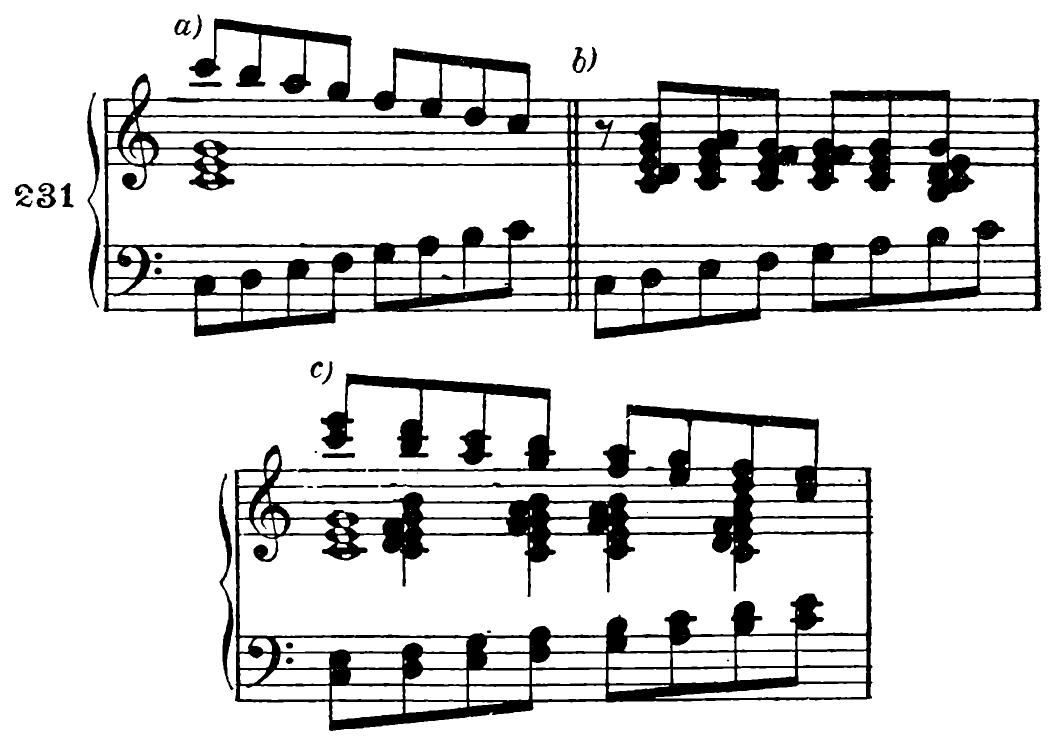
What combinations of tones arise here (231a)? I write out separately the individual moments that are particularly striking (231b). Or two voices move in thirds, in contrary motion, above a sustained C–E–G triad (231c). These are certainly harsh sounds. And the theorists, who always justify the darkest suspicions one can have of them, seem not to have examined these harsh sounds more closely because of their harshness, their lack of beauty—chiefly, it seems, because a theory that wishes to construct beauty instead of seeking truth can do nothing with such harshness. For if they were admitted to the system as equal members, there would be a danger of their spreading like the other harmonies, and then the theorists would have to begin thinking. It would be truly dreadful! Yet such cases occur often enough in reality. I need not even consider the equally frequent case of chromatic scales moving in thirds, or the many other things occurring in what is now called noise music—perhaps a “mannerism” hides behind that name—to demonstrate what these examples alone could show.
I maintain that these are chords: not the chords of the system, but those of music. Someone will object: yes, but that happens only in passing. I say: the seventh chord and ninth chord also occurred only in passing before they were admitted to the system. Someone will say: seventh and ninth chords were not such harsh dissonances as these. I ask: how do you know? Who was there when the aestheticians, the unproductive ones, became indignant about the first seventh and ninth chords? But I do know that people were indignant about the first thirds anyone dared add to the bare fifth. And these dissonances cannot be too harsh, or people would surely not dare to write them. Yet they do dare. The reply is: they dare only because the dissonances pass so quickly, because the resolution is already there before one has become conscious of the dissonance. I ask: what is quick? What is slow to one person is quick to another. Speed can only be expressed as a ratio to the capacity for perception. If one can distinguish, it may indeed be quick, but not too quick. And one does distinguish! At least someone sensitive to dissonances knows that he could not stop at one of these dangerous points. Thus the dissonance enters consciousness at least in this way. But even if it remained only in the unconscious: does anyone believe that the same process does not occur here as with the other, already emancipated dissonances? Does anyone really believe that such simple processes of the subconscious will not eventually become conscious to artists who knowingly write and play such combinations year after year? Apart from that, does a conductor not hear a wrong note in such combinations, provided the figure is not too obscured? If consciousness suffices to test the combinations against the notation, if the ear thus analyzes them quickly enough, why should it not be able to recognize them when they occur detached from their context, when they sound longer, when the ear has more time to analyze them, more time to befriend them by recognizing and acknowledging their impulses and tendencies? Granted that for the present such combinations occur less often freely than in passing: do they not also occur often enough as unprepared suspensions? And what is an unprepared suspension essentially other than a chord? What is the appoggiatura but an embarrassed concession made by the keen ear to the concept-bound eye? Something is supposed to sound here whose appearance the eye cannot tolerate. Must a suspension resolve? A seventh chord must resolve too. Yet a leap away from an unprepared suspension without resolution occurs more often than a leap away from a seventh. Then the unprepared suspension would actually be a less sensitive dissonance than the seventh. Perhaps that is not even so incorrect. In general, unprepared suspensions occur less to present harmony than in melodically developed voices. The melody, the motive, then bears responsibility for them, if one is unwilling to regard the entire combination as a chord. The inability to regard it as a chord does not arise because it is not one, but because it resembles none of those found in the system.
But now an objection is made that can defeat everything I have demonstrated so far: “Such combinations are not beautiful.” And I must say: yes, unfortunately that is true; they are not beautiful. That is precisely what is sad about the matter: even the great masters did not hesitate to write passages of which the smallest aesthetician can so easily assert that they are not beautiful. This has often distressed me. Only recently I found the following four chords in Bach, which could surely never please an aesthetician if he noticed them:
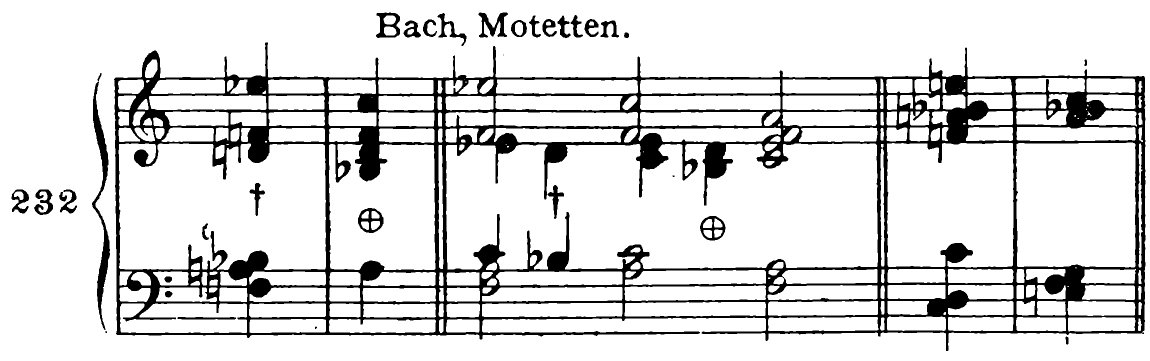
And naturally the sly fellow hid them in motets written in the old clefs, where a theorist cannot easily read them, and in passing, where an aesthetician cannot easily hear them. One should watch the old gentleman's fingers a little more closely and force him to show his colors—that gray color on our theorists' coat of arms. And the strangest thing is that this Bach even reflected on theoretical matters himself and, as a teacher, was actually obliged to concern himself with them. Indeed, he was even suspected of having inherited, as a family secret, a formula for inventing fugue subjects. Only a person with imagination could behave so contrary to the proprieties of his profession. And yet it is incomprehensible that a person of unquestionable knowledge should write such things.
And it is truly incomprehensible that musicians, who always know more than theorists, have written things not permitted by aesthetics. There is, for instance, “this Mozart,” who writes the following chord in the G-minor Symphony (233a). Admittedly it occurs in this context (233b), but nevertheless without any preparation.
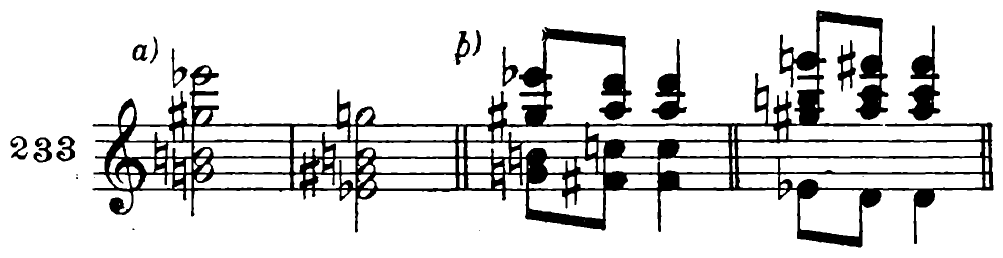
But the theorists told him even during his lifetime what a hunter of dissonances he was, and how all too often he succumbed to the urge to write what was not beautiful, something his talent surely made unnecessary.
It seems that they do need to. That they need to write precisely what the aestheticians dislike, precisely what they declare unbeautiful. Otherwise we would not see it again and again throughout history. But if it truly is unbeautiful, who is right: the aesthetician or the artist? History leaves no doubt that the one who is right is the one who will always be right: the creator, even if it is unbeautiful. What, then, is the situation with beauty?
It is this: beauty exists only from the moment when the unproductive begin to miss it. Before that it does not exist, for the artist has no need of it. Truthfulness is enough for him. It is enough to have expressed himself: to have said what had to be said, according to the laws of his nature. But the laws of the nature of a person of genius are the laws of future humanity. The rebellion of the mediocre against them is sufficiently explained by the fact that these laws are good. Rebellion against the good is so strong an impulse in the unproductive that, to cover its nakedness, it urgently needs the beauty that the geniuses unintentionally give it. But beauty, if it exists at all, is intangible: it exists only where someone whose power of perception alone can bring it forth creates it through that power alone, creates it anew each time he perceives. With this perception it is there; as soon as the perception ends, it ceases again. Everything else is talk. The other beauty, which one can possess in fixed rules and fixed forms, is the longing of the unproductive. To the artist it is incidental, like every fulfillment, for longing is enough for the artist; but the mediocre want to possess beauty. Nevertheless, beauty gives itself to the artist without his having wanted it, for he sought only truthfulness. Only truthfulness! Try to seek it, you unproductive person, if you can! But the artist attains it, for it is within him and he merely expresses it, merely presses it out of himself. And beauty exists in the world through only one other thing: through a kindred stirring in the nature of someone without genius, through the ability to suffer in sympathy what great people have experienced. As an accompaniment to that great capacity for fellow feeling which elevates the ordinary person, as a by-product of the necessary labors genius performs in penetrating nature, beauty may indeed occur.
Then these chords really are not beautiful. Of course not, for nothing is beautiful in itself, not even a tone. Naturally, it is no more ugly in itself. It becomes one or the other according to who handles it and how. Perhaps one is even more justified in calling these chords unbeautiful than in calling other chords beautiful. They are not beautiful, at least not at first; indeed, they never become beautiful. But anyone they do not immediately appeal to may first become familiar with them. Then they too will probably evoke feelings of beauty, like those long familiar to him. The ear is often slow to grasp, but it must adapt. People usually find adapting to the new difficult, and it must be said that precisely those who really possess a kind of cultivated sense of beauty, precisely because they have a conception of what pleases them, resist most fiercely the new that wishes to make a beautiful impression. In fact, it wishes only to make a true and truthful impression, but that is called beautiful.
I might be suspected of wanting to paraphrase the concept of the beautiful through that of the true, the truthful. That alone might even be an advantage, for it would at least eliminate those purely formal investigations, those experiments seeking to reduce beauty to an arithmetic problem. Yet what beauty would have to be, if it were something real, could satisfy us only if it could not be represented by an arithmetic problem: if the whole magic revealed itself as something very complex rather than very simple; if multiplicity really sprang from a seed that burst because it could not withstand the revolution of the forces within it. Not from a well-tamed formula in which an improbability on the left of the equals sign balances one on the right, yet cannot conceal that they are improbabilities precisely because they balance. Life is not symbolized in that way, for it is motion. But a danger does indeed arise that the dry enthusiasm of formalism would be replaced by the damp enthusiasm of extravagant emotional and moral sentimentality. Let that danger arise! Let it produce for a time the same obscurity about the nature of things that formalism previously supplied us so satisfactorily. The change itself, a differently colored glass, would really be enough for me. One will find something new here, and even if it is not substantially more correct than what was found before, it is at least new; and the new, if not the true, is nevertheless the beautiful. I do not share the great anxiety of the philistines who cannot believe in beauty unless they can check it against rules they have merely learned rather than experienced. Anyone with a feeling for people and their works will recognize genius without aesthetics through those immediate effects our instinct distinguishes as reliably as it scents friend and enemy, congenial and uncongenial people. Truthfulness may also be mathematically expressible, perhaps even more so than beauty, for which a formula ultimately does not suffice and feelings of beauty must be explained by the sense of beauty. Truthfulness is a number expressing the artist's relationship to his work. Its relativity is already expressed in this. This already says that, although there is only one complete truthfulness—when this fraction equals one, where motion also ceases—in reality all intermediate stages exist. This accords with life, for it shows both the goal and the criticism of striving. Error too has a place in it, belonging to truthfulness just as truth does. It deserves a place of honor, for we owe it the fact that motion does not cease, that one is not attained, that truthfulness never becomes truth; for it would be scarcely bearable if we knew the truth.
Even causes that arise solely from feeling, and effects that can be tested only through feeling, will probably eventually demand that the intellect recognize their laws. But they will not want it to prescribe those laws so that they must comply with them, as the laws of beauty do. At least the advantage would thus be gained of preventing reason from imposing on things that can be judged only by feeling a simplification suited to reason but too narrow for feelings.
By the time the reader has reached what I have said in response to the quotations from Bach* and Mozart, he will have forgotten that I already refuted the objection that these “discords” occur only in passing. I foresee this, for I know how the kindly reader thinks when intending a rebuttal, and therefore ask him to remember it. The Bach quotations occur in Motet No. 4, pages 56 and 59 of the Peters edition, in the following context:
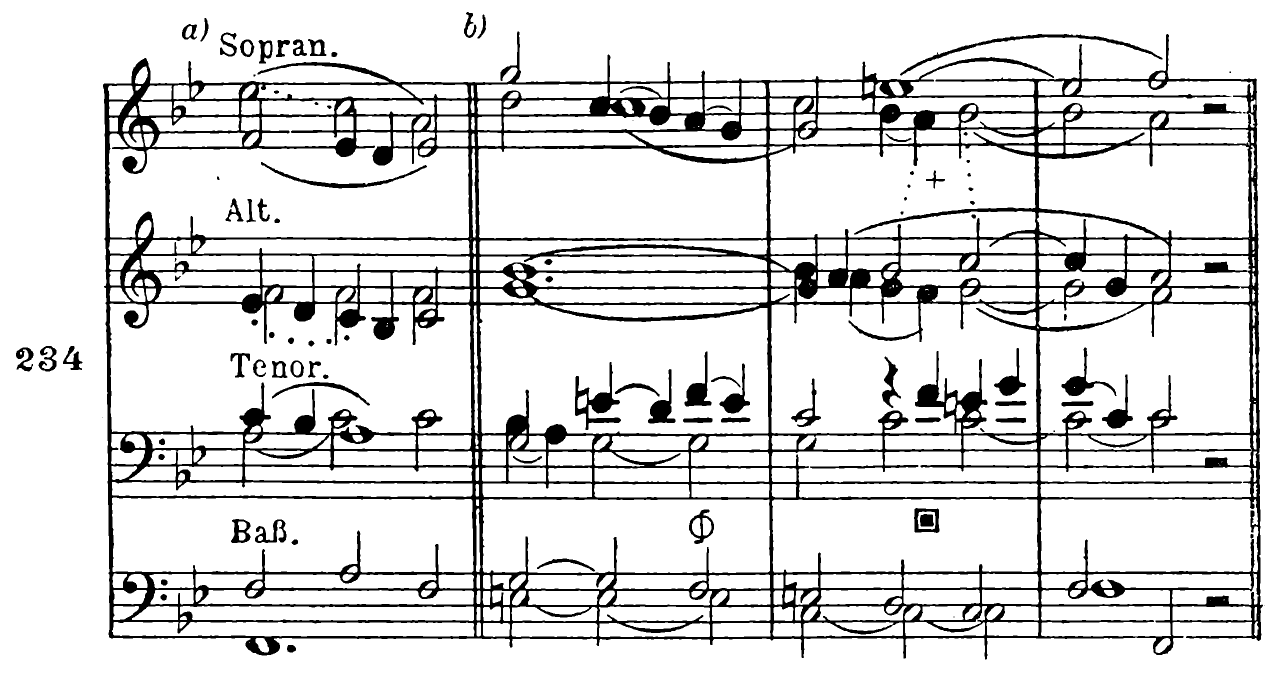
* A misunderstanding by someone who agrees with me draws my attention to the possibility that the chords cited here might be regarded as isolated cases occurring occasionally in Bach. But they are not; on the contrary, they are regular occurrences. Not only because the impulse to use the more distant overtones makes them necessary, but above all because the eight-part writing compels them.
As the reader will recall, I have already discussed the speed and transience of passing motion, and anyone who could follow that discussion must admit that this relative concept cannot serve as an absolute standard. But suppose it could, and suppose Bach really had sought beauty: what would follow? Combinations such as that between the two basses at the circle-and-line sign—note, this is not a fast tempo!!!—or the progression in seconds between second soprano and first alto at the cross, or the unprepared entrance of the tenor at the square, are at least very harsh events. Incidentally, the hidden octaves between second soprano and first alto in 234a are also interesting. Since we cannot assume that a master like Bach would have been unable to avoid such combinations if his sense of beauty had forbidden them, and since it is also impossible that they occur unintentionally or by mistake, for they appear not only in this work but in every other work by Bach, he must undoubtedly have found them beautiful. Or at least they did not disturb him, whether he sought beauty or not. It is therefore certain that harsh combinations, since they occur in Bach and are presumably no blemish on beauty, are actually requirements of beauty, if beauty itself is a requirement. Granted that he allowed them only in passing because his ear could not yet tolerate setting them down freely: he did at least set them down, and thereby did more than nibble at the tree of knowledge. He yielded to the impulse to introduce more complicated combinations wherever he thought this could occur without endangering the intelligibility of the overall effect. But the essential thing was present: the impulse to write harsh combinations, which I find identical with the impulse to draw on more distant overtones. He placed them in passing so that we can use them freely; he used a swimming belt so that we can learn to swim freely, just as he swam freely where his predecessors needed the belt.
People will ask why, in the earlier parts of this book, I explained and discussed every detail of a system so thoroughly, tried to eliminate small errors, gave laws a different form, and so on, if I now provide evidence of that system's inadequacy. They will ask whether I can establish a new system or extend and improve the old one. And since, as I said from the outset, I cannot provide a system, they will see a disproportion in pursuing such subtle distinctions as those concerning the six-four chord while such a great number of combinations are here neither individually nor even collectively examined, ordered, and evaluated. They will find that the pupil, previously guided so strictly, suddenly and unpreparedly confronts a freedom with which he does not know what to do.
First, as to the disproportion: it may even be greater than in other textbooks, but only because I have described matters in the first half more precisely than they do, while still saying as much as they do about the second half. My effort to explain the problems psychologically, through craftsmanship, or through the overtones will in any event benefit a future theorist, even if he builds on principles different from mine. For my attempts never rest on aesthetic judgments subject to change. I never say beautiful or ugly, but have sought causes and reasons that may be regarded as unchanging, or whose changes, manner of change, and reasons for change are known. He will therefore find a fairly clean slate. He will not have to spend time investigating whether, for example, the prohibition of fifths really is grounded in nature. He will find information about the role of the six-four chord in older works and the reasons for it. The distinction between what is given by nature and what arises through artistic activity, indications of the formation of harmonies through the influence of the melodic element, and the interpretation of certain details will guide him. For these reasons alone, I do not believe I have been too detailed. If, as I am convinced, the laws of older harmony—the real laws, not orthodox exaggerations—are also those of future harmony, then I certainly have not said too much in the first half. The disproportion proves still smaller because I do not abandon the old system as abruptly as the theorists, who are likewise forced to do so but fail to notice it. As long as it suffices, they follow the path of referring chords to degrees, ordering them without regard to their origins, which allows their value and capacity for connection to be assessed. But then they jump abruptly to another mode of presentation, the historical one, in which events are ordered and judged only by their origin. I have at least already shown, even among the chords referred to degrees, that some did not originate harmonically, and assigned their justification to melody. And although from the outset I sought only a system of presentation, not a system of nature, I nevertheless found one viewpoint—at least one—that permits a unified view of older harmony and also a look into the future: the principle that dissonances are consonances lying farther away in the overtone series. This alone already said that combinations arising through nonharmonic notes are chords just like the others. This principle is broad enough to encompass all harmonic events and requires no exceptions. The combinations regarded as accidental are chords; clearly they can be used as such, and if the system did not break off here, the presentation could continue. These theorists could not reach that point because they did not recognize these combinations as chords.
As for the pupil, and the accusation that he suddenly stands without guidance or preparation before a freedom he cannot use, I have the following to say. Apart from the fact that the strict preparation of the earlier chapters can better enable him to behave well in freedom than less strict guidance could have done, I have no intention of giving a pupil this freedom. Why should I? Freedom is not given by one person; it is taken by the other. And only a master can take it—someone, therefore, who already possesses it. What a pupil would take if his teacher refused to give it is not freedom. What he acquires in that way is the same freedom he possessed before coming to the teacher: a freedom without prerequisites, as yet unaware of responsibility. I cannot therefore give it to him, and would consequently have either to establish a system regulating the use of such chords myself or to prohibit the use of nonharmonic notes.
I have not succeeded in finding a system or extending the old one to these phenomena. If my disposition denies me this, my achievement may consist in having exposed the break in the previous method. Perhaps, however, it is not yet possible to establish such a system at all, because too little material exists and we still stand too close to it. Apart from the attempts of some younger composers who have the courage to follow their ears—the many who today also have courage but lack the ear, possessing instead an eye for whatever will succeed next, may safely be disregarded—such combinations have so far been used almost only where they can be explained as passing motion and the like. This is natural and in no way contradicts my findings. For these laws really do reside within the musician, not merely because training has instilled them, but because they actually mark the path by which these combinations arose. I have often enough pointed out that most dissonances probably entered harmony through melody. What my polemic seeks to draw attention to is something else: 1. that they are now chords just like all other dissonances that arose in the same way; and 2. that they are attached to the old system only externally, judged by another principle, by their origin, rather than referred to degrees.
By contrast, cases such as the one in Mahler (235), and numerous other passages in his works and Strauss's, remain too isolated, and
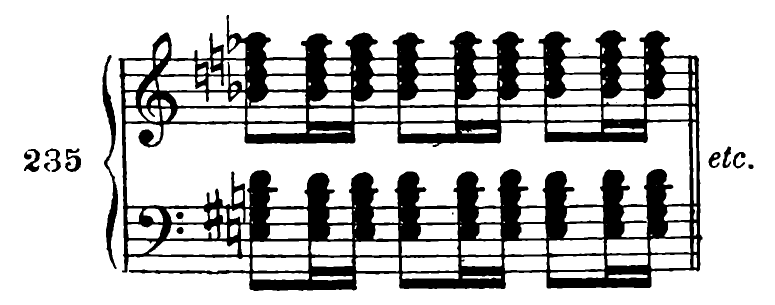
in particular, all this is still too close to us. One must stand at a certain distance from an object to see it as a whole; close up, one sees only individual features, while distance alone reveals what they have in common. It would not, incidentally, be very difficult to calculate every conceivable combination of two to twelve tones referred to a root, connect them with one another, and demonstrate their possible uses in examples. Names could also be found. One might, for instance, call a C-major triad with a “foreign” D-flat a “minor 1/2 major triad,” with a foreign D-natural a “major 1/2 major triad,” with E-flat a “double-third triad,” with F a “minor 3/4 major triad,” with F-sharp a “major 3/4 major triad,” and so on. One could apply the familiar laws of resolution to these chords and add those arising from the treatment of nonharmonic notes. But whether all this would accomplish much is questionable, because without describing and evaluating the effect there is no practical application. If one attempted an evaluation, however, one would again obtain an aestheticizing system, and moreover one that, unlike the old system, could not appeal to the support of a substantial body of artistic facts. Instead, it would anticipate events and prescribe a path they might never take. Only the ear, the sense of tone, the creative impulse, and imagination may lead; never mathematics, combination, or aesthetics. Since I cannot provide a system, I should therefore prohibit the use of nonharmonic notes if I were concerned merely with outward consistency. All the more so because I said at the outset that voice-leading matters belong in harmony only insofar as they are needed to present harmonic processes. But the mutual penetration of the two disciplines, harmony and counterpoint, is as complete as their separation is incomplete: every voice-leading event may one day become harmony, every chord a basis for voice leading. Combining both disciplines into one would therefore be of the greatest advantage, were the subject not to become too large. Keeping this in view already determines the attitude I must take toward these chords, namely:
Only a pedagogical consideration prevents me from granting the pupil entirely free use of these chords. So far I have told him precisely when this or that harmony, according to established experience, has a reliable effect, and I should like to continue doing so. There is no established experience for the free use of these chords; there are, however, tested methods of bringing them under control through voice-leading rules. Consequently, I shall take the same position here as with the prohibition of fifths: the master is free; the pupil, however, must remain bound until he has become free. I shall therefore briefly present nonharmonic notes in a way similar to the customary one. But the pupil will know—and this is an essential difference—that he has chords before him, dissonances like all the others. And he knows that the instructions he receives for their use mean no more than those recommending that vagrant chords be introduced chromatically: no more than that this is the simplest method, modeled on historical development, while the future, as yet outside history, will bring something else.