 Playable Books
Pyotr Ilyich Tchaikovsky · section 27 of 36
Chapter XXV. Passing-notes
Read and hear this section in the playable edition →



§ 82. Passing notes are notes not belonging to the chord which serve to fill out the intervals between two harmonic notes, According to the scale, from which they are taken, we have. I diatonic, II chromatic passing-notes. _
§ 83. With diatonic passing-notes we fill out the intervals of the third and the fourth. In the third but one passing note can be inserted; in the fourth, two.
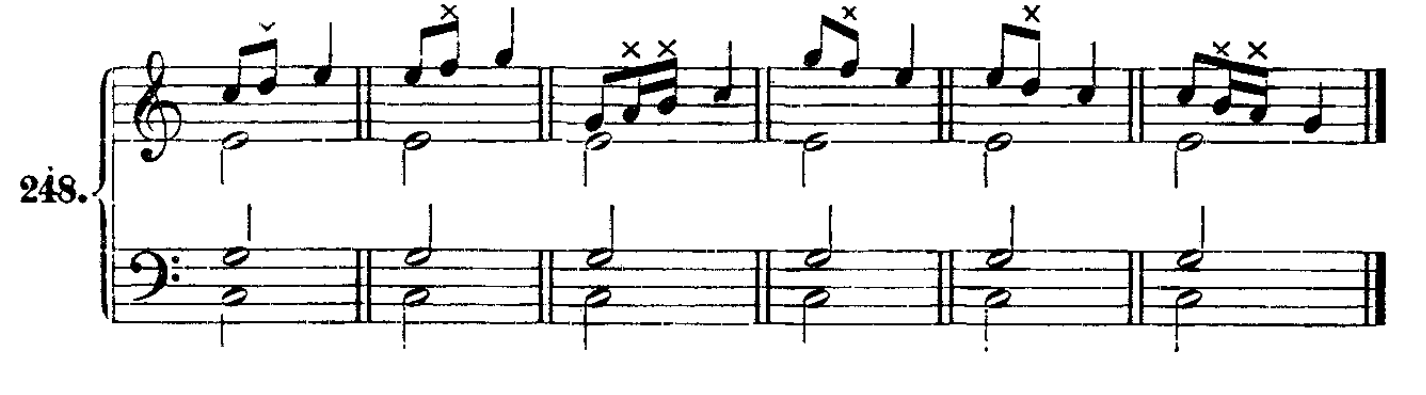
As a rule passing notes are found only on unaccented beats. They can occur in two or more voices at ance, moving either in parallel motion (in thirds or sixths), or in contrary motion. Contrary motion is preferable, since parallel progressions are in opposition to the chief element of harmonic beauty— namely an independent treatment of the voices. Nevertheless parallel progressions of passing notes in thirds and sixths need not be entirely avoided, as, if used moderately, they produce fluency and symmetry.
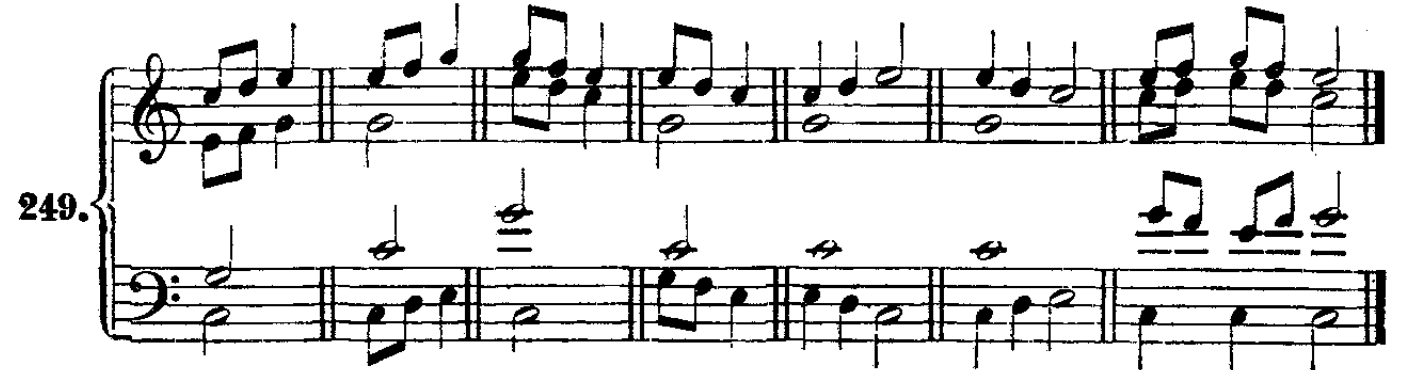
§ 84. Although passing notes conduce to independent voice—leading, they should not be used too copiously. If, for instance, we were to fill out-every skip of a third or fourth with passing notes, we might easily fall into forbidden progressions, while such an extensive Splitting up of the rythmic beats would lend the Harmony a dry pedantic character.
Such an immoderate use of passing notes is illustrated in the following bars.
Case a) shows parallel octaves. At b) two seventh occur in close succession; which is extremely unpleasant, especially in slow tempo. We should see, further, that no dissonance is formed by passing notes in contrary motion, e. g.
At c) there are parallel fifths between Tenor and Bass; at d) likewise. At e) a seventh is formed between Soprano and Bass: there are also parallel fifths. At f) a ninth is formed between Soprano and Tenor; between Soprano and Bass there are even two ninths in succession. Finally, g) shows parallel octaves.
§ 85. In minor the melodic scale is used, in order to avoid the step of the augmented second from the 6-th to the 7-th degree,
§ 86. I have said that passing notes always fall on relatively unaccented beats. To this, however, there are exceptions, of which the works of even the greatest composers show examples. This fact the student should merely bear in mind, reserving its application for more advanced exercises *),
Passing notes on accented beats occur in the following example.
*) The talented student may indeed induige at times in exceptions to the rules, though he should not attach too much importance to such exceptional cases,
It should be remarked that it is by no means a fault, if one of two neighboring passing notes falls on a relatively accented beat.
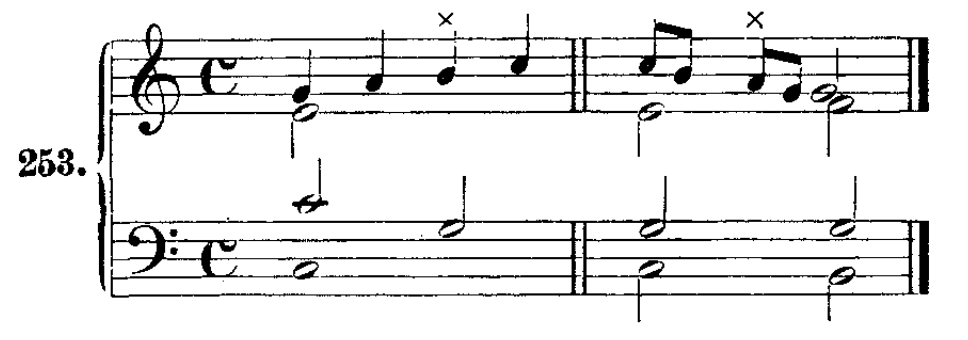
Note. The figuring of passing notes is of no great importance, since the chord does not suffer a real change in consequence of these notes. If they are to be figured, however, not only the interval formed by the passing note, but also the entire chord must be indicated under the bass.
The following example shows the appropriate and correct application of passing notes.
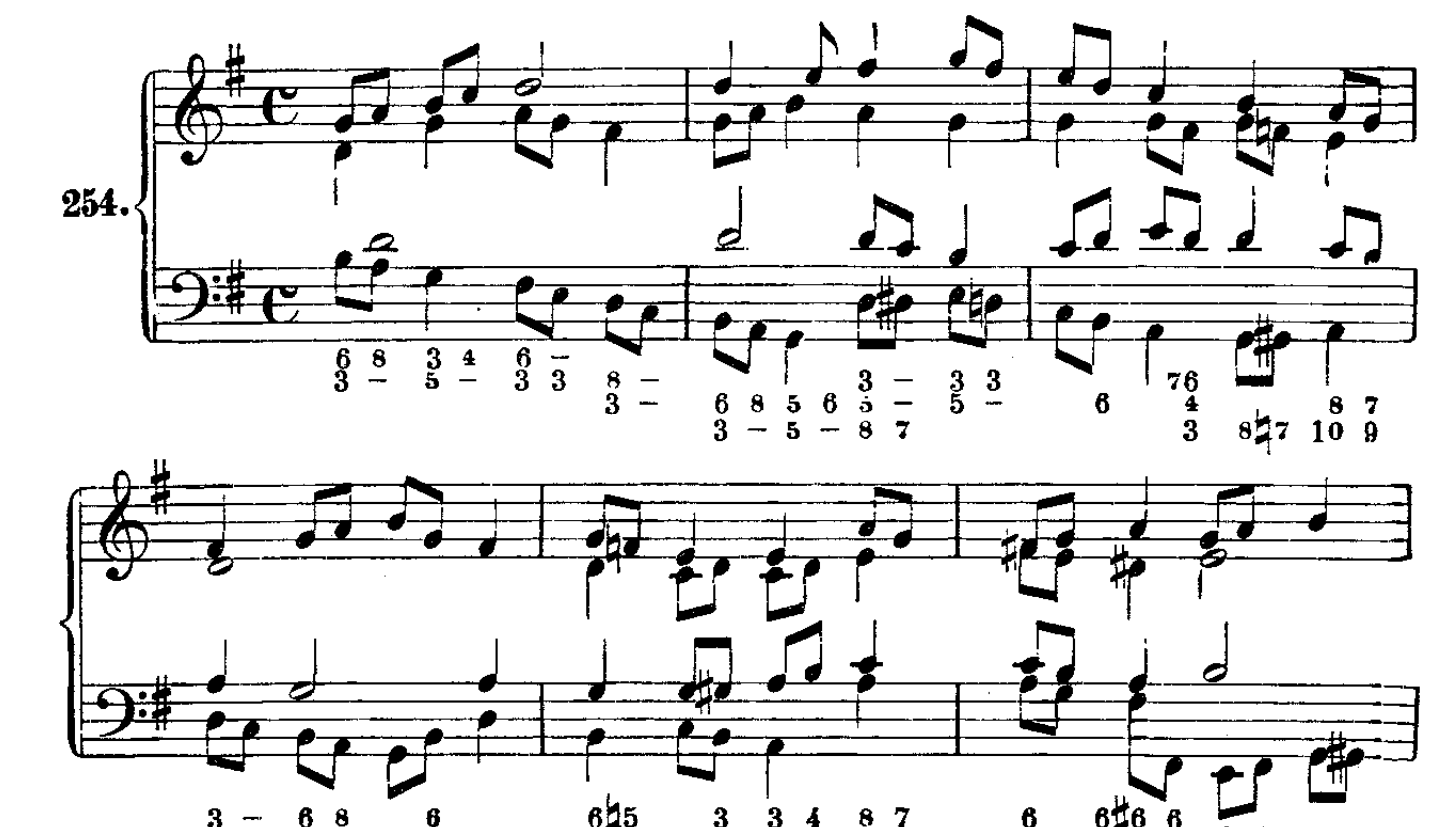
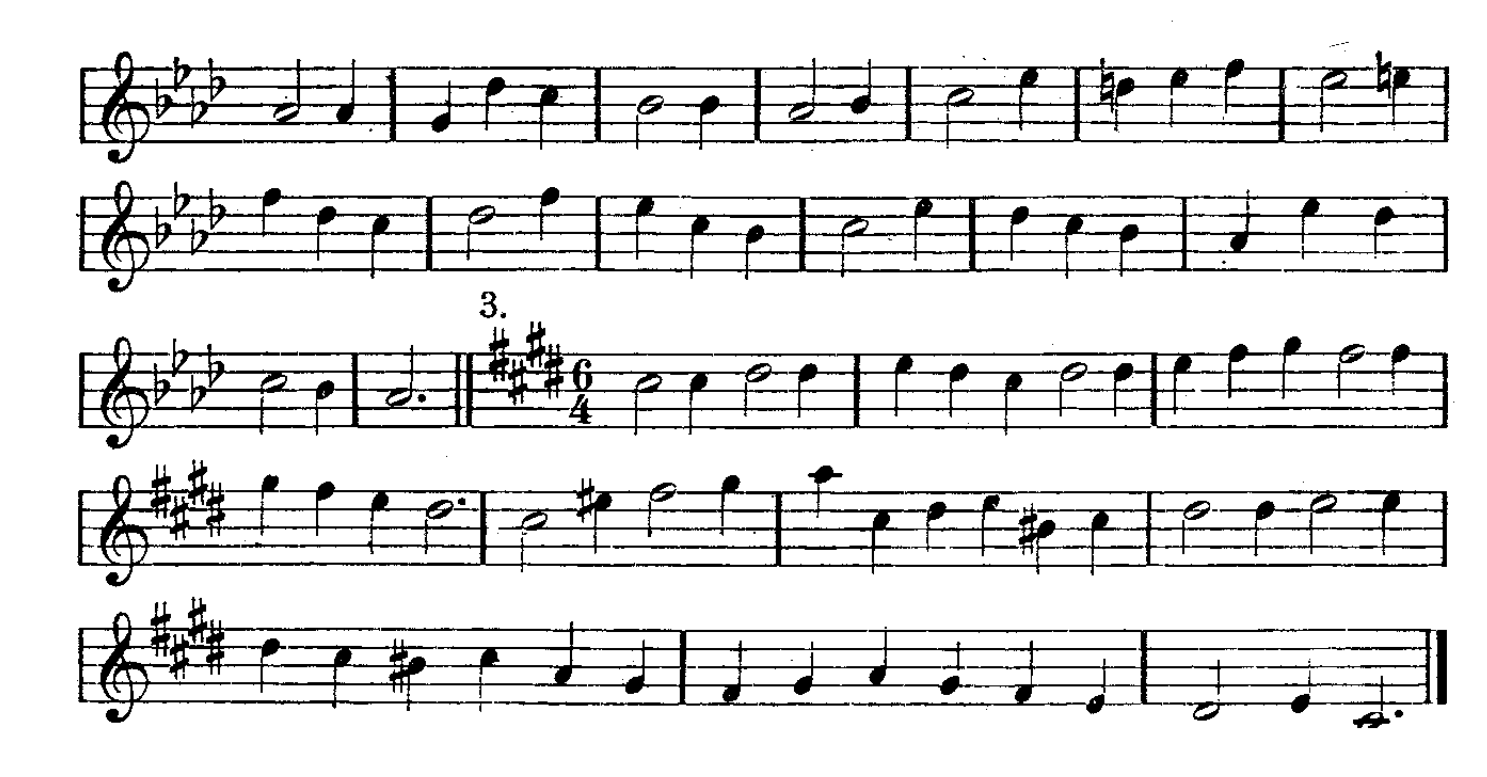
Exercise. In the harmonization of the following melodies passing notes are to be employed.
second is filled out by a chromat: consequently they are
87. The interval of a major
§ sing note. Nothing detrac and naturalness as much as ts from simp to be used in moderation, chromatic passing notes; and with great care.
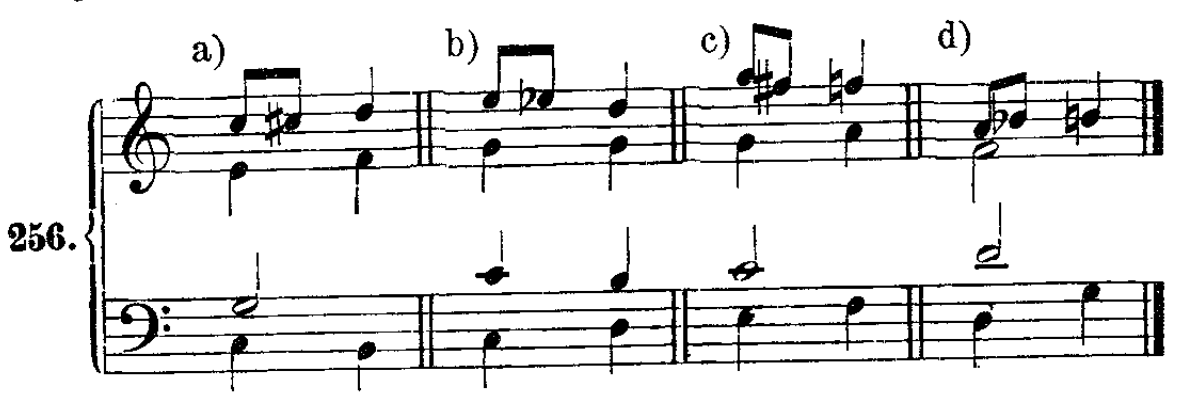
the chromatic scale demands sharps in ascending he flattened 7-
The orthography of its sharp — in like manner
The 6th degree forms an exception and flats in descending ascending—-being written as t th degree (as at d) the flattened 5-th degree—in descending—is written as the sharp of the 4-th degree (as at c).
§ 88. In order to avoid disagreeable tone-combinations we shouid take care not to employ simultaneously in different voices of a chord atone with one of its chromatic alterations, especially where that tone forms the third or the fifth of the chord.
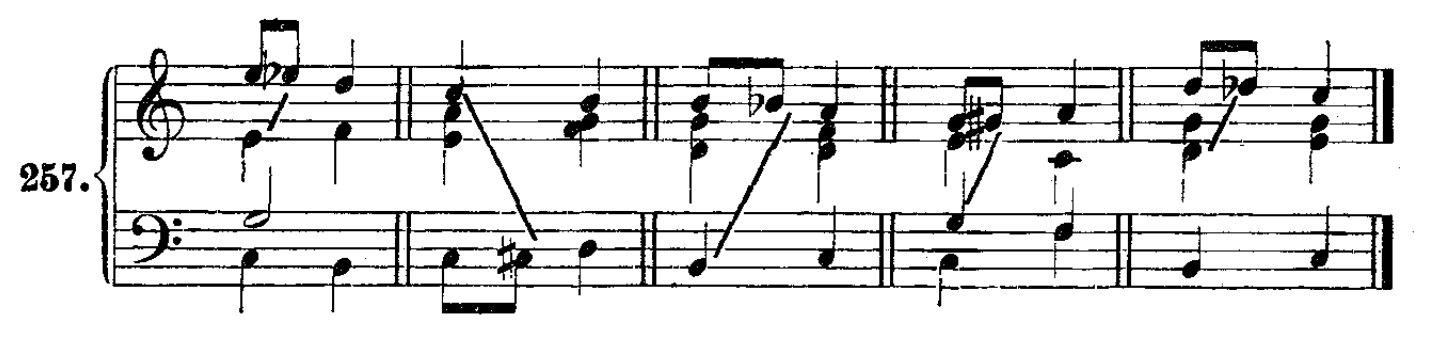
In like manner a chromatic passing note should not be used in the Bass, when the Bass tone is doubled in an upper voice.
good good good not good.
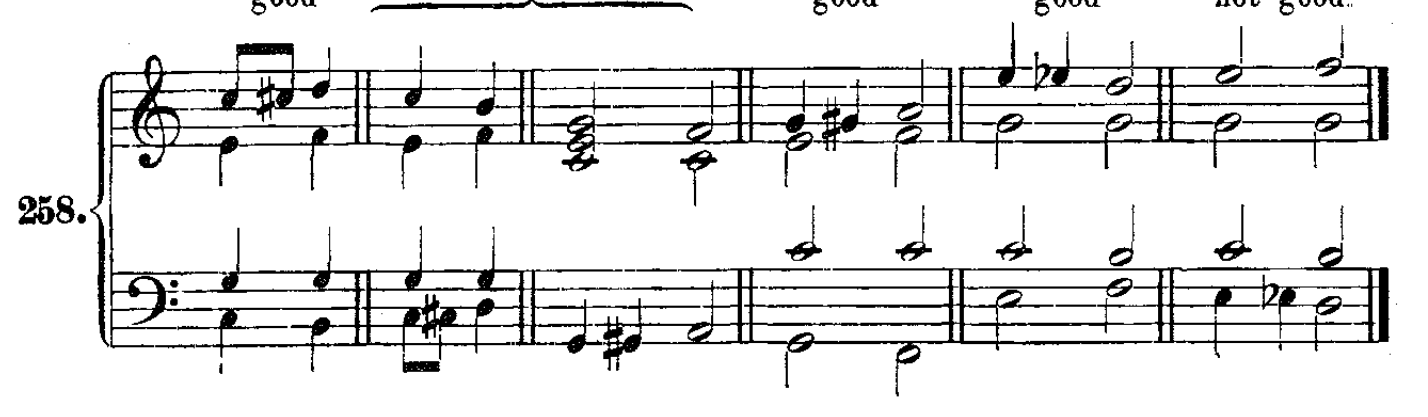
§ 89. Chromatic passing notes rarely occur in two voices at once; these also are most disagreeable, when presenting one and the same degree in its two chromatic aiterations.
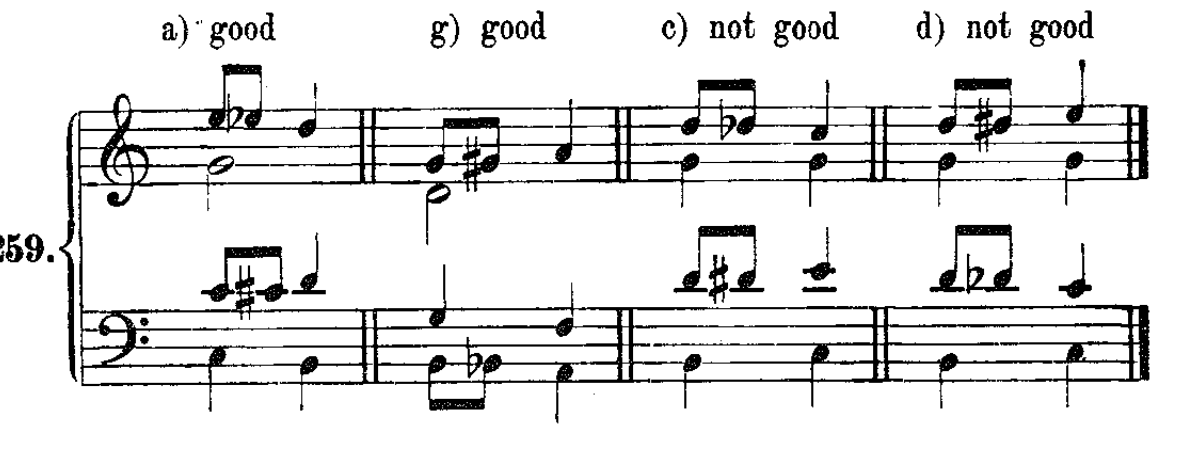
a)" good g) good ce) not good d) not good
At c) and d) we should at least write the passing notes in different form, though according to § 87 they are correct as they are.
SO, or so, So, or so.
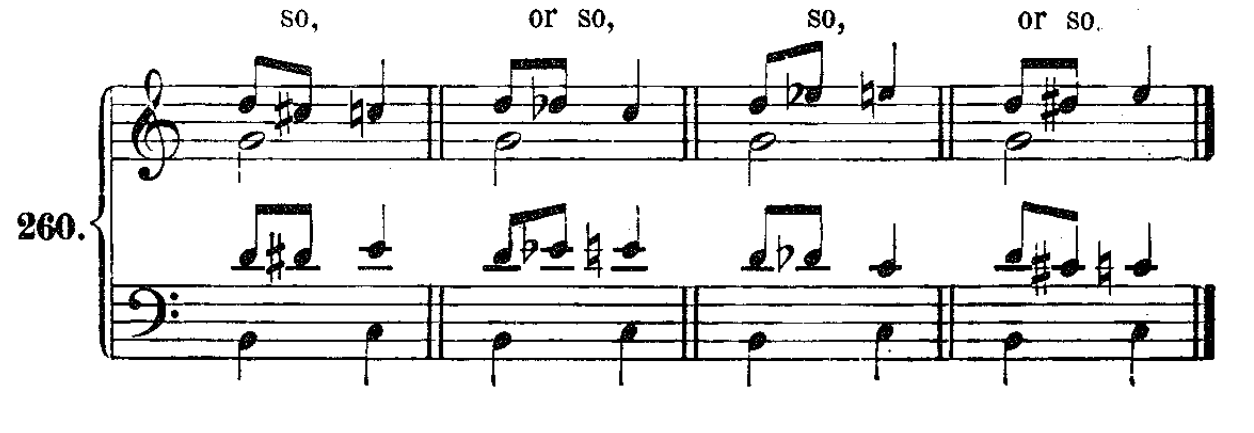
In organ points chromatic pessing notes in three voices produce a row of parallel chords of the sixth.
The following example shows an appropriate use of chromatic passing
Exercise, Harmonize the following melodies, employing diatonie and chromatic (especially the latter) passing notes.
*) The orthography of the chromatic scale in minor is the same as that ofthe parallel ma~peing sharpened in ascending.
the first degree forms an exception,