 Playable Books
Concept index · Dissonance and embellishment
Anticipation
Taught in 6 books. Each one opens at the passage; ▶ plays the example beside it.
This index is Playable Books’ own: a first pass that finds the term’s words in each book, corrected by hand. The authors did not tag these passages, and their terms can differ (Fux’s “ligature” is a suspension). The quoted text is the book’s.
 Gradus ad ParnassumJohann Joseph Fux, 1725
Start: On the figures of variation and anticipation →- On the figures of variation and anticipation
The figure of anticipation occurs when half the value of the preceding note is taken away and added to the following one. For example:
▶ Fig. 399 nearby
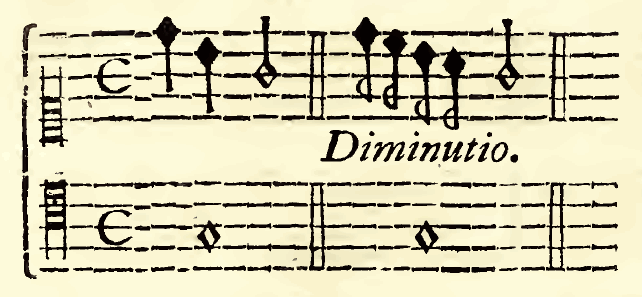 ▶ Fig. 394
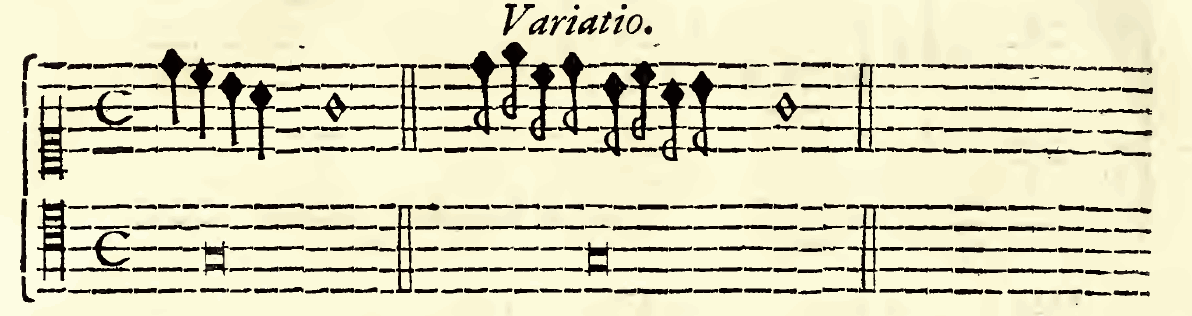 ▶ Fig. 395
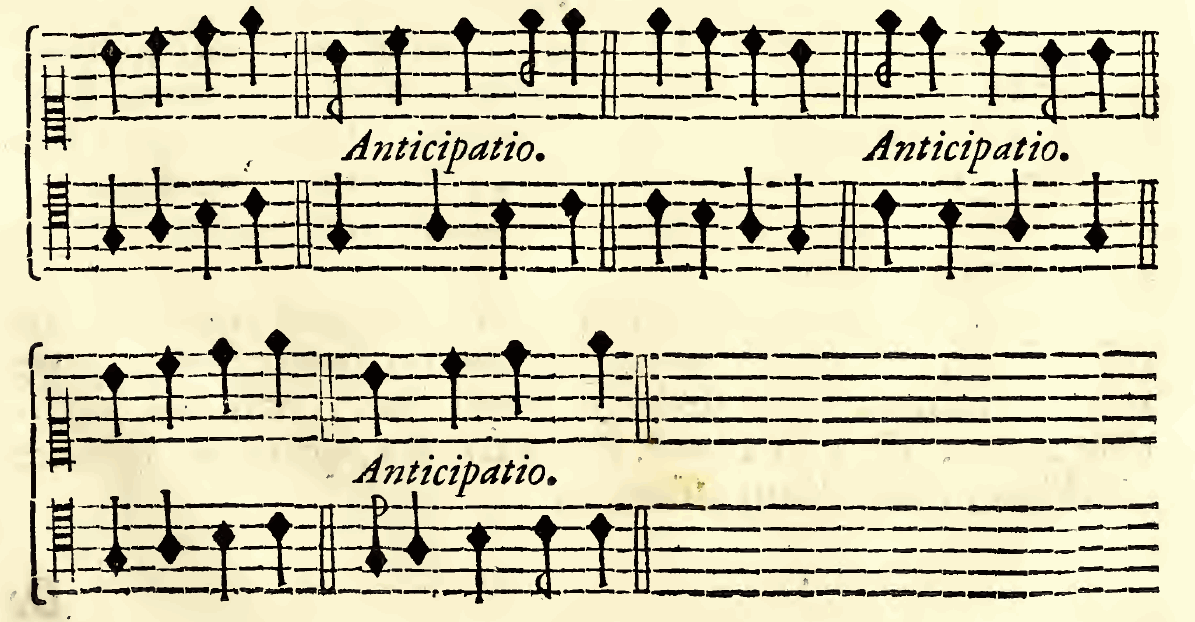 ▶ Fig. 399
 Exercises in Elementary CounterpointPercy Goetschius, 1910
- Chapter XI. The Tie, Continued. Rests
…upon both melody and rhythm. The tying note (the first c) is called an Anticipation, because it does not belong to the chord of its beat, but " anticipates " the harmonic tone of the next beat. While such tones are sometimes used with striking effect, they…
▶ Fig. 179 nearby - Chapter XI. The Tie, Continued. Rests
The second group is not wholly wrong, as the tied note is a suspension; and suspensions are rarely limited in their time-value. Groups 1 and 4 are intolerable, because the tying notes are abrupt anticipations.
▶ Fig. 179 nearby - Chapter XI. The Tie, Continued. Rests
When, on the contrary, the rule is reversed, and the tying note is an anticipation, the result is as follows:
▶ Fig. 181 nearby - Chapter XI. The Tie, Continued. Rests
…the significant fact that this condition prevails throughout; the device of anticipation is applied persistently and uniformly. Such consistency is an excuse for almost any irregularity.
▶ Fig. 181 nearby - Chapter XI. The Tie, Continued. Rests
Observe that these methods, Rule 4, apply best to the note which is legitimately tied as a result of shifting the original essential interval forward; not so well to the tie which creates an anticipation (Ex. 87).
▶ Fig. 190 nearby - Chapter XXIV. Contrapuntal Harmony
…4, the c-natural in Tenor is used as lowered and scale-step (of b minor); in anticipation of this legitimate "alteration," the whole harmonic current sets into C major. The f-sharp in Soprano is a little harsh, but inevitable, as it is the very means of…
▶ Fig. 420 nearby
 ▶ Ex.85
 ▶ Ex.87
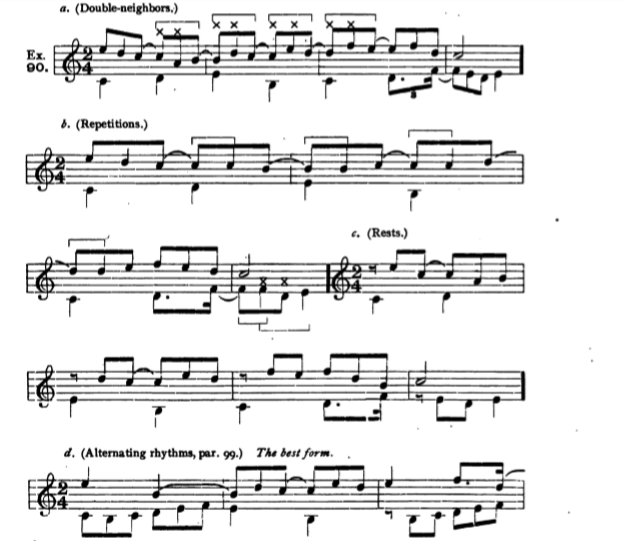 ▶ Ex.90d
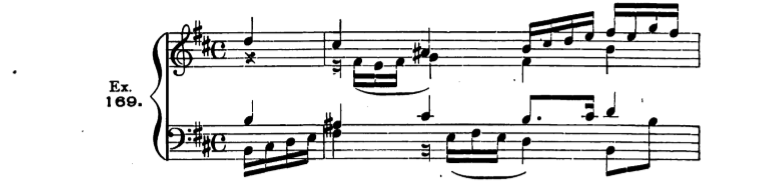 ▶ Ex.169
 Counterpoint AppliedPercy Goetschius, 1902
- Chapter I
…desired point at precisely the right moment, — not too soon (so that awkward anticipation results), nor too late (so that an equally awkward leap is necessary). Supposing ¿ to be the tone to be reached, in a rhythm of four tones to the (preceding) beat:
▶ Fig. 41 nearby - Chapter XII
…in Alto (meas. 8-10) against Theme in Bass, extended at the beginning by an anticipation of the first figure; it recurs again in Bass (meas. 15-17) against Theme in Soprano, with the same introductory extension; and again in Alto (meas, 25-27), in Soprano…
▶ Fig. 358 nearby
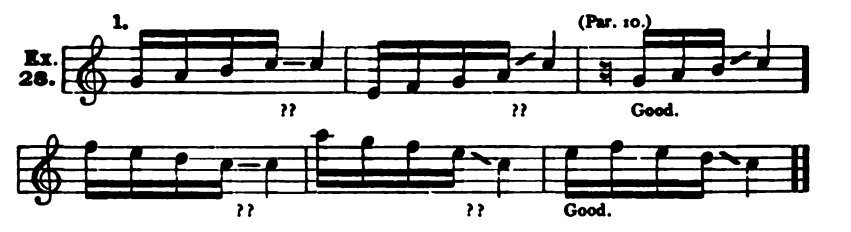 ▶ Ex28-1
 ▶ Ex153
 Practical Manual of HarmonyNikolai Rimsky-Korsakov, 1910
Start: EXERCISE No. 31 (MELODIES WITHOUT GIVEN BASS) →- Given melodies (Anticipation) · 3 playable examples
- Melodies with given basses (Indirect anticipation.) · 6 playable examples
- EXERCISE No. 31 (MELODIES WITHOUT GIVEN BASS)
4) The anticipation: a note which, belonging on a strong beat or on the strong part of a beat, is placed prematurely in the same part on the preceding weak beat or weak part of a beat. The anticipation should be fairly short.
▶ Fig. 332 nearby - EXERCISE No. 31 (MELODIES WITHOUT GIVEN BASS)
The anticipation may precede the chord note in one part or in several parts at once:
▶ Fig. 332 nearby - EXERCISE No. 31 (MELODIES WITHOUT GIVEN BASS)
The anticipation is most often used in concluding cadences.
▶ Fig. 332 nearby - EXERCISE No. 31 (MELODIES WITHOUT GIVEN BASS)
The anticipation may also be used before a diatonic or chromatic passing note, before a neighbour note and before an appoggiatura:
▶ Fig. 333 nearby - EXERCISE No. 32 (GIVEN MELODIES)
5) The indirect anticipation, or escape note (**). These are dissonances left without resolution, which are sometimes also called exchanged notes. Most often they can be explained by the omission of one or more passing notes, or by the possibility of their…
▶ Fig. 334 nearby
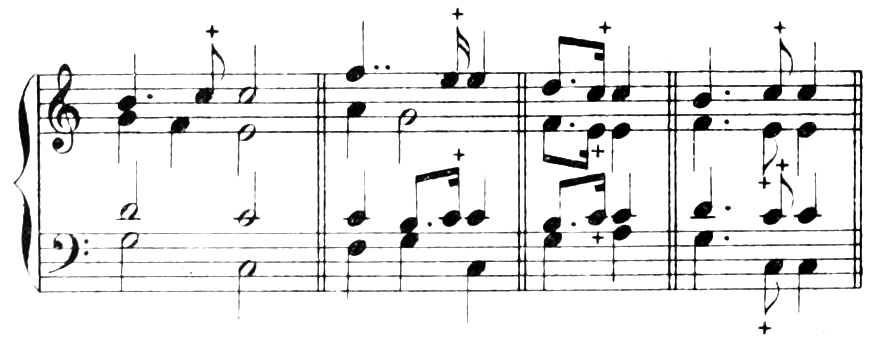 ▶ Four cadential fragments with anticipations (marked +): in the soprano alone; in soprano and tenor; in soprano, alto and tenor; and in all four parts.
EXERCISE No. 31 (MELODIES WITHOUT GIVEN BASS)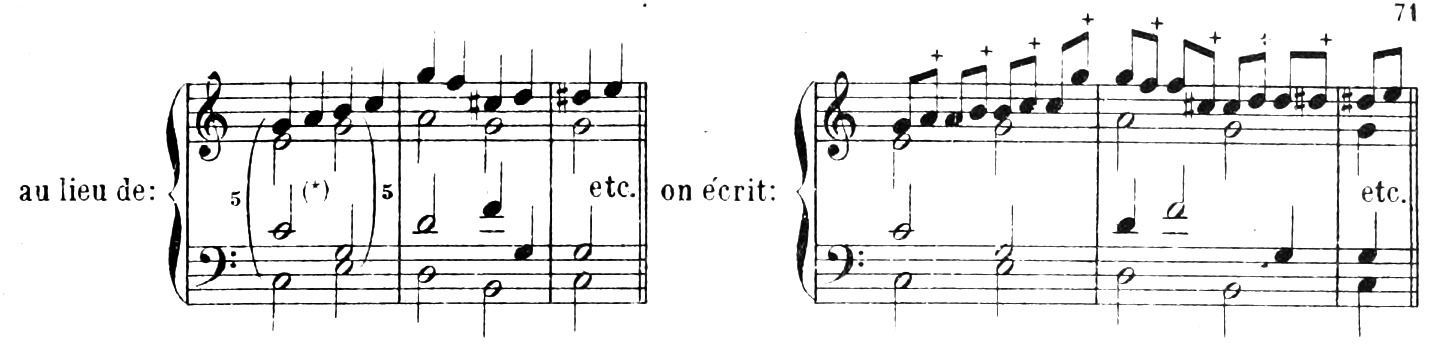 ▶ instead of: … etc. one writes: … etc.
EXERCISE No. 31 (MELODIES WITHOUT GIVEN BASS)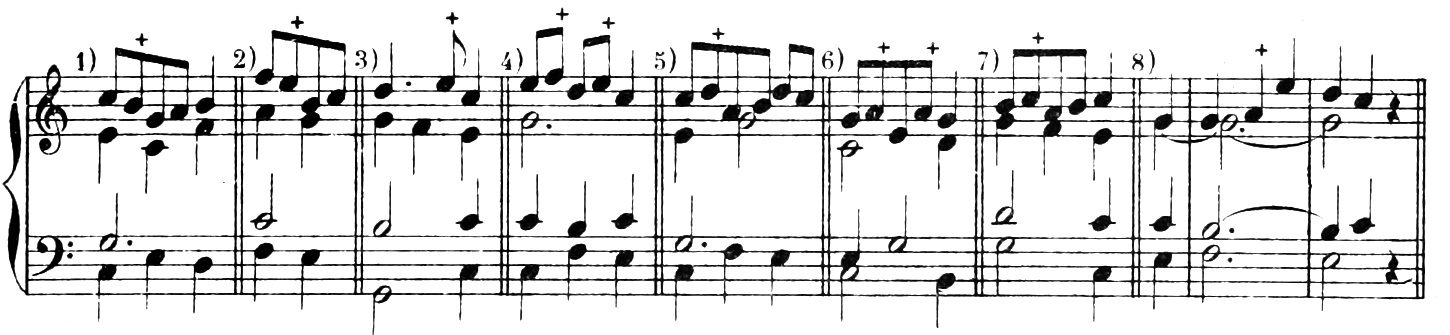 ▶ Eight numbered fragments with escape notes (marked +).
EXERCISE No. 32 (GIVEN MELODIES) ▶ Exercise 32 (anticipation), melody 1, line 1: two flats, 6/8
Given melodies (Anticipation) ▶ Exercise 32, melody 1 (end) and melody 2, line 1: one sharp, 2/4
Given melodies (Anticipation) ▶ Exercise 33 (indirect anticipation), melody 1 with given bass, line 1: two flats, 2/4
Melodies with given basses (Indirect anticipation.)
 Guide to the Practical Study of HarmonyPyotr Ilyich Tchaikovsky, 1900
Start: Chapter XXIV. Anticipation →- Table of contents
Chapter XXIV. Anticipation — 91
- Chapter XXII. The Organ-point
…to the chord do not enter simultaneonsly— as in the case of suspensions and anticipations—or when tones strange to the chord make their entrance—passing and changing notes.
▶ Fig. 222 nearby - Chapter XXIV. Anticipation
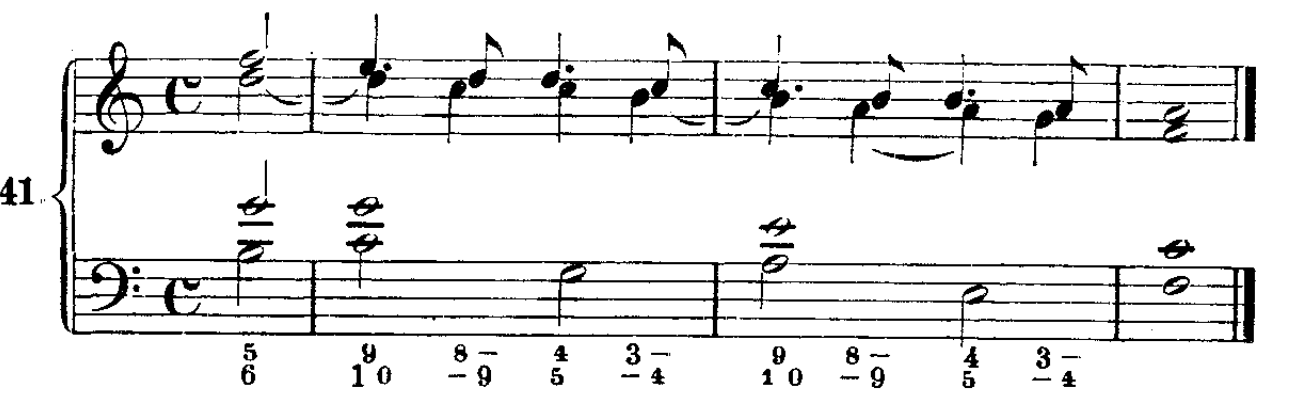
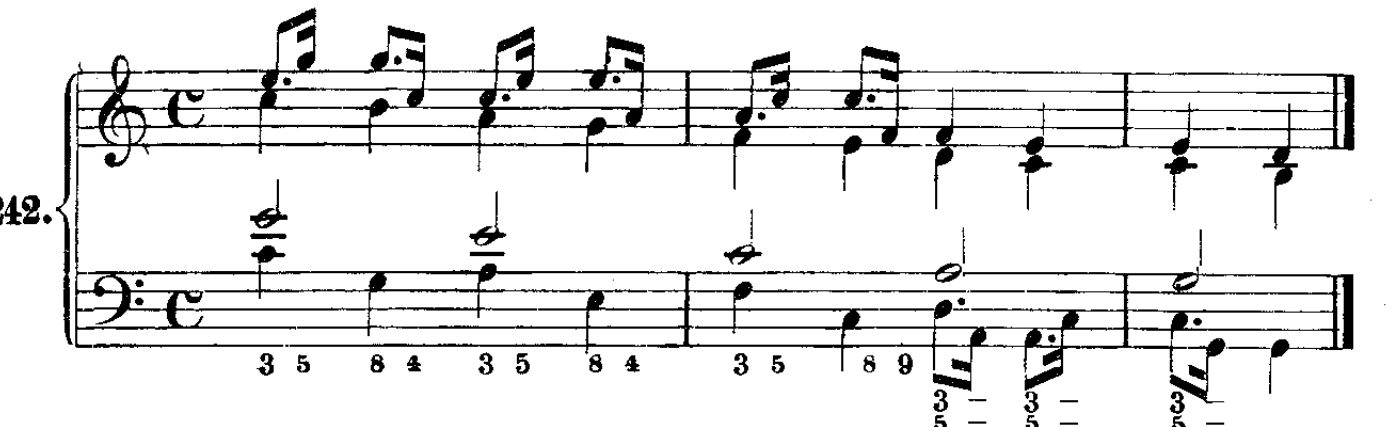
§ 78. By anticipation we mean a harmonic alteration of a chord, in which one or more of its voices adapt certain notes which really belong to the following chord. Anticipation, then, is the opposite of suspension, whieh latter, however, is far more important…
▶ Fig. 251 nearby - Chapter XXIV. Anticipation
An anticipation must never take up an extensive part of the measure; on the contrary, the true purpose of anticipation is the enlivening of the rythm by dividing up notes of long duration.
▶ Fig. 251 nearby - Chapter XXIV. Anticipation
4 9 A suspension and an anticipation can occur simultaneously in one and the same chord; in which case the anticipation must be of shorter duration than the suspension.
▶ Fig. 253 nearby - Chapter XXIV. Anticipation
§ 79. We have said that anticipation is the direct opposite of suspension; this must not, however, be taken literally, since anticipations can, for example, occur in skips, as in the case of suspensions.
▶ Fig. 254 nearby
6 more passages in Guide to the Practical Study of Harmony →
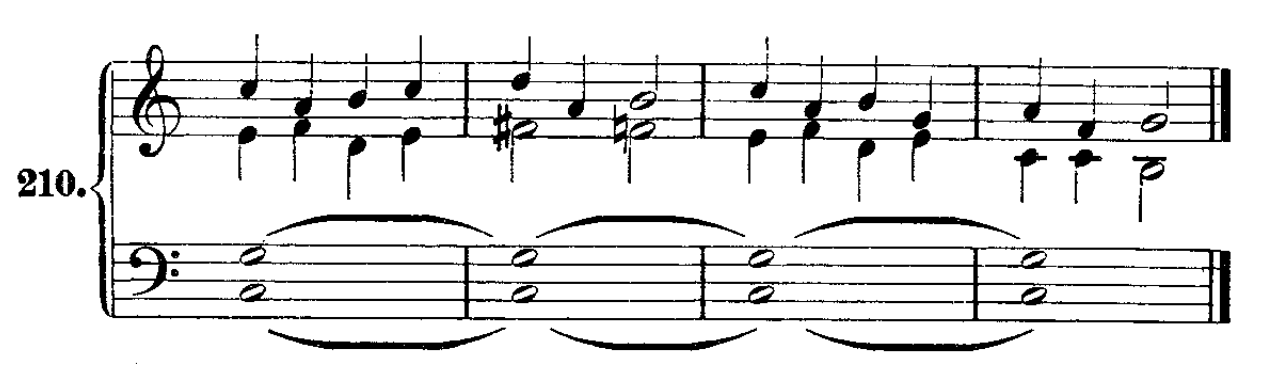 ▶ Fig. 222
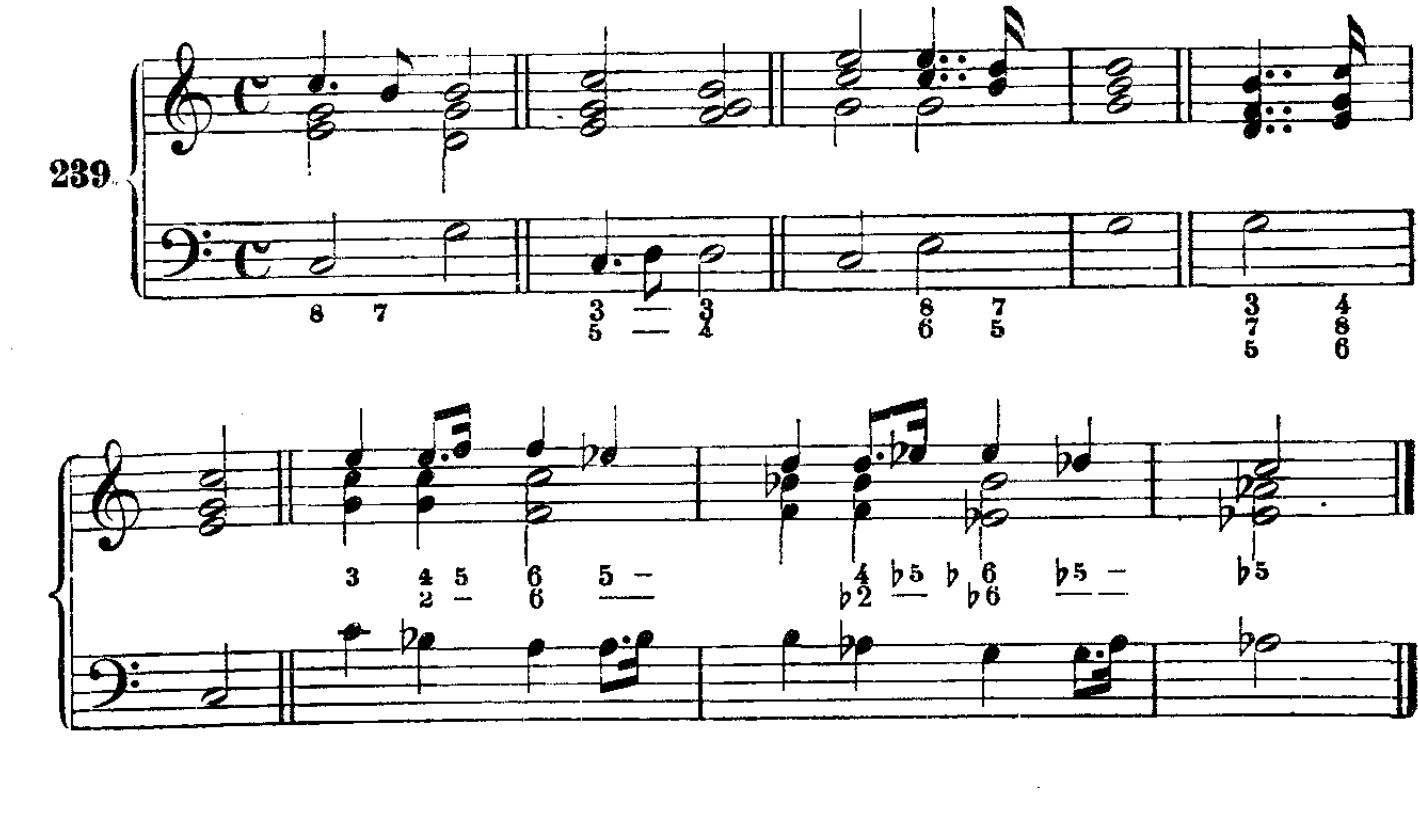 ▶ Fig. 251
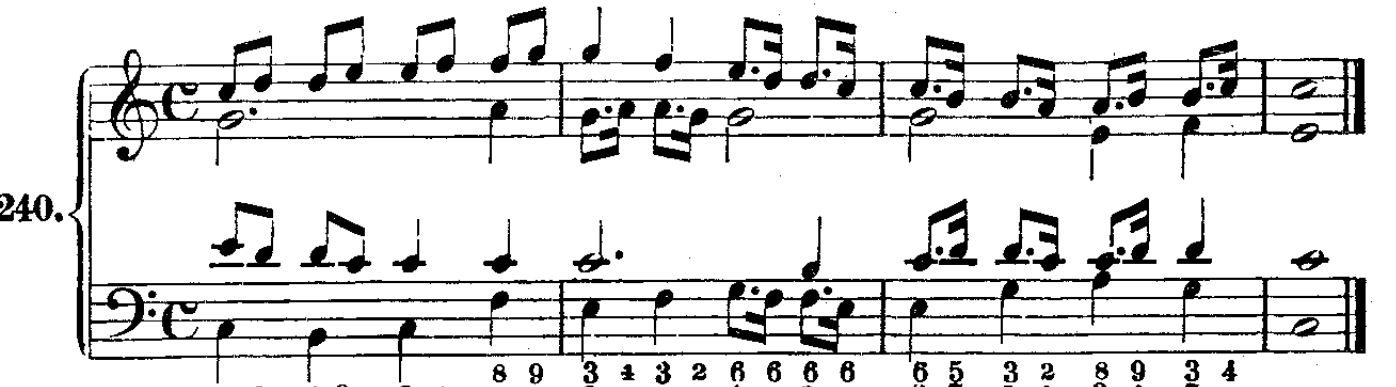 ▶ Fig. 252
 ▶ Fig. 253
 ▶ Fig. 254
 Theory of HarmonyArnold Schoenberg, 1922
- Suspensions and Other Nonharmonic Tones
…so-called nonharmonic notes—suspensions, passing notes, neighboring notes, anticipations—should therefore appear in our exercises as products of melodic events. Their appearance, and the dissonances that invariably accompany them, are thus justified by the…
▶ Fig. 440 nearby - Suspensions and Other Nonharmonic Tones
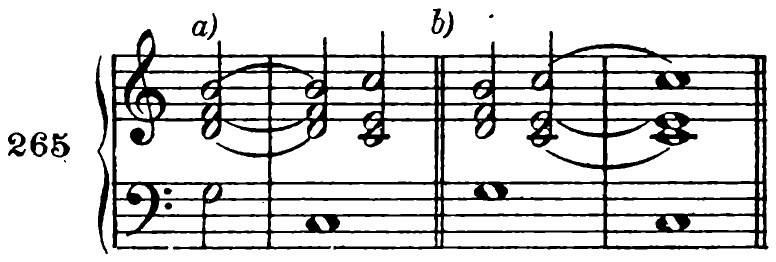
The anticipation rests on the idea opposite to that of the suspension. If with the latter one or more voices are delayed during a change of harmony, with the former it is the other way round: they come too early, so to speak.
▶ Fig. 469 nearby - Suspensions and Other Nonharmonic Tones
In 265a and b, where a is a suspension and b an anticipation, the two pictures are placed side by side for comparison. Like the suspension, the anticipation can take place either in one voice only or in several. Beyond this there is nothing whatever to say…
▶ Fig. 469 nearby - 6. A Few More Small Matters
…by using its tones—nor the penultimate measure of the same song, where anticipation in the bass produces a six-four chord. Rather, I mean a case like measures 14–19 of “Botschaft,” where a free leap is made out of it.
▶ Fig. 607 nearby - Subject index
Anticipation 402, 413
 ▶ Example 236
 ▶ Example 265a (suspension)
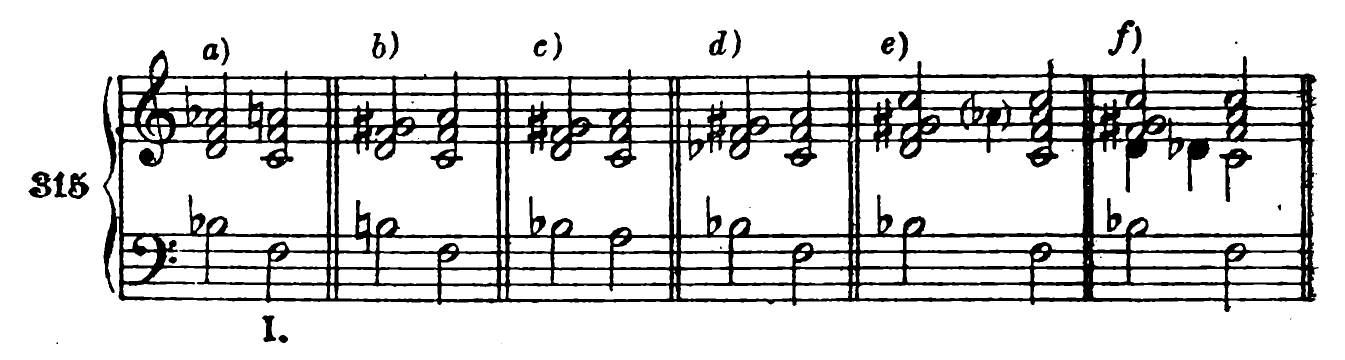 ▶ Example 315-a
More in Dissonance and embellishment
Suspension · Passing notes · Neighbor notes · Appoggiatura · Nota cambiata · Pedal point