 Playable Books
Concept index · Dissonance and embellishment
Passing notes
Taught in 11 books. Each one opens at the passage; ▶ plays the example beside it. Also called passing tone, passing tones, passing notes.
This index is Playable Books’ own: a first pass that finds the term’s words in each book, corrected by hand. The authors did not tag these passages, and their terms can differ (Fux’s “ligature” is a suspension). The quoted text is the book’s.
 Gradus ad ParnassumJohann Joseph Fux, 1725
Start: Second species counterpoint: two notes against one →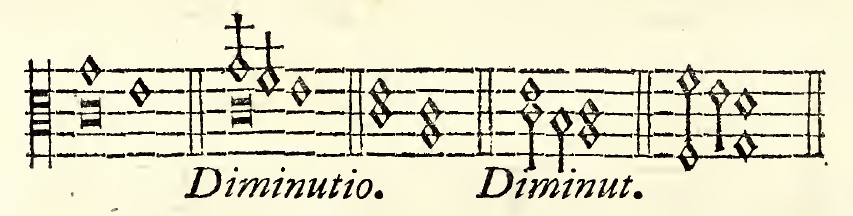 ▶ Fig. 22
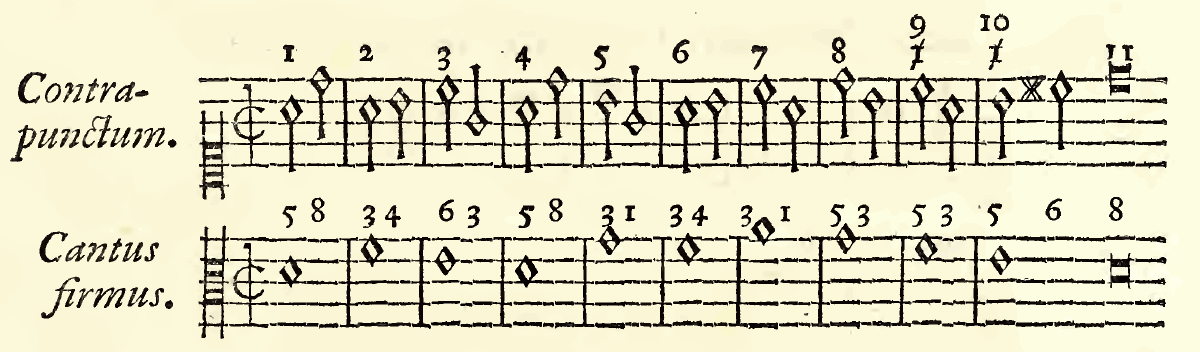 ▶ Fig. 24
 Exercises in Elementary CounterpointPercy Goetschius, 1910
- Chapter VII. Rhythmic Diversity. Two Notes To A Given Beat
The d and b in the first measure are so-called Passing Notes.
▶ Fig. 101 nearby - Chapter VII. Rhythmic Diversity. Two Notes To A Given Beat
…— should not leap, but must progress stepwise. They must be accounted for as passing-notes or neighboring notes which refer diatonically (scalewise) to the following essential tone. And, as a rule, such tones should not enter with a leap, either. In a word,…
▶ Fig. 106 nearby - Chapter XI. The Tie, Continued. Rests
The tie need not be used in every group; the occasional omission of the tie, and substitution of passing-notes, is not only effective, but often convenient. See par. 99 (Ex. 82).
▶ Fig. 191 nearby - Chapter XVI. Three-Part Harmony
The other chords of the Seventh seldom occur as essential bodies, but often as descending passing-notes. Thus:
▶ Fig. 286 nearby - Chapter XVI. Three-Part Harmony
For illustration, a melodic sentence in C major as upper part; each tone an essential chord-tone (that is, no passing-notes or neighboring notes, in these lessons):
▶ Fig. 287 nearby - Chapter XXIII. Modulations
Number 3. In measure 2, beat 3, the g-natural in Bass is merely a passing-note, which does no more than change the mode of the chord from major to minor (compare Notes to Ex. 149, No. 1). Measure 6 is similar, though here the c in Bass is a legitimate lowered…
▶ Fig. 396 nearby
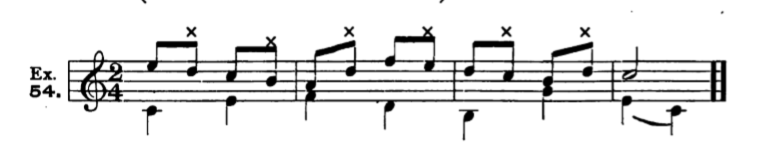 ▶ Ex.54
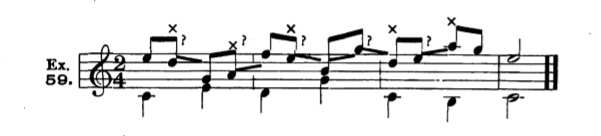 ▶ Ex.59
 ▶ Exercise 11.1
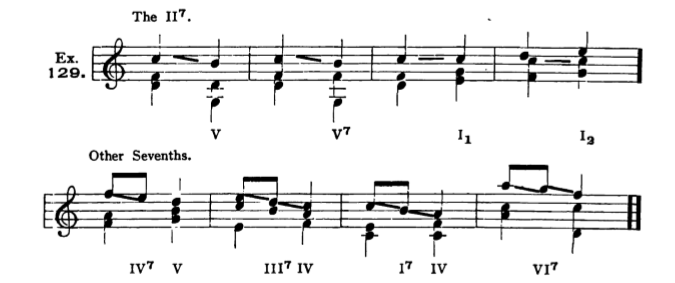 ▶ Ex.129
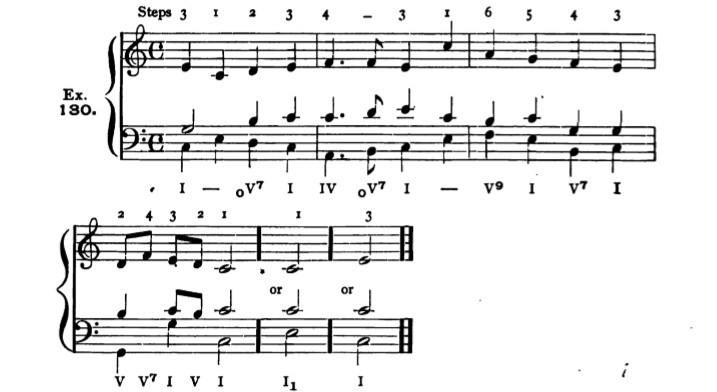 ▶ Ex.130
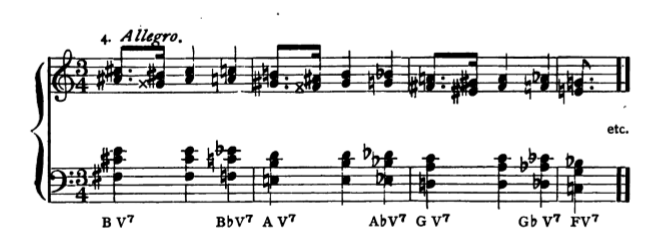 ▶ Ex.159-4
 Counterpoint AppliedPercy Goetschius, 1902
- Chapter I
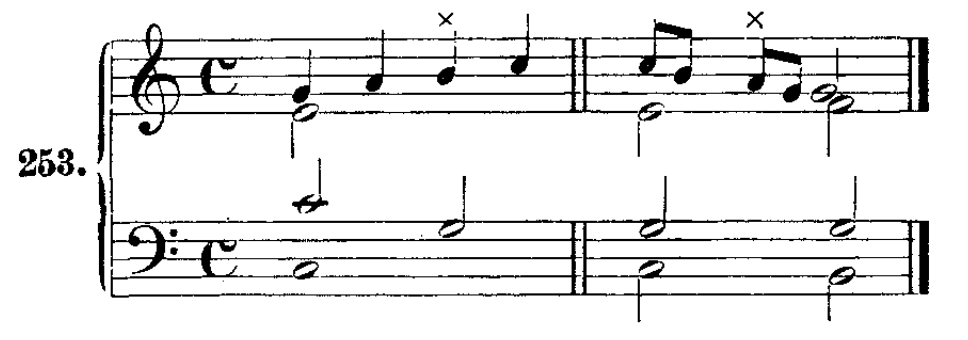
The interposed tones (marked × x), inserted between the Suspension and its resolving-tone, usually belong to the resolving-chord, as seen in the above illustra. tions; but brief diatonic passing-notes may be added. Thus:
▶ Fig. 15 nearby - Chapter I
In the last measure, the awkward leap into b is avoided by inserting an accented passing-note; this is a very common and excellent device.
▶ Fig. 43 nearby - Chapter II
…will be seen to corroborate the general rule that the notation of all passing-notes usually conforms to the scale represented by the chord upon the momentary beat, — or by the chord upon the next-following beat (if near enough to be affected by the latter…
▶ Fig. 125 nearby - Chapter II
…classic writings, of this rational principle of defining the notation of all passing-notes which fall within the limits of a certain chord, as if that chord were, for the time being, a " Tonic" chord. Apparently, it is most commonly the coming chord that…
▶ Fig. 126 nearby - Chapter II
…6th scale-step); this chord representing the Tonic harmony of 6b minor, the passing-notes follow the line of that scale, in descending succession. The analysis of actual key-conditions is noted below the brace; that of the scale-conditions governing each group…
▶ Fig. 128 nearby - Chapter II
e. The notation of passing-notes, within a certain narrow harmonic range, is defined upon the assumption that the chord which governs that range is temporarily the representative of the corresponding key (usually as Tonic chord), irrespective of its actual…
▶ Fig. 131 nearby
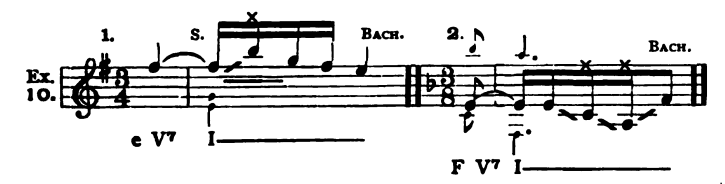 ▶ Ex10
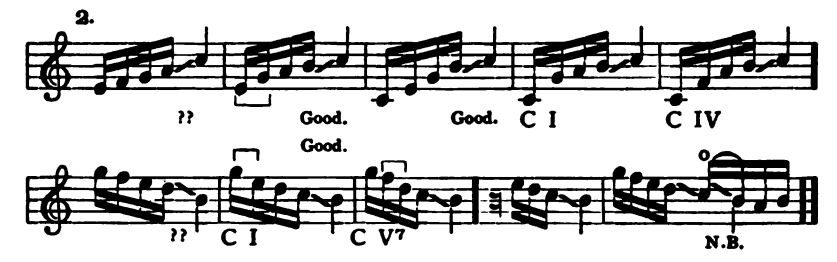 ▶ Ex28-2
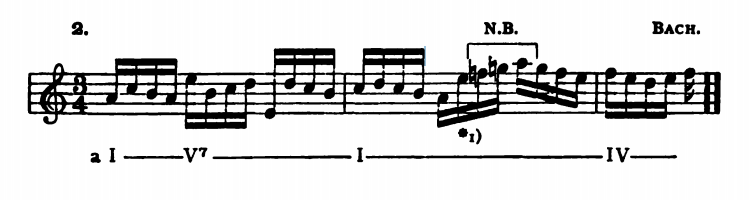 ▶ Ex60-2
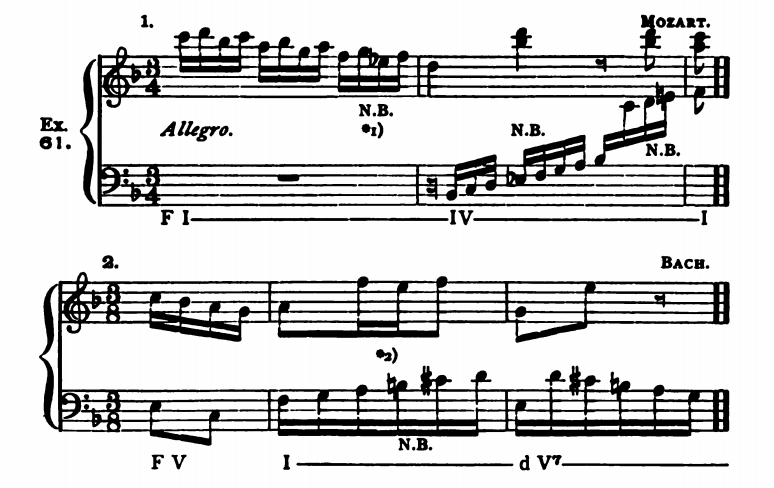 ▶ Ex61-1-2
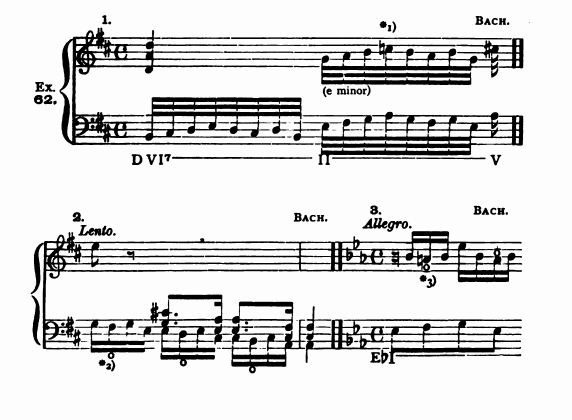 ▶ Ex62
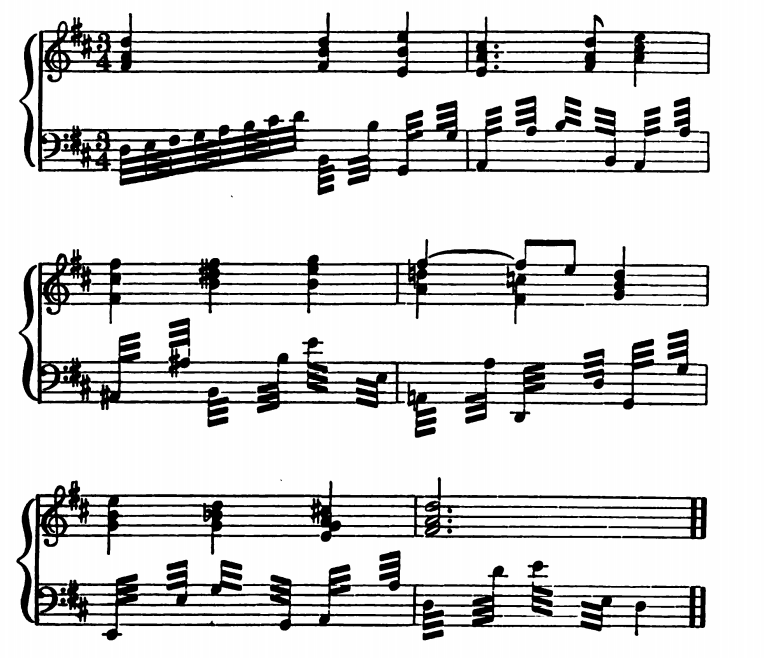 ▶ Exercise5
 Analysis of J. S. Bach’s Forty-Eight FuguesEbenezer Prout, 1910
- Fugue 16 · Book I, No. 16 · BWV 861
…subject in C minor (bars 20 and 21), and one of the answer in G minor with a passing-note D inserted between the first two notes, complete the middle group.
▶ Fig. 43 nearby - Fugue 33 · Book II, No. 9 · BWV 878
…on the subject metamorphosed, the leap of a third being filled in with a passing note, and the rhythm varied. In bars 26 to 29 is a series of entries of subject and answer by diminution, again as two two-voice stretti; and in bars 30 to 32 the answer by…
▶ Fig. 78 nearby - Fugue 44 · Book II, No. 20 · BWV 889
…next entry is made, in the bass, with the countersubject in the treble. A passing note (F, quaver) is here introduced between the first two notes of the subject, as is also the case in the final entry, at bar 25. The second episode modulates back to A minor,…
▶ Fig. 102 nearby - Fugue 48 · Book II, No. 24 · BWV 893
…bars, an incomplete stretto for all the three voices, the bass inserting a passing note between the F sharp and the D, and the treble considerably ornamented.
▶ Fig. 112 nearby
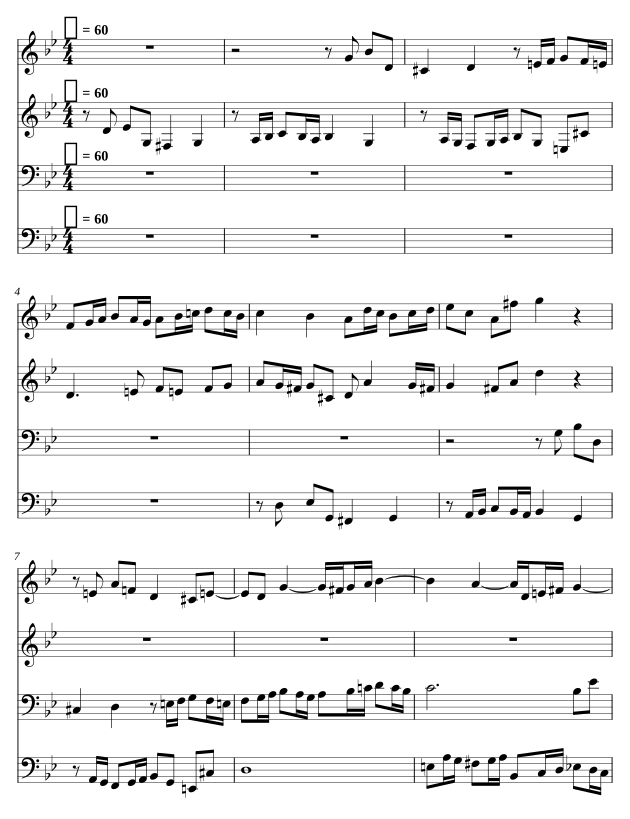 ▶ Complete score
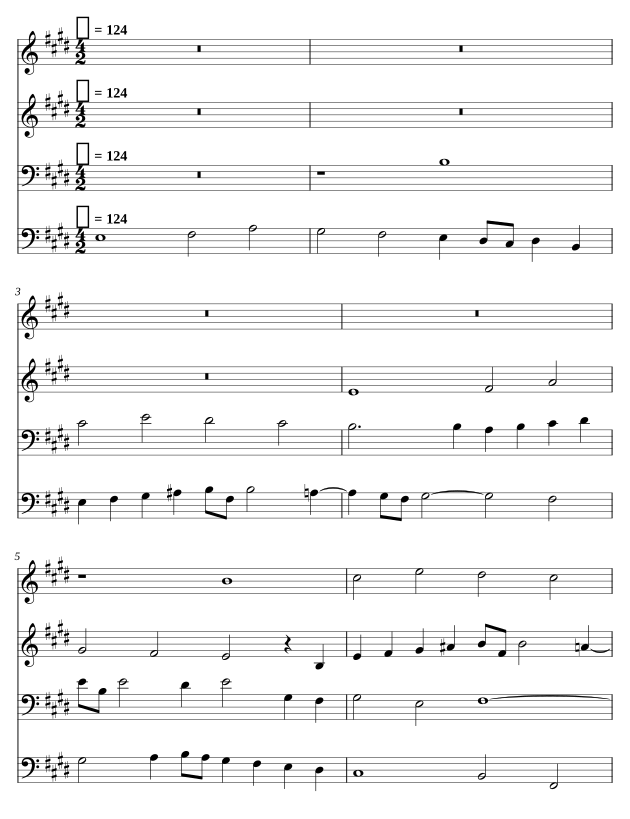 ▶ Complete score
 ▶ Prout’s excerpt · Fugue 44
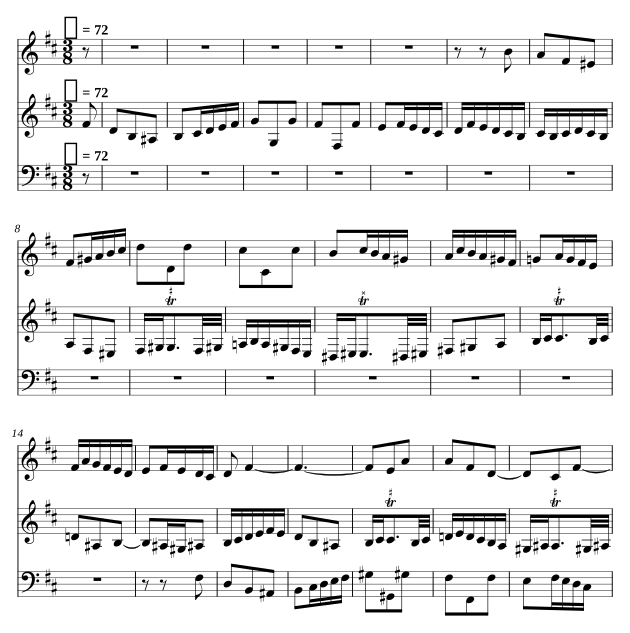 ▶ Complete score
 Treatise on HarmonyJean-Philippe Rameau, 1722
Start: Chapter thirty-nine →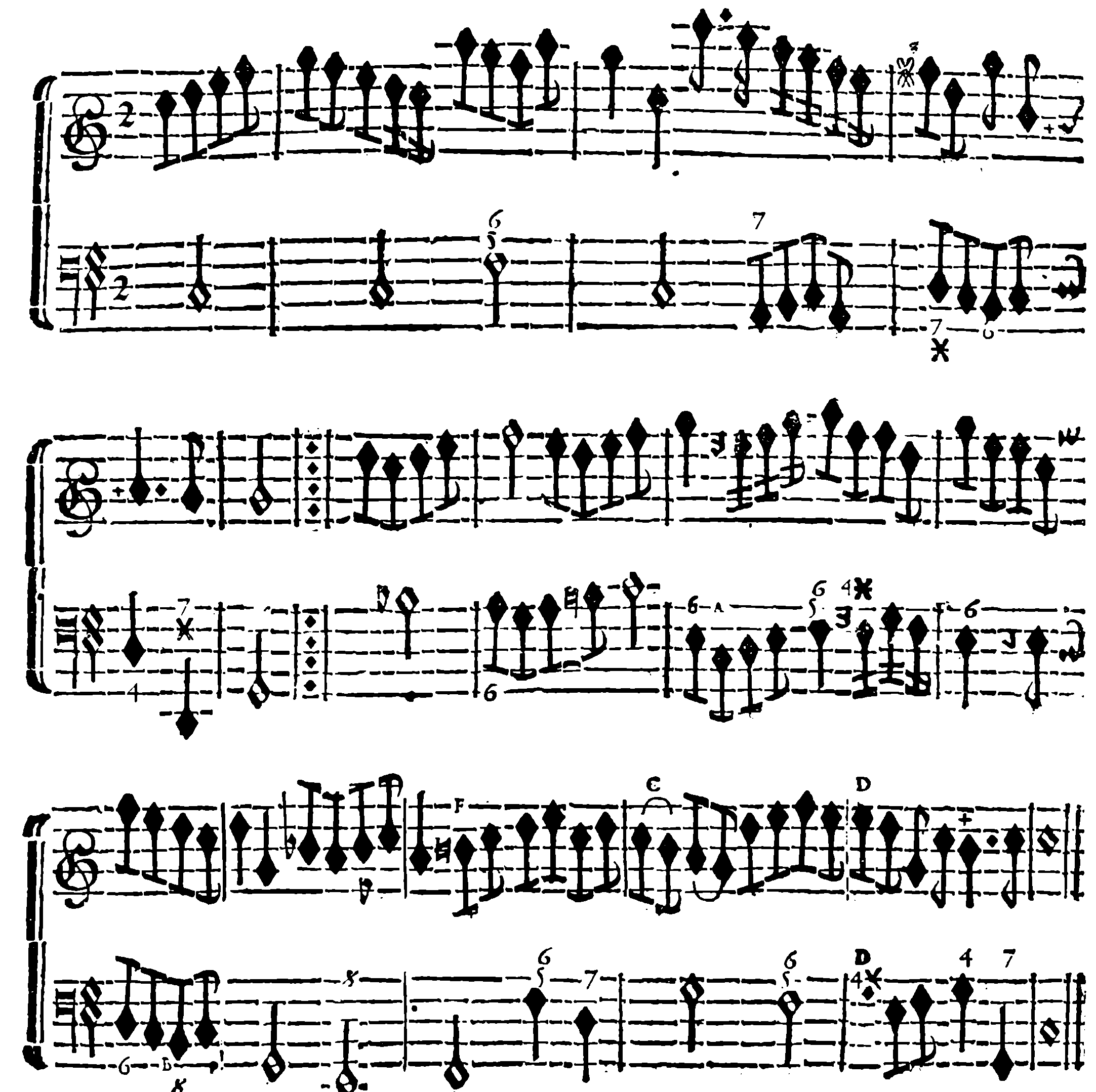 ▶ Fig. 312
 Practical Manual of HarmonyNikolai Rimsky-Korsakov, 1910
Start: Diatonic Passing Notes →- Ninth chords
8) In the natural major mode it is allowed as a passing chord between the triad of the IVth degree and its first inversion.
▶ Fig. 147 nearby - Free use of all the degrees of each mode
6) The second inversion of chords of the second order is used as a passing chord:
▶ Fig. 176 nearby - Free use of all the degrees of each mode
8) Secondary seventh chords, especially those containing a major seventh, are used as passing chords (with a passing seventh) or prepared by notes held in common with the preceding chords:
▶ Fig. 180 nearby - General Principles
§ 64. — Passing notes are those placed on the weak beats of the bar or on the weak part of a beat, filling, by means of stepwise motion, the distance between the real or essential notes (the notes of the chord). According to the scale from which they derive,…
- Diatonic Passing Notes
8) Among passing notes, the best are those that form an incidental chord, e.g. passing notes forming a seventh or a ninth.
▶ Fig. 264 nearby - simple, double, etc
§ 67. — 1) Chromatic passing notes may be placed between real notes a major second apart, or between diatonic passing notes. They may occur in one or in several parts at once, and at the same time as diatonic passing notes:
▶ Fig. 270 nearby
35 more passages in Practical Manual of Harmony →
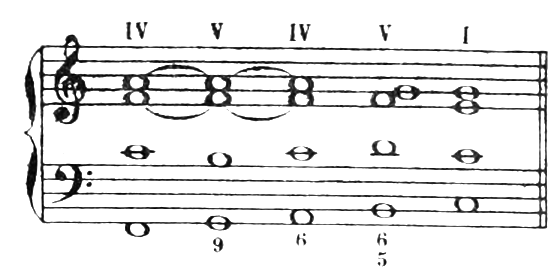 ▶ Ninth chord on V (9) as a passing chord between IV and IV6, then V6/5 – I, in C major
Ninth chords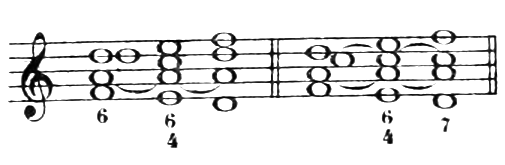 ▶ The 6/4 chord on E (A minor in second inversion) as a passing chord over the bass F–E–D: II6–VI6/4–II, then II 6/5–VI6/4–II7 with C held
Free use of all the degrees of each mode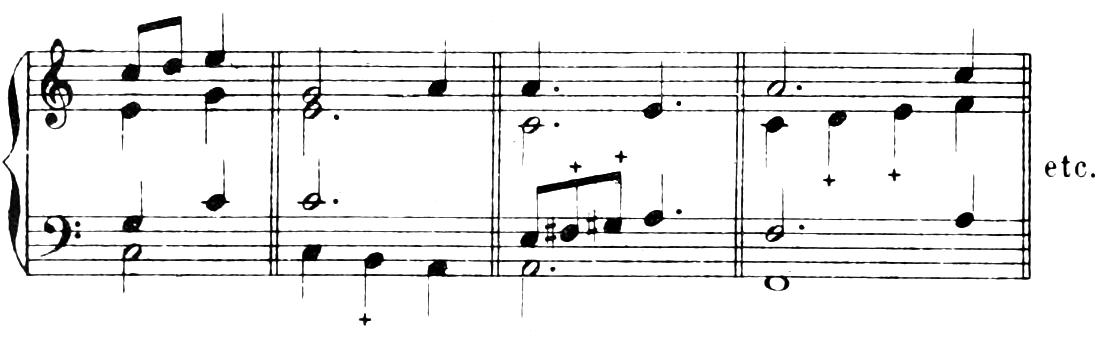 ▶ Example: simple passing notes (+) in one part at a time: soprano D between C and E; bass B between C and A; tenor F♯ and G♯ between E and A (melodic minor); alto D and E between C and F; "etc."
Diatonic Passing Notes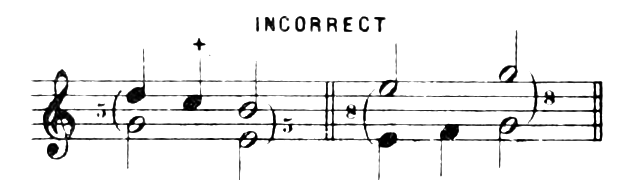 ▶ Incorrect: parallel fifths (D–G to B–E) and parallel octaves (E–E to G–G) are not hidden by an intervening passing note.
Diatonic Passing Notes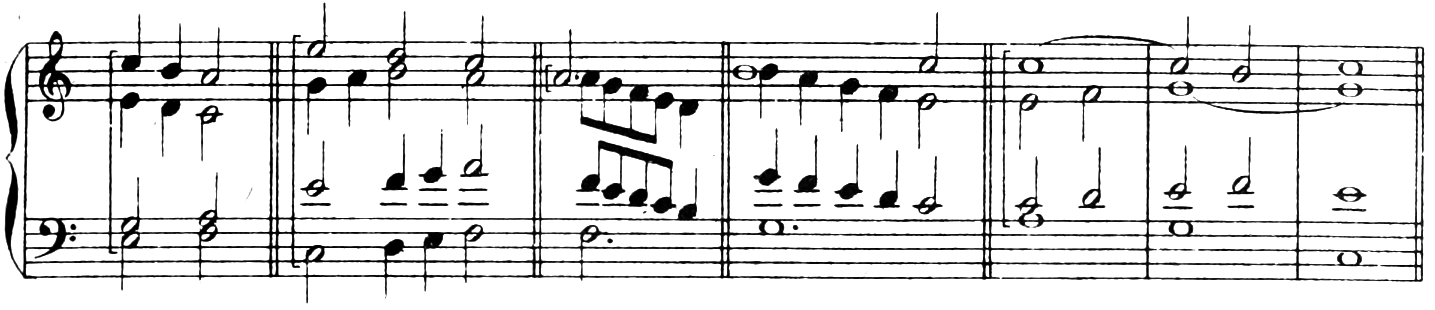 ▶ [Example]
Diatonic Passing Notes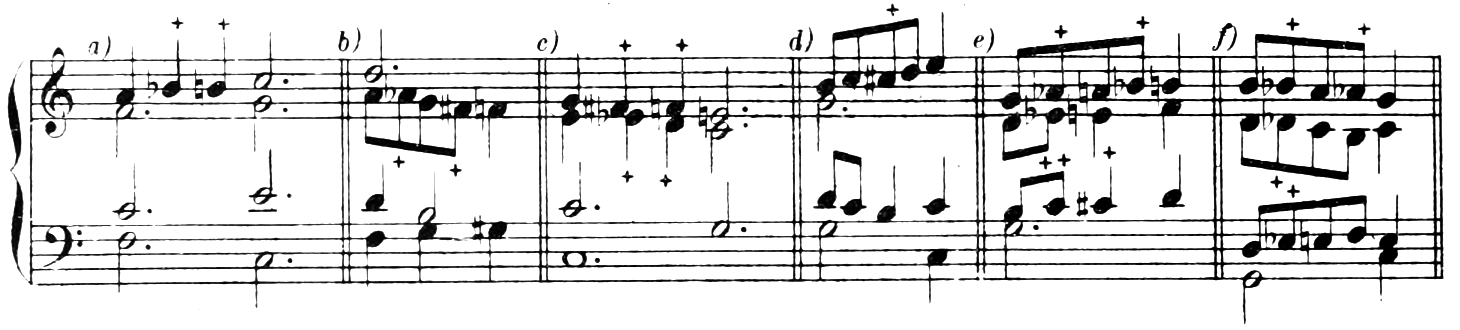 ▶ Example a)–f): chromatic passing notes (+) in one part, in two parts at once, and together with diatonic passing notes.
simple, double, etc
 Guide to the Practical Study of HarmonyPyotr Ilyich Tchaikovsky, 1900
Start: Chapter XXV. Passing-notes →- Chapter XXV. Passing-notes
§ 82. Passing notes are notes not belonging to the chord which serve to fill out the intervals between two harmonic notes, According to the scale, from which they are taken, we have. I diatonic, II chromatic passing-notes. _
▶ Fig. 260 nearby - Chapter XXV. Passing-notes
§ 83. With diatonic passing-notes we fill out the intervals of the third and the fourth. In the third but one passing note can be inserted; in the fourth, two.
▶ Fig. 260 nearby - Chapter XXV. Passing-notes
As a rule passing notes are found only on unaccented beats. They can occur in two or more voices at ance, moving either in parallel motion (in thirds or sixths), or in contrary motion. Contrary motion is preferable, since parallel progressions are in…
▶ Fig. 261 nearby - Chapter XXV. Passing-notes
§ 84. Although passing notes conduce to independent voice—leading, they should not be used too copiously. If, for instance, we were to fill out-every skip of a third or fourth with passing notes, we might easily fall into forbidden progressions, while such an…
▶ Fig. 261 nearby - Chapter XXV. Passing-notes
Note. The figuring of passing notes is of no great importance, since the chord does not suffer a real change in consequence of these notes. If they are to be figured, however, not only the interval formed by the passing note, but also the entire chord must be…
▶ Fig. 265 nearby - Chapter XXV. Passing-notes
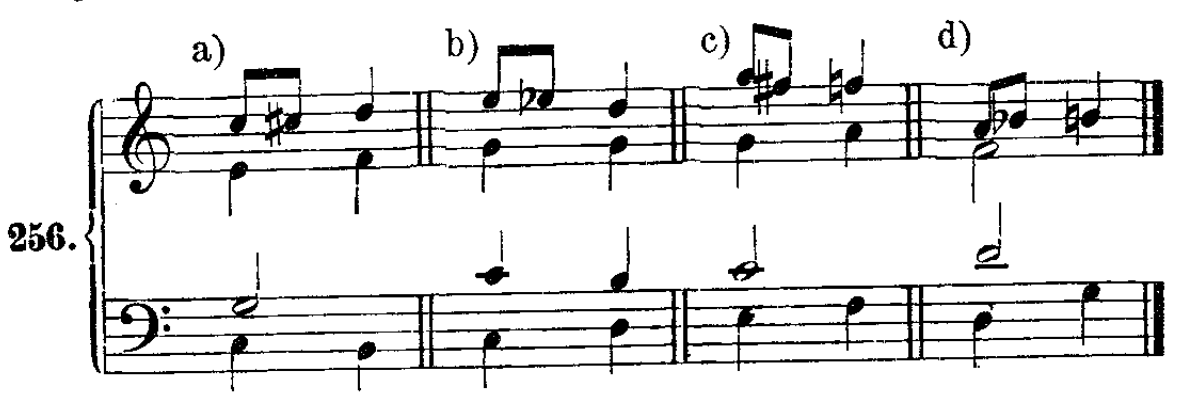
§ 87. The interval of a major second is filled out by a chromatic passing note. Nothing detracts from simplicity and naturalness as much as chromatic passing notes; consequently they are to be used in moderation, and with great care.
▶ Fig. 268 nearby
26 more passages in Guide to the Practical Study of Harmony →
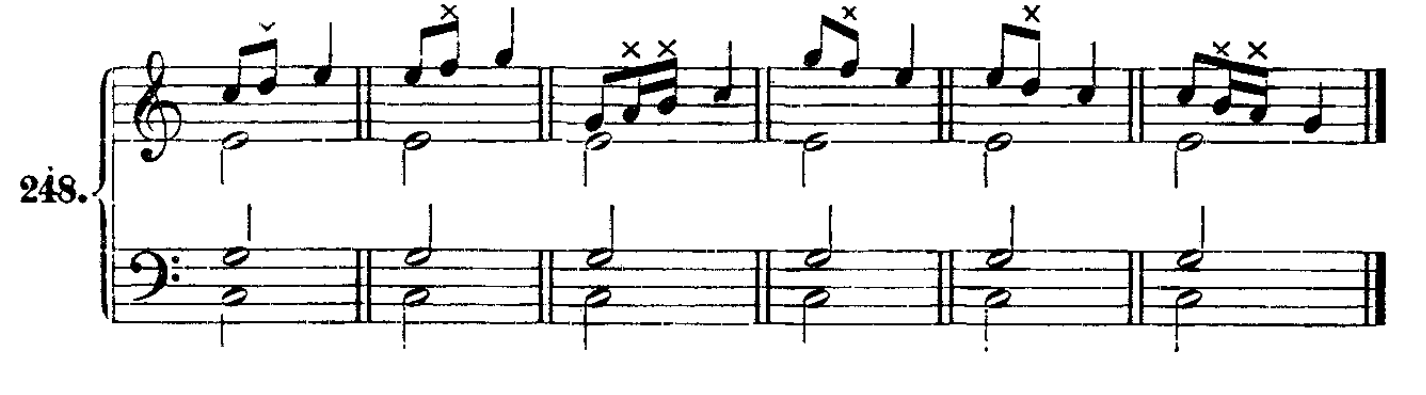 ▶ Fig. 260
 ▶ Fig. 261
 ▶ Fig. 265
 ▶ Fig. 268
 Theory of HarmonyArnold Schoenberg, 1922
Start: “Nonharmonic” Notes →- Degree VII
…a step of the scale. I therefore believe that dissonance first appeared as a passing tone, and that the passing tone arose from portamento, from the need to connect interval leaps smoothly or melodically—which in this case means by scale steps. That this need…
- Chorale Harmonization
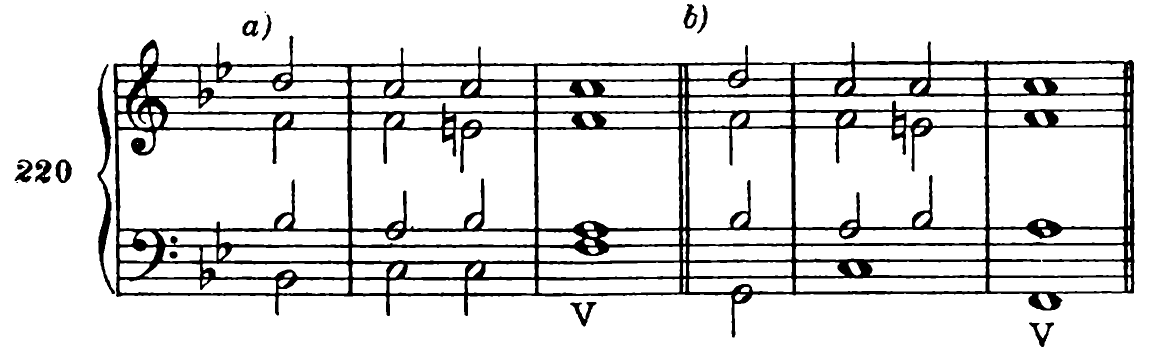
…from which this chorale is taken, simplified by omitting neighboring and passing notes, this line is harmonized as in 219g. By placing two chords against each half note here, Bach can achieve a clearer cadence containing more degrees. The pupil too may…
▶ Fig. 407 nearby - Suspensions and Other Nonharmonic Tones
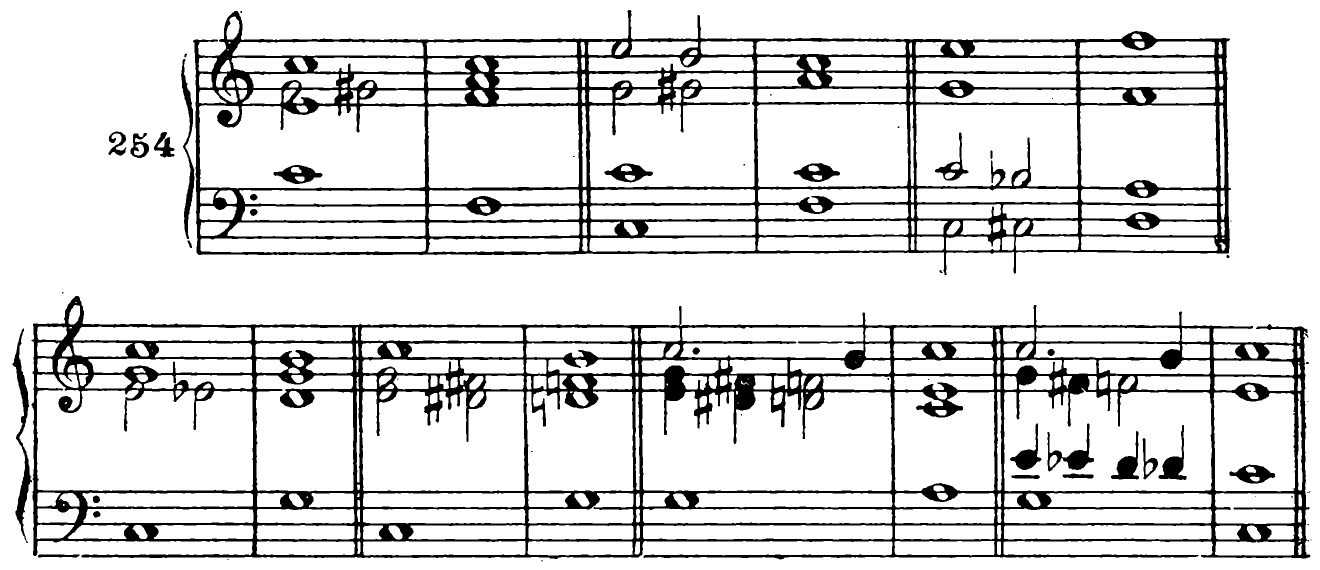
We have already mentioned the passing note several times. It is the scalar melodic connection that fills a melodic interval of at least a third with the intervening tones, so that an interval of a fourth contains two passing notes.
▶ Fig. 451 nearby - Suspensions and Other Nonharmonic Tones
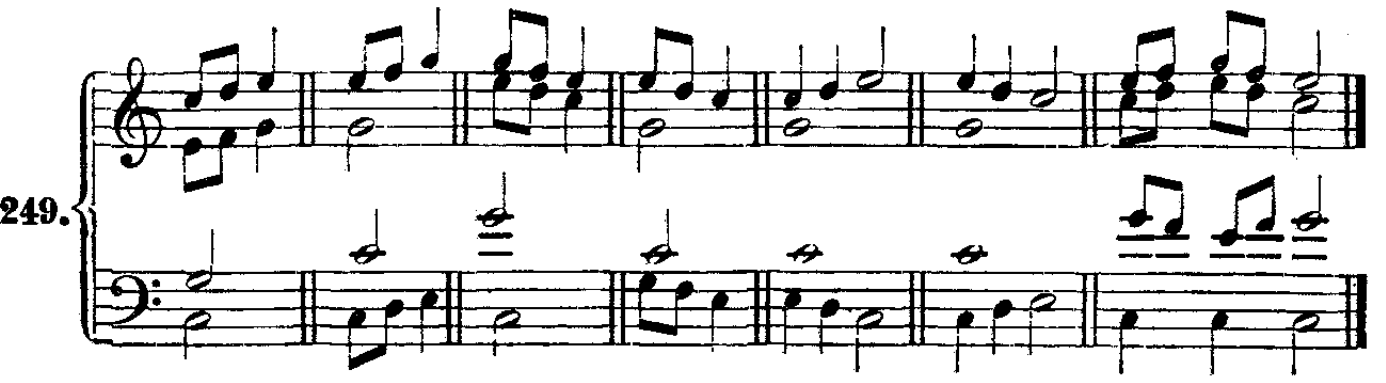
The E in 249a is consonant; in passing motion across a fourth, both passing tones may be dissonant (249b). Passing notes can also occur in several voices simultaneously.
▶ Fig. 454 nearby - Suspensions and Other Nonharmonic Tones
The passing notes can of course also be borrowed from the chromatic scale. That cannot cause the student any difficulty if he thinks of our secondary dominants and keeps in view the meaning of passing notes as a simple melodic form (a segment of the scale).
▶ Fig. 458 nearby - Suspensions and Other Nonharmonic Tones
The passing note renders excellent service with vagrant chords, where, for example, a reinterpretation arising through a passing note makes it possible to combine two turns of phrase such as those at 255 a and b into a single progression (255 c).
▶ Fig. 459 nearby
 ▶ Example 220-a
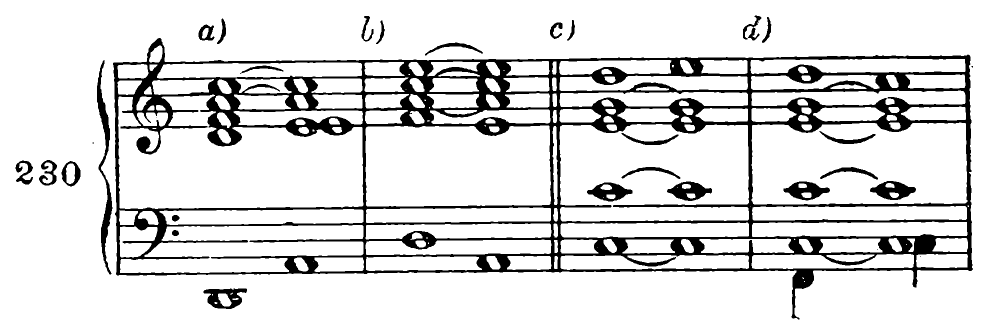 ▶ Example 230a
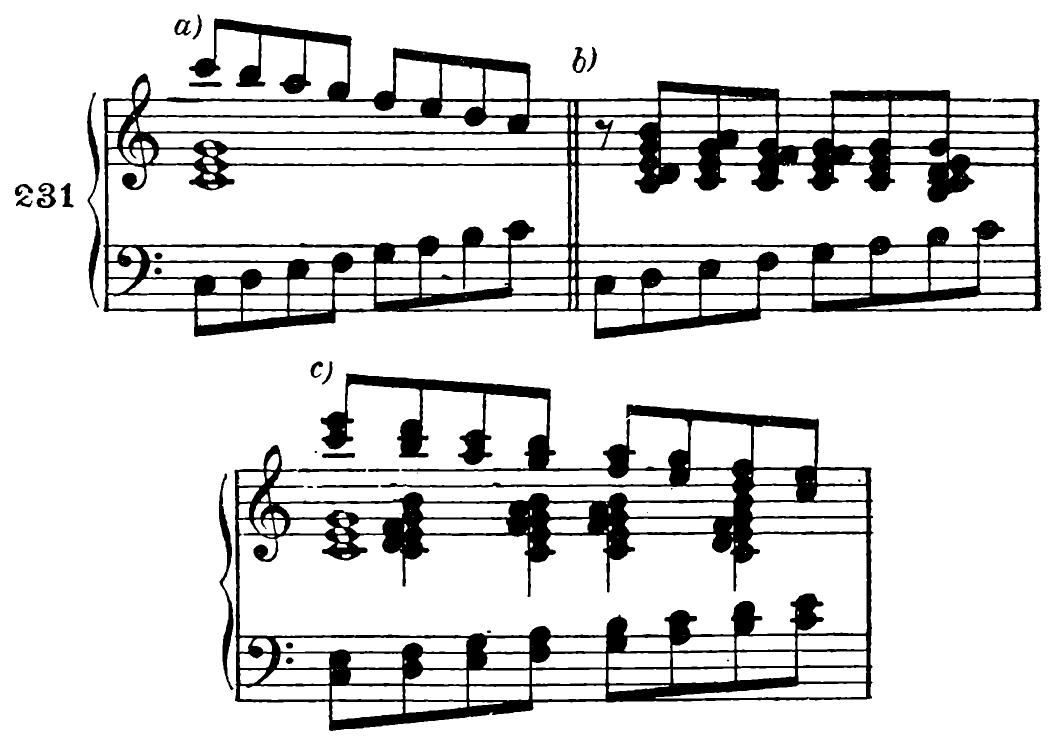 ▶ Example 231a
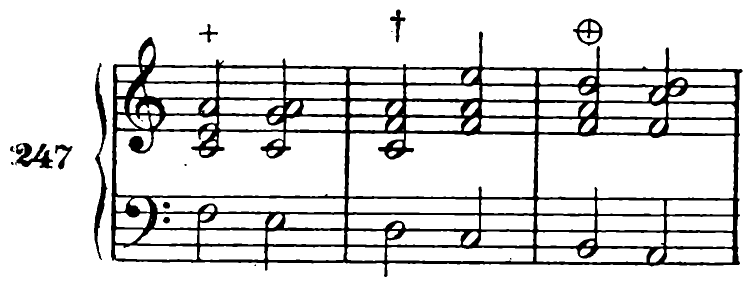 ▶ Example 247
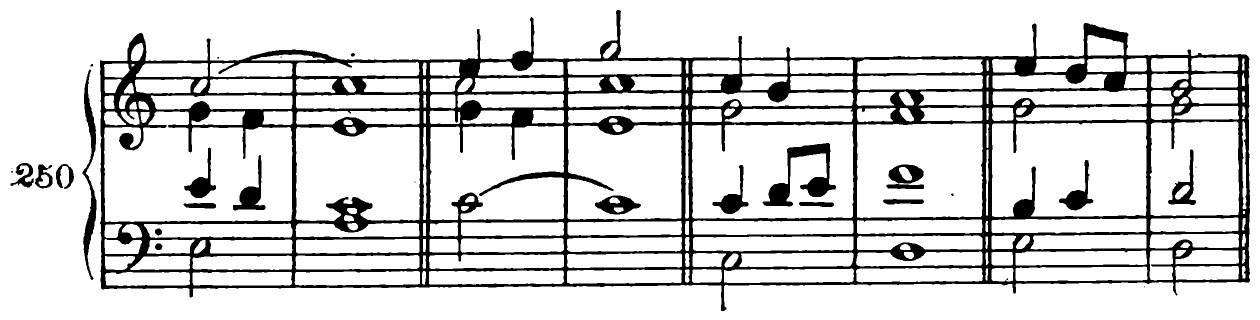 ▶ Example 250
 ▶ Example 254
 OrchestrationCecil Forsyth, 1914
- Brass instruments
…notes of the Harmonic Series which were already slightly out ot tune; (0) as passing notes, where they were only audible for the fraction of a second between two good open notes; (c) as "special-effect" notes, where a dull and muted tone-quality was wanted.
- Stringed instruments
…wider and the enharmonic differences more easily realized. Quick chromatic passing notes which have no harmonic value are generally best written in the simplest form possible. The inclusion of many double- Hats in flat-keys and of double-sharps in sharp-keys…
 Treatise on InstrumentationHector Berlioz, 1905
- The Pianoforte
…of this long prolongation of each tone, ap iaturas with accidentals and passing notes should be avoided as much as possible in the middle of the instrument while the pedal is being used; for these notes, sustained like all the others and thereby mixed with a…
- The Trumpet
proscription and may be considered an open tone. It is produced br the lips only; but since it is always a Jittle too high in pitch, it can be used only as a passing note
- The Trumpet
proscription and may be considered an open tone. It is produced by the lips only; but since it is always a Jittle too high in pitch, it can be used only as a passing note
 ArrivalMayank Sanganeria, 2026
- Preface: One Grammar, Two Axes
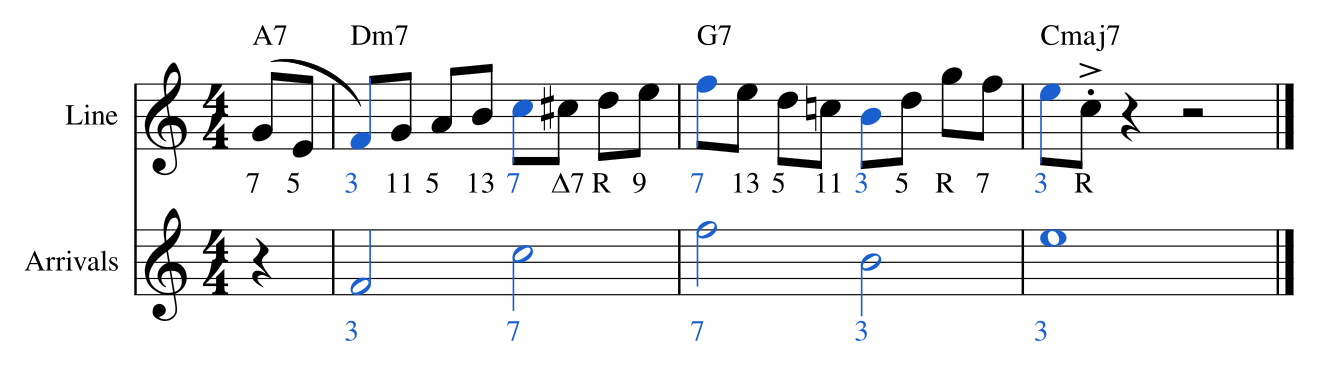
…pickup before the first bar line, a run that rises through one chromatic passing tone so every chord tone lands on a beat, a run down to B, an arpeggio that parks F on the last upbeat, and F falling into E across the final bar line.
▶ Fig. 1 nearby - Chapter 1 — The Two Axes
- Chord symbols sit above the staff. A chord holds until the next symbol. - Blue notes are arrivals: structural landing points, almost always on beat 1 or beat 3. - The numbers under each note name its function against the chord sounding at that moment. R, 3,…
▶ Fig. 3 nearby - Chapter 3 — The Skeleton
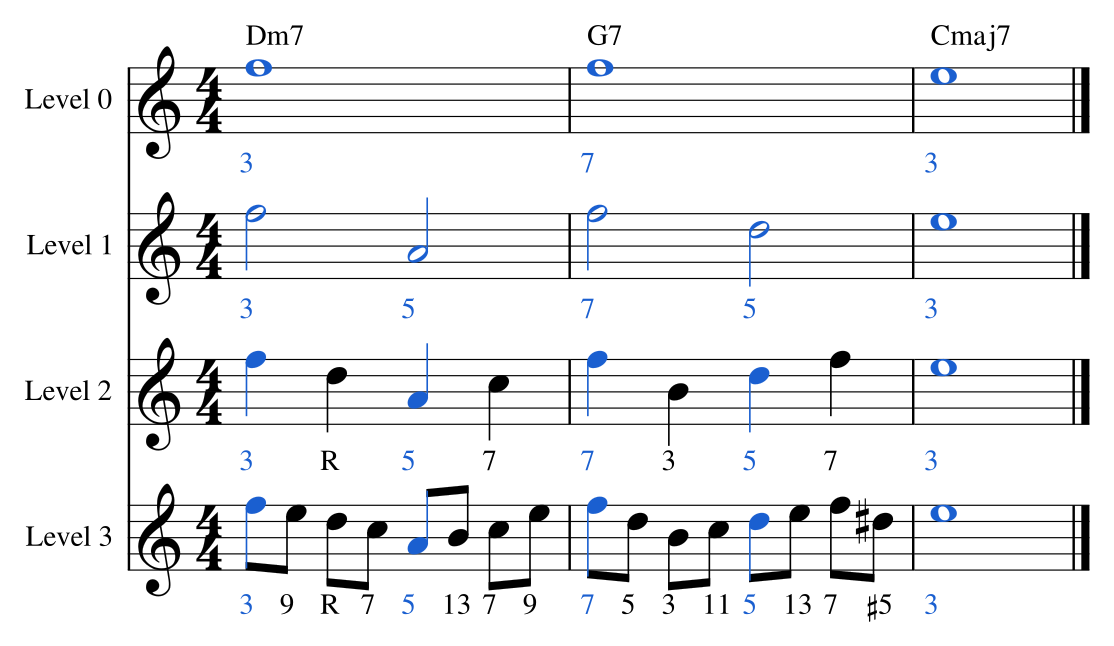
- Level 0 is the skeleton: F, F, E in whole notes. - Level 1 adds a chord tone on beat 3: A over Dm7, D over G7. These are the half-bar arrivals from Chapter 2. - Level 2 fills every beat with a chord tone. The line is now a walking arpeggio: F D A C, F B D F,…
▶ Fig. 7 nearby - Chapter 6 — Scales as Runways
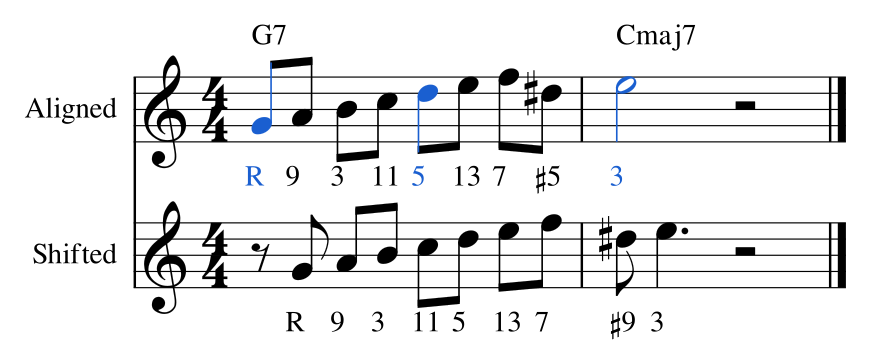
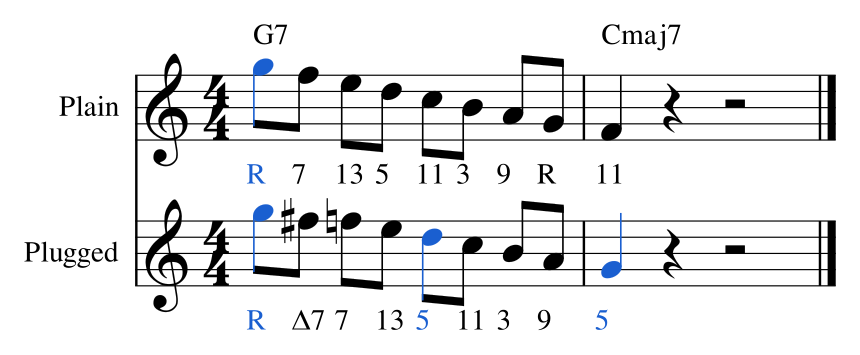
In the plain version, the step from G to F (root to 7th, both chord tones) pushes everything off the beat from the second note on. The run sounds aimless and arrives on the avoid note of Cmaj7. One chromatic passing tone fixes all of it.
▶ Fig. 15 nearby - Chapter 6 — Scales as Runways
Find the adjacent chord-tone pair in the scale and plug the gap with a chromatic passing tone. A run that starts on a chord tone on a beat then stays aligned for a full bar, in either direction.
▶ Fig. 15 nearby - Chapter 6 — Scales as Runways
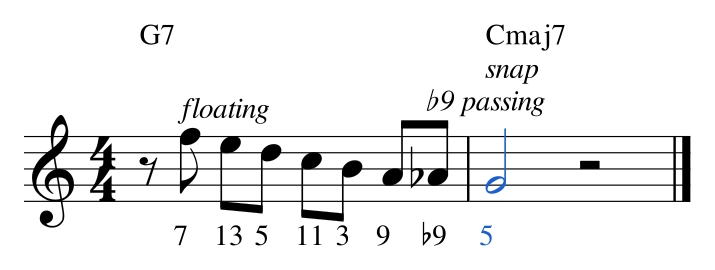
Ex. 6.3 — A run that starts on the & of 1 floats, with chord tones (F, D, B) on the upbeats and tensions on the beats. A♭, the ♭9 of G7, works as a passing tone on the last upbeat and snaps G onto beat 1 of Cmaj7.
▶ Fig. 17 nearby
 ▶ Ex. P.1
 ▶ Ex. 1.2
 ▶ Ex. 3.2
 ▶ Ex. 6.1
 ▶ Ex. 6.3
More in Dissonance and embellishment
Suspension · Neighbor notes · Anticipation · Appoggiatura · Nota cambiata · Pedal point