 Playable Books
Concept index · Dissonance and embellishment
Appoggiatura
Taught in 6 books. Each one opens at the passage; ▶ plays the example beside it. Also called appoggiaturas.
This index is Playable Books’ own: a first pass that finds the term’s words in each book, corrected by hand. The authors did not tag these passages, and their terms can differ (Fux’s “ligature” is a suspension). The quoted text is the book’s.
 Counterpoint AppliedPercy Goetschius, 1902
- Chapter I
…the same, or is changed, during the group. The figure contains a "Double appoggiatura," and results from inserting the upper and lower neighboring-tones successively between the principal tone and its recurrence.
▶ Fig. 13 nearby - Chapter II
…(stepwise); excepting the two leaps of a 3rd shown in Ex. ga ("double-appoggiatura") and Ex. go (unresolved upper neighboring-note); and the " ornamental resolutions " of the suspension, Exs. 10, II.
▶ Fig. 71 nearby - Chapter VI
…Passing-notes (accented and unaccented), and occasional Neighboring tones or Appoggiaturas, as disguising adjuncts of the predefined chords, as evidences of freedom and elasticity in a movement whose general direction is dictated by an underlying stern…
▶ Fig. 246 nearby
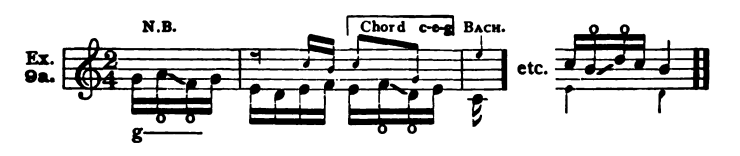 ▶ Ex9-A
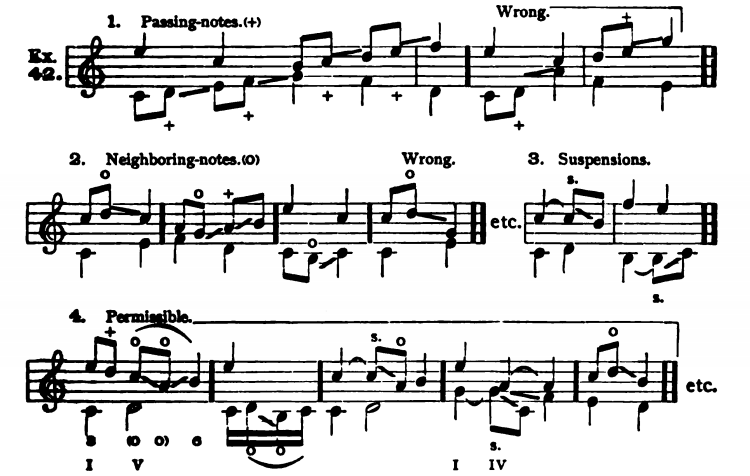 ▶ Ex42
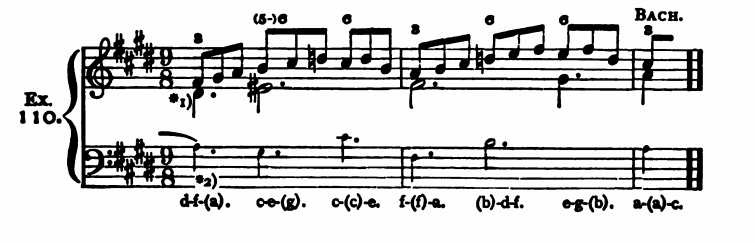 ▶ Ex110
 Practical Manual of HarmonyNikolai Rimsky-Korsakov, 1910
- Melodic Ornamentation in the Free Style
2) Auxiliary notes on the strong and weak beats of the bar, or on the strong and weak parts of a beat, arising from disjunct motion; those on the strong beat or on the strong part of a beat are also called unprepared suspensions or appoggiaturas:
▶ Fig. 328 nearby - Melodic Ornamentation in the Free Style
3) The double appoggiatura: when the principal note is preceded by the ascending appoggiatura followed by the descending one, and vice versa:
▶ Fig. 329 nearby - EXERCISE No. 31 (MELODIES WITHOUT GIVEN BASS)
REMARK.— Parallel fifths arising from the appoggiatura are justified by that very fact (see the first bar of the model).
▶ Fig. 331 nearby - EXERCISE No. 31 (MELODIES WITHOUT GIVEN BASS)
The anticipation may also be used before a diatonic or chromatic passing note, before a neighbour note and before an appoggiatura:
▶ Fig. 333 nearby
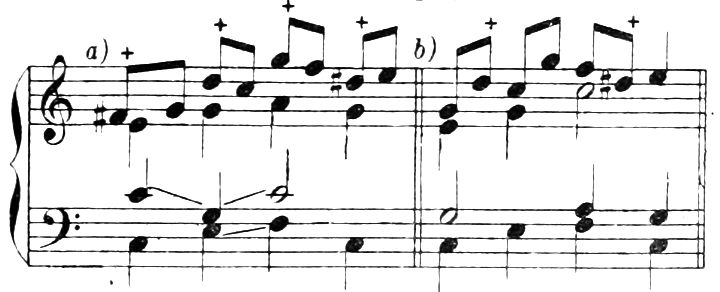 ▶ [Example]
Melodic Ornamentation in the Free Style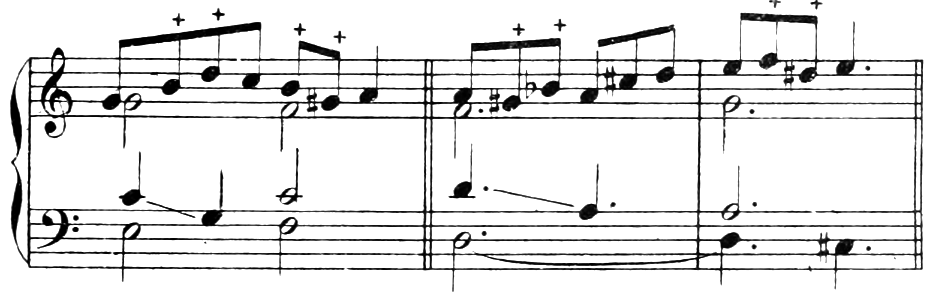 ▶ [Example]
Melodic Ornamentation in the Free Style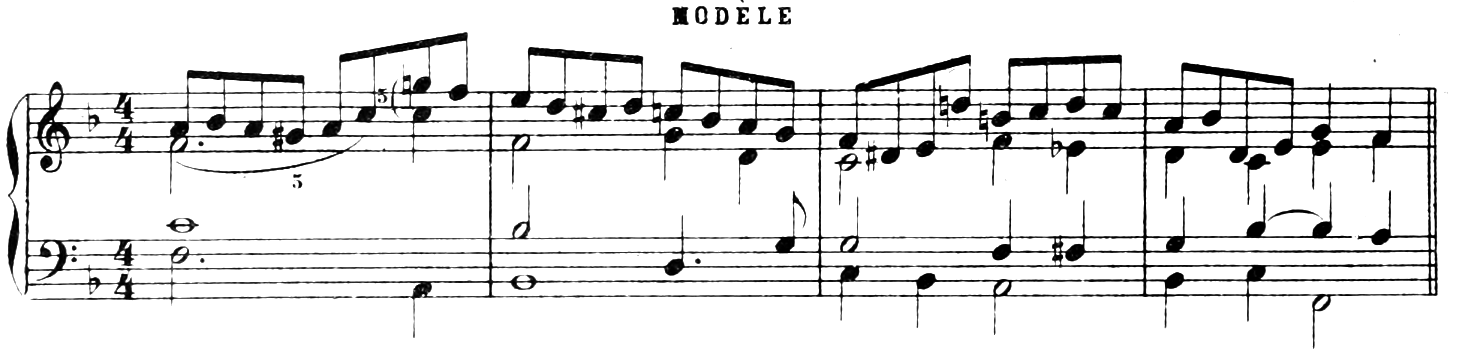 ▶ Model realization in F major, 4/4, four bars, with free ornamentation in the melody
EXERCISE No. 31 (MELODIES WITHOUT GIVEN BASS)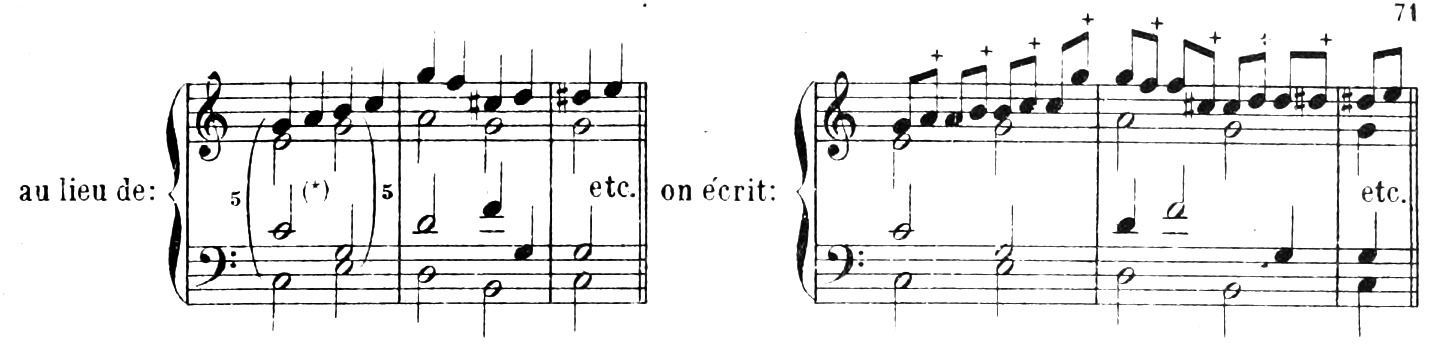 ▶ instead of: … etc. one writes: … etc.
EXERCISE No. 31 (MELODIES WITHOUT GIVEN BASS)
 Theory of HarmonyArnold Schoenberg, 1922
- Degree VII
…written notation could not have represented them; the figures concerned—appoggiaturas, trills, portamenti, and so forth—could therefore be transmitted only through tradition. But through practice, a sense that the dissonances touched upon belonged together…
- “Nonharmonic” Notes
…what is an unprepared suspension essentially other than a chord? What is the appoggiatura but an embarrassed concession made by the keen ear to the concept-bound eye? Something is supposed to sound here whose appearance the eye cannot tolerate. Must a…
▶ Fig. 436 nearby
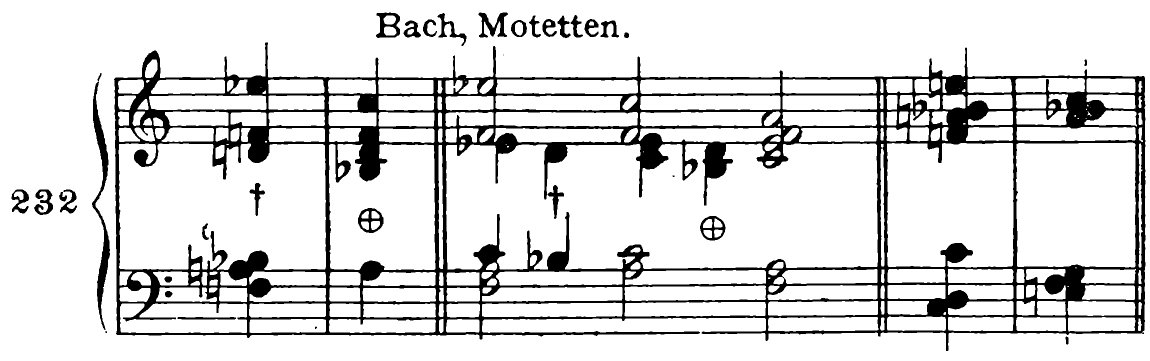 ▶ Example 232 — Bach, Motets
 Principles of OrchestrationNikolai Rimsky-Korsakov, 1922
- Harmonic basis
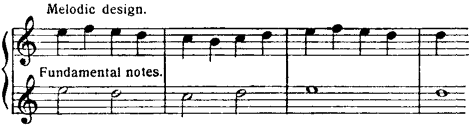
…transposed an octave lower, the discordant effect produced by the contact of appoggiaturas and fundamental notes will be diminished; the quicker the passage is played the less harsh the effect will be, and vice versa. But it would be ill-advised to lay down…
▶ Fig. 118 nearby
 ▶ Fig. 118
 Treatise on InstrumentationHector Berlioz, 1905
- The Violin
Short appoggiaturas are by no means impracticable in pizzicato. The following passage from the Scherzo of Beethoven’s C-minor Symphony is always executed very well.
- The Harp
…or belonging to non-related keys; most embellishments consisting of appoggiaturas with accidentals or several such short notes. All these are impracticable or, at best, extremely difficult and very ugly. Completely impossible on the Ebharp are the following…
- The Harp
Certain appoggiaturas and ornaments containing
 ArrivalMayank Sanganeria, 2026
- Chapter 2 — Arrival Points
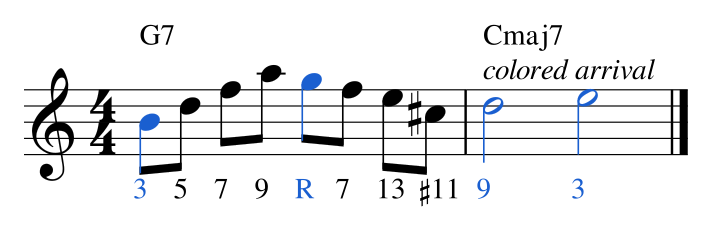
The ear expects the 3rd on beat 1, gets the 9th, and hears it resolve two beats later. It's the jazz cousin of the classical appoggiatura, and it works for the same reason: the arrival still happens, half a bar late.
▶ Fig. 5 nearby - Chapter 7 — Phrase Architecture
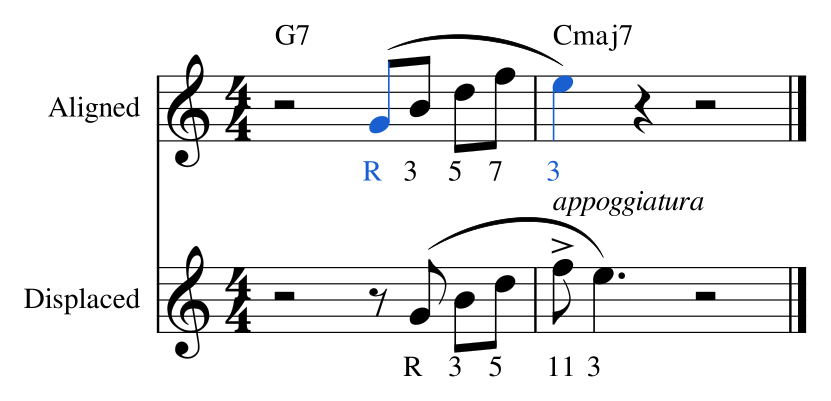
The displaced F is a non-chord tone on the strong beat, resolving down by step: an appoggiatura. Tension on the downbeat, resolution on the upbeat. Use it once a chorus and it sounds intentional. Use it constantly and the time sounds lost.
▶ Fig. 21 nearby - Chapter 7 — Phrase Architecture
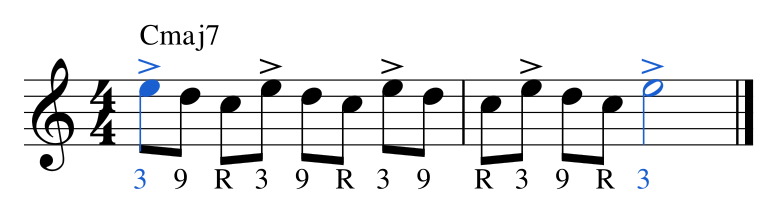
Take the chained line from Chapter 5. Play it from each of the six entry points, adjusting the pickup to fit. End it once long and once clipped. Then displace its final outline by one slot and let the appoggiatura resolve.
▶ Fig. 22 nearby - Appendix — Lexicon, Glossary and Lineage · Table
…Shifting a cell and its arrival by one slot, putting tension on the beat | 7 Appoggiatura | An accented non-chord tone on a strong beat, resolving by step | 7 Clipped ending | A downbeat arrival followed by one short, accented upbeat | 7 Region merge |…
 ▶ Ex. 2.2
 ▶ Ex. 7.4
 ▶ Ex. 7.5
More in Dissonance and embellishment
Suspension · Passing notes · Neighbor notes · Anticipation · Nota cambiata · Pedal point