 Playable Books
Concept index · Dissonance and embellishment
Neighbor notes
Taught in 11 books. Each one opens at the passage; ▶ plays the example beside it. Also called neighbor tone, auxiliary note, neighbour note.
This index is Playable Books’ own: a first pass that finds the term’s words in each book, corrected by hand. The authors did not tag these passages, and their terms can differ (Fux’s “ligature” is a suspension). The quoted text is the book’s.
 Exercises in Elementary CounterpointPercy Goetschius, 1910
- Chapter VII. Rhythmic Diversity. Two Notes To A Given Beat
…but must progress stepwise. They must be accounted for as passing-notes or neighboring notes which refer diatonically (scalewise) to the following essential tone. And, as a rule, such tones should not enter with a leap, either. In a word, skips should be…
▶ Fig. 106 nearby - Chapter XII. Four Notes To A Beat
In group 1, the upper neighboring note (/) is so inserted as to create a 3-tone figure out of the essential tone (e); the final unessential tone (d) goes on to c, or back to e, as the next beat may require. In group 2, the lower neighbor is used in the same…
▶ Fig. 196 nearby - Chapter XIII. Four Notes To A Beat, As Amplified Forms
Observe the manner in which such a " repetition " always occurs when a tone is embellished by its neighbor, — as in Exs. 91 and 100. That is, the principal tone always recurs, after the neighboring note.
▶ Fig. 234 nearby - Chapter XIII. Four Notes To A Beat, As Amplified Forms
…— multiplied, usually, by the addition of the grace-notes (inharmonic neighboring notes) which occupy the spaces between and around the chord-tones themselves. The most hasty analysis of any apparently elaborate piano composition will convince the student of…
▶ Fig. 238 nearby - Chapter XVI. Three-Part Harmony
For illustration, a melodic sentence in C major as upper part; each tone an essential chord-tone (that is, no passing-notes or neighboring notes, in these lessons):
▶ Fig. 287 nearby
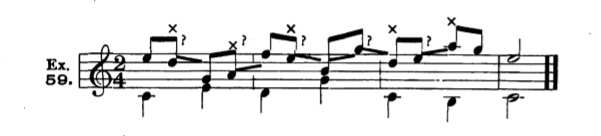 ▶ Ex.59
 ▶ Ex.91
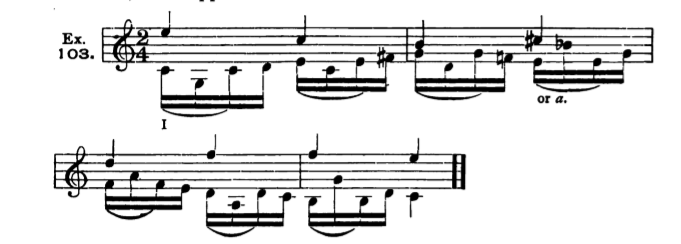 ▶ Ex.103
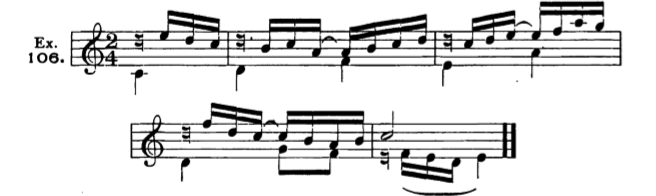 ▶ Ex.106
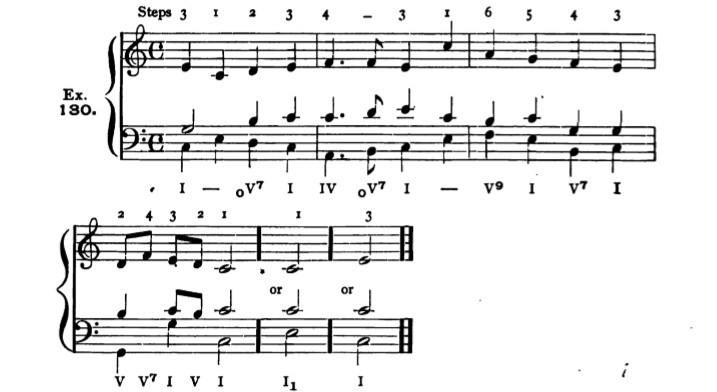 ▶ Ex.130
 Counterpoint AppliedPercy Goetschius, 1902
- Chapter I
c. It is generally unmelodious to separate a chromatic succession by inserting an intermediate neighboring-tone, in quick movement:
▶ Fig. 4 nearby - Chapter I
(1) It is always possible to leap a 3rd, from a neighboring-note to the opposite neighboring-note (of the same essential tone); usually, the essential tone follows and concludes the group, —as it also begins it:
▶ Fig. 13 nearby - Chapter I
…a "Double appoggiatura," and results from inserting the upper and lower neighboring-tones successively between the principal tone and its recurrence.
▶ Fig. 13 nearby - Chapter I
…with. The license then consists in leaping down a 3rd from the upper neighboring-note; it is rarely applied in the opposite direction (leaping upward a 3rd from the lower neighbor).
▶ Fig. 14 nearby - Chapter I
or embellished by either neighboring-tone:
▶ Fig. 29 nearby - Chapter XI
The main object is, so to embellish the c. f. tones with auxiliary notes (passing-, neighboring-notes, etc., in florid rhythmic form) that the original stern chorale-melody is completely transformed into a graceful (though dignified and impressive) Zyric…
▶ Fig. 313 nearby
 ▶ Ex3
▶ Ex3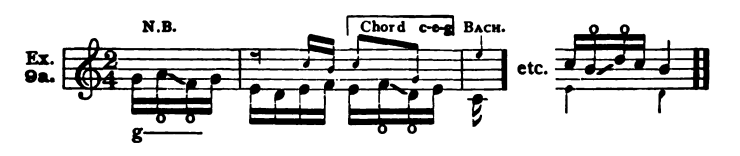 ▶ Ex9-A
 ▶ Ex9-B
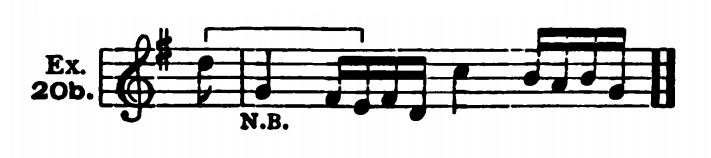 ▶ Ex20-B
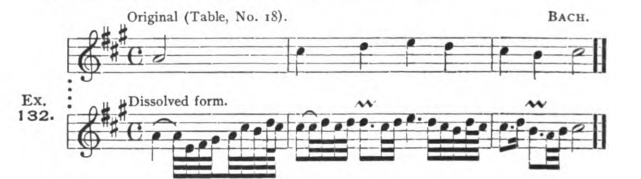 ▶ Ex132
 Analysis of J. S. Bach’s Forty-Eight FuguesEbenezer Prout, 1910
- Fugue 19 · Book I, No. 19 · BWV 864
…dominant, and answer it by the third of the tonic, unless it be an obvious auxiliary note; compare No. 23, also, to some extent, Nos. 18 (second note) and 24 (seventh note). After a few notes of codetta, the bass enters with the subject at the beginning of bar…
▶ Fig. 48 nearby - Fugue 25 · Book II, No. 1 · BWV 870
…the first note of the subject as the dominant of C, not the tonic of G, the auxiliary note, F, lay a whole tone below it, while in the answer the corresponding interval is a semitone. There is no regular countersubject, and no codetta. The exposition ends on…
▶ Fig. 60 nearby
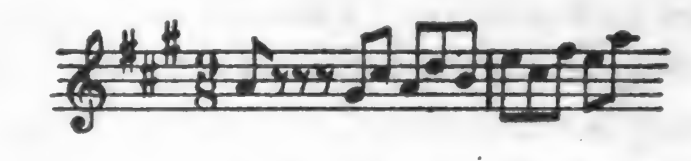 ▶ Subject · Fugue 19
 ▶ Prout’s excerpt · Fugue 25
 Treatise on HarmonyJean-Philippe Rameau, 1722
- Chapter twenty-five
…and resolves directly afterward by descending to the sharp sixth of the neighboring note. There the diatonic progression obliges us to conform our harmony to the key prescribed by the following leading note.
▶ Fig. 260 nearby
 ▶ Fig. 260
 Practical Manual of HarmonyNikolai Rimsky-Korsakov, 1910
Start: The Neighbour Note →- The Neighbour Note
§ 68. — 1) By a neighbour note is meant the note placed on the weak beats of the bar or on the weak part of a beat, between two real notes of the same name, one degree above (upper neighbour note) or one degree below (lower neighbour note) the real notes.
▶ Fig. 274 nearby - The Neighbour Note
2) Neighbour notes, following the diatonic scale, lie a major or minor second from their real notes, but they may be brought to within a semitone of their real notes by an accidental; this chromatic drawing-closer is often obligatory for certain neighbour…
▶ Fig. 274 nearby - The Neighbour Note
The root requires: upper neighbour note: a major or minor second; lower neighbour note: a minor second. The third requires: upper neighbour note: a minor second; lower neighbour note: a major or minor second. The fifth requires: upper neighbour note: a major…
▶ Fig. 275 nearby - The Neighbour Note
The root requires: upper neighbour note: a major second; lower neighbour note: a minor second. The third requires: upper neighbour note: a major second; lower neighbour note: a minor second. The fifth requires: upper neighbour note: a minor second; lower…
▶ Fig. 276 nearby - The Neighbour Note
The upper neighbour note of the seventh does not allow downward alterations:
▶ Fig. 277 nearby - The Neighbour Note
7) Neighbour notes in two parts at once must form parallel thirds or sixths, or move in contrary motion; neighbour notes in three parts at once are subject to the same rule, but they may also form chords of the sixth in parallel motion.
▶ Fig. 282 nearby
13 more passages in Practical Manual of Harmony →
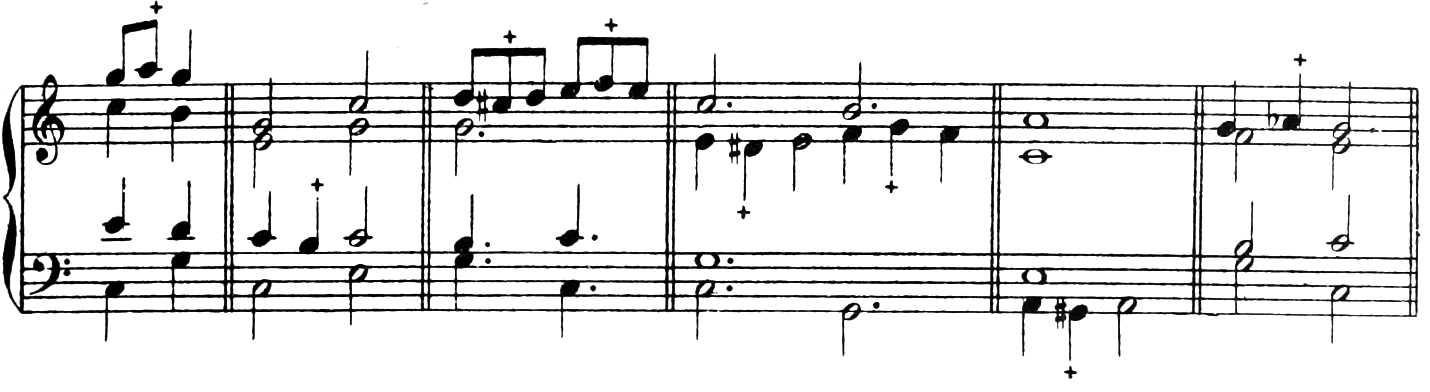 ▶ Example: neighbour notes (+) in one part at a time, six fragments: soprano G-A-G; tenor C-B-C; soprano D-C#-D and E-F-E; alto E-D#-E and F-G-F; bass A-G#-A; soprano G-Ab-G.
The Neighbour Note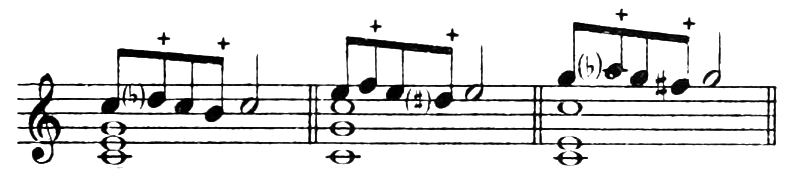 ▶ Example: neighbour notes about the root, third and fifth of the C major triad: C-D(b)-C-B-C; E-F-E-D(#)-E; G-A(b)-G-F#-G.
The Neighbour Note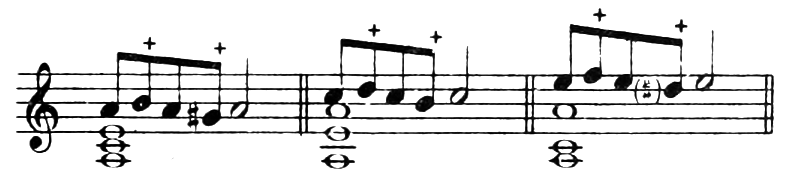 ▶ Example: neighbour notes about the root, third and fifth of the A minor triad: A-B-A-G#-A; C-D-C-B-C; E-F-E-D(#)-E.
The Neighbour Note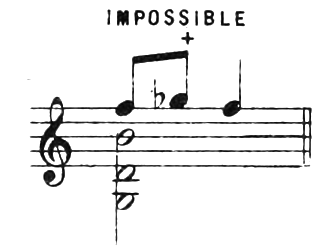 ▶ Example, "IMPOSSIBLE": the seventh F of the G7 chord with a lowered upper neighbour Gb (F-Gb-F).
The Neighbour Note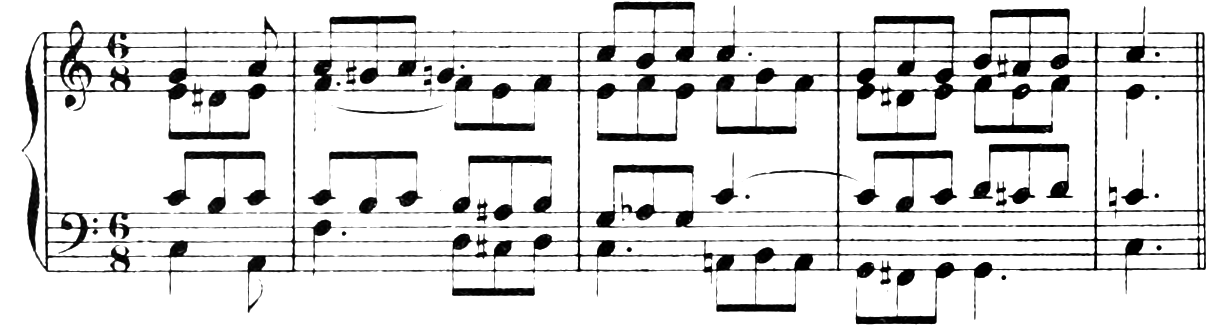 ▶ Example in 6/8, C major: neighbour notes in two and three parts at once, in parallel thirds and sixths, in contrary motion, and as parallel chords of the sixth.
The Neighbour Note
 Guide to the Practical Study of HarmonyPyotr Ilyich Tchaikovsky, 1900
Start: Chapter XXVIII. Changing-notes →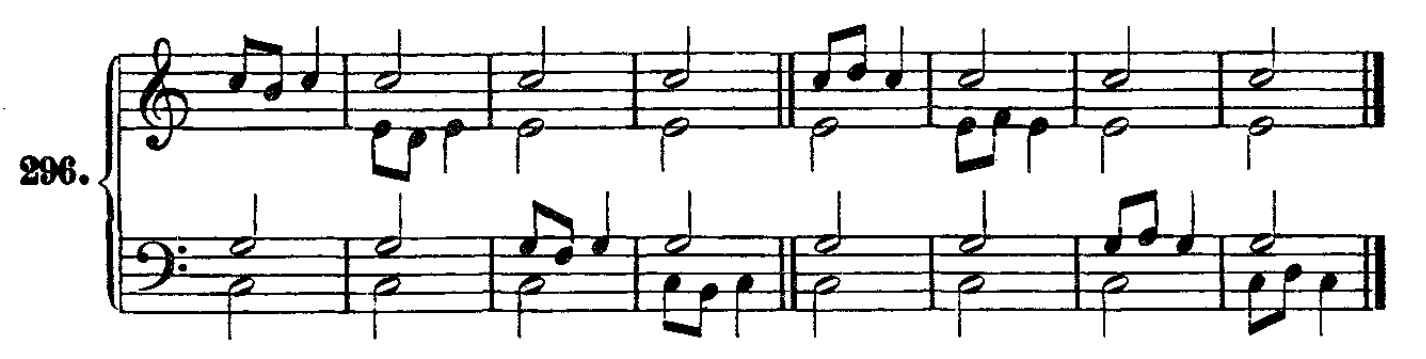 ▶ Fig. 310
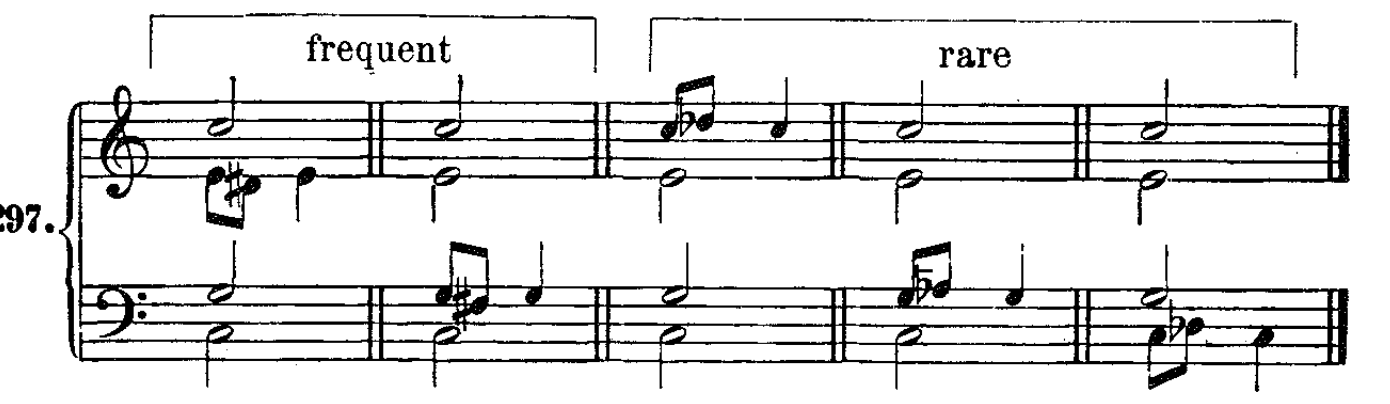 ▶ Fig. 311
 PartimentiFedele Fenaroli, 1800
- Book I: Simple figured basses
…from tones of the chords. With more experience one can add passing or neighboring tones or try to incorporate melodic motives already present in the bass.
 Theory of HarmonyArnold Schoenberg, 1922
Start: “Nonharmonic” Notes →- The Major Key and Its Diatonic Chords
…because it originated melodically. This is what happens with passing and neighboring notes, which would long since have been regarded as constituents of chords if the system of nonharmonic tones were not so much more convenient.
- Modulation through Intermediate Keys
…But also, and this is very important, through preparatory passing and neighboring notes that bring the key relationships closer. What matters is that an apparently sudden departure almost invariably announces itself beforehand: through a certain loosening of…
▶ Fig. 359 nearby - Chorale Harmonization
…(228). Admittedly, it would scarcely be possible without passing and neighboring notes, which are therefore not ornamental here but structural: not accidents, not foreign to the harmony, but necessities, chords. In general, the pupil will have to pay…
▶ Fig. 426 nearby - Suspensions and Other Nonharmonic Tones
All these so-called nonharmonic notes—suspensions, passing notes, neighboring notes, anticipations—should therefore appear in our exercises as products of melodic events. Their appearance, and the dissonances that invariably accompany them, are thus justified…
▶ Fig. 440 nearby - Suspensions and Other Nonharmonic Tones
The free suspension approaches the neighboring note. For the prepared suspension there was initially a rule that it should occur on the strong beat. As an exception (!) it was also allowed on the weak beat. Eventually, however, the exception appears almost…
▶ Fig. 450 nearby - Suspensions and Other Nonharmonic Tones
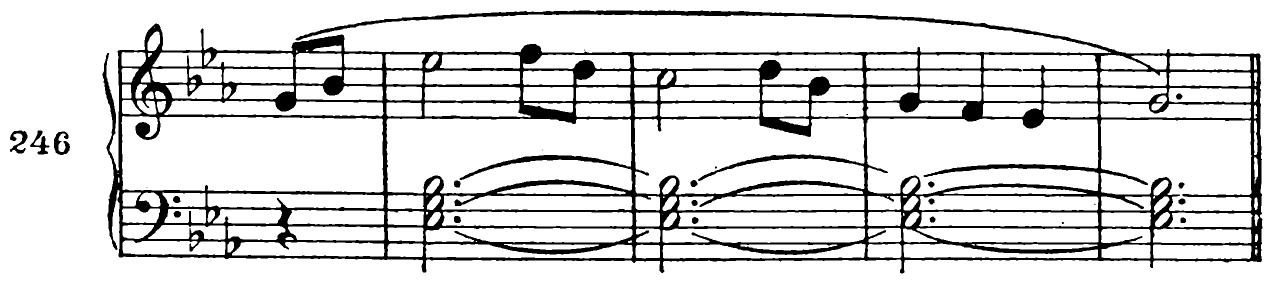
D and B-flat are neighboring notes circling C, but C itself is “nonharmonic.” With the same justification one may naturally leap away from suspension notes. Thus the dissonances in Schumann's “Ich grolle nicht,” marked by the cross, dagger, and circled cross…
▶ Fig. 451 nearby
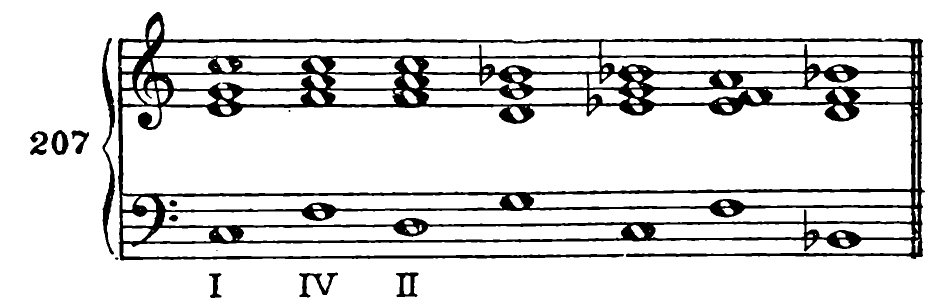 ▶ Example 207
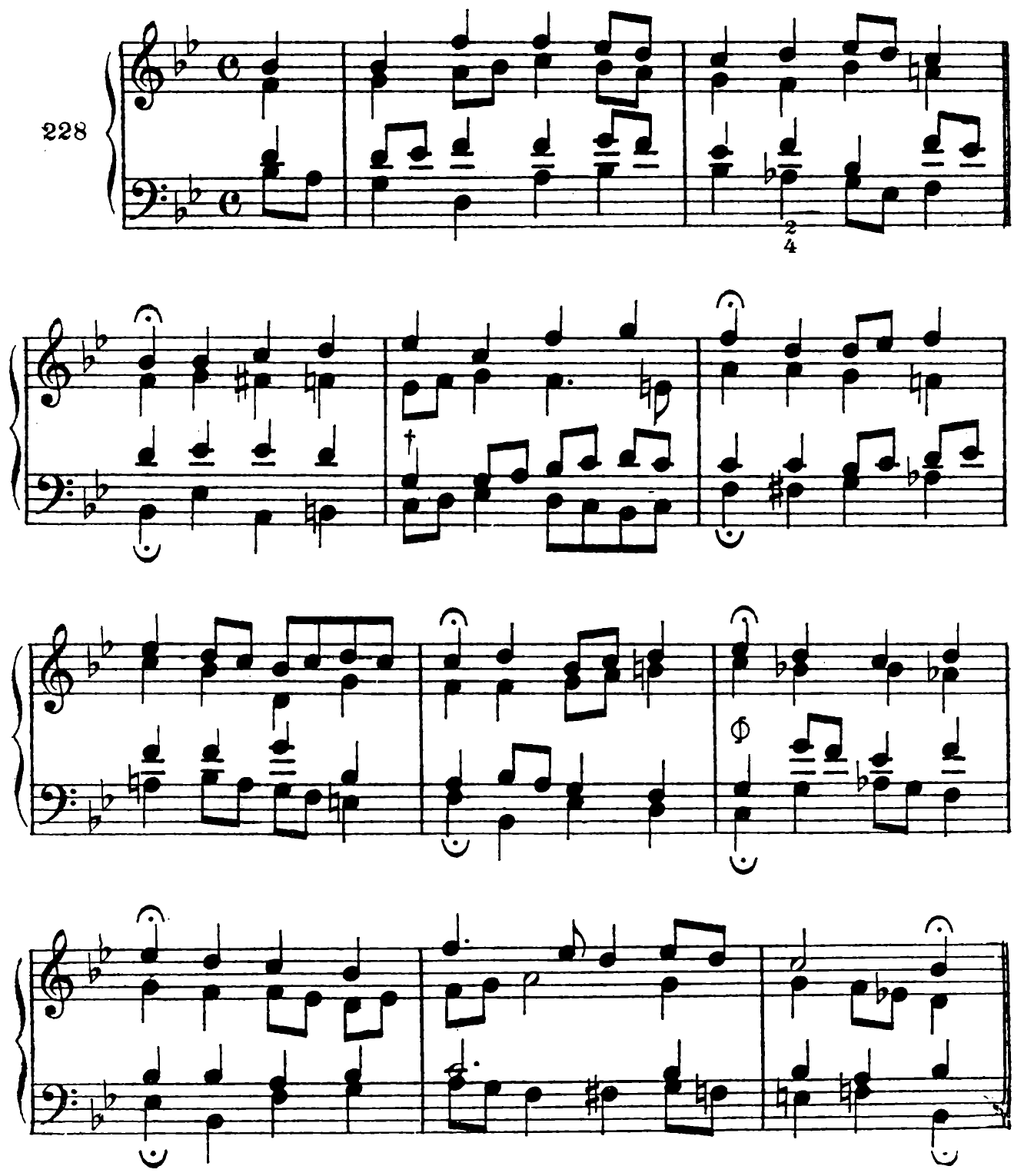 ▶ Example 228 — main
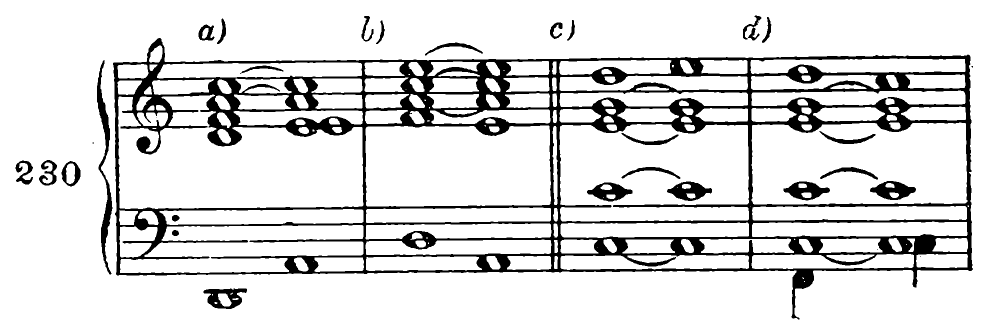 ▶ Example 230a
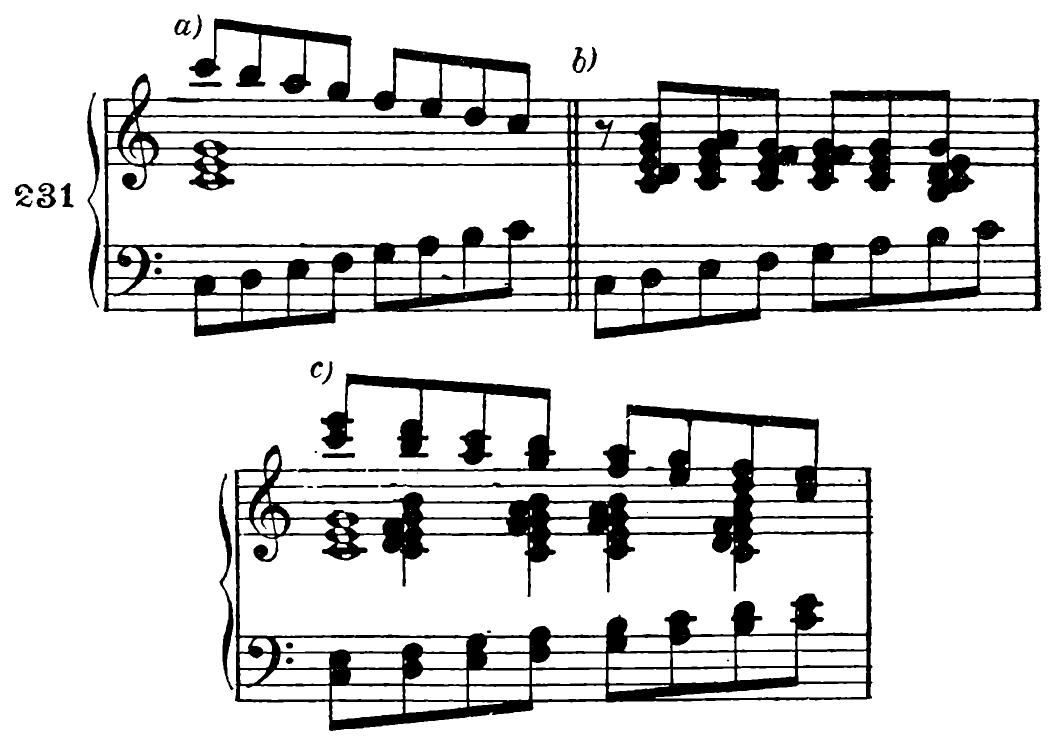 ▶ Example 231a
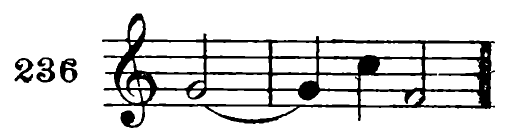 ▶ Example 236
 ▶ Example 246
 Principles of OrchestrationNikolai Rimsky-Korsakov, 1922
- Number of harmonic parts—Duplication
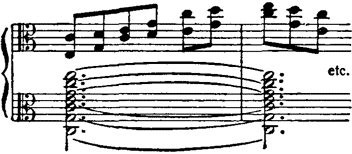
The rules of harmony concerning sustained and pedal passages apply with equal force to orchestral writing. As regards passing and auxiliary notes, échappées, considerable licence is permitted in rapid passages of different texture:
▶ Fig. 40 nearby
 ▶ Fig. 40
 Treatise on InstrumentationHector Berlioz, 1905
- The French Horn
+ nis open G# is not so easy to produce as the G but it becomes easy if prepared by a neighboring tone, ic. G, F# or A. It is a little too high.
 ArrivalMayank Sanganeria, 2026
Start: Chapter 4 — Approach Grammar → ▶ Ex. 4.3
 ▶ Ex. 4.4
More in Dissonance and embellishment
Suspension · Passing notes · Anticipation · Appoggiatura · Nota cambiata · Pedal point