 Playable Books
Concept index · Dissonance and embellishment
Pedal point
Taught in 10 books. Each one opens at the passage; ▶ plays the example beside it. Also called organ point, pedal.
This index is Playable Books’ own: a first pass that finds the term’s words in each book, corrected by hand. The authors did not tag these passages, and their terms can differ (Fux’s “ligature” is a suspension). The quoted text is the book’s.
 Exercises in Elementary CounterpointPercy Goetschius, 1910
Start: Chapter XXII. Four-Part Harmony →- Chapter XXII. Four-Part Harmony
226. The so-called Organ-point is particularly valuable in harmony for four (or more) parts, because it adds a line, — usually the lowermost, — without interfering with the movements of the other parts. The principal rule is that the organ-point, as dissonant…
▶ Fig. 386 nearby - Chapter XXII. Four-Part Harmony
1. Organ-point on the Tonic.
▶ Fig. 387 nearby - Chapter XXII. Four-Part Harmony
2. Organ-point on the Dominant.
▶ Fig. 387 nearby - Chapter XXII. Four-Part Harmony
The X marks the beats where the sustained tone in bass becomes dissonant. In version 1, it is the Tonic of the key; in version 2, the Dominant. No other steps than these are likely to occur as organ-points.
▶ Fig. 387 nearby - Chapter XXII. Four-Part Harmony
Also write a number of original 4-part sentences, with sequences, successive 6ths, and Organ-points.
▶ Fig. 387 nearby - Chapter XXV. Four-Part Counterpoint
In No. 6: At the beginning there is a succession of Sixth-chords, over the tonic organ-point. Compare paragraph 182 (Ex. 132).
▶ Fig. 432 nearby
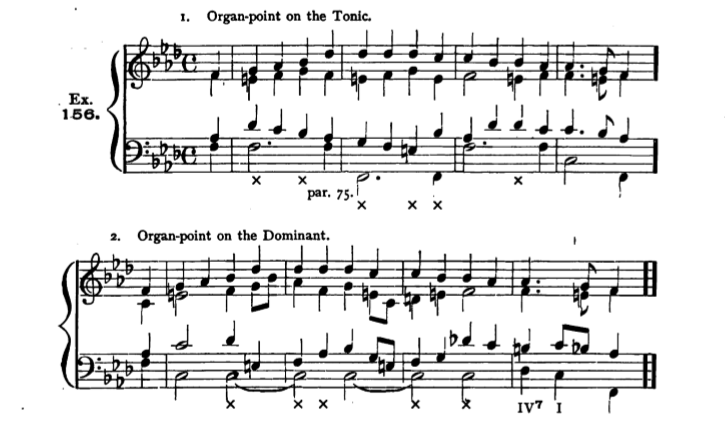 ▶ Ex.156-1
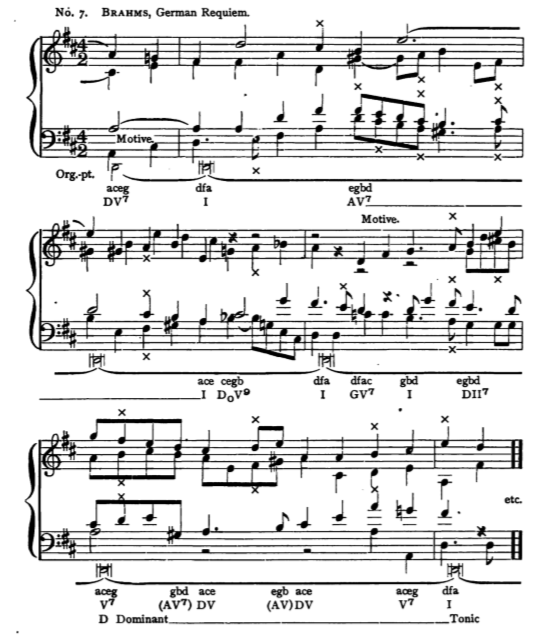 ▶ Ex.171-7
 Counterpoint AppliedPercy Goetschius, 1902
- Chapter V
…a strong Dominant cadence occurs in measure 6o, followed by an extraordinary organ point, as Re-transition into Part III; the M. is announced twice in Part III (measures 77-84); from this to the end is episodic Coda, based on first member of the Motive.
- Chapter X
…and elaborately as desired, in ordinary 4-part writing (with or without Pedal-bass), after the manner of the following:
▶ Fig. 269 nearby - Chapter X
92. The number of parts ordinarily employed is four: the cantus firmus, two inner parts, and the Pedal bass.
▶ Fig. 269 nearby - Chapter X
#4) Or an 8ve lower; the Pedal-bass is generally kept fairly low, though it may cross the Tenor occasionally, without objection. See also Ex. 129.
▶ Fig. 270 nearby - Chapter X
A. Harmonize a number of the above chorales, according to par. 91. Write the chorale in quarter-notes, 4/4 or 3/4 time; limit the accompaniment to eighth- and occasional sixteenth-notes; employ organ-notation (3 staves, including Pedal-bass).
▶ Fig. 300 nearby - Chapter XI
B. One example for 3 voices, preferably for manual (without Pedal-bass). C. One example for 5 voices. Review par. 81. Pedal-bass low.
▶ Fig. 310 nearby
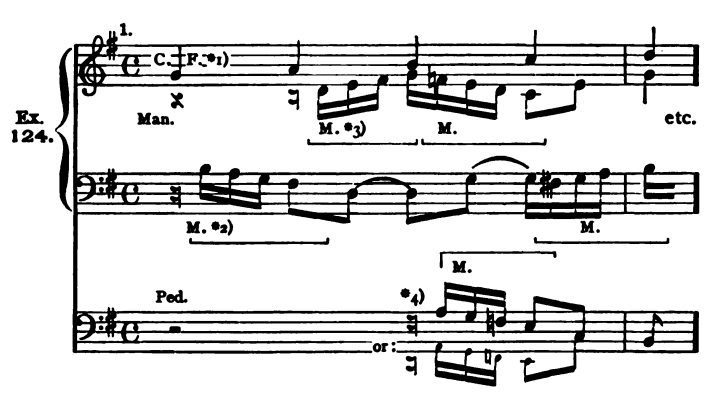 ▶ Ex124-1
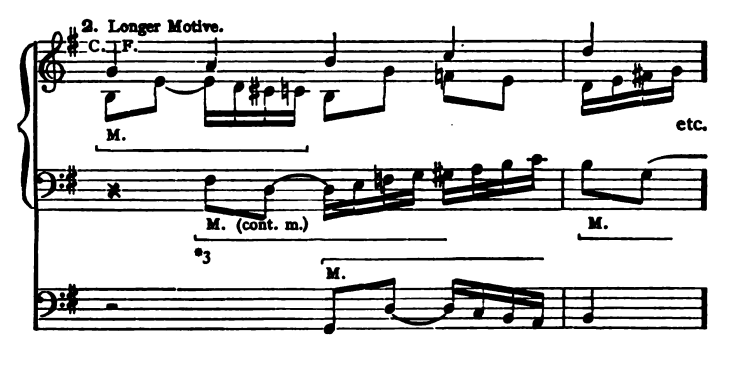 ▶ Ex124-2
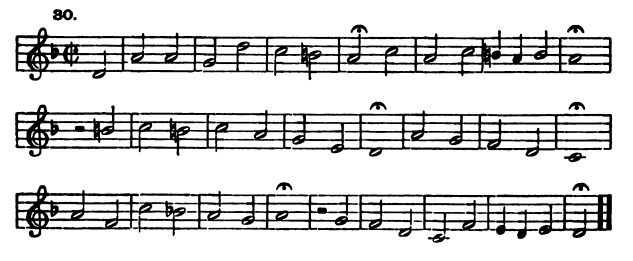 ▶ TableOfGermanChorales-30
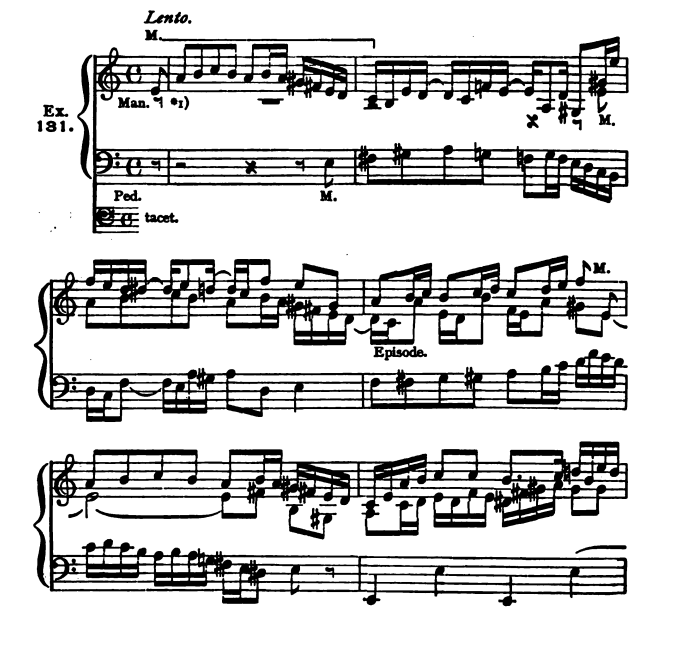 ▶ Ex131
 Analysis of J. S. Bach’s Forty-Eight FuguesEbenezer Prout, 1910
- Introduction
NOTE.—It is assumed that the terms belonging to simpler branches of musical theory, such as "cadence," "sequence," "pedal point," are already familiar to the student.
- Fugue 1 · Book I, No. 1 · BWV 846
…precedes it (bar 23). The whole of this final section is built over a tonic pedal.
▶ Fig. 2 nearby - Fugue 2 · Book I, No. 2 · BWV 847
…bar 29 we reach the coda. Here the subject is heard for the last time over a tonic pedal. It is not accompanied by the countersubject, but additional parts are added to the harmony—a by no means unusual feature at the end of a fugue. We shall find many other…
▶ Fig. 4 nearby - Fugue 4 · Book I, No. 4 · BWV 849
…at bar 102, and chiefly consists of stretto of CS 2. At bar 105 begins a dominant pedal, above which in bar 107 we see the last entry of the subject in the tonic key. It is followed by a coda (bars 110 to 115), the last four bars of which are over a tonic…
▶ Fig. 12 nearby - Fugue 6 · Book I, No. 6 · BWV 851
…and alto, both giving the subject, and in its direct form. At the close, a tonic pedal of two bars is accompanied by additional voices, which give a bar of the subject in its direct and inverted forms simultaneously, and in thirds.
▶ Fig. 18 nearby - Fugue 14 · Book I, No. 14 · BWV 859
…which case the closing appearance of the subject (bars 37 to 40, mostly on a dominant pedal) could be described as coda. The normal tripartite structure is not clear in this fugue, the keys being little varied. At bar 32 the bass responds with the subject by…
▶ Fig. 38 nearby
5 more passages in Analysis of J. S. Bach’s Forty-Eight Fugues →
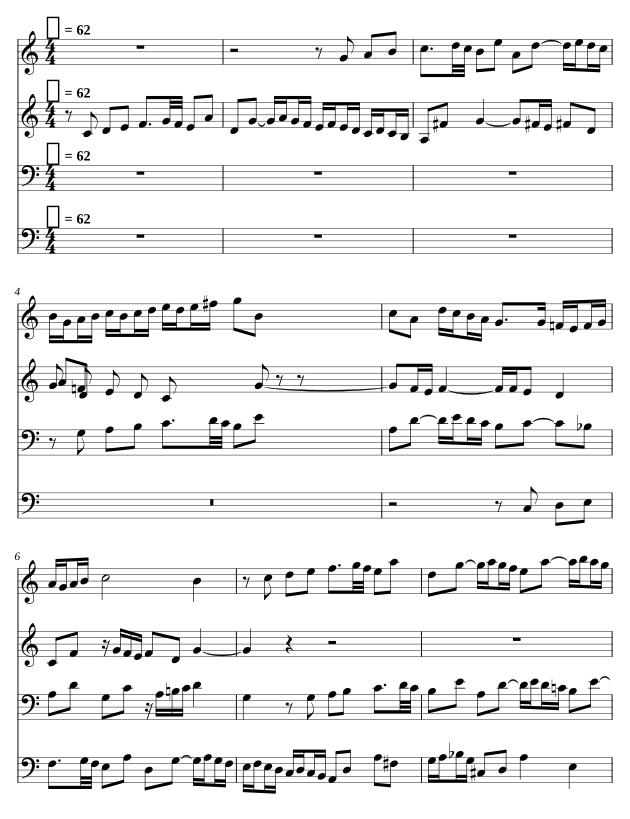 ▶ Complete score
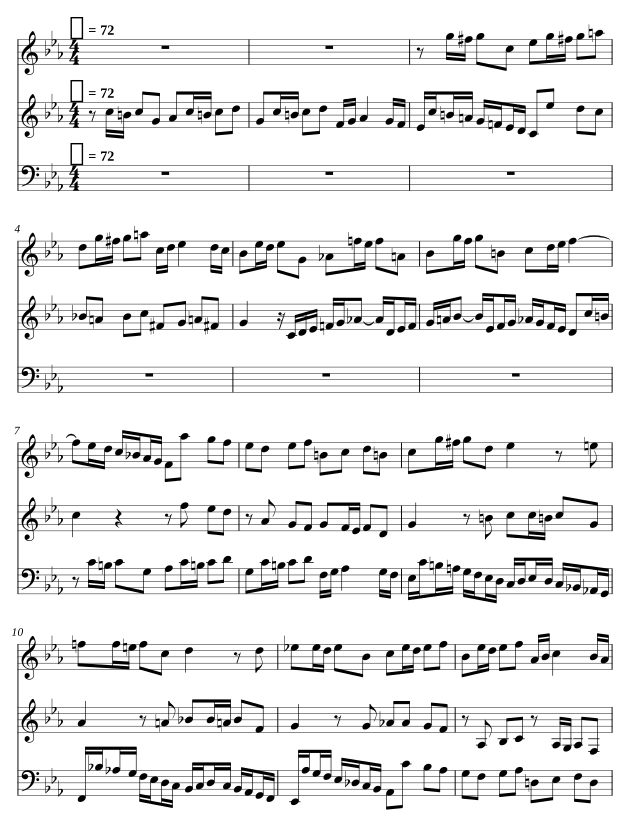 ▶ Complete score
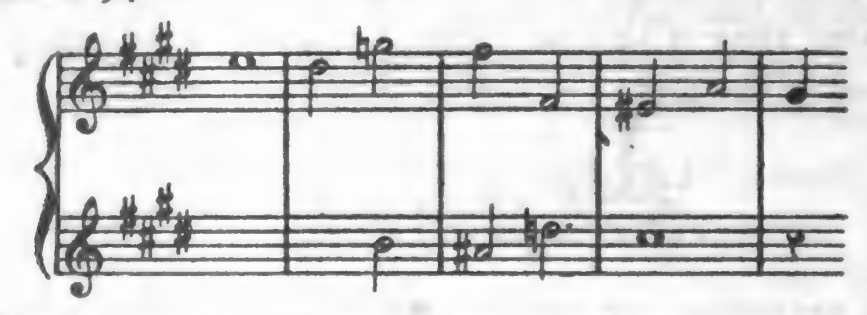 ▶ Stretto · two voices · Fugue 4
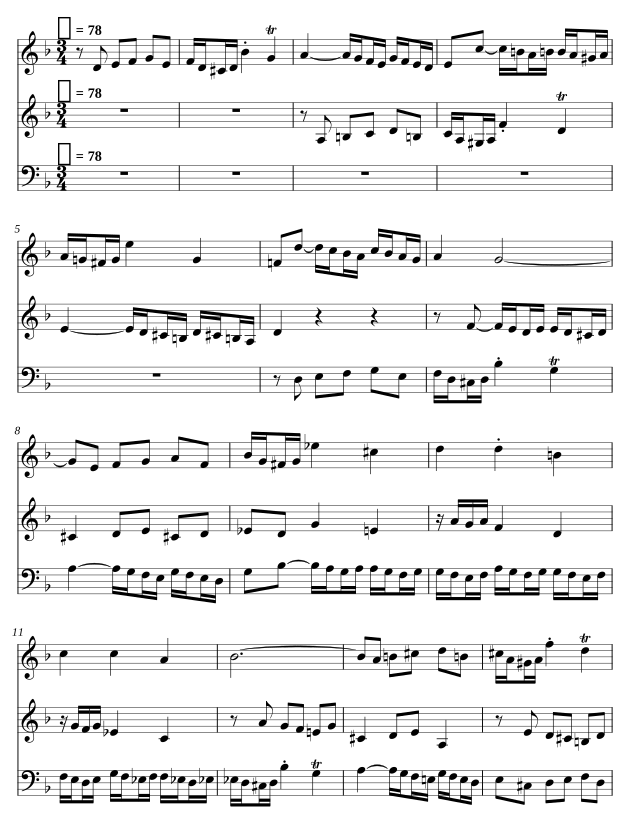 ▶ Complete score
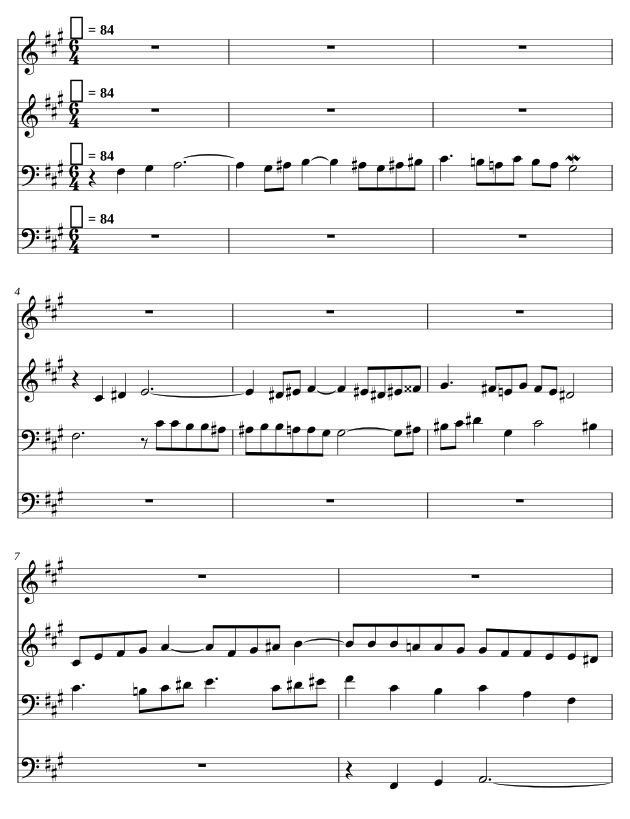 ▶ Complete score
 Treatise on HarmonyJean-Philippe Rameau, 1722
- Chapter seventeen
This is called a pedal point.
▶ Fig. 94 nearby - Chapter seventeen
…uncertain]. We illustrate them in the chromatic rules of Book III and the pedal-point rules of Book IV.
▶ Fig. 94 nearby - Chapter thirty-four
This may be called a pedal point.
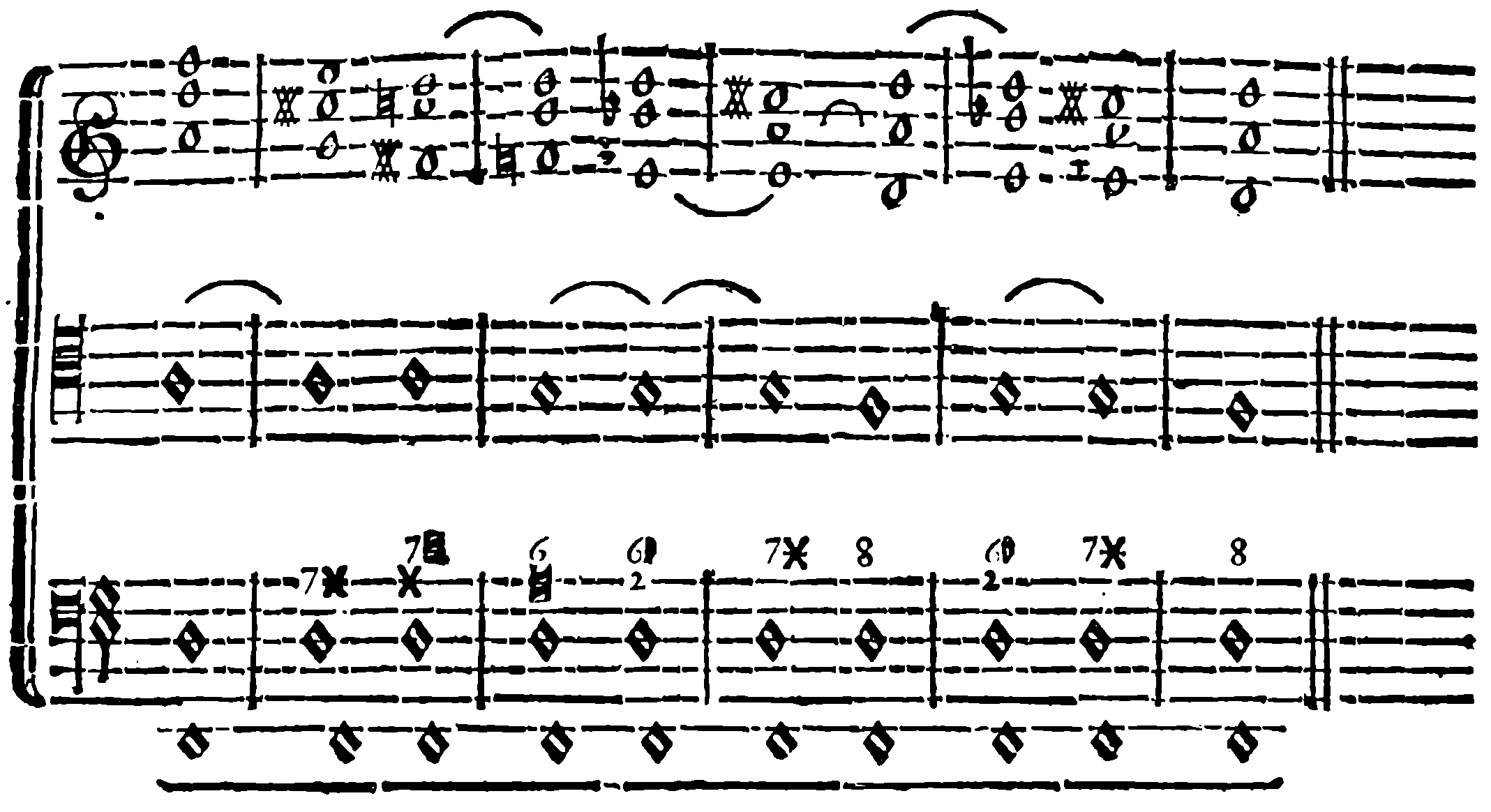
▶ Fig. 294 nearby - CHAPTER XVII. Recapitulation of the different chord successions
…as most of our examples show, and as will again appear in what we call a pedal point.
▶ Fig. 443 nearby - CHAPTER XVII. Recapitulation of the different chord successions
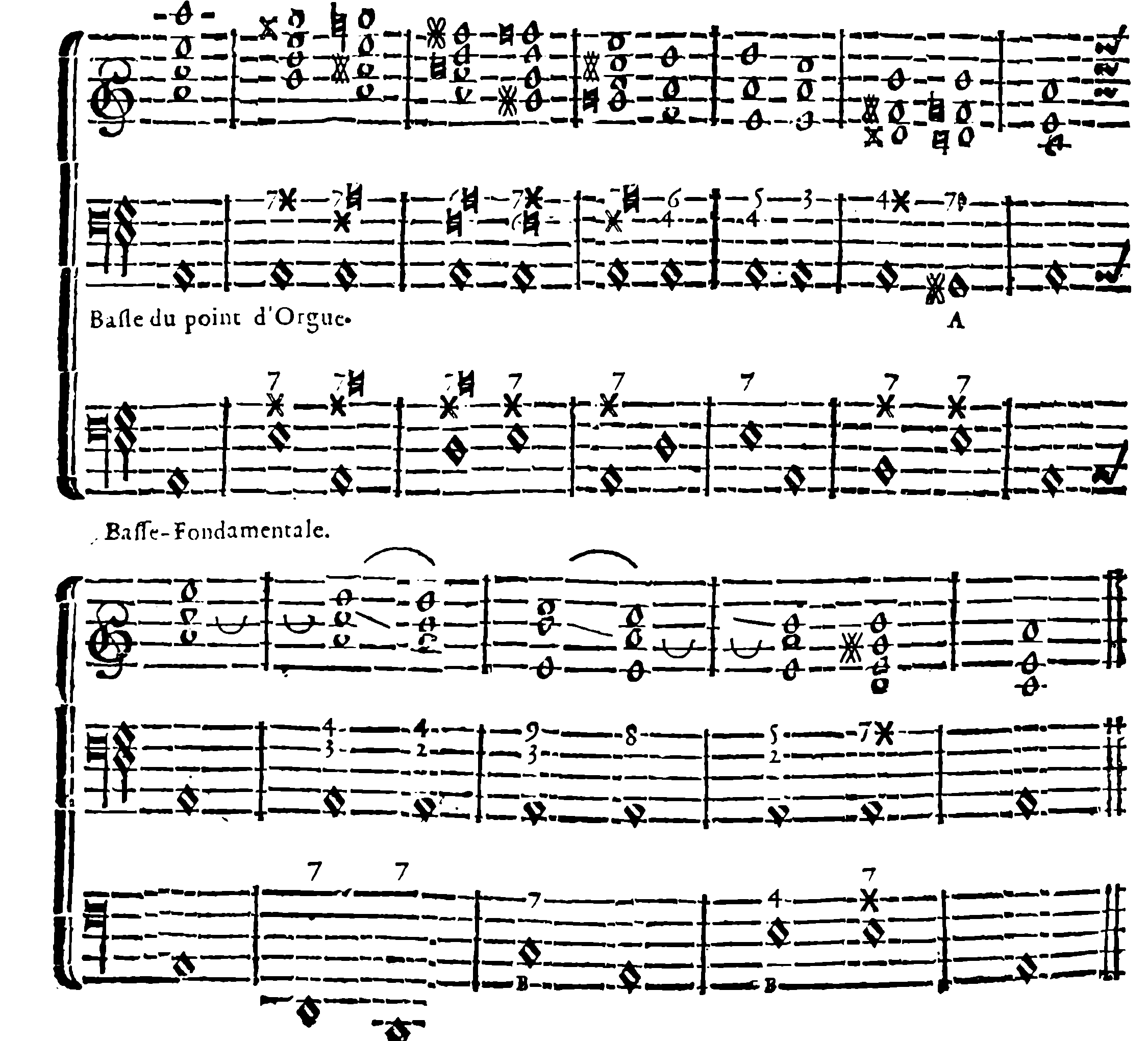
The pedal point lasts only while the bass note remains unchanged. It therefore ends at A and begins again immediately afterward.
▶ Fig. 443 nearby - CHAPTER XVII. Recapitulation of the different chord successions
This pedal point’s harmony follows the rules, as the fundamental bass proves. Remember that the sixth degree replaces the dominant in chords by borrowing, and that the fundamental bass must stand above the other bass in chords by supposition.
▶ Fig. 443 nearby
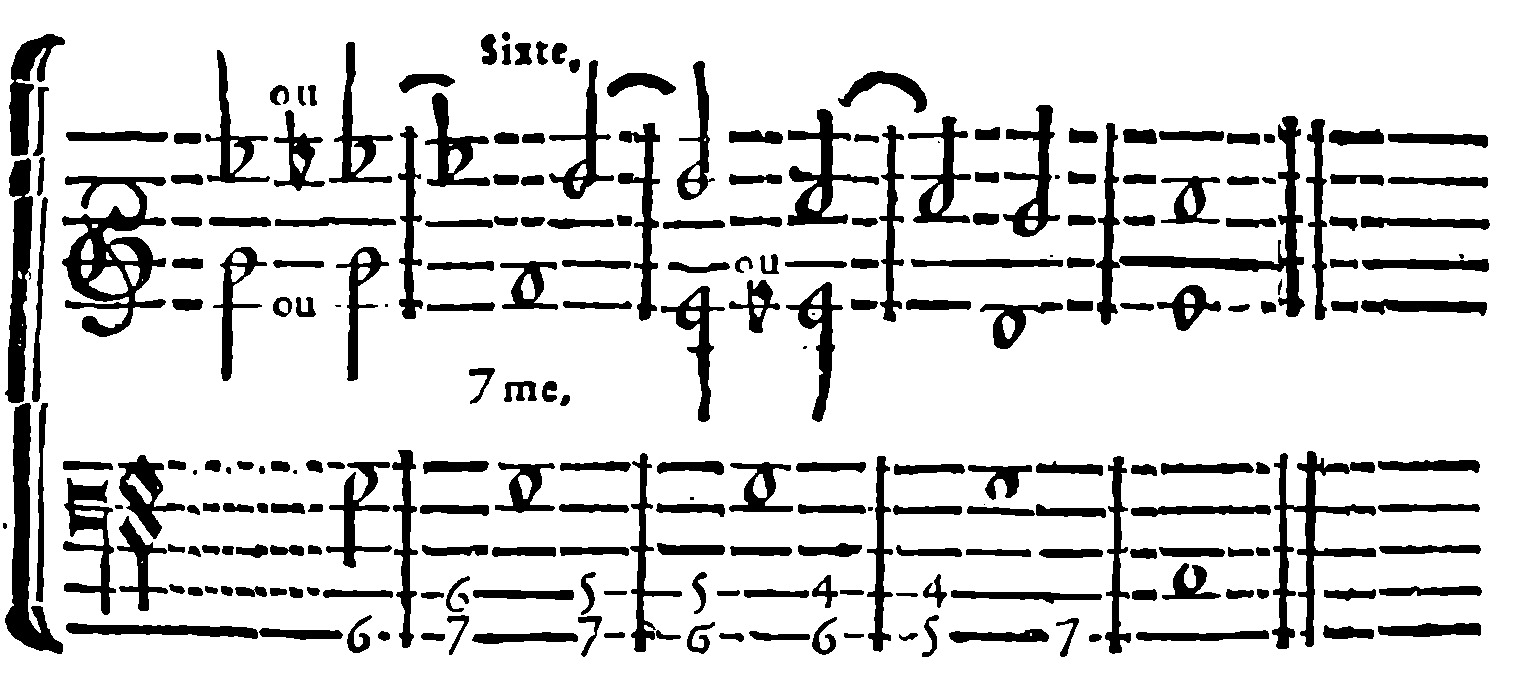 ▶ Fig. 94
 ▶ Fig. 294
 ▶ Fig. 443
 Practical Manual of HarmonyNikolai Rimsky-Korsakov, 1910
Start: On the pedal point →- On the pedal point
4) The pedal must begin on the strong beat of the bar; the tonic pedal may immediately follow the dominant pedal.
▶ Fig. 254 nearby
 ▶ Example of three-part harmony
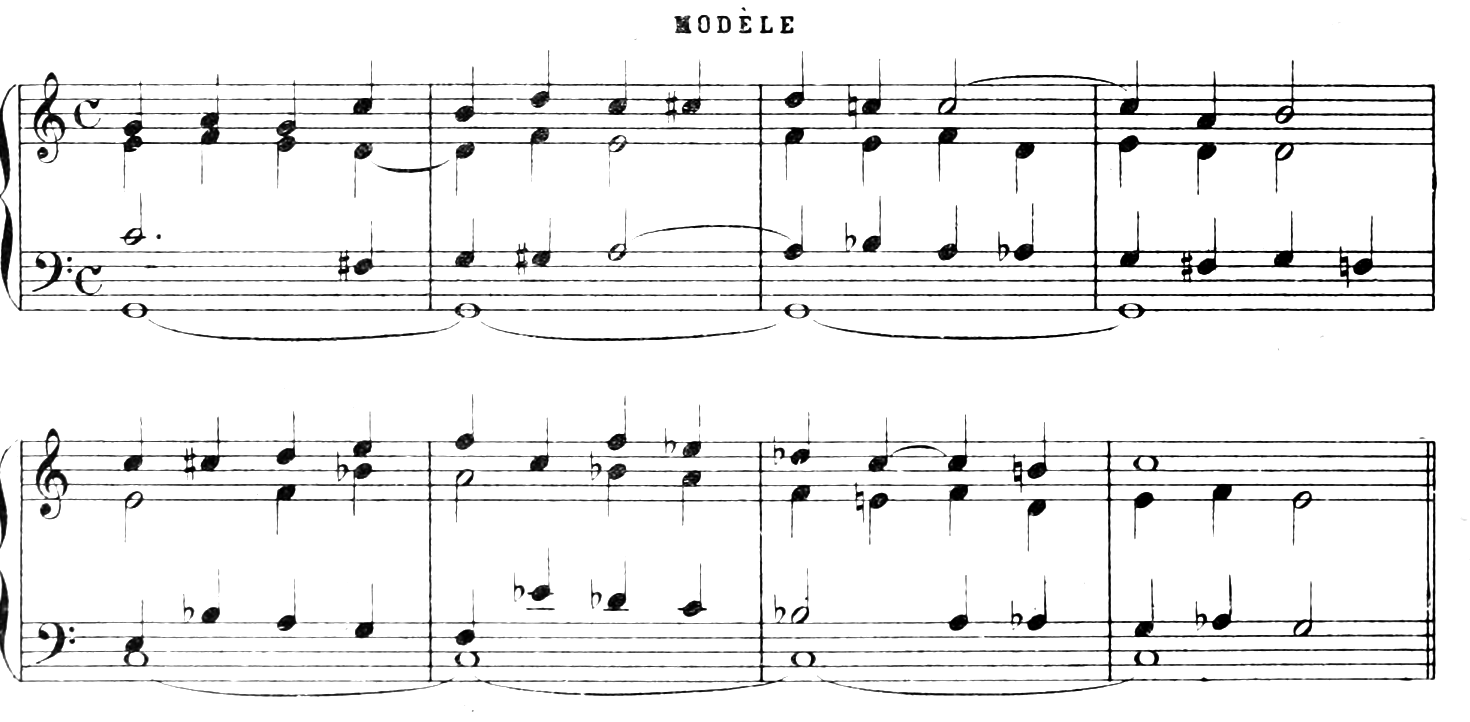 ▶ Model: four parts in common time over a dominant pedal (G, bars 1–4) and then a tonic pedal (C, bars 5–8) in C major.
 Guide to the Practical Study of HarmonyPyotr Ilyich Tchaikovsky, 1900
Start: Chapter XXII. The Organ-point →- Table of contents
Chapter XXII. The Organ-point — 77
- Chapter XXII. The Organ-point
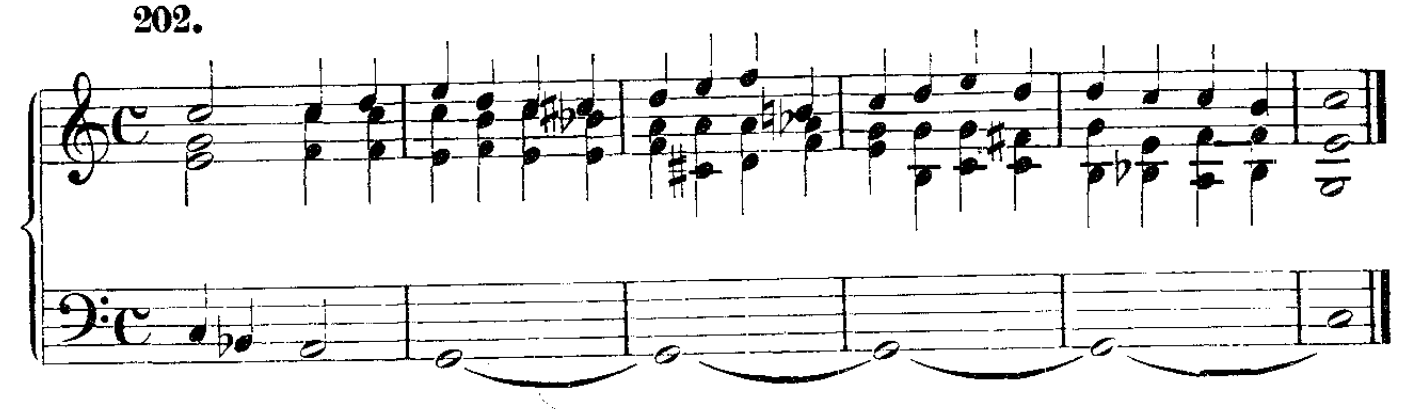
§ 63. In the Organ-point on the Dominant there can occur besides harmonies of the main key, modulations into the key of the Dominant, the Dominant of the Dominant,—equivalent to the second degree and occurring mostly in minor—and the swb-Dominant. The…
▶ Fig. 214 nearby - Chapter XXII. The Organ-point
Exercises. Practise the construction of organ-points, especially in major. Also write passing-modulations, closing them with organ-points on dominant and tonic.
▶ Fig. 219 nearby - Chapter XXII. The Organ-point
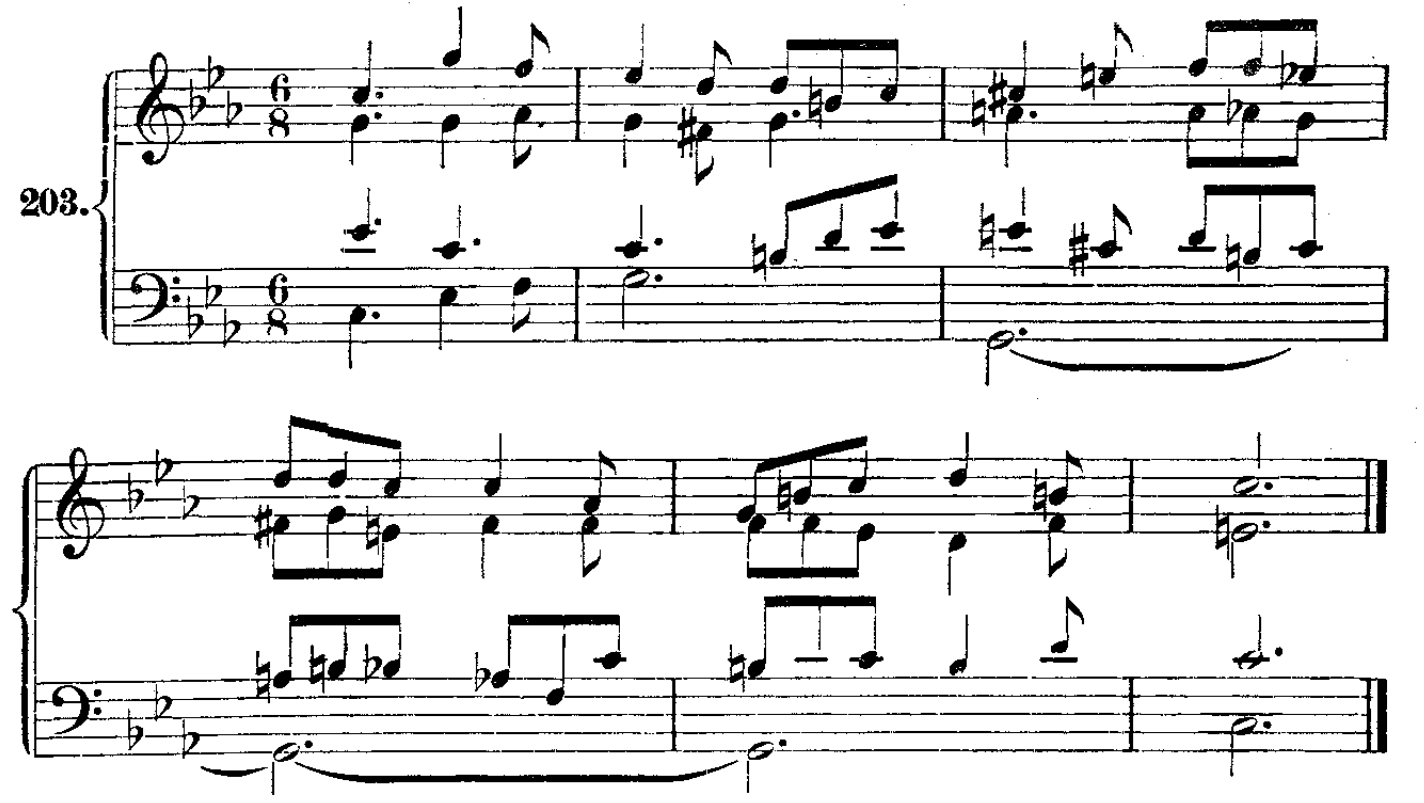
§ 65. Although the organ-point has its origin in the prolonged cadence, and hence usually occurs at the close of a composition, it is also found at the beginning or in the middle of a piece of music. In most atich cases, the organ-point is erected on the…
▶ Fig. 220 nearby - Chapter XXII. The Organ-point
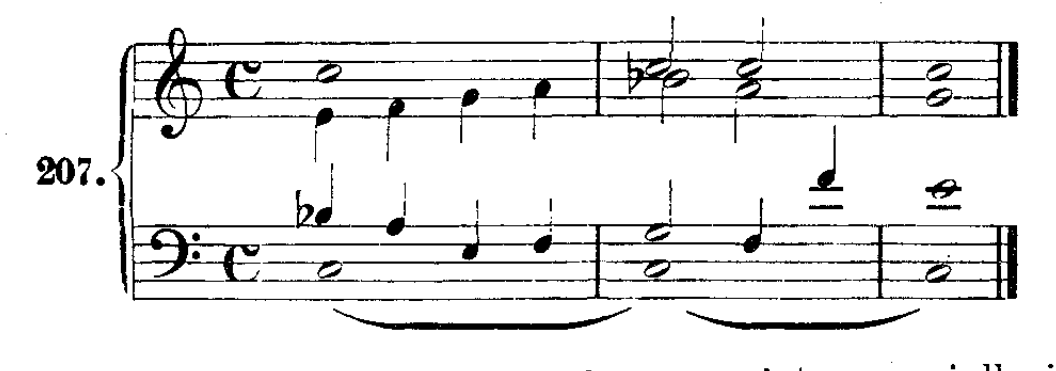
§ 66. The organ-point, or pedal belongs, as its name implies, properly to the bass-voice; yet we meet with a similar harmonic formation in the upper voices, built up, as before, on one prolonged tone, and called an organ-point. Here also there can occur in the…
▶ Fig. 221 nearby - Chapter XXII. The Organ-point
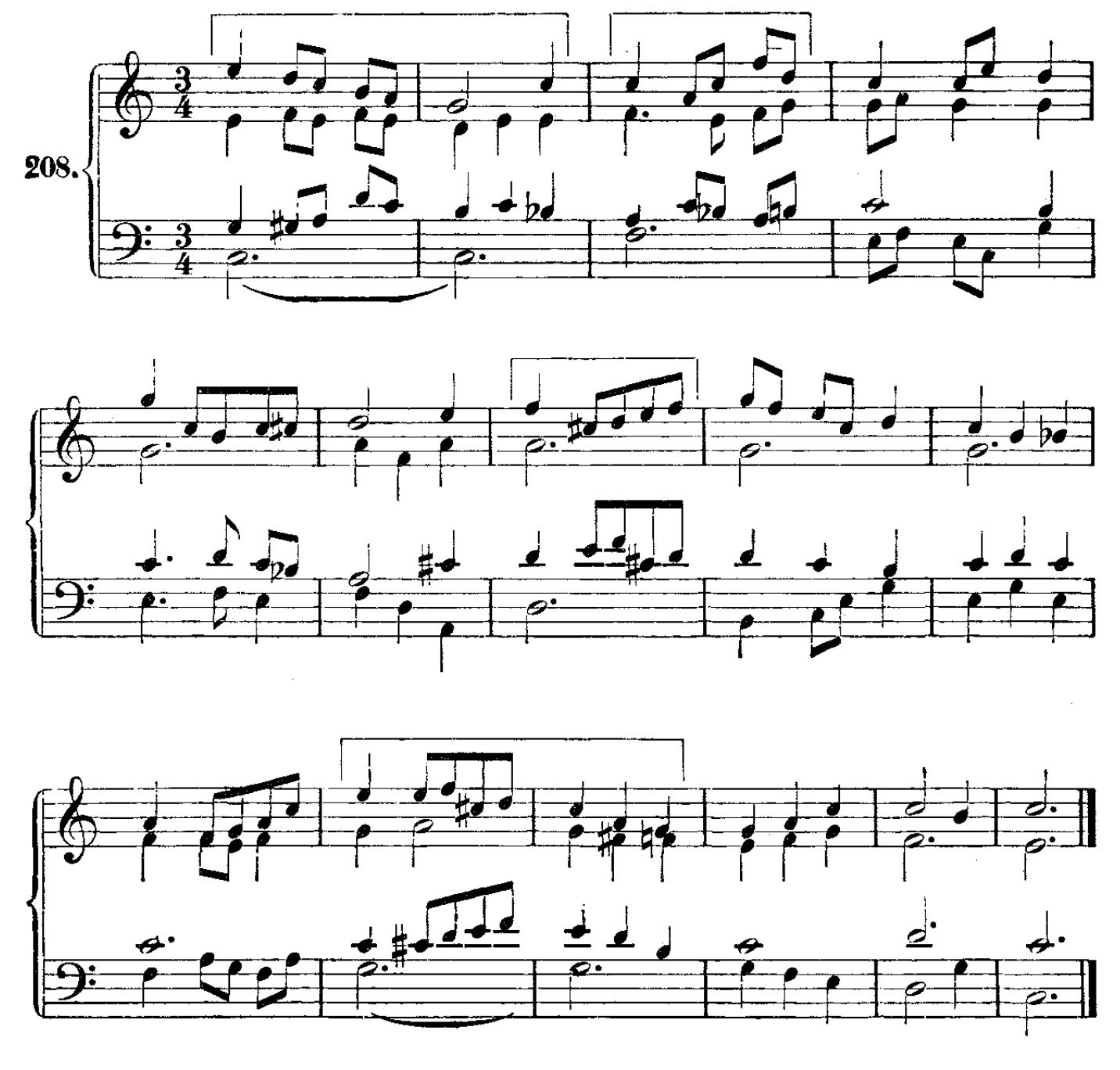
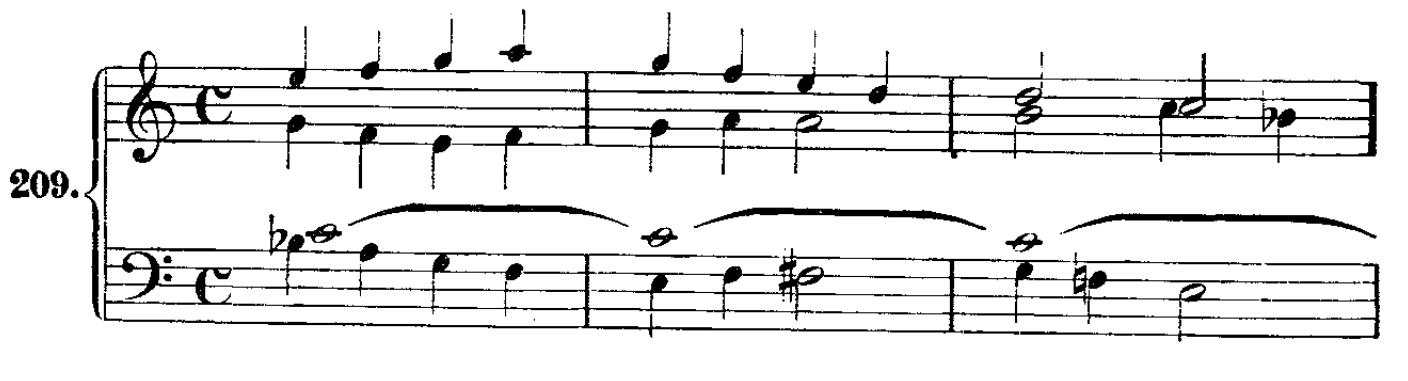
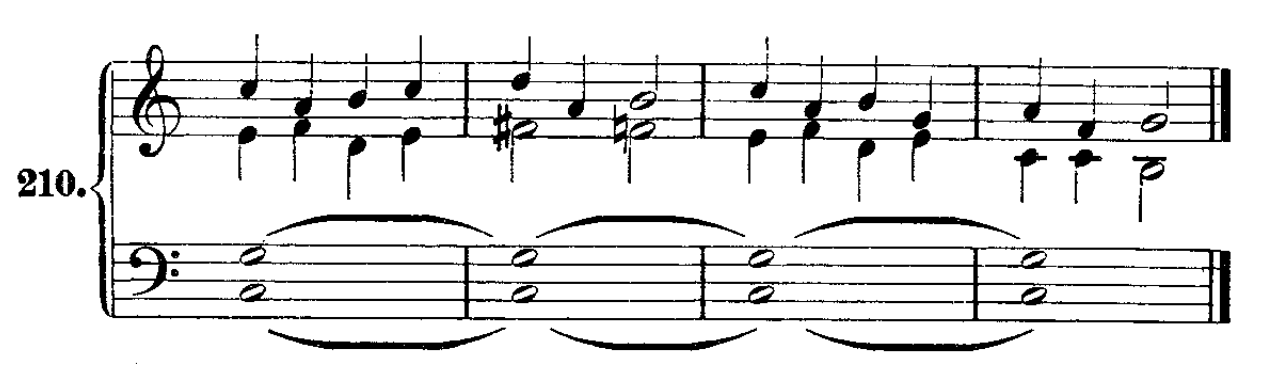
We wish merely to make the pupil acquainted with the organ-points shown in §§ 66 and 67; he should not attempt to make use of them in his exercises. The former of these organ-points demands more experience and skill in voice-leading than can be expected of a…
▶ Fig. 222 nearby
13 more passages in Guide to the Practical Study of Harmony →
 ▶ Fig. 214
 ▶ Fig. 215
 ▶ Fig. 219
 ▶ Fig. 220
 ▶ Fig. 221
 ▶ Fig. 222
 Theory of HarmonyArnold Schoenberg, 1922
- Meter and Harmony
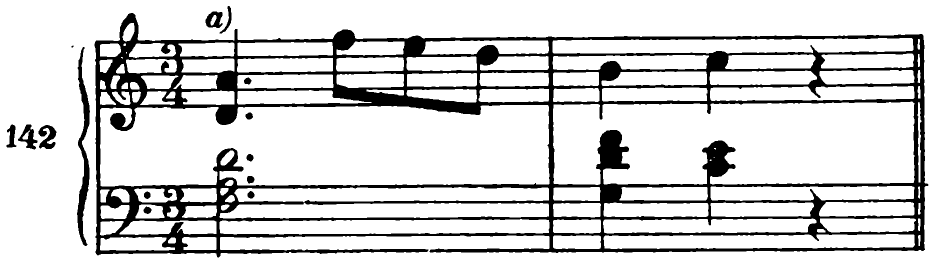
…to furthering the formal effect of our examples. The one law concerns the pedal point; this will be discussed only in the next chapter. The other concerns the six-four chord that appears in the cadence as a retardation before the dominant seventh chord. This…
▶ Fig. 243 nearby - Up Three or Four Fifths
…expedient: 1. the held voice, and in particular its special case, the pedal point, in which, as a substitute for holding the whole chord and as its representative, only one tone—the most important one, the root—is held, while the other voices move on in chords…
▶ Fig. 247 nearby - Up Three or Four Fifths
…certain circumstances it may also be the third. The held voice is called a pedal point when it is the bass tone that is held (usually—and in our case always—it is then the root). The pedal point serves chiefly retarding purposes or purposes of summing up.…
▶ Fig. 247 nearby - Up Three or Four Fifths
…to make full use of our means so far. We shall not write any long-extended pedal point but shall be content with indicating its function. The most important thing for our purpose is the twofold appearance of the dominant that is to be reinterpreted: at the…
▶ Fig. 247 nearby - Up Three or Four Fifths
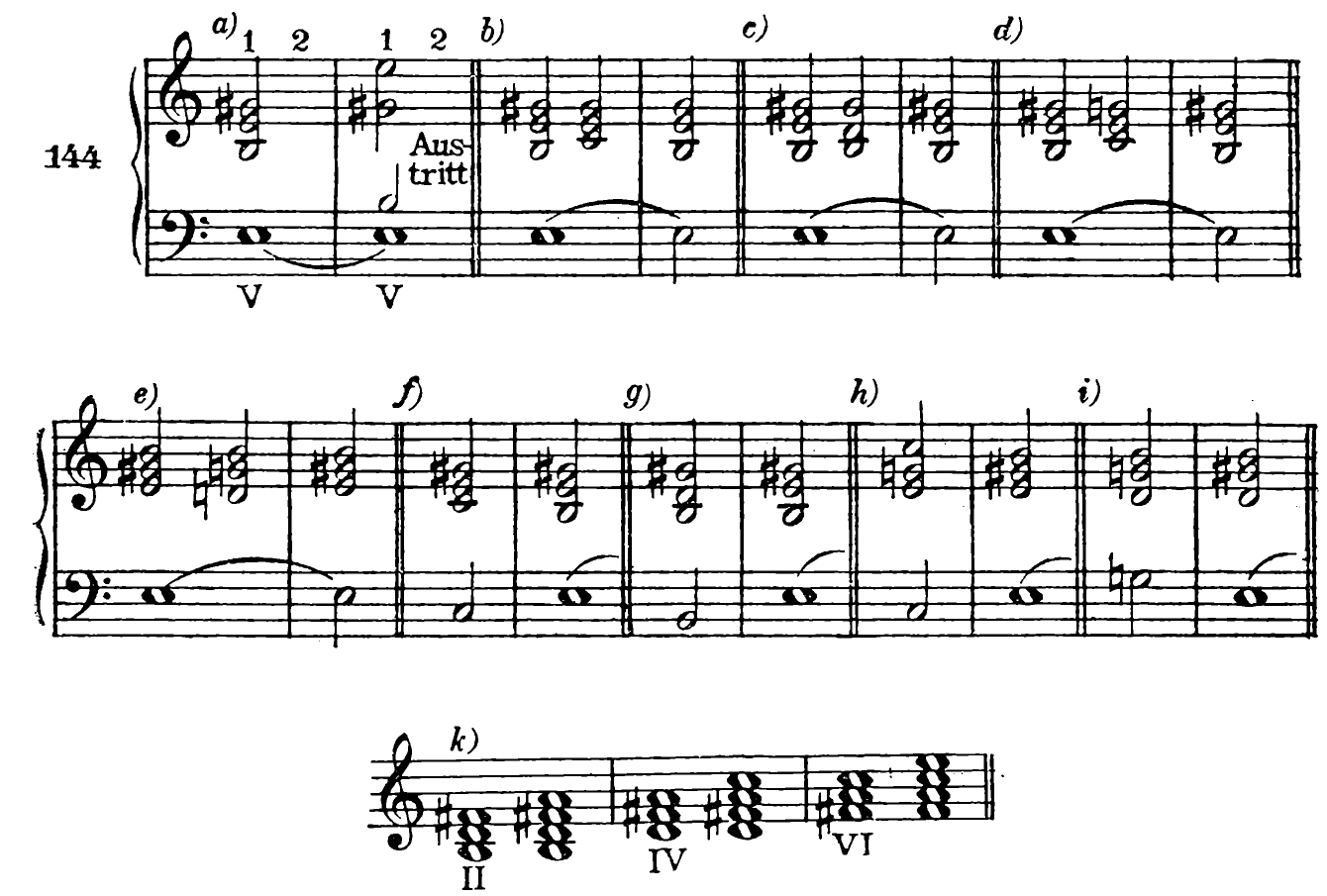
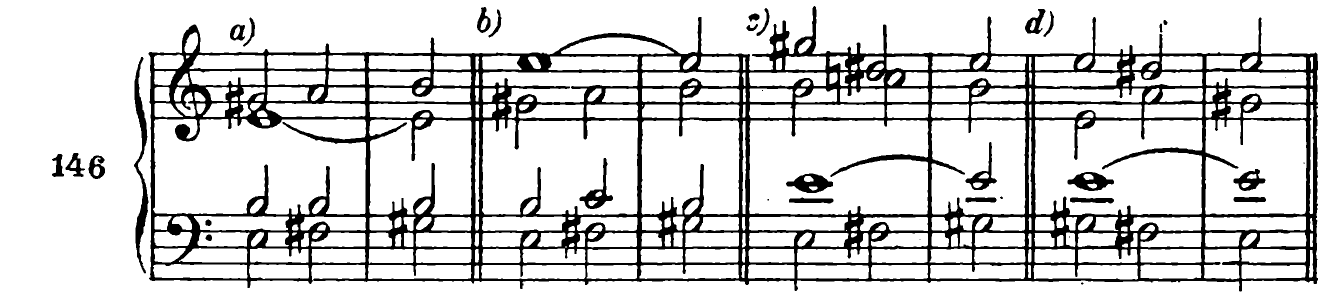
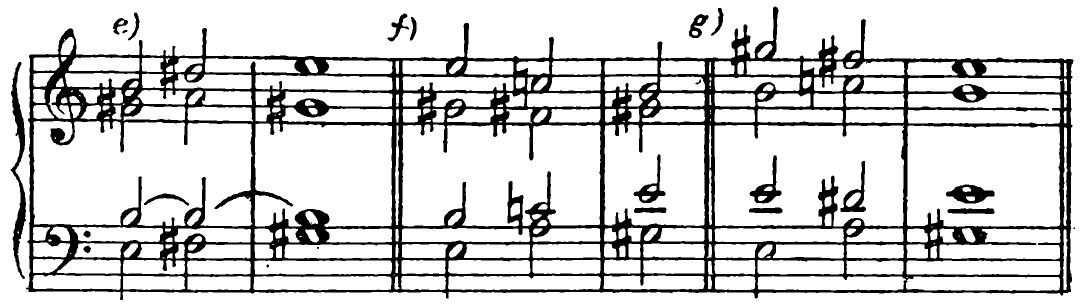
For carrying out this procedure of reinterpretation, called “dwelling on the dominant”, by means of a held voice in the upper parts, and for the so-called passing through the dominant, the same considerations are decisive as for the pedal point.
▶ Fig. 249 nearby - Up Three or Four Fifths
A difference between these forms and the pedal point consists chiefly only in this: with the held voice (146 a, b, c, d, e) a voice other than the bass stays put, which is why one may perhaps avoid excessively harsh dissonant frictions; and with passing…
▶ Fig. 250 nearby
 ▶ Example 142a
 ▶ Example 144a
 ▶ Example 146a
 ▶ Example 146e
 Principles of OrchestrationNikolai Rimsky-Korsakov, 1922
- A. Stringed Instruments
Note. Except in the case of pedal notes, the double bass rarely plays an independent part, usually moving in octaves or in unison with the 'cellos, or else doubling the bassoons. The quality of the double bass tone is therefore seldom heard by itself and the…
- Number of harmonic parts—Duplication
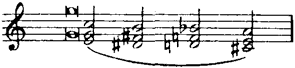
Upper and inner pedal notes are more effective on the orchestra than in pianoforte or chamber music, owing to the greater variety of tone colour:
▶ Fig. 43 nearby - Tutti in the wind
…an extraordinary volume of tone. In the following examples the formation of pedal notes by strings or wood-wind in no way alters the general character of the Tutti:
- Transparence of accompaniment. Harmony
…of harmonic parts is gradually decreased, with some of them sustaining pedal notes, and when the harmony, interspersed with necessary pauses is confined to the limits of one octave, distributed over several octaves, or duplicated in the higher register.
 ▶ Fig. 43
 OrchestrationCecil Forsyth, 1914
- No. 11. The Kettle-Drums
(3) of detached Drum-notes, especially when they form part of a pedal-bass. See the examples quoted below from Bizet's Carmen and Wagner's Flying Dutchman. (Exs. 43, 14);
- Brass instruments
" See pages 134-5 for the "pedal-notes" of the instrument.
- No. 21. The Tenor (or B) Trombone.'
The compass of the instrument is therefore four semitones greater than that actually shown in the list of positions. Of course the corresponding 9th and 10th Harmonies are easier to produce in the lower than in the higher positions, but in actual practice they…
- No. 22. The Alto (or Eb) Trombone
are for all orchestral purposes unplayable. The pedal notes have never been employed, so that the Alto-Trombone is really a two-octave instrument.
- No. 23. The Bass (or G) Trombone
This leaves a gap of two semitones between the bottom note of the Bass-Trombone and the first pedal-note (the low Bo) of the Tenor- Trombone. On the continent the Bass Trombone has always been built in F, one tone below our standard instrument. Built thus, its
- No. 23. The Bass (or G) Trombone
Neither the pedal notes below low CF nor any notes above the high G are of any practical use in the orchestra.
 Treatise on InstrumentationHector Berlioz, 1905
- The Violin
A lower string can cross a higher open string if it is given an ascending movement while the open string continues in the manner of a pedal-point:
- The Trombones
…on the bass trembone—if they can be produced at ail, They are called pedal tones. doubtless beeanse of the similarity of their sound with the lowest tones of the organ. which have the same name. It is rather diffiealt tu use them well and they are even unknown…
- The Trombones
…power to produce them, Even if the bass trombone had only the first of these pedal tones, E>, this one tone could be of great value for certain effects which are unattainable without it. since no other instrument of the orchestra, with the exception of the…
- The Trombones
…of the tube and the key of the instrument, so that one or more or even all pedal tones available on a trombone in ont key may be wanting on one in another key. For instance, if a composer fails to indicate that he requires a trombone in'B5 when writing these…
- The Trombones
Pedal tones of the tenor trombone in Bd:
- The Trombones
Pedal tones of the bass
More in Dissonance and embellishment
Suspension · Passing notes · Neighbor notes · Anticipation · Appoggiatura · Nota cambiata