 Playable Books
Concept index · Imitation and fugue
Canon
Taught in 7 books. Each one opens at the passage; ▶ plays the example beside it. Also called canons, round.
This index is Playable Books’ own: a first pass that finds the term’s words in each book, corrected by hand. The authors did not tag these passages, and their terms can differ (Fux’s “ligature” is a suspension). The quoted text is the book’s.
 Gradus ad ParnassumJohann Joseph Fux, 1725
- Imitation
Aloysius. You have inferred correctly. For that is the task of canons, not imitations, in which it is enough to follow certain notes.
▶ Fig. 230 nearby
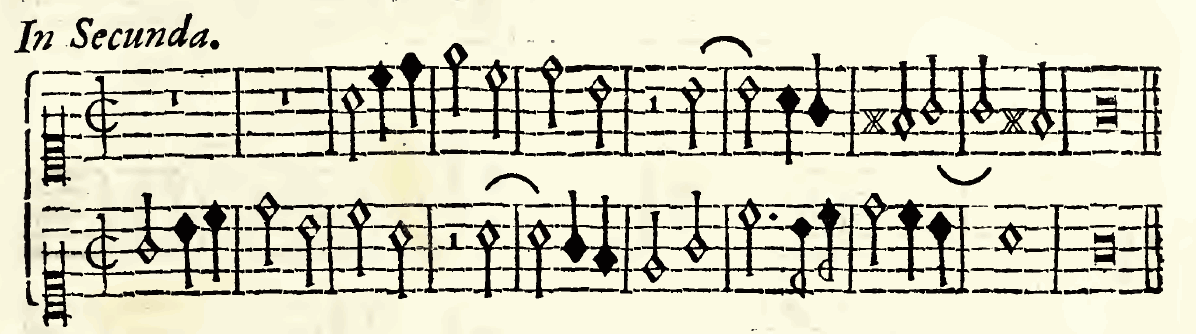 ▶ Fig. 230
 Counterpoint AppliedPercy Goetschius, 1902
Start: Chapter XVIII →- Chapter XVII. THE ROUND, OR ROUND-CANON · 2 playable examples
- Chapter XVII. THE ROUND, OR ROUND-CANON
…perfect cadence. — No. 52; Round for 4 voices, unison, after 6 measures; the Canon is " endless," but provision is made for a cadence. — No. 45; 4-voice, unison, after 8 measures; no cadence. — No. 55 ; 4-voice, unison, after 4 measures; " endless," but a…
▶ Fig. 415 nearby - Chapter XVIII
Klengel, 48 Canons and Fugues, Vol. II, Canon 5; Sve, after 3, beat; cited in Ex. 188. — Vol. II, Canon 11; 8ve, after 4 measures (see par. 192c); last 16 measures free. — Vol. II, Canon 23; 8ve, after I measure; the first 1o measures are monotonous (see par.…
▶ Fig. 421 nearby - Chapter XIX
Klengel, Vol. I, Canon 8; Contrary motion (Dominant = Tonic), after one measure; auxiliary upper part, beginning in 3rd measure. — Vol. I, Canon 11; unison, after 2 beats; auxiliary Bass. — Vol. I, Canon 16; Contrary motion (Tonic = Tonic), after one measure;…
▶ Fig. 433 nearby - Chapter XIX
202. In order to appreciate the significance of the Canon-form, it should be contemplated in the abstract, aside from its uninviting mathematical aspect. As has been observed, each successive time-interval (one measure, or whatever section it may be) of the…
▶ Fig. 439 nearby - Chapter XX
See further, Klengel, Vol. I, Canon 2; in 3rd and 5th, after one measure, unaccompanied. — Vol. I, Canon 4; in 7th and 6th, after one measure, unaccompanied. — Vol. I, Canon 9; 8ve-8ve. — Vol. I, Canon 12 ; in 6th and 4th, after six measures; very definite…
▶ Fig. 444 nearby - Chapter XXII
213. When the canonic imitation falls short of the characteristic requirements of the legitimate Canon (par. 180), either in being interrupted (periodic instead of continitus), or in containing more or less frequent licences (instead of being strict), the…
▶ Fig. 453 nearby
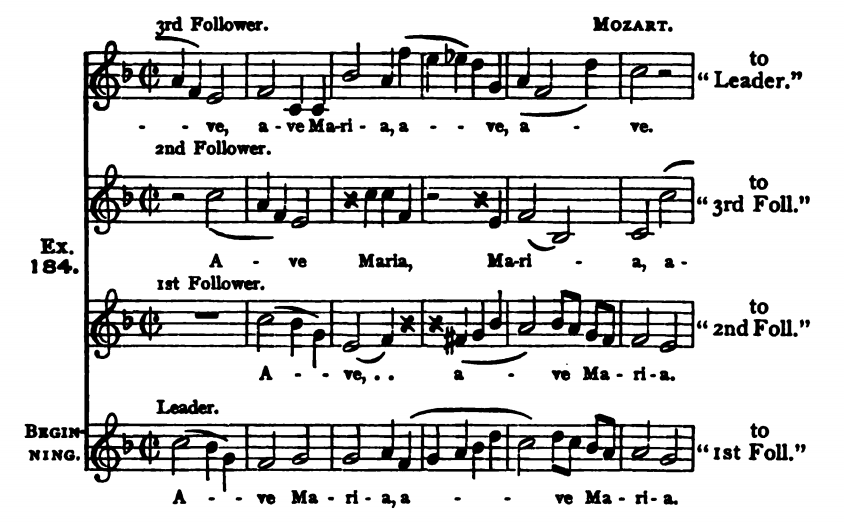 ▶ Ex184
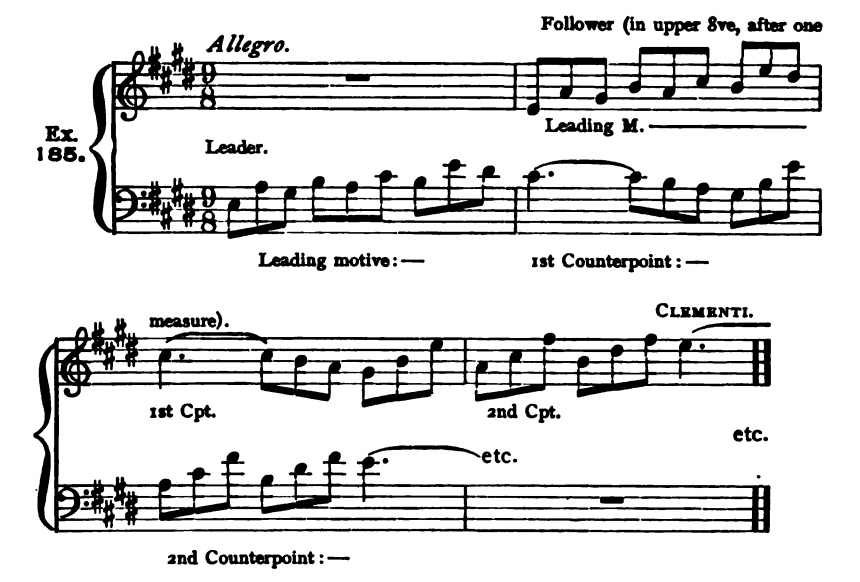 ▶ Ex185
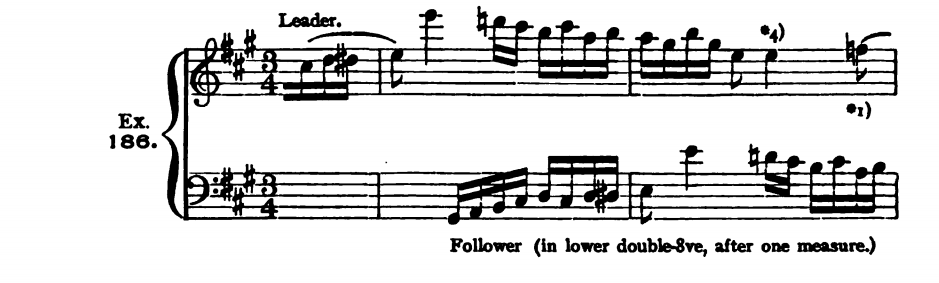 ▶ Ex186
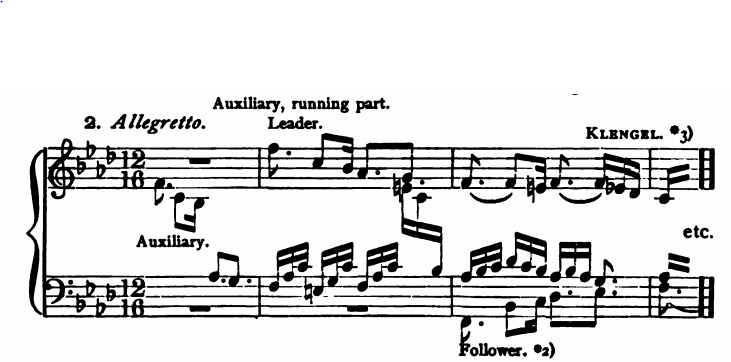 ▶ Ex197-2
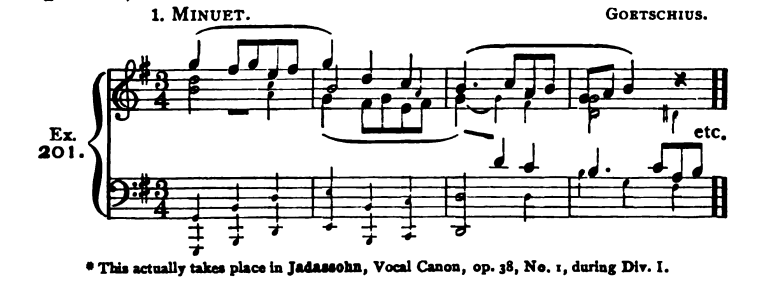 ▶ Ex201-1
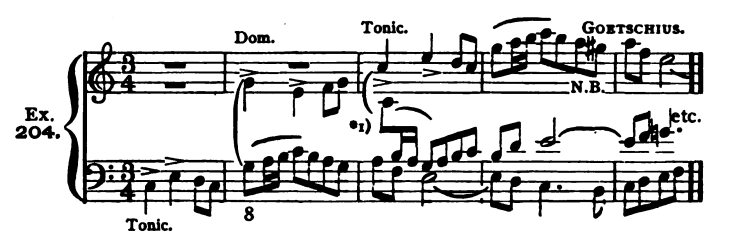 ▶ Ex204
 Analysis of J. S. Bach’s Forty-Eight FuguesEbenezer Prout, 1910
Start: Introduction →- Introduction
CANON.—Strict, note-for-note imitation (though it may be at any interval) throughout a passage of some length. Canon (or stretto, or imitation) "at the octave," or "in the octave" is used to denote the interval separating the entries.
- Fugue 8 · Book I, No. 8 · BWV 853
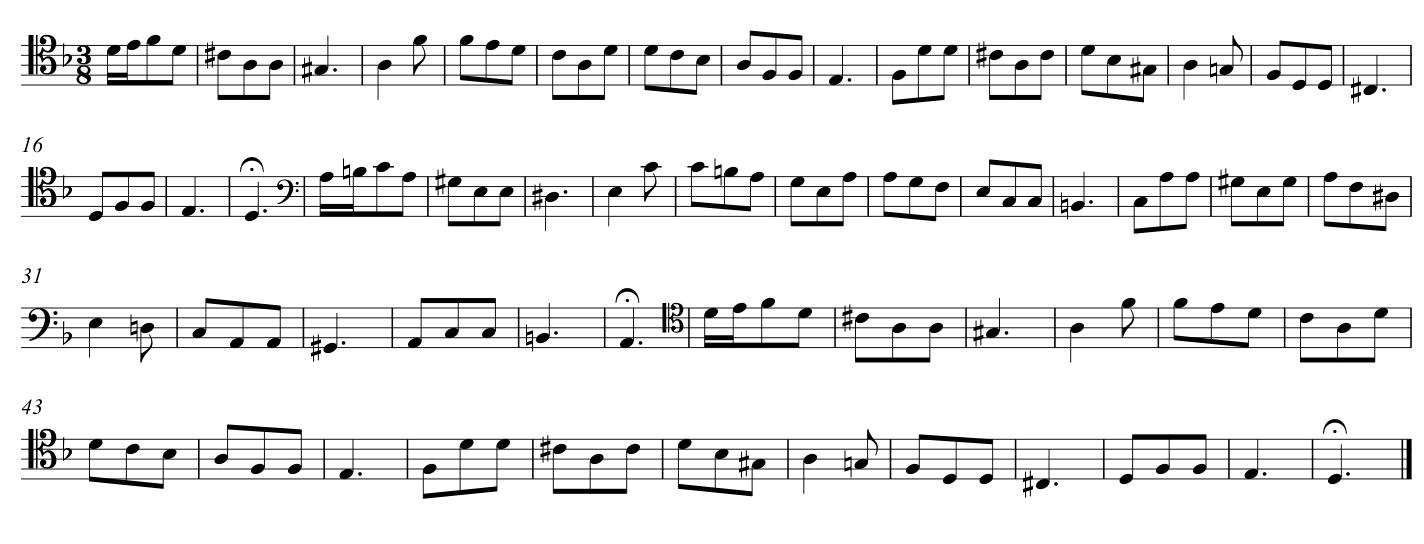
…in bar 15. In bars 19 to 22 the subject, in A sharp minor, is treated as a canon in the octave for alto and treble. In bars 24 to 26 it is employed in close stretto, the voices entering at one beat's distance, the alto in a rhythmically modified form and the…
▶ Fig. 23 nearby - Fugue 20 · Book I, No. 20 · BWV 865
Canonic stretto, which is the special feature of this fugue, first makes its appearance in bars 27 and onwards. The treble and tenor give the subject, in its original key and form, in canon at half-a-bar's distance. The alto and bass (from bar 31) respond with…
▶ Fig. 50 nearby - Fugue 20 · Book I, No. 20 · BWV 865
…at bar 64, in spite of some irregularity in the keys. From this point the canon is at the fifth instead of the octave; bass and tenor give the direct form, treble and alto the inverted. After the second episode (bars 71, 72), there is another canon in the…
▶ Fig. 51 nearby - Fugue 25 · Book II, No. 1 · BWV 870
…13 to 21) the second section of the subject is worked as a bass to a free canon founded on its first section. In bar 21 the subject enters in the alto, modulating into D minor, and followed by the answer in the treble, modulating to A minor. The second episode…
▶ Fig. 60 nearby - Fugue 46 · Book II, No. 22 · BWV 891
In bars 27 to 31 and 33 to 37 there are two canonic stretti, each at one minim's distance; the former is in the original key, between tenor and alto, the lower voice leading; the latter in the relative major, between treble and bass, the higher voice leading;…
▶ Fig. 106 nearby
11 more passages in Analysis of J. S. Bach’s Forty-Eight Fugues →
 ▶ Ornamented form (left)
 ▶ Subject · Fugue 20
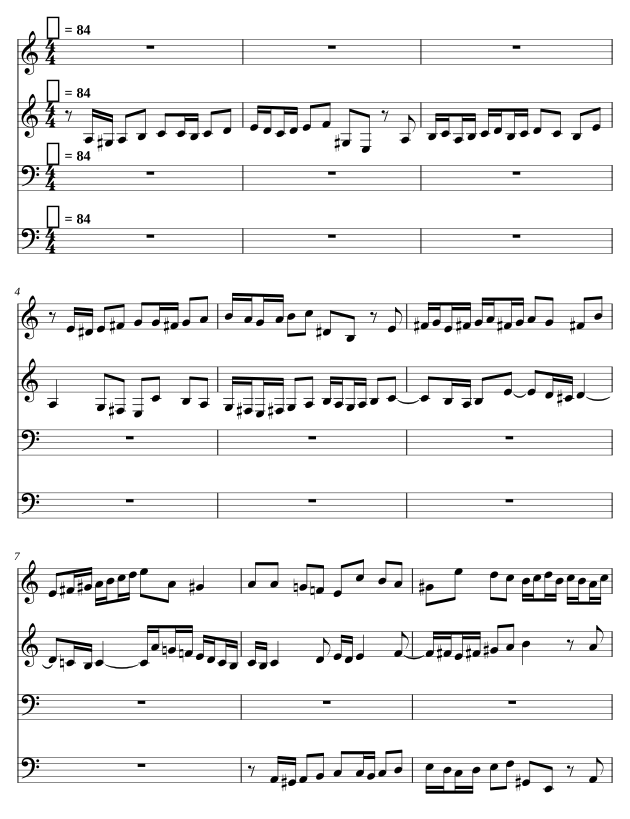 ▶ Complete score
 ▶ Prout’s excerpt · Fugue 25
 ▶ Prout’s excerpt · Fugue 46
 Treatise on HarmonyJean-Philippe Rameau, 1722
- Table Explaining Essential Terms
CANON. Definition of canon. 359 through 362
- Chapter forty-three
…take the form of choruses, quartets, quintets, and so forth. A quintet or canon appears in the final chapter. In choruses each part may be multiplied by as many voices as desired; quartets and quintets ordinarily use only one voice per part. Since it is…
▶ Fig. 324 nearby - Chapter forty-four
…a means of sounding several fugues together or composing another kind called canon, discussed later.
▶ Fig. 328 nearby - Chapter forty-four
Another kind of fugue is called perpetual fugue, or canon. It consists of an entire air whose melody all the parts must repeat with strict regularity.
▶ Fig. 347 nearby - Chapter forty-four
The commonest canons are at the unison or octave, according to the range of voices or instruments. Compose a melody as desired and add as many parts as wanted. Then combine all these parts into a single air, making each part’s melody follow the other…
▶ Fig. 347 nearby - Chapter forty-four
…the difficulty, since each new entry begins in a new key a fifth away for a canon at the fifth or a fourth away for one at the fourth. Although the preceding canon has no limit on its number of parts, we do not believe more than four can be used here; indeed,…
▶ Fig. 350 nearby
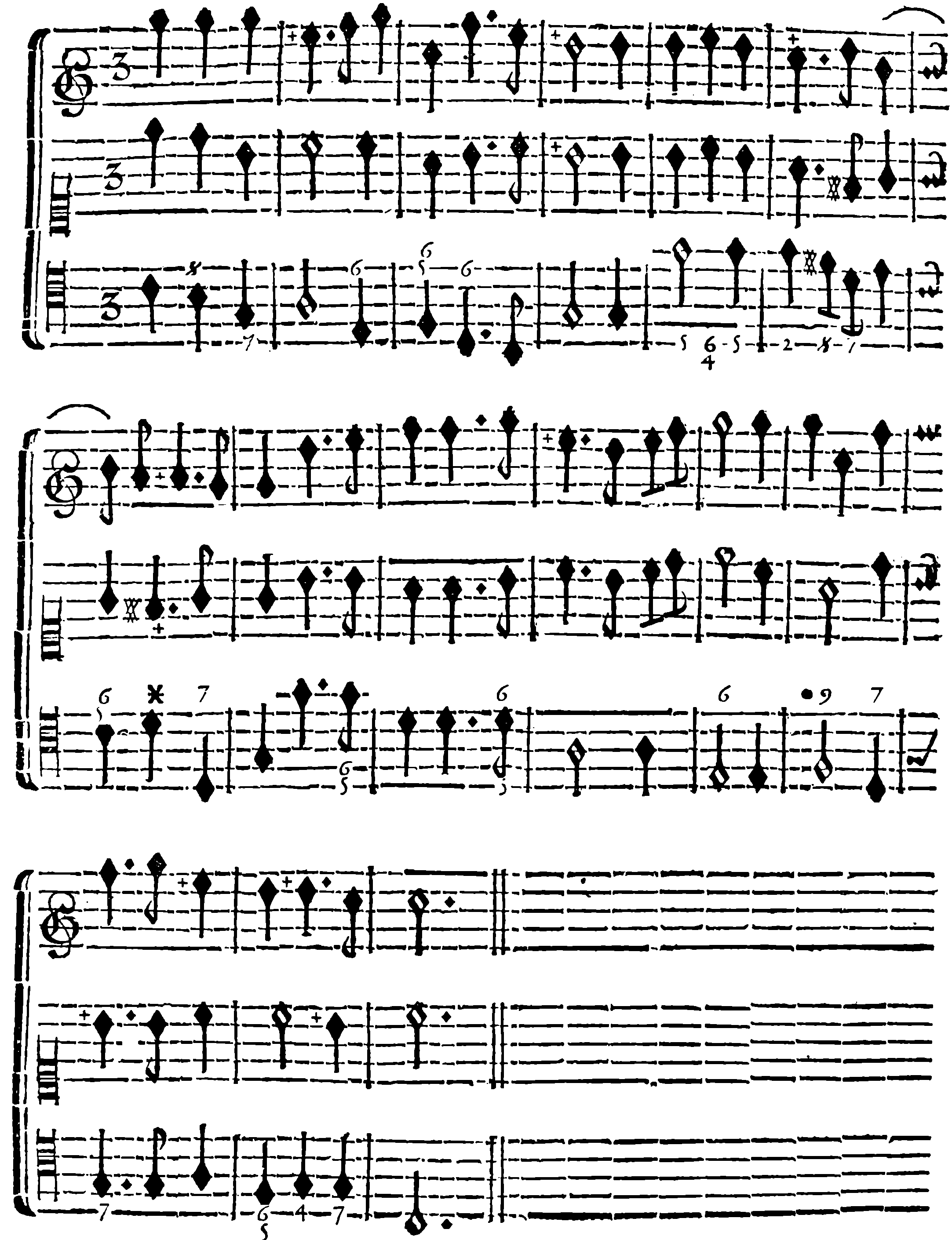 ▶ Fig. 324
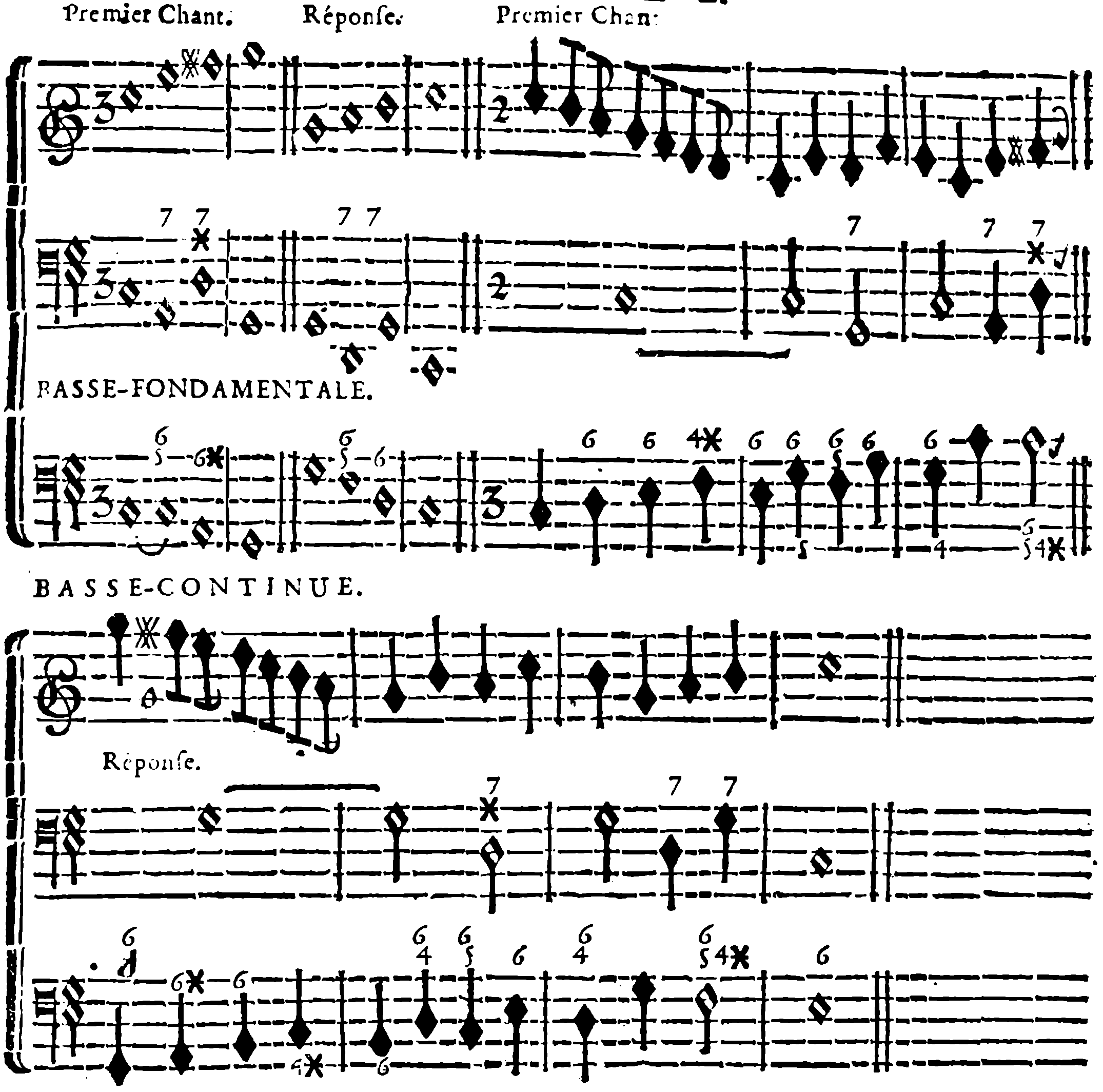 ▶ Fig. 328
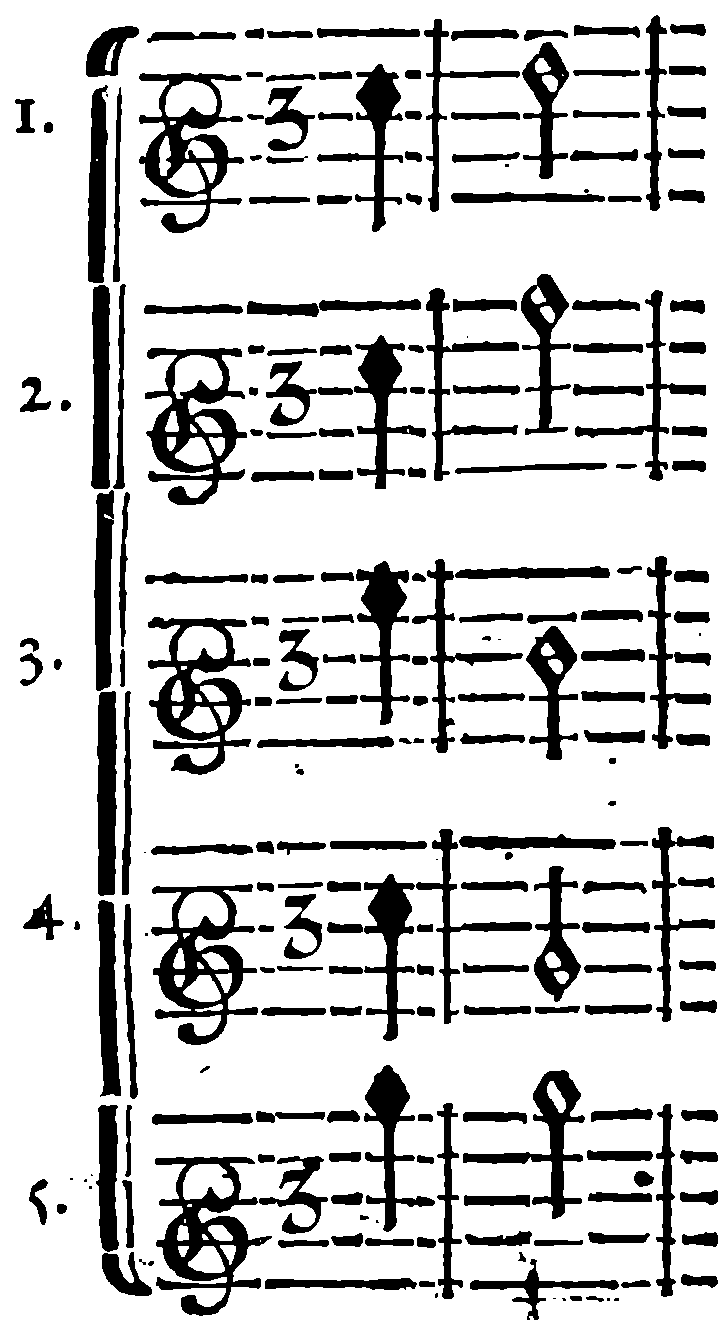 ▶ Fig. 347
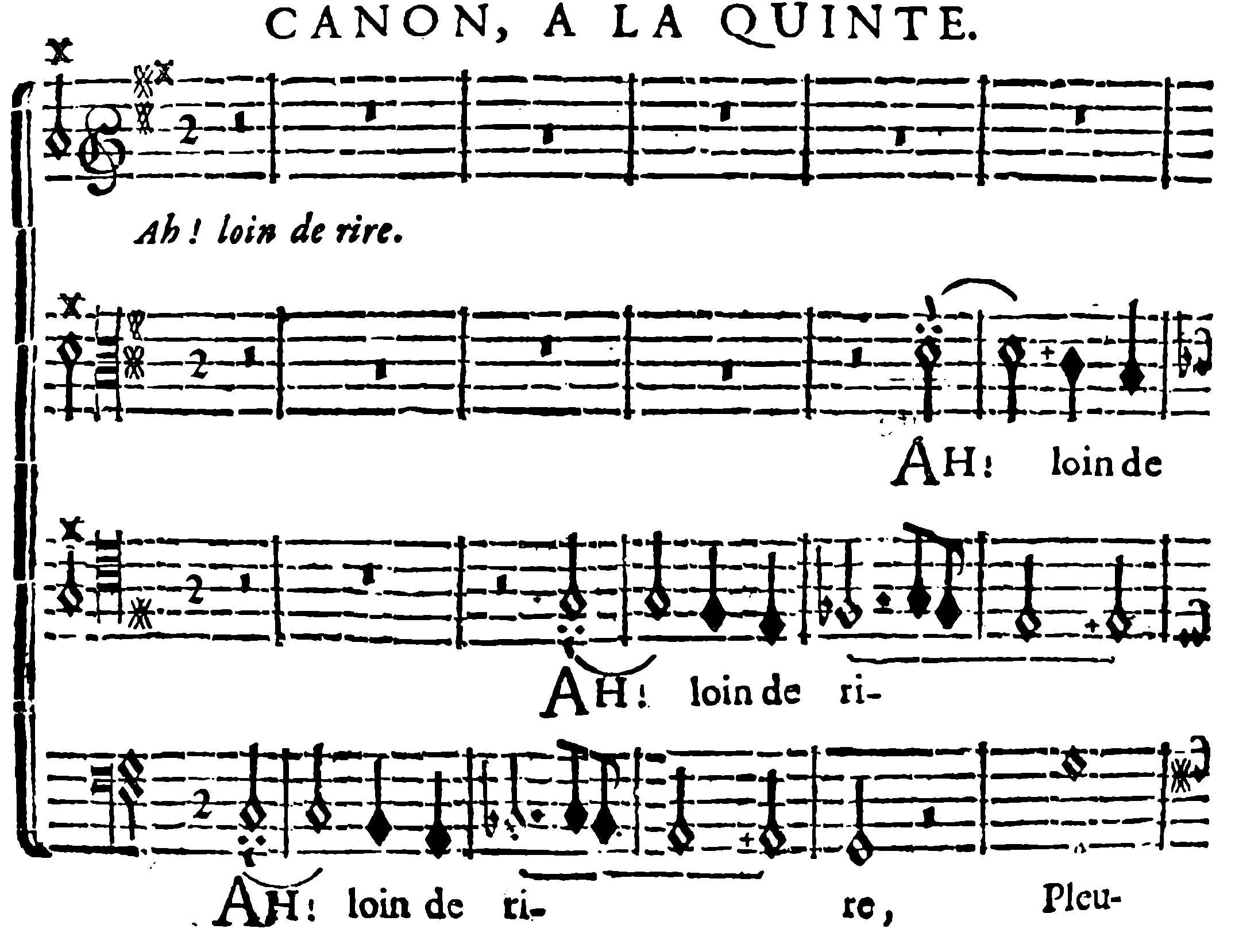 ▶ Fig. 350
 PartimentiFedele Fenaroli, 1800
- Book VI: Advanced partimenti, canons and fugues
- No. 2, Canon · Gj 1424 · 1 playable example
- No. 4, Canon · Gj 1426 · 1 playable example
- No. 6, Canon · Gj 1428 · 1 playable example
- No. 15, Canon · Gj 1441 · 1 playable example
- No. 17, Canon · Gj 1443 · 1 playable example
- Book VI: Advanced partimenti, canons and fugues
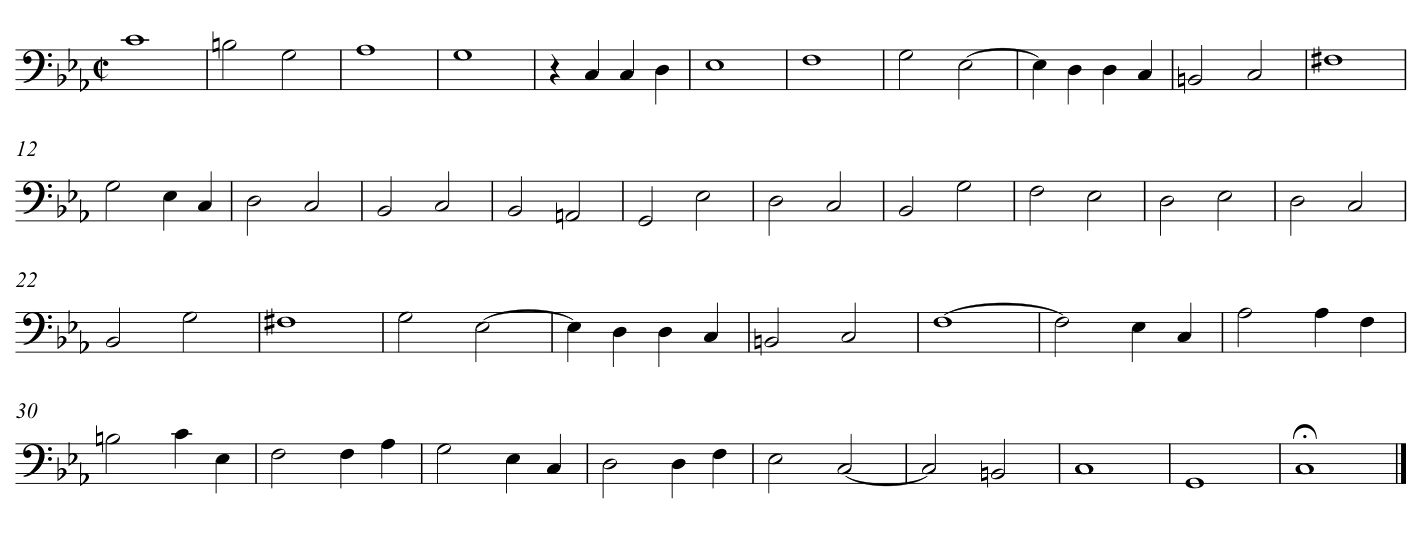
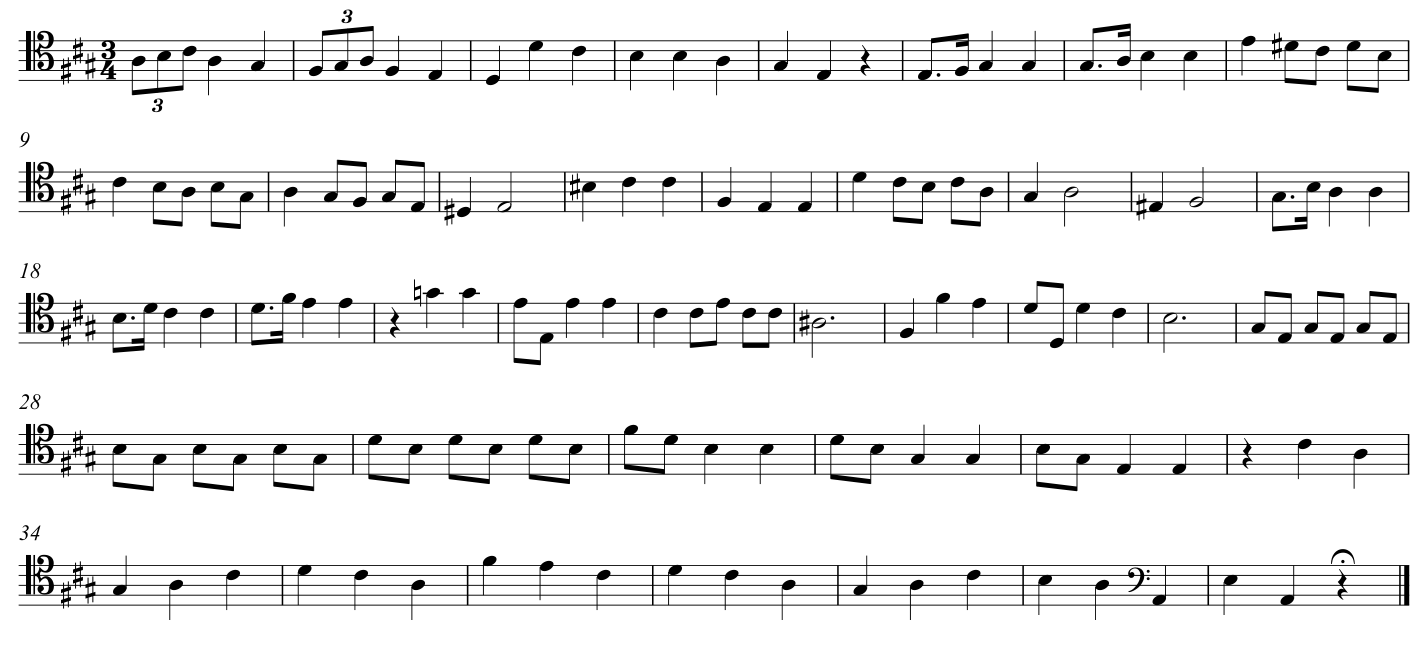
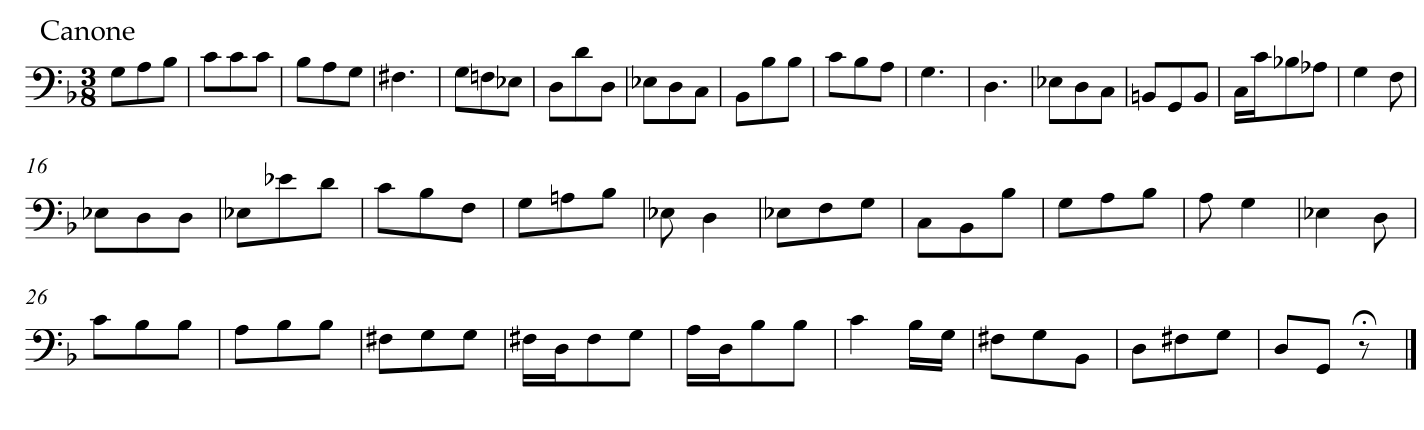
…in the partimento literature. Nos. 2, 4, and others, for example, are canons and one is expected to perform the canon without writing it out beforehand. This is typical of the mental training required—one must read and play one voice while performing a second…
 ▶ Fig. 209
 ▶ Fig. 211
 ▶ Fig. 213
 ▶ Fig. 226
 ▶ Fig. 228
 OrchestrationCecil Forsyth, 1914
- Brass instruments
3 Guillaume, Canon of Auxerre.
- No. 37. The Bassoon
…somewhere before the year 1539,—the invention of the Phagotus by Afranio, Canon of Ferrara.
- No. 56. The Dulcimer (or Cimbalom).1
…Albonesi, or, in Latin, Afranius Albonesius. He was a native of Pavia, a canon of Ferrara, and, though not strictly an instrument-maker, at any rate an enthusiastic musical amateur and an indetatigable collector of instruments. This man invented or perfected…
- No. 56. The Dulcimer (or Cimbalom).1
…was, like his uncle, a priest. He was also a celebrated jurisconsult, a canon of the Lateran, and professor of Syriac and Chaldaic in the University of Bologna. In 1539 he published at lavia what we should call an advanced text-book on the Chaldale and Syriac…
 Treatise on InstrumentationHector Berlioz, 1905
- The Organ
…display? Is it that these innumerable entries of different voices, these canonic imitations, these fragments of twisted and tangied phrases pursuing and fleeing each other, even falling over each other, this confusion that excludes all true melody, where the…
More in Imitation and fugue
Imitation · Invertible (double) counterpoint · Fugue · Subject, answer and countersubject · Episode · Stretto