 Playable Books
Concept index · Imitation and fugue
Episode
Taught in 3 books. Each one opens at the passage; ▶ plays the example beside it. Also called episodes.
This index is Playable Books’ own: a first pass that finds the term’s words in each book, corrected by hand. The authors did not tag these passages, and their terms can differ (Fux’s “ligature” is a suspension). The quoted text is the book’s.
 Exercises in Elementary CounterpointPercy Goetschius, 1910
- Chapter XV. Motive-Development. Imitation
…but only figures from it, derived by sequence. Such a passage is called an Episode. Observe, further, that the sequences are not exact, and remember that such freedom is not only permissible, but necessary.
▶ Fig. 262 nearby - Chapter XV. Motive-Development. Imitation
150. The formation, and the length, of an Episode are entirely optional, excepting that it must be in close keeping with what has gone before. It must, - like the contrapuntal associate, — be a perfectly natural continuation of the foregoing lines (par.…
▶ Fig. 263 nearby - Chapter XV. Motive-Development. Imitation
Episode: Mod. into A minor.
▶ Fig. 263 nearby - Chapter XV. Motive-Development. Imitation
3. An episode of one or two measures, modulating to the Domi-
- Chapter XV. Motive-Development. Imitation
5. An episode of one or two measures, modulating into the Relative (major or minor) key.
- Chapter XXI. Motive-Development
…same motive, intermediate tones are added to the Motive itself, as a brief episode, or interlude; and a similar episode is added to the Imitation. Both of these serve as modulations, to prepare for the transposed imitations: —
▶ Fig. 367 nearby
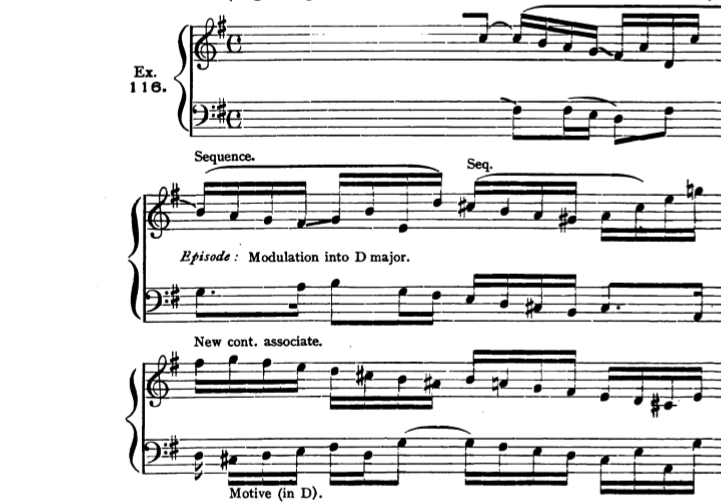 ▶ Ex.116
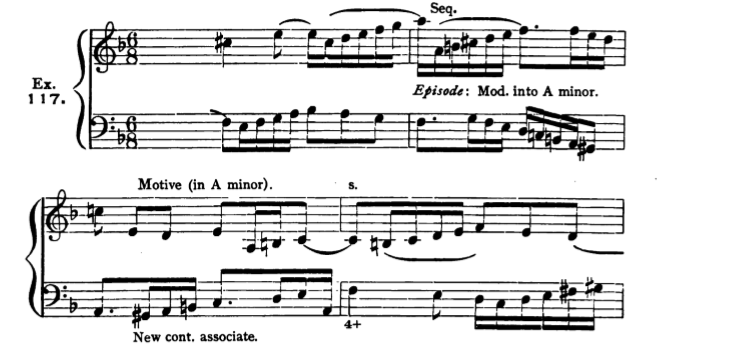 ▶ Ex.117
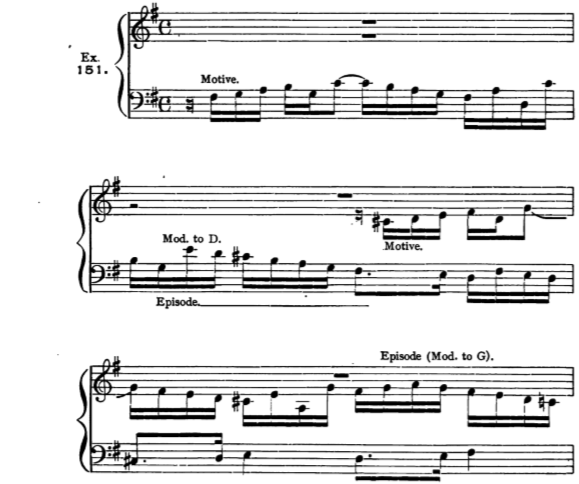 ▶ Ex.151
 Counterpoint AppliedPercy Goetschius, 1902
Start: Chapter V →- Chapter V
b. The Episodes. It would be very wrong to assume that the above episodic passages (Exs. 8g, 90, 91) proceeded from a deliberate intention, on Bach's part, to use just these particular fragments of thematic material, in just this manner. His purpose was a far…
▶ Fig. 223 nearby - Chapter V
…ending in measure 17, is episodic, but derived from' M. I; an independent episode follows, suggesting a third M. (compare par, 52c); in measure 23 the second M. again asserts itself, and continues some time, though fragmentary; measures 29-33 closely resemble…
▶ Fig. 235 nearby - Chapter V
…part and imitated immediately in lower part, with different counterpoint; an Episode follows, based during 4 measures upon a new auxiliary figure, and then for 4 more measures upon a figure from the second contrapuntal associate (measure 7); the Second Section…
▶ Fig. 239 nearby - Chapter V
…in Part I the Motive, 4 measures long, appears twice, followed by an episode (measures 9-16); Part II (measure 17) announces the M. once, in lower voice; a long and brilliant episode follows (measures 21-52), based wholly upon the last measure of the M.; in…
- Chapter XII
…Cl. of Bach : Vol. I, Fugue 23; Section II begins in meas. 9, with episode, followed by one annoancement of Theme (Tenor); Sec. III begins in meas. 13, with same episode, followed by Theme in Alto; Sec. IV begins in meas. 18, with Theme in contrary motion…
- Chapter XII
…announcement, in meas. 38; Sec. 2 begins in meas. 34 (cadence light) with an episode; then Theme in Alto, episode, Theme in Tenor, episode, Theme in Soprano, episode, Theme in Bass; Sec. III begins in meas. 7I, with a long episode (to meas. 83); Sec. IV, in…
▶ Fig. 358 nearby
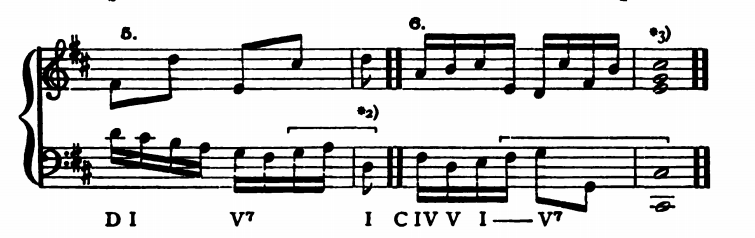 ▶ Ex93-5-6
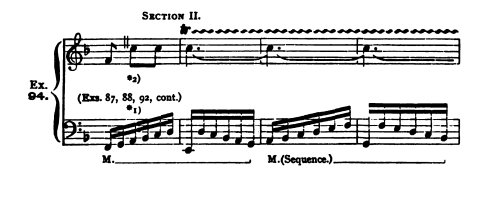 ▶ Ex94
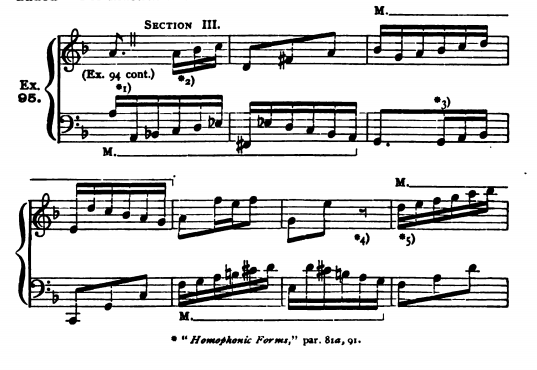 ▶ Ex95
 ▶ Ex100
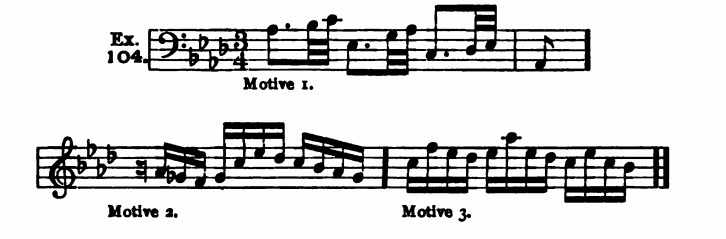 ▶ Ex104
 ▶ Ex153
 Analysis of J. S. Bach’s Forty-Eight FuguesEbenezer Prout, 1910
Start: Introduction →- Fugue 3 · Book I, No. 3 · BWV 848
The middle section of the fugue commences with the second episode (bar 12). Its relationship to the first episode is obvious. The semiquaver figure in the treble of bar 12 is taken from the first countersubject (bar 6), now in direct, not inverse, movement,…
▶ Fig. 7 nearby - Fugue 12 · Book I, No. 12 · BWV 857
The first episode (bars 16 to 19) is a free inversion of the codetta, treated sequentially. The second (bars 22 to 27) is similar to the first, with inversion of the two upper parts. In the third episode (bars 30 to 34) the first bar of the alto in the codetta…
▶ Fig. 32 nearby - Fugue 15 · Book I, No. 15 · BWV 860
…by inverse movement; the bass takes no part in these entries. After a third episode (bars 46 to 51; another variation of the first episode) the subject is treated as a two-part stretto in the octave, in the key of B minor, at one bar's distance, the treble…
▶ Fig. 41 nearby - Fugue 30 · Book II, No. 6 · BWV 875
Middle Section.—The first episode (bars 8, 9) is formed from the fragment of incidental counterpoint in the alto of bar 7. In bars 10 to 12 the impression of a stretto in the octave, at three crotchets' distance, is produced, but the bass really breaks away…
▶ Fig. 70 nearby - Fugue 36 · Book II, No. 12 · BWV 881
The episodes are four in number. The first (bars 15 to 24) begins with a sequential prolongation of bar 3 of the subject, after which, at bar 17, a new sequence appears, formed from the beginning of the subject, with a new counterpoint. The second episode…
▶ Fig. 84 nearby - Fugue 37 · Book II, No. 13 · BWV 882
…minor (subject in treble, countersubject in alto), without any connecting episode. Episode 3 (bars 43 to 52) is a transposition of Episode 1, with the two upper parts inverted. The only other middle entry (from bar 52) is in the key of B, with the subject in…
▶ Fig. 86 nearby
109 more passages in Analysis of J. S. Bach’s Forty-Eight Fugues →
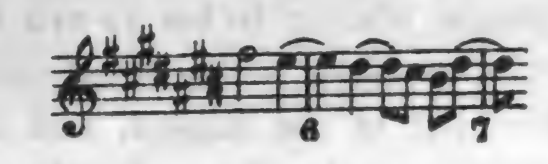 ▶ Analytical excerpt · Fugue 3
Fugue 3 · Book I, No. 3 · BWV 848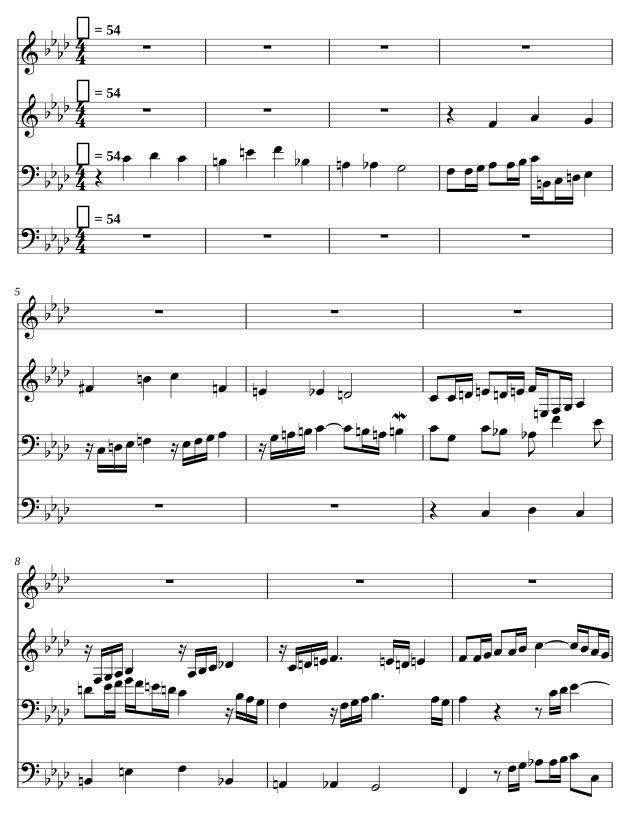 ▶ Complete score
Fugue 12 · Book I, No. 12 · BWV 857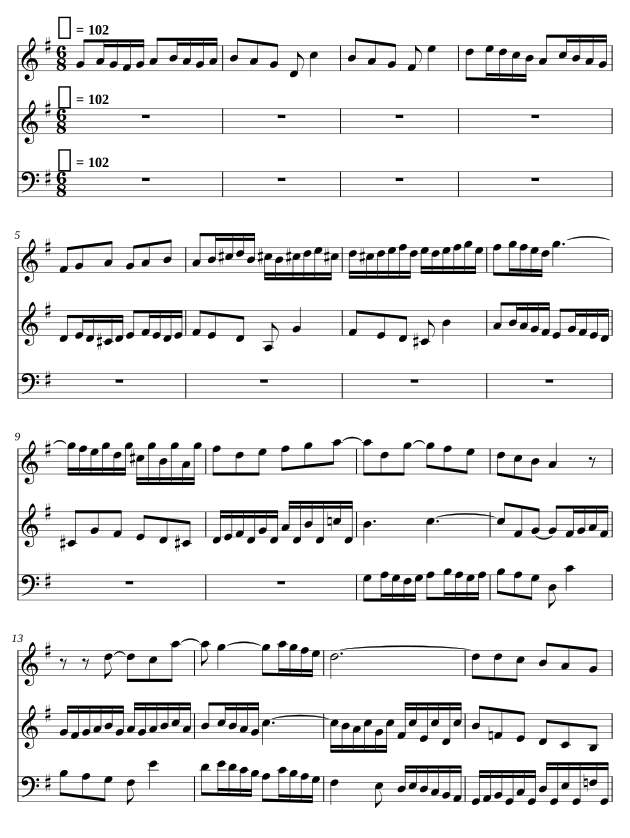 ▶ Complete score
Fugue 15 · Book I, No. 15 · BWV 860 ▶ Prout’s excerpt · Fugue 30
Fugue 30 · Book II, No. 6 · BWV 875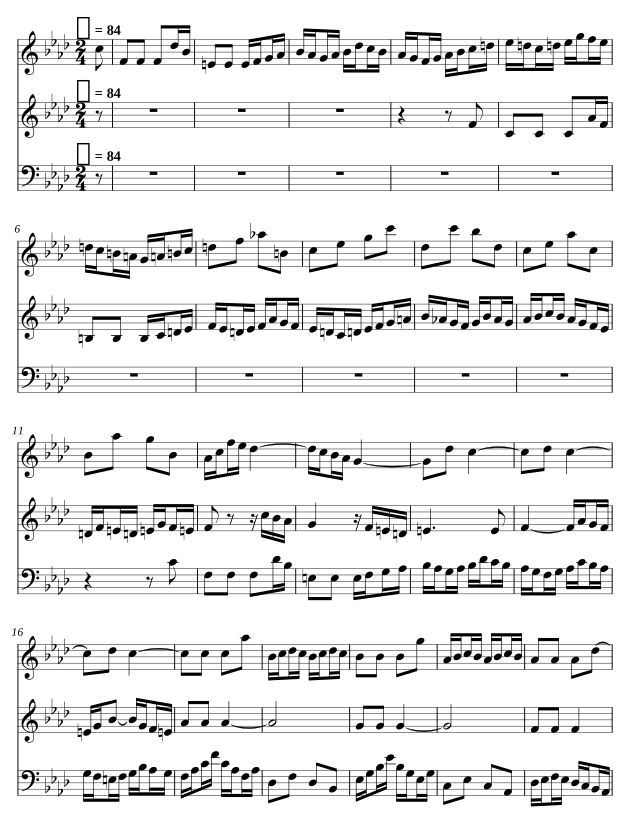 ▶ Complete score
Fugue 36 · Book II, No. 12 · BWV 881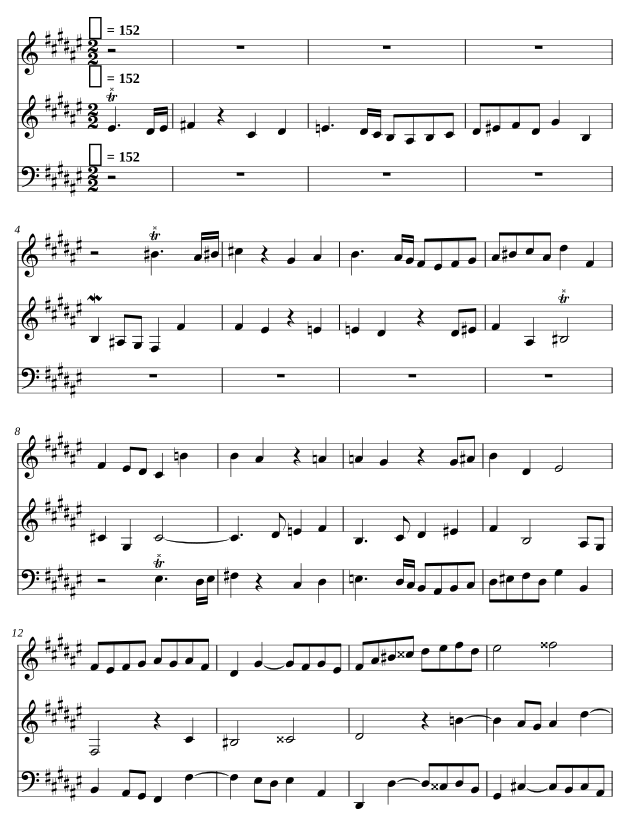 ▶ Complete score
Fugue 37 · Book II, No. 13 · BWV 882
More in Imitation and fugue
Imitation · Canon · Invertible (double) counterpoint · Fugue · Subject, answer and countersubject · Stretto