 Playable Books
Concept index · Imitation and fugue
Invertible (double) counterpoint
Taught in 5 books. Each one opens at the passage; ▶ plays the example beside it. Also called double counterpoint, invertible counterpoint.
This index is Playable Books’ own: a first pass that finds the term’s words in each book, corrected by hand. The authors did not tag these passages, and their terms can differ (Fux’s “ligature” is a suspension). The quoted text is the book’s.
 Gradus ad ParnassumJohann Joseph Fux, 1725
Start: Double counterpoint →- Double counterpoint at the tenth · 15 playable examples
- Double counterpoint at the twelfth · 39 playable examples
- Fugue in four parts
…ornament of several subjects. Since this cannot be done without knowledge of double counterpoint, we must first discuss it.
▶ Fig. 298 nearby - Double counterpoint
By double counterpoint is understood an artful composition constructed so that its parts can exchange places with one another, and the part that was just now upper becomes lower through inversion. In my view it is so called because, apart from the inversion of…
▶ Fig. 300 nearby - Double counterpoint
Counterpoint at the octave, then, is a composition arranged so that, when either part is inverted an octave upward or downward, it produces varied harmony that nevertheless agrees correctly with the rules. Joseph, so that you may have no doubt how this can be…
▶ Fig. 300 nearby - Double counterpoint
…reason for not exceeding the bounds of the octave is that the function of double counterpoint is to produce varied and different harmony through inversion. But if you pass beyond the bounds of the octave, although compound consonances are changed into simple…
▶ Fig. 303 nearby - Double counterpoint at the twelfth
Aloysius. Understand that this was done so that the transposition of the counterpoint at the twelfth may end more suitably in its mode, although it does not harm double counterpoint for the transposed part to stray outside the mode. Now, without moving the…
▶ Fig. 345 nearby - Double counterpoint at the twelfth
Aloysius. To show you how great and excellent is the usefulness of double counterpoint, to which this wonderful variety must be credited. This occurs if counterpoint at the twelfth is given almost no consonance other than a fifth and octave, and those by…
▶ Fig. 367 nearby
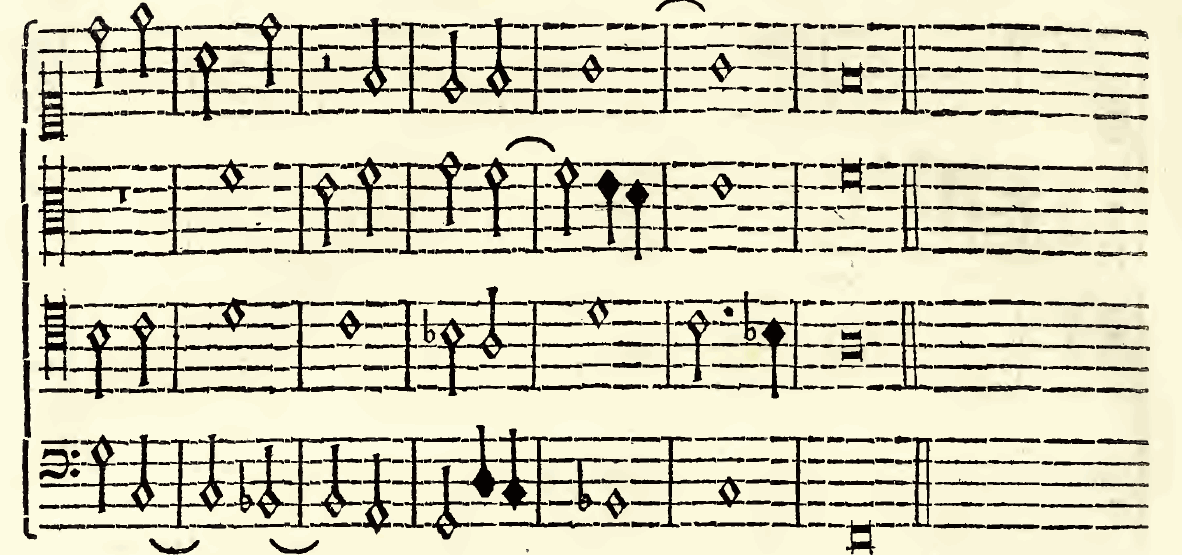 ▶ Fig. 298
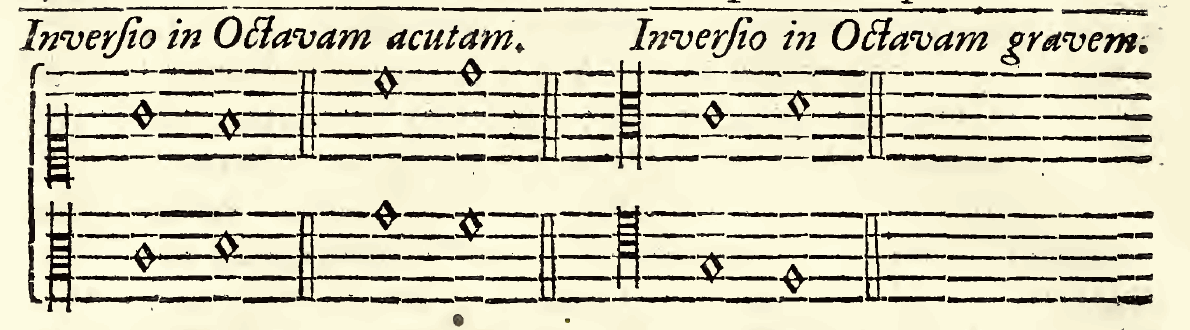 ▶ Fig. 300
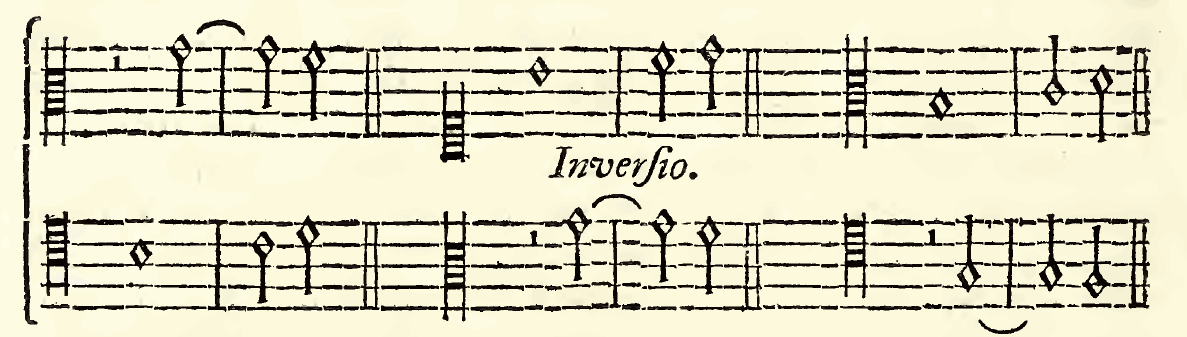 ▶ Fig. 301
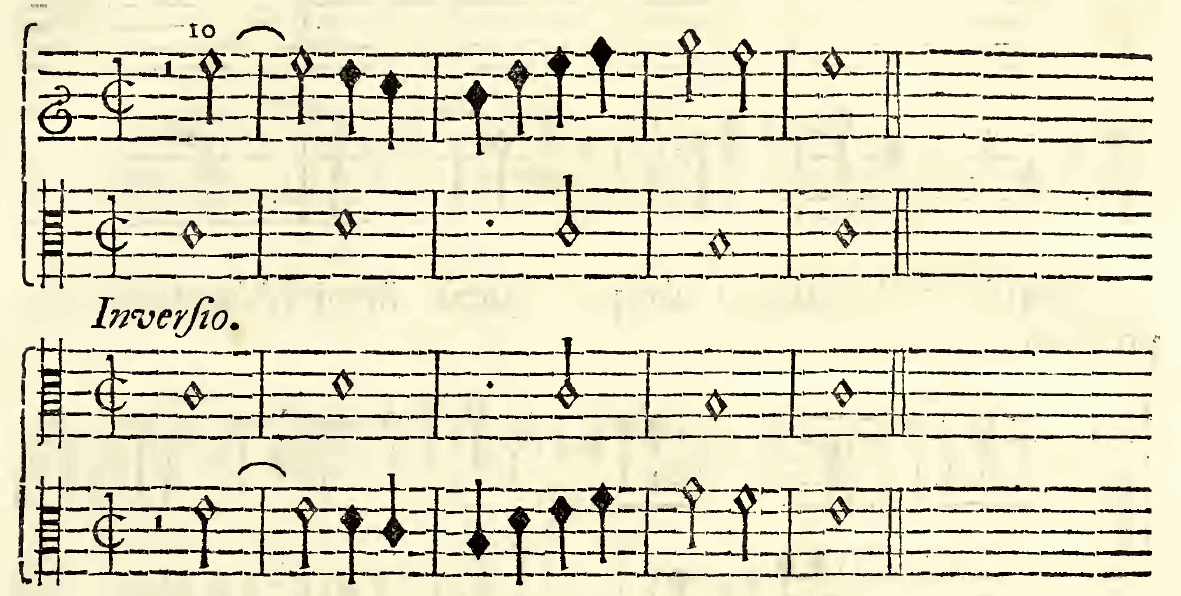 ▶ Fig. 303
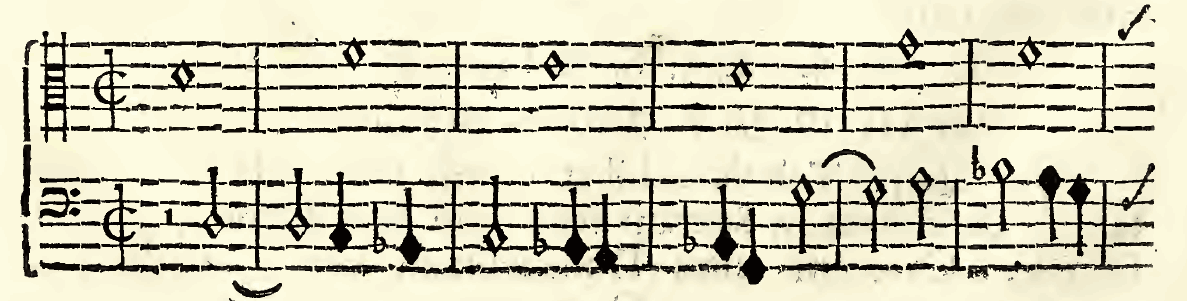 ▶ Fig. 345
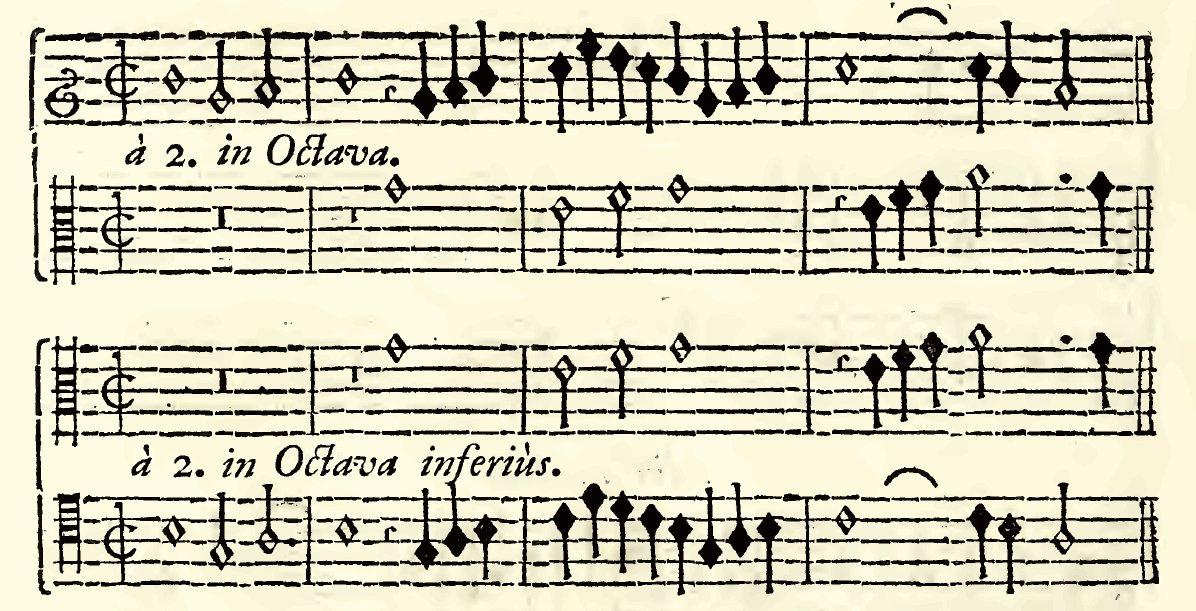 ▶ Fig. 367
 Counterpoint AppliedPercy Goetschius, 1902
- Chapter IX
…Cadenza, 2 measures, —the rest a strictly polyphonic " Invention" in double counterpoint, to be analyzed later. Bach, Fantasia e Fuga (Peters ed. 1959, page 80, 21 measures); same volume, pages 84, 85, — quasi " Toccata." Bach, Clavichord Sonata (Peters ed.…
- Chapter X
MISCELLANEOUS. Bach, Vol. V, No. 4, Verse I (two motives together, Double counterpoint, in inner parts; Pedal employs motive i exclusively). — No. 6 (c. f. in Alto, slightly embellished; M. two beats, in Soprano; same simplified for Pedal). No. 24 (running…
- Chapter XI
Vol. VI, No. 29, Division I (f time); 3-voice; 2 Motives in conjunction (Double counterpoint).
- Chapter XI
Vol. VI, No. 32; 4-voice, manuals; c. f. in Soprano; M. for each of first 3 Lines, invented without reference to chorale; last Line in alternating voices, Double counterpoint.
- Chapter XV. THE DOUBLE-FUGUE
172. Double counterpoint in the iIth. Frequent use of the interval of a 6th will, as a rule, yield a good Inversion in the 11th (the 6th
▶ Fig. 398 nearby
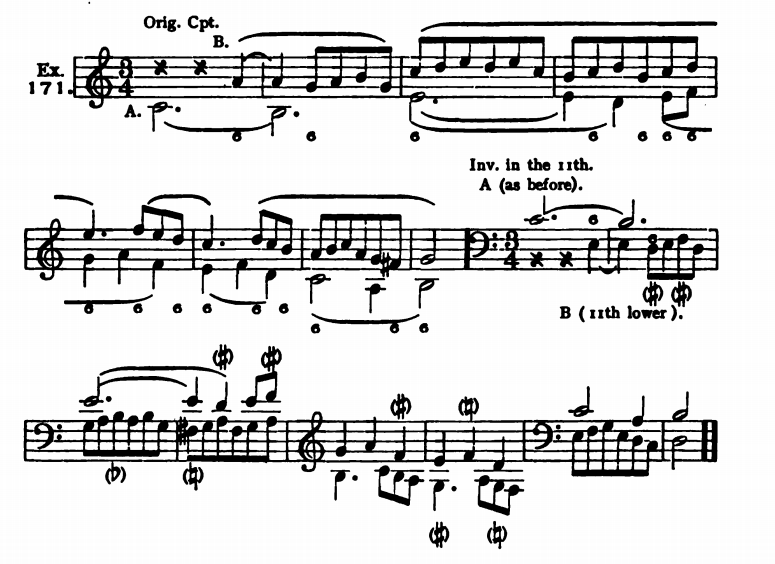 ▶ Ex171
 Analysis of J. S. Bach’s Forty-Eight FuguesEbenezer Prout, 1910
Start: Introduction →- Introduction
…whichever be placed at the bottom, or as a middle part, or at the top. Double counterpoint in the octave (or "at the octave") is that in which the inversion is normal, the lower part being placed an octave higher, or the higher an octave lower; in the tenth is…
- Introduction
…of two subjects, or themes, we mean their changed relation one to the other (double counterpoint), and it is only when one theme alone is in question that the word inversion has been allowed to bear its other meaning (= inverse movement).
- Fugue 2 · Book I, No. 2 · BWV 847
…seen that the two lower voices at bar 17 are the inversion of the codetta in double counterpoint in the twelfth; at the third crotchet of bar 18 the alto and bass are inverted in the octave. The treble adds an accompaniment in thirds.
▶ Fig. 4 nearby - Fugue 17 · Book I, No. 17 · BWV 862
…(bars 11 to 13) is made from bar 3, with the addition of a third voice in triple counterpoint. The third (bars 14 to 17) is an inversion of the second, the outer parts of bars 11 and 12 being here inverted in the twelfth. Episode 4 (bars 19 to 21) is a new…
▶ Fig. 44 nearby - Fugue 38 · Book II, No. 14 · BWV 883
The three themes which have been quoted are now combined in triple counterpoint. In bars 54 to 57 the subject is in the treble, in the tonic key, slightly modified at its commencement, the triple counterpoint being found in bar 56. Bars 57 to 60 and 63 to 66…
▶ Fig. 90 nearby - Fugue 40 · Book II, No. 16 · BWV 885
…the subject in D minor in the alto (bar 28), introducing the new feature of double counterpoint in the twelfth. In bars 32 to 40 there is a pair of entries in the relative major keys, the subject in the treble being answered in the bass. The countersubject is…
▶ Fig. 93 nearby
16 more passages in Analysis of J. S. Bach’s Forty-Eight Fugues →
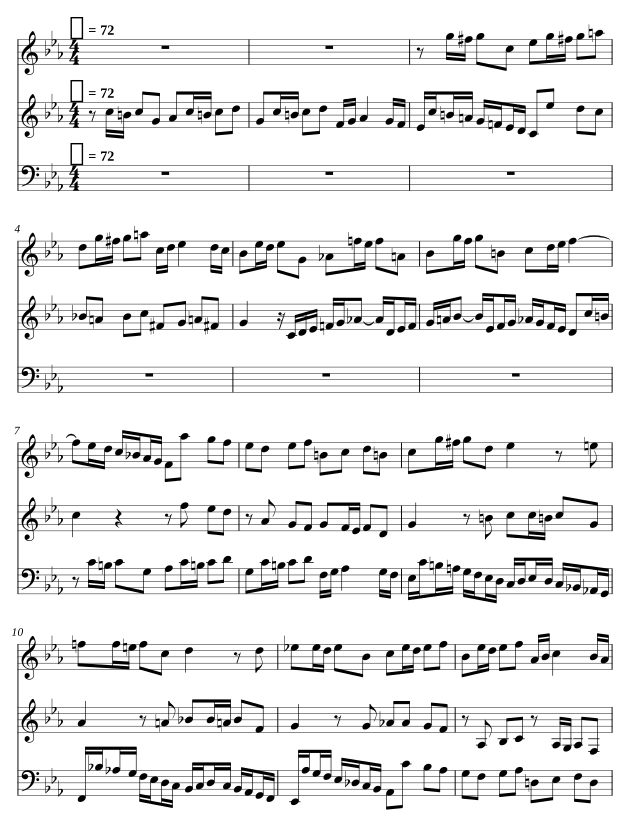 ▶ Complete score
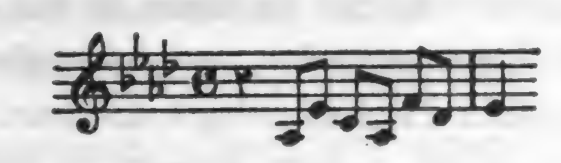 ▶ Subject · Fugue 17
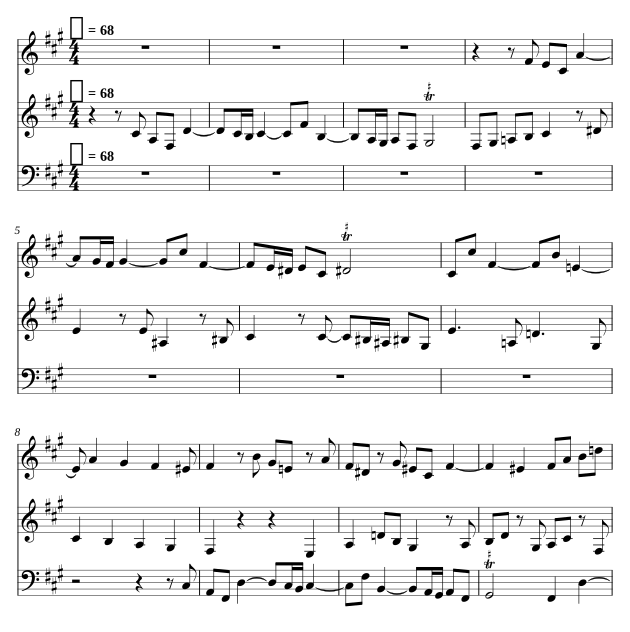 ▶ Complete score
 ▶ Prout’s excerpt · Fugue 40
 Theory of HarmonyArnold Schoenberg, 1922
- Parallel octaves and fifths · Footnote
…evidence, since it explicitly rests on the idea of real, actual voices. In double counterpoint, however, thirds are merely filling voices: a matter of sonority added without acquiring any particular merit in voice leading by the addition. Finally, parallel…
▶ Fig. 31 nearby
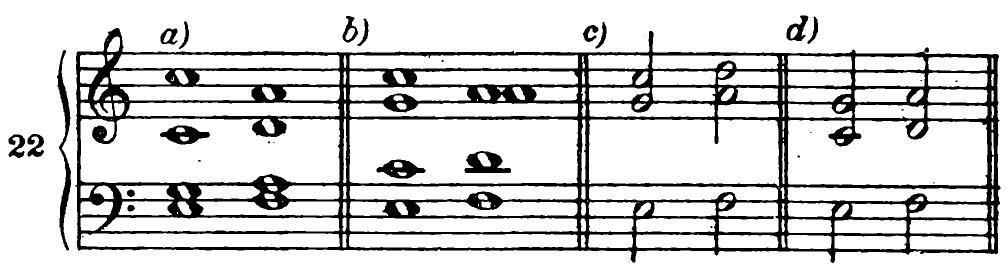 ▶ Example 22a
 Treatise on InstrumentationHector Berlioz, 1905
- The Melodium Organ
…relations with these stops, they should be used only in pieces written in double counterpoint in the octave; but this is not done.
More in Imitation and fugue
Imitation · Canon · Fugue · Subject, answer and countersubject · Episode · Stretto
All concepts · Search every passage for “double counterpoint”