 Playable Books
Concept index · Imitation and fugue
Fugue
Taught in 10 books. Each one opens at the passage; ▶ plays the example beside it. Also called fugues, fugal exposition.
This index is Playable Books’ own: a first pass that finds the term’s words in each book, corrected by hand. The authors did not tag these passages, and their terms can differ (Fux’s “ligature” is a suspension). The quoted text is the book’s.
 Gradus ad ParnassumJohann Joseph Fux, 1725
Start: Fugue in general → Start: Fugue in two parts → Start: Fugue in three parts → Start: Fugue in four parts →- On various fugue subjects · 21 playable examples
- Fugue in general
Several authors of no mean standing affirm that fugue takes its name from fugere, to flee, and fugare, to put to flight, as though the preceding part fled, pursued by the following one. This would be true, were it not that imitation does the same, as was said.…
▶ Fig. 237 nearby - Fugue in general
…I have understood what has been said thus far about modes, imitation, and fugue. Now please teach me what must be considered in choosing subjects and how fugues are to be established and conducted; for I have very often heard that the matter of fugues is not…
▶ Fig. 243 nearby - Fugue in two parts
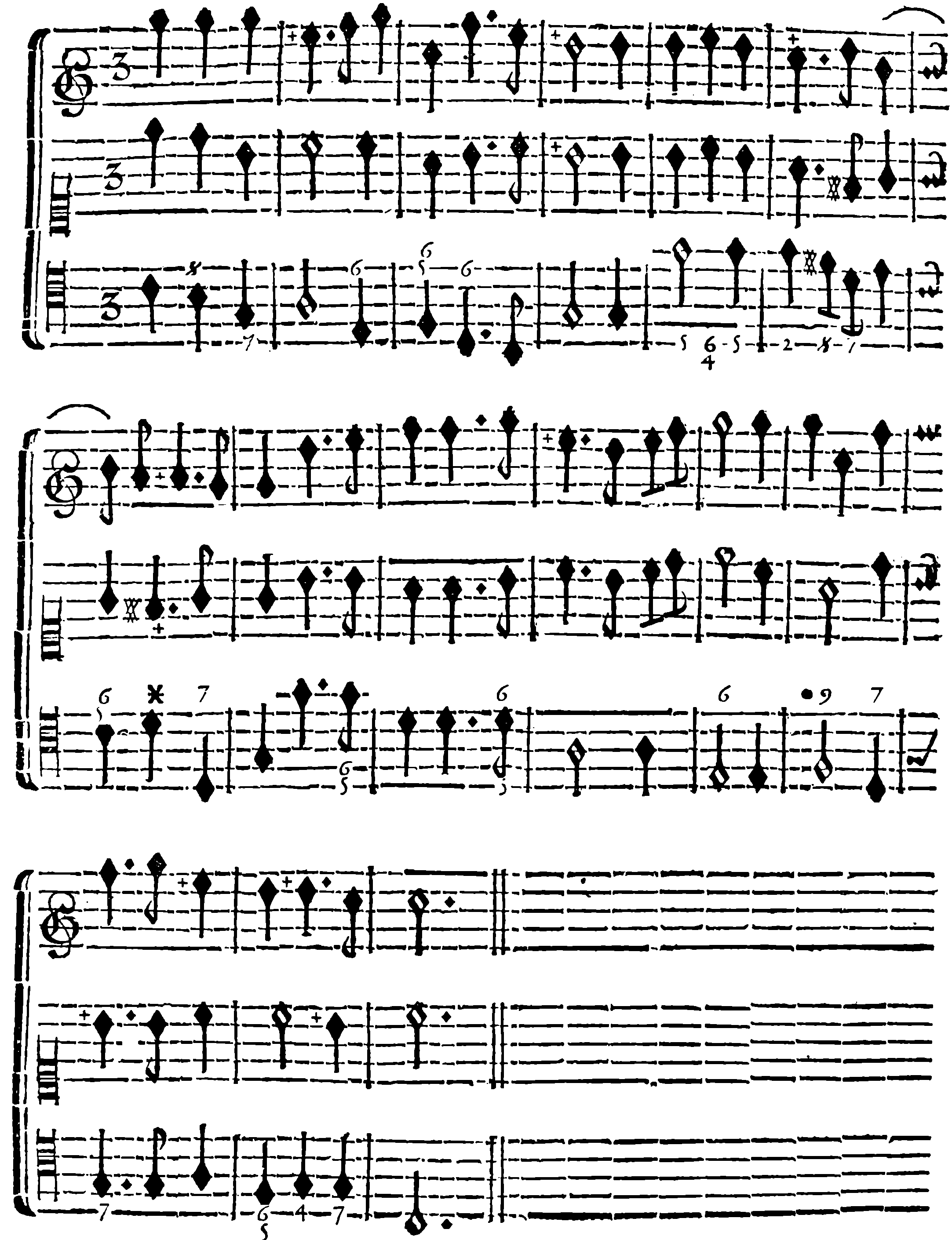
I shall now teach you the art of composing fugues for two parts, first by a clear and very simple method. Take a subject of a few notes appropriate to the mode in which you intend to work, and write those notes in the part with which you have decided to begin.…
▶ Fig. 247 nearby - Fugue in two parts
Joseph. In the distinction given above between fugue and imitation, you asserted that in fugue the following part would have the opportunity to enter only at the fifth, octave, and unison. Yet a little later, in the precepts for composing a fugue, you also…
▶ Fig. 250 nearby - Double counterpoint
…counterpoint, by whose aid, if the subjects are properly constructed, a fugue can easily be built and extended at length. It is now your task, Joseph, to pursue the other fugues in the order of the modes, treating them in the same way. But to provide variety,…
▶ Fig. 316 nearby - Double counterpoint at the tenth
Here is a fugue made briefly, and more for the sake of this counterpoint at the tenth than as an example of a fugue furnished with every artifice. I leave you to compose in the remaining five modes on this model, taking subjects from the simple fugues of each…
▶ Fig. 340 nearby
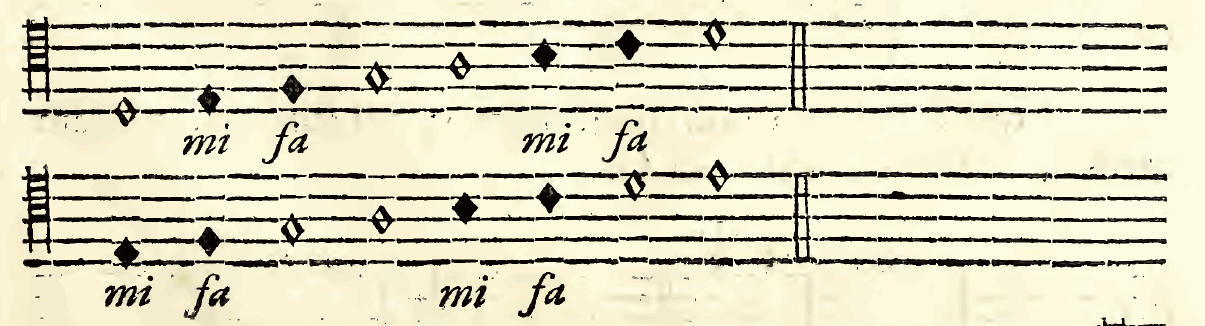 ▶ Fig. 237
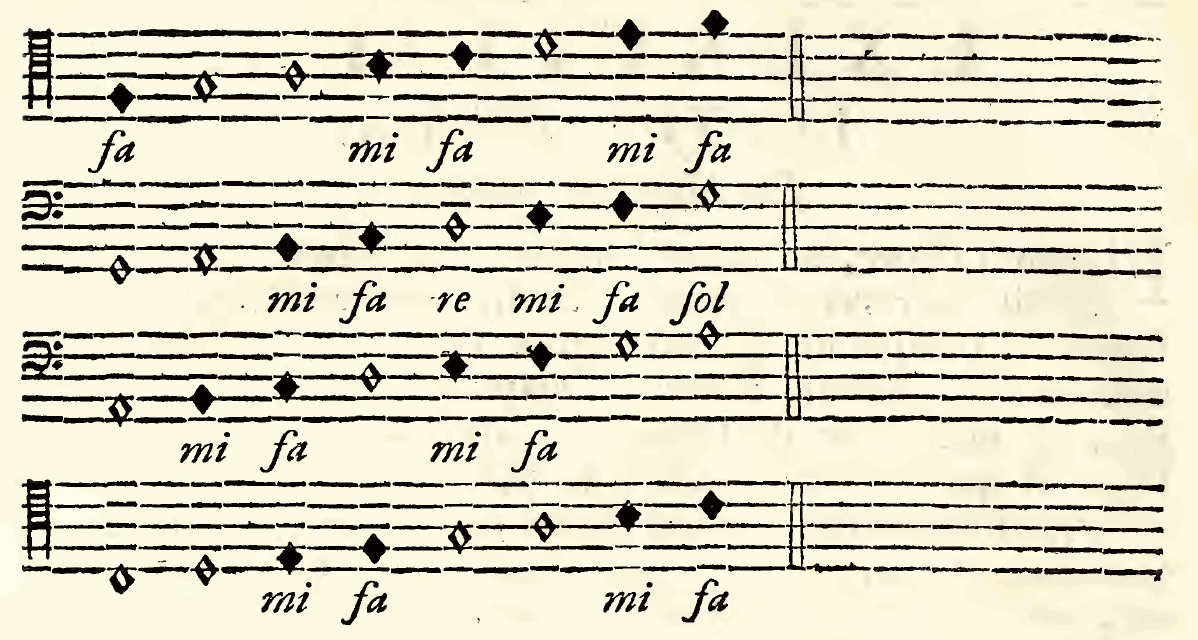 ▶ Fig. 239
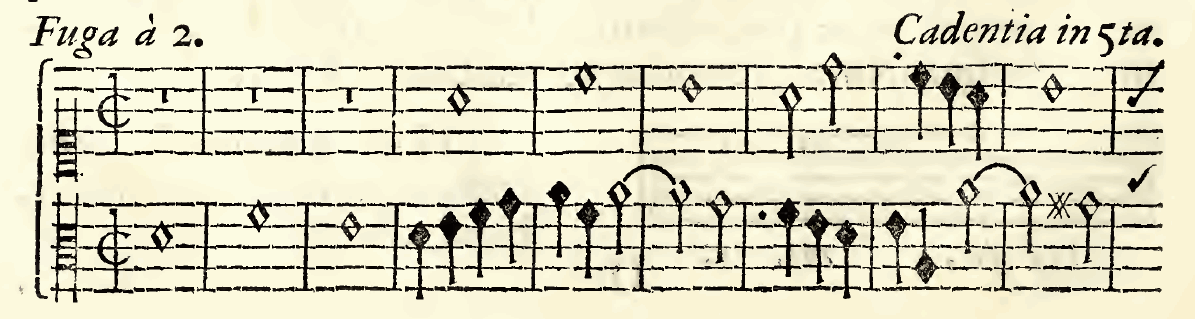 ▶ Fig. 247
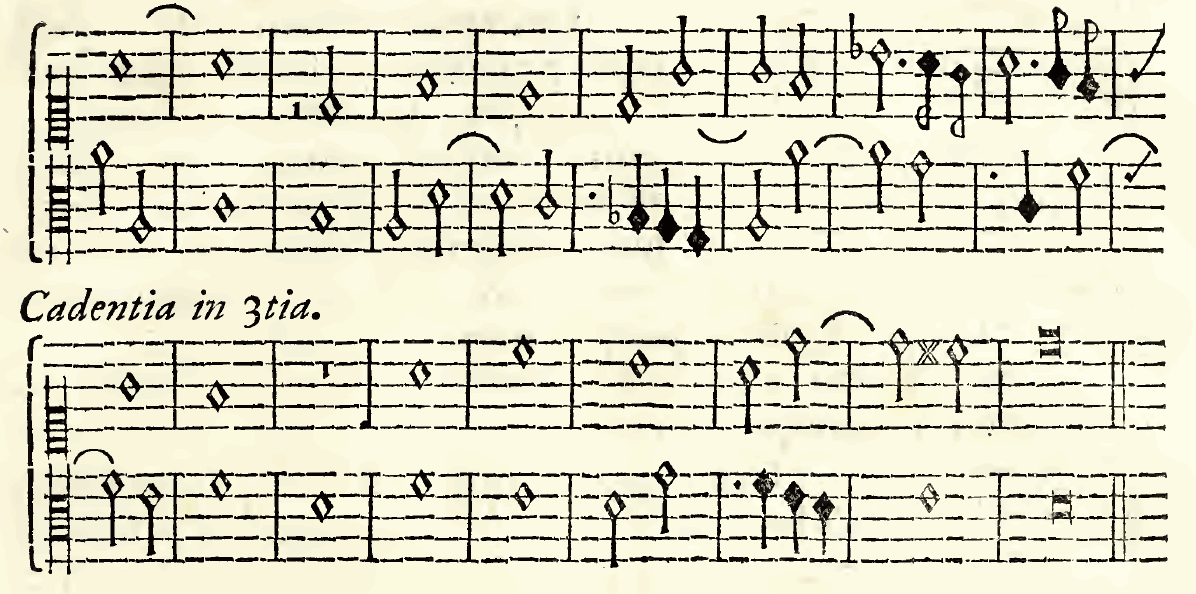 ▶ Fig. 248
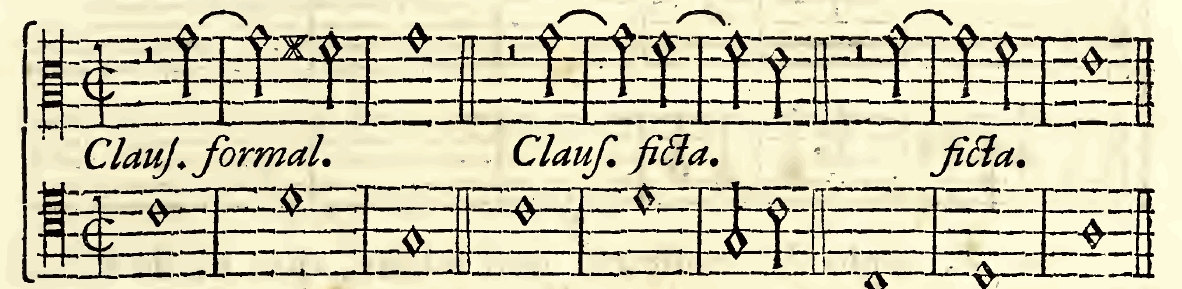 ▶ Fig. 263
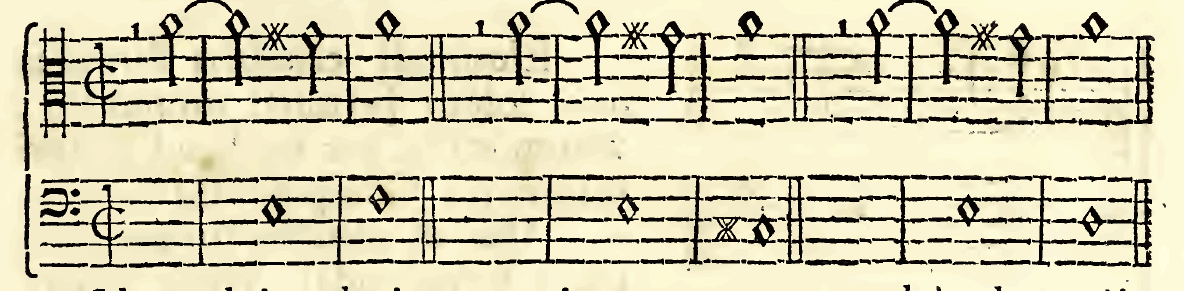 ▶ Fig. 264
 Exercises in Elementary CounterpointPercy Goetschius, 1910
- Introduction
…bulk may be divided into distinct melodies, — as in the Inventions and Fugues of Bach, and many passages in stringquartets, or symphonic scores (where the lines are written separately, of necessity, on independent staves). In many, finally, the bulk is very…
▶ Fig. 5 nearby - Chapter XXV. Four-Part Counterpoint
No. 1. Bach, Organ fugue in C minor.
▶ Fig. 426 nearby - Chapter XXV. Four-Part Counterpoint
No. *. Bach, Organ fugue in B minor.
▶ Fig. 427 nearby - Chapter XXV. Four-Part Counterpoint
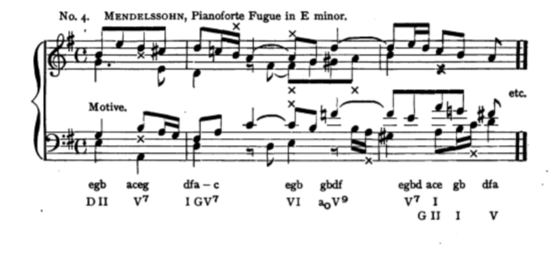
No. 4. Mendelssohn, Pianoforte Fugue in E minor. x
▶ Fig. 429 nearby - Chapter XXV. Four-Part Counterpoint
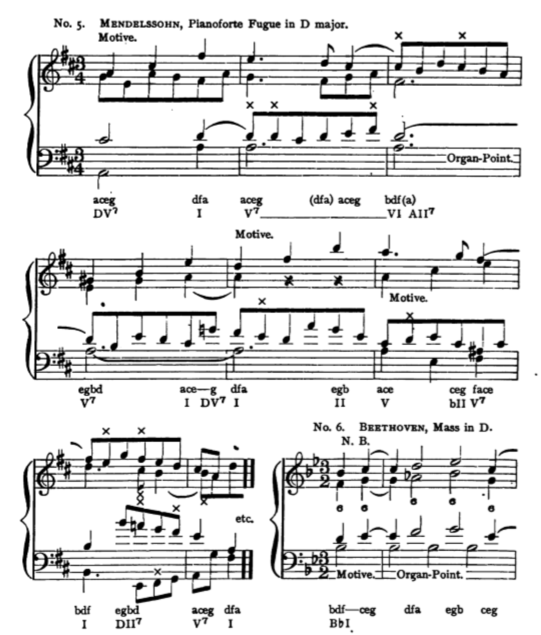
No. 5. Mendelssohn, Pianoforte Fugue in D major. Motive. 1
▶ Fig. 430 nearby - Chapter XXV. Four-Part Counterpoint
" " Fugue No. 7 (Eb major), measure 21 to 30; 58, to the end. •• Fugue No. 9 (E major), measure 5, to the end.
 ▶ Ex.5
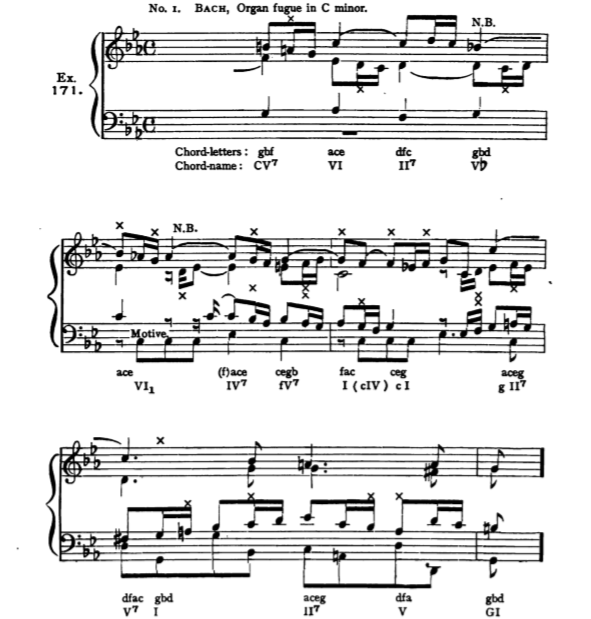 ▶ Ex.171-1
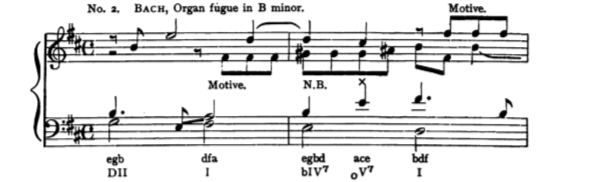 ▶ Ex.171-2
 ▶ Ex.171-4
 ▶ Ex.171-5
 Counterpoint AppliedPercy Goetschius, 1902
Start: Chapter XII → Start: Chapter XIII → Start: Chapter XV. THE DOUBLE-FUGUE → Start: Chapter XVI →- Chapter IX
See Bach, Toccata for Clavichord in e minor (Peters ed. 210, No. I), three brief, totally independent sections, the and ($, Allegro) a Double Fughetta, to be consid. ered later; a Fugue follows, to which the Toccata may be considered to be a "Prelude." Bach,…
- Chapter XII
…with the final tone of the Subject (Bach, Well-temp. Clav., Vol. I, Fugue 8). Or immediately after the Subject ends (Vol. I, Fugue 6). Or still a little later, so that one or more tones must be added to the Subject, as intervening figure (Vol. I, Fugue 1, one…
▶ Fig. 352 nearby - Chapter XIII
Vol. II, Fugue I.— Fugue 6 (contrary motion and stretti employed in later course). — Fugue 1o (episode in meas. 18-20, corroborated in meas. 47-49; characteristic Counterpoint recurs occasionally).— Fugue II (quasi 2-Part Song-form; Exposition to meas. 29;…
- Chapter XIV
Jadassohn, Preludes and Fugues for pianoforte, op. 56, Fugue 1; 4-voice; 2- Part form; stretto in 2nd Part, — Fugue 2; 3-voice; sectional; stretti and contrary motion. — Fugue 3; 3-voice; ditto. — Fugue 4; 4-voice; sectional; various effective Counterpoints,…
- Chapter XIV
See Bach, Org. Comp., Vol. III, Fugue 6; 4-voice; large 3-Part form; the first Subject is the basis of Part I; a totally different Subject (chromatic) is manipulated in Part II, as separate Fugue, so to speak; in Part IIl the first Subject is resumed; this…
- Chapter XVI
Bach, "The Art of Fugue," Fugue 8; 3-voice, sectional; design as follows (Themes named A, B, and C, in the order of their appearance — C being the principal Subject): Sections I and II, Theme A alone; Sec. III (meas. 39) and IV, Themes A and B; Sec. V (meas.…
▶ Fig. 413 nearby
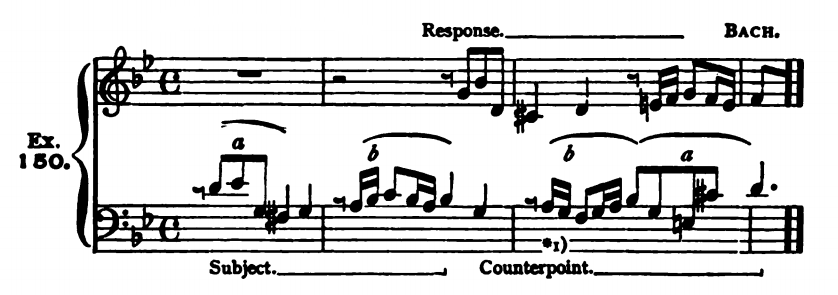 ▶ Ex150
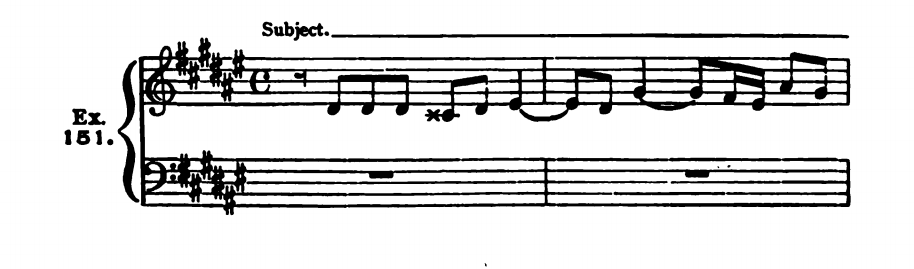 ▶ Ex151
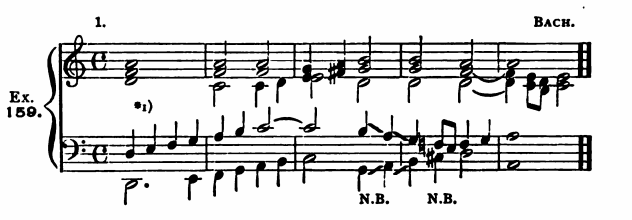 ▶ Ex159-1
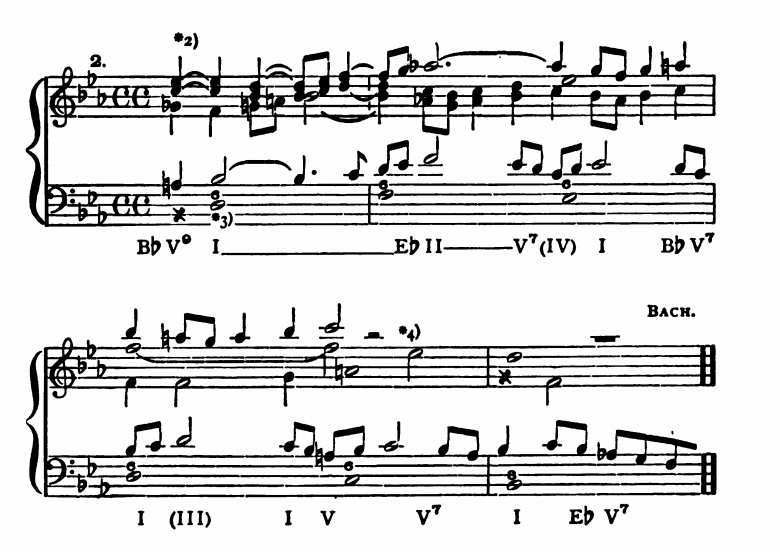 ▶ Ex159-2
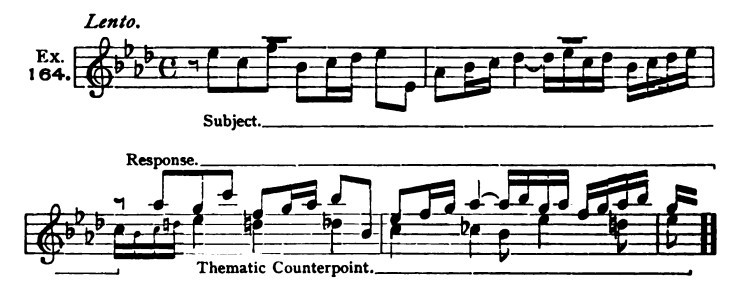 ▶ Ex164
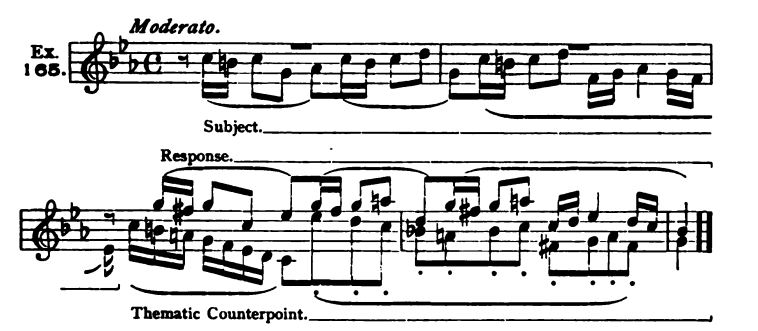 ▶ Ex165
 Analysis of J. S. Bach’s Forty-Eight FuguesEbenezer Prout, 1910
Start: Introduction → Start: Fugue 10 · Book I, No. 10 · BWV 855 → Start: Fugue 2 · Book I, No. 2 · BWV 847 → Start: Fugue 1 · Book I, No. 1 · BWV 846 → Start: Fugue 42 · Book II, No. 18 · BWV 887 → Start: Fugue 38 · Book II, No. 14 · BWV 883 →- Analysis of J. S. Bach’s Forty-Eight Fugues
- Fugue 3 · Book I, No. 3 · BWV 848 · 4 playable examples
- Fugue 4 · Book I, No. 4 · BWV 849 · 5 playable examples
- Fugue 5 · Book I, No. 5 · BWV 850 · 3 playable examples
- Fugue 6 · Book I, No. 6 · BWV 851 · 2 playable examples
- Fugue 7 · Book I, No. 7 · BWV 852 · 3 playable examples
- Fugue 8 · Book I, No. 8 · BWV 853 · 3 playable examples
- Fugue 9 · Book I, No. 9 · BWV 854 · 2 playable examples
- Fugue 11 · Book I, No. 11 · BWV 856 · 2 playable examples
- Fugue 12 · Book I, No. 12 · BWV 857 · 2 playable examples
- Fugue 13 · Book I, No. 13 · BWV 858 · 2 playable examples
- Fugue 14 · Book I, No. 14 · BWV 859 · 4 playable examples
- Fugue 15 · Book I, No. 15 · BWV 860 · 3 playable examples
- Fugue 16 · Book I, No. 16 · BWV 861 · 2 playable examples
- Fugue 17 · Book I, No. 17 · BWV 862 · 2 playable examples
- Fugue 18 · Book I, No. 18 · BWV 863 · 2 playable examples
- Fugue 19 · Book I, No. 19 · BWV 864 · 2 playable examples
- Fugue 20 · Book I, No. 20 · BWV 865 · 2 playable examples
- Fugue 21 · Book I, No. 21 · BWV 866 · 2 playable examples
- Fugue 22 · Book I, No. 22 · BWV 867 · 2 playable examples
- Fugue 23 · Book I, No. 23 · BWV 868 · 2 playable examples
- Fugue 24 · Book I, No. 24 · BWV 869 · 2 playable examples
- Fugue 25 · Book II, No. 1 · BWV 870 · 2 playable examples
- Fugue 26 · Book II, No. 2 · BWV 871 · 2 playable examples
- Fugue 27 · Book II, No. 3 · BWV 872 · 2 playable examples
- Fugue 28 · Book II, No. 4 · BWV 873 · 2 playable examples
- Fugue 29 · Book II, No. 5 · BWV 874 · 2 playable examples
- Fugue 30 · Book II, No. 6 · BWV 875 · 2 playable examples
- Fugue 31 · Book II, No. 7 · BWV 876 · 2 playable examples
- Fugue 32 · Book II, No. 8 · BWV 877 · 2 playable examples
- Fugue 33 · Book II, No. 9 · BWV 878 · 3 playable examples
- Fugue 34 · Book II, No. 10 · BWV 879 · 2 playable examples
- Fugue 35 · Book II, No. 11 · BWV 880 · 2 playable examples
- Fugue 36 · Book II, No. 12 · BWV 881 · 2 playable examples
- Fugue 37 · Book II, No. 13 · BWV 882 · 2 playable examples
- Fugue 39 · Book II, No. 15 · BWV 884 · 2 playable examples
- Fugue 40 · Book II, No. 16 · BWV 885 · 2 playable examples
- Fugue 41 · Book II, No. 17 · BWV 886 · 2 playable examples
- Fugue 43 · Book II, No. 19 · BWV 888 · 2 playable examples
- Fugue 44 · Book II, No. 20 · BWV 889 · 2 playable examples
- Fugue 45 · Book II, No. 21 · BWV 890 · 2 playable examples
- Fugue 46 · Book II, No. 22 · BWV 891 · 2 playable examples
- Fugue 47 · Book II, No. 23 · BWV 892 · 3 playable examples
- Fugue 48 · Book II, No. 24 · BWV 893 · 2 playable examples
- Editor’s Preface
…smaller sections, may find it in Dr. F. Stade's analyzed edition of the fugues, "J. S. Bach, Die Fugen des wohltemperirten Klaviers partiturmässig dargestellt," etc.; Riemann's " Katechismus der Fugen-Komposition" also gives an abundance of valuable and…
- Introduction
The collection of preludes and fugues commonly known as " Das Wohltemperirte Clavier " consists in reality of two complete and separate works, each containing one prelude and fugue in each of the major and minor keys. The first, to which Bach himself gave the…
- Introduction
Bach's part-writing, in the fugues, is as absolutely clear and definite as though each part were given to a separate voice or instrument. The student who desires to obtain a thorough insight into them could not possibly devise a better exercise than to write…
- Introduction
SUBJECT.—The theme on which the fugue is founded (but see “Answer"). If there are two or three subjects, the fugue is called a double or triple fugue.
- Fugue 4 · Book I, No. 4 · BWV 849
The fugue is not only one of the finest but also one of the longest and most elaborate in the present work. It is sometimes spoken of as " a fugue on three subjects "; this, however, is not absolutely correct. In a fugue on three subjects, either all the…
▶ Fig. 9 nearby - Fugue 4 · Book I, No. 4 · BWV 849
…of two bars is inserted between the third and fourth entries (compare Fugue 2, bars 5 to 7). The entry of the answer in the second treble (bar 12) is irregular, not because the first note is shortened, for it is always allowed to shorten or lengthen the first…
▶ Fig. 9 nearby
157 more passages in Analysis of J. S. Bach’s Forty-Eight Fugues →
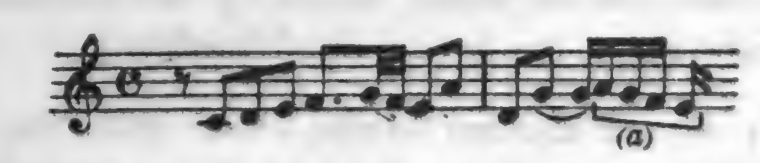 ▶ Subject · Fugue 1
Fugue 1 · Book I, No. 1 · BWV 846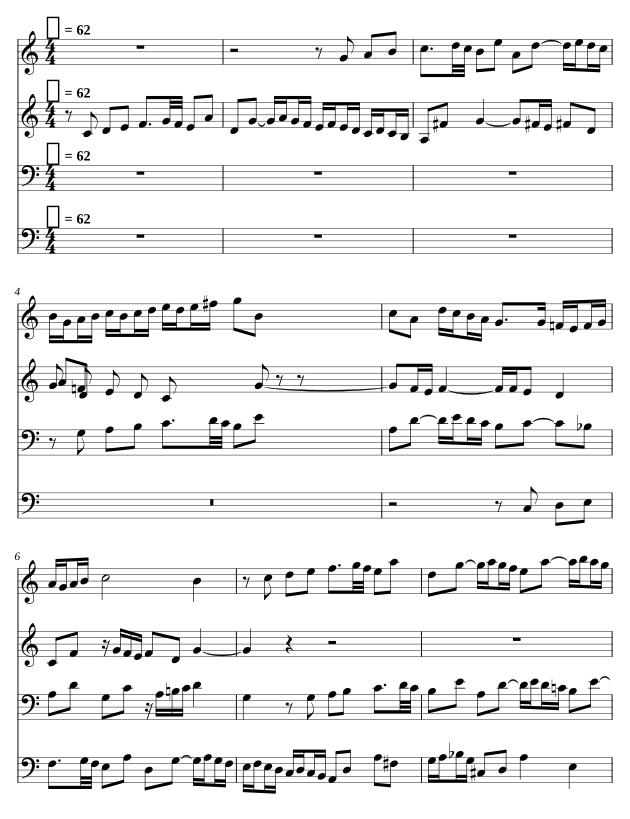 ▶ Complete score
Fugue 1 · Book I, No. 1 · BWV 846 ▶ Subject · Fugue 2
Fugue 2 · Book I, No. 2 · BWV 847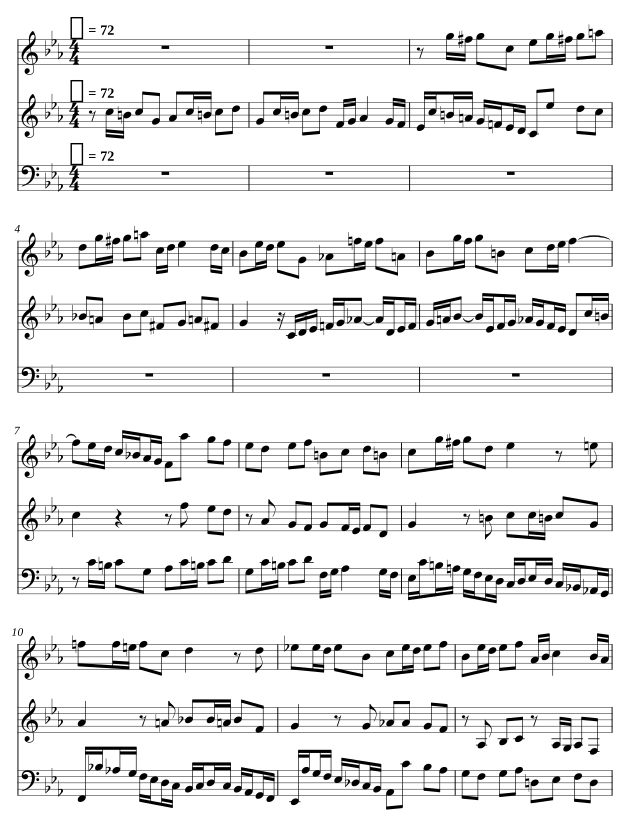 ▶ Complete score
Fugue 2 · Book I, No. 2 · BWV 847 ▶ Subject · Fugue 10
Fugue 10 · Book I, No. 10 · BWV 855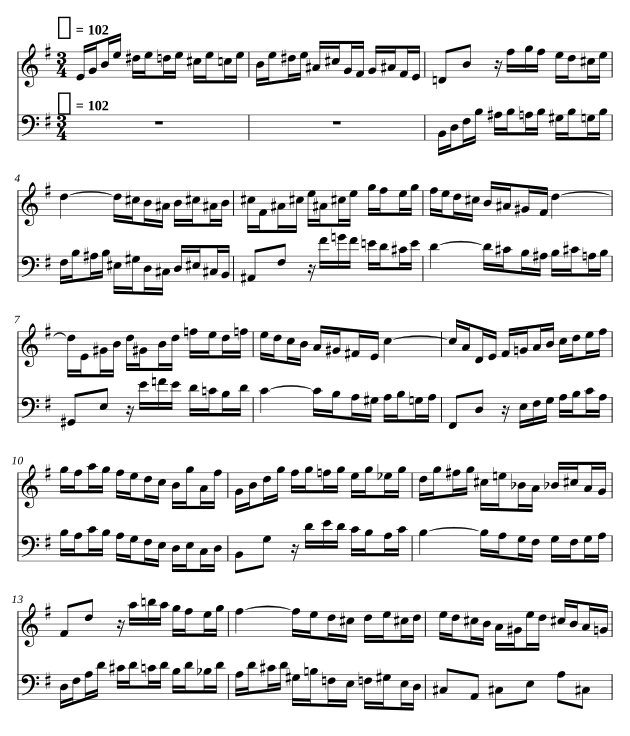 ▶ Complete score
Fugue 10 · Book I, No. 10 · BWV 855
 Treatise on HarmonyJean-Philippe Rameau, 1722
Start: Chapter forty-four →- Chapter twenty-eight
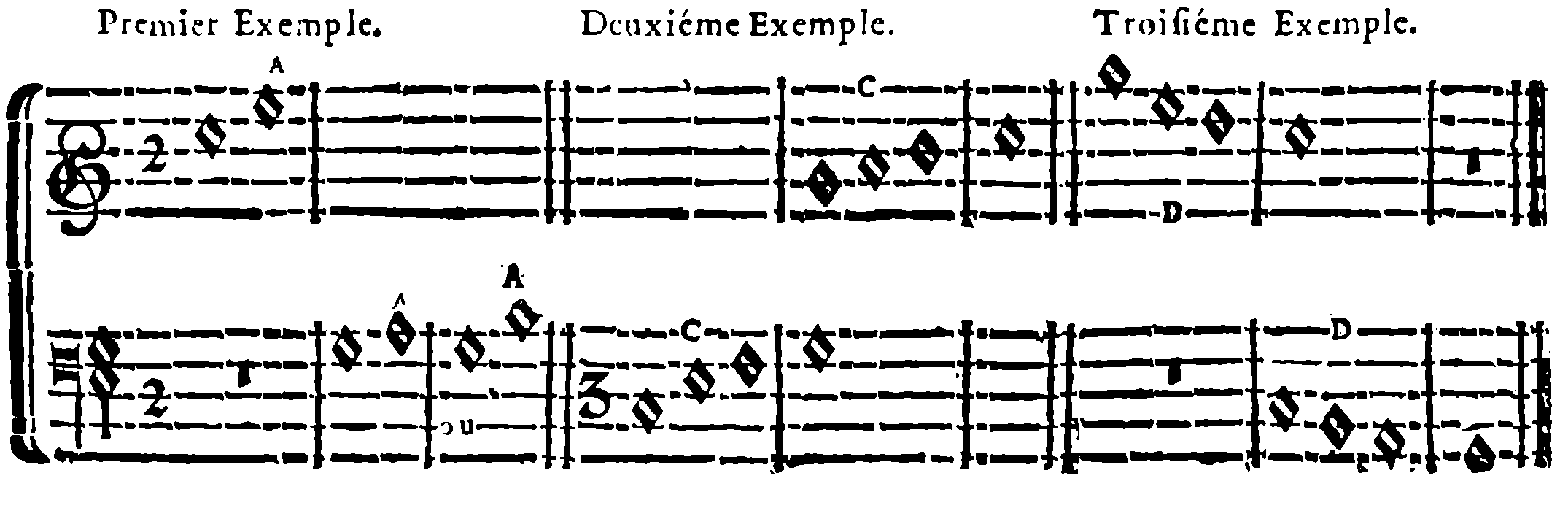
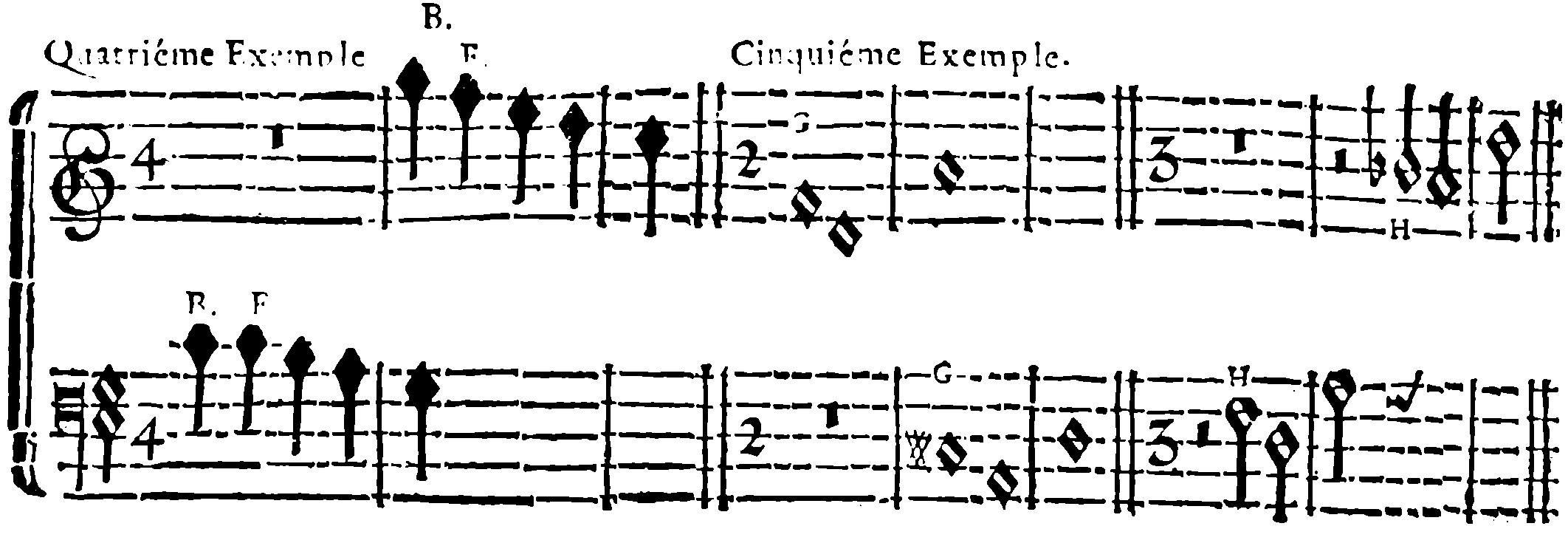
Fugue differs from imitation in that imitation may occur in a single part, ordinarily the one called the subject. Fugue, however, must be heard alternately in each part, where the part that began seems to follow the one that follows it, continuing in a chain…
- Chapter forty-three
…quartet or quintet with beautiful melody, every effort must be made. Perhaps fugue was invented chiefly for such pieces. They have little charm without it; moreover, the fugue’s return in one part after another pleasantly surprises the listener and draws…
▶ Fig. 324 nearby - Chapter forty-four
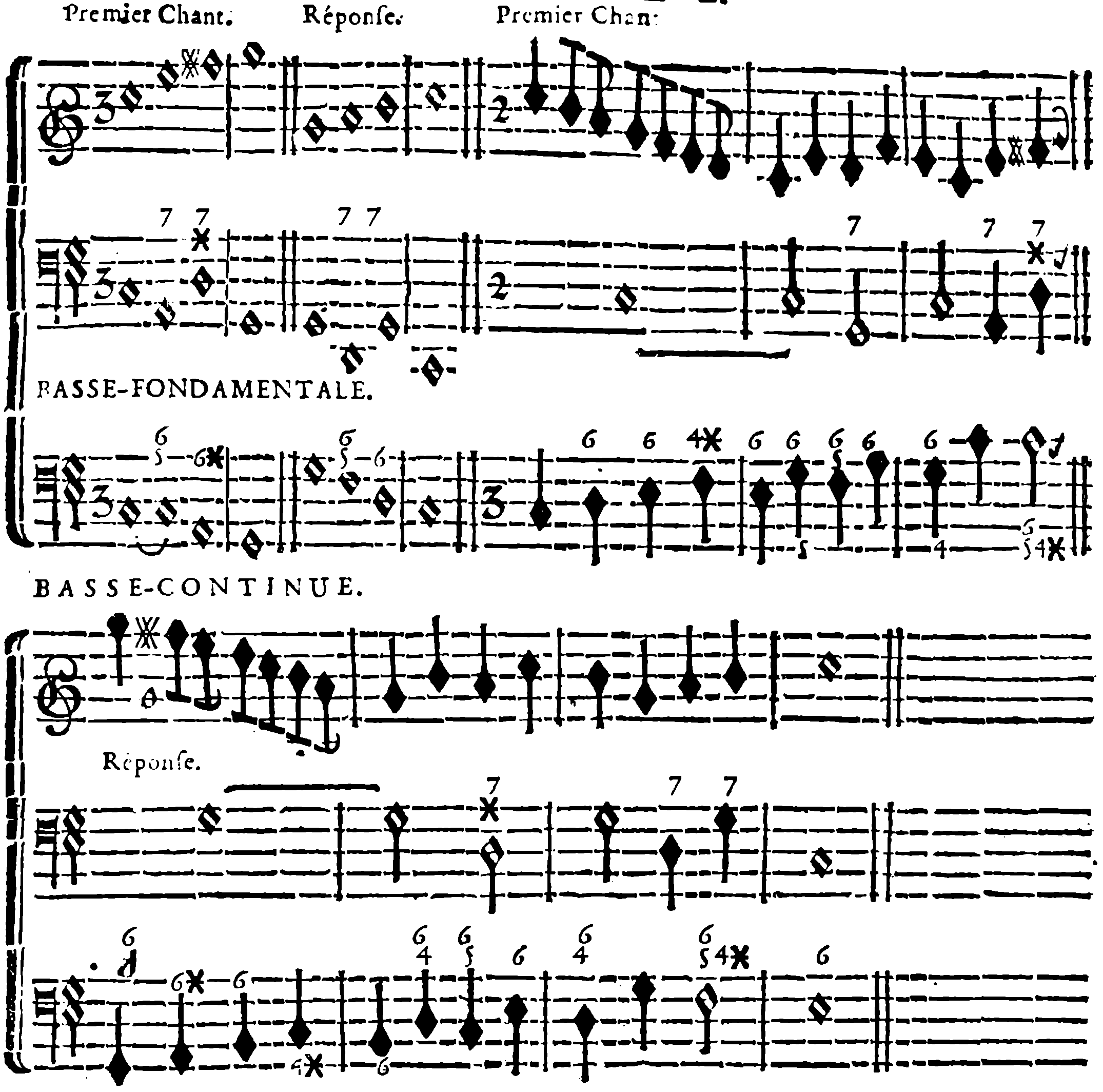
4. A fugue melody may admit several basses, and may itself suit the bass better than any other part. This makes no difference, since inversion offers several ways of composing a bass or using a melody as bass that would better suit an upper part. Alternating…
▶ Fig. 328 nearby - Chapter forty-four
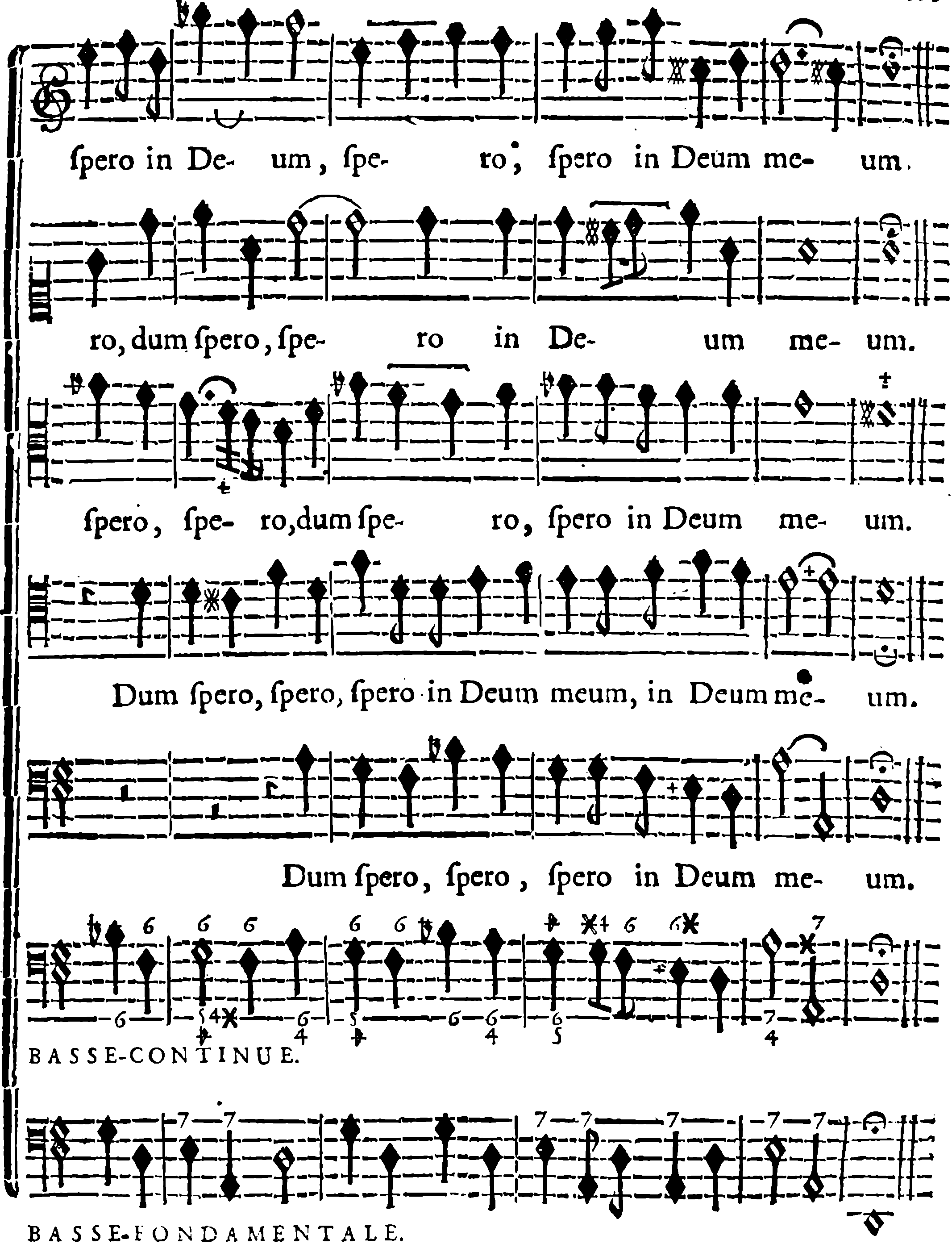
The fugue on “Raucæ factæ sunt,” whose answer to the dominant ends almost everywhere on the second note, would be more perfect if it ended on the tonic, as when the bass sings it. Yet this second note substituted for the tonic is tolerable, especially when…
▶ Fig. 346 nearby - Chapter forty-four
As many fugues may be found as there are different melodies; their number cannot be exhausted. Leave the choice to good taste while observing the rules already given for beginning, ending, and answer. When several fugues sound together, one must always guide…
▶ Fig. 346 nearby - Chapter forty-four
All entries of the first fugue may be heard before any others appear; then introduce the second, third, and so on, mingling earlier fugues with new ones. Or present each independently and combine them afterward. Simultaneous first entries of different fugues…
▶ Fig. 346 nearby
 ▶ Fig. 324
 ▶ Fig. 325
 ▶ Fig. 326
 ▶ Fig. 328
 ▶ Fig. 346
 PartimentiFedele Fenaroli, 1800
- Book V: Themes, preludes and fugues
- No. 6, Fugue · Gj 1381 · 1 playable example
- No. 7, Fugue · Gj 1383 · 1 playable example
- No. 8, Fugue · Gj 1385 · 1 playable example
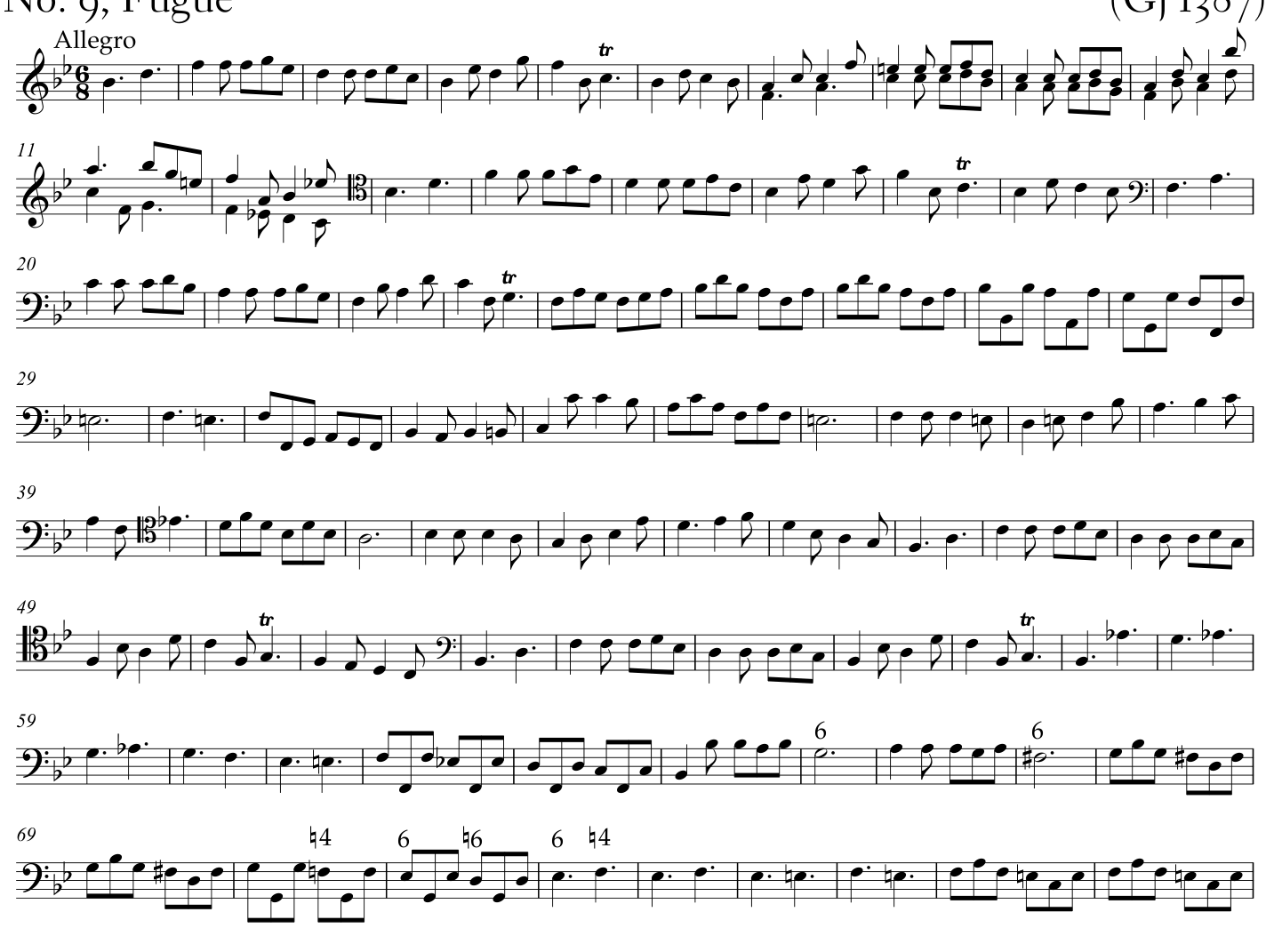
- No. 9, Fugue · Gj 1387 · 1 playable example
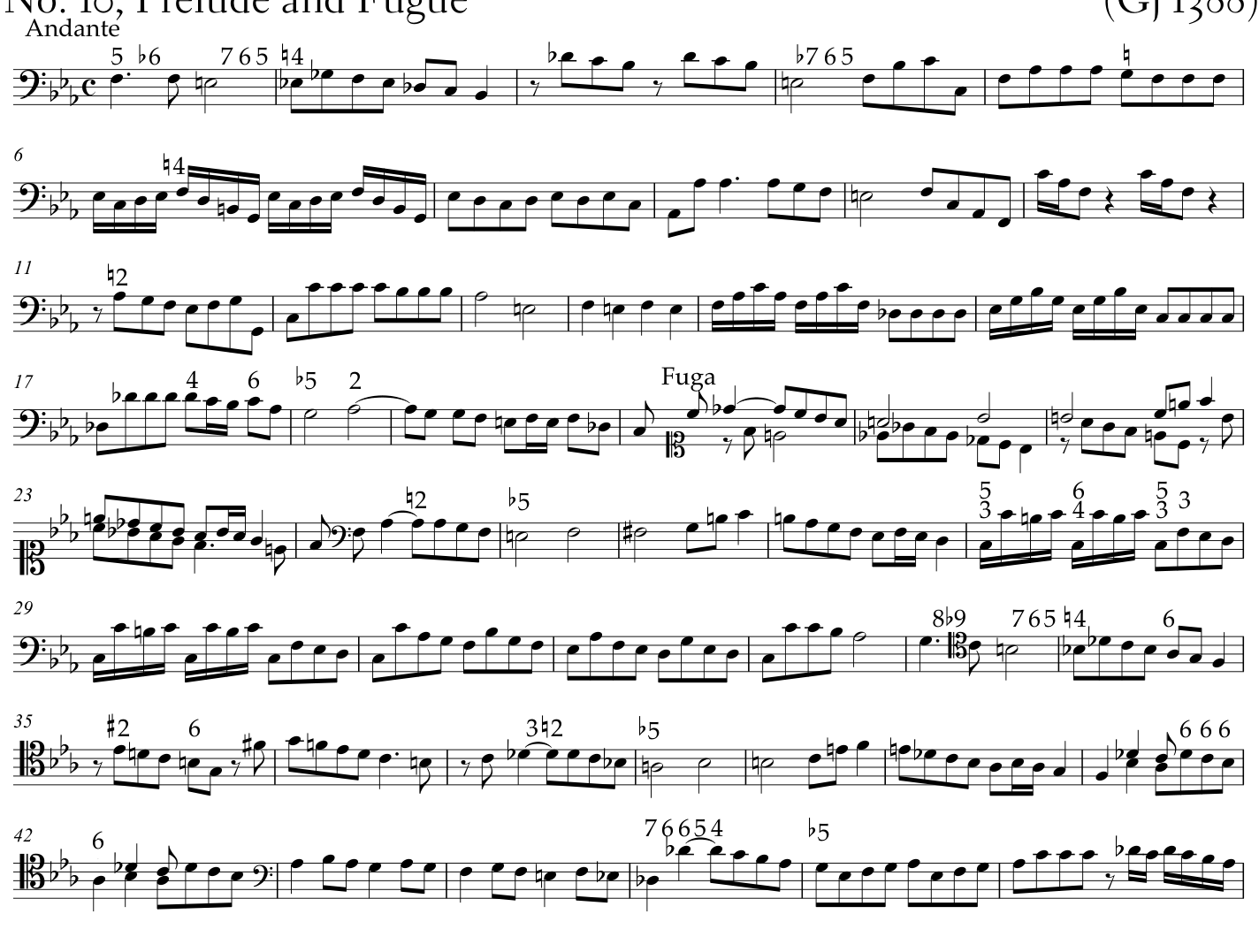
- No. 10, Prelude and Fugue · Gj 1388 · 1 playable example
- No. 11, Fugue · Gj 1390 · 1 playable example
- No. 12, Fugue · Gj 1392 · 1 playable example
- No. 13, Fugue · Gj 1394 · 1 playable example
- No. 14, Fugue · Gj 1396 · 1 playable example
- No. 15, Fugue · Gj 1398 · 1 playable example
- No. 16, Fugue · Gj 1400 · 1 playable example
- No. 17, Fugue · Gj 1402 · 1 playable example
- No. 18, Fugue · Gj 1404 · 1 playable example
- No. 19, Fugue · Gj 1406 · 1 playable example
- No. 20, Fugue · Gj 1408 · 1 playable example
- No. 21, Fugue · Gj 1410 · 1 playable example
- No. 22, Fugue · Gj 1412 · 1 playable example
- No. 23, Fugue · Gj 1414 · 1 playable example
- No. 24, Fugue · Gj 1416 · 1 playable example
- No. 25, Fugue · Gj 1418 · 1 playable example
- No. 26, Fugue · Gj 1420 · 1 playable example
- No. 27, Fugue · Gj 1422 · 1 playable example
- Book VI: Advanced partimenti, canons and fugues
- No. 1, Fugue · Gj 1423 · 1 playable example
- No. 3, Fugue · Gj 1425 · 1 playable example
- No. 5, Fugue · Gj 1427 · 1 playable example
- No. 8, Fugue · Gj 1430 · 1 playable example
- No. 10, Fugue · Gj 1433 · 1 playable example
- No. 11, Fugue · Gj 1435 · 1 playable example
- No. 12, Fugue · Gj 1437 · 1 playable example
- No. 13, Fugue · Gj 1439 · 1 playable example
- No. 16, Fugue · Gj 1442 · 1 playable example
- No. 18, Fugue · Gj 1444 · 1 playable example
- No. 21, Fugue · Gj 1448 · 1 playable example
- No. 22, Fugue · Gj 1450 · 1 playable example
- No. 23, Fugue · Gj 1452 · 1 playable example
- No. 24, Fugue · Gj 1454 · 1 playable example
- No. 25, Fugue · Gj 1456 · 1 playable example
- No. 26, Fugue · Gj 1458 · 1 playable example
- No. 27, Fugue · Gj 1460 · 1 playable example
- No. 28, Fugue · Gj 1462 · 1 playable example
- No. 29, Fugue · Gj 1464 · 1 playable example
- No. 30, Fugue · Gj 1466 · 1 playable example
- No. 31, Fugue · Gj 1468 · 1 playable example
- Book III: Rules and realizations
…assignments was to write a string quartet inspired by a Fenaroli partimento fugue. Thus for generations of students, mastery of Fenaroli and mastery of the classical tradition were one and the same achievement.
- Book V: Themes, preludes and fugues
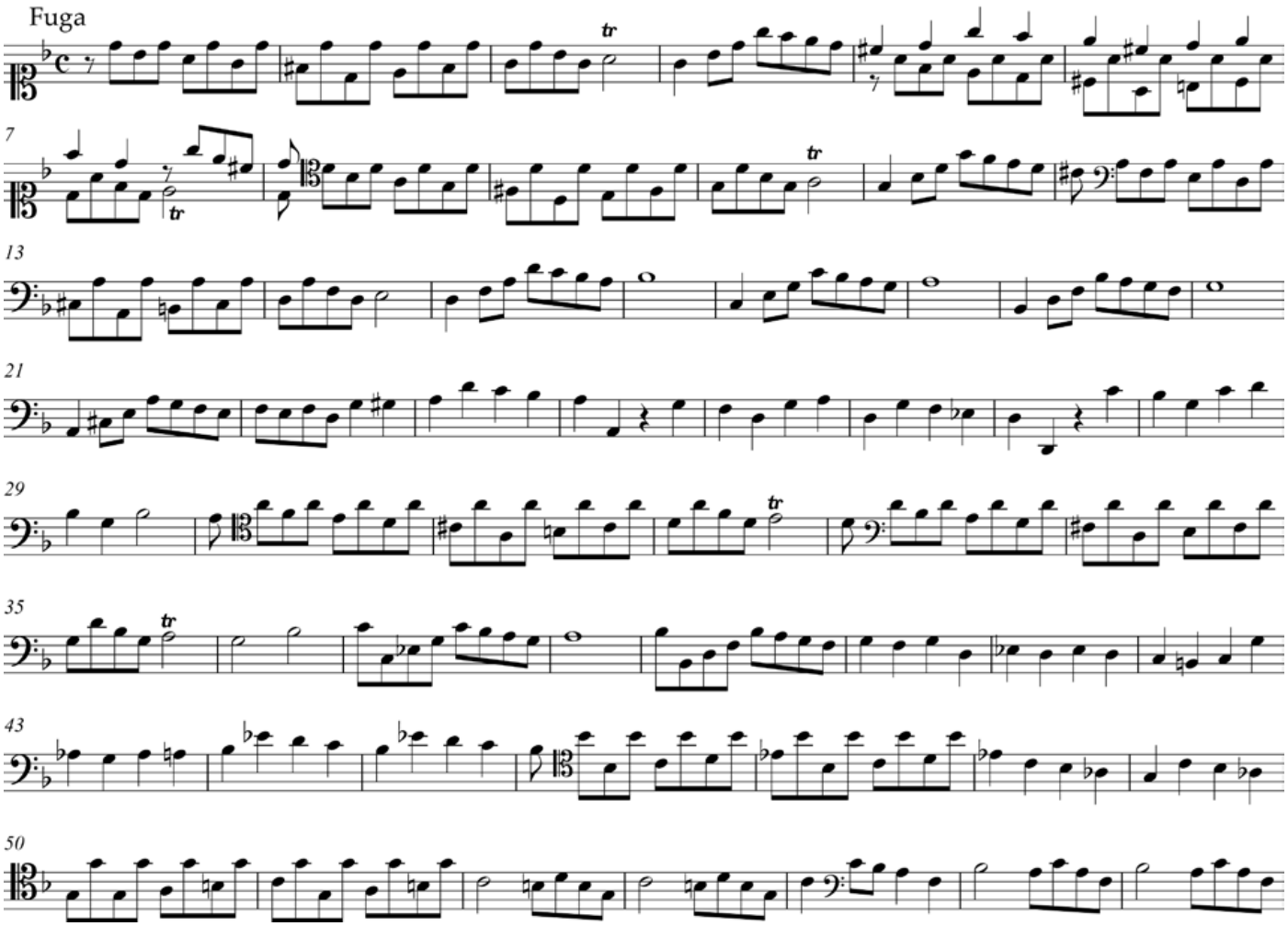
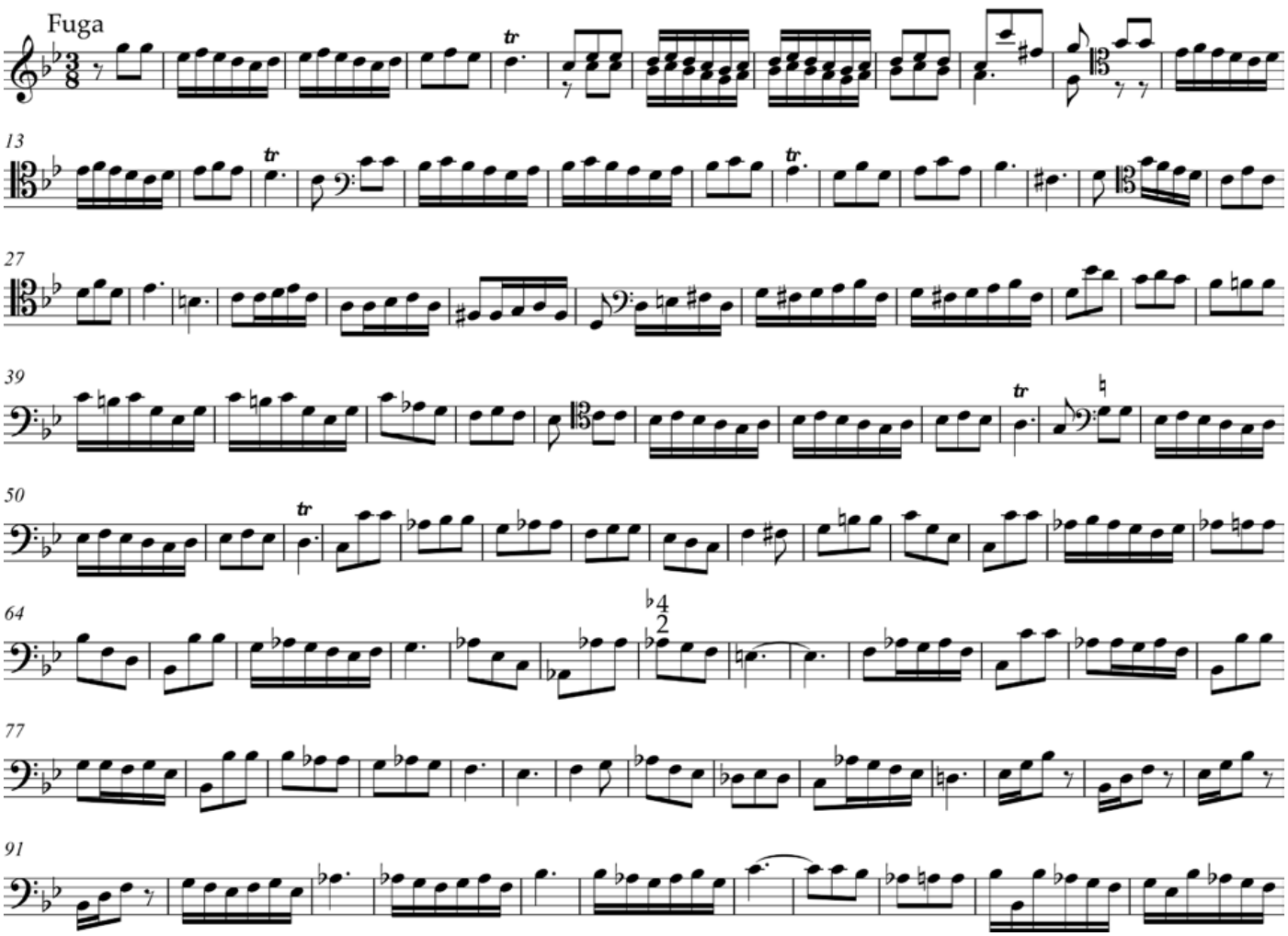
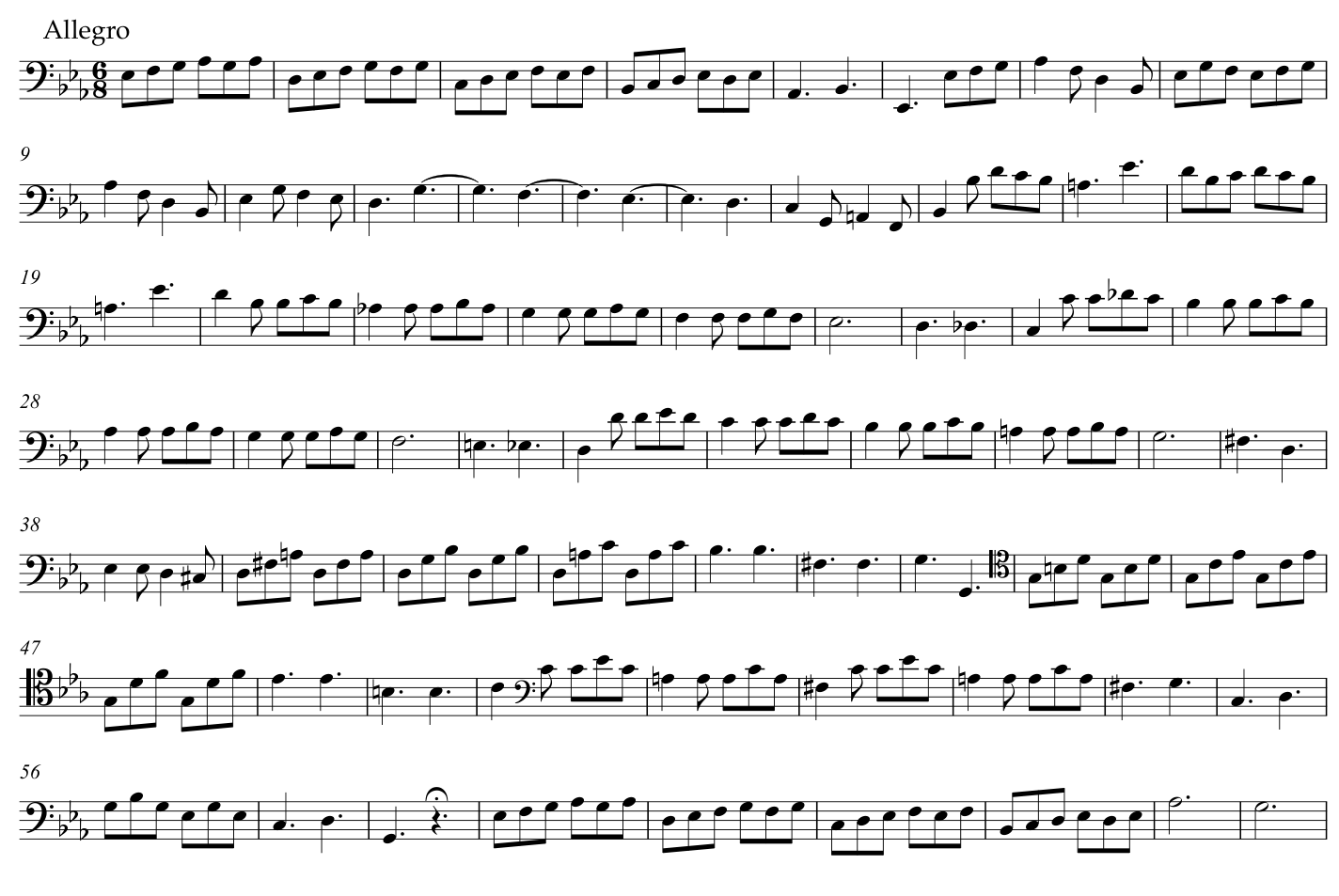
…realizations. The remaing partimenti come in two sets of preludes and fugues. Both sets are of moderate to high difficulty, with the second set being written in more difficult keys. Partimento fugues are tests of memory. The subject and countersubject of the…
- No. 31, Fugue · Gj 1468
The following eight partimenti (nos. 32–39) have, to a greater or lesser degree, characteristics of fugues. They were not, however, labelled as fugues in early editions of Fenaroli’s Book VI. So here they are called simply “partimenti.”
▶ Fig. 253 nearby
 ▶ Fig. 166
 ▶ Fig. 168
 ▶ Fig. 170
 ▶ Fig. 172
 ▶ Fig. 173
 ▶ Fig. 253
 Theory of HarmonyArnold Schoenberg, 1922
- Endings and cadences
…Otherwise it would scarcely be possible to write two or more different fugues on the same subject, as Bach and others repeatedly did. If such laws exist, we have not yet recognized them. But I believe something else: each age has a particular sense of form…
▶ Fig. 113 nearby - At the Boundaries of the Key
…was called upon. And when a piece is called a “Chromatic Fantasia and Fugue,” one can be certain that this chord plays a leading part in producing its chromaticism. Yet another significance was recognized in it: it was the “expressive” chord of that period.…
▶ Fig. 286 nearby - Augmented Sixth and Vagrant Chords
…the harmony a particular coloring, as in Bach’s “Chromatic” Fantasia and Fugue. Since nothing is bad in itself, one cannot assert that an isolated occurrence must necessarily be bad. Yet it is clear that large numbers of chords distant from the key favor…
▶ Fig. 305 nearby - “Nonharmonic” Notes
…suspected of having inherited, as a family secret, a formula for inventing fugue subjects. Only a person with imagination could behave so contrary to the proprieties of his profession. And yet it is incomprehensible that a person of unquestionable knowledge…
▶ Fig. 436 nearby
 ▶ Example80a
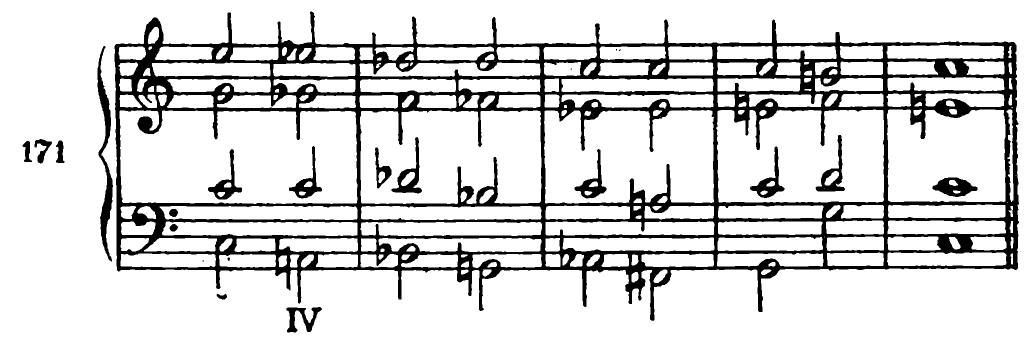 ▶ Example 171
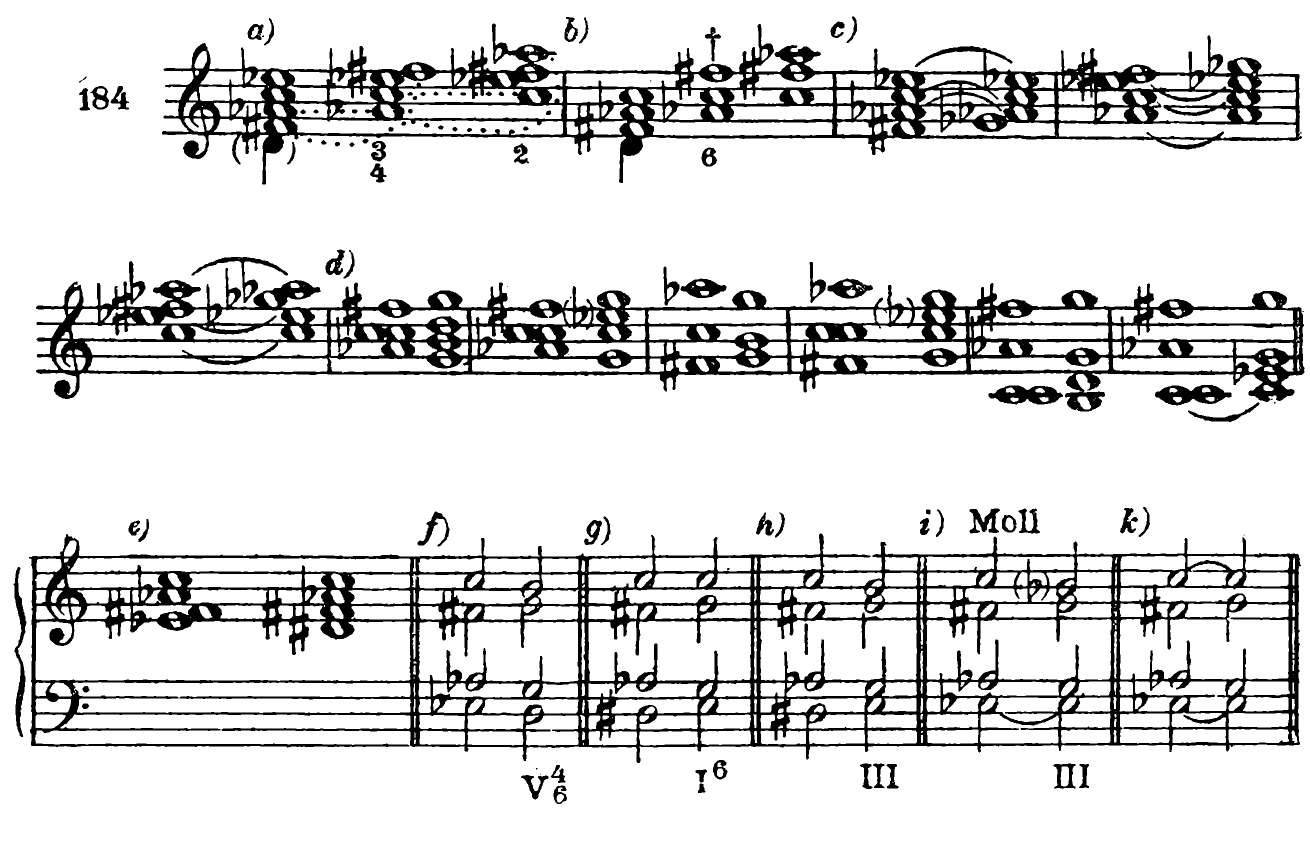 ▶ Example 184a
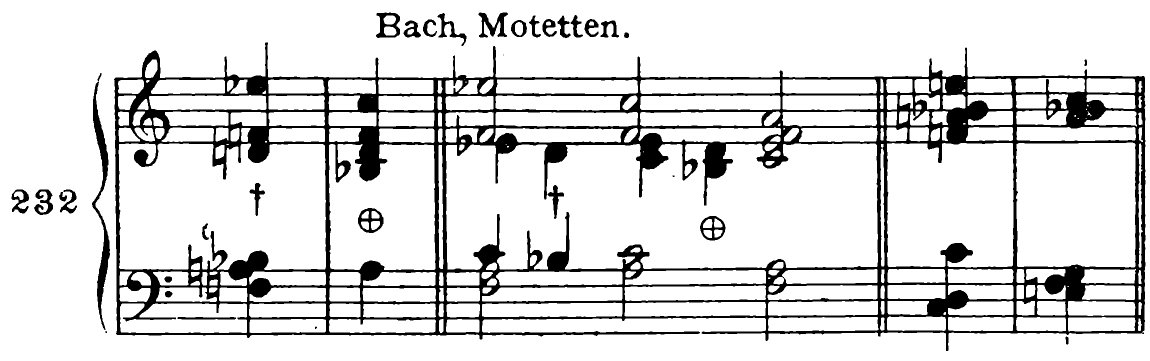 ▶ Example 232 — Bach, Motets
 Principles of OrchestrationNikolai Rimsky-Korsakov, 1922
- Voices (divisi); harmonic use of the mixed chorus
In fugato writing and fugal imitation for mixed chorus the distribution is generally in four parts, but this number may be increased for cumulative effects as in the example quoted. In such cases the composer should be careful as to the arrangement of the…
- B. Men’s chorus and women’s chorus
In fugato writing, and fugal imitation in three parts, allotted to a chorus composed of voices of one kind, the principal subject is given to two parts, the counter subject to one; by this method the doubled themes will stand out to better advantage.
 OrchestrationCecil Forsyth, 1914
- Stringed instruments
…it has made its way Westward. Even in a London restaurant a Bach fugue on the Cimbalum has been heard as an accompaniment to the clatter of knives, forks, and dishes.
- Stringed instruments
…from the Solo Violin Sonatas alone. Here is one taken at random from the Fugue of the 3rd Sonata.
- Stringed instruments
…of the music. The following example of the pp sforzando is from the fugato in Weber's Euryanthe Overture. The whole passage is played at a dead pianssimo, the four minims only just bitten into prominence.
- No. 47. The Viola (or Tenor)
…The instrumental family which joined its voices in the elaboration of fugues and fugatos was a happy family, the members of which differed among themselves only in the matter of pitch, not of importance. With the downfall of the old polyphony, however, all was…
- No. 51. The Double-Bass.'
…and interesting from the technical point of view is the extraordinary Fugue in Strauss's Also sprach Zarathustra (" Von der Wissenschaft" section).
 Treatise on InstrumentationHector Berlioz, 1905
- Foreword by Richard Strauss
…mainly in Haydn’s and Mozart’s string quartets (as well as in Bach’s organ fugues). The symphonic works of these two masters reveal in their style, in their themes, melodies and figurations the character of the string quartet with all its polyphonic…
- The Double-Bass
…(third act). (Examples 42, 43, 44.) Also to be mentioned here is the fugue from my tone-poem “Thus spake Zarathustra”.
- The Organ
…da gamba stop, whle certain flute stops admit a beautiful, close arpeggio. A fugue by Bach has to played more slowly in an empty Gothic church, where each tone reverberates for a long time, than in a completely filled concert hall.
- The Organ
…upon careful shading on the organ. Bach's great organ works—the Preludes, Fugues, Toccatas, etc.—should be “orchestrated” like a symphony, utilizing all the resources of the instrument: combination of colors, dynamics, the simultaneous use of different manuals…
- The Organ
…these crities have never thought of prohibiting the use of quick fugues, which for ages have formed the basis of organ music in all schools? Is it that the themes of these fugnes—some of which are quite trivial, others even almost grotesque—become religious…
- The Organ
…all this to be true. At any rate, these critics do not consider quick organ fugues inappropriate even though they do not claim them to be imbued with religious spirit. Their opinion is based on the fact that these fugues have been in long-established use, that…
More in Imitation and fugue
Imitation · Canon · Invertible (double) counterpoint · Subject, answer and countersubject · Episode · Stretto