 Playable Books
Concept index · Counterpoint
Consonance and dissonance
Taught in 10 books. Each one opens at the passage; ▶ plays the example beside it. Also called consonance, dissonance.
This index is Playable Books’ own: a first pass that finds the term’s words in each book, corrected by hand. The authors did not tag these passages, and their terms can differ (Fux’s “ligature” is a suspension). The quoted text is the book’s.
 Gradus ad ParnassumJohann Joseph Fux, 1725
- First species counterpoint: note against note
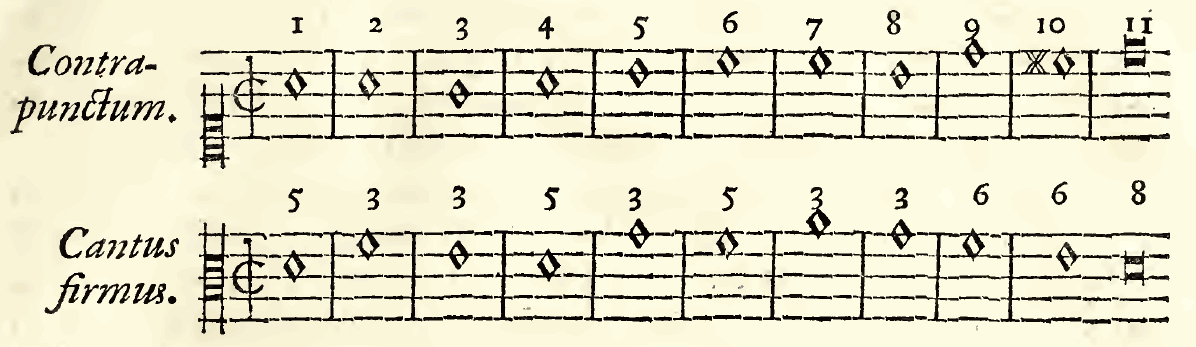
…outset, overwhelmed by so many different matters. Know, then, that imperfect consonances are more harmonious than perfect ones, for a reason to be given elsewhere. Consequently, if a composition in this species, for only two parts and already extremely simple,…
▶ Fig. 2 nearby - First species counterpoint: note against note
Joseph. With the numbers placed above the alto I wished to identify the consonances I used, so that, keeping before my eyes the motions from one consonance to another, I would stray less from the correct manner of proceeding. Those placed above the soprano—for…
▶ Fig. 2 nearby - Second species counterpoint: two notes against one
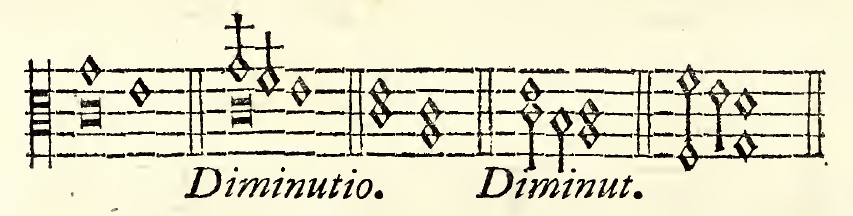
…against one semibreve. One of them, falling on the thesis, must always be consonant; the other, on the arsis, may also be dissonant if it moves by step from the preceding note to the following one. But if it proceeds by leap, it must necessarily be consonant.…
▶ Fig. 22 nearby - Third species counterpoint: four notes against one
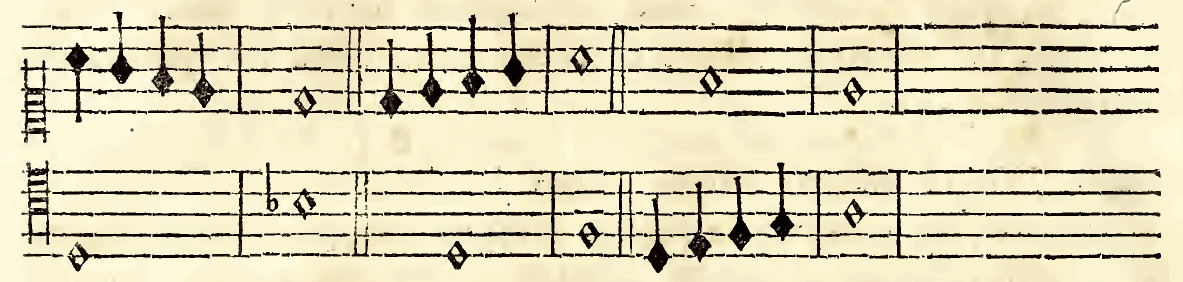
…continuously by step, either ascending or descending, the first must be consonant, and the second may be dissonant. The third must again be consonant. The fourth may be dissonant if the fifth is consonant, as in the examples:
▶ Fig. 45 nearby - First species in three voices
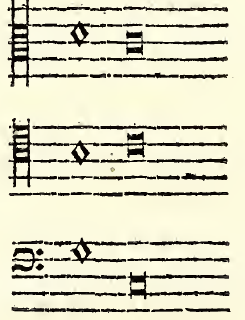
…faulty. Not only does it move, so to speak, from an imperfect to a perfect consonance; worse still, that fifth is not consonant at all, but diminished. The rules must be considered not only in relation to the bass, but also between the other parts themselves…
▶ Fig. 101 nearby - Fourth species in three voices: ligatures
…distinction, let us recall what we said elsewhere about the perfection of consonances: namely, that the fifth is a perfect consonance, the octave more perfect, and the unison the most perfect; and that the more perfect they are, the less harmony they possess.…
▶ Fig. 144 nearby
 ▶ Fig. 2
 ▶ Fig. 22
 ▶ Fig. 45
 ▶ Fig. 101
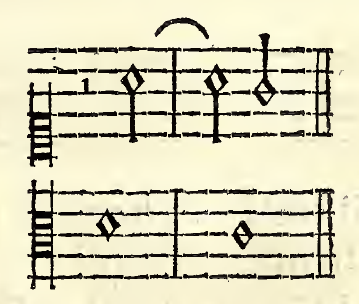 ▶ Fig. 144
 Exercises in Elementary CounterpointPercy Goetschius, 1910
- Chapter II. Wider Leaps
…and Dominant-gth. The chords on steps VI and III, and all subordinate dissonant chords, are too inferior to afford justification for wide leaps. Thus, in C major:
▶ Fig. 14 nearby - Chapter IV. The Association Of Two Melodic Lines
…association of melodies is that of harmonious agreement. The condition of consonance should prevail; not to the exclusion of dissonance (as will be seen in a later lesson), for the latter, in its proper place and proportion, is precisely as necessary and…
▶ Fig. 39 nearby - Chapter IV. The Association Of Two Melodic Lines
36. Rule 1. The " harmonious " intervals, those that are invariably consonant and therefore acceptable for the union of two melodies, are the Third (or tenth), major and minor;
▶ Fig. 39 nearby - Chapter IV. The Association Of Two Melodic Lines
…evidently to be achieved by a sensible interchange of these three different consonant intervals. Thus, as applied to the above given melody:
▶ Fig. 44 nearby - Chapter IV. The Association Of Two Melodic Lines
…errors in the added melody, despite the fact that each separate interval is consonant, and that the two melodies, sung or played together, form a harmonious union:
▶ Fig. 44 nearby - Chapter VI. Exceptional Intervals
…union of parts, there are a few other intervals, mostly of a mildly dissonant character, which, when used in moderation, greatly improve the effect, without in the least impairing the general harmonious or consonant character of the sentence as a whole.
▶ Fig. 77 nearby
 ▶ Ex.12
 ▶ Ex.31
 ▶ Ex.36
 ▶ Ex.44
 Counterpoint AppliedPercy Goetschius, 1902
- Chapter II
…a harmonious result; not necessarily wholly, but preponderantly so. The consonant intervals must, therefore, dominate all Essential tones, while the equally desirable and necessary dissonant intermixtures must be limited to the Unessential tones.
- Chapter II
15. The consonant, or at least harmonious, intervals which are to govern the association of Essential tones, are of three grades: Primary consonances, secondary consonances, and mild dissonances.
▶ Fig. 63 nearby - Chapter VI
*1) Some of the ties in this sentence result in positive dissonance, by producing Suspensions; at other places, on the contrary, the tie simply modifies the rhythm of its part, without influencing the consonant effect. See also Ex. 57, No. 6 (ties in lower…
▶ Fig. 248 nearby - Chapter VI
…of chord-fifths in the lowermost part (i.e., 6-4 chords) when both represent Consonant forms of harmony; if either of them is an imperfect 5th, or the inverted form of any Dissonant harmony, the succession is good. This grave error is most easily checked by…
▶ Fig. 252 nearby - Chapter VI
6. The problem of good Polyphony for more than two parts is, to preserve an equipoise between the Consonance of the chord-forms and the Dissonance involved by independent part-conduct.
- Chapter VIII
…character; and the difficulty of preserving proper balance between the dissonances of friction, inevitable in the "independent conduct" of the parts, and the consonances indispensable to their " harmonious union," becomes more and more real and severe. Review…
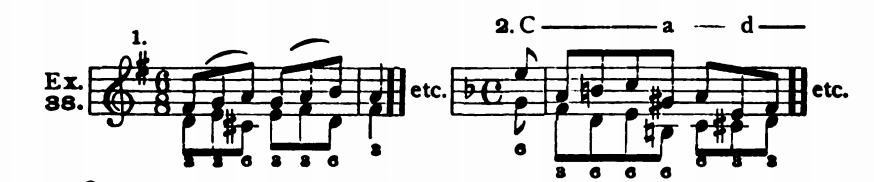 ▶ Ex38-1-2
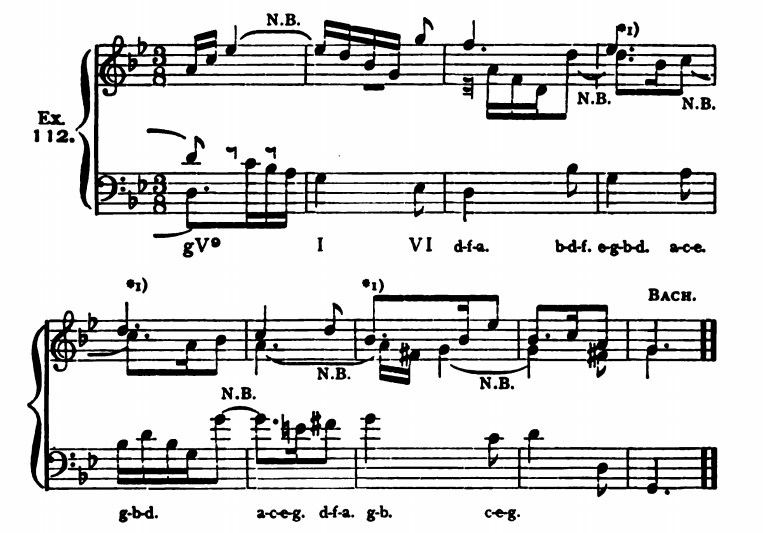 ▶ Ex112
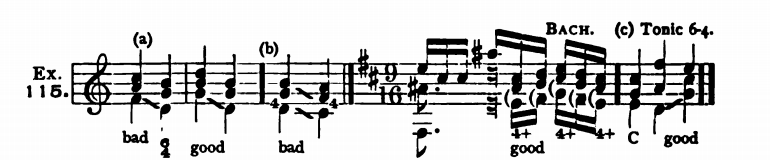 ▶ Ex115
 Treatise on HarmonyJean-Philippe Rameau, 1722
- CHAPTER XV. How to prepare and resolve all dissonances, and thereby recognize the current key and the chords belonging to each of its notes · 3 playable examples
- Chapter thirteen
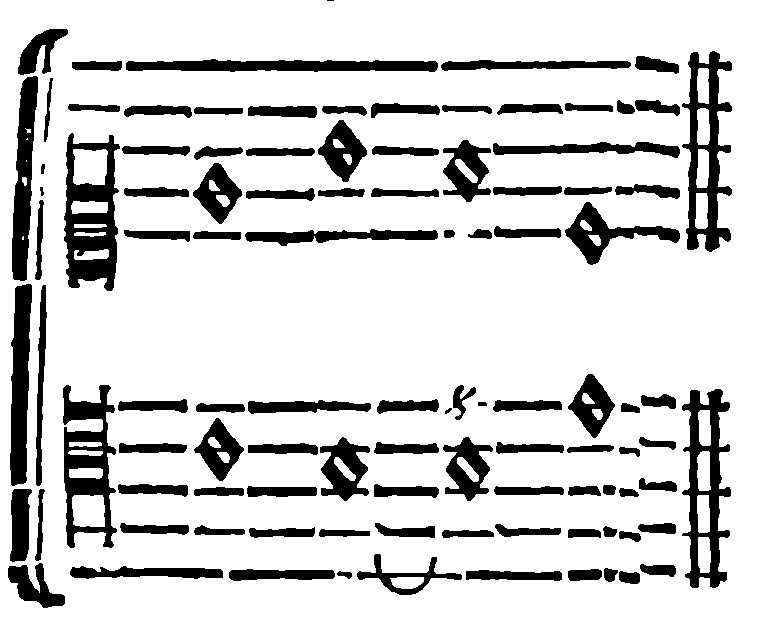
We have already observed that dissonances fall into two kinds according to the quality of the thirds generating them, and follow those thirds' properties: major dissonances ascend, minor ones descend. But in the natural succession of chords we also observe…
▶ Fig. 57 nearby - Chapter sixteen
…conclude that the principle, perfect in itself and equally the source of consonances and dissonances, cannot be considered dissonant. Dissonance must therefore reside only in the sound compared with it. This is especially clear because the rule of preparing…
▶ Fig. 77 nearby - Chapter sixteen
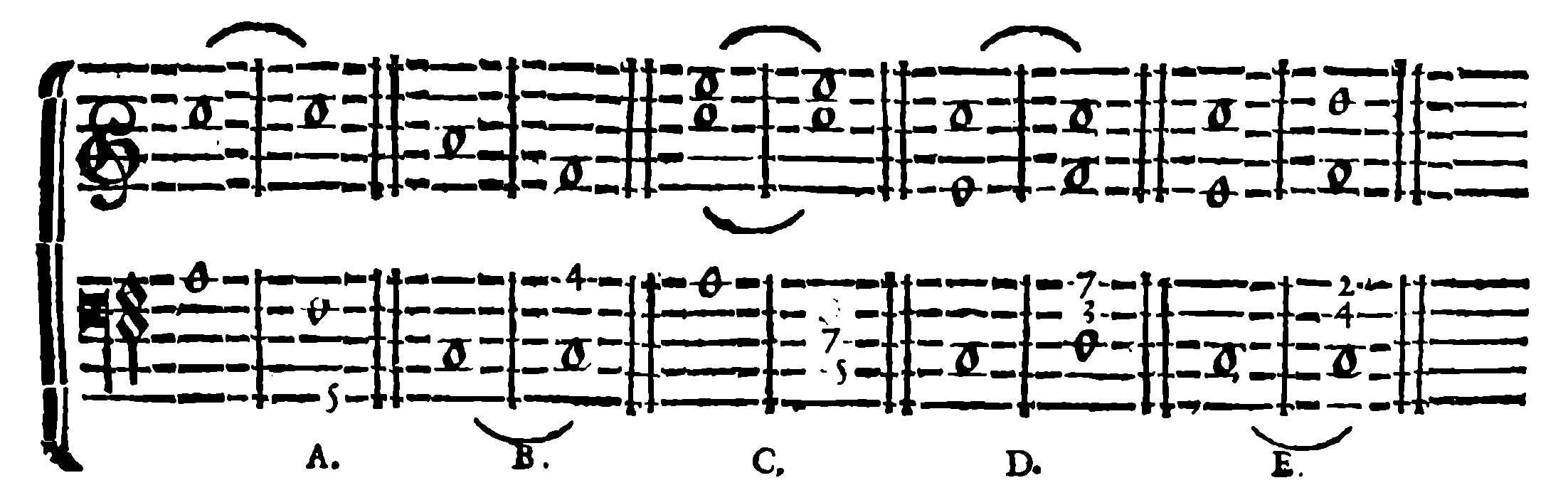
…Without explanation, the rule leaves us in error: we do not know whether consonance or dissonance must syncopate, and consequently do not know the syncopated note's subsequent course. The confusion is resolved by these simple principles, reduced to two certain…
▶ Fig. 82 nearby - Chapter seventeen
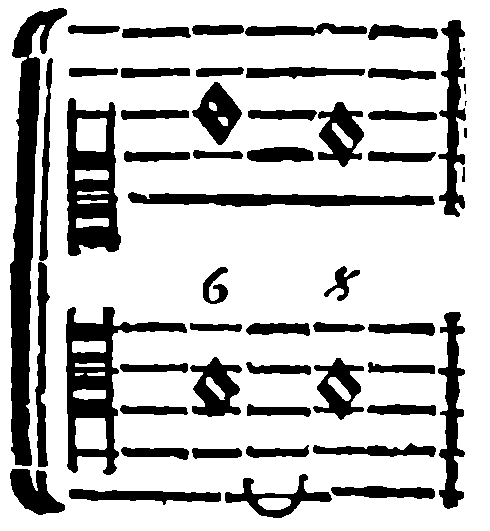
…fundamental-bass progression already explained. We suppose this progression consonant here. Though unrestricted with consonant chords, it is restricted with dissonant chords, even though a new interval—the dissonance—extends its resources. Dissonance arises…
▶ Fig. 83 nearby - Chapter twenty-seven
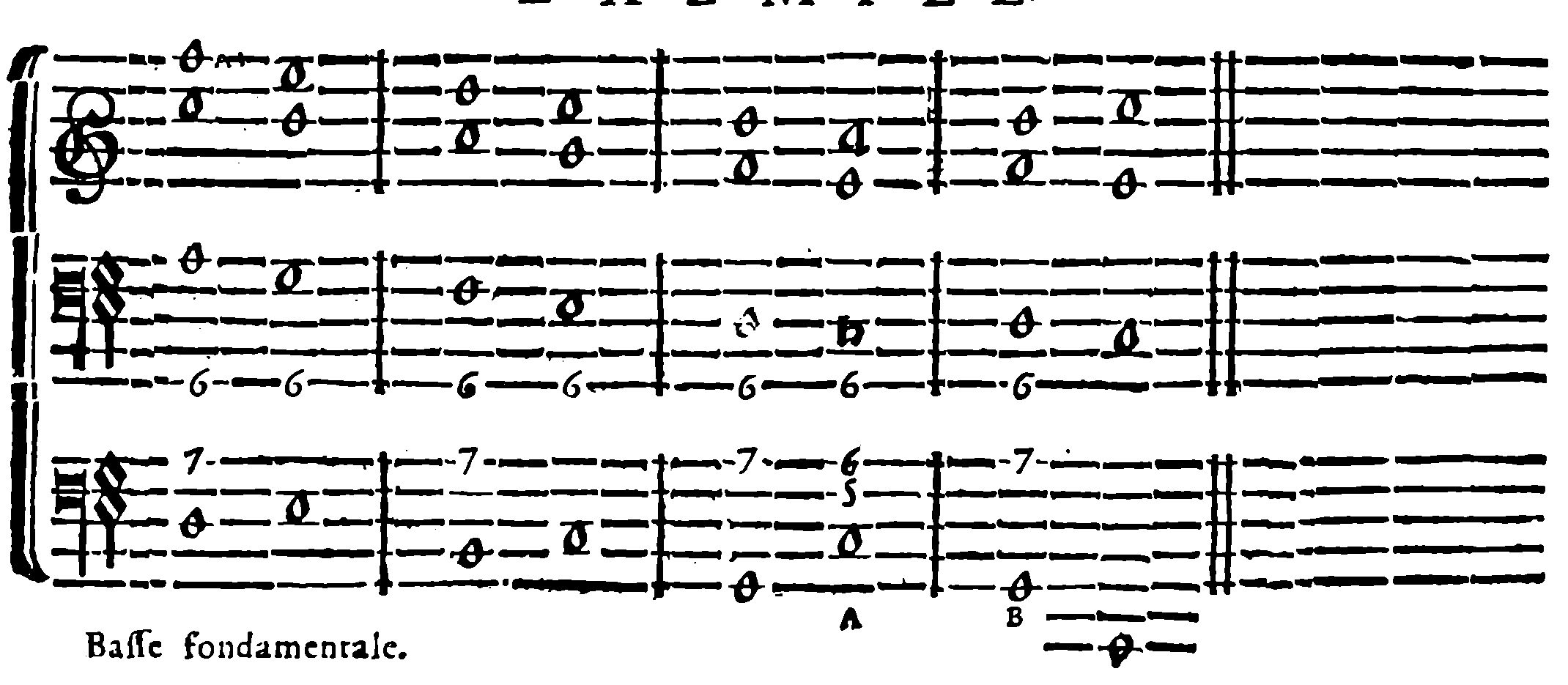
The difference between examples A and B is that the major dissonance occurs in the first, while only the minor dissonance occurs in the other. In the small-sixth chord at A, natural to the second note, there is a dissonance between the third and fourth that…
▶ Fig. 264 nearby - SUPPLEMENT: changes to two chapters and necessary corrections
In the example, dissonance B rests while consonance A strikes it. Immediately afterward the consonance stops and forces the dissonance toward C, where the consonance itself might have moved. The consonance can no longer go there once the dissonance takes its…
▶ Fig. 458 nearby
 ▶ Fig. 57
 ▶ Fig. 77
 ▶ Fig. 82
 ▶ Fig. 83
 ▶ Fig. 264
 ▶ Fig. 458
 Practical Manual of HarmonyNikolai Rimsky-Korsakov, 1910
- Preface to the First Edition
In general, while these treatises present the various dissonant chords as means of modulation, they omit the true principle of modulation: the relationship of keys and the chords they share.
- Preface to the First Edition
…his modulations are harsh and abrupt, and his progressions — even those of consonant chords — are flat and incoherent.
- Preface to the First Edition
3) To harmonize a chorale freely, with dissonant chords and chords from several keys (example, p. 81).
- Introduction
A chord containing a dissonant interval (a dissonant chord) requires a move to a consonance or to a consonant chord; this move is called its resolution.
▶ Fig. 9 nearby - Triads
These last two chords, which contain the dissonant intervals of the diminished and augmented fifth, are called dissonant.
▶ Fig. 11 nearby - General Principles
2) The suspension must form a dissonant chord or an incidental combination. In his exercises the student will do well to refrain from consonant suspensions.
▶ Fig. 285 nearby
12 more passages in Practical Manual of Harmony →
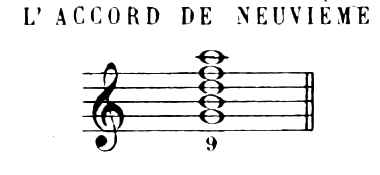 ▶ The ninth chord
Introduction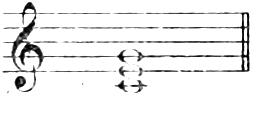 ▶ Triad in root position
Triads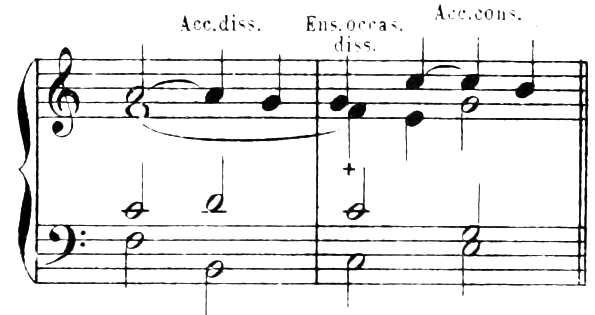 ▶ Example: a suspension forming a dissonant chord (soprano A held over B–D–F); one forming a dissonant incidental combination (alto F held over C, marked +); and a consonant suspension (soprano C held over E–G), which is to be avoided.
General Principles
 Guide to the Practical Study of HarmonyPyotr Ilyich Tchaikovsky, 1900
- Chapter XIV. The connection of dissonant Harmonies resolving into the tonic Triad · 13 playable examples
- Introduction · Intervals
…to the manner in which they affect the ear, intervals are separated into Consonances and Dissonances. The former are complete in themselves, as they express a certain repose; the latter, however, convey the element of motion and demand a goal or solution in…
▶ Fig. 8 nearby - Introduction · Intervals
…Primes, Octaves and Fifths as well as major and minor Thirds and Sixths are consonances, the first three being termed perfect consonances, and the major and minor Thirds and Sixths imperfect consonances. Seconds, Sevenths and all augmented and diminished…
▶ Fig. 8 nearby - Introduction · Intervals
…which, as its name indicates, consists of three tones. Being composed of two consonant intervals (Third and Fifth) its effect on the musical ear is satisfying, in contrast to that of chords consisting of four or five tones, which contain ‘dissonant intervals…
▶ Fig. 9 nearby - Chapter IX. The Inversions of the Diminished and Augmented Triads
_All chords consisting of four or five tones are dissonant chords, as their fundamental tone forms a seventh or a ninth with the uppermost tone. These chords are not independent harmonies. but find their support and justification in the chord that follows…
▶ Fig. 77 nearby - Chapter XVI. Chords of sequence in minor
…real purpose of resolution. For, it is only by a melodic progression of the dissonance downward into a consonance, that our musical susceptibilities, disturbed by that dissonance, are quitted.
▶ Fig. 140 nearby - Chapter XXIX. Strict Part-writing
We have said in a former chapter that strongly dissonant tone-combinations—as, for instance, the sequence chords and the augmented and diminished chords—are frequently of great value to the composer, in cases, where, by their very harshness, he is enabled to…
▶ Fig. 323 nearby
50 more passages in Guide to the Practical Study of Harmony →
 ▶ Fig. 8
Introduction · Intervals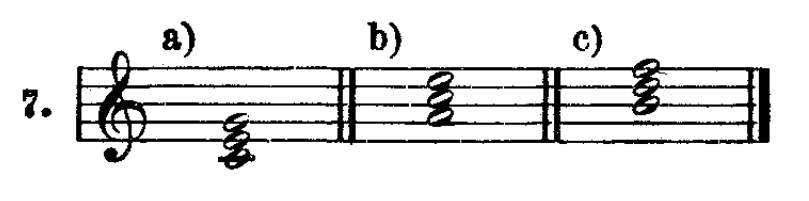 ▶ Fig. 9
Introduction · Intervals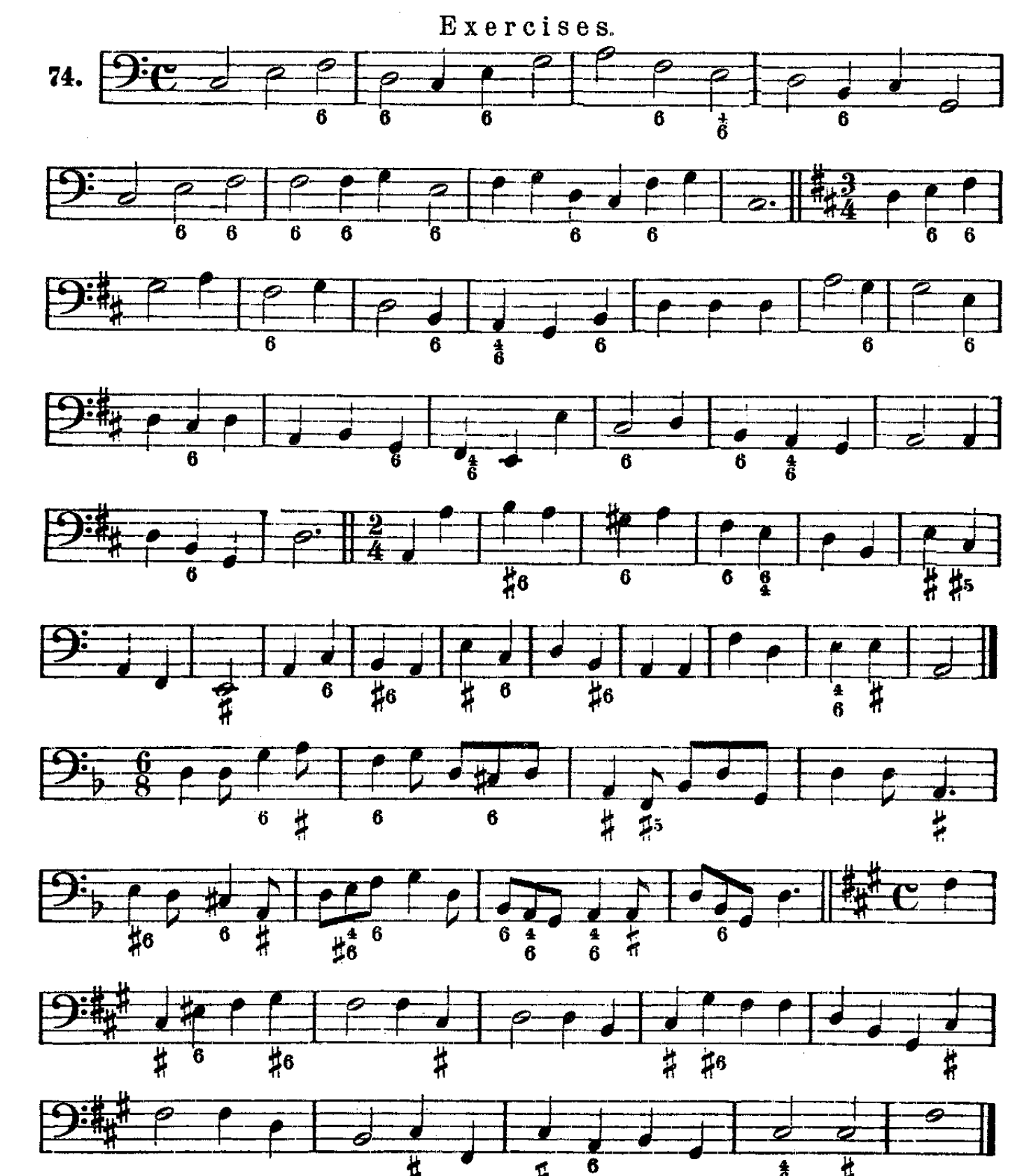 ▶ Fig. 77
Chapter IX. The Inversions of the Diminished and Augmented Triads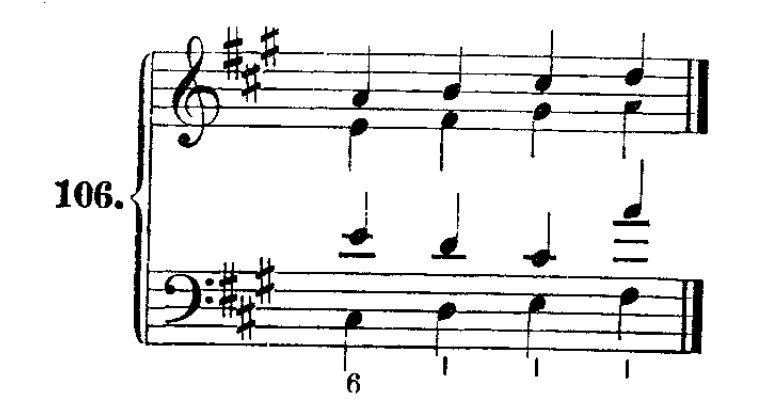 ▶ Fig. 110
Chapter XIV. The connection of dissonant Harmonies resolving into the tonic Triad ▶ Fig. 140
Chapter XVI. Chords of sequence in minor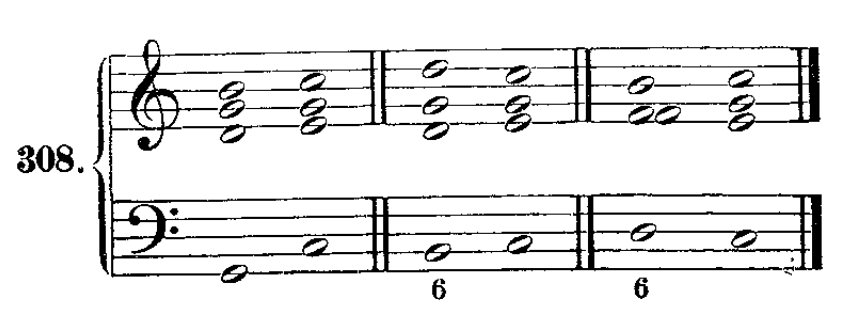 ▶ Fig. 323
Chapter XXIX. Strict Part-writing
 PartimentiFedele Fenaroli, 1800
- The Rules of Music
Music is composed of consonances and dissonances.
▶ Fig. 33 nearby - The Rules of Music
The said consonances group into two perfect ones and two imperfect ones. The perfect ones are the 8ve and 5th, which are said to be “perfect” because they are unchanging; The imperfect ones are the 3rd and 6th, which are called “imperfect” because they change…
▶ Fig. 34 nearby - Concerning Scales
There are four [types of] dissonances, namely [the intervals of the] 2nd, 4th, 7th, and 9th. These were invented in order to render the consonances more beautiful. But note that the aforementioned dissonances cannot be used unless they are prepared by…
▶ Fig. 58 nearby - or the Suspension of the Fourth
Observe that the dissonance of a 4th should always be accompanied by the consonance of the 5th. That is because the aforementioned dissonance can never have a place above a note that, by its nature, does not take the 5th.
▶ Fig. 61 nearby - or the Suspension of the Seventh
Observe that the aforementioned dissonance of a 9th is always accompanied by the 10th (the said 3rd) and by the 5th, when a movement of the bass by the same progression is not involved. This dissonance of a 9th can be resolved to an 8ve, 3rd, and 6th,…
▶ Fig. 67 nearby - Book IV: Unfigured basses
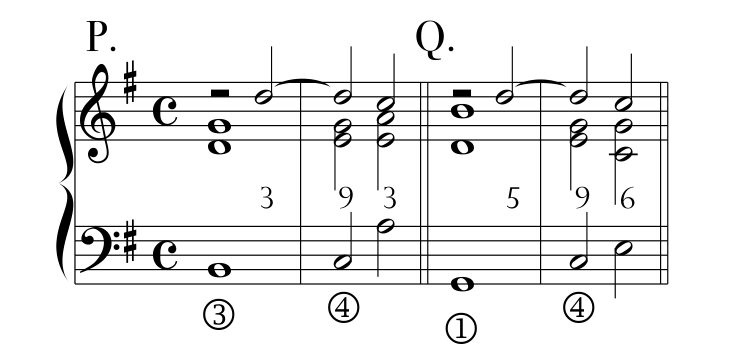
…In a beginning level of realization, the right hand will play mostly consonant chords. At an intermediate level, the right hand will add carefully prepared dissonances and small melodic figures. At an advanced level, the realization will feature extended…
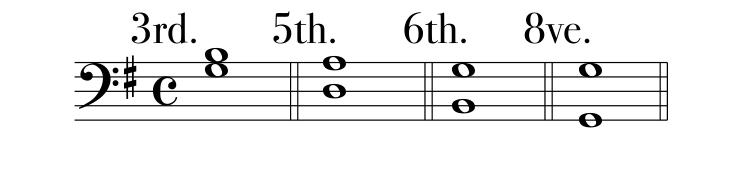 ▶ Fig. 33
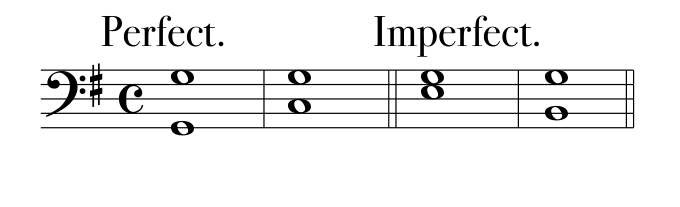 ▶ Fig. 34
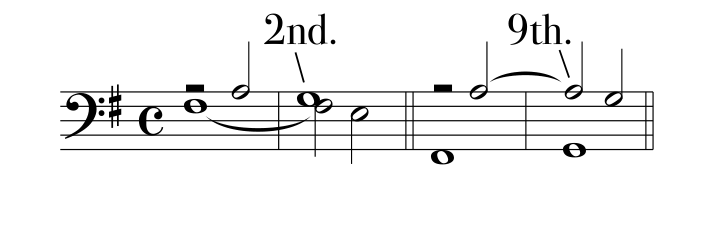 ▶ Fig. 58
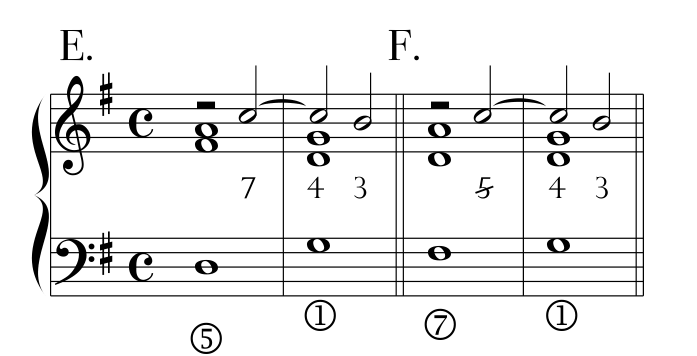 ▶ Fig. 61
 ▶ Fig. 67
 Theory of HarmonyArnold Schoenberg, 1922
- Consonance and Dissonance
If I nevertheless continue using the terms consonance and dissonance, although they are unjustified, it is because there are signs that the development of harmony will demonstrate the inadequacy of this classification within a short time. Introducing another…
- Degree VII
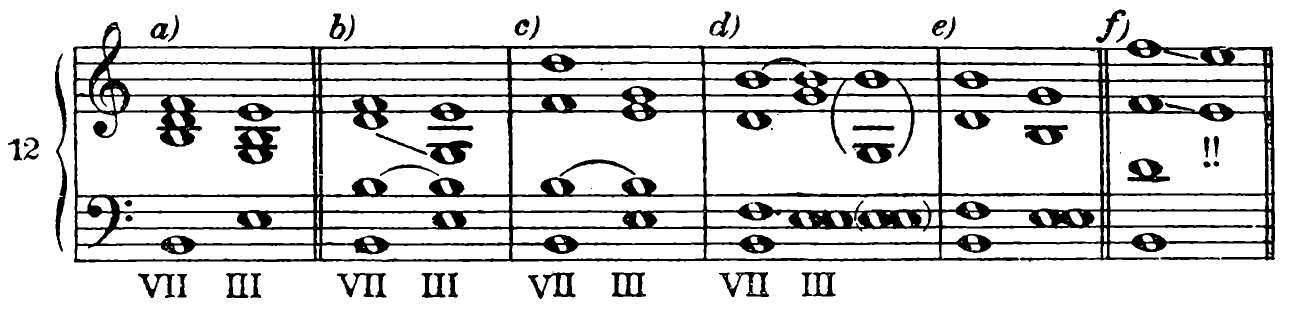
Applied to our case, the diminished triad, this means that the dissonant diminished fifth must be prepared and resolved. That no note other than the fifth can be the dissonance in the diminished triad follows not only from comparison with the overtones, among…
▶ Fig. 20 nearby - a) THE SIXTH CHORD · Footnote
…when the following was put to me: if the six-four chord is a greater dissonance than the sixth chord because its chord tones support the overtone sound of its bass note, this would mean in general that a chord is all the more dissonant, the greater the chance,…
▶ Fig. 24 nearby - b) The Six-Four Chord
…by older theory should be recalled: the fourth was regarded as an imperfect consonance, indeed even as a dissonance. This corresponds to a sound perception, for although the fourth occurs among the earliest overtones, it occurs in the reverse direction, and is…
▶ Fig. 44 nearby - b) The Six-Four Chord
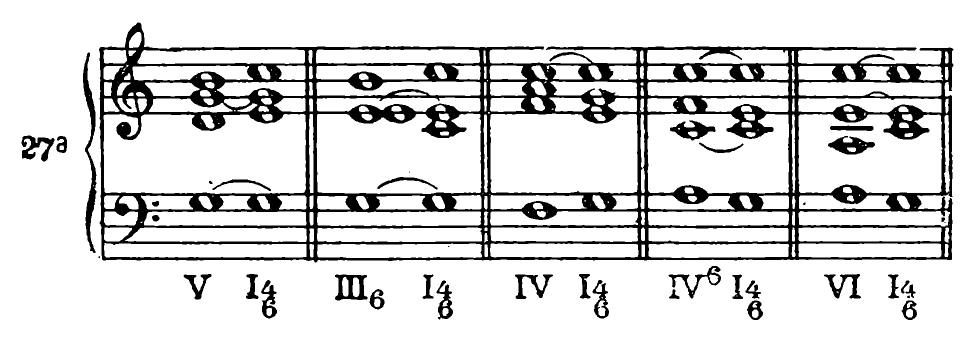
The following explanation seems simpler to me. A bass note that is not also the root seems to strive to assert its overtones—in other words, to become the root itself. As shown earlier, on page 69, the bass of the six-four chord receives ample support for this…
▶ Fig. 44 nearby - Seventh chords
…of three thirds built above a root: root, third, fifth, and seventh. It is a dissonance and thus belongs to those phenomena produced by the need to put the more remote overtones to use. In discussing degree VII I already mentioned one way in which they may…
▶ Fig. 50 nearby
 ▶ Example 12a
 ▶ Example 15a — doubled root
 ▶ Example 27a
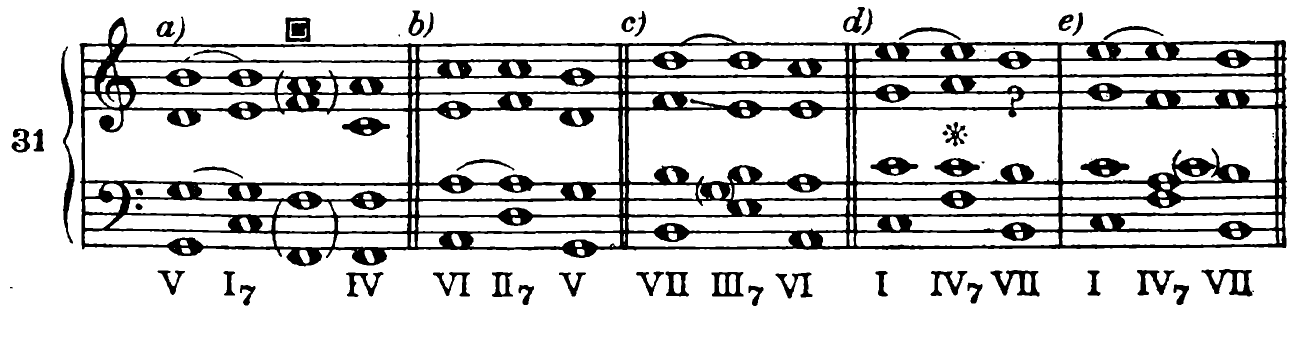 ▶ Example 31a–e — primary readings
 OrchestrationCecil Forsyth, 1914
- No. 11. The Kettle-Drums
…a "neutral element" in the orchestra. always has harmonic value. It you want dissonances, you can get these the tote noes to out yous opend, it dos sod pety do that, "neutral" in quality:
 Treatise on InstrumentationHector Berlioz, 1905
- Introduction
At first a succession of consonant chords, with a few suspensions here and there, was considered “music”. When later Monteverde dared to introduce the dominant seventh chord without preparation, he was violently blamed and abused for this innovation. In spite…
- The Pianoforte
which they do not belong, produce excessive dissonances. Such melodic ornaments are possible only in the highest octaves of the keyboard, where the strings are very short and have relatively little resonance.
- Voices
…Consegentiy, these suecessions of fourths sung on the stage sound ike dissonance, (ar ore. at least, extremely harsh’, because of the apparentiv missing complementary sixth,
- The Concertina
…in its present state together with these other instruments without producing dissonances as soon 45
- The Concertina
…Gb of the basses are executed differently, an intolerable and unmusical dissonance, highly offensive to the ear, would result. In reality this phrase makes a deeply stirring and entirely musical impression upon the hearer, awakening in him feelings of terror…
- On Conducting
…some might hold the F longer than others and thereby cause a@ momentary dissonance.
More in Counterpoint
Species counterpoint · Cantus firmus · Contrary, oblique and similar motion · Parallel fifths and octaves · Voice leading · The melodic line