 Playable Books
Concept index · Counterpoint
Contrary, oblique and similar motion
Taught in 10 books. Each one opens at the passage; ▶ plays the example beside it. Also called contrary motion, oblique motion, similar motion.
This index is Playable Books’ own: a first pass that finds the term’s words in each book, corrected by hand. The authors did not tag these passages, and their terms can differ (Fux’s “ligature” is a suspension). The quoted text is the book’s.
 Gradus ad ParnassumJohann Joseph Fux, 1725
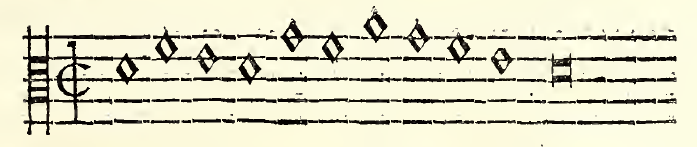
- First species counterpoint: note against note
…and the rules set out at the end of the preceding book. Use contrary or oblique motion for the most part, since by using them we cannot easily fall into error. Greater caution will be needed in proceeding from one note to another by similar motion; because the…
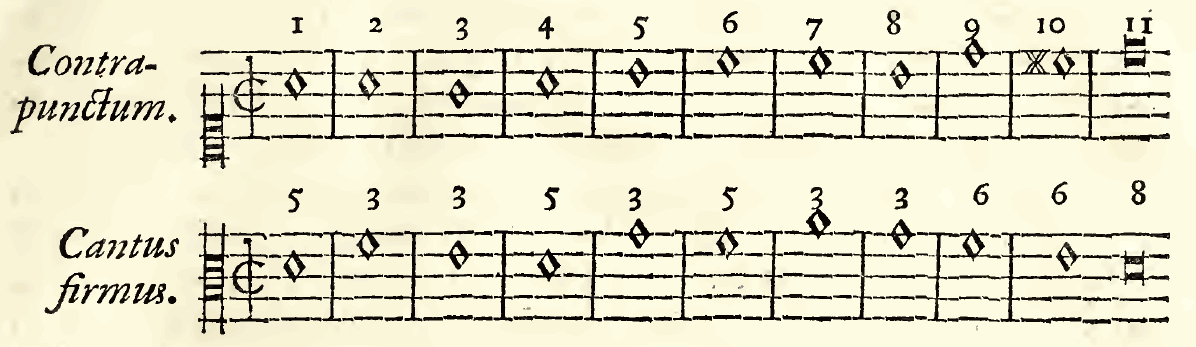
▶ Fig. 1 nearby - First species counterpoint: note against note
…to a third, or from a perfect to an imperfect consonance, I proceeded by oblique motion, although it could have been done by any of the three motions. From the second note to the third, namely from a third to a third, or from an imperfect to an imperfect…
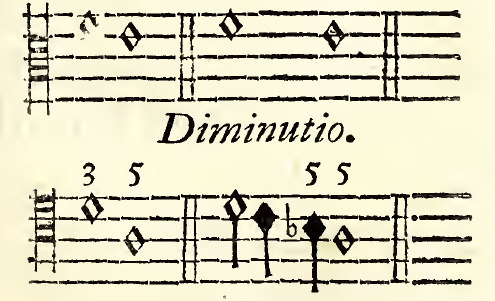
▶ Fig. 2 nearby - First species counterpoint: note against note
…note in relation to the third: you proceeded from a third to a fifth by similar motion, contrary to the rule which says: from an imperfect to a perfect consonance by contrary motion. This error is easily corrected by having the second note remain below on D,…
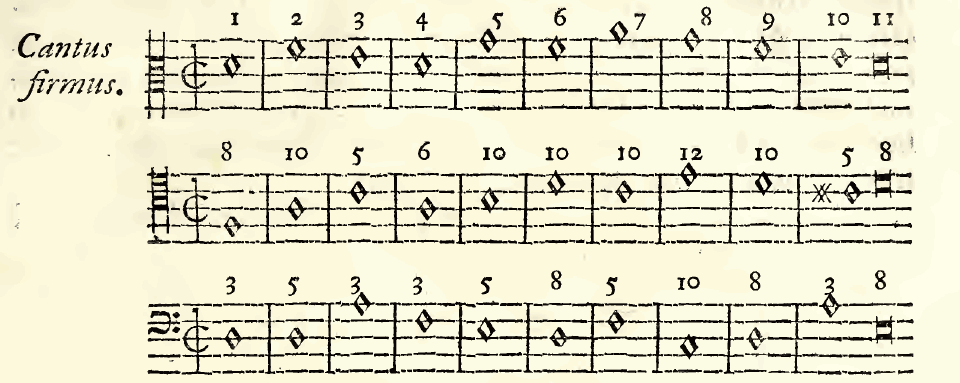
▶ Fig. 4 nearby - First species in three voices
Joseph. Yet from the seventh measure to the eighth, in the alto in relation to the bass, you seem not to have observed the rule that says: from an imperfect consonance to a perfect consonance by contrary motion. You have proceeded by similar motion instead.
▶ Fig. 102 nearby - Double counterpoint at the twelfth
…is given almost no consonance other than a fifth and octave, and those by contrary motion, and a third by oblique motion. When this is done, counterpoint at the octave and tenth can be drawn from counterpoint at the twelfth, with the benefit of such splendid…
▶ Fig. 367 nearby - Double counterpoint at the twelfth
…over how a composition without ligatures of dissonances may be inverted by contrary motion. This inversion can be made in two ways: by simple contrary motion and by reversed contrary motion. Simple contrary motion occurs when the notes are simply inverted, so…
▶ Fig. 372 nearby
 ▶ Fig. 1
 ▶ Fig. 2
 ▶ Fig. 4
 ▶ Fig. 102
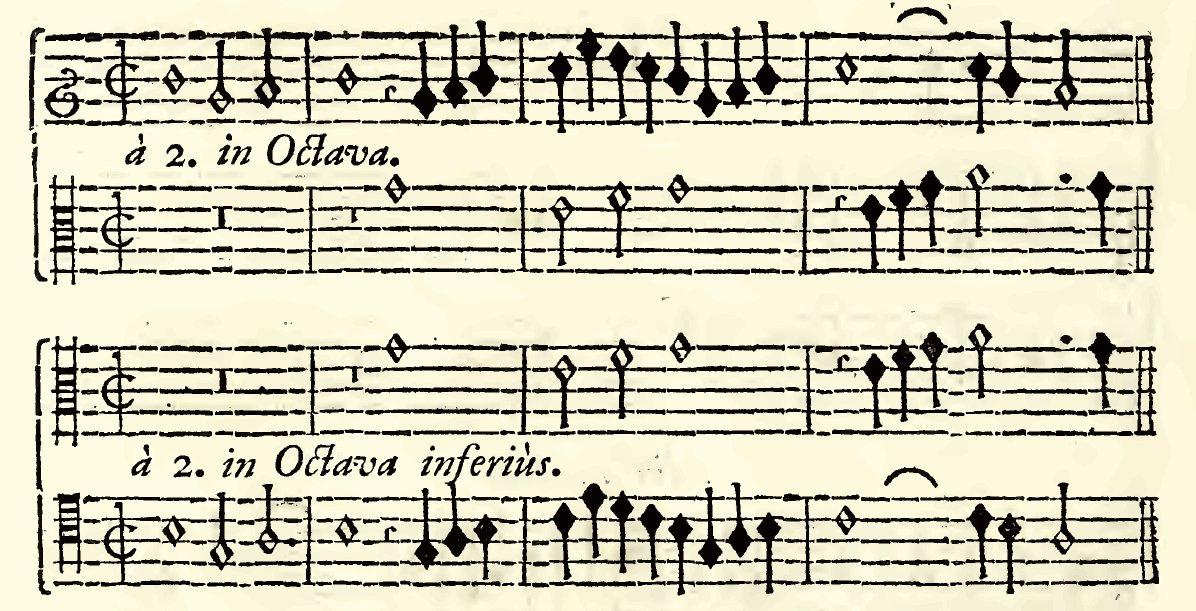 ▶ Fig. 367
 ▶ Fig. 372
 Exercises in Elementary CounterpointPercy Goetschius, 1910
- Chapter XVII. Secondary Chords
…the conduct of the inner part, which redeems its independence by occasional contrary motion, and wide skips.
▶ Fig. 298 nearby
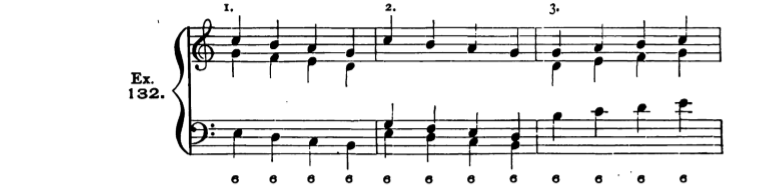 ▶ Ex.132
 Counterpoint AppliedPercy Goetschius, 1902
- Chapter V
…analyzed), is very brief; though strongly suggestive of the first M. in Contrary motion, it is really new (as its own Contrary motion, further on, proves). The Part has two sections, separated in the 4th measure; its perfect cadence is evaded in the 1oth…
▶ Fig. 228 nearby - Chapter VII
…x and %, respectively); Part II begins with the second Motive, — not with Contrary motion of the principal Motive (par. 51.) — Bach, Partita No IV, "Gigue"; Part II is based upon a new Motive, which proves, after 6 measures, to be a Counter-motive to the…
- Chapter XII
…to meas. 14 ; Sec. II is an equally complete Exposition of the Theme in contrary motion, to meas. 27; Sec. III is the exposition of a stretto in the 8ve after two beats (Soprano and Tenor) carried through all the parts, up to meas. 48; Sec. IV is a similar…
▶ Fig. 366 nearby - Chapter XII
…27, Tenor and Alto); Sec. III, meas. 42, is an Exposition of the Theme in contrary motion; Sec. IV, meas, 67, the same stretto as before, but in contrary motion (Alto and Soprano). Thus far, to meas. 77, the Fugue consists of two similar doublesections, one in…
▶ Fig. 366 nearby - Chapter XIV
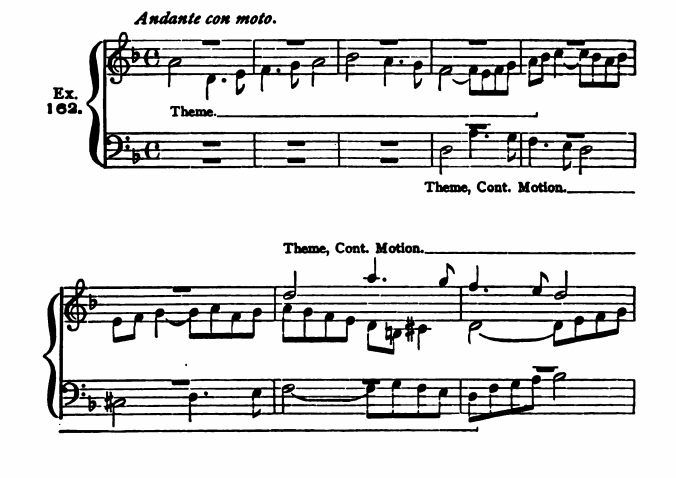
158. The Fugue in Contrary motion (per moto contrario). In this species the first and third Imitations of the Theme are made in Contrary motion, so that the 4-voice Exposition consists of the alternate "regular" and "contrary" motion (the latter standing each…
▶ Fig. 372 nearby - Chapter XIV
…to the preceding one; Sec. III (meas. 33-46) is based upon a stretto in contrary motion; Sec. IV (meas. 47-65) upon a stretto in parallel motion, after one and one-half measures; Sec. V (to meas. 86) upon a parallel stretto, after The Coda (last 5 measures) is…
▶ Fig. 372 nearby
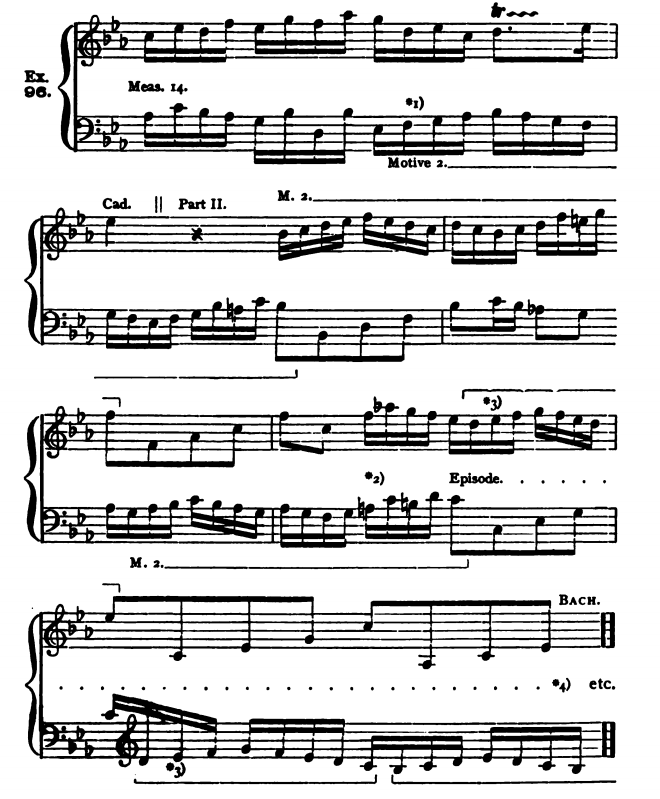 ▶ Ex96
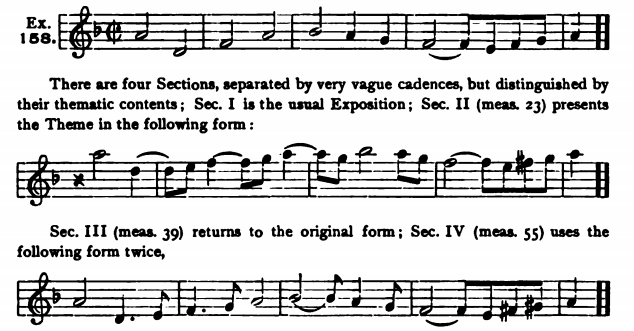 ▶ Ex158
 ▶ Ex162
 Analysis of J. S. Bach’s Forty-Eight FuguesEbenezer Prout, 1910
- Fugue 1 · Book I, No. 1 · BWV 846
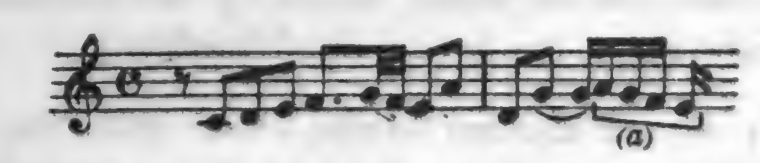
…above with ' (a)—', are very frequently used throughout the fugue, either by direct motion, as in bars 2, 7 and 10, or by inverse movement, as in bars 4, 5 and 6.
▶ Fig. 1 nearby - Fugue 2 · Book I, No. 2 · BWV 847
…sequential, is formed from the commencement of the countersubject taken by contrary motion. At bar 7 the bass enters with the subject, the countersubject being now taken, according to rule, by the treble—the voice that had just before given the answer. The…
▶ Fig. 3 nearby - Fugue 2 · Book I, No. 2 · BWV 847
…on the countersubject. The treble is the bass of the first episode by contrary motion; the two lower voices in thirds accompany with a quaver figure seen in bars 3 and 4, though the figure is not exactly imitated.
▶ Fig. 3 nearby - Fugue 4 · Book I, No. 4 · BWV 849
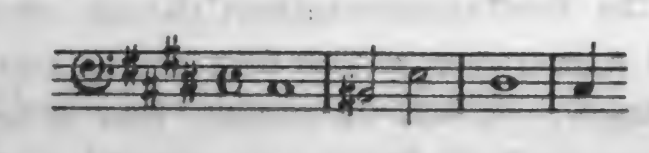
…of four crotchets first seen in the bass of bar 7, and employed not only by direct motion, but also by inversion (bars 17, 18, 23, 24, etc.), and even by diminution bar 26); it is seen in all twenty-six times.
▶ Fig. 9 nearby - Fugue 5 · Book I, No. 5 · BWV 850
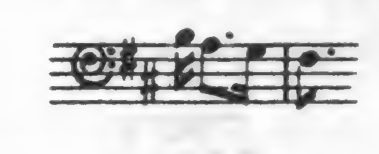
both by direct and contrary motion. The final section of this fugue is quite irregular in its construction, though the whole piece is very effective musically.
▶ Fig. 15 nearby
 ▶ Subject · Fugue 1
 ▶ Subject · Fugue 2
 ▶ Subject · Fugue 4
 ▶ Analytical excerpt · Fugue 5
 Treatise on HarmonyJean-Philippe Rameau, 1722
- Chapter seventeen
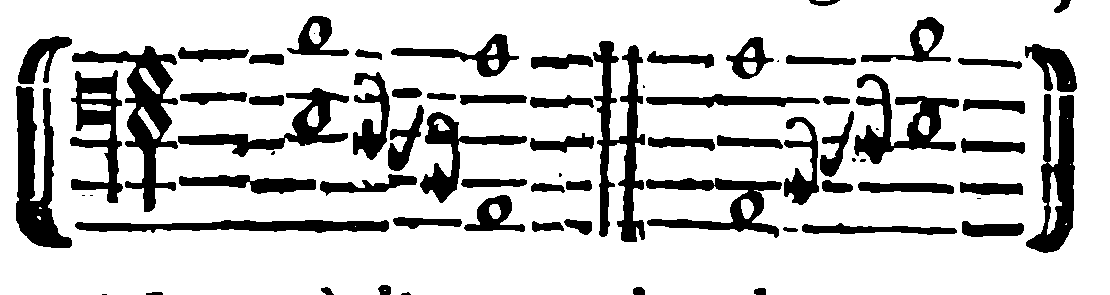
…extravagant part movements, especially with dissonance. With consonance, contrary motion easily avoids the fault. Yet these passages occur constantly in perfect and irregular cadences: hidden octaves in one, hidden fifths in the other. Fill the bass’s leap…
▶ Fig. 88 nearby - Chapter thirty-six
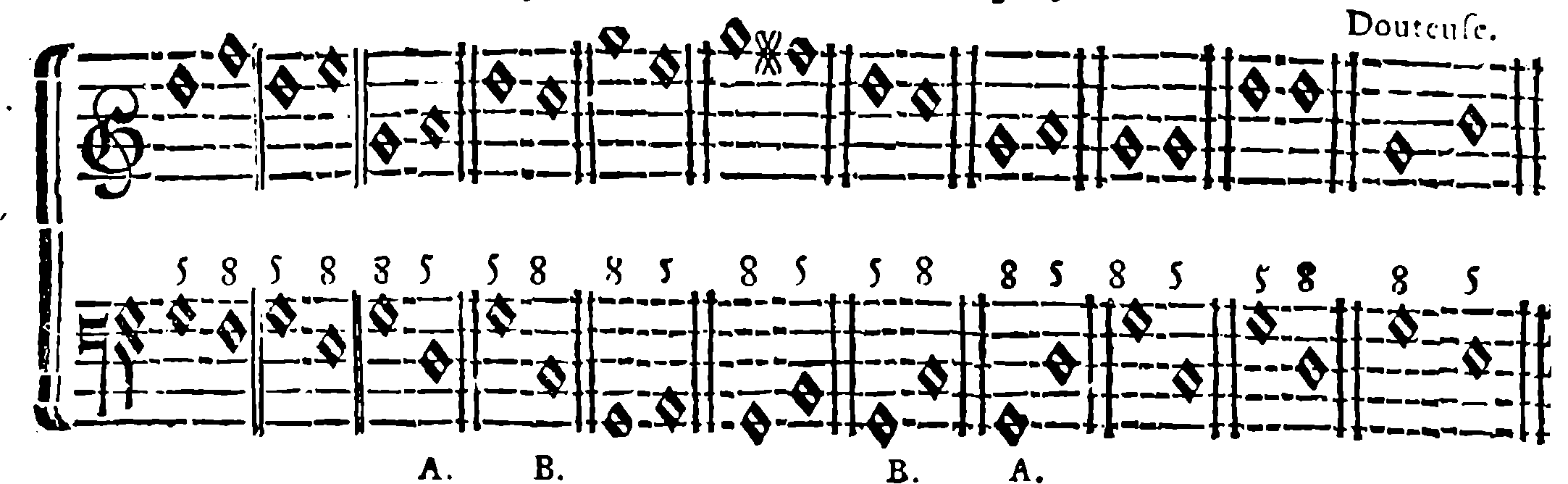
One can scarcely pass from a perfect consonance to another, or to an imperfect one, or from an imperfect to a perfect one, unless one part moves diatonically while the other moves by a consonant interval. Even then, contrary motion is advisable.
▶ Fig. 304 nearby - Chapter thirty-six
4. Passages from octave to fifth are good provided the parts move in contrary motion. The one in which the bass descends diatonically is nevertheless bad.
▶ Fig. 304 nearby - Chapter thirty-six
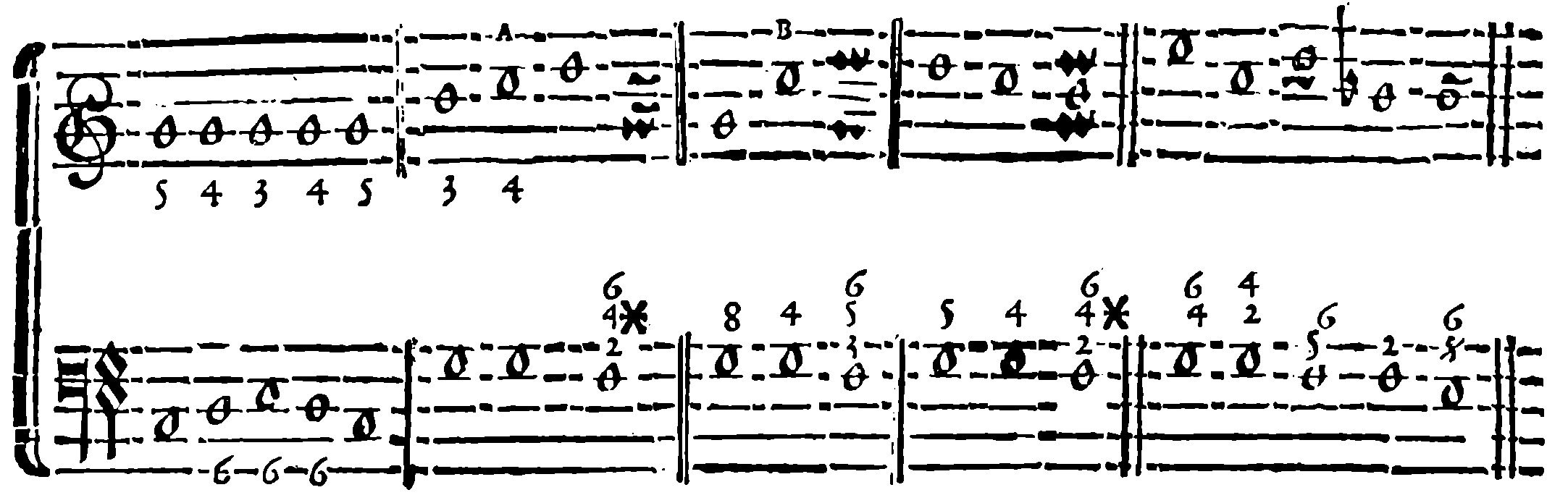
9. Passages from third to octave are good except when the bass descends diatonically. Also observe contrary motion when the bass ascends a fifth.
▶ Fig. 305 nearby - Chapter thirty-six
10. Passages from third to fifth are also good, provided the parts move in contrary motion where the bass ascends a second, third, or fourth. Indeed, make it ascend a fourth rather than descend a fifth, otherwise this progression would be bad.
▶ Fig. 305 nearby - CHAPTER XVII. Recapitulation of the different chord successions
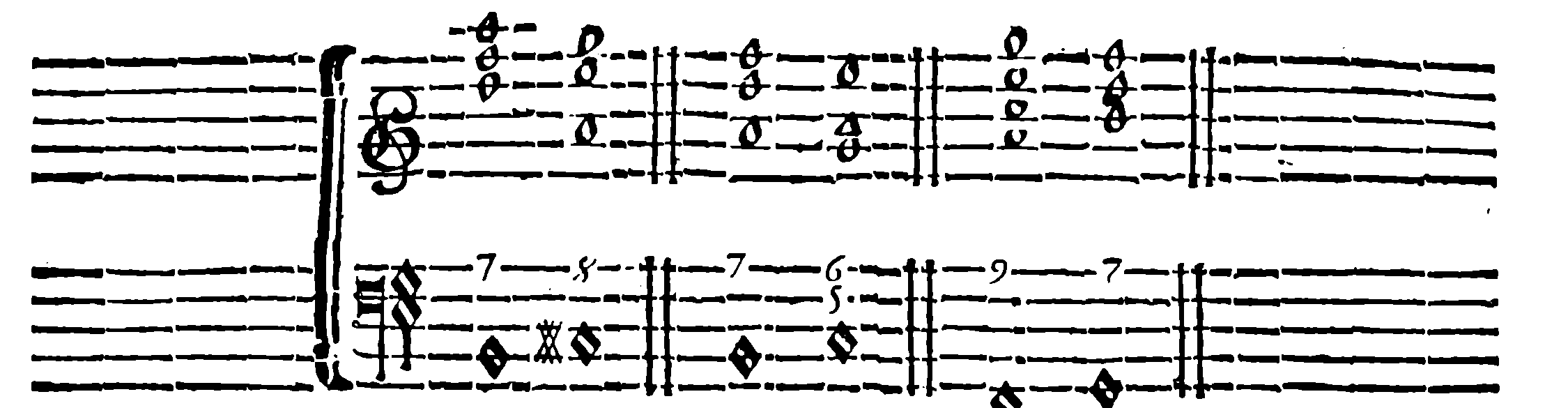
…the natural rule, and you do not wish to make the reductions above, use contrary motion between bass and chords: lower the chords when the bass rises, and raise them when it falls. Do this at P, Q, or P, M, Q, unless the chord at M in the third bass is reduced…
▶ Fig. 441 nearby
 ▶ Fig. 88
 ▶ Fig. 304
 ▶ Fig. 305
 ▶ Fig. 441
 Practical Manual of HarmonyNikolai Rimsky-Korsakov, 1910
- Motion of the Parts
When direct motion produces a series of like intervals (examples a and b), it is called parallel motion.
▶ Fig. 48 nearby - Motion of the Parts
2) Contrary motion: when the parts move in opposite directions.
▶ Fig. 49 nearby - Motion of the Parts
3) Oblique motion: when one part stays still while the other moves.
▶ Fig. 50 nearby - Harmonic and Melodic Connection of Triads
4) The moving upper parts must proceed in similar motion; where they rise in a harmonic connection, they fall in the melodic one, and the reverse.
▶ Fig. 58 nearby - Harmonic and Melodic Connection of Triads
6) The three upper parts move in parallel and in contrary motion to the bass; the spacing stays the same, close or open.
▶ Fig. 59 nearby - The Neighbour Note
7) Neighbour notes in two parts at once must form parallel thirds or sixths, or move in contrary motion; neighbour notes in three parts at once are subject to the same rule, but they may also form chords of the sixth in parallel motion.
▶ Fig. 282 nearby
11 more passages in Practical Manual of Harmony →
 ▶ Direct motion: a) and b) parallel sixths and thirds; c) and d) similar motion into different intervals
Motion of the Parts ▶ Contrary motion: four pairs of two-part progressions
Motion of the Parts ▶ Oblique motion: in each pair one part holds a tied note while the other moves by step
Motion of the Parts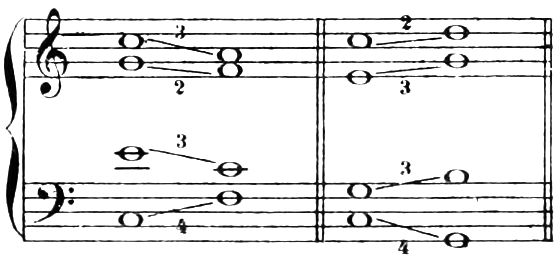 ▶ Melodic connection: I–IV and I–V in C major, all parts moving
Harmonic and Melodic Connection of Triads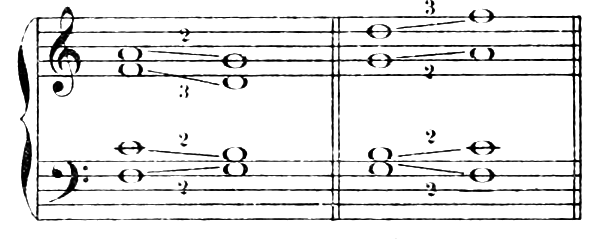 ▶ Melodic connection of chords a second apart: IV–V and V–IV in C major
Harmonic and Melodic Connection of Triads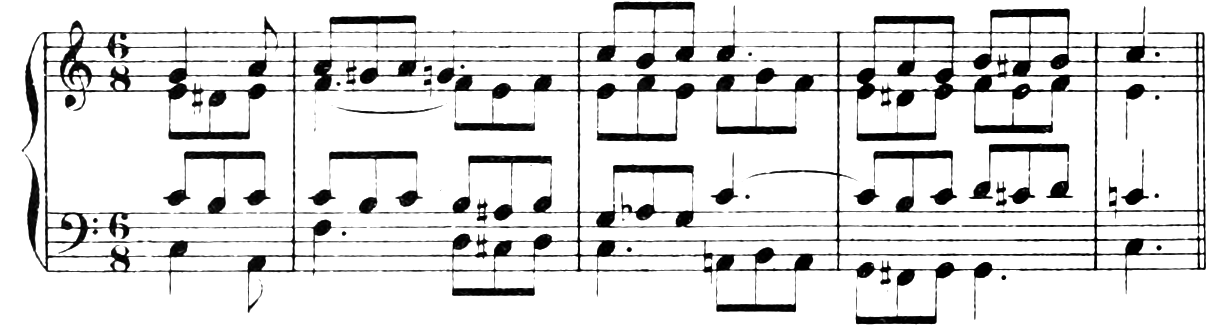 ▶ Example in 6/8, C major: neighbour notes in two and three parts at once, in parallel thirds and sixths, in contrary motion, and as parallel chords of the sixth.
The Neighbour Note
 Guide to the Practical Study of HarmonyPyotr Ilyich Tchaikovsky, 1900
- Chapter III. Connection of Triads, showing no External agreement
1) Parallel motion (motus rectus), in which two voices progress in one and the same direction, that is, upwards or downwards.
▶ Fig. 20 nearby - Chapter III. Connection of Triads, showing no External agreement
2) Oblique motion (motus obliquus), in which one voice remains stationary, while the other moves onward:
▶ Fig. 21 nearby - Chapter III. Connection of Triads, showing no External agreement
3) Contrary motion (motus contrarius); one voice progresses upwards, the other downwards.
▶ Fig. 22 nearby - Chapter III. Connection of Triads, showing no External agreement
To avoid this fault we must employ contrary motion, without, however, proceeding in great skips.
▶ Fig. 25 nearby - Chapter XXV. Passing-notes
…beats. They can occur in two or more voices at ance, moving either in parallel motion (in thirds or sixths), or in contrary motion. Contrary motion is preferable, since parallel progressions are in opposition to the chief element of harmonic beauty— namely an…
▶ Fig. 261 nearby - Chapter XXVIII. Changing-notes
…occurring in two voices at the same time can move either in parallel or in contrary motion. Parallel changing-notes, while having an agreeable effect, are used less frequently than those in contrary motion; the latter, though by no means always consonating,…
▶ Fig. 312 nearby
18 more passages in Guide to the Practical Study of Harmony →
 ▶ Fig. 20
Chapter III. Connection of Triads, showing no External agreement ▶ Fig. 21
Chapter III. Connection of Triads, showing no External agreement ▶ Fig. 22
Chapter III. Connection of Triads, showing no External agreement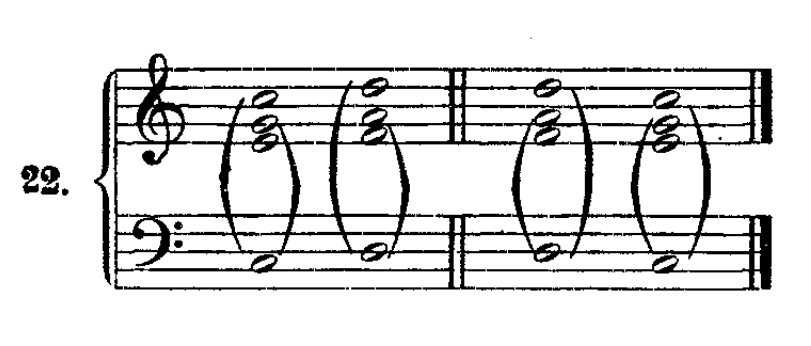 ▶ Fig. 25
Chapter III. Connection of Triads, showing no External agreement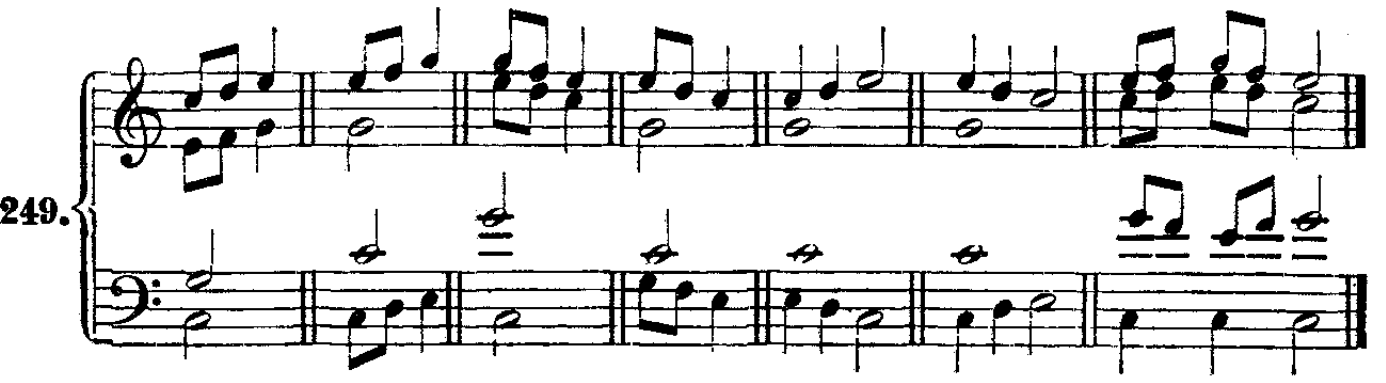 ▶ Fig. 261
Chapter XXV. Passing-notes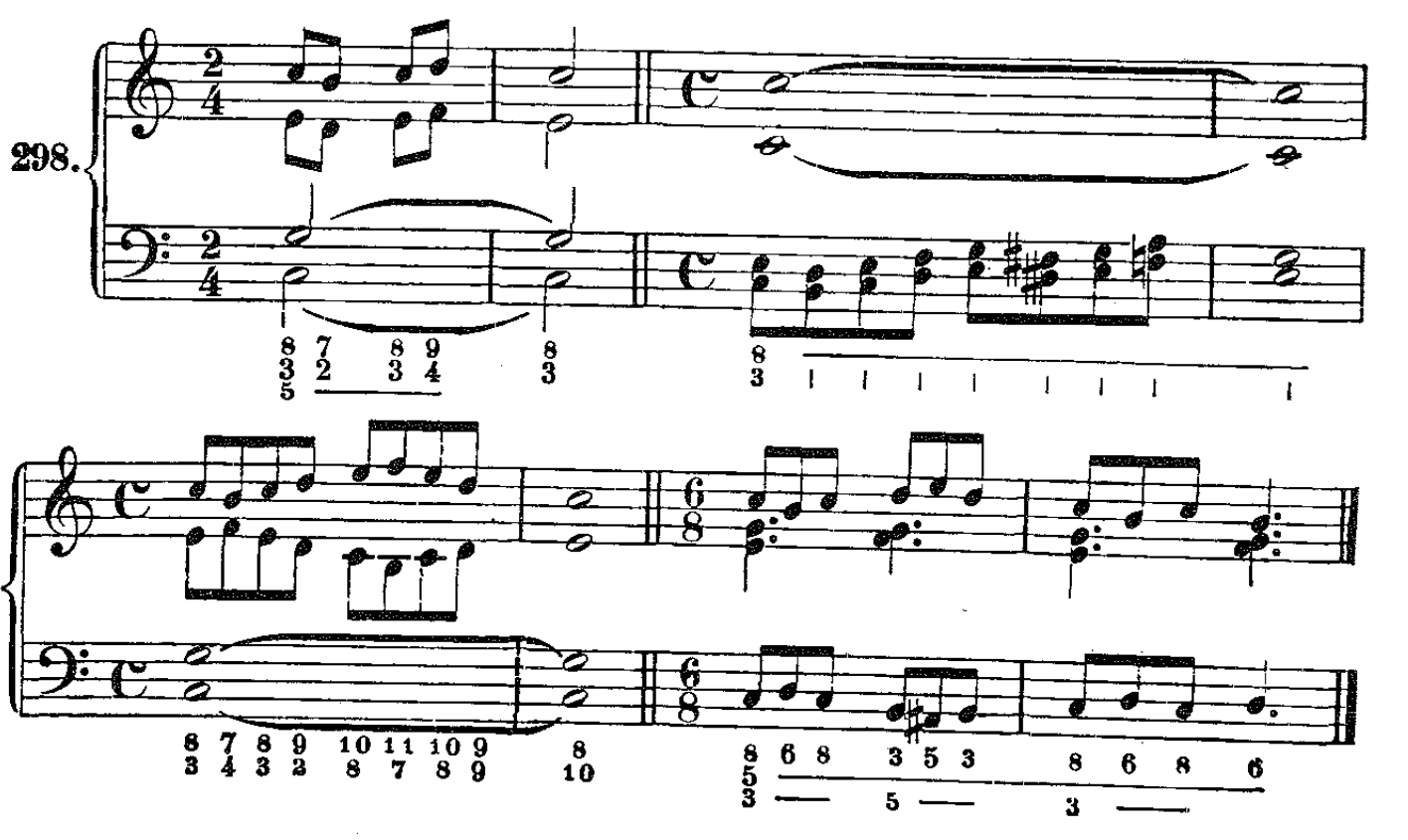 ▶ Fig. 312
Chapter XXVIII. Changing-notes
 PartimentiFedele Fenaroli, 1800
- Concerning a Partimento that Descends in Ties
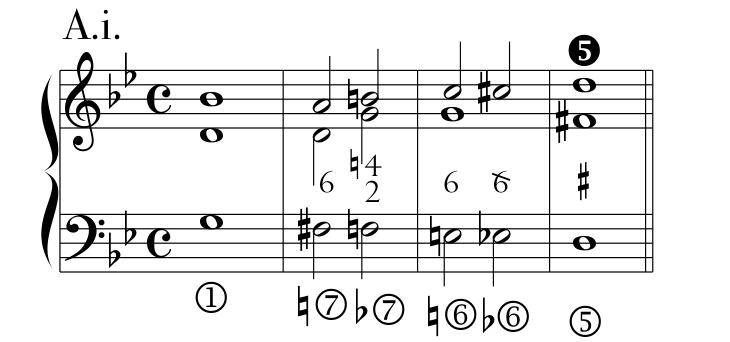
Second, a partimento descending by semitone, can be accompanied in contrary motion, that is:
▶ Fig. 92 nearby
 ▶ Fig. 92
 Theory of HarmonyArnold Schoenberg, 1922
- Parallel octaves and fifths
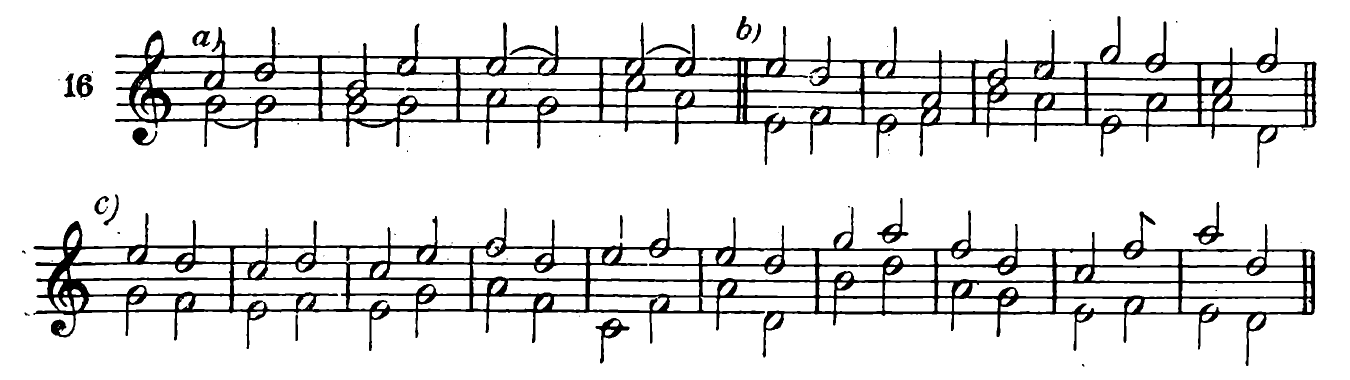
1. While one voice moves, the other remains in place (oblique motion), 16a; 2. while one voice moves downward, the other moves upward (contrary motion), 16b; 3. both voices move in the same direction, both descending together or ascending together (parallel…
▶ Fig. 25 nearby - Parallel octaves and fifths
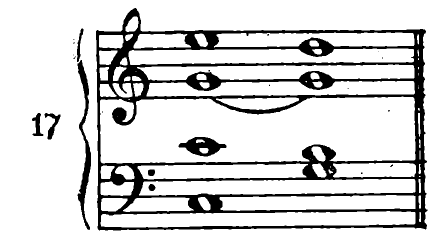
Thus, in musical example 17, oblique motion occurs between soprano and alto, or between tenor and alto, or between bass and alto; parallel motion occurs between soprano and tenor; and contrary motion between soprano and bass, or between tenor and bass.
▶ Fig. 26 nearby - Parallel octaves and fifths
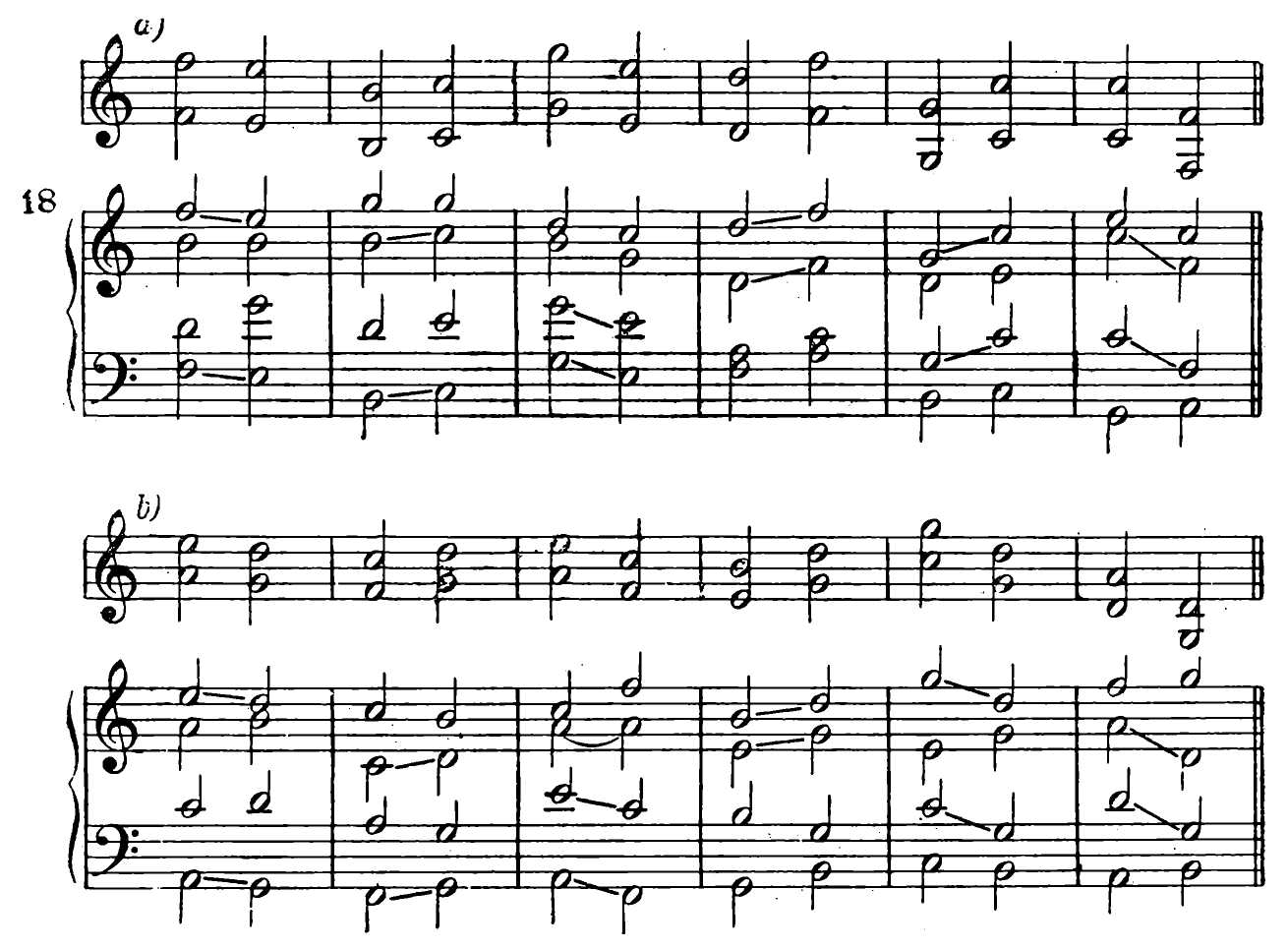
While older theory allowed oblique and contrary motion unconditionally, it prohibited parallel motion conditionally in some cases, and absolutely in others. These are the cases known as parallel octaves and parallel fifths.
▶ Fig. 27 nearby - Parallel octaves and fifths
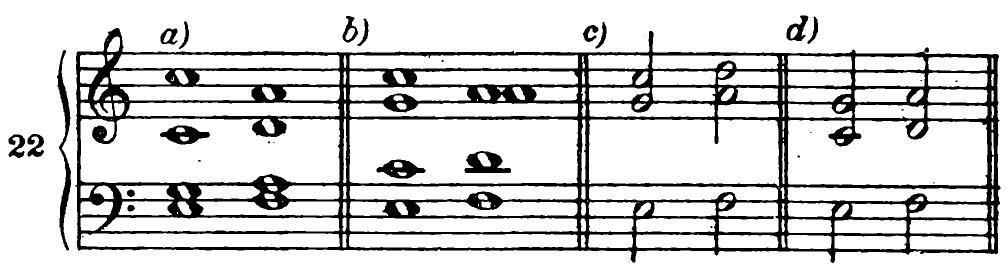
…by such a lower third (22d)? Harmonically there is no difference. Since this parallel motion does not sound bad, and parallel thirds and sixths even sound good, is it specifically parallel motion in fifths that sounds unconditionally bad, while every other…
▶ Fig. 31 nearby - Parallel octaves and fifths
…as a consonance, people probably discovered the possibility of contrary and oblique motion. Besides parallel unisons, octaves, and fifths, there was thus the possibility of parallel thirds and, probably soon afterwards, as stated, contrary and oblique…
▶ Fig. 31 nearby - Parallel octaves and fifths
It was probably the same here. When the coercion of the guild joins the joy of achievement, the child of this marriage can only be orthodoxy. No longer needing to establish what has newly been attained, orthodoxy finds its task in preserving it through…
▶ Fig. 31 nearby
 ▶ Example 16a
 ▶ Example 17
 ▶ Example 18a — two-voice patterns
 ▶ Example 22a
 Principles of OrchestrationNikolai Rimsky-Korsakov, 1922
- Distribution of notes in chords
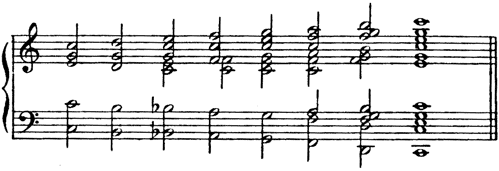
…in piano passages such distribution may be possible. Progression in contrary motion, the upper and lower parts diverging by degrees gives rise to the gradual addition of extra parts occupying the middle register:
▶ Fig. 51 nearby
 ▶ Fig. 51
More in Counterpoint
Species counterpoint · Cantus firmus · Consonance and dissonance · Parallel fifths and octaves · Voice leading · The melodic line