 Playable Books
Concept index · Counterpoint
Species counterpoint
Taught in 5 books. Each one opens at the passage; ▶ plays the example beside it. Also called species.
This index is Playable Books’ own: a first pass that finds the term’s words in each book, corrected by hand. The authors did not tag these passages, and their terms can differ (Fux’s “ligature” is a suspension). The quoted text is the book’s.
 Gradus ad ParnassumJohann Joseph Fux, 1725
Start: First species counterpoint: note against note → Start: Second species counterpoint: two notes against one → Start: Third species counterpoint: four notes against one → Start: Fourth species counterpoint: syncopation and suspensions → Start: Fifth species counterpoint: florid counterpoint →- First species in three voices · 30 playable examples
- Second species in three voices · 8 playable examples
- Third species in three voices · 5 playable examples
- Fourth species in three voices: ligatures · 18 playable examples
- Florid counterpoint in three voices · 8 playable examples
- Four-part counterpoint: first species · 12 playable examples
- Second species in four voices · 4 playable examples
- Third species in four voices · 15 playable examples
- Fourth species in four voices · 10 playable examples
- Florid counterpoint in four voices · 6 playable examples
- First species counterpoint: note against note
Joseph. Through your kindness, my first question has been answered. Now please explain what this first species of counterpoint, note against note, is.
▶ Fig. 1 nearby - First species counterpoint: note against note
Joseph. Is that everything required for this species of counterpoint?
▶ Fig. 2 nearby - First species counterpoint: note against note
in which case the unison, consisting as it does in a ratio of equality, is heard very little, and seems almost swallowed up and lost. For this reason, in this species of counterpoint, except at the beginning and the end, it must never be used.
▶ Fig. 16 nearby - First species counterpoint: note against note
From the last two examples it is apparent that you now know everything necessary to know for this species. We must now pursue the second species.
▶ Fig. 21 nearby - Second species counterpoint: two notes against one
Before I undertake to explain this second species of counterpoint, it must first be understood that we are at present working in duple time, whose beat or measure consists of two equal parts: one in the lowering of the hand, the other in its raising. The…
▶ Fig. 22 nearby - Fifth species counterpoint: florid counterpoint
This species is called florid counterpoint, so named because it should bloom like a garden with little flowers, with ornament of every kind, grace of melody, supple ease of motion, and a pleasing variety of note forms. For just as we use all the other…
▶ Fig. 82 nearby
21 more passages in Gradus ad Parnassum →
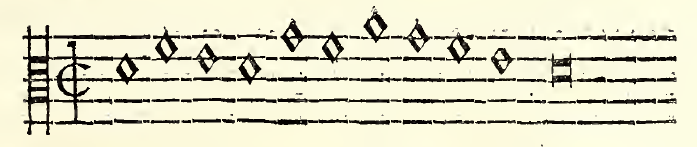 ▶ Fig. 1
First species counterpoint: note against note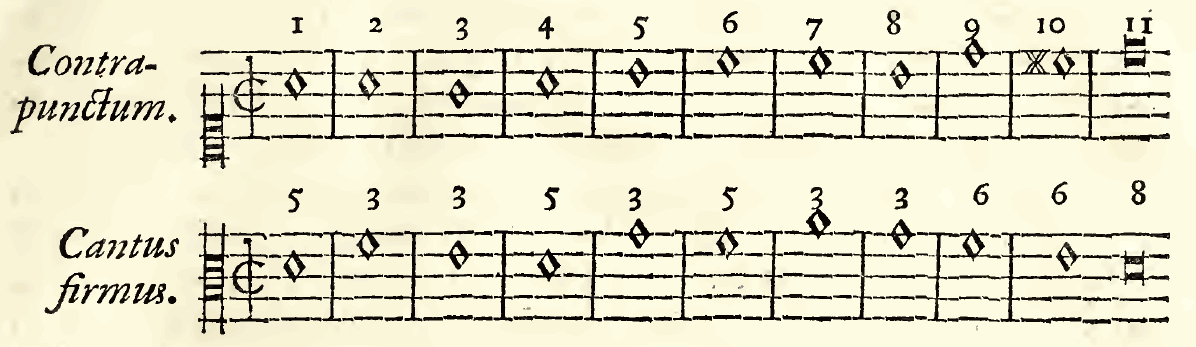 ▶ Fig. 2
First species counterpoint: note against note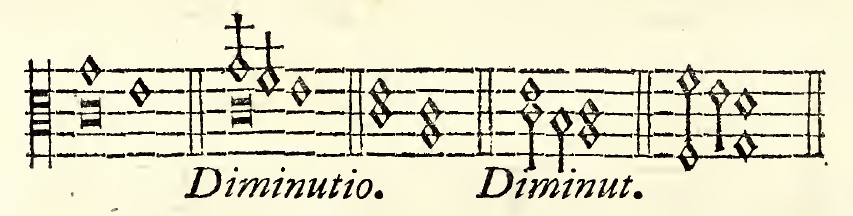 ▶ Fig. 22
Second species counterpoint: two notes against one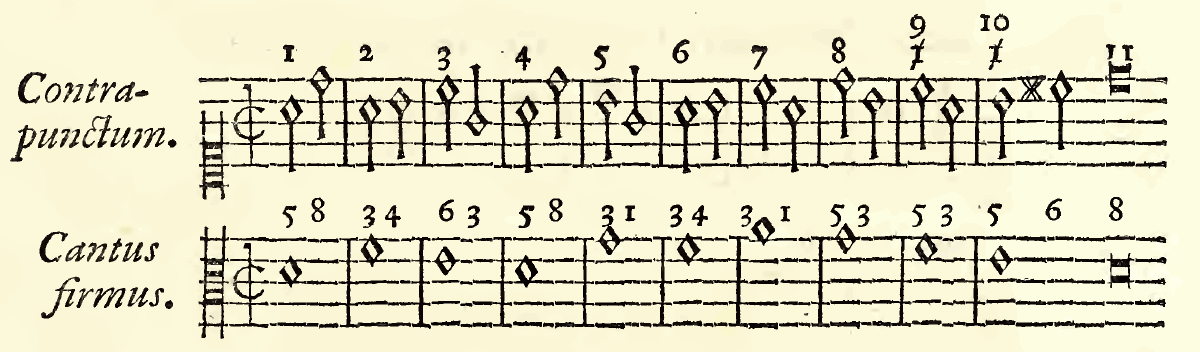 ▶ Fig. 24
Second species counterpoint: two notes against one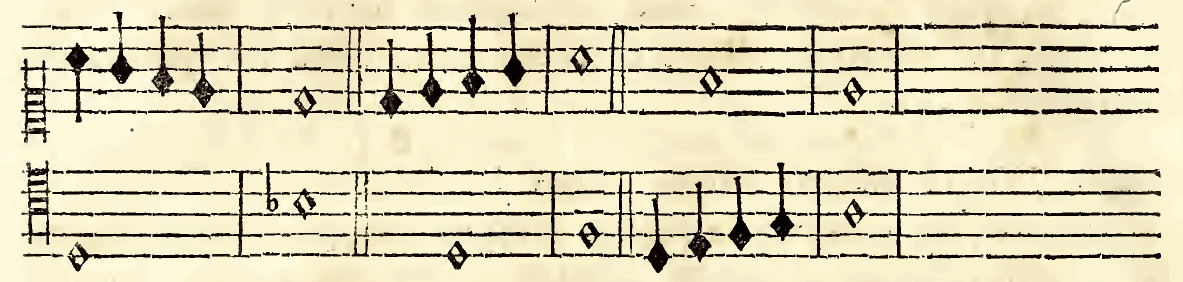 ▶ Fig. 45
Third species counterpoint: four notes against one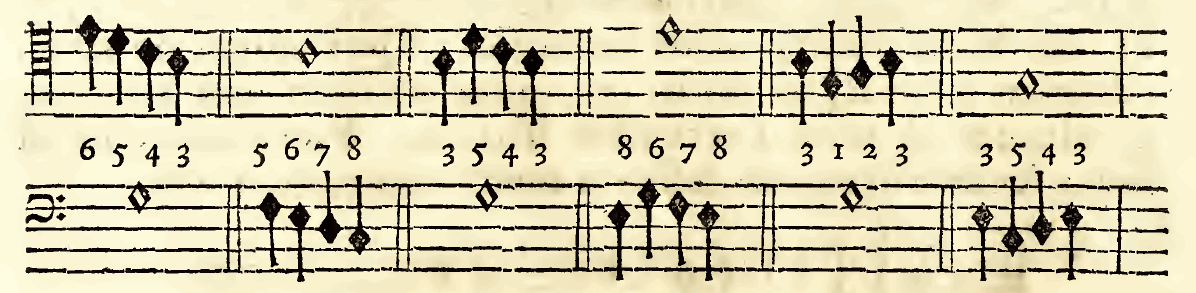 ▶ Fig. 46
Third species counterpoint: four notes against one
 Exercises in Elementary CounterpointPercy Goetschius, 1910
Start: Chapter IV. The Association Of Two Melodic Lines → Start: Chapter VII. Rhythmic Diversity. Two Notes To A Given Beat → Start: Chapter XII. Four Notes To A Beat → Start: Chapter X. Syncopation, Or Shifted Rhythm → Start: Chapter XIV. Diversity Of Rhythmic Movement →- Chapter VII. Rhythmic Diversity. Two Notes To A Given Beat
…of the given melody. That is, the counterpoint may not only be devised " note against note " in exactly or nearly similar rhythm, as in the preceding lessons, but may run in a more rapid rhythm of two (or more) notes to each note of the given melodic part.
▶ Fig. 101 nearby - Chapter VII. Rhythmic Diversity. Two Notes To A Given Beat
…in the added part, must be determined precisely as if they stood alone, — note against note, as in former lessons. They are therefore defined according to the table of permissible intervals, 6th, 3rd, 8ve, occasionally the augmented 4th, diminished 5th, and so…
▶ Fig. 103 nearby - Chapter XIV. Diversity Of Rhythmic Movement
Add a contrapuntal part to each of the following melodies, in corresponding rhythm (note against note, as in Exercise 4), being careful to select good essential intervals, as required in par. 101, — which review.
▶ Fig. 252 nearby
 ▶ Ex.31
Chapter IV. The Association Of Two Melodic Lines ▶ Ex.32
Chapter IV. The Association Of Two Melodic Lines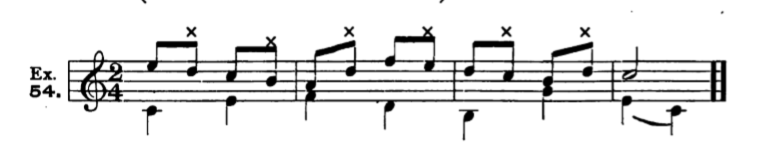 ▶ Ex.54
Chapter VII. Rhythmic Diversity. Two Notes To A Given Beat ▶ Ex.55
Chapter VII. Rhythmic Diversity. Two Notes To A Given Beat ▶ Ex.91
Chapter XII. Four Notes To A Beat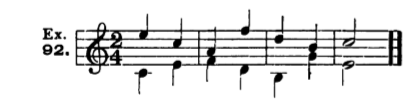 ▶ Ex.92
Chapter XII. Four Notes To A Beat
 Counterpoint AppliedPercy Goetschius, 1902
- Chapter II
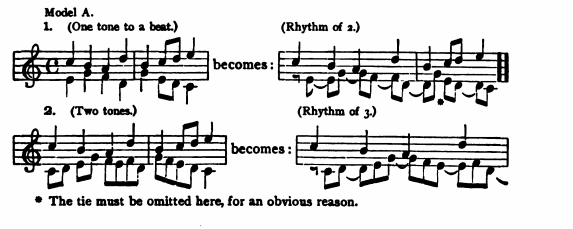
Rule A. The tie may be applied to any of the preceding (uniform) species of counterpoint with one, two, or three notes to a beat, and results in a faultless syncopation of the same, representing, in each case, the next higher grade of rhythmic motion; ie., the…
▶ Fig. 99 nearby - Chapter VII
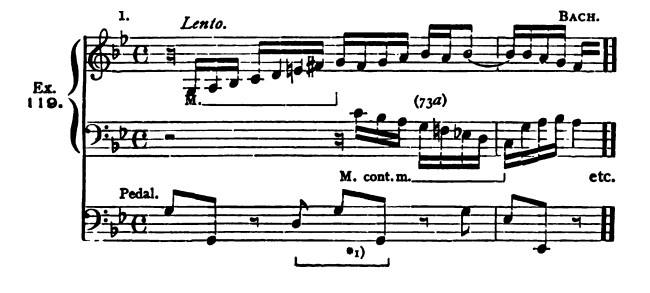
The first species is most common in Organ music; the peculiar difficulties and limitations of Pedal-technique render it often expedient to assign certain adapted figures to the Pedal-part, either quite independent of the Motive, or as a modified (simplified)…
▶ Fig. 259 nearby - Chapter XIII
This design is the type of the Double-fugue, Third Species (par. 178, class i;
- Chapter XV. THE DOUBLE-FUGUE
Analyze, very minutely, the following examples of the First Species :
- Chapter XV. THE DOUBLE-FUGUE
168. In the Second Species, Theme B enters as first contrapuntal associate, in connection with the second announcement of Theme A (i.e., with the first "Response"). It therefore corresponds, in this respect, to the Fugue with Thematic Counterpoint; but all the…
- Chapter XV. THE DOUBLE-FUGUE
The order of voices during the Exposition is simpler than in the First Species, because Theme B naturally (and almost invariably) follows Theme A in the same voice,— precisely as shown in Exs. 164, 165, excepting that the contrapuntal associate is a genuine…
 ▶ Exercise4-Model-A
 ▶ Ex119-1
 Analysis of J. S. Bach’s Forty-Eight FuguesEbenezer Prout, 1910
- Fugue 12 · Book I, No. 12 · BWV 857
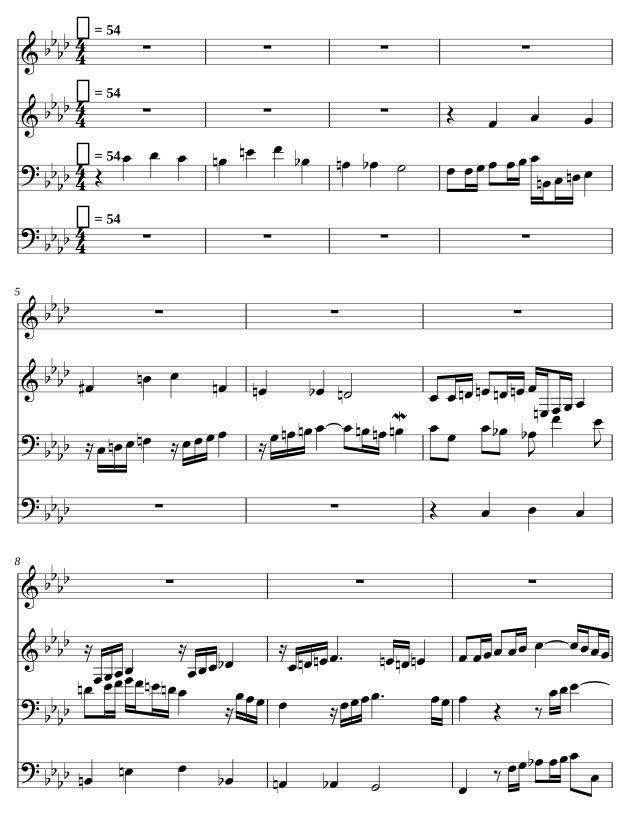
…the treble and made the pattern for some free imitation in the alto, with a florid counterpoint in the bass. Episode 5 (bars 43 to 47) gives a new and more elaborate sequential treatment of the codetta with the addition of a fourth voice; all the other…
▶ Fig. 32 nearby - Fugue 18 · Book I, No. 18 · BWV 863
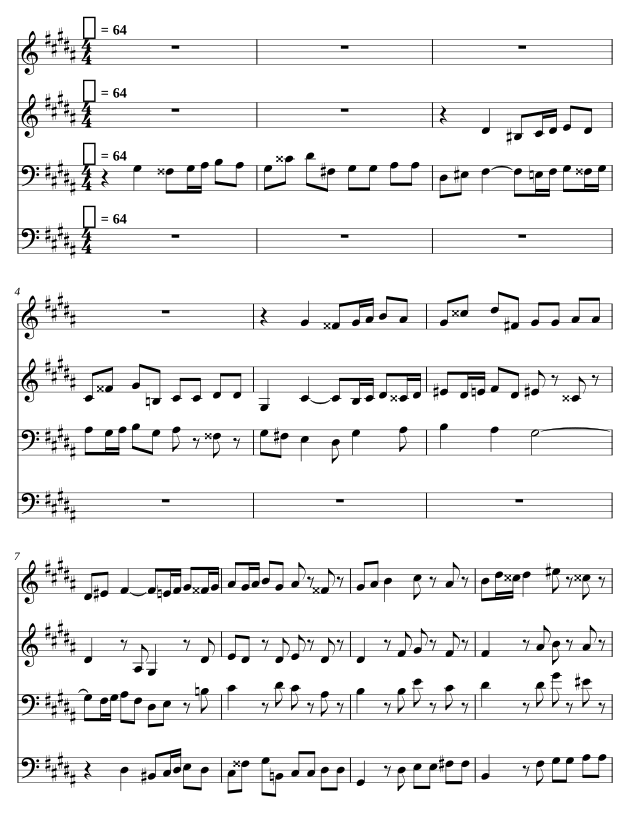
…of the subject. The employment of homophony, that is, of chords proceeding note against note in place of combined melodies, is remarkable in the first episode, being extremely rare in fugal writing.
▶ Fig. 47 nearby
 ▶ Complete score
 ▶ Complete score
 Complete Method for Rhythmical ArticulationPasquale Bona, 1905
Start: Study 58 →More in Counterpoint
Cantus firmus · Consonance and dissonance · Contrary, oblique and similar motion · Parallel fifths and octaves · Voice leading · The melodic line