 Playable Books
Concept index · Counterpoint
Parallel fifths and octaves
Taught in 9 books. Each one opens at the passage; ▶ plays the example beside it. Also called parallel fifths, parallel octaves, consecutive fifths, hidden fifths.
This index is Playable Books’ own: a first pass that finds the term’s words in each book, corrected by hand. The authors did not tag these passages, and their terms can differ (Fux’s “ligature” is a suspension). The quoted text is the book’s.
 Gradus ad ParnassumJohann Joseph Fux, 1725
Start: First species counterpoint: note against note →- First species in three voices
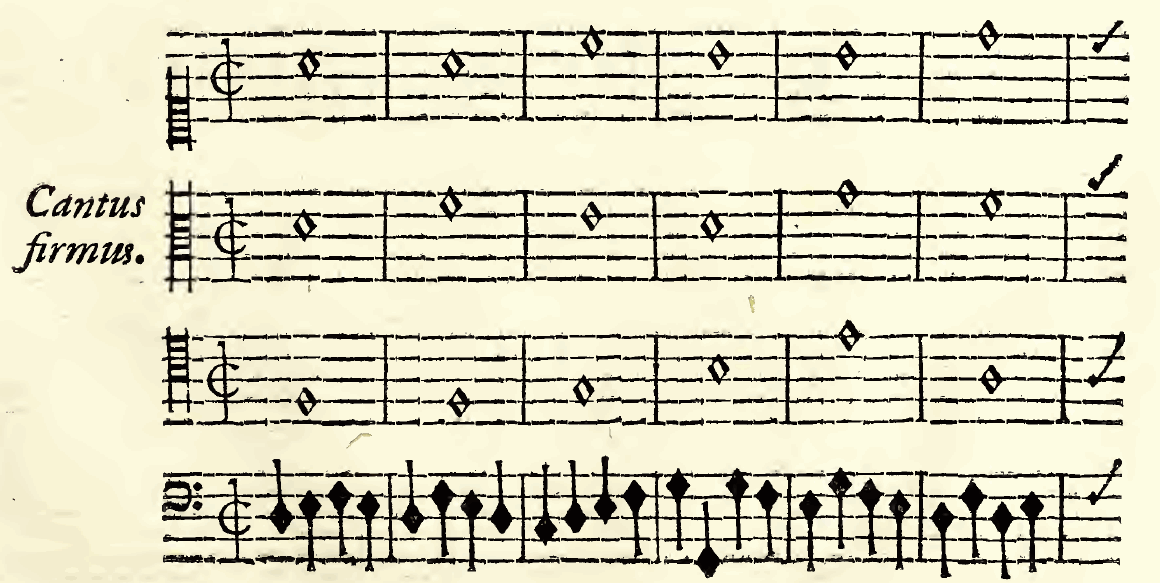
…measure of the first example: the fifth proceeds to the final octave, a perfect consonance to a perfect consonance, by similar motion, because it cannot be done otherwise. For example:
▶ Fig. 101 nearby - Third species in four voices
Joseph. That progression between the alto and tenor seems faulty, because it proceeds from a perfect consonance to a perfect consonance by similar motion.
▶ Fig. 191 nearby - Third species in four voices
Joseph. That progression from a perfect consonance to a perfect consonance by similar motion, that is, from a fifth to an octave, raises some scruple in me, all the more because it occurs in the outer parts.
▶ Fig. 197 nearby
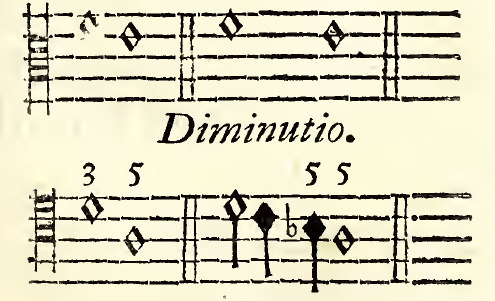 ▶ Fig. 4
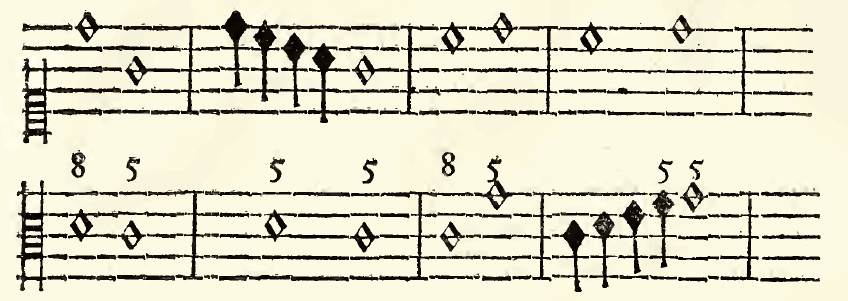 ▶ Fig. 5
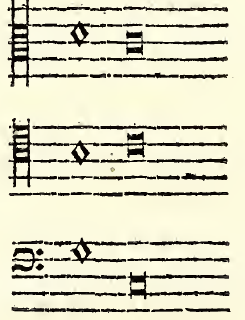 ▶ Fig. 101
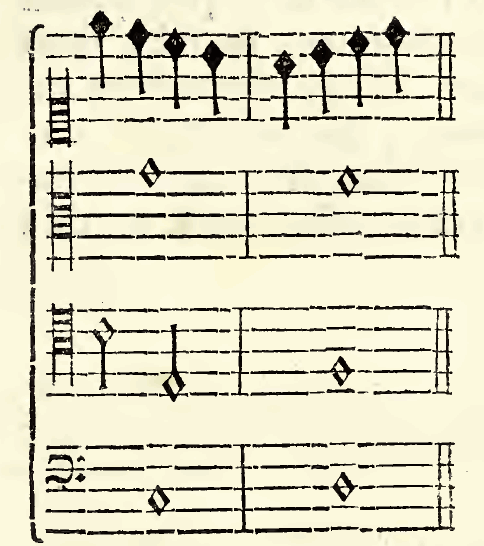 ▶ Fig. 191
 ▶ Fig. 197
 Exercises in Elementary CounterpointPercy Goetschius, 1910
- Chapter VII. Rhythmic Diversity. Two Notes To A Given Beat
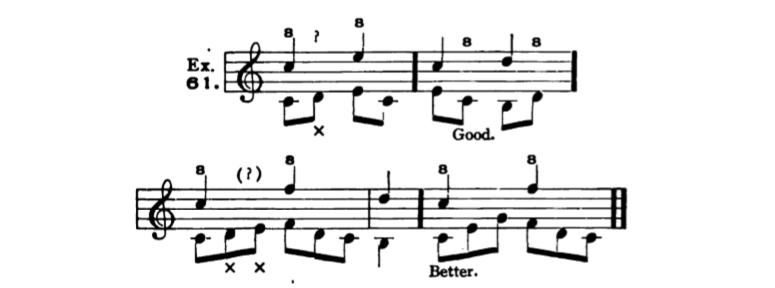
73. Rule 8. Successive octaves (which were proven objectionable in Ex. 34) are not rectified when separated by one unessential tone, but may be excused when an accented essential tone intervenes (or, possibly, when separated by two unessential tones). Thus:
▶ Fig. 109 nearby
 ▶ Ex.61
 Counterpoint AppliedPercy Goetschius, 1902
- Chapter XVIII
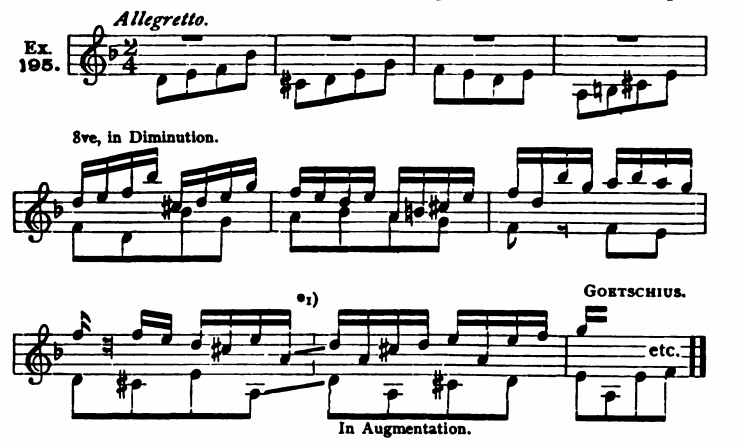
*1) The parallel octaves at the confluence of the parts are of course inevitable. From here on, the upper part is, practically, the Leader.
▶ Fig. 430 nearby
 ▶ Ex195
 Treatise on HarmonyJean-Philippe Rameau, 1722
Start: Chapter five → Start: Chapter seventeen →- CHAPTER NINE. On Avoiding Cadences while Imitating Them
X. It is sometimes appropriate to transpose parts an octave higher or lower to restore their natural range, provided this introduces neither two consecutive octaves nor two consecutive fifths.
- Chapter seventeen
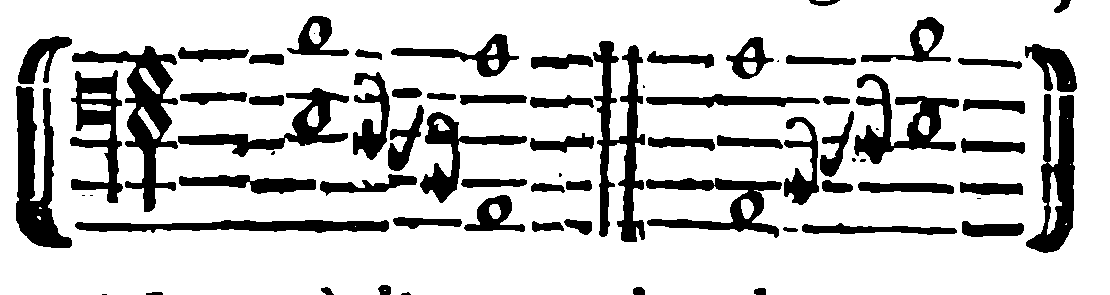
Hidden octaves and fifths were forbidden only to prevent extravagant part movements, especially with dissonance. With consonance, contrary motion easily avoids the fault. Yet these passages occur constantly in perfect and irregular cadences: hidden octaves in…
▶ Fig. 88 nearby - Chapter seventeen
…whether in moving major or minor thirds and sixths naturally or in avoiding consecutive octaves and fifths. We often think we see fifths or octaves that we do not hear. Masson* and others allow sixth-to-fifth movement as shown, though two fifths appear if the…
▶ Fig. 91 nearby - Chapter five
1. Never make two successive octaves or two successive fifths. This is easily recognized in the sequence of figures: the same part must never contain two octaves, 8 8, or two fifths, 5 5. As we can observe, this fault can now be avoided without requiring…
▶ Fig. 199 nearby - Chapter forty
…with the bass from those serving only melodic taste. If it leaps, they fear consecutive fifths or octaves with the fundamental bass, not knowing that the melody then follows the fundamental bass’s natural route. This is precisely why another bass must be…
▶ Fig. 322 nearby - SUPPLEMENT: changes to two chapters and necessary corrections
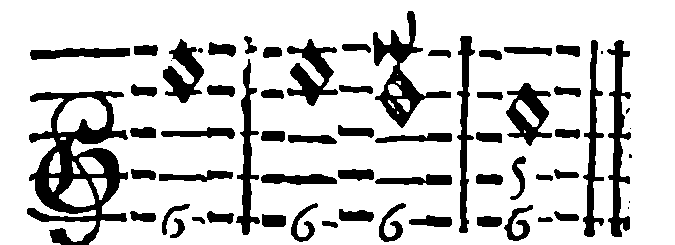
Page 104, lines 10–11: replace “consecutive octaves” with “consecutive octaves or fifths.”
▶ Fig. 464 nearby
 ▶ Fig. 88
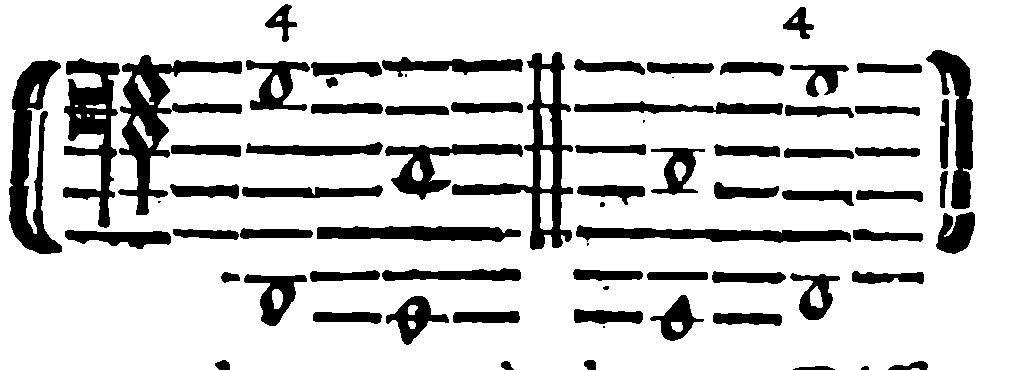 ▶ Fig. 89
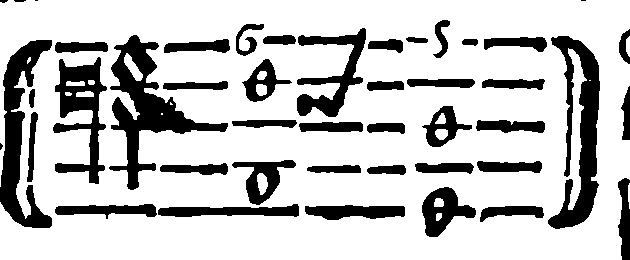 ▶ Fig. 91
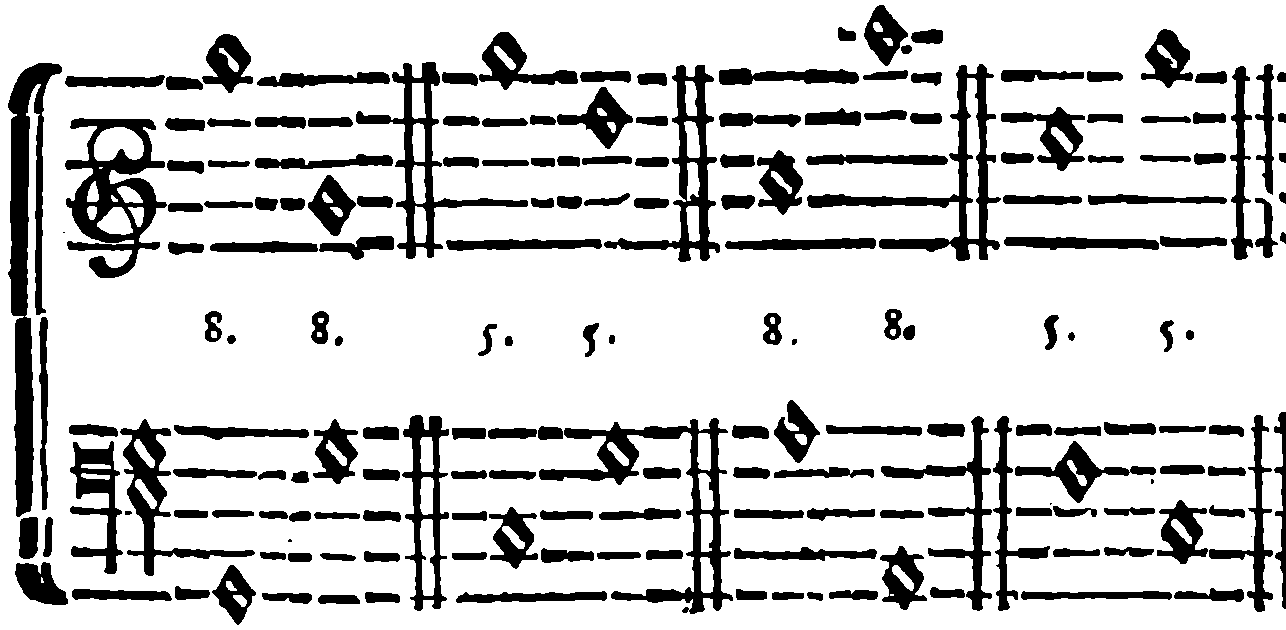 ▶ Fig. 199
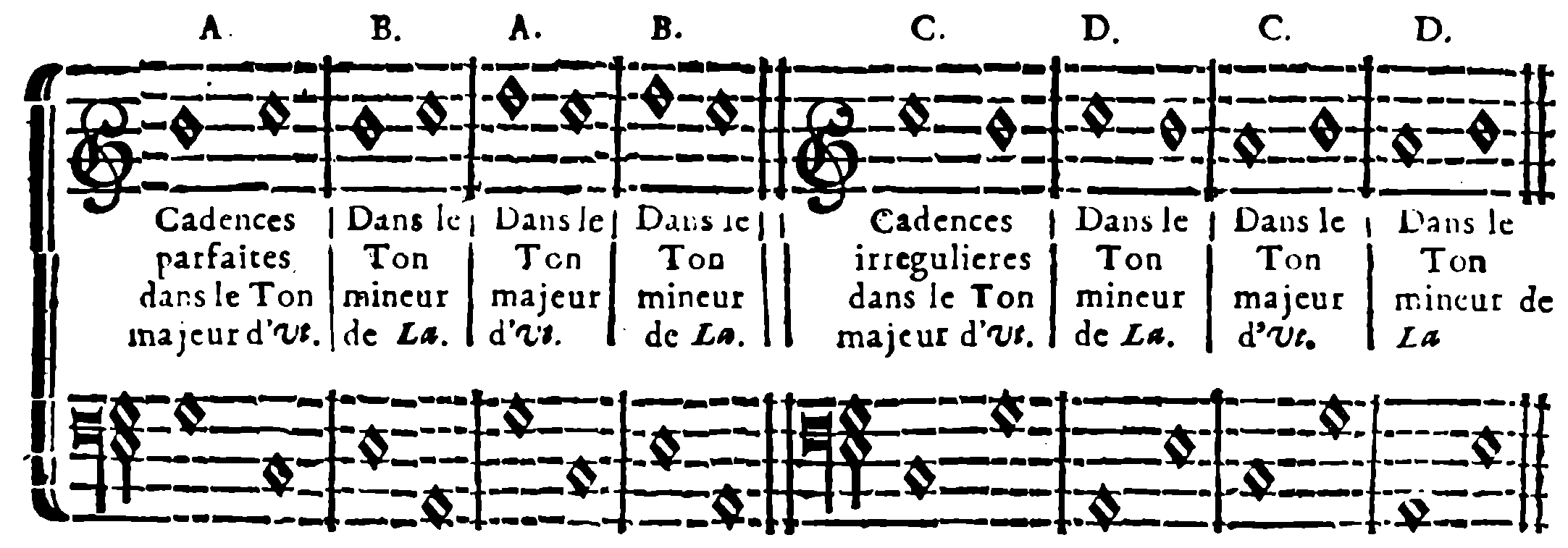 ▶ Fig. 322
 ▶ Fig. 464
 Practical Manual of HarmonyNikolai Rimsky-Korsakov, 1910
Start: Forbidden Motions →- Preface to the First Edition
…take to explain every harmonic fact — for example, the reasons that forbid consecutive fifths, and so on. But in truth they offer little or almost no teaching on how to harmonize a melody or how to choose chords well.
- Preface to the Third Edition
…among other things, the following material, which is needed in practice: hidden fifths and octaves, the plagal half cadence, the triad on the second degree and its seventh chord, ascending sequences, and some explanation of how to lay out a modulation plan.…
- Forbidden Motions
The parallel fifths and octaves, and the fifths and octaves by contrary motion, that arise in this case are strictly forbidden to the pupil; parallel unisons come under the same rules:
▶ Fig. 63 nearby - Succession of the Two Sixth Chords of the Fourth and Fifth Degrees
REMARK. — In this case, to avoid forbidden successions (parallel fifths), the sixth chord of the fourth degree must have its root in melodic position (in the soprano).
▶ Fig. 79 nearby - Assignment No. 9 · Footnote
(*) Direct motion bringing the outer parts to a perfect fifth or an octave is not allowed (hidden fifths and octaves).
▶ Fig. 94 nearby - Assignment No. 9 · Footnote
(**) Hidden octaves.
▶ Fig. 94 nearby
11 more passages in Practical Manual of Harmony →
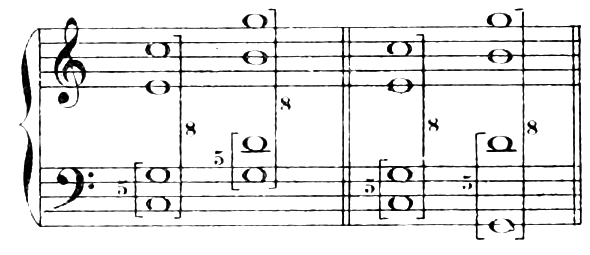 ▶ I–V with both chords in octave position: parallel fifths and octaves, then fifths and octaves by contrary motion (bracketed and marked 5 and 8)
Forbidden Motions ▶ Two-part illustrations, bracketed: parallel fifths, fifths by contrary motion, parallel octaves, octaves by contrary motion, parallel unisons, and unison to octave
Forbidden Motions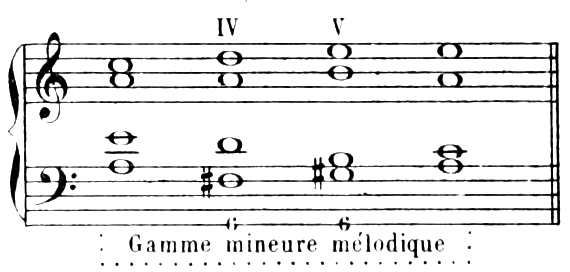 ▶ Minor-mode illustration of rule 3 (A minor): the bass of IV6 is raised to F sharp; caption 'Melodic minor scale'
Succession of the Two Sixth Chords of the Fourth and Fifth Degrees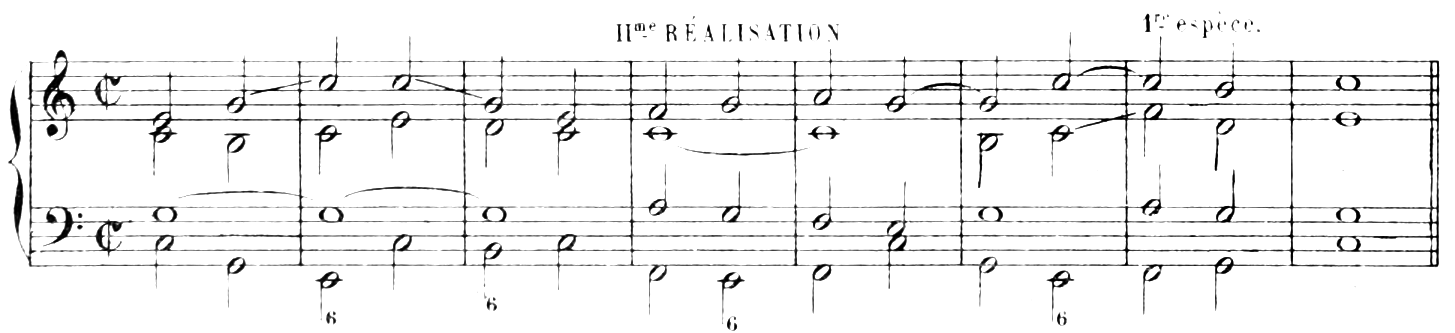 ▶ Model, second realization of the same melody, ending with a cadence of the first kind
Assignment No. 9
 Guide to the Practical Study of HarmonyPyotr Ilyich Tchaikovsky, 1900
- Introduction · Intervals
Pure Primes, Octaves and Fifths as well as major and minor Thirds and Sixths are consonances, the first three being termed perfect consonances, and the major and minor Thirds and Sixths imperfect consonances. Seconds, Sevenths and all augmented and diminished…
▶ Fig. 8 nearby - Chapter III. Connection of Triads, showing no External agreement
…the independent movement of the voices. Such forbidden progressions are Parallel Fifths and Octaves.
▶ Fig. 24 nearby - Chapter III. Connection of Triads, showing no External agreement
Remark.To comprehend clearly the reason for prohibiting parallel Fifths and Octaves, it must be borne in mind that we have to deal not with the massive harmonization of orchestra or piano composition, but with 4 separate independent voices, which do not permit…
▶ Fig. 24 nearby - Chapter III. Connection of Triads, showing no External agreement
lf we wish to connect two triads having no external relationship, we can not lead all the voices a second upwards or downwards, as parallel fifths and octaves would arise.
▶ Fig. 25 nearby - Chapter XVII. The Harmonization of a given melody
…importance of guarding from the very start against forbidden progressions of fifths and octaves. My prolonged experience has taught me, that no fault grows into a habit more easily than negligence in this respect. The ablest pupil will overlook a great number…
▶ Fig. 159 nearby - Chapter XXV. Passing-notes
At c) there are parallel fifths between Tenor and Bass; at d) likewise. At e) a seventh is formed between Soprano and Bass: there are also parallel fifths. At f) a ninth is formed between Soprano and Tenor; between Soprano and Bass there are even two ninths in…
▶ Fig. 263 nearby
21 more passages in Guide to the Practical Study of Harmony →
 ▶ Fig. 8
 ▶ Fig. 24
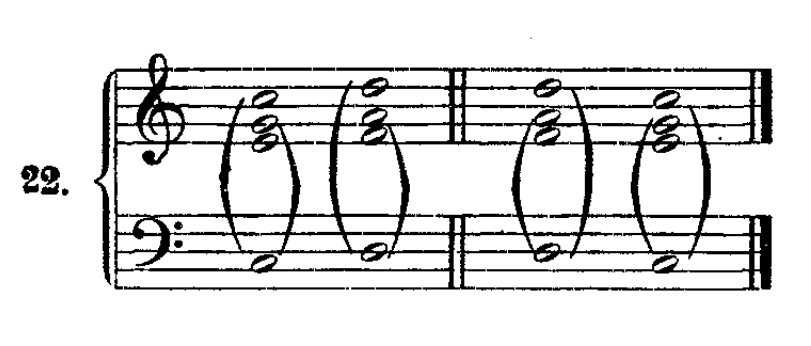 ▶ Fig. 25
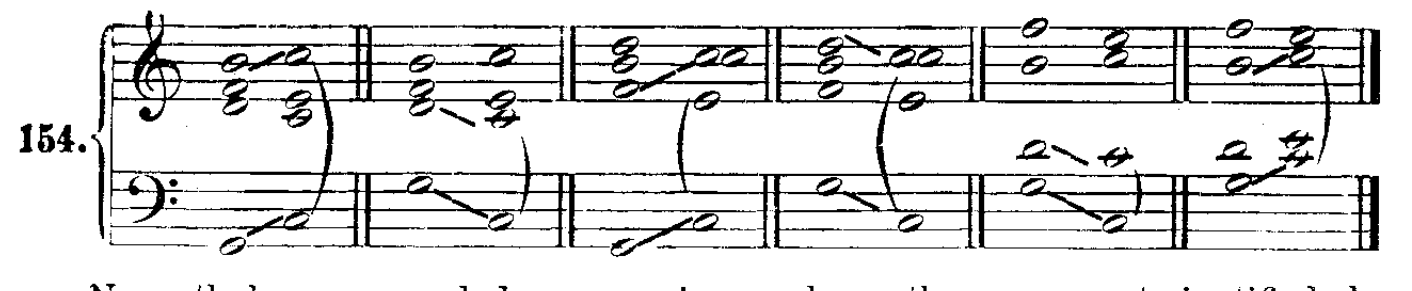 ▶ Fig. 159
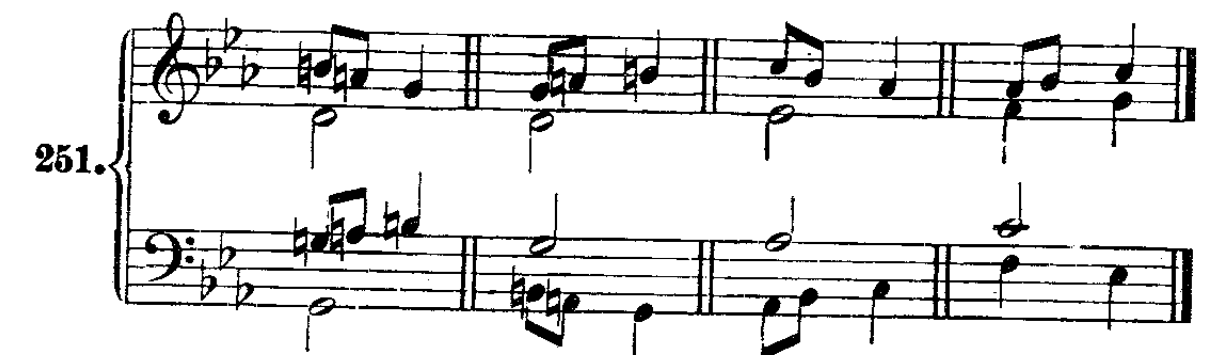 ▶ Fig. 263
 Theory of HarmonyArnold Schoenberg, 1922
Start: Parallel octaves and fifths →- Parallel octaves and fifths
This version also prohibits what are called hidden parallel octaves and hidden parallel fifths. It could also be formulated thus: when two voices, starting from any intervallic relationship—including that of a fifth or octave—meet in an octave or fifth through…
▶ Fig. 28 nearby - Parallel octaves and fifths
Open parallel octaves or fifths were unconditionally forbidden, but certain hidden ones were permitted under specified conditions. Above all, those that could not be avoided: necessity knows no prohibition! Among octaves*), these include those that almost…
▶ Fig. 29 nearby - Parallel octaves and fifths
Exceptions were therefore established: hidden octaves or fifths are conditionally permissible when they are less conspicuous because they occur between two inner voices, or at least between an inner and an outer voice. And: hidden octaves are better when one…
▶ Fig. 30 nearby - Parallel octaves and fifths
…independence of the voices is abolished. It may not be incorrect that, with parallel octaves, the voices’ independence seems lost at the single moment of progression. But the assertion that they sound bad—or, worse, that they sound bad because the voice’s…
▶ Fig. 30 nearby - Parallel octaves and fifths
…for reasons of sonority can naturally never arise. We shall therefore avoid parallel octaves entirely in our exercises. We shall do so also for the reason already suggested, which will answer in the same negative sense the question of whether to write parallel…
▶ Fig. 31 nearby - Parallel octaves and fifths
It was probably the same here. When the coercion of the guild joins the joy of achievement, the child of this marriage can only be orthodoxy. No longer needing to establish what has newly been attained, orthodoxy finds its task in preserving it through…
▶ Fig. 31 nearby
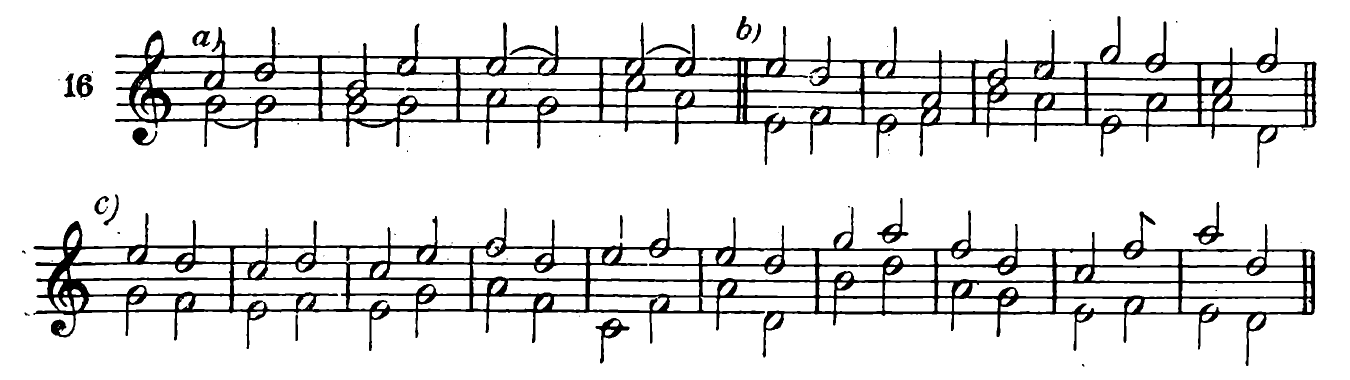 ▶ Example 16a
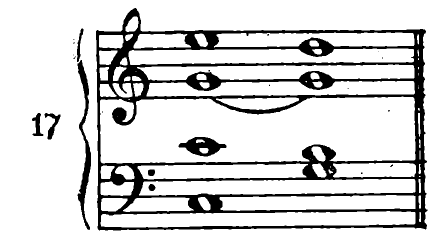 ▶ Example 17
 ▶ Example 19a
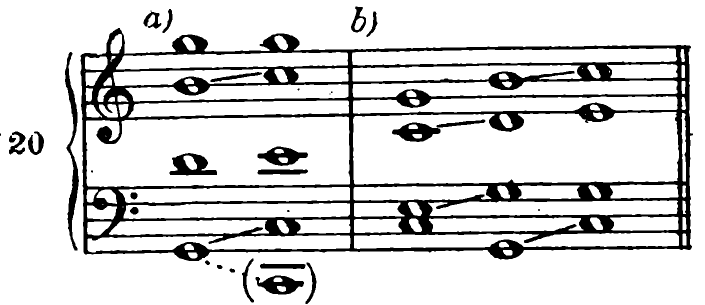 ▶ Example 20a
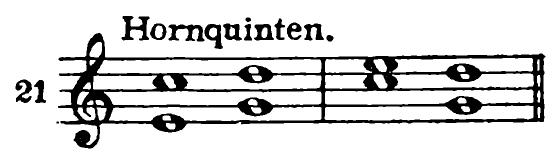 ▶ Example 21 — horn fifths
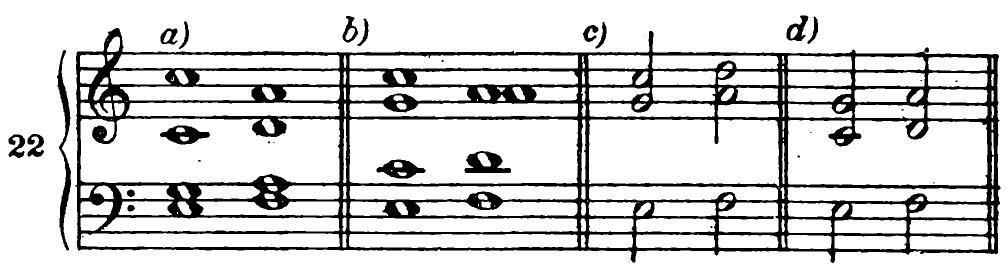 ▶ Example 22a
 Principles of OrchestrationNikolai Rimsky-Korsakov, 1922
- Number of harmonic parts—Duplication
Consecutive octaves between the upper parts are not permissible:
▶ Fig. 34 nearby - Number of harmonic parts—Duplication
Consecutive fifths resulting from the duplication of the three upper parts moving in chords of sixths are of no importance:
▶ Fig. 35 nearby
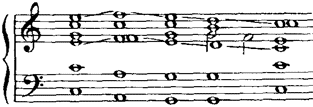 ▶ Fig. 34
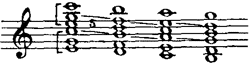 ▶ Fig. 35
 OrchestrationCecil Forsyth, 1914
- Stringed instruments
…able to accompany the unison choral melodies with those forbidding series of fifths and octaves which satisfied the same craving in the early middle ages as Wagner's harmony satisfied in the nineteenth century. These series of fifths and octaves are known to…
- Stringed instruments
…to e strings: indeed their only object was to produce the tearsome series of fifths and octaves which made up the "organum" of those very dark ages.
- No. 49. The Cello
…the Cellos again. However, if the two lower parts are merely playing in fifths and octaves, there is not so much danger of the unpleasant clash of overtones resulting from the divided Bass-parts. If the Basses are divided it is always better for safety's sake…
- No. 51. The Double-Bass.'
…in two parts divisi. A narrow exception may be made in favour of those fifths and octaves which have one open string. The list is as follows:
More in Counterpoint
Species counterpoint · Cantus firmus · Consonance and dissonance · Contrary, oblique and similar motion · Voice leading · The melodic line