 Playable Books
Concept index · Counterpoint
The melodic line
Taught in 9 books. Each one opens at the passage; ▶ plays the example beside it. Also called melody, melodic leap.
This index is Playable Books’ own: a first pass that finds the term’s words in each book, corrected by hand. The authors did not tag these passages, and their terms can differ (Fux’s “ligature” is a suspension). The quoted text is the book’s.
 Gradus ad ParnassumJohann Joseph Fux, 1725
- First species counterpoint: note against note
Joseph. Because otherwise I would have had to proceed continually by similar motion up to that point, with a less graceful melodic line.
▶ Fig. 13 nearby - Fourth species counterpoint: syncopation and suspensions
Aloysius. You have exercised quite prudent judgment, for no little allowance must be made both for the melodic line and for the grace of the progression. Continue.
▶ Fig. 74 nearby - Fifth species counterpoint: florid counterpoint
…pleases me no little is that you have devoted considerable attention to the melodic line and that, on entering the thesis, you have generally used oblique motion or syncopation. I wish to commend this practice to you further, because it adds very great grace…
▶ Fig. 85 nearby - Fifth species counterpoint: florid counterpoint
…at the beginning of a measure without a ligature immediately following, the melodic line seems to limp. Therefore, if you wish to use only two semiminims at the beginning of a measure, it will be more advisable to bind them to a following ligature, or to ease…
▶ Fig. 90 nearby - First species in three voices
Aloys. Sometimes a more graceful melodic line calls for another consonance, either a sixth or an octave, in place of the triad. More often, the need to avoid two perfect consonances in immediate succession requires us to depart from the triad and use a sixth…
▶ Fig. 92 nearby - First species in three voices
…if you look a little more closely, you will find that the octave serves the melodic line better. As I have often said, and shall have to say still more often, great weight must be given to the melody. One example remains to be completed, with the cantus firmus…
▶ Fig. 106 nearby
5 more passages in Gradus ad Parnassum →
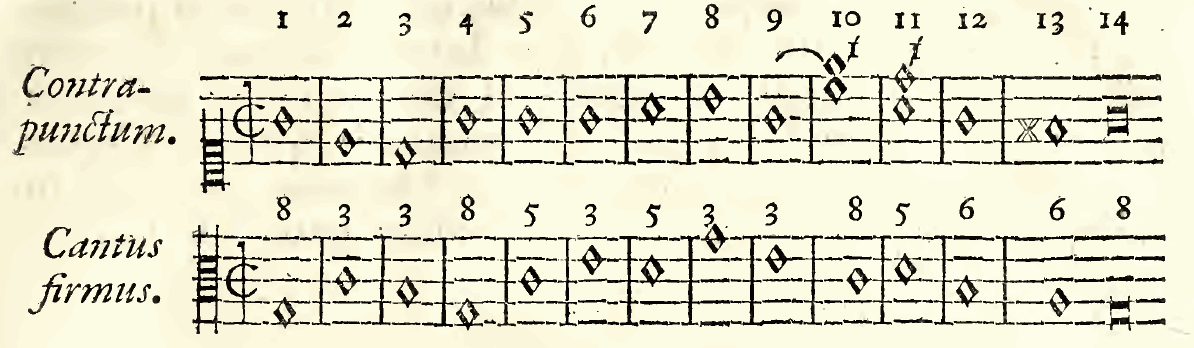 ▶ Fig. 13
First species counterpoint: note against note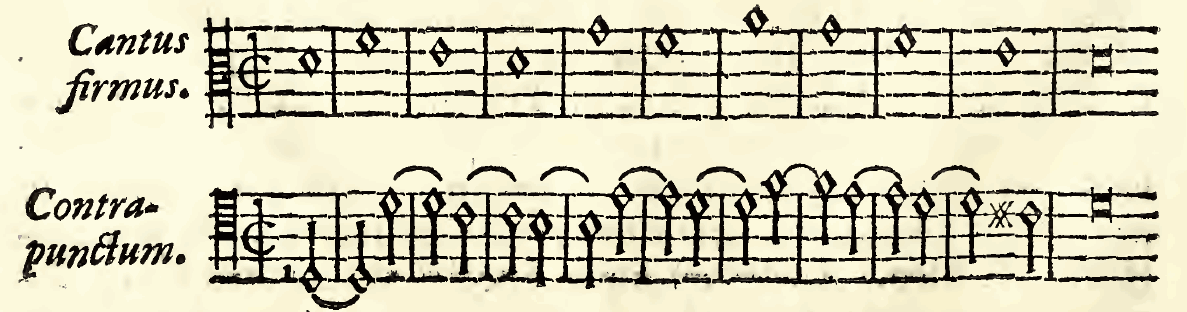 ▶ Fig. 74
Fourth species counterpoint: syncopation and suspensions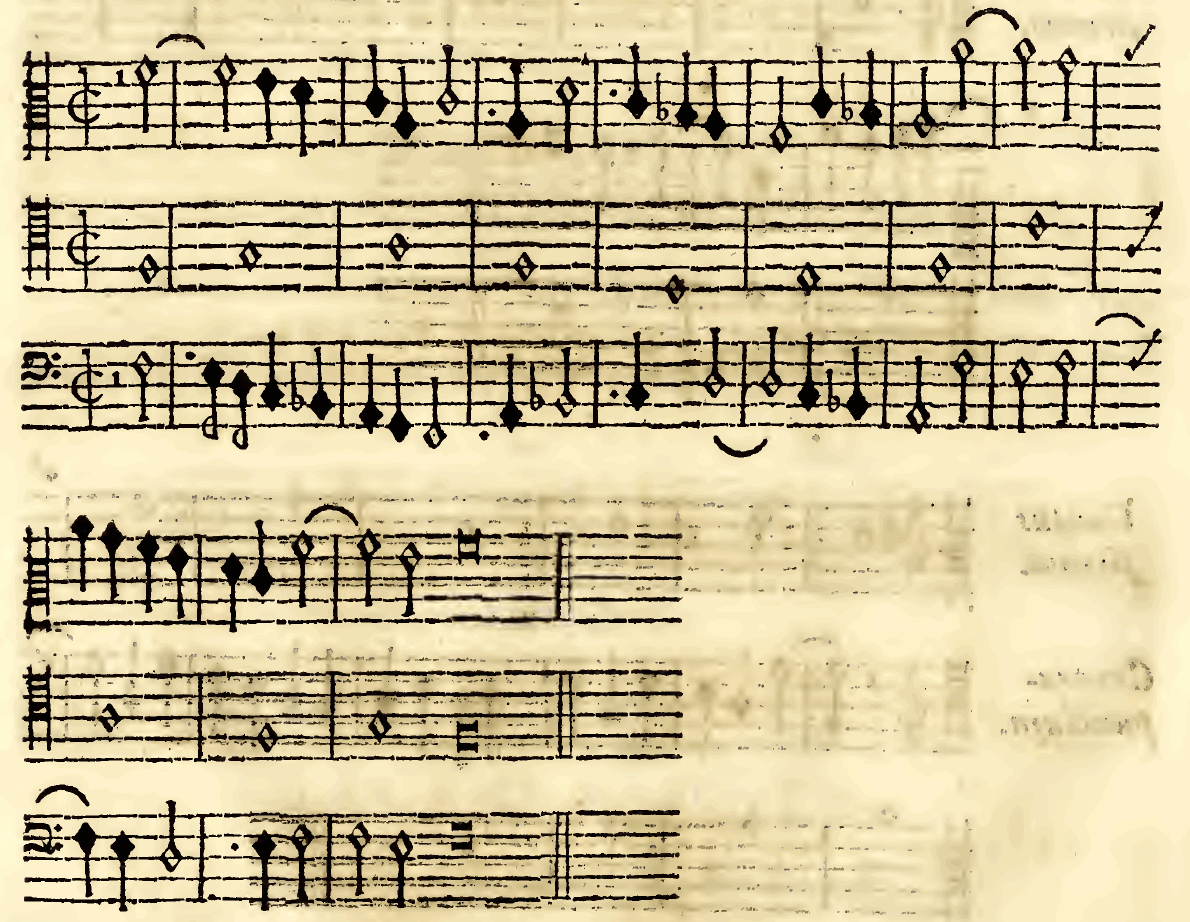 ▶ Fig. 85
Fifth species counterpoint: florid counterpoint ▶ Fig. 90
Fifth species counterpoint: florid counterpoint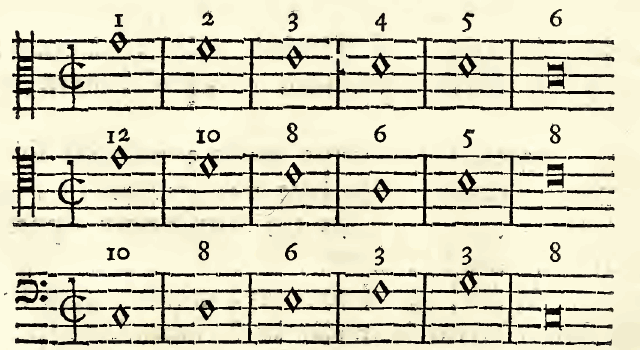 ▶ Fig. 92
First species in three voices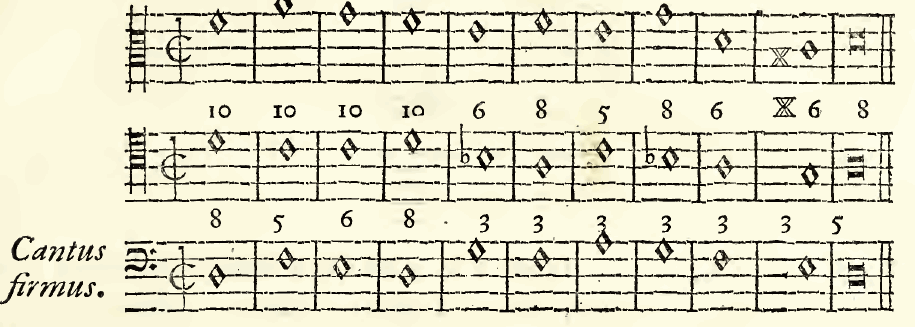 ▶ Fig. 106
First species in three voices
 Exercises in Elementary CounterpointPercy Goetschius, 1910
Start: Chapter I. The Single Melodic Line →- Chapter IV. The Association Of Two Melodic Lines · 27 playable examples
- Introduction
…yet are sufficiently independent of each other to present really different melodic lines. Briefly defined:
▶ Fig. 5 nearby - Chapter I. The Single Melodic Line
…first consideration, for the beginner, is the correctness of each separate melodic line, independently of the other, or others. Each line, sung or played alone, must produce a satisfactory melodic impression.
▶ Fig. 6 nearby - Chapter I. The Single Melodic Line
…good melodic movement. He must acquire the ability to judge the quality of a melodic line, and to avoid any tone-progression which is unnatural,—that is, which violates the natural conditions of Melody (smooth, rational, congruous, well-balanced and…
▶ Fig. 6 nearby - Chapter IV. The Association Of Two Melodic Lines
…that each part, the given one and the added one, must describe a faultless melodic line (see par. 44). But it also depends partly upon the underlying harmonic result, — for the implied chord-successions must also be natural and rational.
▶ Fig. 40 nearby - Chapter IV. The Association Of Two Melodic Lines
…counterpoint is to be no such artless multiplication of one and the same melodic line, but the harmonious association of independent and individually perfect melodies, the following rule must be observed:
▶ Fig. 43 nearby - Chapter V. The Minor Mode
It is simply necessary, in minor, to guard the melodic progressions more carefully, and to be sure that each part, alone, is a perfectly acceptable melodic line.
▶ Fig. 67 nearby
 ▶ Ex.5
 ▶ Ex.6
 ▶ Ex.7
 ▶ Ex.32
 ▶ Ex.35
 ▶ Ex.42
 Counterpoint AppliedPercy Goetschius, 1902
Start: Chapter I →- Chapter I
…melody is, to lead each single part as smoothly and evenly as possible. CONJUNCT MOVEMENT (that is, stepwise ascending or descending progression along the line of the prevailing scale) is therefore preferable to disjunct movement (that is, by leap or skip), as…
▶ Fig. 1 nearby - Chapter I
* An exhaustive exposition of the fundamental laws of melodic progression may be found in the author's " Exercises in Melody-Writing " Thorough understanding of Chapters I-V of that book will facilitate (possibly supersede) the study of the above chapter.
▶ Fig. 1 nearby - Chapter I
2. Diatonic conjunct movement is preferable to chromatic.
▶ Fig. 1 nearby - Chapter I
3. Disjunct progressions are qualified as narrow leaps (major or minor 3rds), and wide leaps (all skips beyond the intervals of the 3rd).
▶ Fig. 5 nearby - Chapter I
Such evidences of harmonic design are most palpable in melodies in disjunct movement (i.e., with many skips); but are more vague in melodies in preponderantly conjunct movement. Hence it is that, according to the rule of par. I, conjunct or stepwise…
▶ Fig. 62 nearby - Chapter II
…influence of the original harmonic principles is chiefly exhibited wherever disjunct movement is employed; but it is never absent, and is the remote power which directs even conjunct movements. The laws of harmonic (chord) succession may be summarized as…
▶ Fig. 86 nearby
 ▶ Ex1
▶ Ex1 ▶ Ex2-1
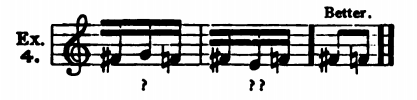 ▶ Ex4
▶ Ex4 ▶ Ex37-4
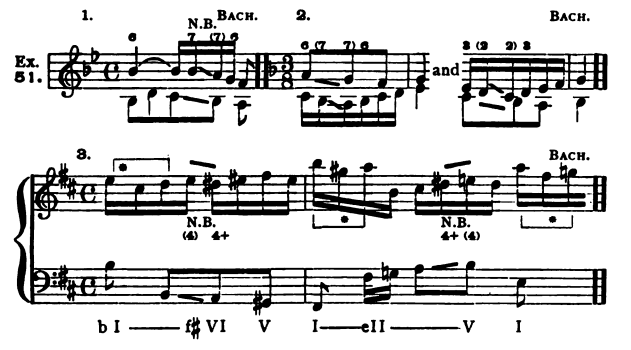 ▶ Ex51
 Treatise on HarmonyJean-Philippe Rameau, 1722
- Table Explaining Essential Terms
CONJUNCT. Conjunct progression or steps include diatonic and chromatic motion.
- Table Explaining Essential Terms
DISJUNCT. Disjunct progression includes consonant and dissonant motion.
- Table Explaining Essential Terms
See Fundamental Bass, Cadence, String, Harmony, Music, Proportion, Ratio, Consonance, Dissonance, Chromatic, Diatonic, Conjunct, and Disjunct.
- BOOK TWO. On the Nature and Properties of Chords, and Everything That Can Serve to Make Music Perfect
…is, farther apart than those of the other parts—so that they can proceed by conjunct movements, especially the part forming the soprano, because this is its property, and so forth. Yet compare so clear and accurate a definition of harmony's fundamental part…
- Chapter twenty-five
…whose final note provides a melodic repose in relation to a new consonant or disjunct progression beginning again.
▶ Fig. 261 nearby - Chapter twenty-five
…within that diatonic progression, and its interruption by consonant or disjunct movement must unfailingly reveal that note’s place in the present key or in the key that may replace it. Admittedly, the consonant interval preceding diatonic movement is less…
▶ Fig. 262 nearby
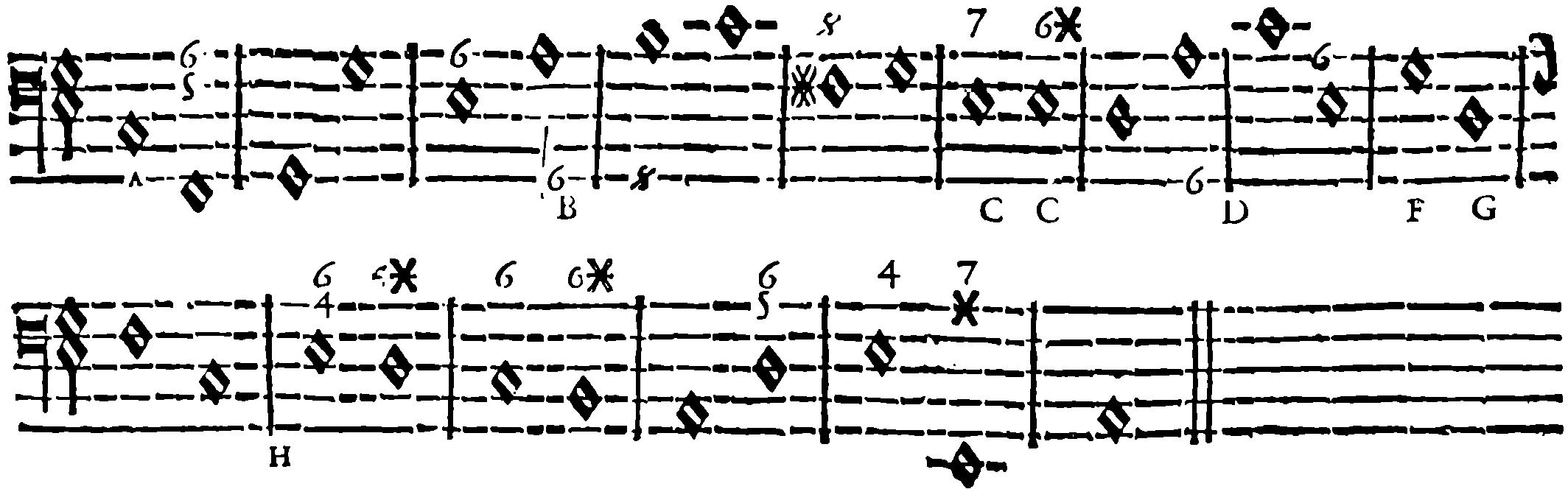 ▶ Fig. 261
 ▶ Fig. 262
 Practical Manual of HarmonyNikolai Rimsky-Korsakov, 1910
- Disjunct Motion of the Thirds of Chords · 1 playable example
- Disjunct Motion of the Thirds of Chords
3) After the disjunct motion, proceed in the opposite direction by the interval of a second or a third:
▶ Fig. 95 nearby - Melodic Ornamentation in the Strict Style
Disjunct motion of the parts does not allow suspensions to be formed, just as conjunct motion gives no occasion for passing notes. Both are obtained by means of a leap in one of the parts to one of the consonant notes of the chord:
▶ Fig. 305 nearby - On the Figured Chorale, and the Harmonization of a Melody Containing Melodic Ornamentation
d) Disjunct motion after the resolution of suspensions:
▶ Fig. 320 nearby - Melodic Ornamentation in the Free Style
2) Auxiliary notes on the strong and weak beats of the bar, or on the strong and weak parts of a beat, arising from disjunct motion; those on the strong beat or on the strong part of a beat are also called unprepared suspensions or appoggiaturas:
▶ Fig. 328 nearby - General Notions
2) In these successions, conjunct motion of the parts and harmonic connection are obligatory.
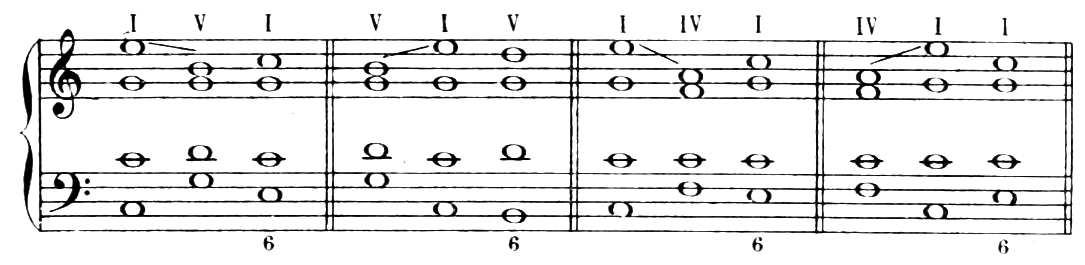 ▶ Four examples in C major: the soprano leaps by a fourth or fifth from the third of one chord to the third of the next (I–V, V–I, I–IV, IV–I), then turns back by step or third into a I6 or V6
Disjunct Motion of the Thirds of Chords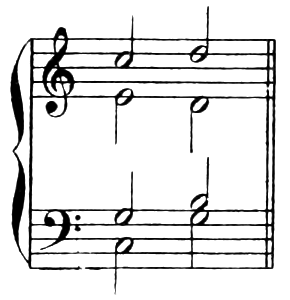 ▶ [Example]
Melodic Ornamentation in the Strict Style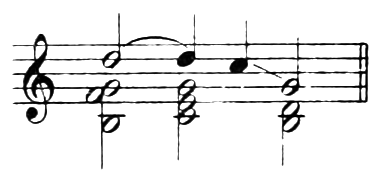 ▶ [Example]
On the Figured Chorale, and the Harmonization of a Melody Containing Melodic Ornamentation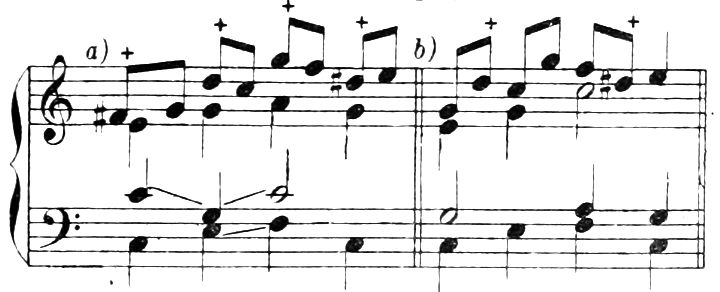 ▶ [Example]
Melodic Ornamentation in the Free Style
 Guide to the Practical Study of HarmonyPyotr Ilyich Tchaikovsky, 1900
- Chapter XVI. Chords of sequence in minor
…quite at variance with the real purpose of resolution. For, it is only by a melodic progression of the dissonance downward into a consonance, that our musical susceptibilities, disturbed by that dissonance, are quitted.
▶ Fig. 140 nearby - Chapter XXIX. Strict Part-writing
§ 113. Regarding the melodic progression of the voices the following should be observed: Strict part-writing admits, jumps of octaves, minor sixths,—pure fifths and fourths, major and minor thirds—jumps of major sixths are to be avoided. Jumps of dissonant…
▶ Fig. 324 nearby
 ▶ Fig. 140
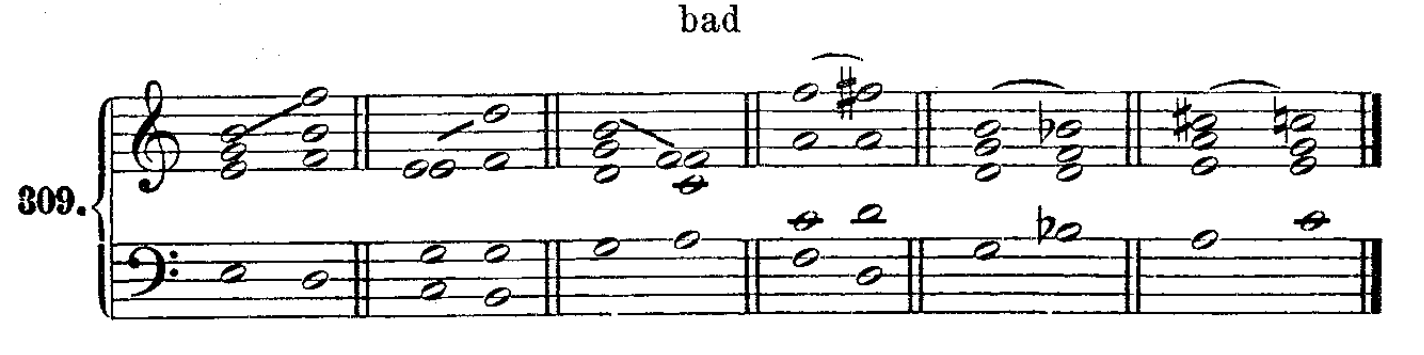 ▶ Fig. 324
 Theory of HarmonyArnold Schoenberg, 1922
- Writing Short Chord Progressions
…melodic practice. They would scarcely agree completely even with the melodic lines of Haydn, Mozart, and Beethoven, let alone those of Schumann, Brahms, or Wagner. But one should remember that, as already mentioned, melody does not fully enter into the working…
▶ Fig. 16 nearby - Writing Short Chord Progressions
One of these instructions reads: two melodic leaps in the same direction, of the size of a fourth or a fifth, should be avoided because the outermost notes form a dissonance. Or, stated somewhat more generally: two interval leaps in the same direction that add…
▶ Fig. 16 nearby - Writing Short Chord Progressions
…sound together, in a chord, but also when they occur successively, in the melodic line; that it does not grasp them as quickly, experiences them as an impediment, and wishes for their removal, their resolution. It may at most admit them for the sake of their…
▶ Fig. 16 nearby - Degree VII
…upper voice makes a leap here, some attention will have to be paid to its melodic line. This will be done shortly. In 12d, by contrast, whether the alto leaps upward or downward, the distance between two adjacent voices would be too great: in the first case…
▶ Fig. 20 nearby - Connecting Triads and Sixth Chords
In deciding whether to choose a first-inversion chord or root position, the melodic line of the bass must naturally also be considered. In general the bass should, if possible, avoid remaining on one note. Sometimes this can be avoided, as in example 26a, by…
▶ Fig. 43 nearby - Seventh chords
…be imagined as follows. Suppose a voice has to sing the succession F–E. This melodic step could be accompanied by two chords, F by degree IV, for instance, and E by I. If at some point one wished to make this step stronger by presenting it as the result of a…
▶ Fig. 50 nearby
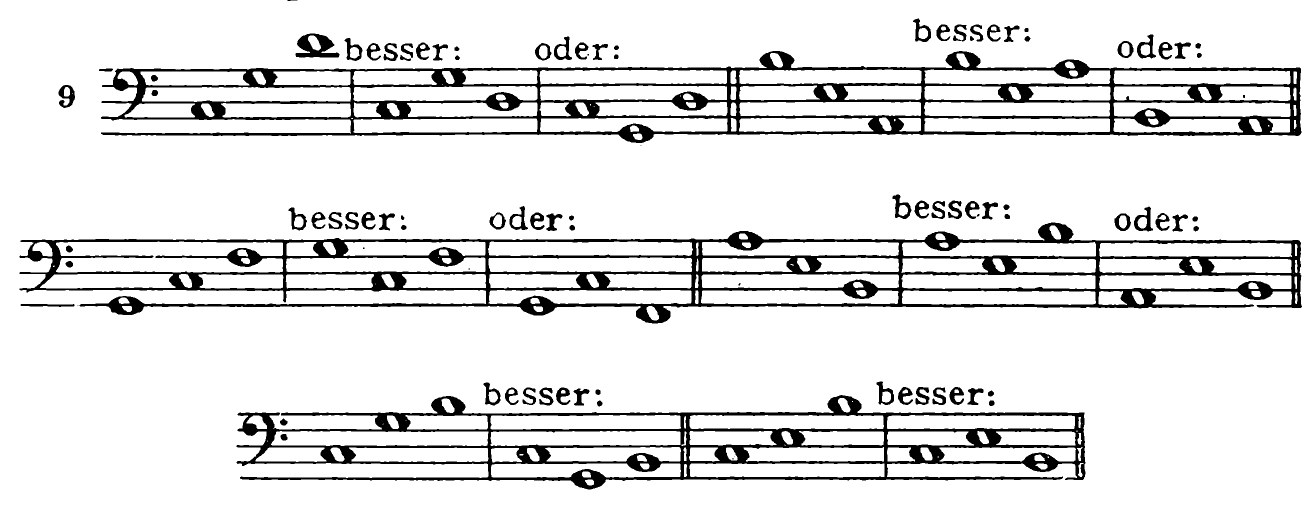 ▶ Example 9 — group 1
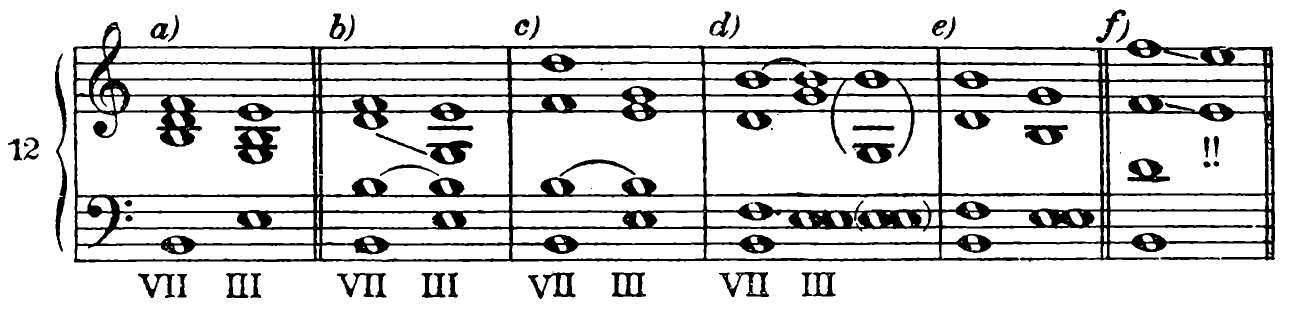 ▶ Example 12a
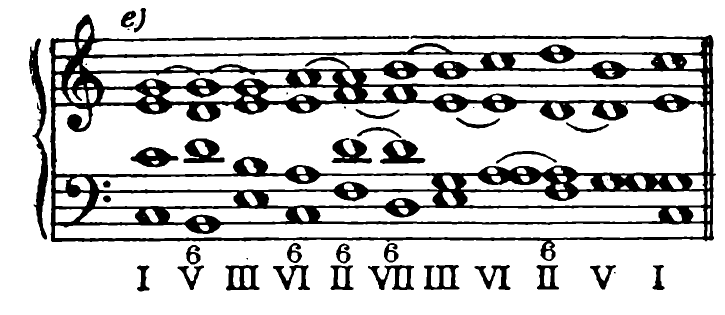 ▶ Example 26e
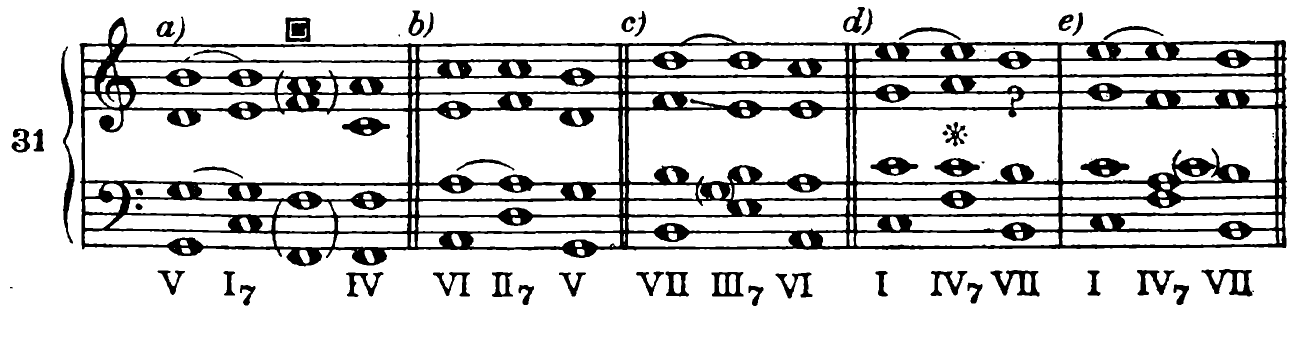 ▶ Example 31a–e — primary readings
 Principles of OrchestrationNikolai Rimsky-Korsakov, 1922
- Wood-wind
…be aroused by one single isolated timbre; it depends more upon the general melodic line, the harmony, rhythm, and dynamic shades of expression, upon the whole formation of a given piece of music. The choice of instruments and timbre to be adopted depends on…
- Melody in stringed instruments
…taken independently, is qualified to assume full responsibility for the melodic line.
- Melody in thirds and sixths
Melodic progression in thirds and sixths demands either two instruments of the same colour (2 Fl., 2 Ob., 2 Cl., 2 Fag.), or instruments of different colours in the normal order of register:
▶ Fig. 24 nearby - 1. In unison (juxtaposition or contrast of tone qualities)
This class of combination possesses the same features as combinations in the melodic line (cf. Chap. II). Wood-wind reinforces the brass, softens it and reduces its characteristic qualities. Arrangements such as the following are possible:
▶ Fig. 106 nearby - Method of emphasising certain notes and chords
…decrescendo and sf, chords of 2, 3, and 4 notes can be inserted into the melodic progression by the instruments of the string quartet, each playing a single note; short notes in the wood-wind may also be used as well as a chain of three or four grace notes, in…
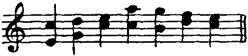 ▶ Fig. 24
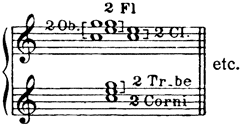 ▶ Fig. 106
 Treatise on InstrumentationHector Berlioz, 1905
- Foreword by Richard Strauss
…and basses also take part in the soulful enunciation of beautifully curved melodic lines. This is the secret of the wonderful tone-poetry in the scores of “Tristan” and ‘‘Meistersinger’ as well as of the “Siegfried Idyll”, which was written for “small…
- Clarinets
This is beautifully felt, but it is somewhat onegradations of feeling if the registers are properly employed, the melodic lines skillfully formed
- Voices
…wants to add the range of one voice to that of another in a descending melodic line, he must not let a mass of heavy timbres suddenly follow one of lighter quality because the joining-point would be too apparent. In such cases it is better to let the upper…
- On Conducting
…is terrible, the orchestra lacks assurance, the violins have spoiled the melodic line; nobody has vigor and fire, the tenor has made mistakes, he does not know his part; the harmonies are confused; the composer does not know how to write accompaniments for…
More in Counterpoint
Species counterpoint · Cantus firmus · Consonance and dissonance · Contrary, oblique and similar motion · Parallel fifths and octaves · Voice leading