 Playable Books
Concept index · Counterpoint
Voice leading
Taught in 8 books. Each one opens at the passage; ▶ plays the example beside it. Also called part writing.
This index is Playable Books’ own: a first pass that finds the term’s words in each book, corrected by hand. The authors did not tag these passages, and their terms can differ (Fux’s “ligature” is a suspension). The quoted text is the book’s.
 Counterpoint AppliedPercy Goetschius, 1902
- Chapter X
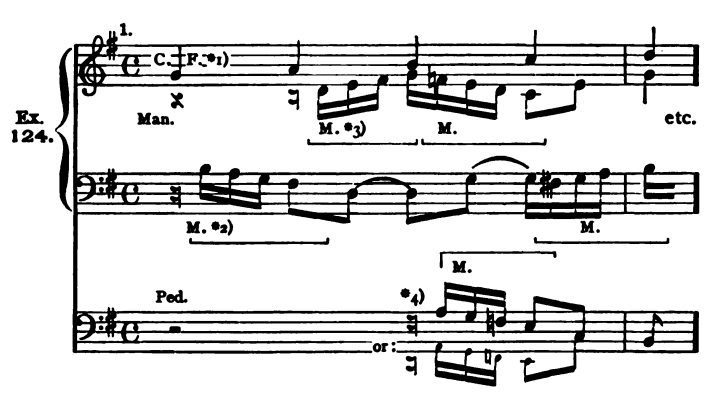
…as ingeniously as possible and elaborately as desired, in ordinary 4-part writing (with or without Pedal-bass), after the manner of the following:
▶ Fig. 269 nearby
 ▶ Ex124-1
 Analysis of J. S. Bach’s Forty-Eight FuguesEbenezer Prout, 1910
- Introduction
Bach's part-writing, in the fugues, is as absolutely clear and definite as though each part were given to a separate voice or instrument. The student who desires to obtain a thorough insight into them could not possibly devise a better exercise than to write…
- Fugue 15 · Book I, No. 15 · BWV 860
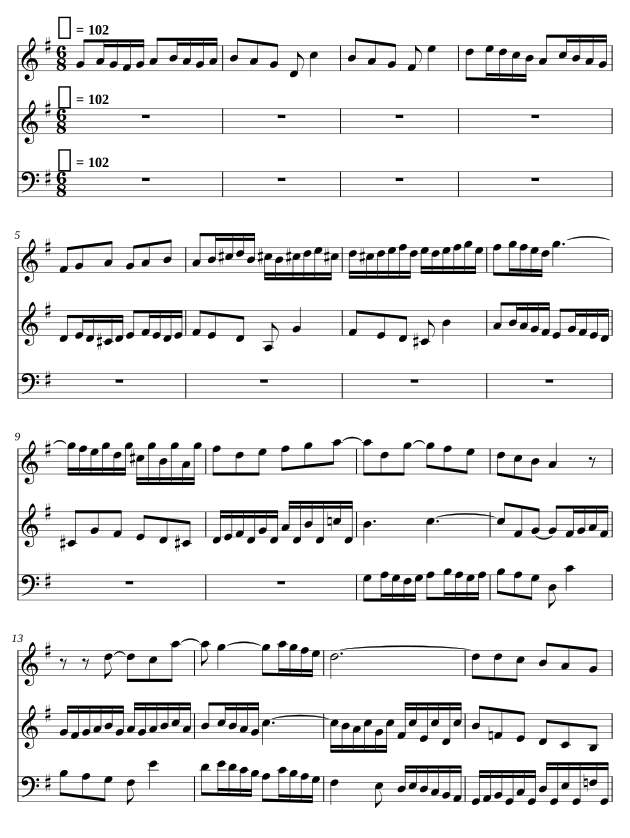
…treble) are analogous to the preceding ones, but in D major, with the lower voice leading, and with an added counterpoint. The fifth episode (bars 64 to 69) is yet another variation of the first, with different distribution of the parts.
▶ Fig. 41 nearby - Fugue 22 · Book I, No. 22 · BWV 867
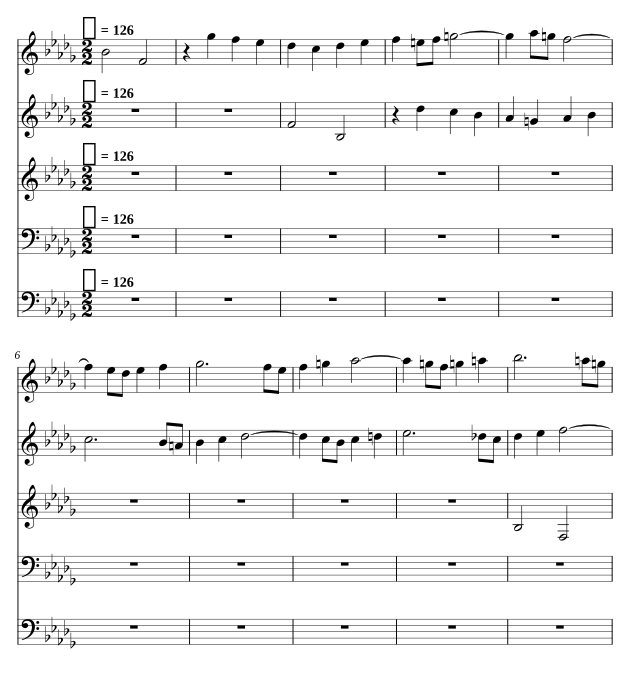
The fugue is a masterly specimen of five-part writing, though less elaborate in structure than No. 4.
▶ Fig. 55 nearby - Fugue 41 · Book II, No. 17 · BWV 886
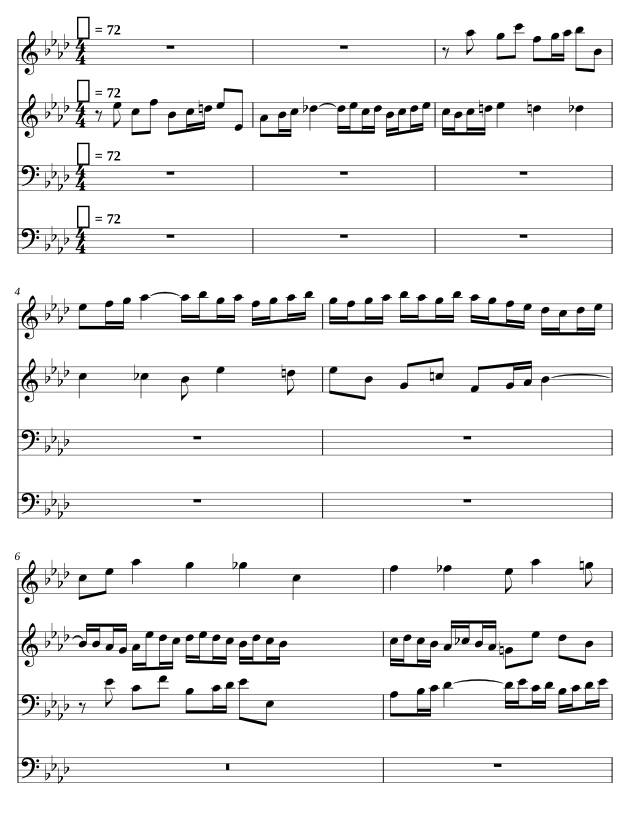
Although nominally a four-part fugue, there is a great predominance of three-part writing, less than one-third of the whole being really in four parts.
▶ Fig. 96 nearby - Fugue 46 · Book II, No. 22 · BWV 891
…the former is in the original key, between tenor and alto, the lower voice leading; the latter in the relative major, between treble and bass, the higher voice leading; the countersubject is absent. Bars 42 to 62 constitute an irregular counter-exposition,…
▶ Fig. 106 nearby
 ▶ Complete score
 ▶ Complete score
 ▶ Complete score
 ▶ Prout’s excerpt · Fugue 46
 Treatise on HarmonyJean-Philippe Rameau, 1722
Start: Chapter four →- Chapter eighteen
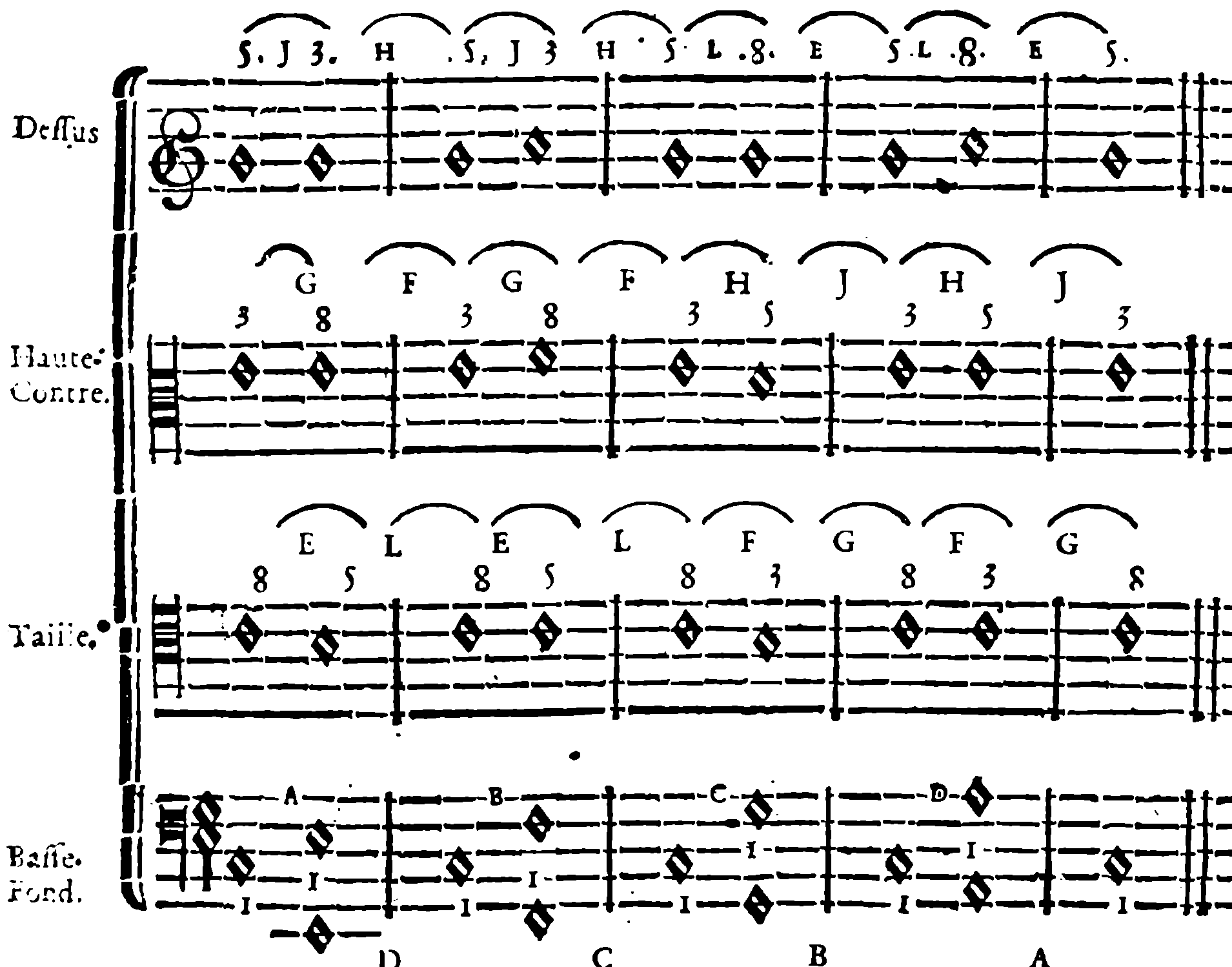
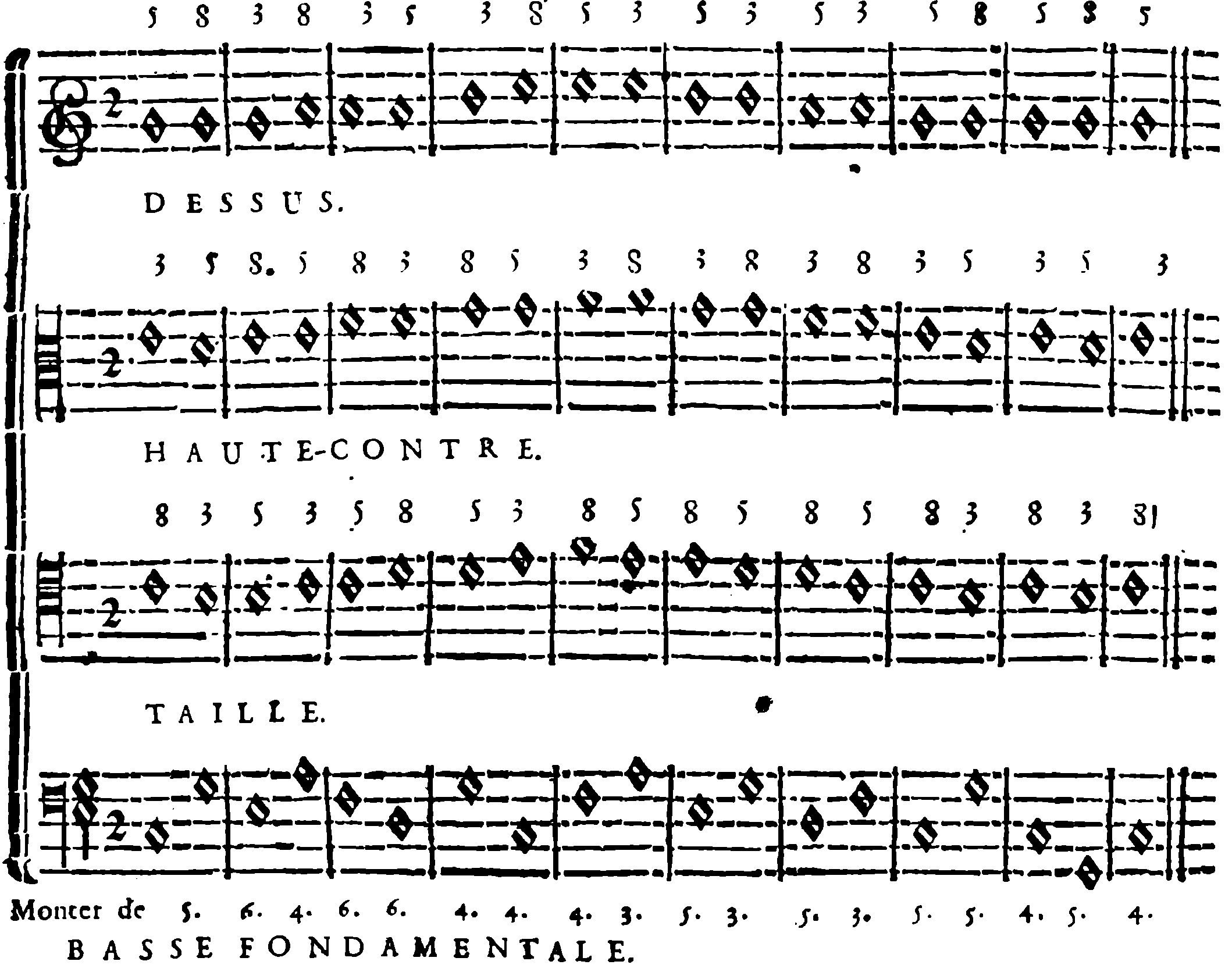
7. This bass is added only as proof. Do not dwell on voice-leading faults, such as consecutive octaves, that arise with it but do not occur among the already composed parts.
▶ Fig. 98 nearby
 ▶ Fig. 98
 ▶ Fig. 196
 ▶ Fig. 198
 Guide to the Practical Study of HarmonyPyotr Ilyich Tchaikovsky, 1900
Start: Chapter XI. Free Voice-Leading →- Chapter XXIX. Strict Part-writing · 26 playable examples
- Chapter XXX. The further development of Voice-leading · 7 playable examples
- Table of contents
Chapter XI. Free Voice-Leading — 38
- Table of contents
Chapter XXIX. Strict Part-writing — 116
- Chapter XI. Free Voice-Leading
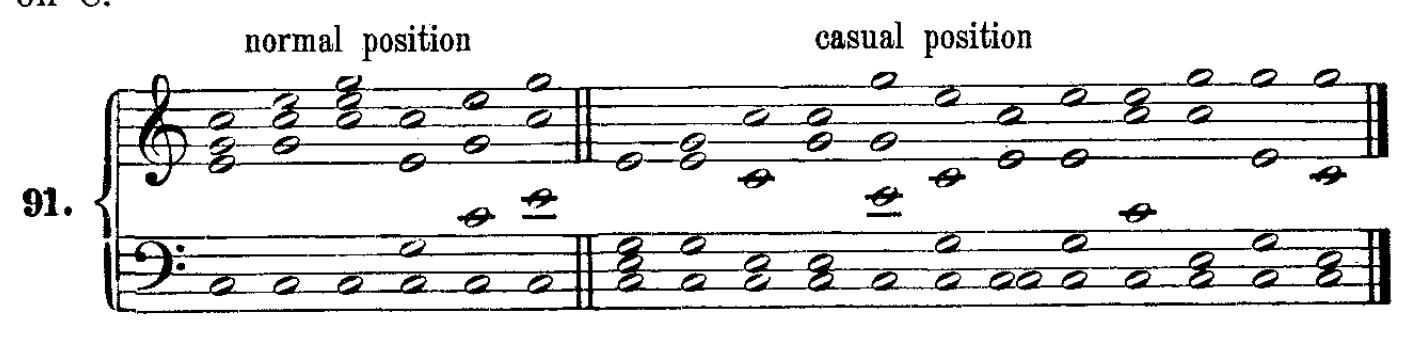
…in the character and independence ot the voices themselves—that is, in voice-leading which not only is not dependent on these two positions, but, on the contrary, gives rise to either one of them by reason of its peculiar character. Hitherto, in all our…
▶ Fig. 95 nearby - Chapter XI. Free Voice-Leading
…by diligent application all the finer points and peculiarities of free-voice-leading — matters which cannot be laid down in formula. The following is an example of free-voice-leading:
▶ Fig. 96 nearby - Chapter XXIX. Strict Part-writing
…the simplest chord—-succession can, by means of these three attributes of voice-leading, be exalted to a high pitch of artistic and technical perfection. Nowhere is this perfection so thoroughly attained as in so-called strict part-writing He who can skilfully…
▶ Fig. 323 nearby - Chapter XXX. The further development of Voice-leading
Having now, in strict part-writing, learned the art, melodically to round off and perfect the voices, we can return to freer harmonic forms: all possible chord-combinations are again at our disposal, provided the elegance and fluency of the movement be not…
40 more passages in Guide to the Practical Study of Harmony →
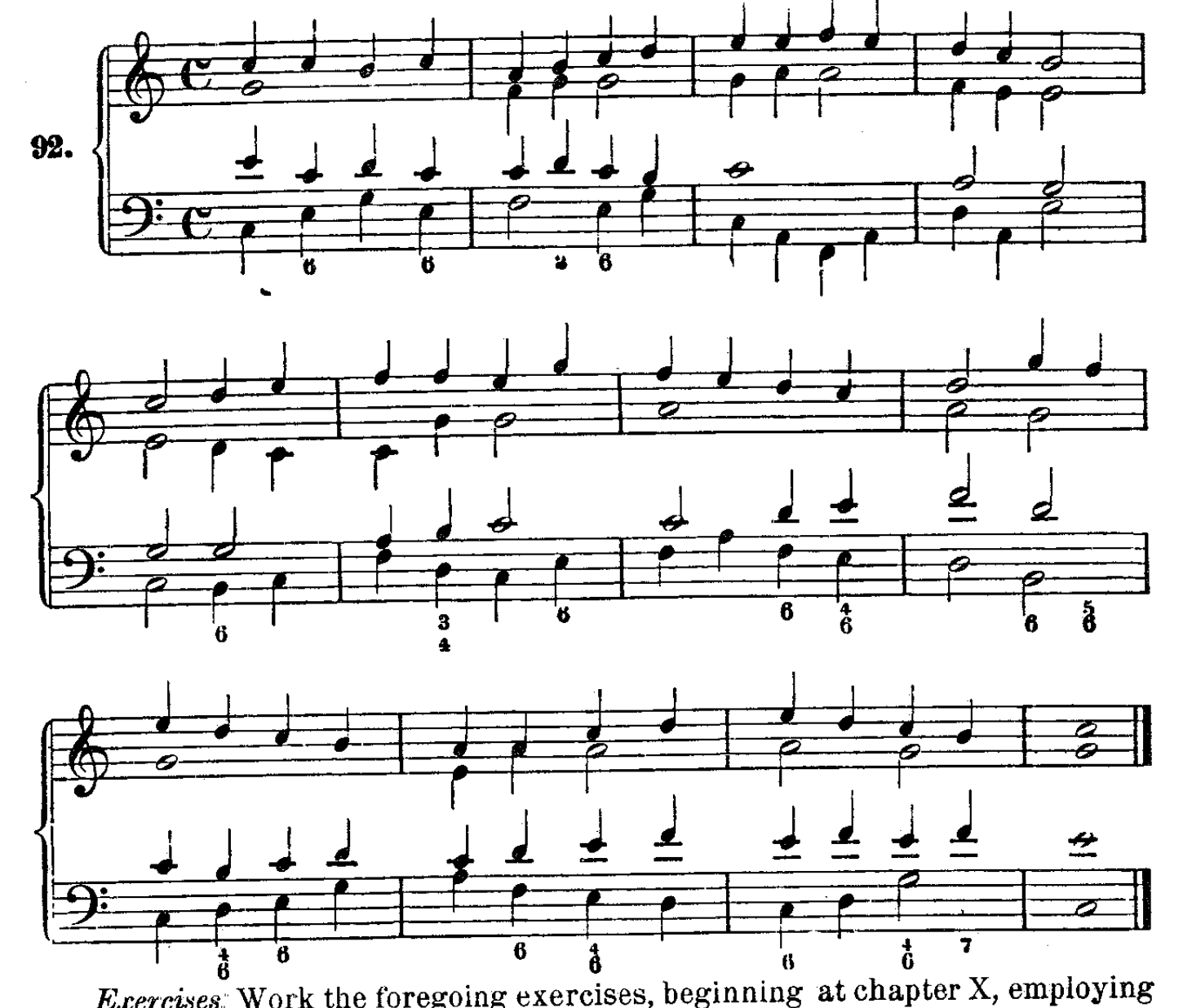
 ▶ Fig. 95
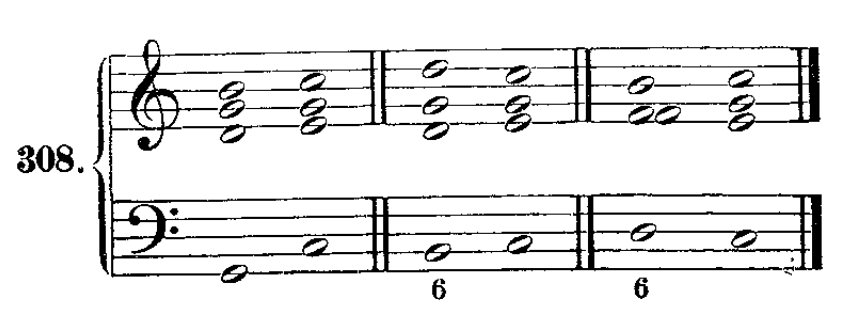
 ▶ Fig. 96
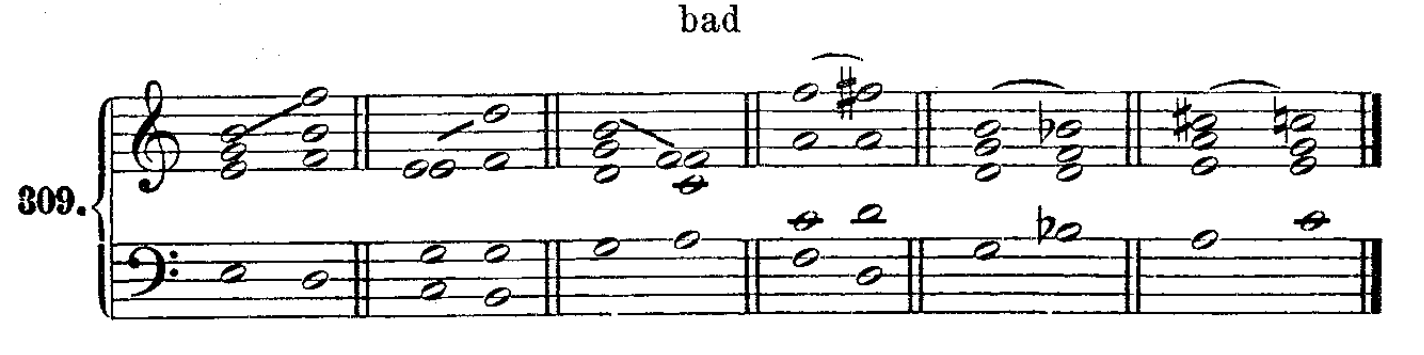
 ▶ Fig. 323
 ▶ Fig. 324
 ▶ Fig. 349
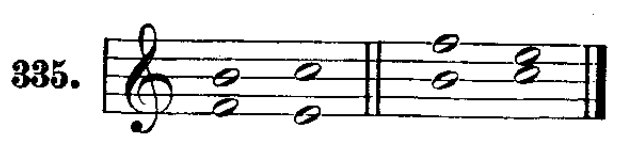 ▶ Fig. 350
 Theory of HarmonyArnold Schoenberg, 1922
Start: Voice Leading and Cadences →- The Method of Teaching Harmony
…out parts over figured basses are unsuitable; for from this he learns only voice leading, which, to a limited extent, might be a secondary task of harmony instruction. The expectation that he will thereby acquire a feeling for good chord progressions on his…
- The Major Key and Its Diatonic Chords
…usually done in the teaching of harmony; or to explain polyphony purely as voice leading that, within certain limits drawn only by the taste of the time, disregards the meeting of voices in chords, as is done in counterpoint. Rather, the truth is that melodic…
- Writing Short Chord Progressions
A few more things must be said here about voice leading. It should be melodic. But this should not be understood to mean that it must be expressive or beautiful in the manner of a song, for example, or have varied contours, rich ornamentation, or even…
▶ Fig. 16 nearby - Parallel octaves and fifths · Footnote
*) I published this chapter in the August 1910 issue of the journal Die Musik. It was exposed to discussion, and I learned of several “objections” raised. They concern the organ mixture, and also—see the notes—organum in fifths and parallel thirds. I welcome…
▶ Fig. 30 nearby - Voice Leading and Cadences · Footnote
…that harmony teaching should deal with harmonic progressions rather than voice leading. But the contradiction is only apparent: that polemic was directed against the figured-bass method, which develops only skill in voice leading, not in directing harmony.…
▶ Fig. 103 nearby - “Nonharmonic” Notes
…with outward consistency. All the more so because I said at the outset that voice-leading matters belong in harmony only insofar as they are needed to present harmonic processes. But the mutual penetration of the two disciplines, harmony and counterpoint, is…
▶ Fig. 439 nearby
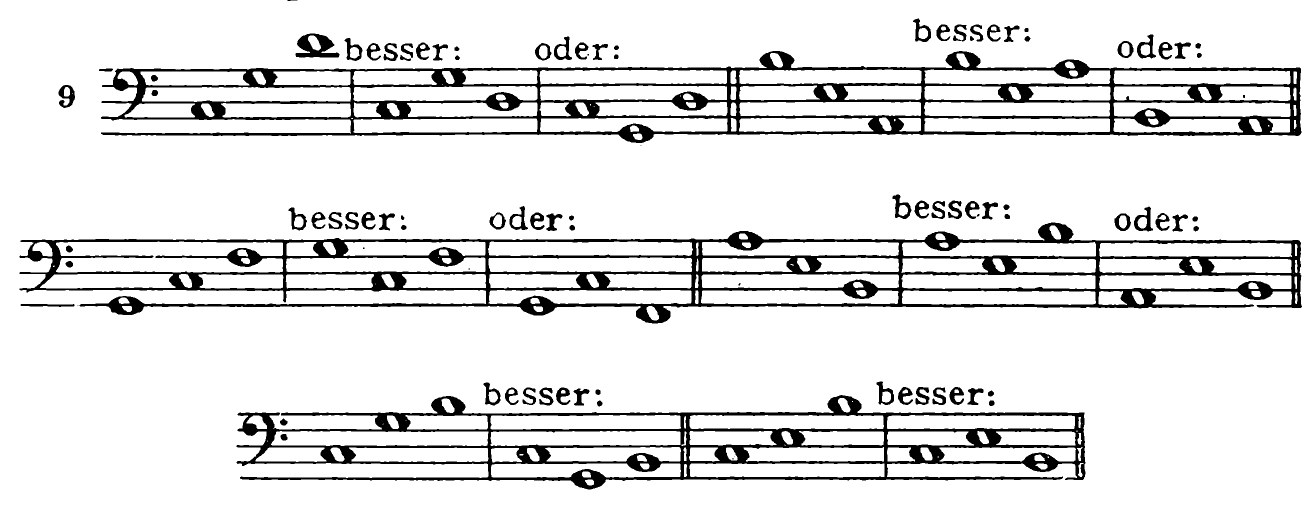 ▶ Example 9 — group 1
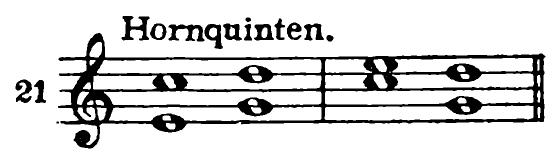 ▶ Example 21 — horn fifths
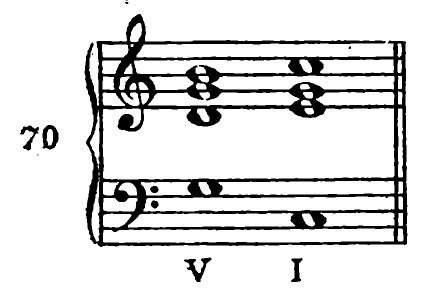 ▶ Example 70
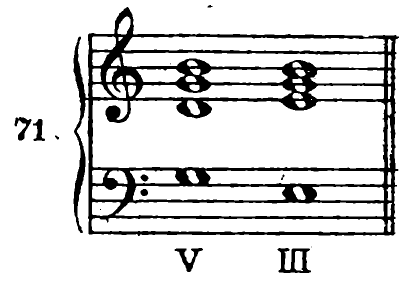 ▶ Example 71
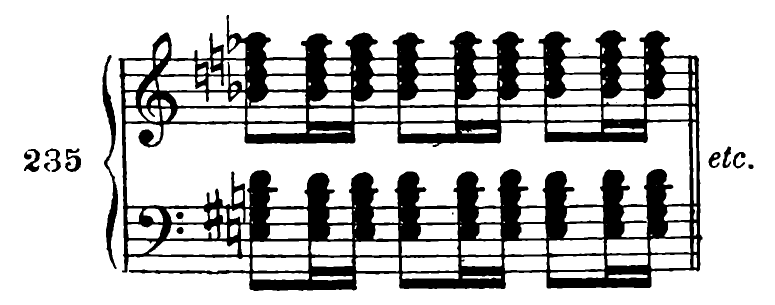 ▶ Example 235 — Mahler
 Principles of OrchestrationNikolai Rimsky-Korsakov, 1922
- Four-part writing · 7 playable examples
- Three-part writing · 1 playable example
- Number of harmonic parts—Duplication
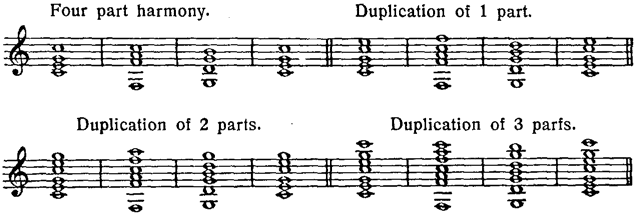
A. Close part-writing.
▶ Fig. 30 nearby - Number of harmonic parts—Duplication
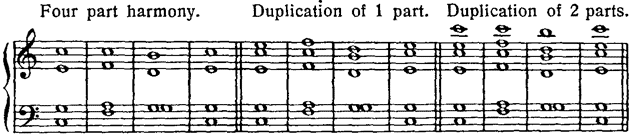
B. Widely-divided part-writing.
▶ Fig. 31 nearby - Remarks
…of what he is doing, and finally to concentrate his attention on close part-writing.
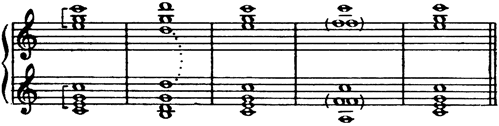
▶ Fig. 88 nearby - Harmony in the brass
Here, as in the wood-wind, part writing should be of the close order with no empty spaces in the intervals.
- Trios, quartets etc
it will be noted that widely-spaced part writing is the most natural and suitable form (especially in forte passages), as the four voices can sing together in their proper registers (low, middle and high), while, in close part writing they may find themselves…
- Voices (divisi); harmonic use of the mixed chorus
To secure a well-balanced forte chord in close part writing the following distribution is recommended:
 ▶ Fig. 30
 ▶ Fig. 31
 ▶ Fig. 88
 ▶ Fig. 89
 ▶ Fig. 90
 ▶ Fig. 96
 OrchestrationCecil Forsyth, 1914
- No. 24. The Double-Bass-Trombone
…deal of vocal accompaniment in the old-fashioned German way, and of Trombone part-writing with Horns and Wood-Wind. In particular there is a surprisingly modern stroke at the opening of the Sanctus. The key of the movement is Eb. The Chorus repeats the word…
- Stringed instruments
where distinction of part-writing is called for.
- No. 47. The Viola (or Tenor)
A consideration arises here which is of general application. All two-part writing for single stringed-instruments is less pure and flexible than the same two-part writing when played divisi. This has been matter of general observation, though the reason has,…
- No. 56. The Dulcimer (or Cimbalom).1
…in addition to that, all sorts of complex chord passages and even elaborate part-writing can be, as it were, outlined by means of rapidly, pertormed arpeggios. Melodie passages, broken . chords, figures, and shakes are all in the character of this facile and…
 ArrivalMayank Sanganeria, 2026
Start: Chapter 3 — The Skeleton →- Preface: One Grammar, Two Axes
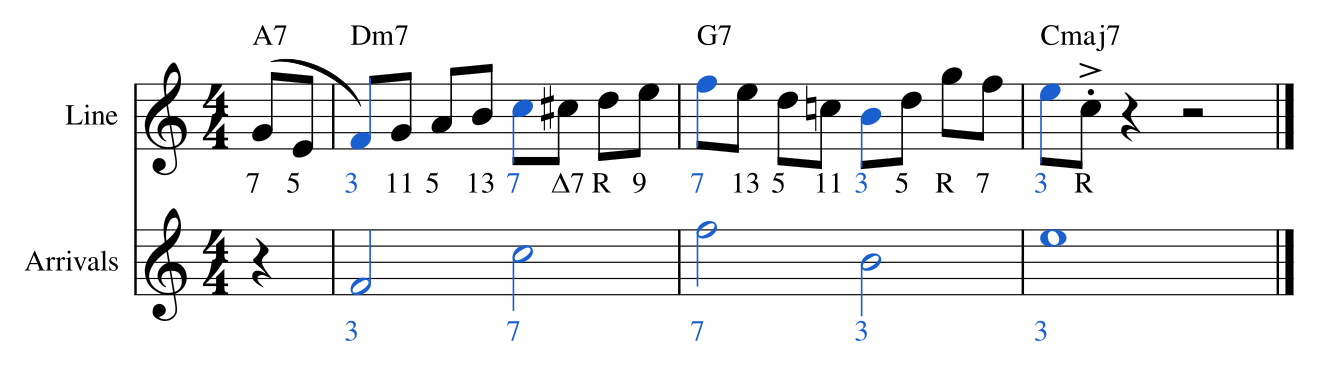
…Chords with Linear Harmony solved the pitch problem. A bebop line is voice-leading in disguise: a stepwise skeleton of guide tones, decorated with a small vocabulary of arpeggios, enclosures and chromatic approaches.
▶ Fig. 1 nearby - Preface: One Grammar, Two Axes
The top staff is a finished line. The bottom staff keeps only its notes on beats 1 and 3, and they make a slow voice-leading melody on their own: F, C, F, B, E. Every other note in the top staff exists to deliver the next note in the bottom staff on time.
▶ Fig. 1 nearby - Chapter 1 — The Two Axes
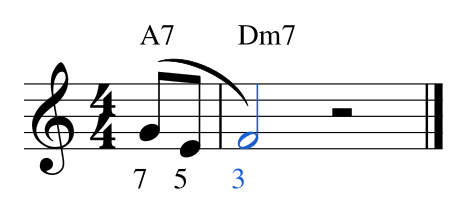
Every note in a line does two jobs at once. On the time axis it is either an arrival or a pickup heading toward one. On the pitch axis it is either a skeleton tone, part of the voice-leading that carries the harmony, or an elaboration of one.
▶ Fig. 2 nearby - Chapter 5 — Outlines
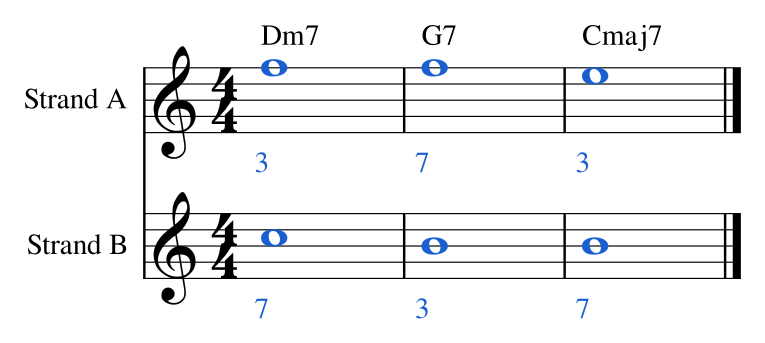
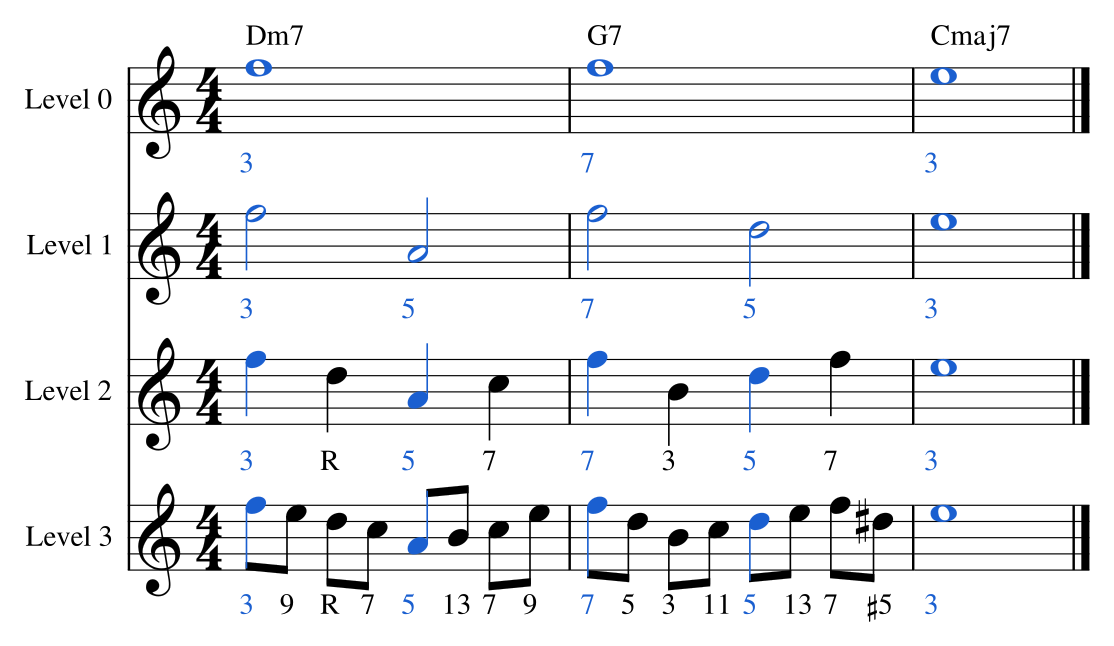
Each outline is named for the chord degrees it starts and ends on. All four put chord tones of the current chord on beats 3 and 4 and color on the upbeats, so the grid and the voice-leading agree without any extra rule.
▶ Fig. 13 nearby - Appendix — Lexicon, Glossary and Lineage
…from Bert Ligon, Connecting Chords with Linear Harmony (1996): guide-tone voice-leading, outlines and approach patterns as connective vocabulary. Enclosures and bebop scales are common-practice vocabulary that predates both.
 ▶ Ex. P.1
 ▶ Ex. 1.1
 ▶ Ex. 3.1
 ▶ Ex. 3.2
 ▶ Ex. 5.1
More in Counterpoint
Species counterpoint · Cantus firmus · Consonance and dissonance · Contrary, oblique and similar motion · Parallel fifths and octaves · The melodic line