 Playable Books
Concept index · Cadence, key and progression
Deceptive cadence
Taught in 6 books. Each one opens at the passage; ▶ plays the example beside it. Also called interrupted cadence, broken cadence.
This index is Playable Books’ own: a first pass that finds the term’s words in each book, corrected by hand. The authors did not tag these passages, and their terms can differ (Fux’s “ligature” is a suspension). The quoted text is the book’s.
 Gradus ad ParnassumJohann Joseph Fux, 1725
- Fugue in three parts
Joseph. What do you mean, dearest Master, by a deceptive cadence?
▶ Fig. 263 nearby - Fugue in three parts
…cadence concludes with a major third and proceeds from there to an octave. A deceptive cadence, however, using a minor third instead of a major one, eludes the formal cadence expected by the ear and deceives the listener’s expectation. Hence the Italians call…
▶ Fig. 263 nearby - On a cappella style
…has finished the subject, and how a brief melodic continuation through a deceptive cadence gives the third part, namely the tenor, an opportunity to enter. After this, the soprano and alto, instead of melodic continuation, take up what is almost another…
▶ Fig. 468 nearby
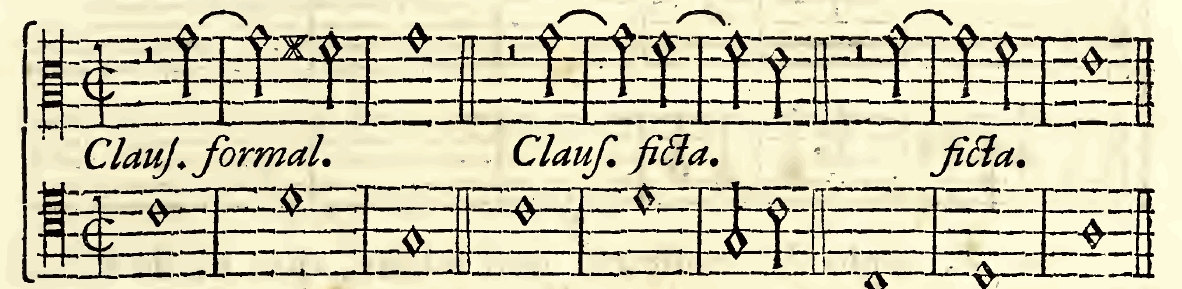 ▶ Fig. 263
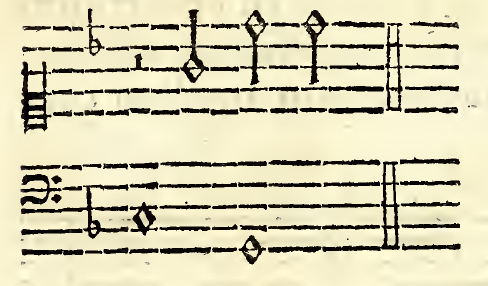 ▶ Fig. 468
 Counterpoint AppliedPercy Goetschius, 1902
- Chapter V
See further, Bach, 2-v. Invention No. Io. Part I closes in measure 14 (already analyzed as Section I); Part II in measure 30, with an evaded cadence, followed by an extension of 3 measures.
- Chapter VII
…is a nearly exact transposed recurrence of the First Part, ending, with an evaded cadence, in measure 22, and followed by a brief Codetta, or plagal extension.
 Treatise on HarmonyJean-Philippe Rameau, 1722
Start: Chapter six →- BOOK TWO. On the Nature and Properties of Chords, and Everything That Can Serve to Make Music Perfect
…only a whole tone or semitone, this arises from a license introduced by the interrupted cadence, which we shall discuss later. Moreover, observe that this whole tone or semitone ascending, not descending, is the inversion of the seventh then sounding between…
- CHAPTER NINE. On Avoiding Cadences while Imitating Them
We can also avoid perfect and interrupted cadences even in their imitation, by adding a sixth instead of a seventh to every second note of these cadences, provided the fifth is prepared by the preceding note's octave or third: the fifth then represents the…
▶ Fig. 52 nearby - Chapter seventeen
Besides the licenses created by inverting the interrupted cadence, there is a certain succession of sixths attributed only to good taste. Zarlin* expressly forbids it, saying its consecutive fourths produce much the same effect as consecutive fifths when the…
▶ Fig. 83 nearby - Chapter twenty-eight
An interrupted cadence is a certain bass progression that interrupts the conclusion of a perfect cadence. After sounding the seventh chord on a tonic dominant, if, instead of falling naturally onto the tonic, you make the bass rise only a whole tone or…
▶ Fig. 267 nearby - CHAPTER XI. Sixth chords
…This would also be a suitable place to discuss the perfect, imperfect and interrupted cadences, but these are included within our other rules. For example, a seventh chord followed by a sixth–fourth chord on a tonic dominant represents an imperfect cadence.…
▶ Fig. 429 nearby - SUPPLEMENT: changes to two chapters and necessary corrections
…almost only perfect cadence, calling its inversions Cadenze fuggite*—what interrupted cadence ought to translate. To approach his meaning in French, however, we should call those inversions imperfect. “Interrupted” suggests a break in the perfect cadence,…
▶ Fig. 456 nearby
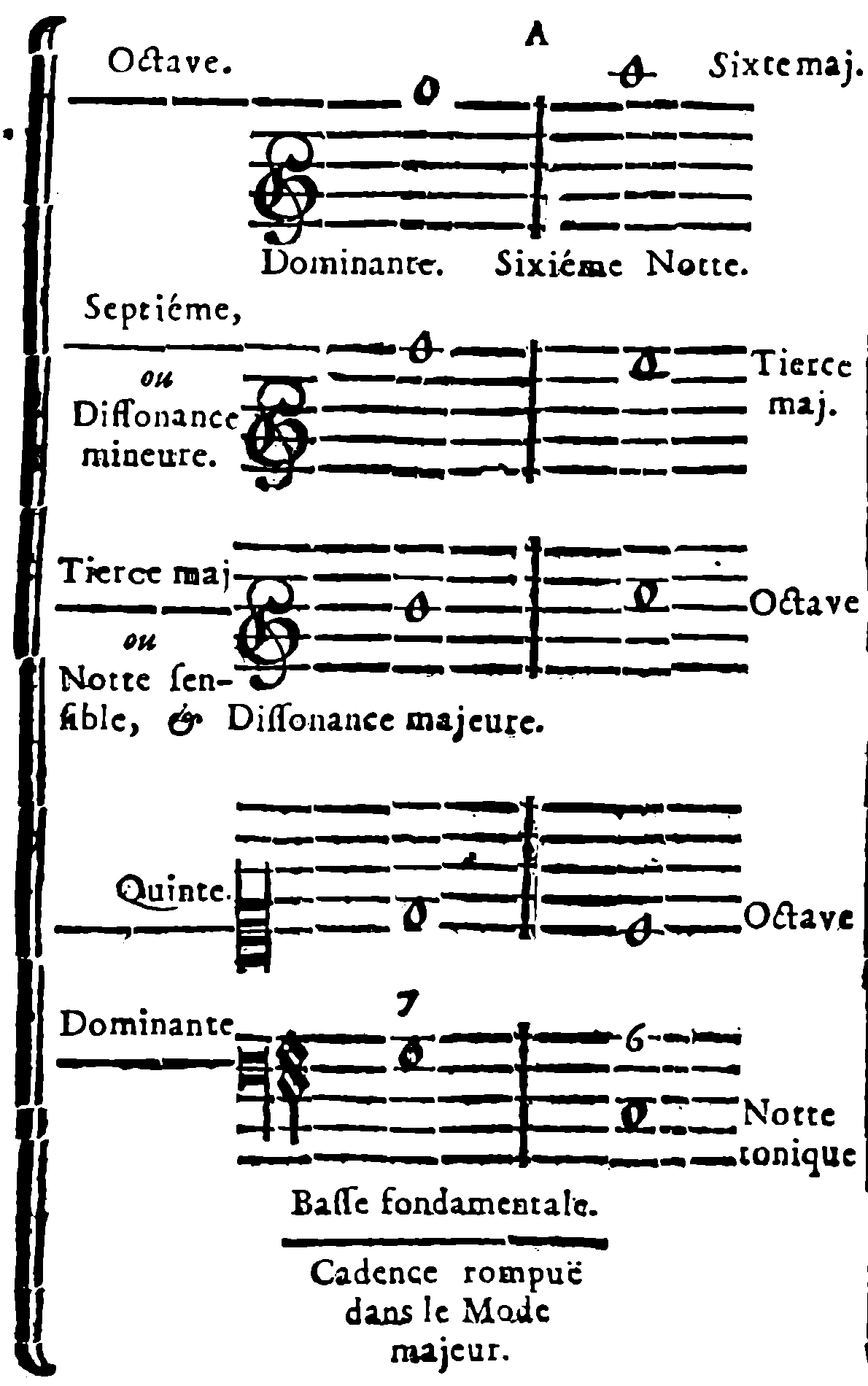 ▶ Fig. 46
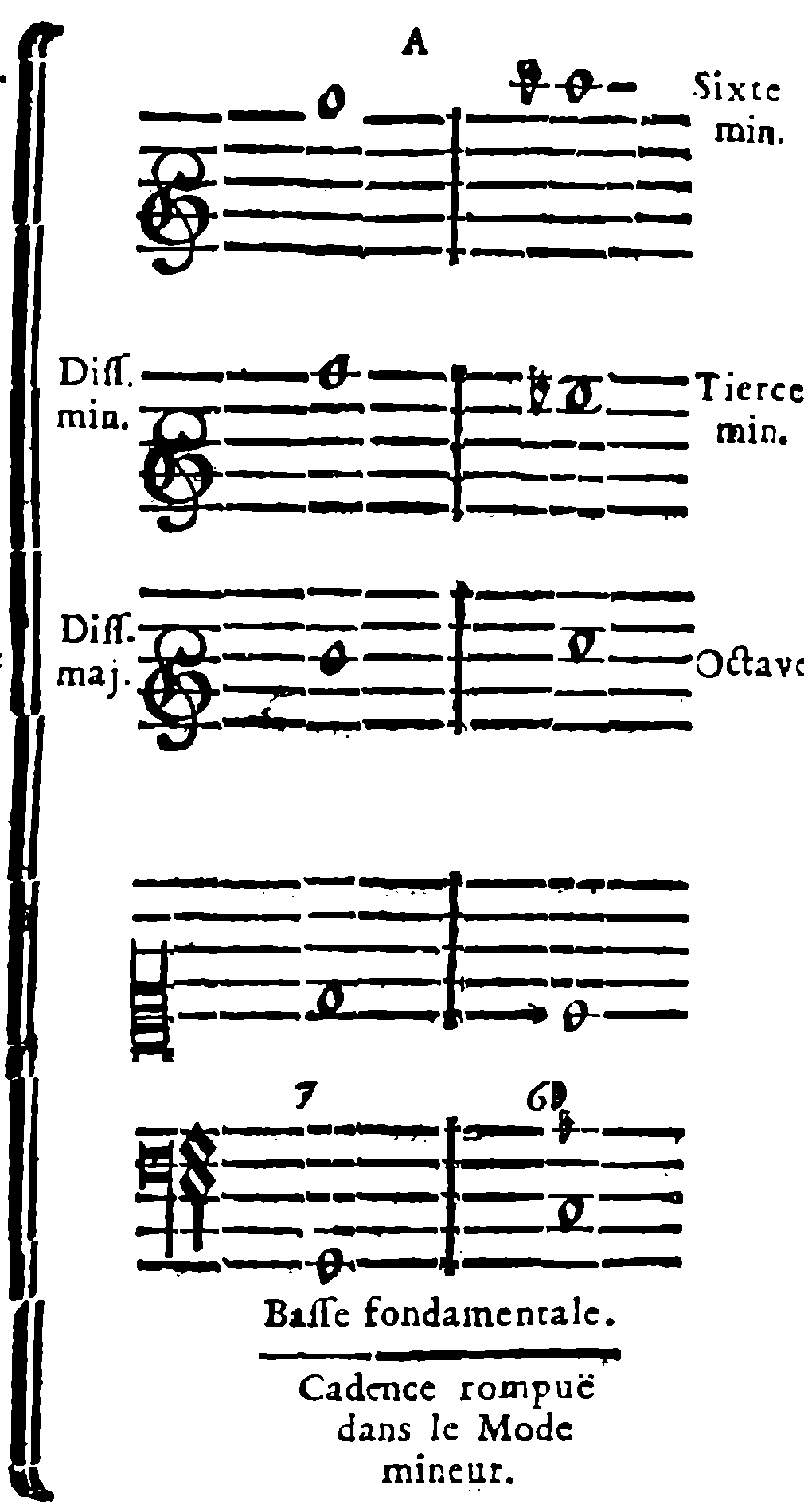 ▶ Fig. 47
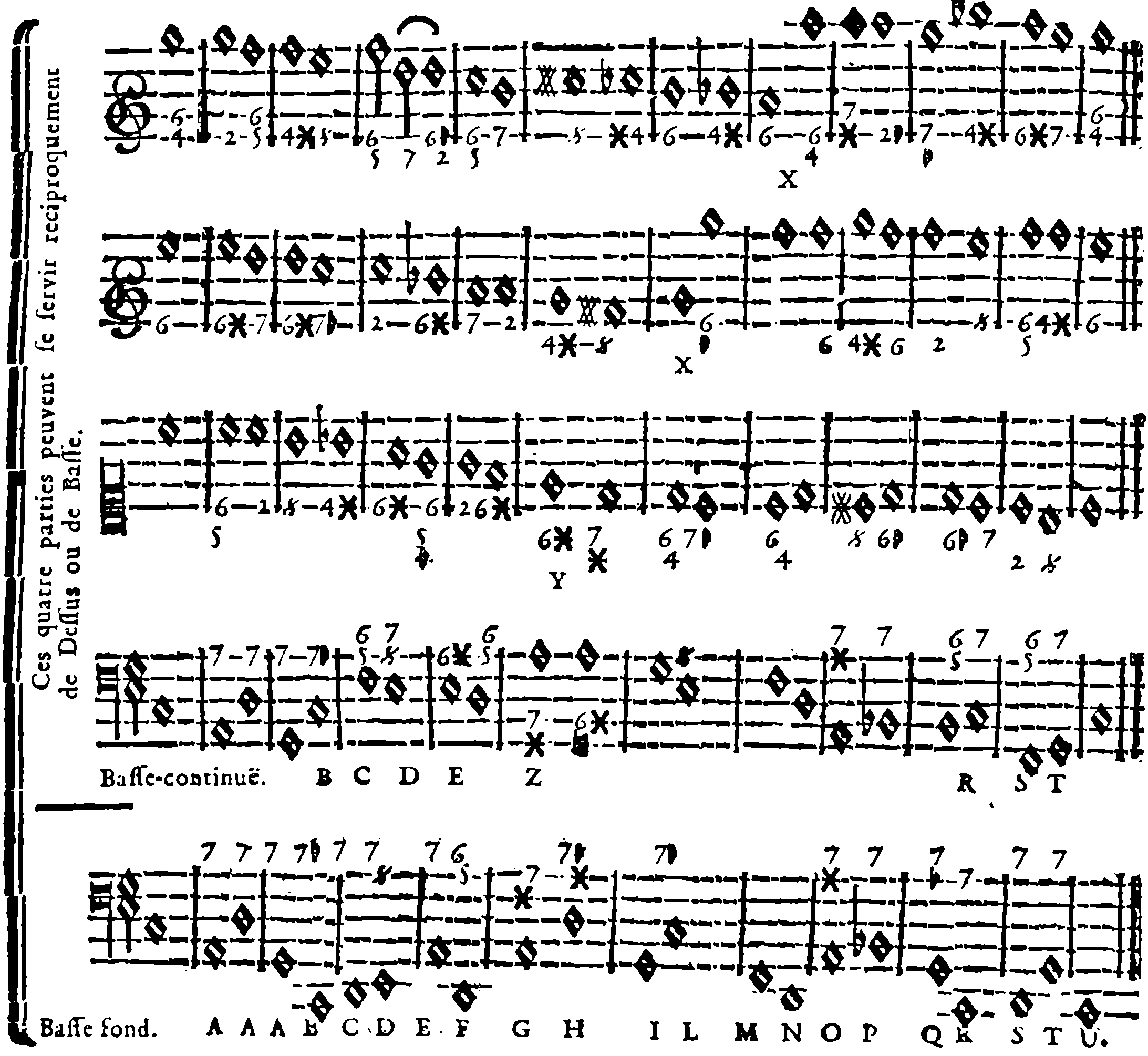 ▶ Fig. 52
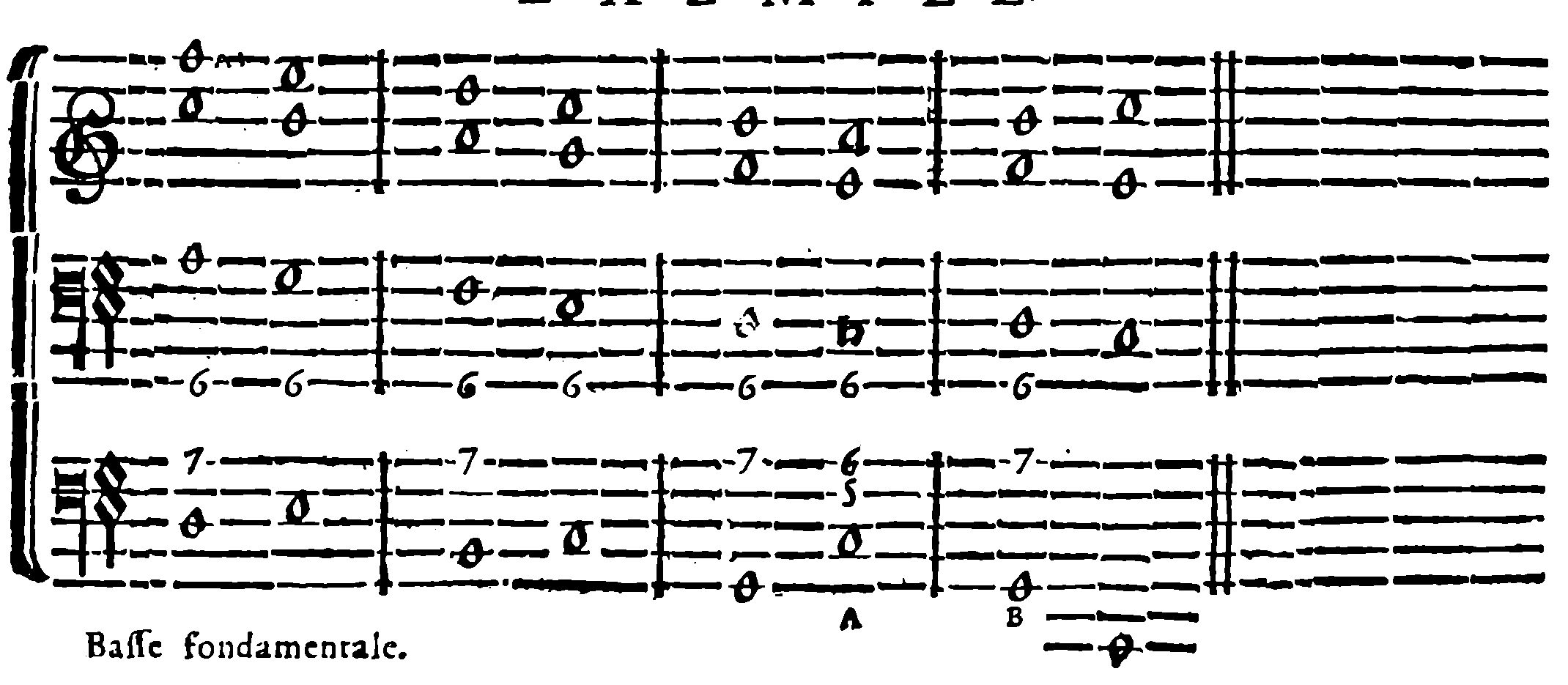 ▶ Fig. 83
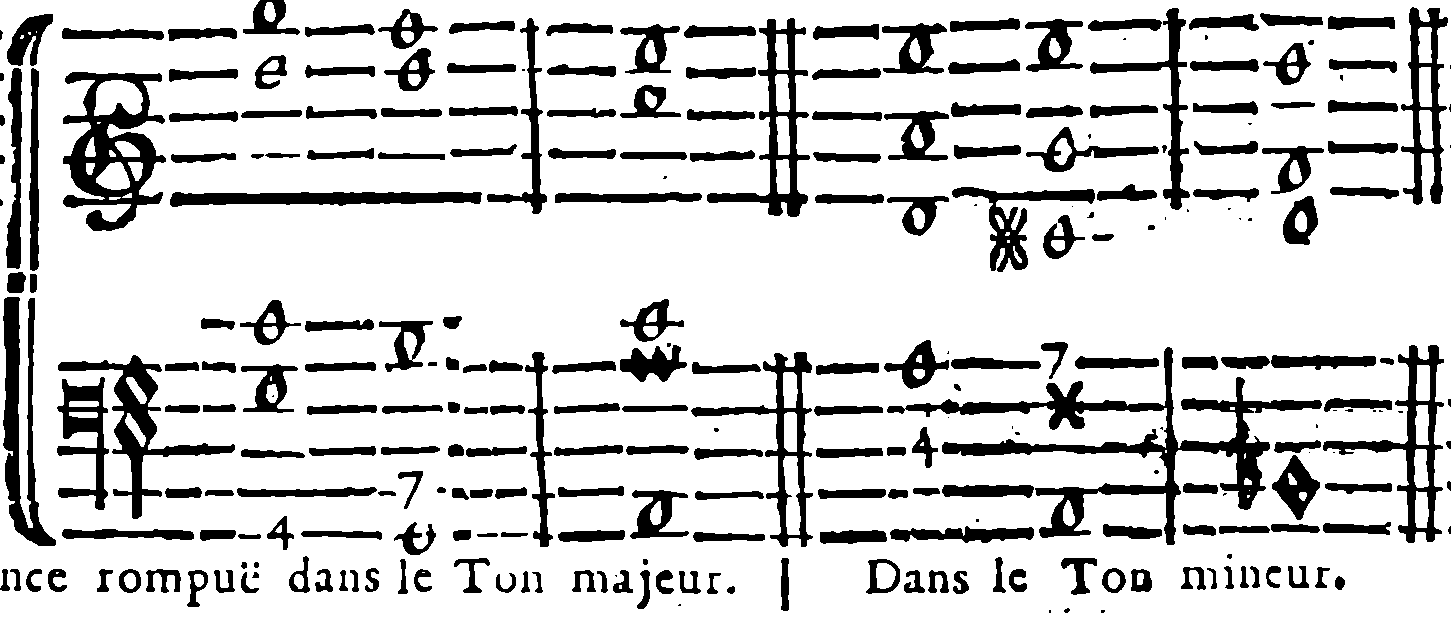 ▶ Fig. 267
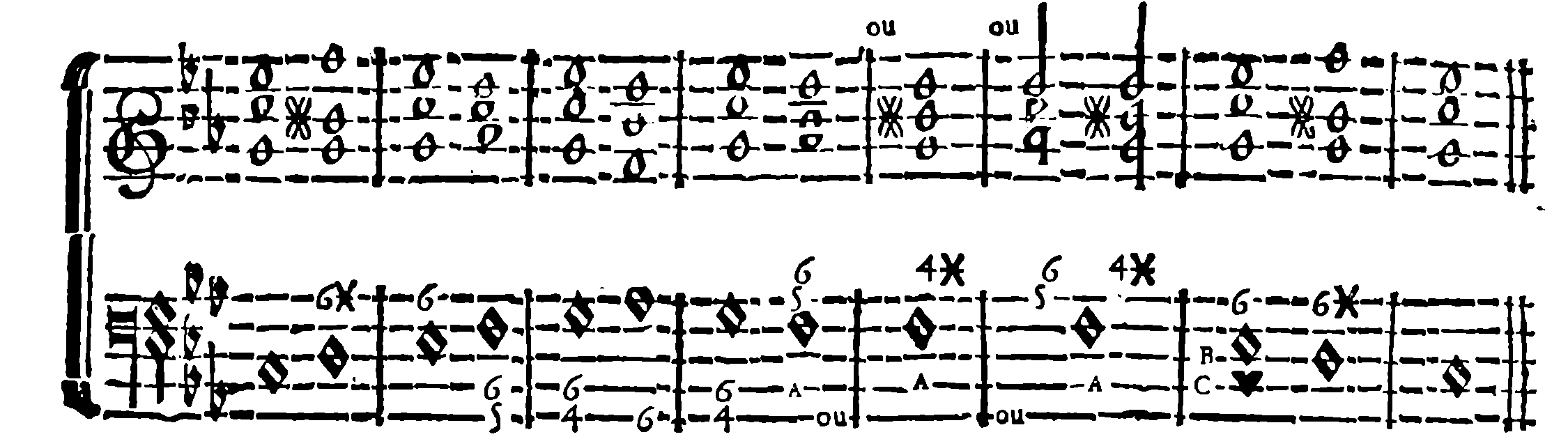 ▶ Fig. 429
 Practical Manual of HarmonyNikolai Rimsky-Korsakov, 1910
Start: Twofold Use of the Triad of the Sixth Degree →- Twofold Use of the Triad of the Sixth Degree
§ 30. — I. In the deceptive cadence.
▶ Fig. 108 nearby - Twofold Use of the Triad of the Sixth Degree
2) Such a stop at the end of a phrase is called a Deceptive Cadence; the following phrase begins with the triad of the fourth degree or with the sixth chord of the second degree.
▶ Fig. 108 nearby - Twofold Use of the Triad of the Sixth Degree
3) The same combination is sometimes used in turns of phrase that have the character of a deceptive cadence:
▶ Fig. 108 nearby - Root position
b) The dominant seventh chord, like the triad on the same degree, also resolves onto the chord of the sixth degree, with the third doubled, in the deceptive cadence. (See § 32.)
▶ Fig. 128 nearby - Examples of modulations from C major to its related keys
When modulating from a major key to the keys of its major and minor subdominant (C-F or C-f), one most often resorts to the indirect means (*) — that is, one goes first to the deceptive cadence in order to obtain the subdominant harmony of the following key:
▶ Fig. 190 nearby - Assignments
After the deceptive cadence one usually modulates transiently to the subdominant keys of both modes:
▶ Fig. 236 nearby
2 more passages in Practical Manual of Harmony →
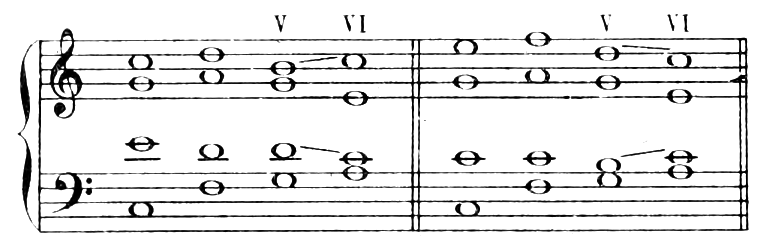 ▶ Deceptive cadences in C major: V–VI with the third (C) doubled in VI; the leading note B rises to C and the other upper voices fall
Twofold Use of the Triad of the Sixth Degree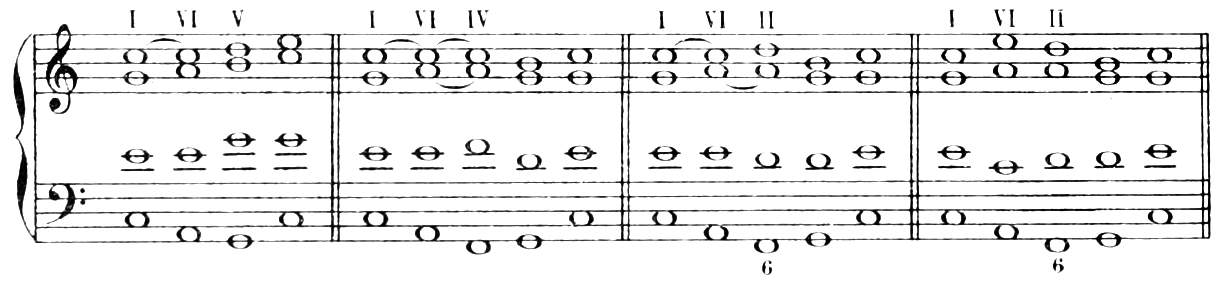 ▶ Four progressions in C major: I–VI–V–I; I–VI–IV–V–I; I–VI–II6–V–I (twice, with different spacing of VI)
Twofold Use of the Triad of the Sixth Degree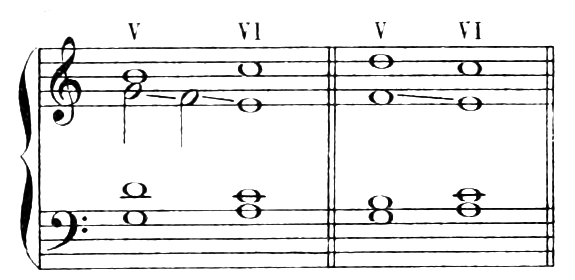 ▶ V7–VI in C major, the third (C) of the VI chord doubled: with a passing seventh in the alto, and with the seventh already present
Root position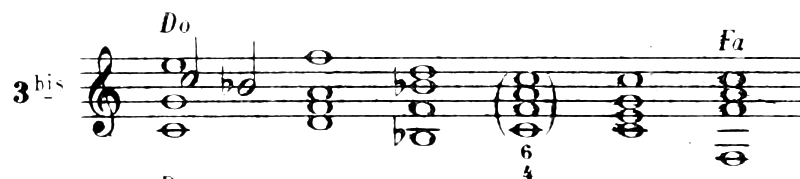 ▶ Example 3bis: C major to F major by the indirect means (deceptive cadence first).
Examples of modulations from C major to its related keys ▶ Example: in A minor, a deceptive cadence (V7–VI) followed by a transient modulation to D minor, the subdominant key ("ton de passage"), and a return to A minor.
Assignments
 Guide to the Practical Study of HarmonyPyotr Ilyich Tchaikovsky, 1900
Start: Chapter XXXIV. Cadences (closes) →- Chapter XXXIII. Deviations from the laws of Harmony
These irregular resolutions of dissonant chords are called: interrupted cadences, or deceptive cadences.
▶ Fig. 366 nearby - Chapter XXXIV. Cadences (closes)
Complete close (authentic). Half close and Deceptive cadence.
▶ Fig. 367 nearby - Chapter XXXIV. Cadences (closes)
When the fundamental (in the Bass) of the Dominant resolves into a degree other than that of the tonic, we have a deceptive cadence.
▶ Fig. 368 nearby
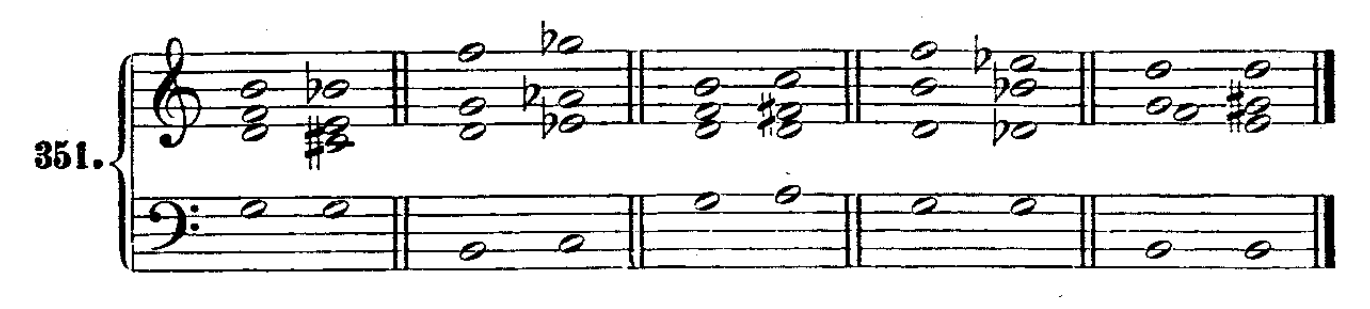 ▶ Fig. 366
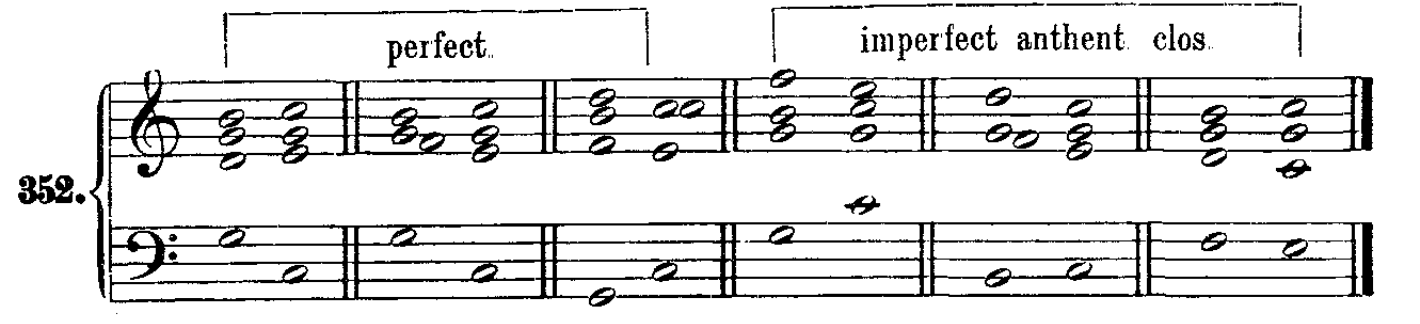 ▶ Fig. 367
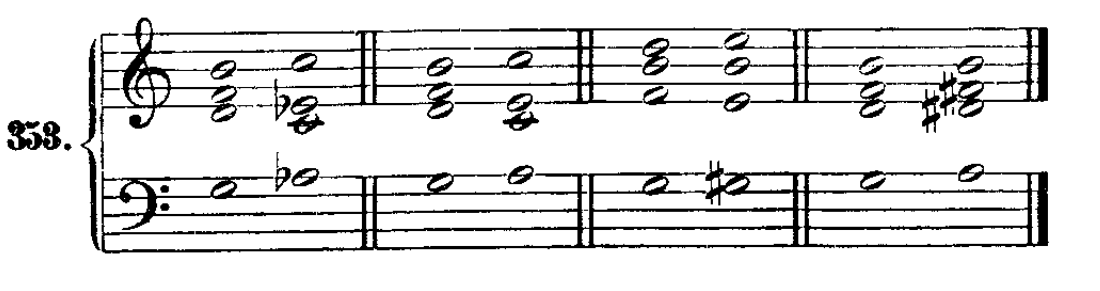 ▶ Fig. 368
 Theory of HarmonyArnold Schoenberg, 1922
Start: Deceptive cadences →- Deceptive cadences
First we introduce the deceptive cadence into the cadence and use it for the purpose mentioned earlier, the lengthening of the cadence. Some things must be observed in doing so. Since the deceptive cadence takes the cadential degree V (thus not just any V) as…
▶ Fig. 119 nearby - Deceptive cadences
Except where the deceptive cadence is concerned (that deceptive cadence which we have recognized as a specific resource of the cadence), these connections may also start from inversions of the seventh chords (93); only those cases that lead into a six-four…
▶ Fig. 130 nearby - Modulation
…with a passing seventh (2 chord) into the ⁵₆ chord of V, afterwards makes a deceptive cadence by means of a passing ⁴₆ chord, which leads to a repetition of V of G and flows into the sixth chord of I. Such a repetition of the modulating chord (I call this:…
▶ Fig. 146 nearby - Secondary Dominants and Modal Chords · Footnote
…a synthesis as I do. According to my presentation, for example, a deceptive cadence made from a secondary dominant is explained without strain, as will be seen; since one cannot speak of a process of tonicization here—for the second chord (e.g., III–IV) is not…
▶ Fig. 172 nearby - Secondary Dominants and Modal Chords
…The only thing new to us in this case is that here a step resembling a deceptive cadence (II–I) is made from a secondary dominant. Such connections are naturally possible from other secondary dominants too. But the student will do well to be sparing with them,…
▶ Fig. 192 nearby - Chorale Harmonization
…though with some caution, because III and IV—a progression resembling a deceptive cadence—have no such direct relationship. Moreover, if the deceptive-cadence progression, the “superstrong” progression, is to be used in accordance with its character, it must…
▶ Fig. 402 nearby
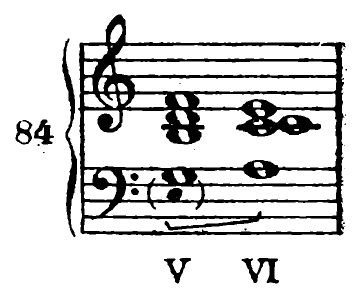 ▶ Example 84
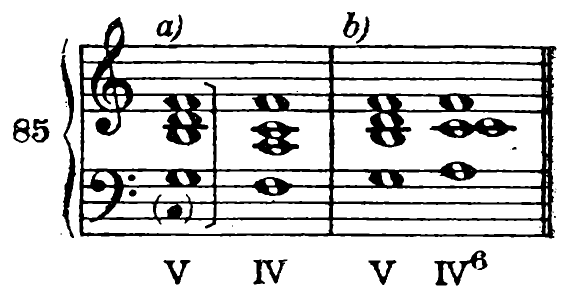 ▶ Example 85a
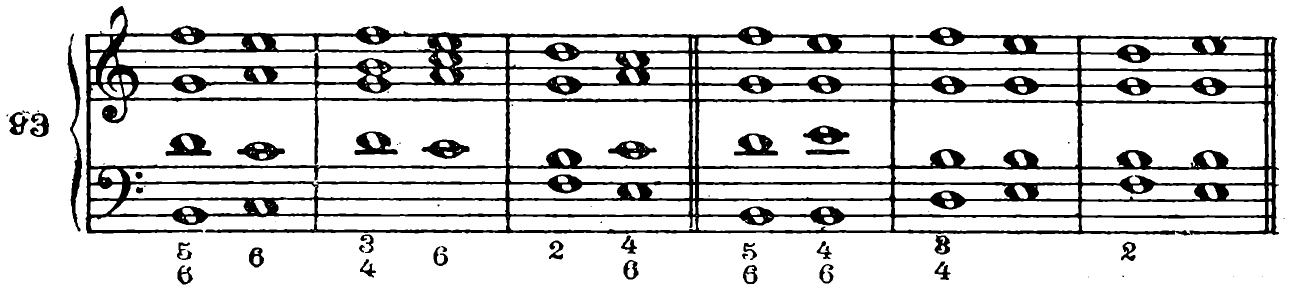 ▶ Example 93 (system 1)
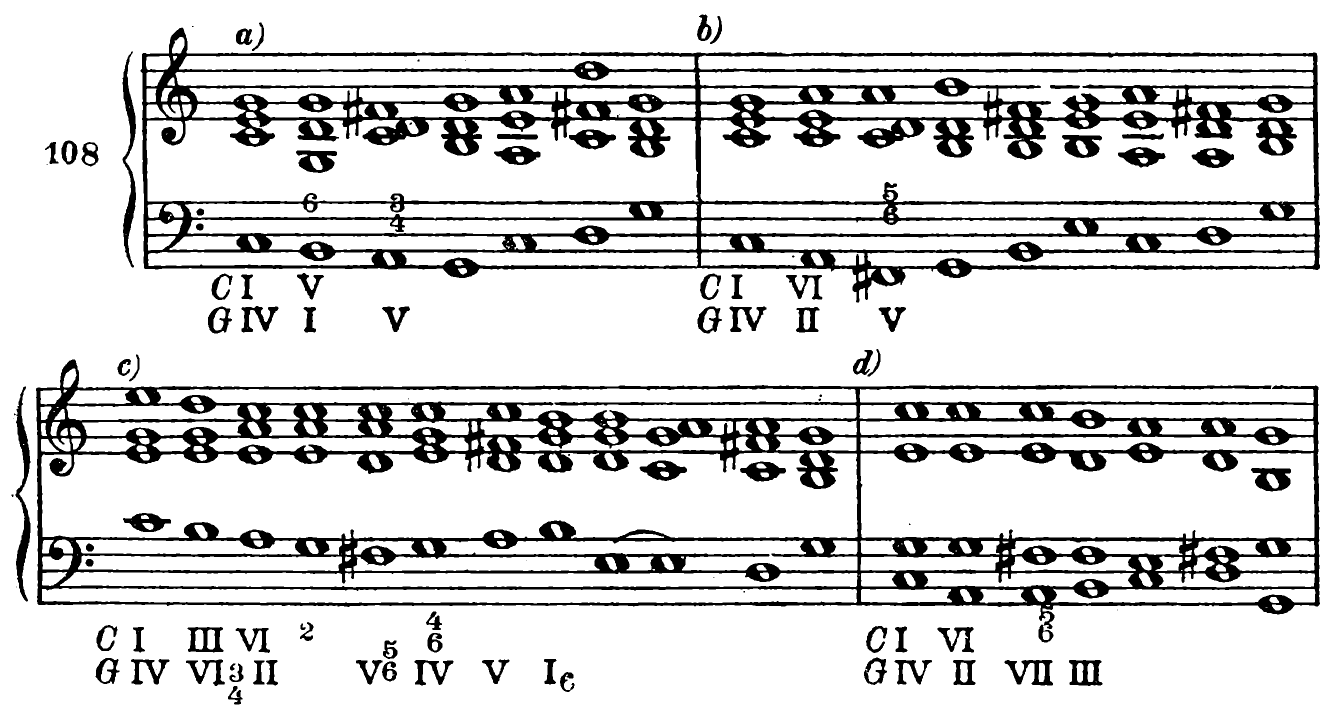 ▶ Example 108a
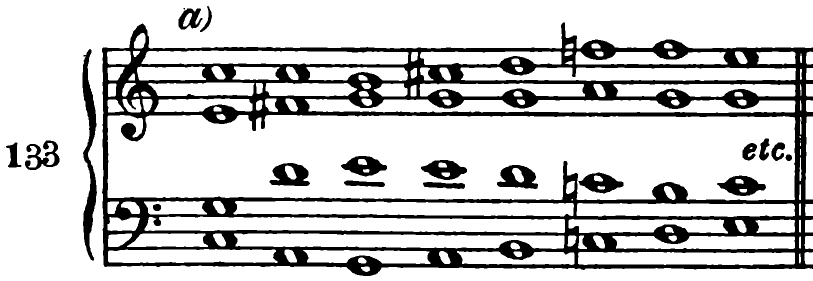 ▶ Example 133a
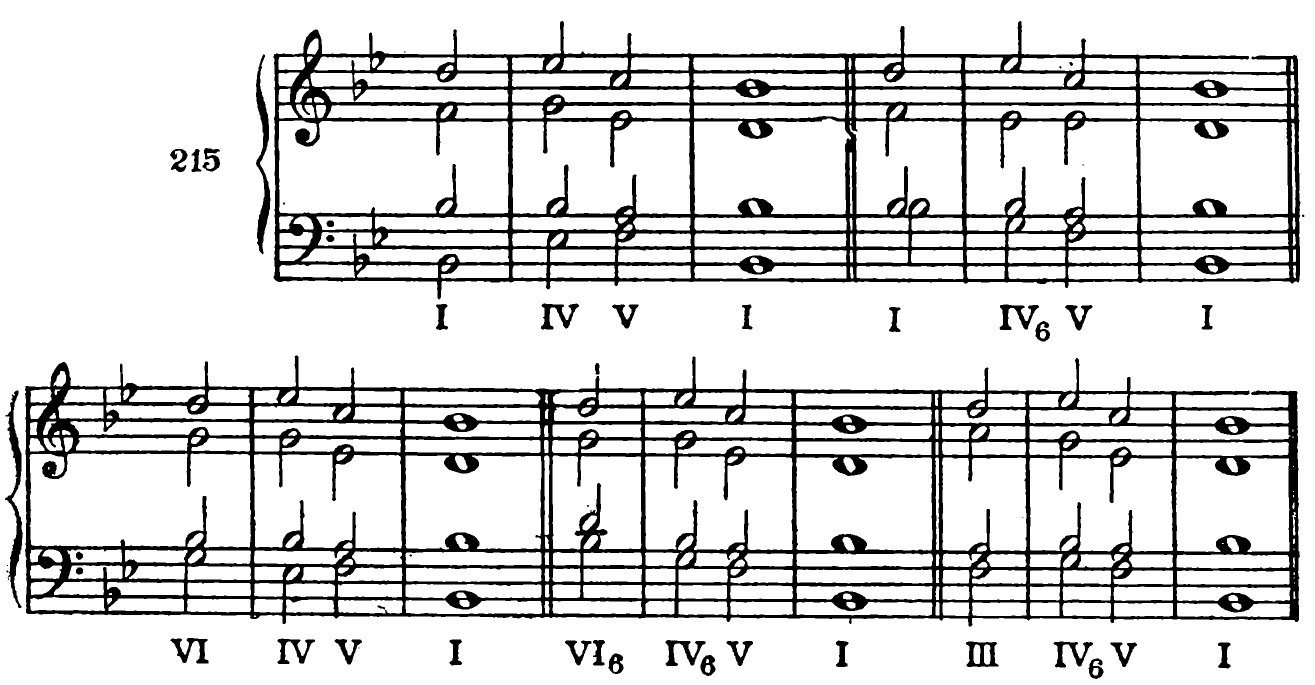 ▶ Example 215 — 1
More in Cadence, key and progression
Cadence · Modulation · Sequence · Modes · The leading note · Figured bass and partimento · Fundamental bass · Harmonizing a melody
All concepts · Search every passage for “interrupted cadence”