 Playable Books
Concept index · Cadence, key and progression
Modulation
Taught in 11 books. Each one opens at the passage; ▶ plays the example beside it. Also called modulate, enharmonic modulation, change of key.
This index is Playable Books’ own: a first pass that finds the term’s words in each book, corrected by hand. The authors did not tag these passages, and their terms can differ (Fux’s “ligature” is a suspension). The quoted text is the book’s.
 Exercises in Elementary CounterpointPercy Goetschius, 1910
Start: Chapter VIII. Modulations →- Chapter XVIII. With Modulations · 21 playable examples
- Chapter XXIII. Modulations · 25 playable examples
- Chapter VIII. Modulations
…or the given melody, should remain in the same key from beginning to end. Modulations in either, or in both, of the parts, are likely to add greatly to the beauty and smoothness of the counterpoint. Such changes of key may be made at any point in the course of…
- Chapter VIII. Modulations
N. B. If the student is not absolutely familiar with all the signatures, major and minor, he will do well to pause here, and not undertake any exercises in modulation before thoroughly mastering this necessary item of musical knowledge.
▶ Fig. 124 nearby - Chapter VIII. Modulations
81. Rule i. Modulations that are made during a brief melodic sentence (phrase, period, or double-period) should be limited to the next-related keys of the principal or central key. Thus, a sentence in C major may contain brief modulations into A minor (same…
▶ Fig. 124 nearby - Chapter VIII. Modulations
…studies of counterpoint, the next-related keys should suffice for all modulatory changes.
▶ Fig. 124 nearby - Chapter VIII. Modulations
84. Or, this same melody may be counterpointed in such a manner as to contain one or more modulations. For example:
▶ Fig. 126 nearby - Chapter XX. Three-Part Counterpoint
…foreign to each other (excepting near the end, where, as is rational, the modulatory movements concentrate toward the principal keynote). These irregular modulations are chiefly accounted for by the chromatic progressions; in measure three, by the enharmonic…
▶ Fig. 362 nearby
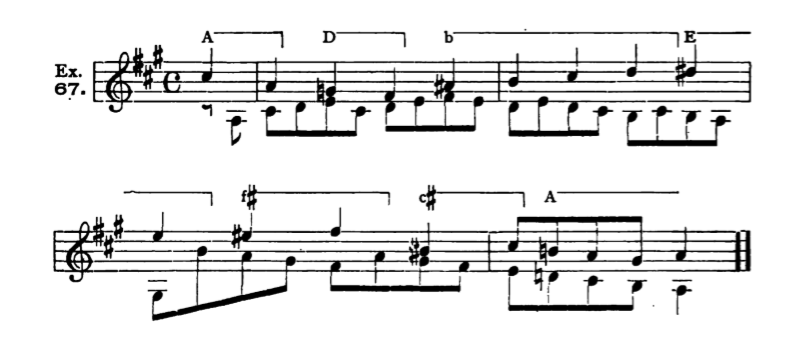 ▶ Ex.67
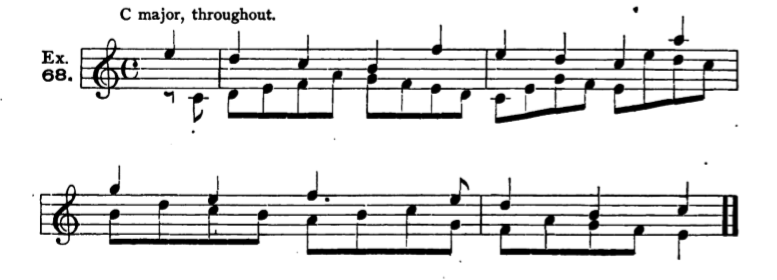 ▶ Ex.68
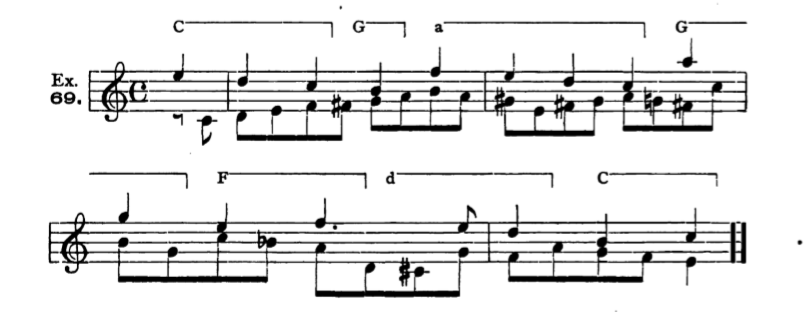 ▶ Ex.69
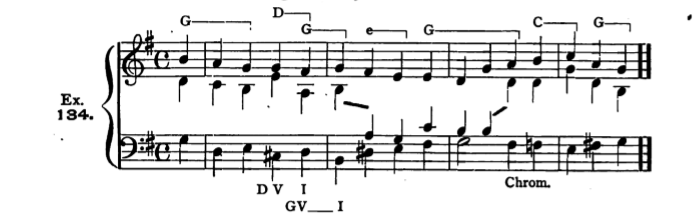 ▶ Ex.134
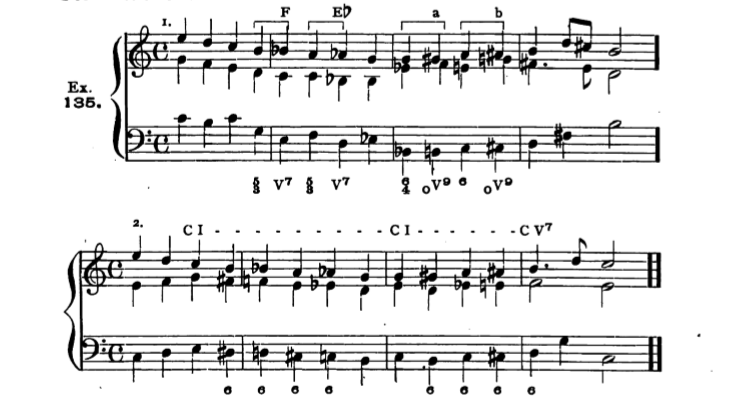 ▶ Ex.135
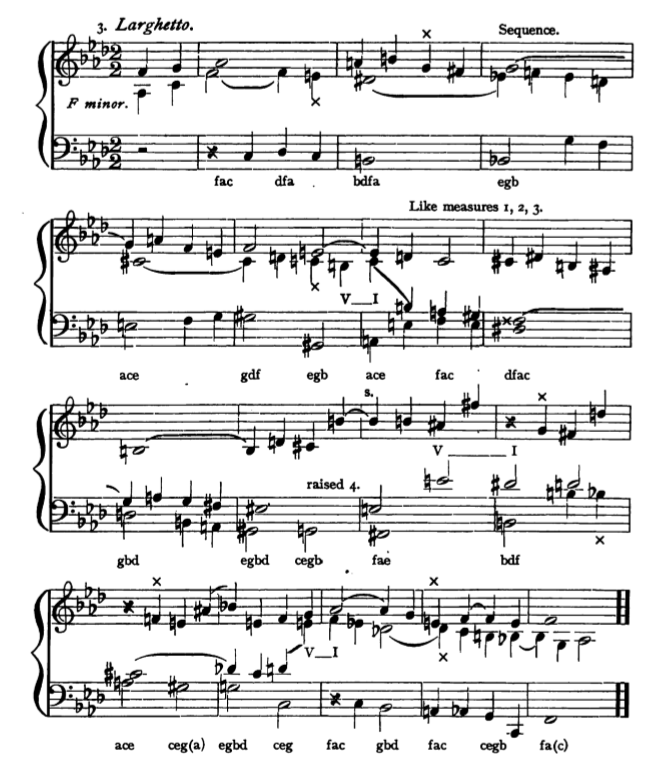 ▶ Ex.149-3
 Counterpoint AppliedPercy Goetschius, 1902
- Chapter II
No modulations are to be made.
▶ Fig. 68 nearby - Chapter II
…and from this into its Tonic harmony. Comp. par. I8a, and 18b and c. This modulatory formula is the most common and reliable, whether effected exclusively by diatonic successions, or involving a chromatic inflection (see par. 196). It is least binding for…
▶ Fig. 103 nearby - Chapter II
*1) The accidentals suggested in the brackets above are doubtless too " extreme"; though they might, perhaps, be justly adopted in slower movement. — *2) The comparison of these two widely different terminations of one and the same series of letters, with the…
▶ Fig. 115 nearby - Chapter II
…accord with the rule (par. 1ga).-*3) Here the keys are related, but the modulatory process is irregular — from I into I.— *4) Similar (from V of the old key into I of the new).-*5) This extraordinary series of modulations is justified by the sequential…
▶ Fig. 119 nearby - Chapter V
…breadth of design will probably induce (or necessitate) transient modulations into various next-related keys; and the prescribed modulatory aim of the whole may not assert itself until the Section approaches its cadence. In this case, further, the cadence is…
▶ Fig. 222 nearby - Chapter XI
…only by carefully testing the effect, and preserving a good, smooth, modulatory and melodic result. The trouble consists, as stated, simply in deciding which tones . are inseparably connected with the Dominant; and this may depend upon the melodic structure,…
▶ Fig. 335 nearby
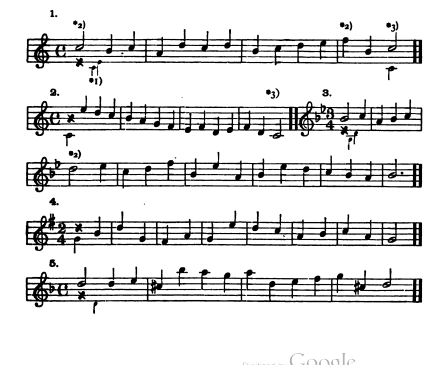 ▶ Exercise2
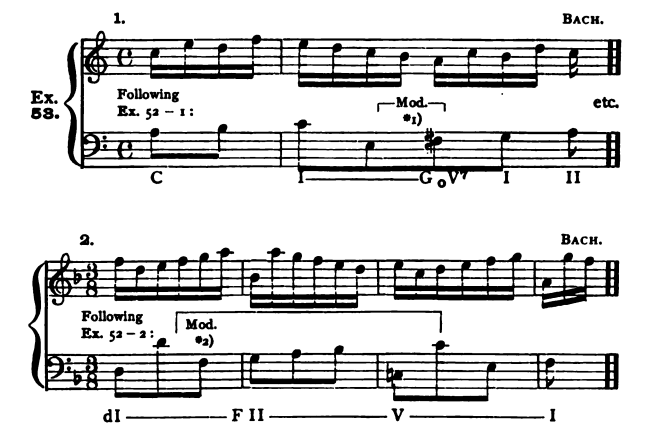 ▶ Ex53-1-2
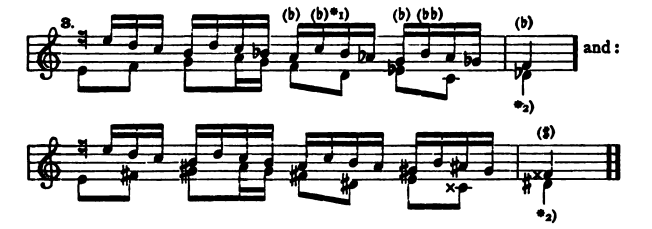 ▶ Ex56-3
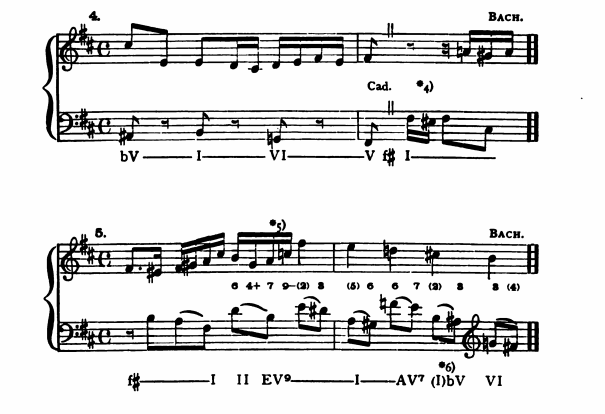 ▶ Ex57-4-6
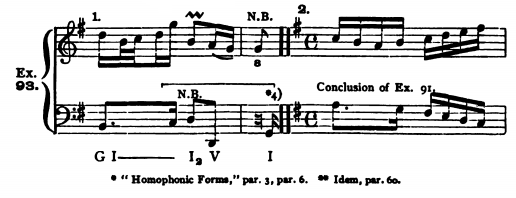 ▶ Ex93-1-4
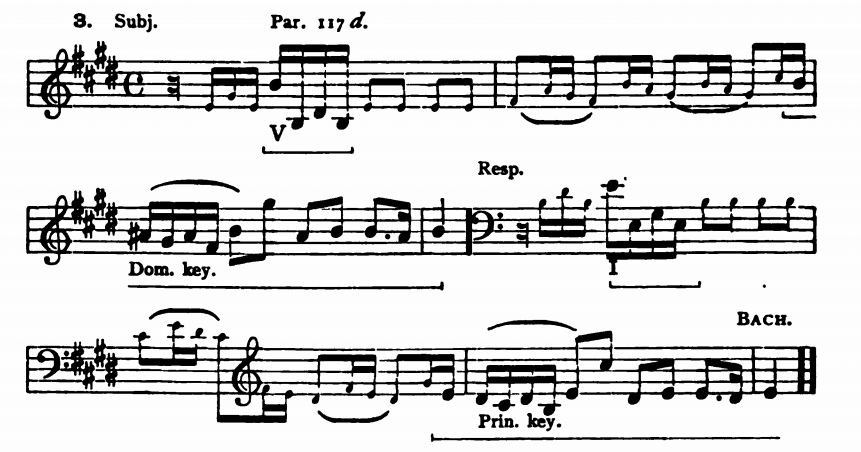 ▶ Ex144-3
 Analysis of J. S. Bach’s Forty-Eight FuguesEbenezer Prout, 1910
- Fugue 10 · Book I, No. 10 · BWV 855
As it modulates into the key of the dominant, the strict rule would have demanded a tonal answer, returning to E minor. But there is no third voice to be introduced, and hence no real necessity for a return, which, indeed, Bach has not provided; he has…
▶ Fig. 27 nearby - Fugue 19 · Book I, No. 19 · BWV 864
…F sharp minor, in the bass; bar 16 (irregular and incomplete) in the bass, modulating into E; bars 23 to 28 a group of entries in the original keys, the subject in the bass being given a tonal answer in the treble (varied at the end) and a real answer* in the…
▶ Fig. 49 nearby - Fugue 21 · Book I, No. 21 · BWV 866
…CS 1 in the treble and CS 2 in the bass. The answer follows in the bass, modulating into C minor, with CS 1 in alto and CS 2 in treble. The second group commences at bar 35, in C minor, modulating to E flat. It comprises (i) an entry of answer in alto, with CS…
▶ Fig. 52 nearby - Fugue 25 · Book II, No. 1 · BWV 870
…founded on its first section. In bar 21 the subject enters in the alto, modulating into D minor, and followed by the answer in the treble, modulating to A minor. The second episode (bars 29 to 39) is for treble and alto alone, beginning with a new treatment of…
▶ Fig. 60 nearby - Fugue 43 · Book II, No. 19 · BWV 888
…treble) which is in the key of D, and therefore as still belonging to the modulating section. It will be noticed that it is made to close in D, not in A. The second episode (bars 17 to 20) separates these two entries, and contains incidental modulation into B…
▶ Fig. 100 nearby - Fugue 44 · Book II, No. 20 · BWV 889
The first episode (bars 8, 9) modulates from the key of A minor into the relative major, in which key the next entry is made, in the bass, with the countersubject in the treble. A passing note (F, quaver) is here introduced between the first two notes of the…
▶ Fig. 102 nearby
40 more passages in Analysis of J. S. Bach’s Forty-Eight Fugues →
 ▶ Subject · Fugue 10
Fugue 10 · Book I, No. 10 · BWV 855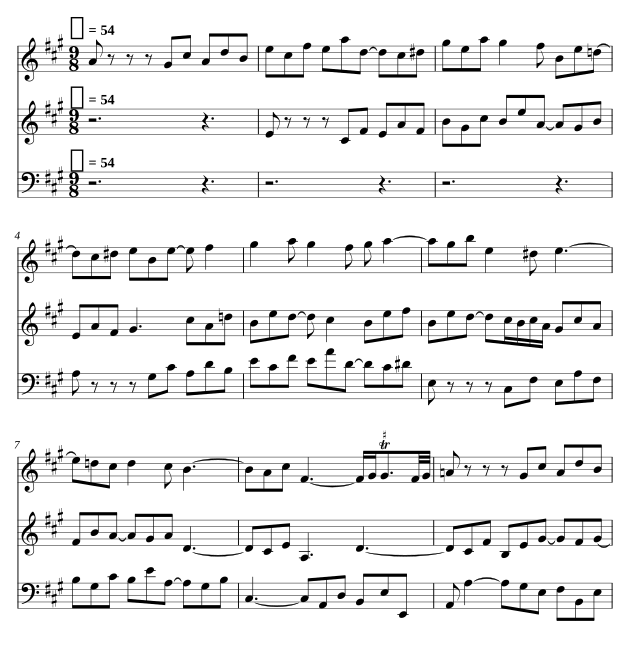 ▶ Complete score
Fugue 19 · Book I, No. 19 · BWV 864 ▶ Subject · Fugue 21
Fugue 21 · Book I, No. 21 · BWV 866 ▶ Prout’s excerpt · Fugue 25
Fugue 25 · Book II, No. 1 · BWV 870 ▶ Prout’s excerpt · Fugue 43
Fugue 43 · Book II, No. 19 · BWV 888 ▶ Prout’s excerpt · Fugue 44
Fugue 44 · Book II, No. 20 · BWV 889
 Treatise on HarmonyJean-Philippe Rameau, 1722
Start: Chapter twenty-three →- Table Explaining Essential Terms
…Those sensitive to true harmony regard them as extraneous, since good modulation supplies simpler, sounder rules that ensure correctness, provided the subject—as it absolutely should—follows good modulation. See Plainchant below, and for further satisfaction…
- Table Explaining Essential Terms
…tones, hence its name. It often represents a perfect fourth altered only by modulation, and is then no longer the tritone usually imagined. The same applies to fifths, seconds, sevenths, and ninths that modulation sometimes alters. Understanding modulation…
- Chapter nine
…these chords have never been distinguished by other names, because modulation obliges us to use particular sounds, which determine the order of the thirds composing every chord. Once modulation is determined by the difference in the third occupying the lower…
- Chapter twenty-one
…differ, and consequently their sixths. This is the whole difference in modulation—not second, fourth, fifth, or augmented seventh ascending to the octave, whose intervals never change, and still less melodic range, since intervals above or below the octave do…
▶ Fig. 99 nearby - Chapter twenty-three
…with their thirds and fifths, are formed from the notes belonging to the modulation of C. We thus pass freely from a major key to a minor one, or from a minor to a major, according as the thirds conform to the diatonic order of the starting key, or at least of…
▶ Fig. 250 nearby - SUPPLEMENT: changes to two chapters and necessary corrections
…this ancient passage, Brossard apparently overlooked how different their modulation was from ours. Lacking experience, they were extremely restricted. They applied irregular not only to cadences foreign to the first mode but also to melodic range, which…
▶ Fig. 456 nearby
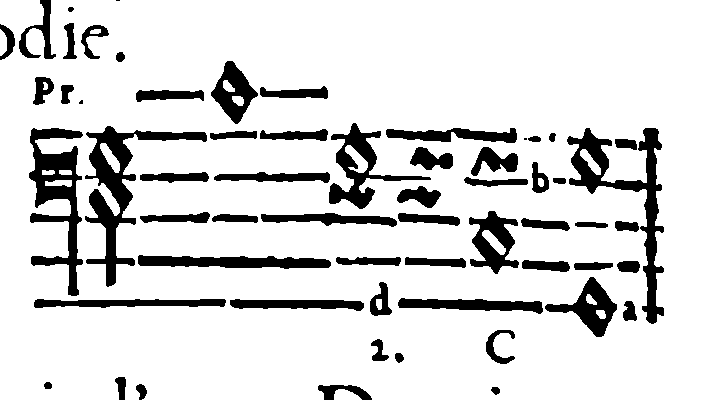 ▶ Fig. 99
 ▶ Fig. 250
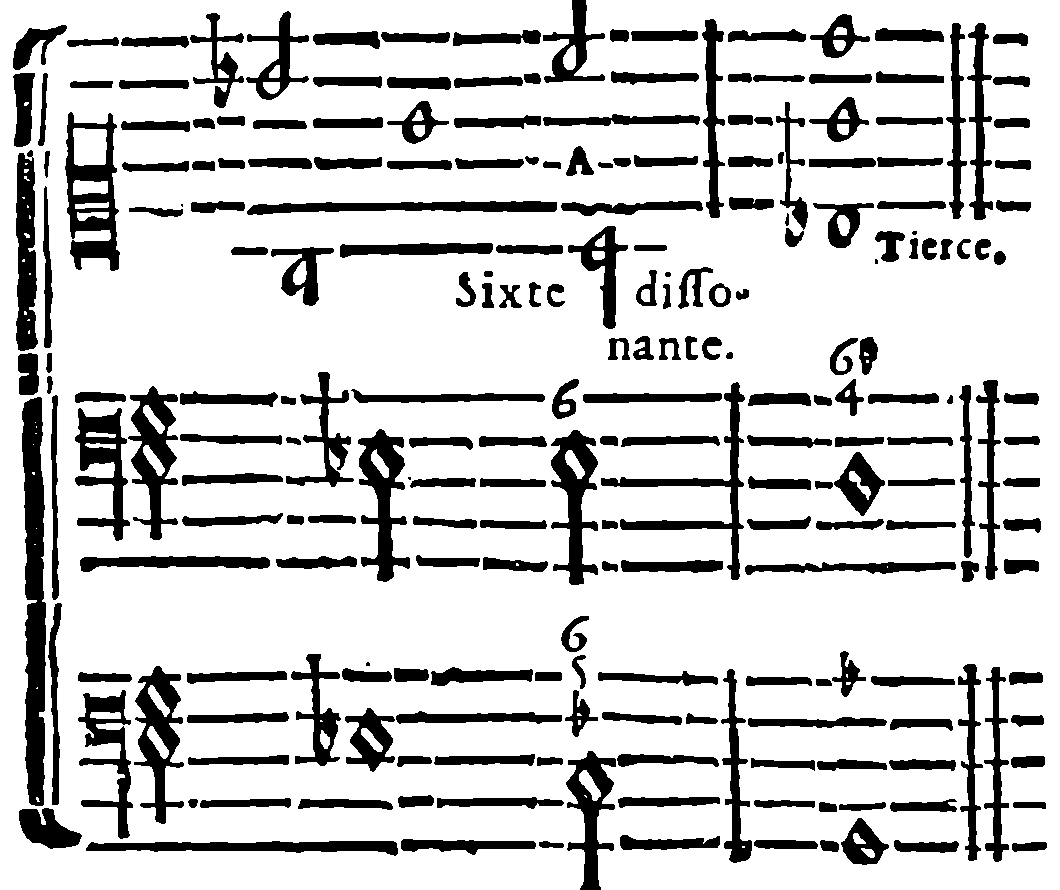 ▶ Fig. 456
 Practical Manual of HarmonyNikolai Rimsky-Korsakov, 1910
Start: Diatonic modulation → Start: Enharmony of Augmented-Sixth Chords →- Chapter III. Modulation
- Examples of modulations from C major to its related keys · 8 playable examples
- Examples of modulations from A minor to its related keys · 5 playable examples
- Immediate modulation
- Examples of modulations from C major to its related keys · 6 playable examples
- Examples of modulations from A minor to its related keys · 6 playable examples
- Chromatic modulation · 1 playable example
- Examples of chromatic modulations to a minor key from the keys of C and A · 6 playable examples
- Examples of modulations to a major key from the keys of C and A · 5 playable examples
- Examples of modulation from the keys of C and a · 1 playable example
- Definitive and transient modulation
- THE USE OF MODULATION in harmonizing a melody · 2 playable examples
- Modulation to keys of the second class
- Modulating plans · 2 playable examples
- Perfect modulation
- EXAMPLE OF PERFECT MODULATIONS TO KEYS OF THE 2nd CLASS · 6 playable examples
- Imperfect modulation · 2 playable examples
- Chapter V. Enharmony and Sudden Modulation
- Enharmonic Modulation
- Application of Polytony to Sudden Modulation · 3 playable examples
- MODULATING PRELUDE on the same theme · 5 playable examples
- Chorale melodies with modulations · 21 playable examples
- Melodies with modulations · 6 playable examples
- Preliminary notions
§ 47. 1) The action by which one passes from one key to another is called modulation. There are two ways of modulating: gradually (gradual modulation) and suddenly (sudden modulation).
- Preliminary notions
2) For gradual modulation one makes use of the affinity of keys (related keys); for sudden modulation, of polytonality and of enharmonicism.
- Assignments
REMARK. — Chromatic modulation, through its clarity and brevity, is especially applicable to transient modulation. To establish the following key firmly it is customary to modulate transiently to the subdominant keys, and also to the key of the IInd degree in…
▶ Fig. 235 nearby - Assignments
NOTE. — Before a modulation from a major key to the key of its minor subdominant (C–f), and after a modulation from a minor key to the key of its major dominant (a–E), it is better not to modulate transiently to the neighbouring keys, because of the…
▶ Fig. 237 nearby - Enharmony of Augmented-Sixth Chords
§ 84. — 1) To modulate enharmonically from one key to another — say, with C major (Do) as the starting point — one takes its dominant seventh chord, complete or incomplete (in the latter case the doubling of the third is indispensable), and regards it as the…
▶ Fig. 358 nearby - Application of Polytony to Sudden Modulation
3) Sudden modulation, used as a passing modulation of short duration to keys of the second class, imposes, as it were, the following rule: after modulating suddenly to one of the keys of the second class, one goes immediately to the key of the first class that…
▶ Fig. 385 nearby
94 more passages in Practical Manual of Harmony →
 ▶ Example 1: C major to A minor (a) through II of C = IV of a, (b) through VII of C = II of a, (c) through the C major tonic taken as the natural III of a, with a Phrygian progression.
Examples of modulations from C major to its related keys ▶ Model (A minor – E major): an eight-bar period in four parts, 3/2 time, passing through neighbouring keys ("tons de passage", "ton de passage") before reaching E major.
Assignments ▶ Bad: a) C major with a transient modulation to D minor ("ré", bracketed), back to C, then to F minor; b) A minor to E major, then a transient modulation to F♯ minor ("fa♯", bracketed) before returning to E major.
Assignments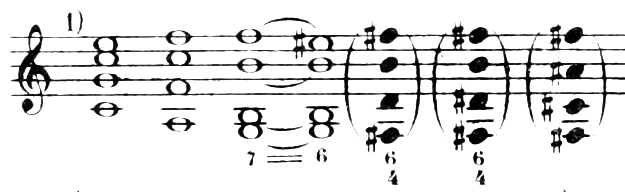 ▶ Example 1): C major — dominant seventh, incomplete with doubled third (G–B–B–F), reinterpreted as an augmented-sixth chord (G–B–B–E♯, figured 7 = 6) — resolved, as three alternatives in parentheses, on the B minor six-four, the B major six-four or the F♯ major triad.
Enharmony of Augmented-Sixth Chords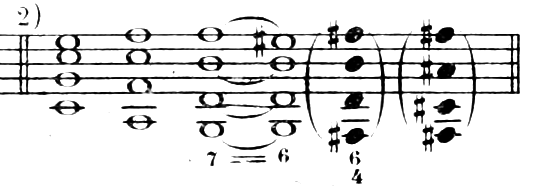 ▶ Example 2): C major — complete dominant seventh G–D–B–F, reinterpreted as an augmented six-five chord (G–D–B–E♯, figured 7 = 6) — resolved, as two alternatives in parentheses, on the B minor six-four or the F♯ major triad.
Enharmony of Augmented-Sixth Chords ▶ EXAMPLE OF PASSING MODULATIONS. Four-part whole-note chords in C major (Do) passing through A major (La), D minor (ré), back to C (Do), then by enharmony (C–E–G–B♭ reinterpreted as C–E–F♯–A♯) to E major (Mi), through A minor (la), and back to C major (Do).
Application of Polytony to Sudden Modulation
 Guide to the Practical Study of HarmonyPyotr Ilyich Tchaikovsky, 1900
Start: Chapter XVIII. Direct Modulation → Start: Chapter XXI. The enharmonic properties of the chord of the diminished seventh →- Chapter XIX. Transient Modulation · 7 playable examples
- Chapter XX. Harmonization of given melodies with modulations · 7 playable examples
- Chapter XVIII. Direct Modulation
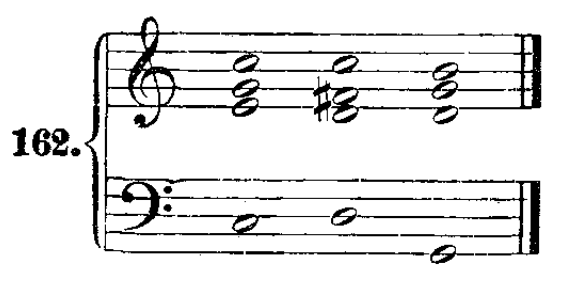
…by the dominant triad, when followed by the tonic. The most important of all modulating chords is the Dominant chord; for, notwithstanding its resolution into the tonic triad, its very outward form shows, that it can belong to but one key; which is not the…
▶ Fig. 172 nearby - Chapter XVIII. Direct Modulation
As the Dominant-seventh chord is the same in minor as in major, the modulation remains unchanged, whether leading to major or minor. Modulations starting from minor are more difficult to effect because there are fewer intermediate chords. Resource must…
▶ Fig. 180 nearby - Chapter XIX. Transient Modulation
§ 57. Besides direct modulation, there is the indirect or transient modulation, which, instead of immediately introducing the desired key, first passes through one or more neighboring keys. It would be impossible to set down exact limits for such a degression;…
▶ Fig. 195 nearby - Chapter XIX. Transient Modulation
§ 58. Under this heading belongs also the transient modulation in form of a sequence. If a modulating chord be found in the motive of a sequence, it need not, in the repetition of the motive, modulate in the same—direction; in this we must be governed by the…
▶ Fig. 196 nearby - Chapter XX. Harmonization of given melodies with modulations
…trend of the melody itself also determines, in a measure, the choice of the modulation. If, for instance, in a melody in C major we meet with ac sharp, followed by d,—into what key would it be best to modulate? The note ¢ sharp, coming, as it does, before d,…
▶ Fig. 202 nearby - Chapter XXVII. Chords of the augmented Sixth
…A chord of the augmented sixth on the 6-th degree is nothing else than a modulatory degression into the key of the Dominant; this degression is indeed so unnoticeable, that without the help of a prolonged cadence we scarcely get the impression of a modulation.…
▶ Fig. 304 nearby
64 more passages in Guide to the Practical Study of Harmony →
 ▶ Fig. 172
Chapter XVIII. Direct Modulation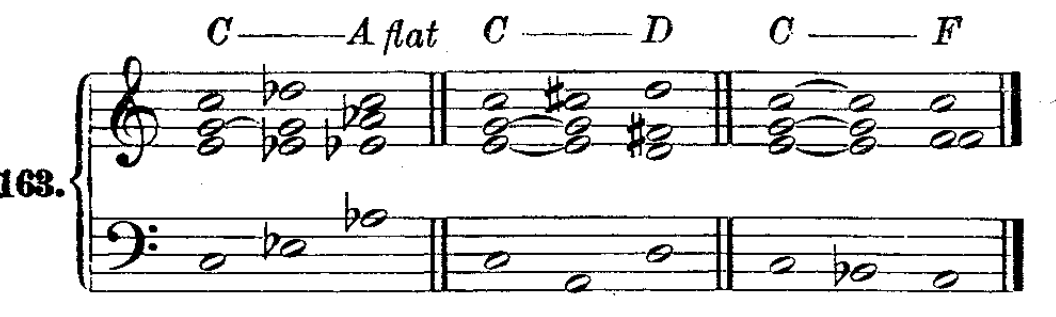 ▶ Fig. 173
Chapter XVIII. Direct Modulation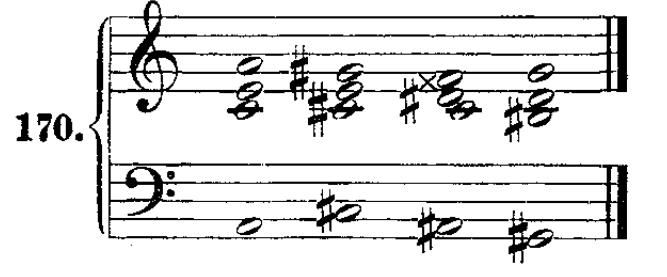 ▶ Fig. 180
Chapter XVIII. Direct Modulation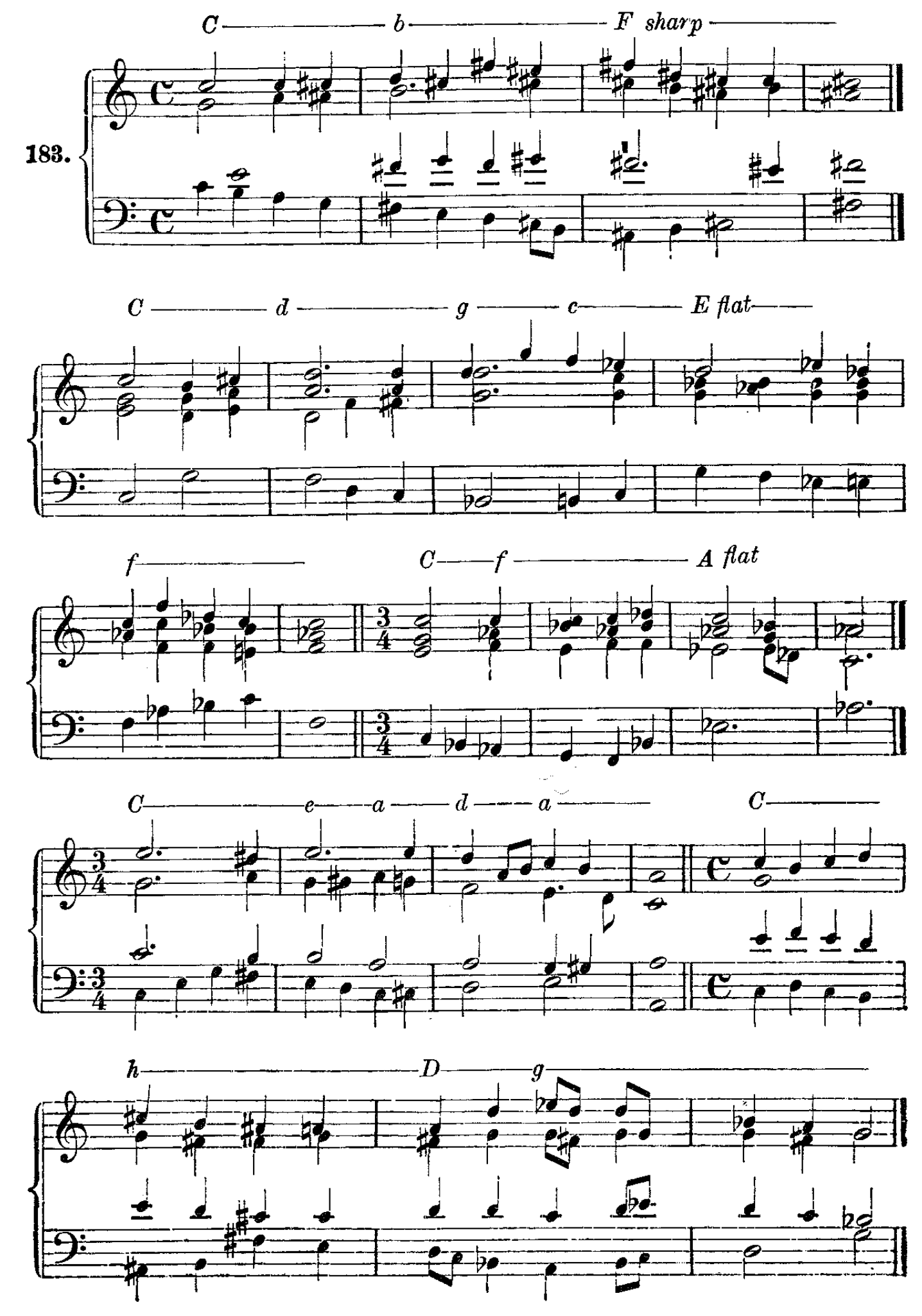 ▶ Fig. 195
Chapter XIX. Transient Modulation ▶ Fig. 209
Chapter XXI. The enharmonic properties of the chord of the diminished seventh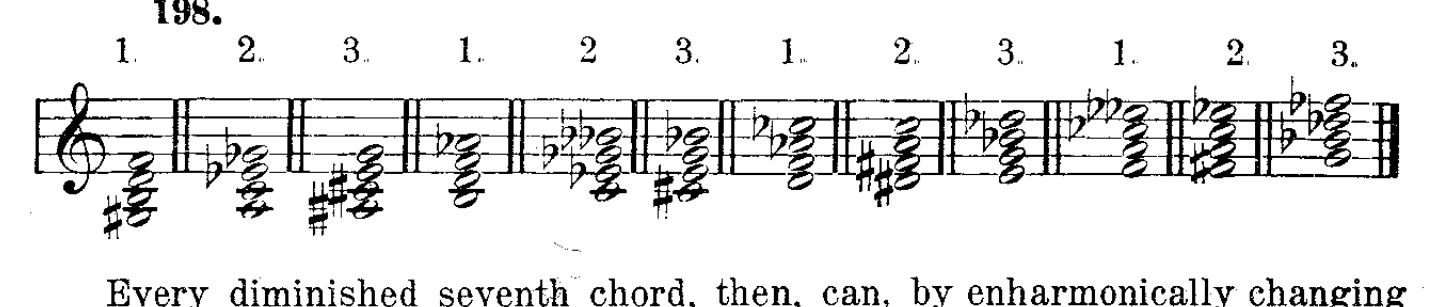 ▶ Fig. 210
Chapter XXI. The enharmonic properties of the chord of the diminished seventh
 Supplement to the Theory of ModulationMax Reger, 1904
Start: Preliminary Remarks →- Preliminary Remarks
This “Supplement to the theory of Modulation” is intended both for the professional musician (for those learning harmony, for pianists, organists, singers and others), and for the amateur to whom the rudiments of the theory of music are not a sealed book.
- Preliminary Remarks
…draw special attention to the fact that in this ‘Supplement to the theory of modulation’, i. e. in the examples of modulation, I have purposely avoided anything pertaining to enharmonics, with a view of drawing the student’s special attention to musical logic;…
- Preliminary Remarks
The musician, studying the examples of modulation with their analyses, under the guidance of an experienced teacher with a “mind open to improvement or progress”, should transpose the examples into as many keys as possible, and should himself try to invent…
- Preliminary Remarks
In conclusion, I would request that my examples of modulation be looked upon not as compositions, but that they be merely taken for what they are intended — “dry” examples explaining the simplest principles of the theory of modulation, one of the most…
- From C♯-major
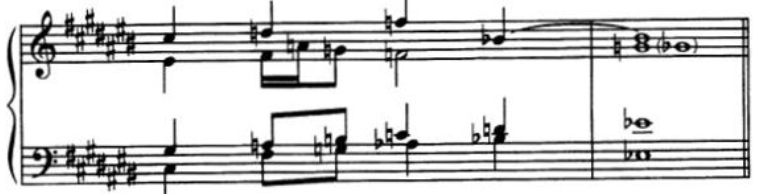
NB. To modulate to e♭-minor, use the f-minor (f a♭ c), which is also the chord of the Dorian sixth in e♭-minor; dominant (B♭-major) of e♭-minor. (Cadence!)
▶ Fig. 86 nearby - From C♯-major
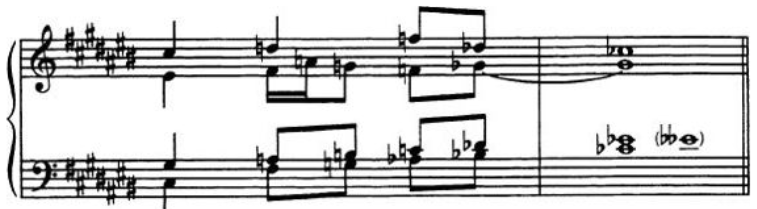
NB. The modulations in Nr. 43, 44, 45, 46 to a♭-, d♭-, g♭- and c♭-minor are less recommendable, for in these, the major third of the finally reached tonic, seems more natural. (In Nr. 42, however, the Dorian sixth c, in e♭-minor, is quite natural and also…
▶ Fig. 95 nearby
 ▶ Ex-42
 ▶ Ex-46
 Theory of HarmonyArnold Schoenberg, 1922
Start: Modulation →- Modulation Continued
- Modulation through Intermediate Keys · 18 playable examples
- 5. A Few More Modulation Schemes · 35 playable examples
- The Method of Teaching Harmony
…grows with the means available, moving from the simplest cadences through modulation to a few practical applications in exercises. This has the advantage that, in a certain sense, the pupil composes for himself from the very beginning. These settings, which he…
- Modulation
…two ways of putting it characterize the first two principal means of our modulation. The one: the use of such neutral chords as mediate between starting point and goal; the other: the reinterpretation of chords common to both keys. Mostly both work at the same…
▶ Fig. 145 nearby - Modulation
…sixth chord for the sake of the bass melody and to avoid repetition, and the modulating chord (degree V) as a ³₄ chord*). 108b, after VI of C (II of G), brings V of G as a ⁵₆ chord. The cadence is worked out somewhat more richly, in order to blur the…
▶ Fig. 146 nearby - Modulation through Intermediate Keys
But unless one is taking an examination and has to hurry, one has time for a modulation and can plan it: can make its route genuinely one of close relationships rather than accidents, and can draw on characteristic means to obtain a characteristic effect.…
▶ Fig. 359 nearby - Fifth and Sixth Circles of Fifths
These examples make frequent use of the modulatory resources mentioned most recently. In 211c, for example, the modulation C–G is introduced through the Neapolitan sixth; in 211f, the Neapolitan sixth of F minor is itself introduced through the corresponding…
▶ Fig. 397 nearby - 5. A Few More Modulation Schemes
Modulations are only episodes. But one can also select such an episode, which a cadence presents only in concentrated form, and treat it separately. Then it can be presented more broadly, less concentrated, more richly developed, with more independent motion…
▶ Fig. 566 nearby
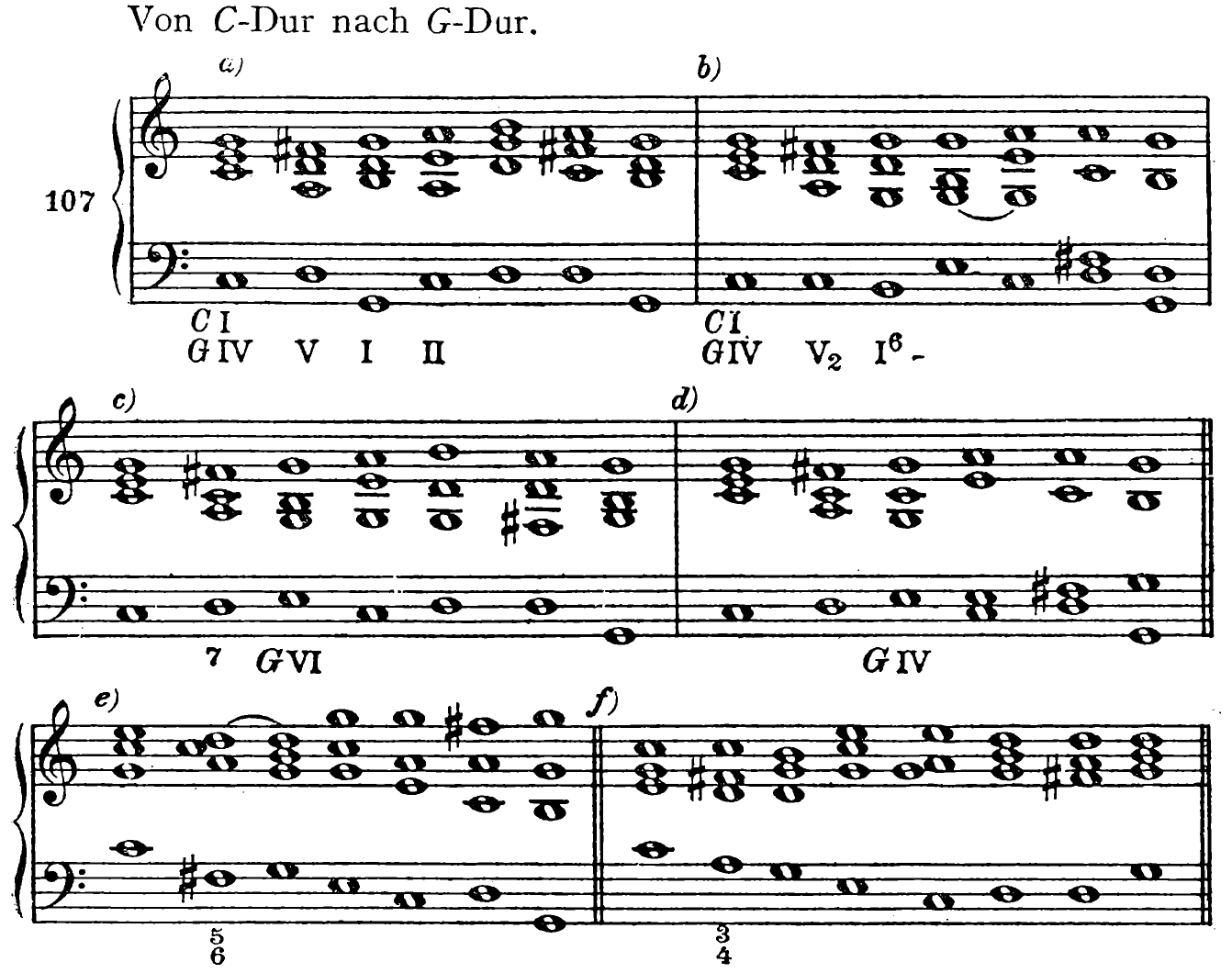 ▶ Example 107a
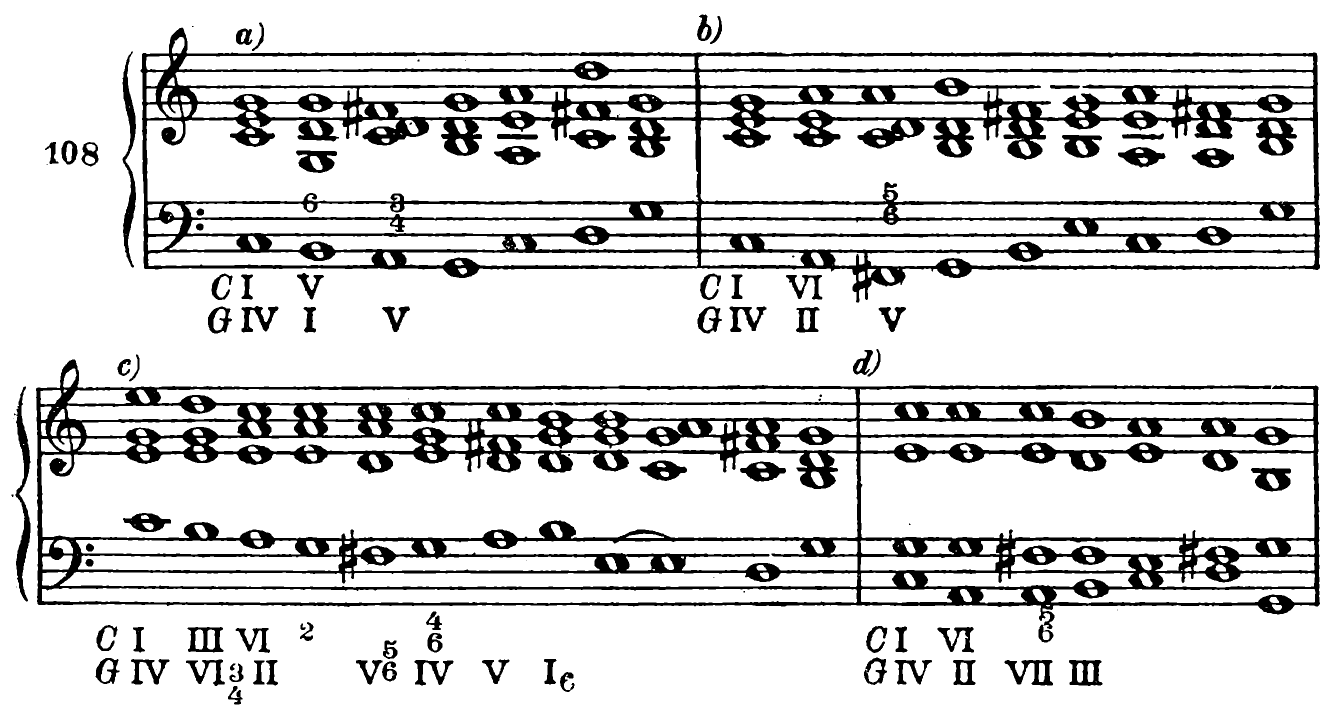 ▶ Example 108a
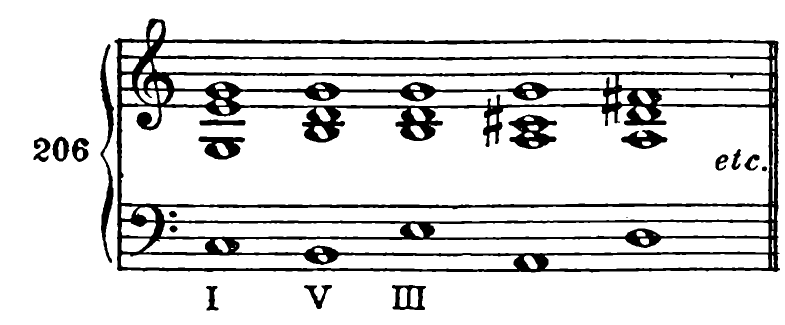 ▶ Example 206
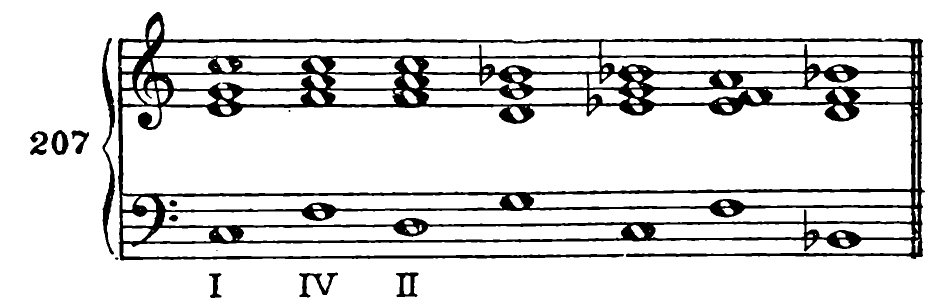 ▶ Example 207
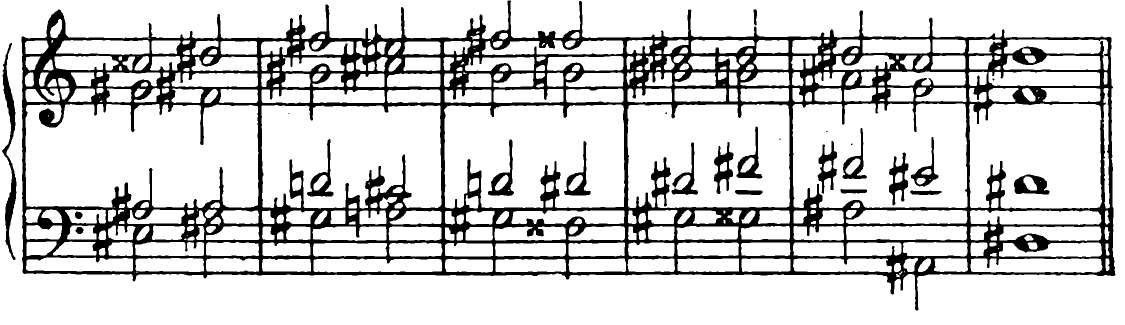 ▶ Example 211-qu2
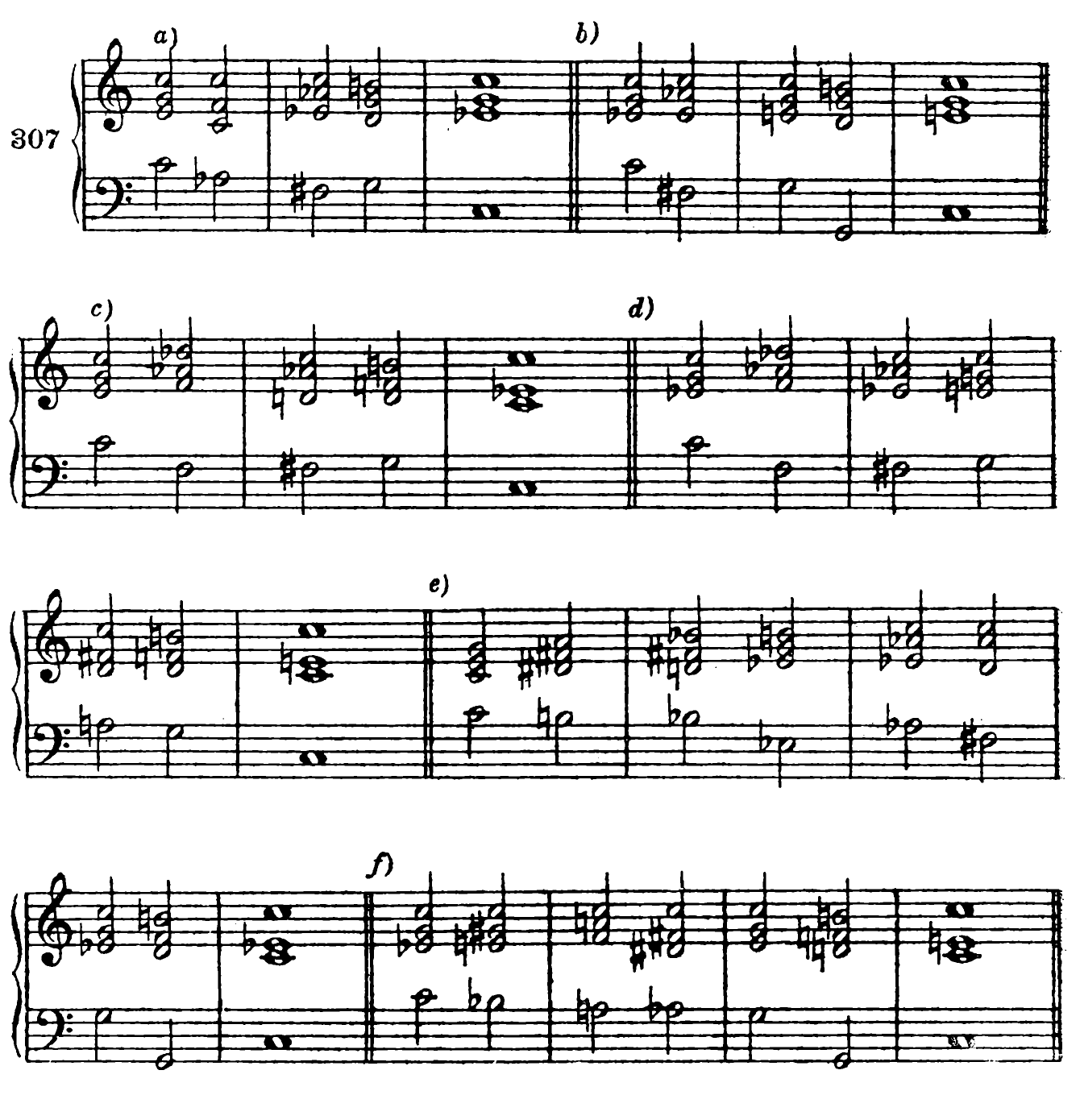 ▶ Example 307a
 Principles of OrchestrationNikolai Rimsky-Korsakov, 1922
- Harp
…the player stops the vibration of the strings with his hands, but, in quick modulations, this method is not feasible, and the mixture of one chord with another produces a discordant effect. It follows that more or less rapid figures can only be realised…
- Harp
…of the pedals. For this reason the harp does not lend itself to rapid modulation, and the orchestrator is advised to bear this fact in mind. But the difficulty may be obviated by using two harps alternately.[10]
- Harp
…is not capable of double sharps or double flats. For this reason, certain modulations from one key to another one, adjacent to it can only be accomplished enharmonically. For instance, the transition from C flat, G flat or D flat, major to their minor…
- Harp
…as embellishments. Glissando passages in chords of the seventh and ninth, enharmonically obtained, are much more common, and as the above reservations do not apply, every dynamic shade of tone is possible. Chords in harmonics can only consist of three notes…
- Melody in the brass
Melodies involving chromatic or enharmonic writing are much less suitable to the character of brass instruments. Nevertheless such melodies may sometimes be allotted to the brass, as in the music of Wagner, and the modern Italian realists, who, however, carry…
- B. Men’s chorus and women’s chorus
…of parts is correct, if discords are properly prepared, sudden and remote modulations, even of the harshest and most uncommon kind will be comparatively simple and may be approached with some degree of confidence. This is a fact which composers do not always…
 OrchestrationCecil Forsyth, 1914
- No. 19. The Cornet
…keys and A-crook for sharp keys, will suttice for all the simpler keys and modulations. Notice, however, that when one is dealing with the borderland keys, such as Db, Gb, F* Bi, and with the less simple modulations, it is often wise to modify inv general rule…
- No. 19. The Cornet
Minor keys are just as easy to deal with, if only one keeps an eye on the modulations and remembers that a transition to the dominant puts one four degrees to the North. In flat keys this generally brings one fairly near home (C major); but in sharp keys it…
- No. 19. The Cornet
In a similar way the student may deal on their merits with the other modulations, namely those from major to minor and from minor to minor keys. In a few of these cases he will find extreme modulations where a change of crook is a necessity. For example, from…
- No. 39. The Clarinet
…for flat keys, A-Clarinets for sharp keys, and remember the possibilities of enharmonically varied key-signatures for the extreme keys. Example: Key OF's, FF major = Go major. Bb Clarinets will therefore be in Ab major (4 flats), and if the modulations are…
- No. 39. The Clarinet
…difficulties did not exist. Music was written in short sections and rarely modulated far from "home." A suitable choice of Clarinet was made at the beginning of a piece, and only on the rarest occasions even in Opera was it necessary to change the instrument…
- Stringed instruments
…and are of actual' harmonic importance the player distinguishes between the enharmonics, both in the fingering " and in the resultant pitch. The correct notes should theretore be written, especially in the case of the larger stringedinstruments such as Violas…
 Treatise on InstrumentationHector Berlioz, 1905
- Introduction
Then came modulation’s turn. At the time when modulation was limited to nearly-related keys, the first who ventured into more distant keys were censured. One might have expected this. Whatever the effect of these new modulations, the masters rejected them…
- Introduction
…vanity from stupidity and obstinacy. Concerning harmony, melody and modulation, there is now general agreement to-approve whatever produces a good effect, and to reject what has a poor effect. Even the authority of a hundred old men (be they as old as a…
- The Viola d’Amore
…those three chords (D, A, F#) are obviously not adequate in accompanying a modulating melody without interruption, this could easily be remedied by using several differently tuned violas d’amore, for instance in C or Db, according to the chords required by the…
- The Harp
The other four keys (Ab, Db, Gb, Cb) can be obtained only by enharmonic changes, and by quickly taking and releasing
- The Harp
nothing but an enharmonic C}. The player must therefore quit the C#-pedal immediately after taking it to keep the Ck open, the major third of the key in which he is playing; furthermore, he must skip the Dh-string when ascending diatonically. This is so…
- The Concertina
the melodic phrase or the harmony cause unisons between the enharmonic A® or G#, or E® or D# of the concertina with the same, but well-tempered tones of the other instrument. On the instruments with equal temperament A> and G# as well as E> and D# are…
More in Cadence, key and progression
Cadence · Deceptive cadence · Sequence · Modes · The leading note · Figured bass and partimento · Fundamental bass · Harmonizing a melody