 Playable Books
Concept index · Cadence, key and progression
Sequence
Taught in 13 books. Each one opens at the passage; ▶ plays the example beside it. Also called harmonic sequence, sequences.
This index is Playable Books’ own: a first pass that finds the term’s words in each book, corrected by hand. The authors did not tag these passages, and their terms can differ (Fux’s “ligature” is a suspension). The quoted text is the book’s.
 Gradus ad ParnassumJohann Joseph Fux, 1725
- Fourth species in four voices
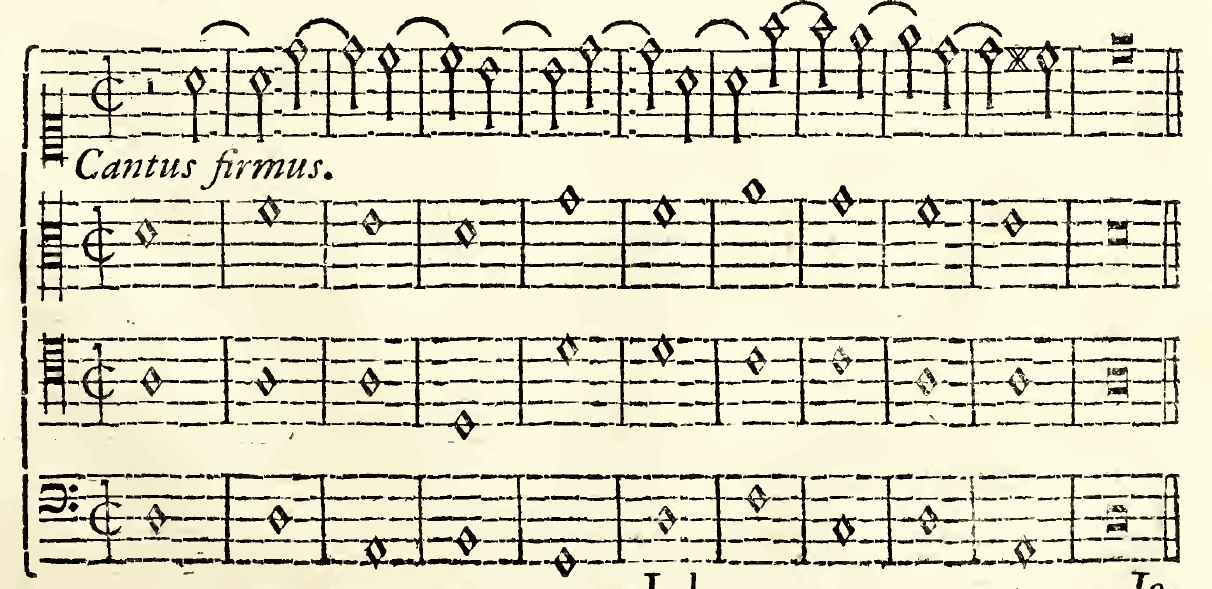
…there are very many, where there is no room for an octave because of the sequence of preceding and following notes, a fifth must necessarily be used. Then the semibreve must be divided, as in many other circumstances, as the following examples teach.
▶ Fig. 215 nearby
 ▶ Fig. 215
 Exercises in Elementary CounterpointPercy Goetschius, 1910
- Chapter III. Exceptional Progressions. Minor Mode
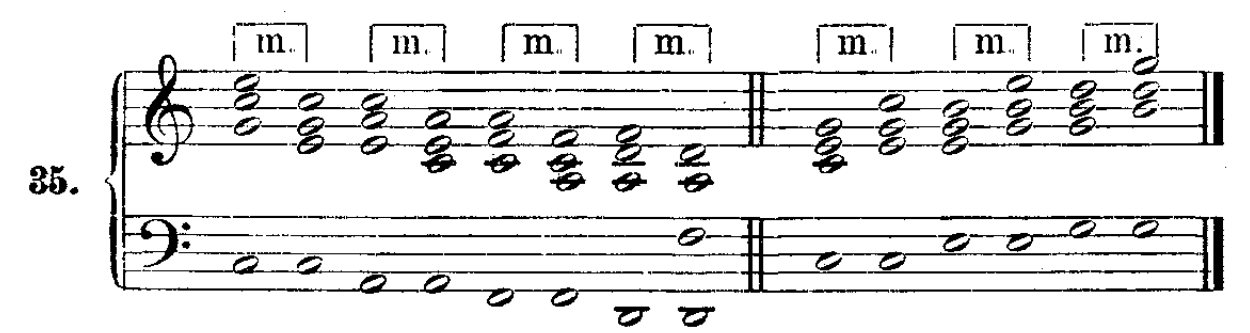
…whole measure, or two measures in length) may be reproduced as repetition, sequence, or some other closely corresponding form, — generally in some corresponding rhythmic group. For example:
▶ Fig. 33 nearby - Chapter III. Exceptional Progressions. Minor Mode
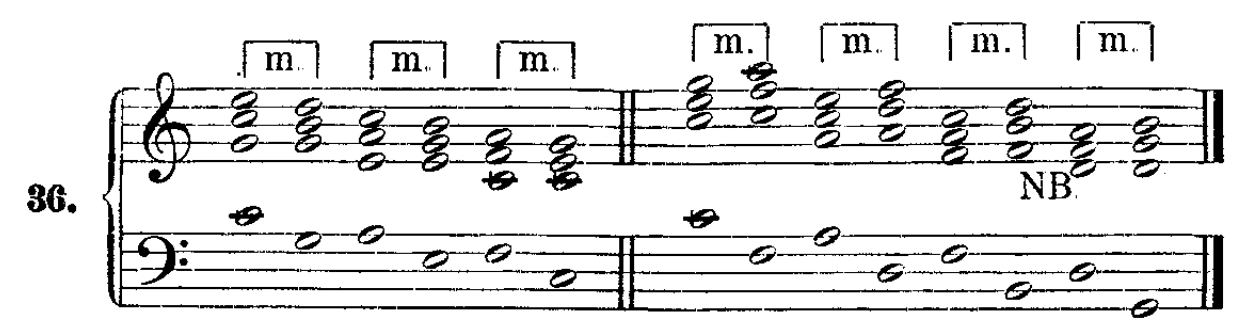
In No. 1, the poor progressions 7-6-7 and 5-4-5 are both justified by being sequences of the first measure (which is a blameless figure). In No. 2, the awkward movement from 4 up to 7 is justified by the repetition of the first figure. In No. 3, several poor…
▶ Fig. 36 nearby - Chapter XV. Motive-Development. Imitation
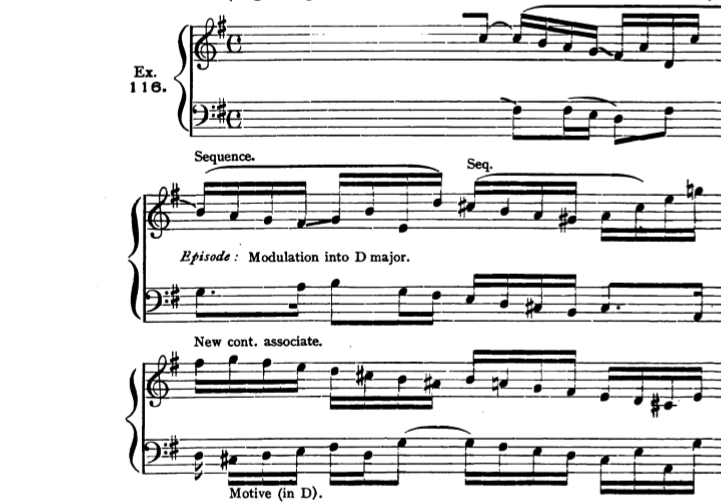
…does not contain the entire Motive, but only figures from it, derived by sequence. Such a passage is called an Episode. Observe, further, that the sequences are not exact, and remember that such freedom is not only permissible, but necessary.
▶ Fig. 262 nearby - Chapter XVII. Secondary Chords
183. In sequential successions, almost any irregularity is excused, as usual. See par. 29. For example, in the following, many of the conditions of par. 169 are set aside. It is mainly necessary that the first figure is regular (normal), and that it interlocks…
▶ Fig. 298 nearby - Chapter XVII. Secondary Chords
N. B. The uppermost slurs indicate the actual figure and its sequences. The inner and lower slurs are merely noted to show how the sequence interlocks with its (preceding) figure. Examine every group very carefully, observing exactly the effect of each system…
▶ Fig. 305 nearby - Chapter XVII. Secondary Chords
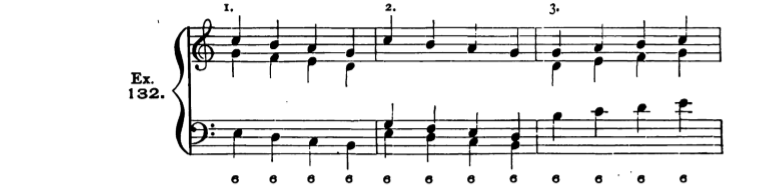
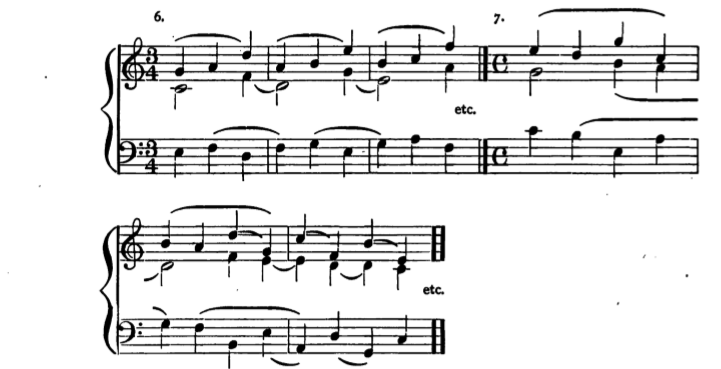
Any good figure will yield a number of sequences, but the points at which the sequence may begin must be those into which the figure itself runs smoothly.
▶ Fig. 305 nearby
 ▶ Ex.27
 ▶ Ex.28-3
 ▶ Ex.116
 ▶ Ex.132
 ▶ Ex.133-7
 Counterpoint AppliedPercy Goetschius, 1902
- Chapter I
To be feasible, such a line of sequences should start from a figure that is faultless. The rectitude of the initial figure is the justification of all reasonable sequence. shifts (or reproductions) of it.
▶ Fig. 11 nearby - Chapter II
This emphasizes the importance of the Sequence, without which truly good and intelligible polyphony can scarcely be imagined. But it refers also to all other means by which the evidence of clear form and broader melodic design may be established, and which are…
▶ Fig. 80 nearby - Chapter II
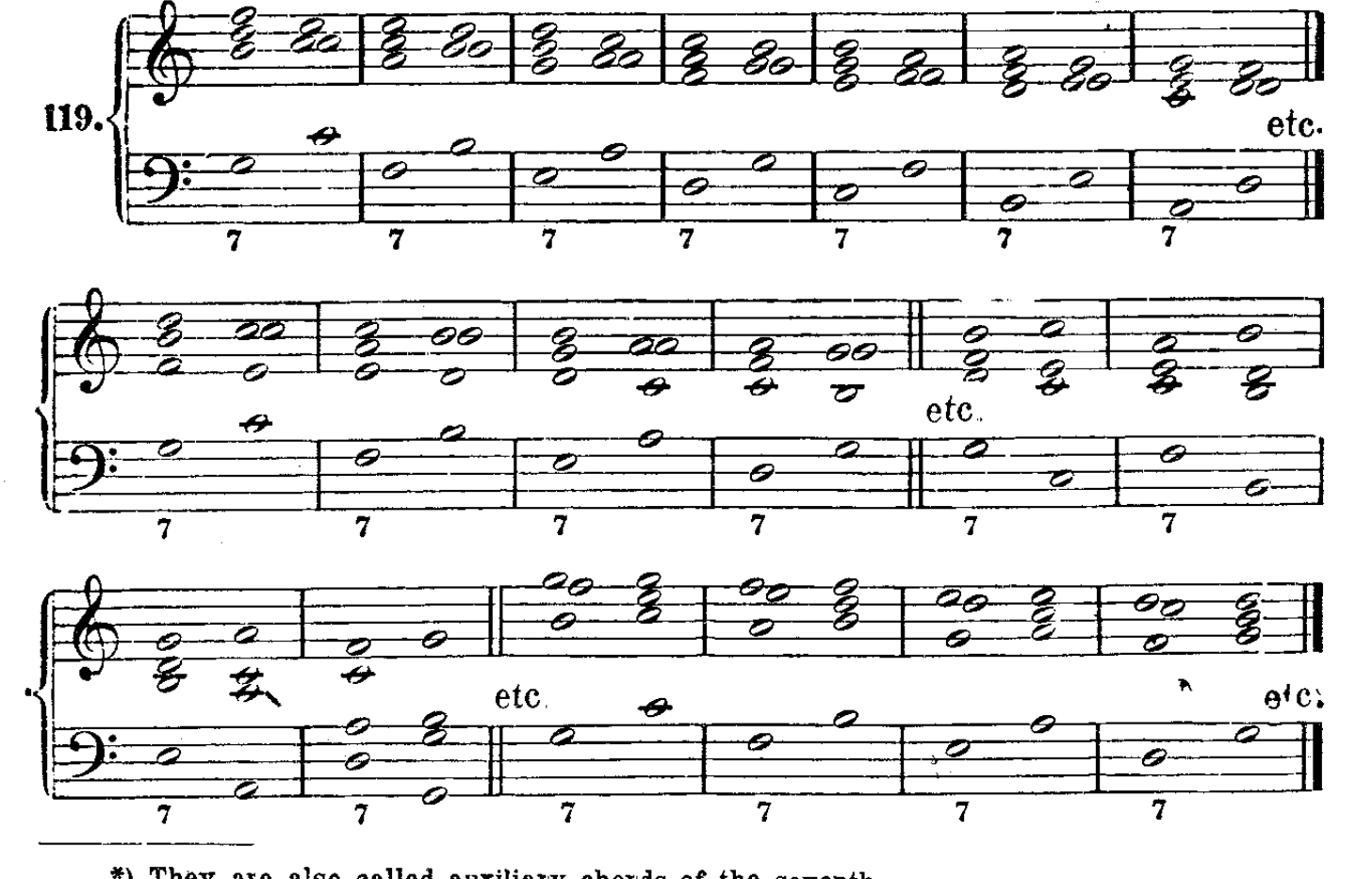
…the new).-*5) This extraordinary series of modulations is justified by the sequential formation of the lower part. The unessential intervals are in brackets. The clin Soprano is the minor 9th (lowered 6th scale-step) of E.—*6) The at in Bass is substituted for…
▶ Fig. 119 nearby - Chapter IV
…apparently regardless of the Imitation (observe the collision at N. B.), in sequential projection of its final member. The importance of the Sequence is here again vindicated; by no other means can melodic evolution be more easily and naturally effected than…
▶ Fig. 189 nearby - Chapter V
…The Motive, instead of being again imitated in the other part, reappears as Sequence in the same part, upon the next lower step. The first tone is omitted, in order not to disturb the smooth termination of the preceding announcement. A clue to the impulses…
▶ Fig. 214 nearby - Chapter V
The Sequence imparts at least regularity and symmetry to the operations of thematic development; and, while particularly important in the more vagrant episodic components, is even freely used in the thematic passages themselves (par. 4oe). Hence, the pupil may…
 ▶ Ex7
▶ Ex7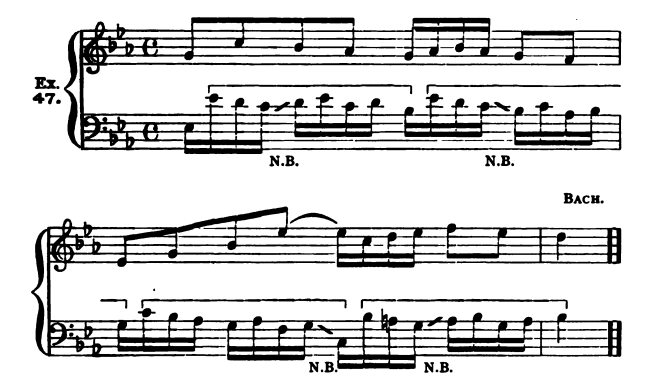 ▶ Ex47
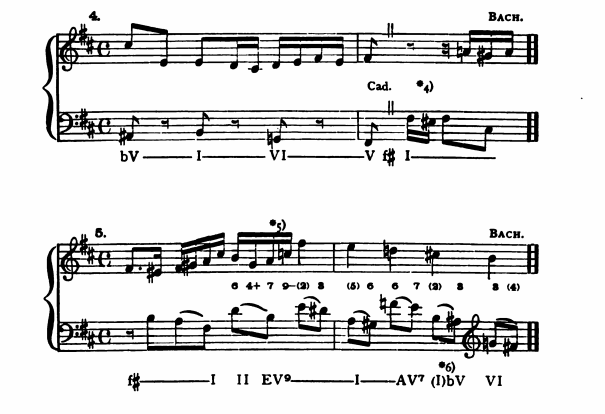 ▶ Ex57-4-6
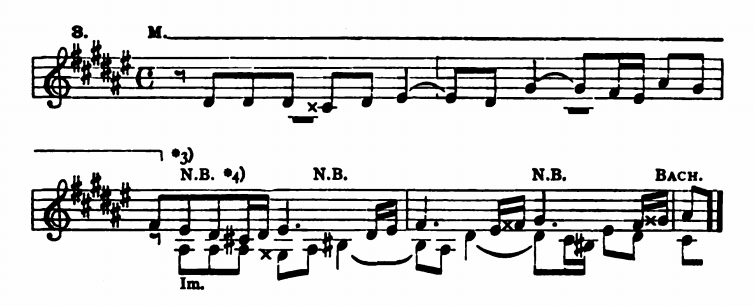 ▶ Ex84-3
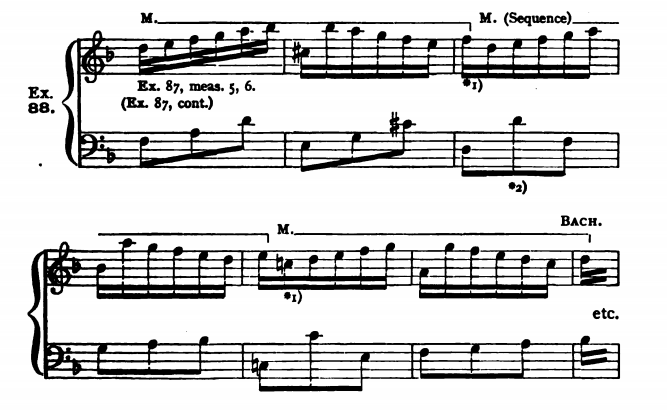 ▶ Ex88
 Analysis of J. S. Bach’s Forty-Eight FuguesEbenezer Prout, 1910
- Introduction
NOTE.—It is assumed that the terms belonging to simpler branches of musical theory, such as "cadence," "sequence," "pedal point," are already familiar to the student.
- Fugue 2 · Book I, No. 2 · BWV 847
…a codetta is introduced (bars 5 to 7). The upper part is founded on a sequential treatment of the first notes of the subject, a descending sixth being substituted for a fourth. The alto, also sequential, is formed from the commencement of the countersubject…
▶ Fig. 3 nearby - Fugue 2 · Book I, No. 2 · BWV 847
…descending scale passage with which the countersubject opens. Bar 10 is a sequential repetition of bar 9, by means of which a modulation is effected to the relative major, E flat; in this key we find at bar 11 the first middle entry. It is in the treble, and…
▶ Fig. 3 nearby - Fugue 17 · Book I, No. 17 · BWV 862
…the triple counterpoint of episode 2. The last episode (bars 25 to 27) is a sequential treatment in the tenor of the semiquaver figure of bars 2 and 3, with sequential counterpoints added in treble and alto.
▶ Fig. 44 nearby - Fugue 35 · Book II, No. 11 · BWV 880
The first and longest episode (bars 25 to 52) commences with a sequential treatment of bar 25, followed, at bars 29 to 33, with imitations founded on bars 4 and 5 of the subject. Bars 33 to 34 are developed from the codetta (bars 9 to 14). From bar 45 to 52 is…
▶ Fig. 81 nearby - Fugue 36 · Book II, No. 12 · BWV 881
The episodes are four in number. The first (bars 15 to 24) begins with a sequential prolongation of bar 3 of the subject, after which, at bar 17, a new sequence appears, formed from the beginning of the subject, with a new counterpoint. The second episode…
▶ Fig. 84 nearby
17 more passages in Analysis of J. S. Bach’s Forty-Eight Fugues →
 ▶ Subject · Fugue 2
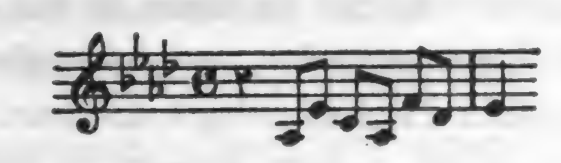 ▶ Subject · Fugue 17
 ▶ Prout’s excerpt · Fugue 35
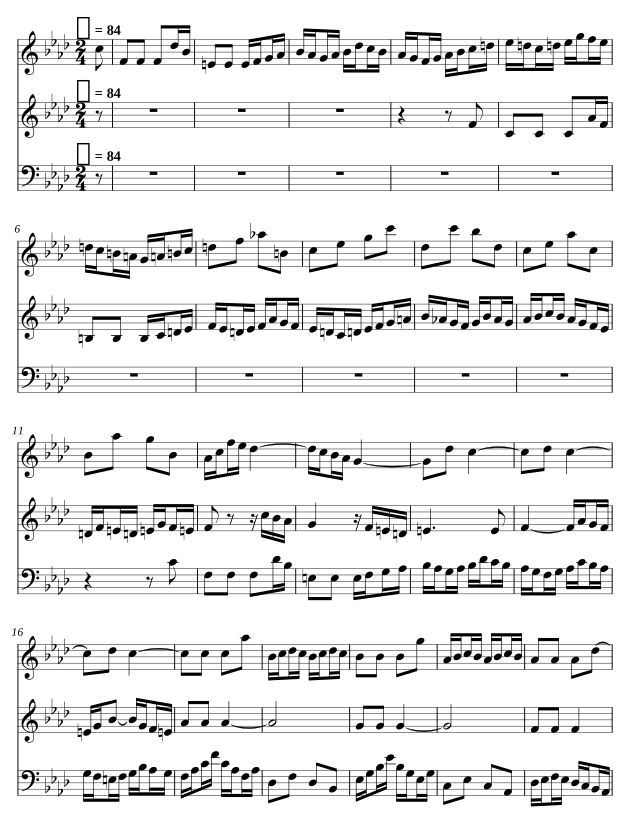 ▶ Complete score
 Treatise on HarmonyJean-Philippe Rameau, 1722
- Table Explaining Essential Terms
Ways to maintain a long sequence of melody and chords without any conclusion. page 68
- Table Explaining Essential Terms
Divide this string according to the natural sequence of numbers to obtain every necessary harmonic benefit. 3. 4. 15. 16 and 21
- Table Explaining Essential Terms
To apply the natural numerical sequence to harmony, imagine that numbers indicate divisions of unity, and so forth. 11 and 19
- Chapter five
…octaves or two successive fifths. This is easily recognized in the sequence of figures: the same part must never contain two octaves, 8 8, or two fifths, 5 5. As we can observe, this fault can now be avoided without requiring special attention. Both…
▶ Fig. 199 nearby - Chapter twenty-three
6. As soon as we change key, we must know its principal note, the tonic. Conceiving that note as ‘ut’ or ‘ré’—the tonic names of our major and minor models—immediately determines the sequence and progression of all notes within its octave and tells us which…
▶ Fig. 250 nearby - Chapter twenty-five
…them. If the leading note cannot be distinguished, there is a certain sequence of chords in diatonic progression from the last consonant chord that the final note in consonant progression must have borne. We must not depart from this sequence as prescribed in…
▶ Fig. 261 nearby
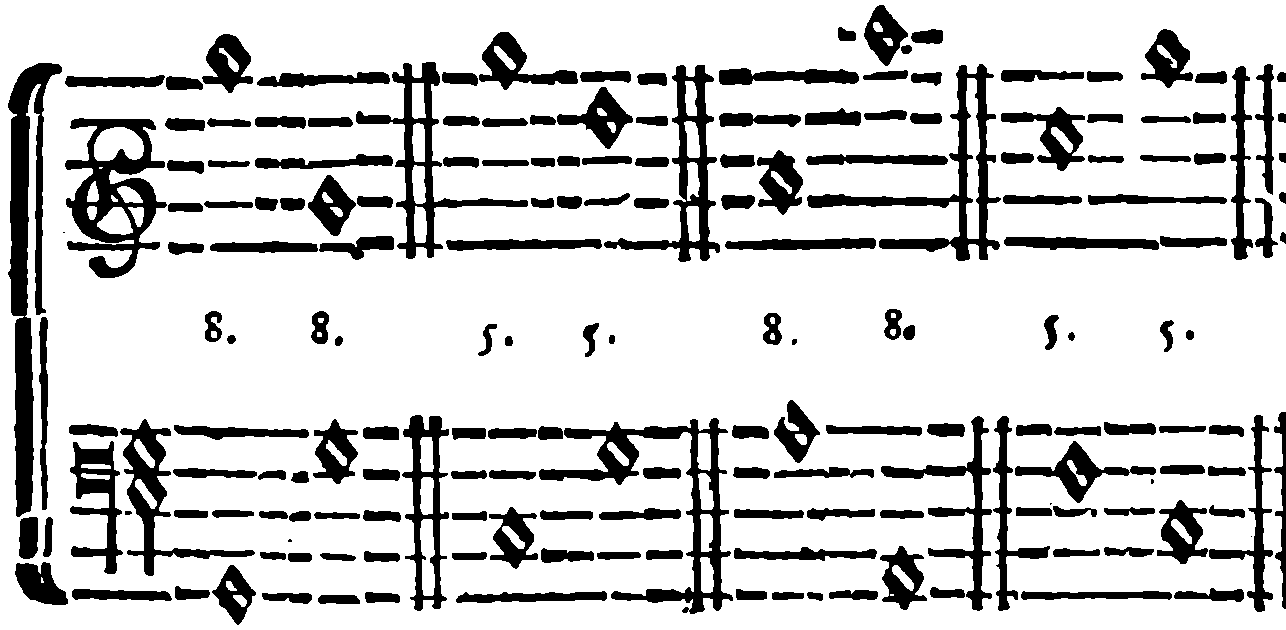 ▶ Fig. 199
 ▶ Fig. 250
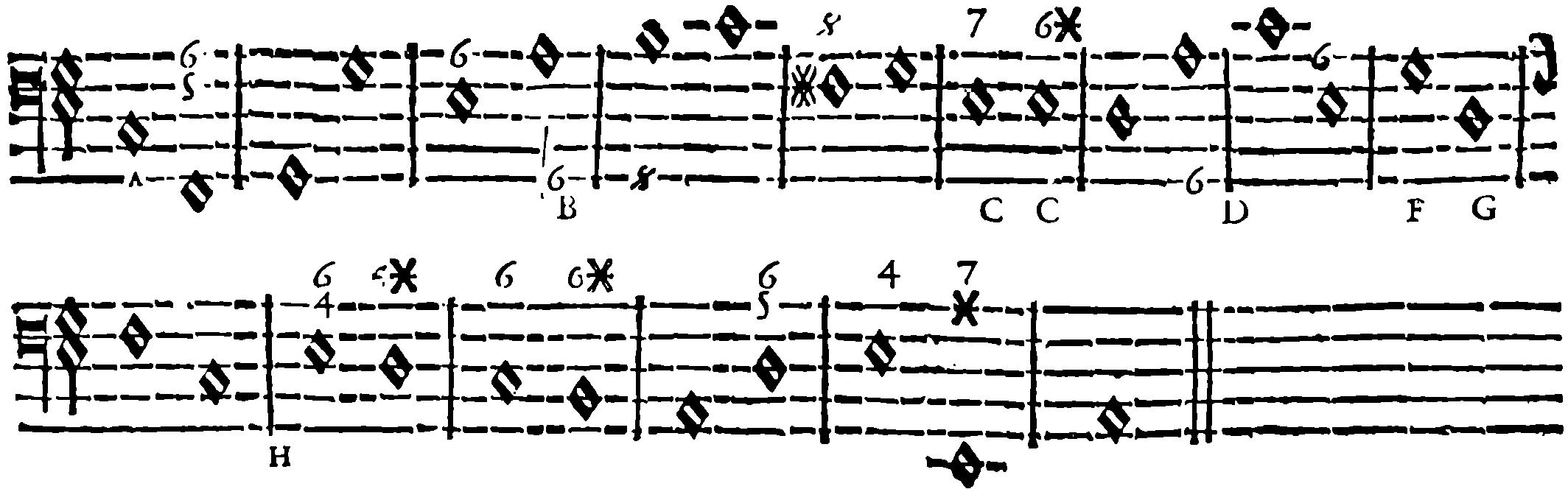 ▶ Fig. 261
 Practical Manual of HarmonyNikolai Rimsky-Korsakov, 1910
Start: B) harmonic sequences of seconds and thirds →- A) harmonic sequences by fourths and fifths
- Harmonic sequences with seventh chords · 4 playable examples
- Preface to the First Edition
In addition, the pupil should be able to play any gradual or sudden modulation at the piano, to improvise a prelude in any key, preferably in four parts, and finally to play various sequences and harmonic progressions.
- B) in the minor mode
Harmonic sequences by fourths and fifths show the most natural relations that exist between the chords belonging to a single key. In them the connection is alternately harmonic and melodic; diminished-fifth chords, which in progressions containing no sequences…
▶ Fig. 149 nearby - Supplement
Following the preceding examples of descending sequences of common chords and their inversions, sequences in ascending motion can also be made, e.g.:
▶ Fig. 158 nearby - Exercises
3) Sequences can also be made on the model of the (less natural) resolution of the leading-note seventh chord to the tonic chord with the third doubled; the result is sequences in which each triad prepares the seventh chord lying a third below it:
▶ Fig. 170 nearby - Exercises
Write the same sequences in the minor mode; make sequences with ninth chords, and play them all at the piano, beginning with chords on various degrees and returning to the tonic.
- Polytonic Succession of Dominant Seventh Chords in the Relation of an Upper or Lower Third
…(b), on the other hand, is fairly common. It derives from the modulating sequence, a modification of the one-key sequence; that is, each seventh chord of the one-key sequence is transformed into a dominant seventh chord in the modulating sequence.
▶ Fig. 380 nearby
22 more passages in Practical Manual of Harmony →
 ▶ Harmonic sequence by descending fifths in A minor: natural minor throughout, with harmonic V at the start and before the final tonic
B) in the minor mode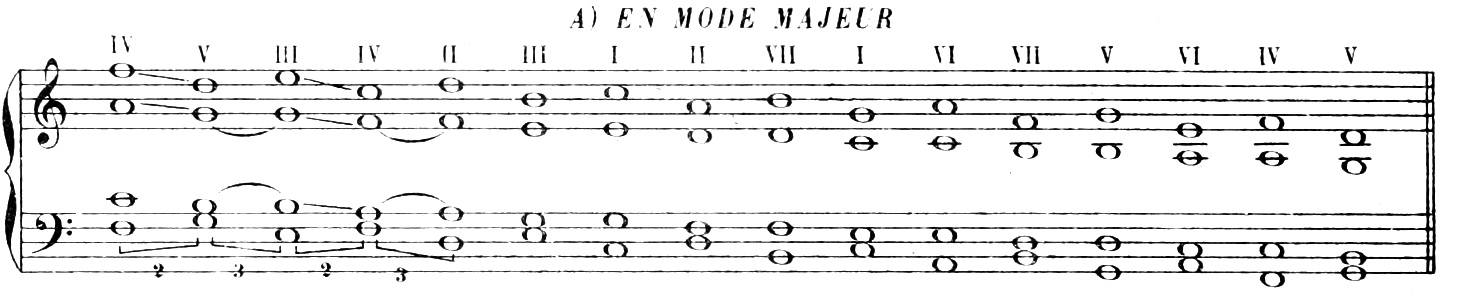 ▶ A) In the major mode: the sequence IV–V, III–IV, II–III, I–II, VII–I, VI–VII, V–VI, IV–V in C major
B) harmonic sequences of seconds and thirds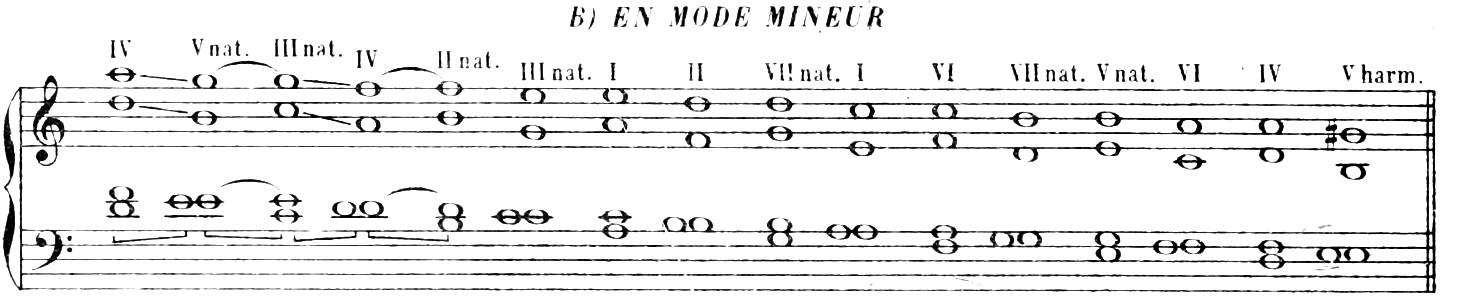 ▶ B) In the minor mode: the same sequence in A minor, every fifth-degree chord natural except the last (harmonic, with G♯)
B) harmonic sequences of seconds and thirds ▶ Three ascending sequences in C major on one staff: by fourth up and third down (I IV II V III VI); with sixth chords (I6 II II6 III III6 IV); by fifth up and fourth down (I V II VI III VII)
Supplement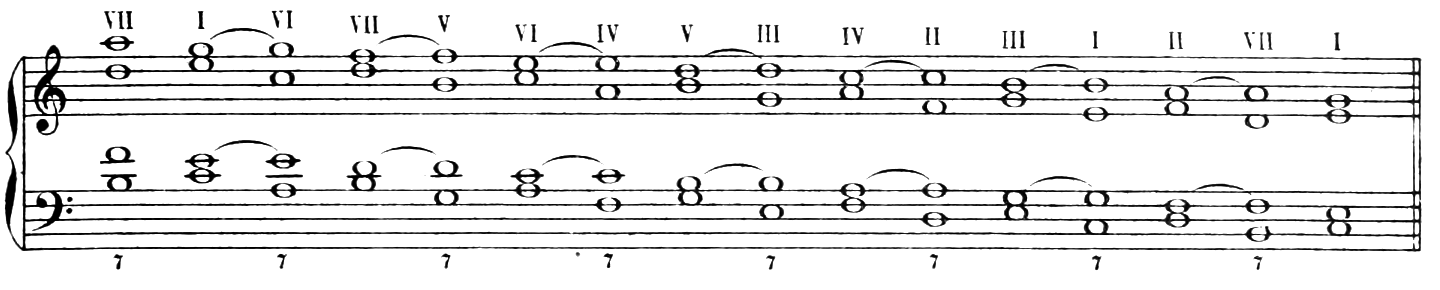 ▶ Sequence in C major: each triad prepares, by two tied common tones, the seventh chord a third below — VII7–I, VI7–VII, V7–VI, IV7–V, III7–IV, II7–III, I7–II, VII7–I
Exercises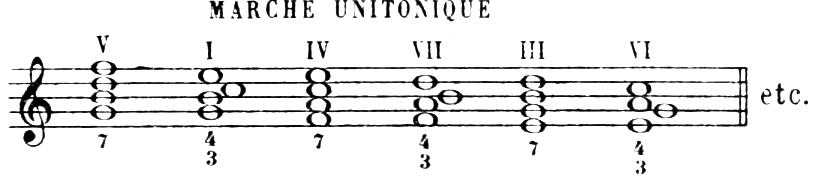 ▶ ONE-KEY SEQUENCE (in C major): seventh chords on V, I, IV, VII, III, VI, alternately in root position (7) and as 4/3 chords — G–B–D–F, C–E–G–B over G, F–A–C–E, B–D–F–A over F, E–G–B–D, A–C–E–G over E — etc.
Polytonic Succession of Dominant Seventh Chords in the Relation of an Upper or Lower Third
 Guide to the Practical Study of HarmonyPyotr Ilyich Tchaikovsky, 1900
Start: Chapter V. Harmonic Sequences →- Chapter XV. Chords of sequence · 16 playable examples
- Chapter XVI. Chords of sequence in minor · 8 playable examples
- Chapter V. Harmonic Sequences
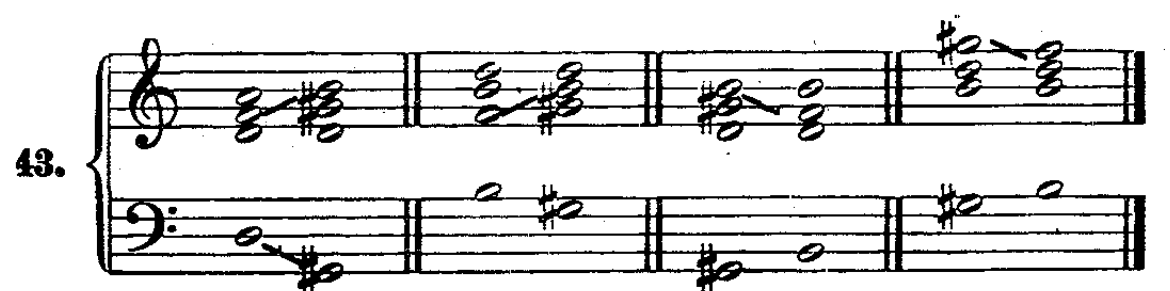
…indulge in its use only with the greatest precaution. Its use in the Sequence is justified on the ground that the repetition of the motive and the carrying out of the Sequence demand it.
▶ Fig. 40 nearby - Chapter VI. The Harmony of the Minor Scale
Since, however, harmonic sequences, which justify the use of the diminished triad in major, are not quite practicable in minor because of the many dissonant chords, let us see, if diminished and augmented triads cannot be used otherwhere than in a sequence,…
▶ Fig. 46 nearby - Chapter XV. Chords of sequence
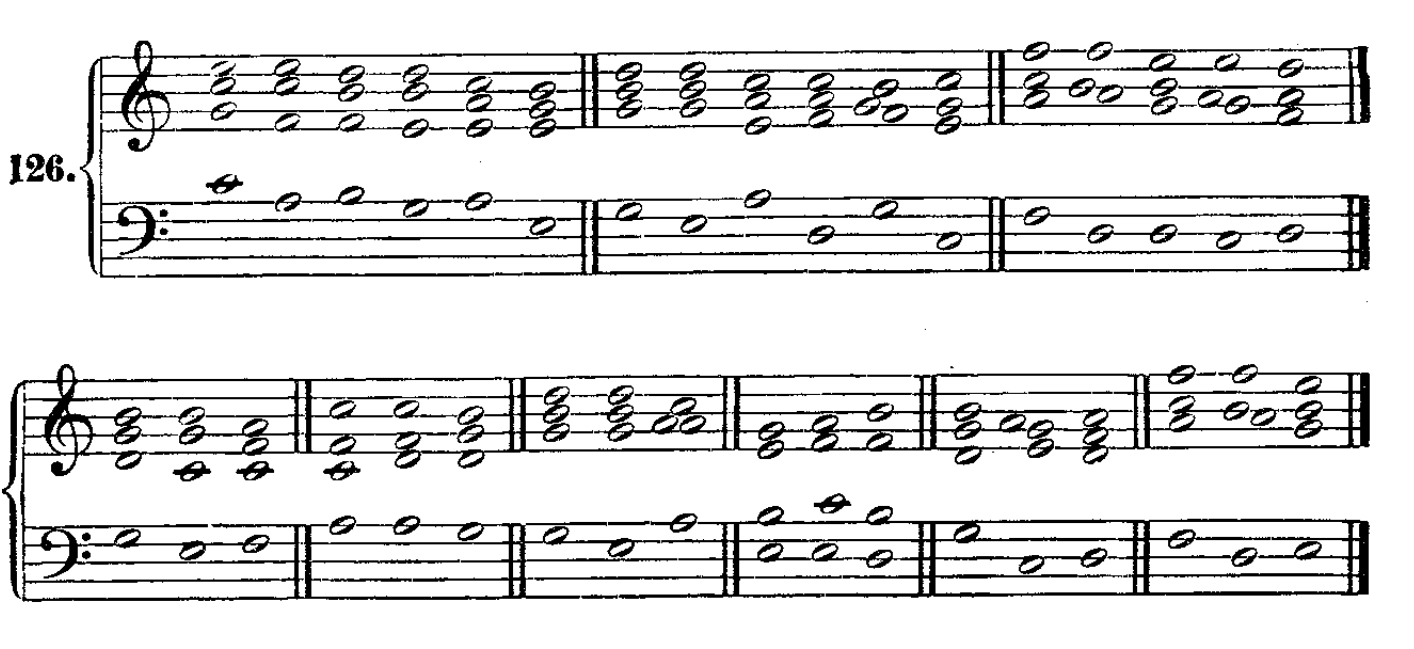
…and the tonic triad, and descend one step with each repetition, we obtain a Sequence made up of a series of chords of the seventh, each one of which—like the initial dominant chord—finds its solution in a triad a fourth higher or a fifth lower. Such chords of…
▶ Fig. 123 nearby - Chapter XV. Chords of sequence
Such a sequence is but a modification of the original sequence; and the law of resolution is by no means violated, as each seventh chord contains the tones of the triad erected on its fundamental. This is illustrated in the following group of chords:
▶ Fig. 129 nearby - Chapter XV. Chords of sequence
§ 43. Chords of sequence are not confined to the sequence; they may also appear otherwhere or in fragments of sequences. These fragments can be introduced by any seventh chord, we choose. We have to bear in mind, though, that the Seventh must at all times be…
▶ Fig. 130 nearby - Chapter XV. Chords of sequence
Ezercises. The pupil should write out and play all the existing chords of sequence in the several major keys. Not until he has thoroughly digested the rules governing the connection and resolution of sequence chords should he work the following exercises.
▶ Fig. 138 nearby
29 more passages in Guide to the Practical Study of Harmony →
 ▶ Fig. 38
 ▶ Fig. 39
 ▶ Fig. 40
 ▶ Fig. 46
 ▶ Fig. 123
 ▶ Fig. 130
 PartimentiFedele Fenaroli, 1800
- Book II: Harder figured basses
…the phrase and cadence patterns indicated in the bass and smoothly connect sequential passages through the use of ascending or descending lines.
- Concerning a Partimento that Descends Stepwise
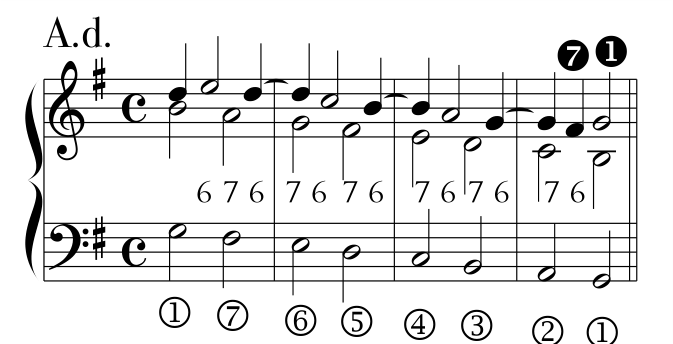
…7th above the following note of the partimento, and this continues in sequence down to ②, on which the suspended 7th will resolve to a major 6th [❼]. It will rise to the 8ve [❶] to form a consonance on an 8ve on the last note of the partimento [①]. See A.d.
▶ Fig. 87 nearby - Book V: Themes, preludes and fugues
…and countersubject will sound together. You may use thicker textures for sequential episodes learned from the Regole.
 ▶ Fig. 87
 Theory of HarmonyArnold Schoenberg, 1922
- Theory or a System of Presentation?
…it clearly, and proceed from principles that secure an uninterrupted sequence. I shall show how soon such a system proves inadequate, how soon it has to be broken through and patched with a second system—which is no system at all—merely to accommodate the most…
- Writing Short Chord Progressions
…way: the voice should not be unmelodic; that is, it should avoid motions and sequences of motions that attract unpleasant attention. It is difficult to find a standard for this, for much that used to be unmelodic is now felt to be melodic. Bellermann, for…
▶ Fig. 16 nearby - Degree VII
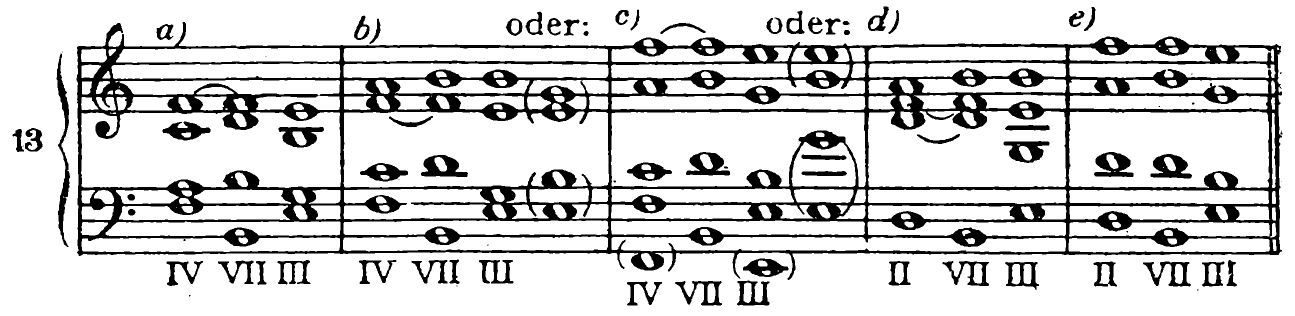
…degree VII in as many examples as possible, including other keys. The degree sequences will be IV, VII, III or II, VII, III. For the present, VII is always followed only by III, and preceded only by IV or II. Once the pupil is sufficiently secure in handling…
▶ Fig. 21 nearby - Connecting seventh chords with one another
…mentioned only because such successions often form the harmonic framework of sequential repetitions of motives in earlier composers.
▶ Fig. 69 nearby - Fifth and Sixth Circles of Fifths
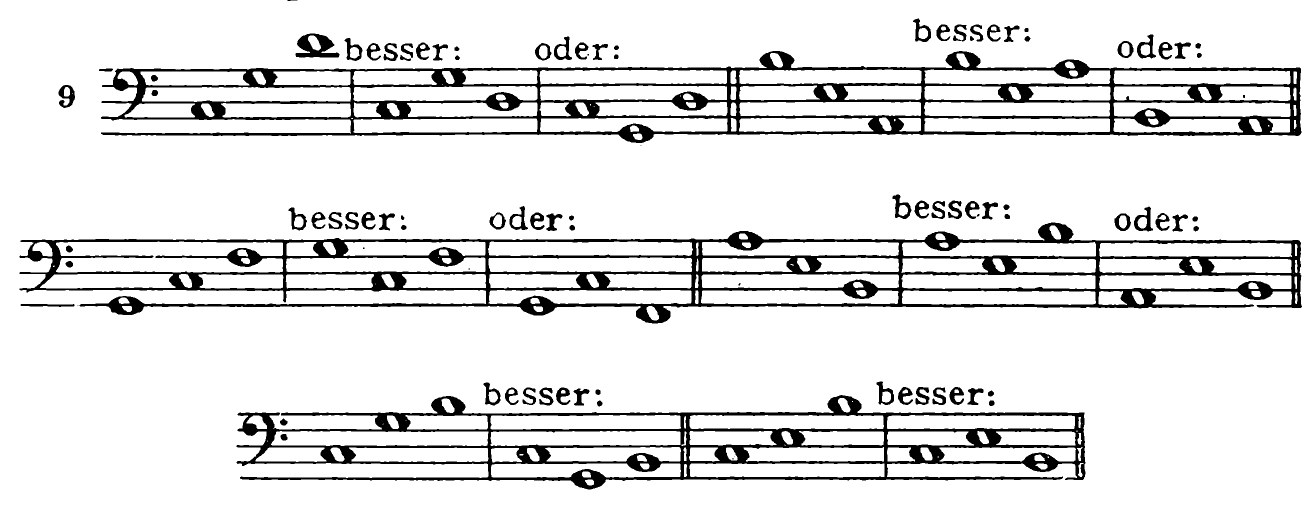
…device recommended in most textbooks, and occasionally used in 211, is the sequence. A sequence is a kind of repetition capable of establishing coherence. Repetition, sometimes felt as monotony, produces reinforcement and intensification when properly used.…
▶ Fig. 398 nearby - Fifth and Sixth Circles of Fifths
…the transposed repetition of part of a melody can also be regarded as a sequence, even when the harmony is not sequenced. I consider such a sequence more meritorious, since it is less mechanical. The soprano in 211m is an example, as is 211p.
▶ Fig. 398 nearby
 ▶ Example 9 — group 1
 ▶ Example 13a
 ▶ Example 40k
 ▶ Example 212-aa
 Principles of OrchestrationNikolai Rimsky-Korsakov, 1922
- A. Stringed Instruments
Higher notes given in Table A, should only be used with caution, that is to say when they are of long value, in tremolando, slow, flowing melodies, in not too rapid sequence of scales, and in passages of repeated notes. Skips should always be avoided.
 OrchestrationCecil Forsyth, 1914
- No. 21. The Tenor (or B) Trombone.'
…2nd. But with regard to the lower notes it must be observed that very rapid sequences of notes involving extreme changes of position, say from the Ist to the ith, or vice versa, are not only awkward but impossible. The slide takes an appreciable time to pass…
- No. 51. The Double-Bass.'
…regard to pitch as one would treat melodie passages on any other instrument. Sequence-patterns, in Bass-parts, and, if these however, occur continually descending-sequence, it is otten a little troublesome, especially it the notes be long and heavy or the…
- No. 52. The Harp
…the fact that the former instrument could be less freely set to any required sequence of notes. The modern Harp can be set almost as one chooses. Its radius of action is great. Once set, however, it is nearly as much bound to its formula as was the Eb-Harp.…
 Treatise on InstrumentationHector Berlioz, 1905
- Introduction
…composers eventually came to look down with contempt upon any harmonic sequence which was simple, clear and natural. They admitted only compositions which, from beginning to end, abounded in the harshest dissonances (minor and major seconds, sevenths, ninths,…
- The Violin
All sequences of chords combined in this fashion are not difficult. They can also be executed in arpeg-
- The Violin
Sequences of diminished seventh chords are also easy because the fingering remains the same while
- The Harp
…are all impossible (except in very slow tempo): chromatic scales; sequences of chords with chromatic progressions, or belonging to non-related keys; most embellishments consisting of appoggiaturas with accidentals or several such short notes. All these are…
- The Harp
…or in arpeggio-form—even though he may not be able to execute chromatic sequences. °
- The Harp
…as he likes, because the instrument is tuned by means of the synonyms in a sequence of minor thirds producing the chord of the dinimished seventh. Instead of the scale
 ArrivalMayank Sanganeria, 2026
- Appendix — Lexicon, Glossary and Lineage · Table
…2 Pickup | Any note whose job is to lead into an arrival | 1 Skeleton | The sequence of arrivals, moving by step or holding | 3 Strand | One guide-tone voice through a progression (A from the 3rd, B from the 7th) | 3 Elaboration ladder | Building a line by…
More in Cadence, key and progression
Cadence · Deceptive cadence · Modulation · Modes · The leading note · Figured bass and partimento · Fundamental bass · Harmonizing a melody