 Playable Books
Concept index · Cadence, key and progression
Figured bass and partimento
Taught in 5 books. Each one opens at the passage; ▶ plays the example beside it. Also called thoroughbass, partimento, rule of the octave, continuo.
This index is Playable Books’ own: a first pass that finds the term’s words in each book, corrected by hand. The authors did not tag these passages, and their terms can differ (Fux’s “ligature” is a suspension). The quoted text is the book’s.
 Treatise on HarmonyJean-Philippe Rameau, 1722
- CHAPTER XIX. Figuring a continuo bass and recognizing the chord indicated by each figure · 1 playable example
- Chapter thirty-eight
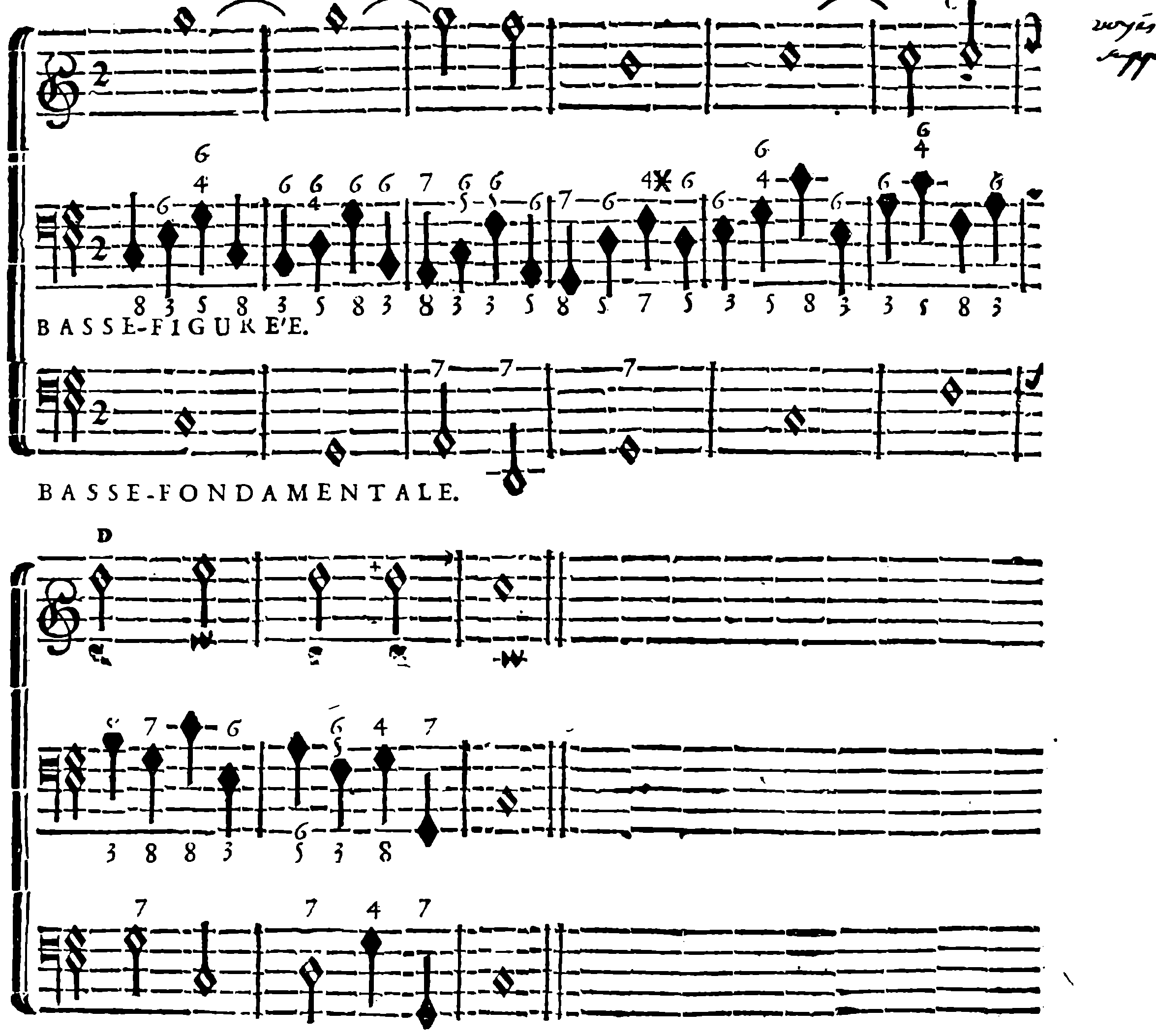
These observations concerning the continuo bass become clearer by comparing the upper part and then the continuo bass with the fundamental bass. From each perfect or seventh chord borne by the fundamental-bass notes, the third, fifth, octave, or seventh is…
- Chapter thirty-nine
To write a figured bass, first compose a fundamental bass and write the figured bass above it, much as one writes a figured upper part above a bass. I say “much as,” because instead of avoiding the same notes in both basses, one should, on the contrary, sound…
▶ Fig. 310 nearby - Chapter thirty-nine
One may instead compose the figured bass first. After distinguishing its beats, put beneath it a fundamental bass that conforms completely to the prescribed rules for that bass’s progression and chords. One may then compose an upper part with more or less…
▶ Fig. 310 nearby - Chapter forty-one
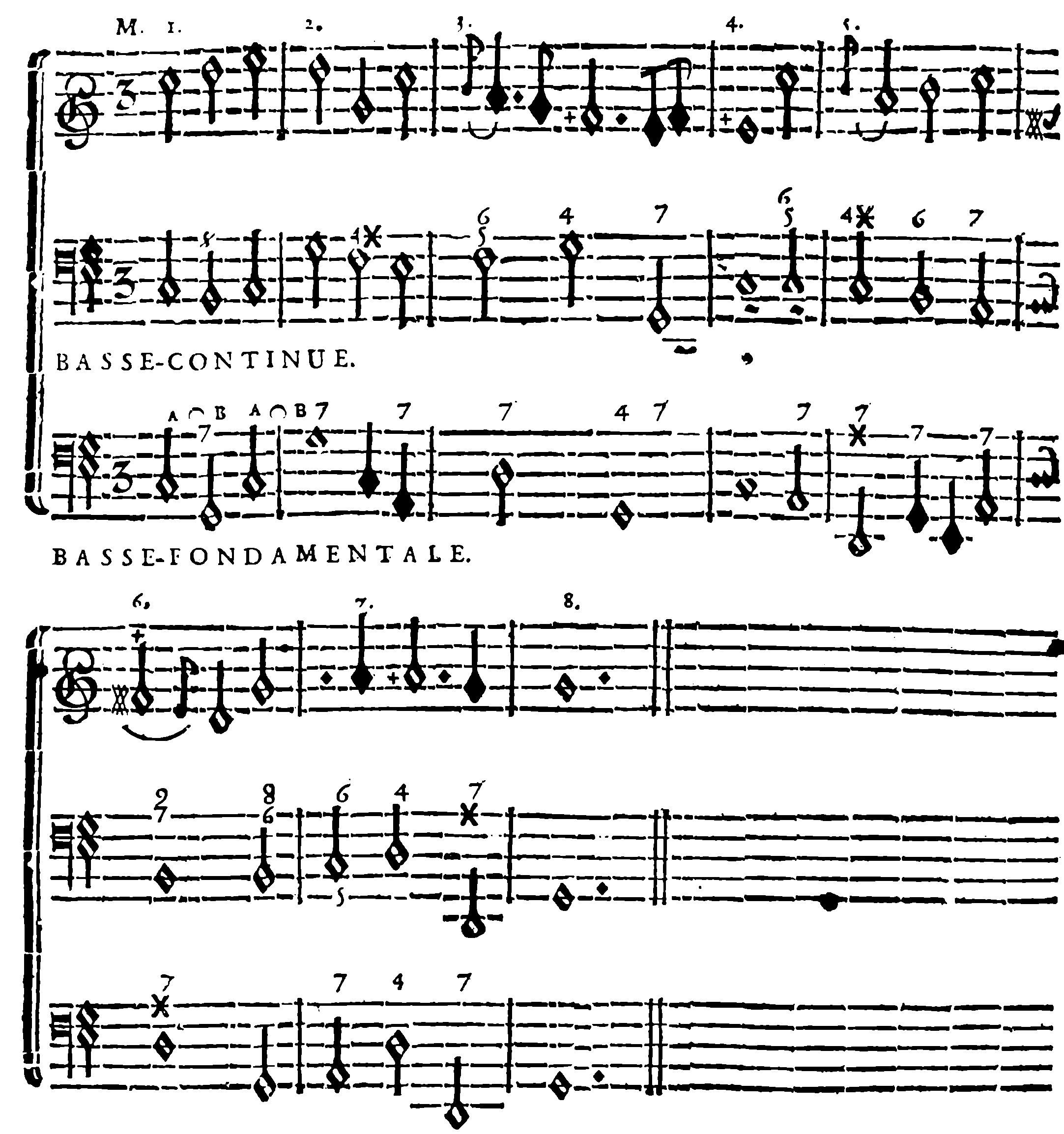
The true continuo bass should be the fundamental bass. But custom gives that name to the bass dictated by good taste according to the paths of the other parts above it. We therefore distinguish it from the fundamental bass by the epithet “continuo.”
▶ Fig. 323 nearby - Chapter forty-one
…in the fourth measure it is perfect. Returning to measure one, I give the continuo a diatonic progression agreeing fully with the upper part. To continue it in measure two, I put the second beat on a note forming a seventh with the fundamental bass and…
▶ Fig. 323 nearby - Chapter forty-two
…This shows whether any fault has occurred and which chords belong to the continuo notes. Remember that a note forming a third, fifth, or seventh with the fundamental bass can bear only its corresponding chord. If the continuo note lies a third or fifth below…
 ▶ Fig. 310
 ▶ Fig. 323
 ▶ Fig. 445
 Practical Manual of HarmonyNikolai Rimsky-Korsakov, 1910
- Preface to the First Edition
…(hardly necessary nowadays) of a different clef for each part, and notes on figured bass; one also finds the care their authors take to explain every harmonic fact — for example, the reasons that forbid consecutive fifths, and so on. But in truth they offer…
 Guide to the Practical Study of HarmonyPyotr Ilyich Tchaikovsky, 1900
- Chapter II. The Connection of the Triads of the Major Scale
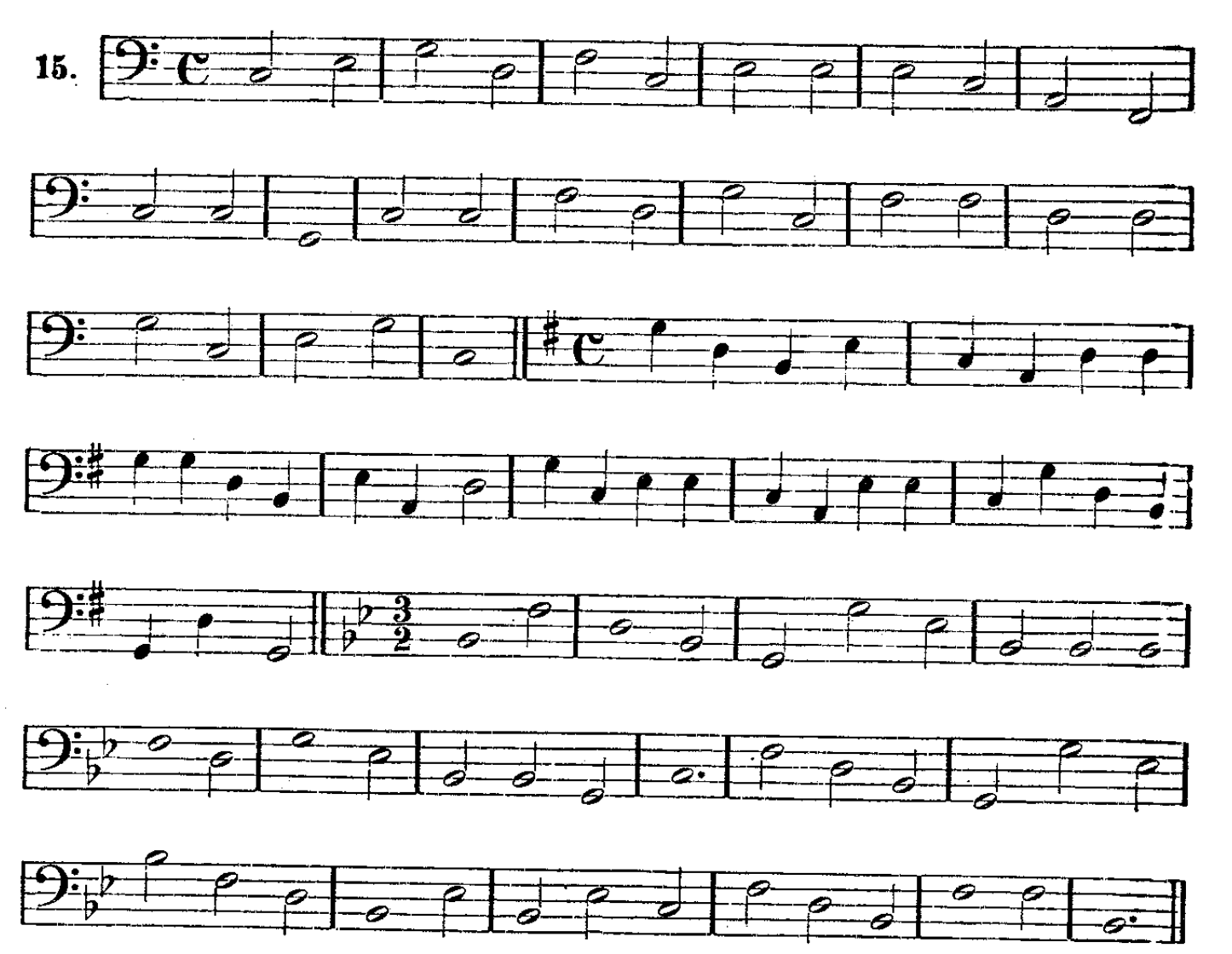
…the superstitious awe that prevails regarding the so-called,Theory“ or,,Thorough Bass“
▶ Fig. 18 nearby - Chapter VI. The Harmony of the Minor Scale
Remark. The figures and accidentals below the notes in these examples are the signs of the so-called figured Bass. These signs, which indicate the Harmony, are placed above or below the Bass—notes. In this connection observe the following rules:
▶ Fig. 52 nearby - Chapter X. The Dominant Chord
Note. The figuring of the Dominant chord and its inversions is done according to their names. The fundamental form is expressed by the figure 7; the chord of the sixth and fifth by é the chord of the sixth and fourth by—9; the chord of the second by 2.
▶ Fig. 87 nearby - Chapter XII. The chord of the Ninth
Note. In figured Bass this chord is designated by 9.
▶ Fig. 100 nearby - Chapter XIII. Chords of the minor and diminished Seventh
Note The horizontal lines in the figured bass notation indicate that the intervals next to which they are placed, have to remain stationary, while in the Bass sound the next following intervals of the chord in notation. For instance, in the first bar of the…
▶ Fig. 108 nearby - Chapter XXII. The Organ-point
Note. The figuring of the chord-formations arising in the course of an organ-point is so complicated, that it is only in the rarest cases undertaken at all. In the figured bass of old scores we frequently find but one organnote, under which are written the…
▶ Fig. 218 nearby
4 more passages in Guide to the Practical Study of Harmony →
 ▶ Fig. 18
Chapter II. The Connection of the Triads of the Major Scale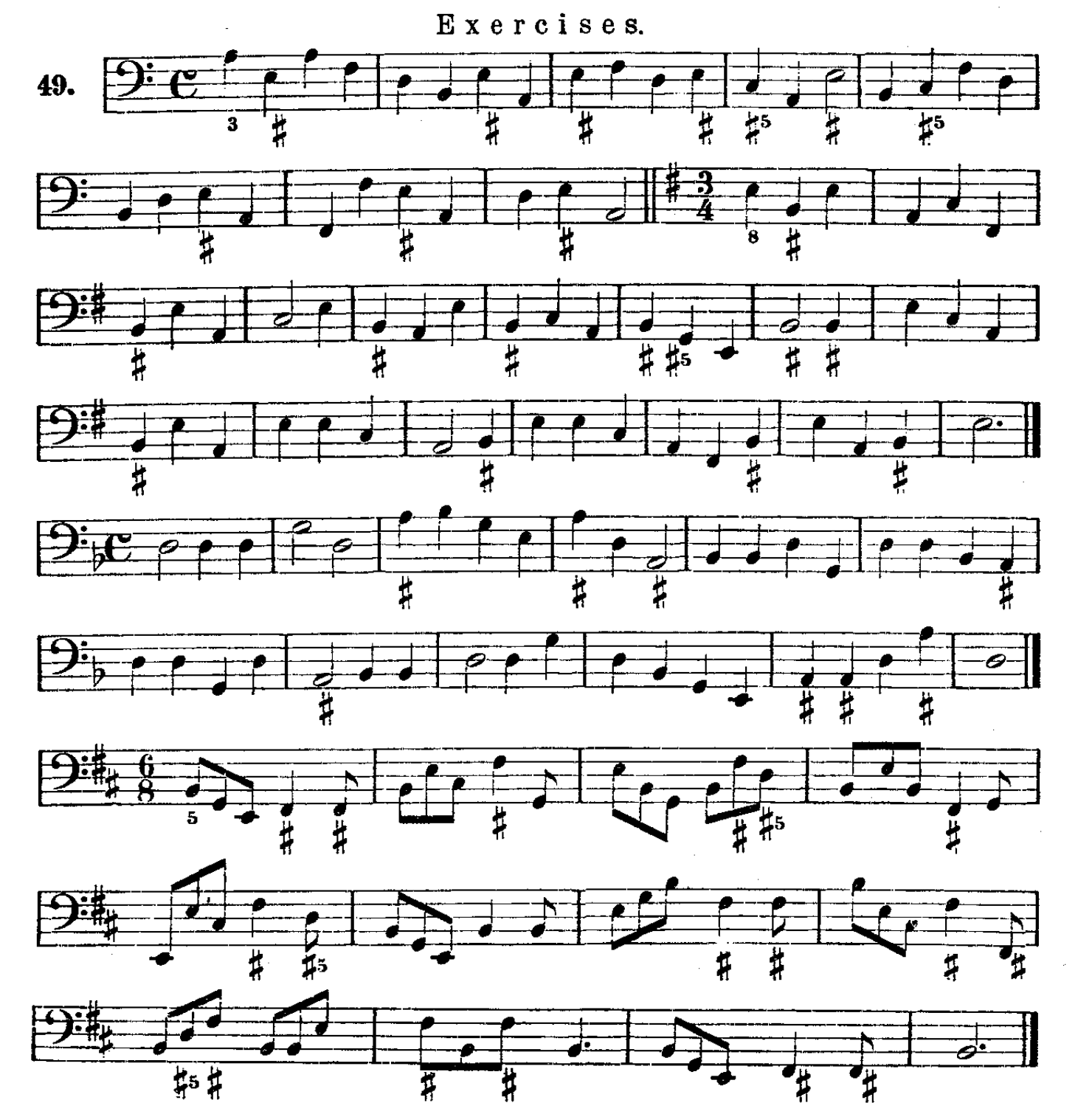 ▶ Fig. 52
Chapter VI. The Harmony of the Minor Scale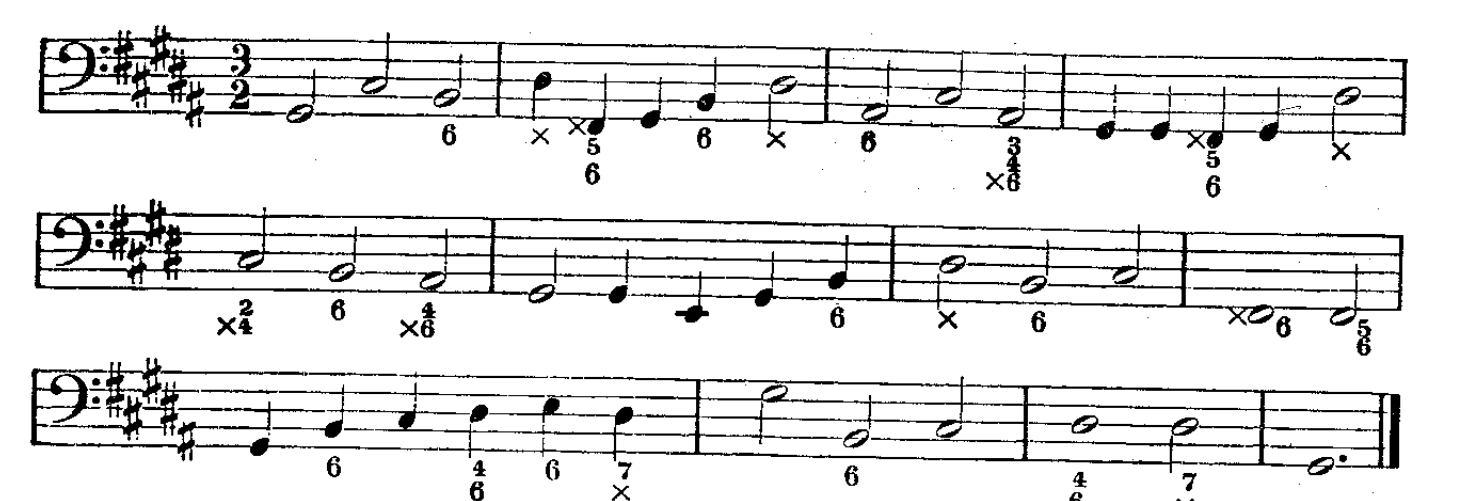 ▶ Fig. 87
Chapter X. The Dominant Chord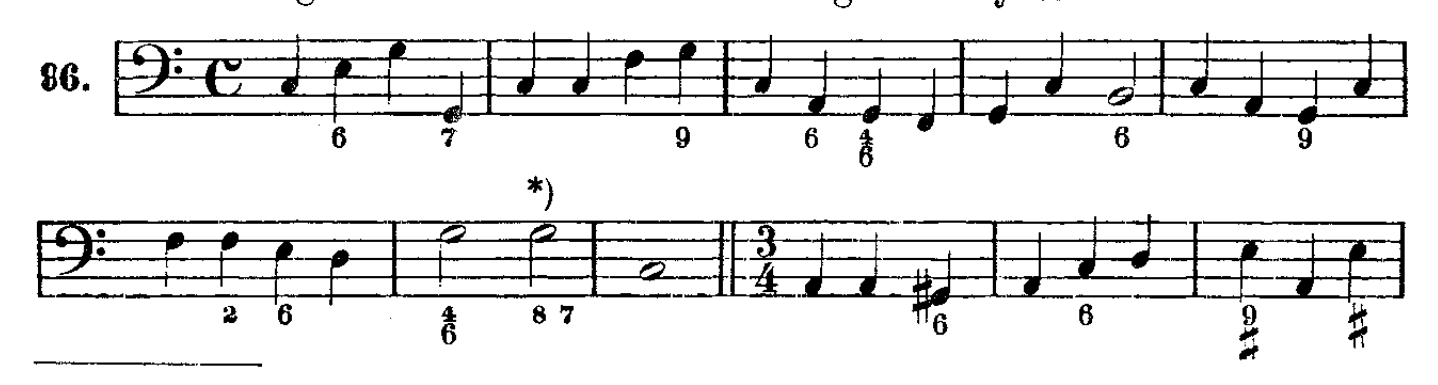 ▶ Fig. 100
Chapter XII. The chord of the Ninth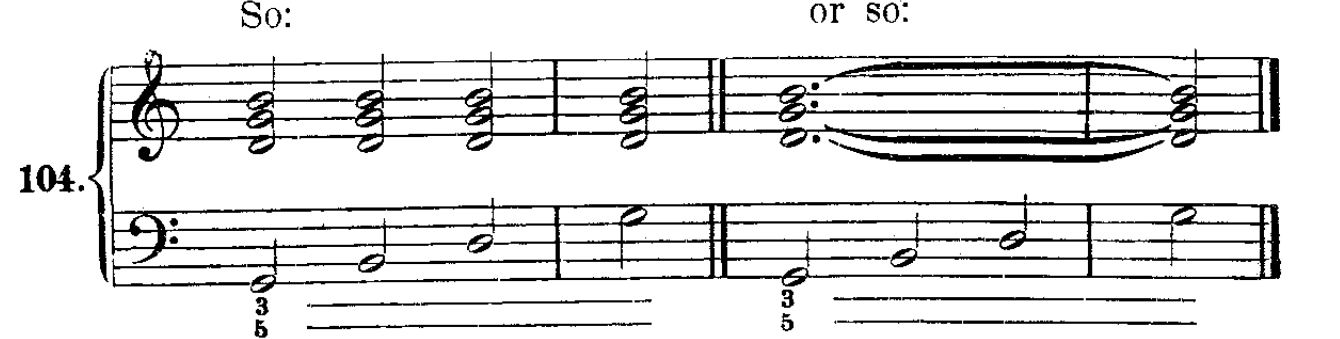 ▶ Fig. 108
Chapter XIII. Chords of the minor and diminished Seventh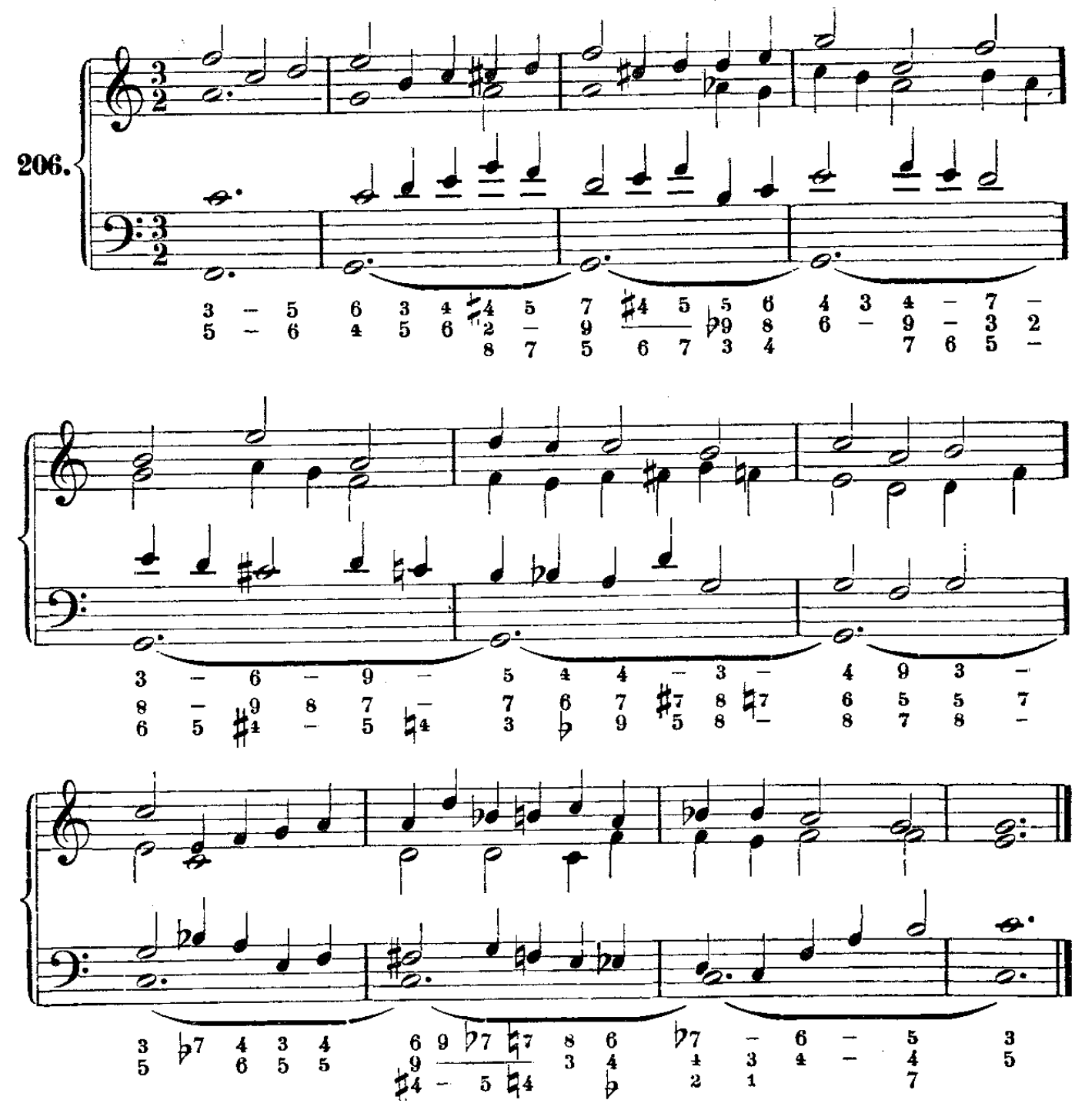 ▶ Fig. 218
Chapter XXII. The Organ-point
 PartimentiFedele Fenaroli, 1800
- Book I: Simple figured basses
- Book II: Harder figured basses
- Concerning a Partimento that Rises by Semitone · 2 playable examples
- Concerning a Partimento that Descends Stepwise · 4 playable examples
- Concerning a Partimento that Descends in Ties · 5 playable examples
- Concerning a Partimento that Rises by a Third and Falls by a Step · 3 playable examples
- Concerning a Partimento that Falls by Third and Rises by Step · 4 playable examples
- Concerning a Partimento that Rises by Fourth and Descends by Third · 2 playable examples
- Concerning a Partimento that Falls a Fourth and Rises a Step · 2 playable examples
- Concerning a Partimento that Rises a Fifth and Falls a Fourth · 2 playable examples
- Concerning a Partimento that Rises a Fourth and Falls a Fifth · 3 playable examples
- Concerning a Partimento that Rises a Sixth and Falls a Fifth · 2 playable examples
- Book IV: Unfigured basses
- No. 1, The Partimento · Gj 1375 · 1 playable example
- No. 2, The Partimento · Gj 1376 · 1 playable example
- No. 3, The Partimento · Gj 1377 · 1 playable example
- No. 4, The Partimento · Gj 1378 · 1 playable example
- No. 5, The Partimento · Gj 1379 · 1 playable example
- Book VI: Advanced partimenti, canons and fugues
- No. 32, Partimento · Gj 1469 · 1 playable example
- No. 33, Partimento · Gj 1470 · 1 playable example
- No. 34, Partimento · Gj 1471 · 1 playable example
- No. 35, Partimento · Gj 1472 · 1 playable example
- No. 36, Partimento · Gj 1473 · 1 playable example
- No. 37, Partimento · Gj 1474 · 1 playable example
- No. 38, Partimento · Gj 1475 · 1 playable example
- No. 39, Partimento · Gj 1476 · 1 playable example
- Book I: Simple figured basses
Fenaroli’s Book I introduces the student to simple figured basses. Even the simplest partimenti of this set require prior knowledge of the three cadences and the Rule of the Octave as detailed in Fenaroli’s Rules (see the separate file). The first partimenti…
- or the Suspension of the Seventh
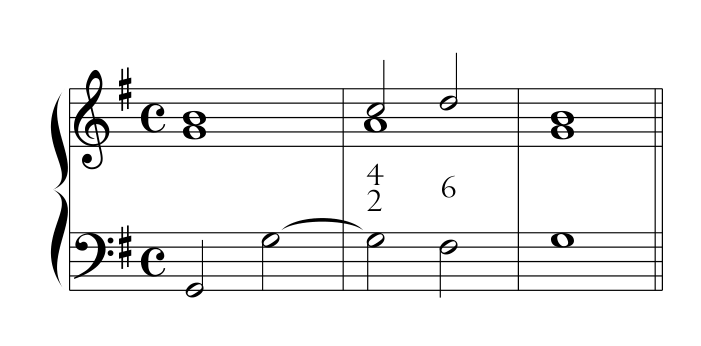
When the partimento is tied and then returns to the same tone, the suspended note of this partimento requires a major 2nd and a perfect 4th [above it]. Above the partimento’s subsequent note, which descends a semitone, the note that had been the 2nd above the…
▶ Fig. 69 nearby - that Rises by Semitone and Begins said Ascent from ③
[I.] One should observe that the said ⑤ should have a major 3rd, a 5th, and 8ve [above it]. This 8ve will hold over as a 7th above the subsequent note [♭⑥] of the partimento ascending by semitone. On the next note of the partimento [♮⑥] rising similarly by…
▶ Fig. 82 nearby - that Rises by Semitone and Begins said Ascent from ③
of a major 3rd, a 5th, and 8ve. Above the subsequent note of the partimento ascending by semitone, the note which comes to be ♭⑥, one will provide a 3rd and 6th. Above the next note of the partimento rising yet again by semitone, the note which comes to be ♮⑥,…
▶ Fig. 83 nearby - Concerning a Partimento that Rises by a Third and Falls by a Step
I. To the first note of the partimento, which one supposes to be ①, one will give the 3rd and 5th. To the note of the partimento that rises by third, and will be ③, one will give the 3rd and 6th. To the note of the partimento that descends by step, and will be…
▶ Fig. 93 nearby - Concerning a Partimento that Falls by Third and Rises by Step
II. The first note of the partimento, considered as ①, will be accompanied with a 3rd and 5th. And the second note of the partimento [⑥] descending by 3rd, will be considered as ⑦ in relation to the following note to which it will rise by step. And like a ④…
▶ Fig. 97 nearby
90 more passages in Partimenti →
 ▶ Fig. 69
or the Suspension of the Seventh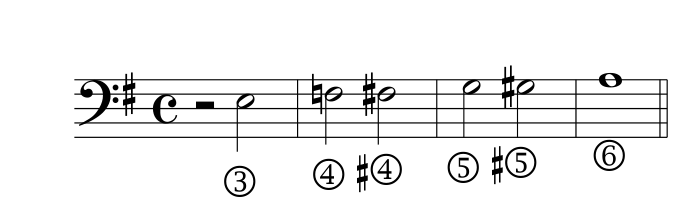 ▶ Fig. 77
Concerning a Partimento that Rises by Semitone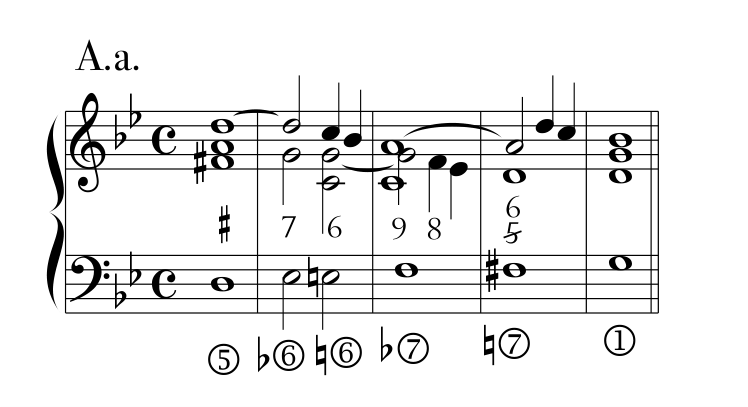 ▶ Fig. 82
that Rises by Semitone and Begins said Ascent from ③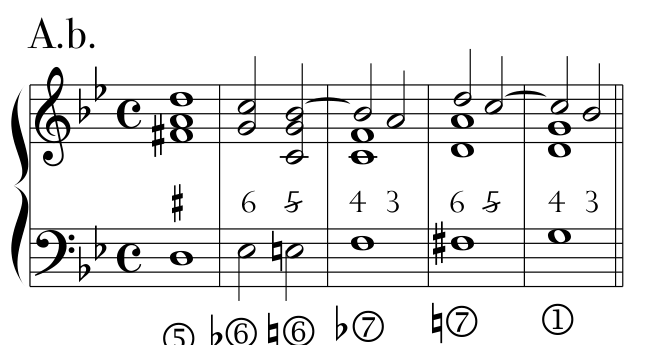 ▶ Fig. 83
that Rises by Semitone and Begins said Ascent from ③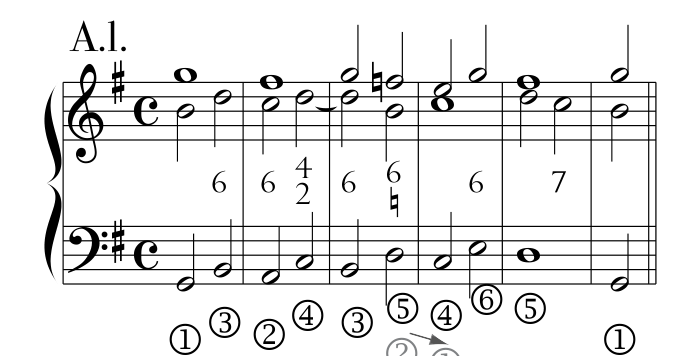 ▶ Fig. 93
Concerning a Partimento that Rises by a Third and Falls by a Step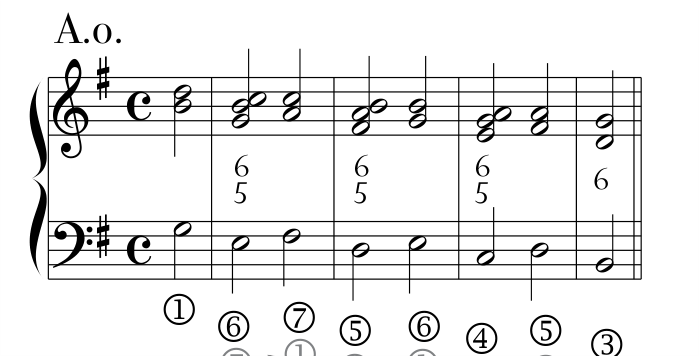 ▶ Fig. 97
Concerning a Partimento that Falls by Third and Rises by Step
 Theory of HarmonyArnold Schoenberg, 1922
- The Method of Teaching Harmony
In this sense all harmony textbooks that follow the old thoroughbass method and require the pupil to write out parts over figured basses are unsuitable; for from this he learns only voice leading, which, to a limited extent, might be a secondary task of…
- The Method of Teaching Harmony
Realizing a thoroughbass may once have been valuable, when the keyboard player still had the task of accompanying from figured basses. Teaching it today, when no musician needs it any longer, is as time-consuming as it is purposeless, prevents attention to…
- Setting the Chords
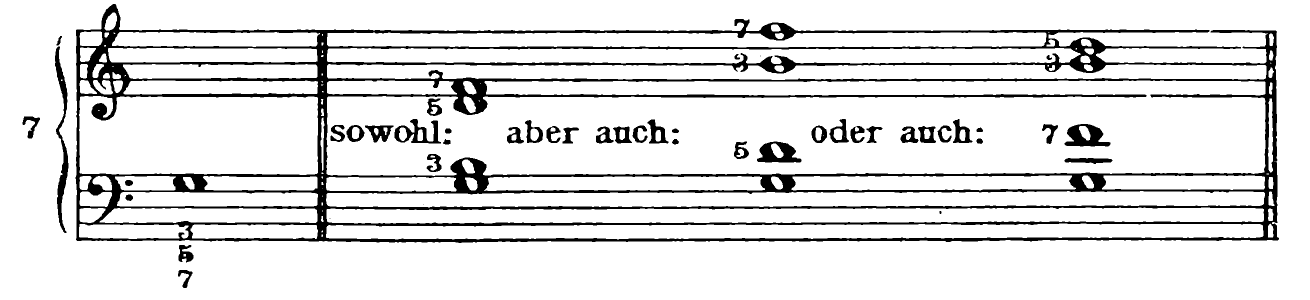
The method of so-called thoroughbass or figured bass should also be mentioned here: a kind of musical shorthand formerly used to give the harpsichordist the harmonic skeleton of a composition, whose sound he completed by improvising the added harmonies that…
▶ Fig. 12 nearby - Parallel octaves and fifths
…adaptation of older masterpieces whose harmony is indicated only by figured bass, and which become more accessible to us the more faithfully their style is restored, using inappropriate means of voice leading would inevitably create an incongruity between…
- Diatonic triads in minor
Short passages should now again be planned. In general, raised degrees should be used less frequently than unraised ones. An example containing several of each must necessarily be relatively long, since several chords are almost always needed to pass from one…
▶ Fig. 80 nearby - Subject index
Thoroughbass: see Figured bass
 ▶ Example 7: figured bass and realizations
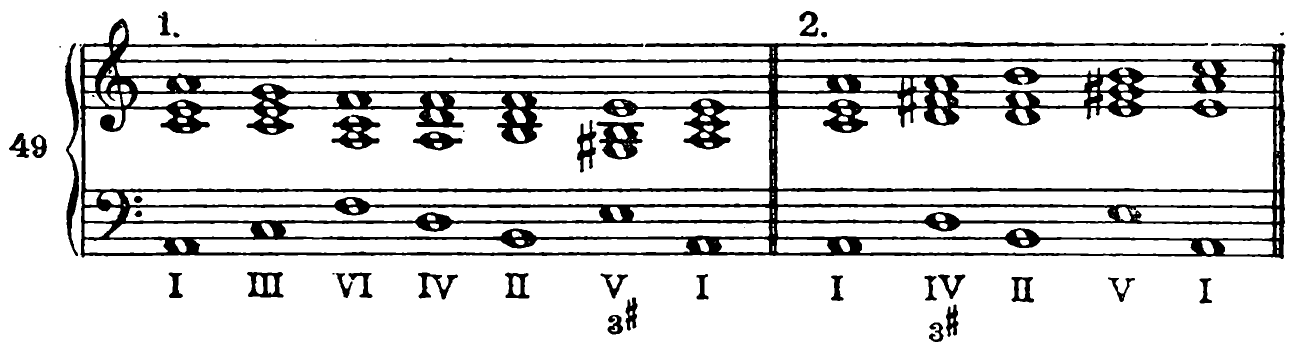 ▶ Example 49 — first sentence
More in Cadence, key and progression
Cadence · Deceptive cadence · Modulation · Sequence · Modes · The leading note · Fundamental bass · Harmonizing a melody